

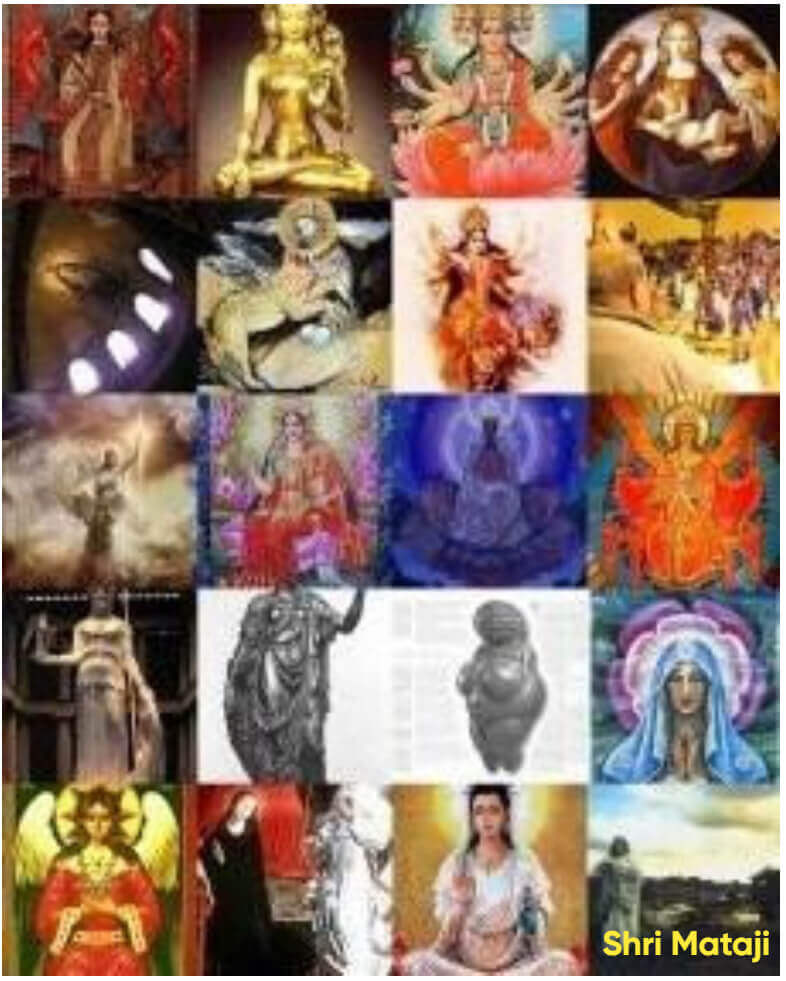
The Comforter Will Recall to Their Minds Jesus' Teachings of Salvation
When comparing the traditional Christian understanding of the Comforter and salvation with Shri Mataji's interpretation, several key similarities and differences emerge. Both perspectives recognize the necessity of a divine intervention in human spiritual transformation. Both acknowledge that the Comforter's role is central to the fulfillment of salvation. Both emphasize the importance of spiritual rebirth and transformation, rather than mere intellectual belief.
Table of Contents
1. Introduction
The promise of a divine guide and helper, the Comforter, who would follow Jesus Christ's earthly ministry, has been a cornerstone of Christian eschatology and a source of profound theological reflection. This paper explores the multifaceted concept of the Comforter, as foretold by Jesus, and its intricate connection to the doctrine of salvation. It examines the traditional Christian understanding of the Holy Spirit as the Paraclete, delving into its role as a teacher, witness, and agent of conviction. Furthermore, the paper will analyze Jesus's teachings on salvation, highlighting the transformative process of being "born again" and the significance of divine grace.
In a comparative theological approach, this paper will also investigate the interpretations of these concepts by Shri Mataji Nirmala Devi, the founder of Sahaja Yoga. Shri Mataji offers a unique perspective, identifying herself as the Comforter and presenting Sahaja Yoga as the mechanism for the Last Judgment and mass resurrection. By juxtaposing these different theological frameworks, this paper aims to provide a comprehensive analysis of the Comforter's role in recalling and fulfilling Jesus's teachings on salvation, thereby offering a broader understanding of these profound spiritual truths.
2. The Comforter in Christian Theology
The term Comforter, as used in the Gospel of John, is a translation of the Greek word parakletos. This term carries a rich and multifaceted meaning, which is essential to understanding the role of the Holy Spirit in Christian theology. The word is variously rendered in English as "Counselor," "Advocate," "Helper," and "Friend."[1] The complexity of this term suggests that the Holy Spirit's role is not limited to a single function but encompasses a broad range of supportive and guiding actions.
Jesus introduces the Holy Spirit as "another Paraclete" (John 14:16), implying that He Himself was the first Paraclete to His disciples. While Jesus was physically present with them, He was their guide, teacher, and advocate. The coming of the Holy Spirit signifies a continuation of this divine support, but in a new, internalized form. Jesus explains, "But you know him, for he lives with you and will be in you" (John 14:17). This transition from an external to an internal divine presence is a key aspect of the Christian understanding of the Holy Spirit's work.
The functions of the Comforter are further elaborated in the Paraclete passages of John's Gospel. The Holy Spirit is presented as a teacher who will "teach you all things and will remind you of everything I have said to you" (John 14:26). This teaching role is not about introducing new revelations but about illuminating and interpreting Jesus's teachings. The Holy Spirit also acts as a witness, testifying about Jesus (John 15:26), and as an agent of conviction, convicting the world of sin, righteousness, and judgment (John 16:8). Finally, the Holy Spirit is a guide who leads believers into all truth (John 16:13). This multifaceted role emphasizes that the Comforter's primary function is to make the teachings of Jesus accessible, understandable, and transformative for believers across all generations.
3. Jesus' Teachings on Salvation
Jesus' teachings on salvation are central to the Christian faith and are intrinsically linked to the work of the Comforter. The concept of salvation in Christianity refers to the deliverance from sin and its consequences, which include death and separation from God. This deliverance is made possible through the life, death, and resurrection of Jesus Christ.[2] Salvation is not merely a legal transaction of forgiveness, but a comprehensive restoration of the human relationship with God and a transformation of the human being at the deepest level.
A key aspect of Jesus' teaching on salvation is the necessity of being "born again." In his dialogue with Nicodemus, Jesus states, "Very truly I tell you, no one can see the kingdom of God unless they are born again" (John 3:3). When Nicodemus questions how this is possible, Jesus clarifies that this rebirth is not physical but spiritual: "flesh gives birth to flesh, but the Spirit gives birth to spirit" (John 3:6). This spiritual rebirth is a transformative process enabled by the Holy Spirit, through which an individual's nature is renewed and aligned with God's will.
The role of the Holy Spirit in salvation is therefore not merely as a guide or teacher, but as the very agent of regeneration. The Spirit works in the hearts of individuals, convicting them of sin and drawing them to repentance and faith in Christ. This process of sanctification, or being made holy, is a lifelong journey of spiritual growth and transformation, guided and empowered by the indwelling Holy Spirit. The ultimate goal of salvation is not just forgiveness of sins, but a restored relationship with God and the promise of eternal life in His kingdom. In this framework, the Comforter's role as the one who recalls Jesus's teachings becomes essential, as it is through the Spirit's work that believers come to understand and appropriate the full meaning of Christ's redemptive work.
4. Shri Mataji's Interpretation of the Comforter and Salvation
Shri Mataji Nirmala Devi, the founder of the Sahaja Yoga movement, offers a unique and profound interpretation of the Comforter and the process of salvation. She identifies herself as the Comforter, the Holy Spirit, who has come to fulfill Jesus's promise and to bring about the Last Judgment and the resurrection of humanity. This interpretation is not presented as a new religion, but as the culmination and synthesis of all existing spiritual traditions. In her teachings, Shri Mataji emphasizes that the time has come for the fulfillment of all scriptural prophecies, and that this fulfillment is happening through the mechanism of Sahaja Yoga.
Shri Mataji's teachings are deeply rooted in the concept of Self-realization, which she equates with being "born again." This spiritual rebirth is achieved through the awakening of the Kundalini, a dormant spiritual energy located at the base of the spine. Once awakened, the Kundalini rises through the central channel of the subtle system, piercing the fontanelle bone area, and connecting the individual consciousness with the all-pervading divine power. This is the moment of Self-realization, the baptism by the Holy Spirit, which Shri Mataji describes as the true meaning of salvation.
"Sahaja Yoga is different from the other Yogas because it begins with Self realisation instead of this being the unobtainable dream of a distant goal."[3]
In Shri Mataji's view, the Last Judgment is not a future apocalyptic event, but a process that is happening in the present time through Sahaja Yoga. It is a time of collective spiritual evolution, where individuals are given the opportunity to judge themselves through the light of their own awakened Spirit. The vibrations of the Kundalini, which can be felt on the central nervous system and on the fingertips, provide a direct and tangible experience of one's own spiritual state. This allows for a process of self-correction and transformation, leading to a state of thoughtless awareness and inner peace.
"This is the Last Judgment time, and everyone can judge him or herself through the light of the Spirit."[4]
Shri Mataji reinterprets the concept of resurrection, moving away from the literal interpretation of bodies rising from graves. Instead, she teaches that resurrection is the spiritual transformation of individuals who are alive today. The souls of those who have sought God throughout the ages are reborn in this special time to receive their Self-realization and to enter the Kingdom of God. This is the "Blossom Time," where the flowers of seeking are transformed into the fruits of spiritual realization.
"That's what it is today. I do not know that what it is to that we are now in the Blossom Time, as I call it, because many flowers are born and they are to become the fruits. This is the Resurrection Time, which is described in all the scriptures, but it's not like this, the way they had described us."[5]
Shri Mataji's teachings emphasize the feminine aspect of the Divine, which she identifies as the Holy Spirit, the Adi Shakti. This is consistent with the ancient traditions that viewed the Spirit as feminine. She presents herself as the Mother, who has come to grant this spiritual awakening out of pure love for her children. This motherly love makes the process of Last Judgment and resurrection a beautiful and gentle experience, rather than a horrifying one.
"Though you can understand that Mother's Love makes it very easy for you to get to your Realization and that the whole story of Last Judgment - which looks such a horrifying experience - has been made very beautiful, and very tender, and delicate, and does not disturb you."[6]
Furthermore, Shri Mataji emphasizes that the fulfillment of Christ's promise regarding the Comforter is not limited to a single function. Just as the traditional Christian understanding presents the Holy Spirit with multiple roles, Shri Mataji's teachings encompass the roles of teacher, guide, and transformer. She states:
"Christ didn't say that, 'I am the Destination.' He said, 'I'll send you the Holy Ghost; I'll send you a Comforter; I'll send you a Redeemer; I'll send you a Councilor.' He talked about the future."[7]
This statement underscores that Christ's promise was about a future fulfillment, which Shri Mataji claims is now taking place through her mission and the practice of Sahaja Yoga.
5. Comparative Analysis: Traditional and Contemporary Perspectives
When comparing the traditional Christian understanding of the Comforter and salvation with Shri Mataji's interpretation, several key similarities and differences emerge. Both perspectives recognize the necessity of a divine intervention in human spiritual transformation. Both acknowledge that the Comforter's role is central to the fulfillment of salvation. Both emphasize the importance of spiritual rebirth and transformation, rather than mere intellectual belief.
However, the eschatological frameworks differ significantly. Traditional Christianity places the fulfillment of Christ's promises primarily in a future eschaton, at the end of history when Christ will return and the final judgment will occur. Shri Mataji's teachings, by contrast, present the Last Judgment and resurrection as processes occurring in the present time, with the potential for immediate spiritual transformation through Sahaja Yoga. This difference reflects a shift from a futuristic to an immanent understanding of salvation.
Additionally, while traditional Christianity emphasizes faith in Christ as the pathway to salvation, Shri Mataji's teachings emphasize direct experiential knowledge of the Spirit through Kundalini awakening. This represents a shift from a faith-based to an experience-based approach to spirituality. Yet both approaches share the conviction that salvation is ultimately about a transformation that connects the individual to the Divine and brings about a new state of consciousness.
6. Conclusion
The promise of the Comforter and the teachings of salvation form a profound and interconnected theological framework within Christianity. The Comforter, or Holy Spirit, is understood as the divine presence that continues Jesus's work on Earth, guiding believers, teaching them, and convicting the world. Salvation, in turn, is the process of spiritual rebirth and transformation made possible through faith in Christ and the regenerative power of the Spirit. This traditional understanding emphasizes a future hope of resurrection and a final judgment.
Shri Mataji Nirmala Devi's teachings offer a compelling and immanent reinterpretation of these concepts. By identifying herself as the Comforter and Sahaja Yoga as the mechanism for the Last Judgment, she brings a sense of urgency and immediacy to Christian eschatology. Her emphasis on Self-realization through Kundalini awakening provides a tangible and experiential path to salvation, one that is not based on blind faith but on a verifiable inner transformation. The concept of a loving, motherly Divine who makes the process of judgment and resurrection a beautiful and accessible experience offers a profound message of hope and empowerment.
In conclusion, while the traditional Christian and Shri Mataji's interpretations of the Comforter and salvation differ in their eschatological timelines and methodologies, they converge on the central theme of spiritual transformation. Both perspectives underscore the necessity of a divine intervention to elevate human consciousness and to bring about a new creation. Whether understood as a future event or a present reality, the promise of the Comforter recalling Jesus's teachings on salvation remains a powerful and enduring message of hope for humanity. The Comforter's role—whether in the traditional sense or through Shri Mataji's interpretation—is to ensure that the deepest truths of Jesus's teachings are not lost but are continually recalled, understood, and lived out by believers across all ages and cultures.