
"God almighty does not hear the prayer of a Jew"
"The Bible was clearly the enemy when I began to address the way that Christians had treated the Jews throughout Christian history. My church had filled me with a deep-seated but Bible-based religious bigotry. I breathed it inside my congregation's life. Whenever the gospels said 'the Jews,' there was no escaping the fact that something evil was meant. This evil was acted out in the Western world again and again, culminating in the Holocaust, but not ending with it. I have dealt with the defacement of synagogues even in the twenty-first century. Religious bigotry is certainly still present in the rhetoric of certain preachers, such as the former president of the Southern Baptist Convention who said on national television not only in my presence but in the presence of his Jewish interviewer, Larry King: 'God almighty does not hear the prayer of a Jew.'"Bishop John Shelby Spong
"The Bible is a subject of interpretation: there is no doctrine, no
prophet, no priest, no power, which has not claimed biblical
sanctions for itself.”— Paul Tillich
"In the history of the Western world, however, this Bible has also
left a trail of pain, horror, blood and death that is undeniable. Yet
this fact is not often allowed to rise to consciousness. Biblical
words have been used not only to kill, but even to justify that
killing. This book has been relentlessly employed by those who say
they believe it to be God's Word, to oppress others who have been,
according to the believers, defined in the 'hallowed' pages of this
text as somehow subhuman. Quotations from the Bible have been cited
to bless the bloodiest of wars. People committed to the Bible have
not refrained from using the cruellest forms of torture on those whom
they believe to have been revealed as the enemies of God in
these 'sacred' scriptures. A museum display that premiered in
Florence in 1983, and later traveled to the San Diego Museum of Man
in 2003, featured the instruments used on heretics by Christians
during the Inquisition. They included stretching machines designed
literally to pull a person apart, iron collars with spikes to
penetrate the throat, and instruments that were used to impale the
victims. The Bible has been quoted throughout Western history to
justify the violence done to racial minorities, women, Jews and
homosexuals. It might be difficult for some Christians to understand,
but it is not difficult to document the terror enacted by believers
in the name of the Bible.
How is it possible, we must ultimately wonder, that this book, which
is almost universally revered in Western religious circles, could
also be the source of so much evil? Can that use of the Bible be
turned around and brought to an end? Can the Bible once again be
viewed as a source—even an ultimate source—of life? Or is it too late
and the Bible too stained? These are the themes I will seek to
address in this volume...
When the excitement of Christmas Day was over that year, I placed my
treasured new gift (of a Bible) on the table beside my bed and began
that night a regular practice of reading it, day after day, week
after week, month after month and year after year. That was more
than sixty years ago. There have been few days in my life since that
Christmas that I have not intentionally and intensely read and
studied these words. I suppose I have worked through this sacred
text from cover to cover some twenty to twenty-five times. Some
individual books, like the four gospels, the Acts of the Apostles and
Genesis, I have read many more times than that. Because I loved this
book so much and because I read it so carefully, I could not fail to
notice its gory passages that did not jibe with what I had been told
about either God or religion. I met in its pages things that were
disturbing, malevolent and evil. That was how the dark side of the
Bible first began to dawn on my consciousness.
Looking back, I believe now that these insights would have come to me
even sooner had I not been what the Bible seems to regard as a
privileged person. I do not refer to my social or economic status,
which was modest to say the least, but to the fact that I was white,
male, heterosexual and Christian. The Bible affirmed, or so I was
taught, the value in each of these privileged designations. It was
clearly preferable to be white than to be a person of color; male, in
whom the image of God was clear, rather than female; heterosexual and
therefore 'normal' rather than homosexual and therefore 'bnormal';
and Christian, which was, of course, the only true religion. I grew
secure in each of these definitions.
I hope these brief autobiographical comments will make it clear that
I do not come to this biblical interpretive task as an enemy of
Christianity. I am a Christian, a deeply committed, believing
Christian. I am not even a disillusioned former Christian, as some of
my biblical scholar friends now identify themselves. I recognize that
the Christian faith has traditionally claimed that its beliefs and
practices are based on and supported by the Bible. I understand that
centrality of this book. I write as one whose entire professional
life has been lived to the service of that Christian church with
which I am still joyfully identified. I was ordained a priest in the
Episcopal Church at age twenty-four and elected one of its bishops at
age forty-four...
My election as a bishop tempered that ambition but did not diminish
my zest for teaching. Like my great mentor John A. T. Robinson in
England, I interpreted the office of bishop as a teaching and writing
office. The result of this commitment was that I both know and love
the Bible deeply. I also recognize where its warts are.
I know what parts of it has been used to undergird prejudices and to
mask violence. I have discovered that there is a strange ability
among believers not to see the negative side of their religious
symbols. It did not take a genius to realize that human conflicts the
world over always seemed to have a religious component. Slowly I was
also forced to acknowledge that every great battle that I had joined
both as priest and bishop, to call the church into being what I
believed the church had to be, was ultimately a battle against the
way the Bible had been used throughout history. It was out of the
Bible that the pious and devout people drew the definitions they
sought to impose on powerless people and to justify the oppression
that those powerful religious voices seemed eager to impose. It was
strange and uncomfortable to come to the awareness that the people
who quoted this book most often were opposed to the justice issues
that I found so compelling. At first I convinced myself that the
problem was not the Bible itself, but in the way the Bible was used.
That, however, was a defensive and ultimately dishonest response. I
had to come to the place where I recognized that the Bible itself was
often the enemy. Time after time, the Bible, I discovered, condemned
itself with its own words.
This was certainly true in the battle to overcome the racism and
segregation that so deeply affected my childhood church in North
Carolina. Quotations from the Bible were frequently employed in the
racist battle to maintain segregation in which I, as a white person,
was judged to be of greater worth than a black person. Quotations
from the Bible were also the chief source of that very patriarchal
prejudice by which I, as a male, profited and through which women
were diminished.
The Bible was clearly the enemy when I began to address the way that
Christians had treated the Jews throughout Christian history. My
church had filled me with a deep-seated but Bible-based religious
bigotry. I breathed it inside my congregation's life. Whenever the
gospels said 'the Jews,' there was no escaping the fact that
something evil was meant. This evil was acted out in the Western
world again and again, culminating in the Holocaust, but not ending
with it. I have dealt with the defacement of synagogues even in the
twenty-first century. Religious bigotry is certainly still present in
the rhetoric of certain preachers, such as the former president of
the Southern Baptist Convention who said on national television not
only in my presence but in the presence of his Jewish interviewer,
Larry King: 'God almighty does not hear the prayer of a Jew.'"
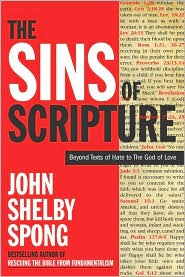
The Sins of Scripture: Exposing the Bible's Texts of Hate to Reveal the God of Love,
Bishop John Shelby Spong, HarperOne (April 12, 2005) pp. 4-12
Disclaimer: Our material may be copied, printed and distributed by referring to this site. This site also contains copyrighted material the use of which has not always been specifically authorized by the copyright owner. We are making such material available to our readers under the education and research provisions of "fair use" in an effort to advance freedom of inquiry for a better understanding of religious, spiritual and inter-faith issues. The material on this site is distributed without profit. If you wish to use copyrighted material for purposes other than “fair use” you must request permission from the copyright owner.

