|

Brahman is eternal and unchanging while Shakti is eternal
and always changing.
From:
"jagbir singh" <www.adishakti.org@gmail.com>
Date: Sat Aug 28, 2004 8:22 am
Subject: The shortest distance to The Mother is
within yourself.
>
> The Devi of the Devi Mahatmyam came to us in Sanskrit that
was
> written by Aryan peoples, who worshiped masculine deities.
They had >
> poured into India from the north, over the
mountains, conquering,
> and eventually living off, the dark peoples who grew crops
there.
> The Devi belonged not to the invaders but to the growers
of crops.
>
> Mystics from each of these two traditions report they have
glimpsed
> behind the veil of their deities' human forms and
personalities, a
> formless impersonal Godhead. Aryan mystics called that
Godhead
> Brahman. Another name is Satchidananda, which is a linking
up of
> three Sanskrit words meaning Existence-Knowledge-Bliss
that
> describes as nearly as possible their understanding of
Brahman. And
> similarly some followers of the Devi have encountered
behind the
> Mother's form and personality, a formless, impersonal
Godhead they
> named Shakti.
>
> Descriptions of Shakti and Brahman are exactly the
same—except in
> one particular. Brahman is eternal and unchanging while
Shakti is
> eternal and always changing. The two actually are one,
Ramakrishna
> said, "like fire and its power to burn." According to East
Indian
> cosmology Shakti's creative force spews out and develops
this
> universe, which after an "age" draws back into itself to
rest in the
> blissful, unchanging being of Brahman, only to spew out
again
> through Shakti's restless power. This model is not so
different from
> the theoretical model, proposed by some contemporary
physicists,
> which depicts the universe exploding from a tiny and
> incomprehensibly dense core of existence to expand farther
and
> farther until finally, drawn by gravitational pull, it
falls back
> upon itself into a tiny and incomprehensibly dense core of
> existence, which will once again explode and expand.
>
SCIENTIFIC AMERICAN
Feature Article
The Myth of the Beginning of Time
String theory suggests that the
big bang was not the origin of the universe but simply the
outcome of a preexisting state

Image: ALFRED T.
KAMAJIAN
|
Was the big bang
really the beginning of time? Or did the universe exist
before then? Such a question seemed almost blasphemous
only a decade ago. Most cosmologists insisted that it
simply made no sense—that to contemplate a time before
the big bang was like asking for directions to a place
north of the North Pole. But developments in theoretical
physics, especially the rise of string theory, have
changed their perspective. The pre-bang universe has
become the latest frontier of cosmology.
The new willingness to
consider what might have happened before the bang is the
latest swing of an intellectual pendulum that has rocked
back and forth for millennia. In one form or another,
the issue of the ultimate beginning has engaged
philosophers and theologians in nearly every culture. It
is entwined with a grand set of concerns, one famously
encapsulated in an 1897 painting by Paul Gauguin:
D'ou venons-nous? Que sommes-nous? Ou allons-nous?
"Where do we come from? What are we? Where are we
going?" The piece depicts the cycle of birth, life and
death—origin, identity and destiny for each
individual—and these personal concerns connect directly
to cosmic ones. We can trace our lineage back through
the generations, back through our animal ancestors, to
early forms of life and protolife, to the elements
synthesized in the primordial universe, to the amorphous
energy deposited in space before that. Does our family
tree extend forever backward? Or do its roots terminate?
Is the cosmos as impermanent as we are?
|
|
The
ancient Greeks debated the origin of time fiercely.
Aristotle, taking the no-beginning side, invoked the
principle that out of nothing, nothing comes. If the
universe could never have gone from nothingness to
somethingness, it must always have existed. For this and
other reasons, time must stretch eternally into the past
and future. Christian theologians tended to take the
opposite point of view. Augustine contended that God
exists outside of space and time, able to bring these
constructs into existence as surely as he could forge
other aspects of our world. When asked, "What was God
doing before he created the world?" Augustine
answered, "Time itself being part of God's creation,
there was simply no before!"
|
|

|
Strings abhor infinity. They cannot collapse to
an infinitesimal point, so they avoid the paradoxes that
collapse would entail.
Einstein's general theory of
relativity led modern cosmologists to much the same
conclusion. The theory holds that space and time are
soft, malleable entities. On the largest scales, space
is naturally dynamic, expanding or contracting over
time, carrying matter like driftwood on the tide.
Astronomers confirmed in the 1920s that our universe is
currently expanding: distant galaxies move apart from
one another. One consequence, as physicists Stephen
Hawking and Roger Penrose proved in the 1960s, is that
time cannot extend back indefinitely. As you play cosmic
history backward in time, the galaxies all come together
to a single infinitesimal point, known as a
singularity—almost as if they were descending into a
black hole. Each galaxy or its precursor is squeezed
down to zero size. Quantities such as density,
temperature and spacetime curvature become infinite. The
singularity is the ultimate cataclysm, beyond which our
cosmic ancestry cannot extend.
Strange Coincidence
The unavoidable singularity poses serious problems for
cosmologists. In particular, it sits uneasily with the
high degree of homogeneity and isotropy that the
universe exhibits on large scales. For the cosmos to
look broadly the same everywhere, some kind of
communication had to pass among distant regions of
space, coordinating their properties. But the idea of
such communication contradicts the old cosmological
paradigm.
To be specific, consider what
has happened over the 13.7 billion years since the
release of the cosmic microwave background radiation.
The distance between galaxies has grown by a factor of
about 1,000 (because of the expansion), while the radius
of the observable universe has grown by the much larger
factor of about 100,000 (because light outpaces the
expansion). We see parts of the universe today that we
could not have seen 13.7 billion years ago. Indeed, this
is the first time in cosmic history that light from the
most distant galaxies has reached the Milky Way. ...
So, when did time begin?
Science does not have a conclusive answer yet, but at
least two potentially testable theories plausibly hold
that the universe—and therefore time—existed well
before the big bang. If either scenario is right, the
cosmos has always been in existence and, even if it
recollapses one day, will never end.
https://www.sciam.com/article.cfm?articleID=00042F0D-1A0E-1085-94F483414B7F0000
GABRIELE VENEZIANO, a
theoretical physicist at CERN, was the father of string
theory in the late 1960s—an accomplishment for which he
received this year's Heineman Prize of the American
Physical Society and the American Institute of Physics. |
|
 |
|
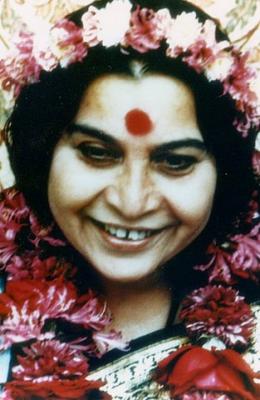
The Messiah-Paraclete-Ruh-Devi
|
|
" Science
is not truth. Today it might appear, tomorrow it
disappears. Today you may think it is correct, but every
hypotheses is challenged, every law is challenged.
That's
no law!“
Shri Mataji,
Brahmapuri,
India,
December 29, 1989
|
 |
|
The Messiah-Paraclete-Ruh-Devi
|
|
"But
to begin with, if I say before starting all this creation,
who was
created first, it is most interesting
and
may not be very congenial to the mind of a scientist. It is
much beyond science I am talking now, that much before
anything was created on this Earth.“
H. H. Mataji,
Gandhi Bhawan,
Delhi University in Feb. 1979.
|
 |
|
The Messiah-Paraclete-Ruh-Devi
|
|
" This
is meta-modern science
(of Spirit),
above modern science. But do we who are Indians know we have
this heritage of ours? We believe more in the English
language and knowledge. We should believe in our own culture
and our own knowledge. Sahaja Yoga is very ancient. Nanak
has said, 'Sahaja samadhi lago.' Every saint has described
it. Spirit is what we have to be. That's the ultimate goal
of our life. All the rest of them fall in line, and that's
what we have got from every scripture, from every
incarnation, from everywhere. Let us now just think that.
Let us become the Spirit and then let us become a realized
soul, a master.“
Shri Mataji,
Madras Public Program,
December 7, 1991
|