
Nine nights and a thousand names
"And so, nothing, not even a million names and descriptions would ever suffice to describe the infinitude of Her. But the Lalitha Sahasranama is a beautiful place to start with. 'Lalitha' meaning one the Devi's most beautiful incarnations and 'Sahasranama' meaning a thousand (sahasra) names. When you first hear it, just the sound of the Lalita Sahasranama being chanted, has a strange effect — calming, yet energizing; washing over you in wave after wave. But after a while, the meanings begin to filter through. I'm not a Sanskrit scholar, but even to me, who could understand just a few of the thousand names, the awesome beauty was evident.”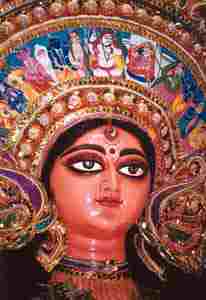
Nine nights and a thousand names
Saturday October 16 2004 17:51 IST
Ratna Rajaiah
Aditi, Malini, Nalini, Sandhya, Medha, Ranjani, , Gauri, Nirupama, Savitri, Madhumati Yashasvini, Vidya, Damini, Meenakshi, Mohini, Lalita, Jayanti, , Madhavi, Prabha, Indrani, Shalini, Arundhati, Nidhi, Sudha, Tara, not to mention Saraswati and Lakshmi.
Just think of how many girls or women you know who have one of these names. All names of the Goddess. It's my guesstimate, and probably a conservative one — that over half of all the girls in India have been named after Her. I recently heard a beautiful explanation about why we name our children after our deities. Each time we call out their names, we remember God!
Today is the 4th of those 9 days in the year that we dedicate to the Goddess. Navratri. For these nine days, we celebrate and exult in the Goddess, in her many forms and manifestations. But 'Goddess' is a miniscule description of She whom we so often call 'Devi'. Because it is with her that everything began, begins and will begin.
And so, nothing, not even a million names and descriptions would ever suffice to describe the infinitude of Her. But the Lalitha Sahasranama is a beautiful place to start with. 'Lalitha' meaning one the Devi's most beautiful incarnations and 'Sahasranama' meaning a thousand (sahasra) names. When you first hear it, just the sound of the Lalita Sahasranama being chanted, has a strange effect — calming, yet energizing; washing over you in wave after wave. But after a while, the meanings begin to filter through. I'm not a Sanskrit scholar, but even to me, who could understand just a few of the thousand names, the awesome beauty was evident.
So, this Navaratri, I share with you a few small glimpses of the Devi through extracts from the Lalitha Sahasranama, in the hope that you will be both touched and blessed by Her and go in her quest...
Mother incarnate
Perhaps, the Devi's most beloved aspect is that of The Mother. And so the Lalitha Sahasranama is replete with names for the Devi in her most powerful but most benign aspect — the Divine Mother. Vishvagarbha or She who has the universe in her womb. Brahma-janani — The Mother of everything. Sri Mahi — Mother Earth. Pranada, the Giver of life, Pranesvari, the Queen of all forms of life.
We fervently invoke her presence because She is Duhkhahantri, who ends all sorrows, but like a mother, doesn't stop there and becomes Sukhaprada, enveloping us with peace and joy. There is room for all in her compassionate embrace, because She is Bhedanashini, destroying disparity and because She is Nirbheda — without any differences. Where She is, there is no fear. Because She is Mrutymathani, the destroyer of that terrible fear that haunts all who are born —— the fear of death.
She is The Mother who guides us through the right path. She is The Mother who empowers us because She is Iccha-shakti-Gyana-shakti-Kriya-shakti- Svarupini, the power of will, knowledge and action. In her presence, obstacles melt away because She is Vighna Nashini. In her purifying radiance, we are freed from sin because She is Parampaapanashini. And so, She is Vandaru jana Vatsala — who loves her devotees like a mother. Or then, She is just simply — Mata.
Supreme being
As Maha Vishnu lay resting on a fig leaf in the form of a child, he began thinking about who he was, who created him and how he should act, a celestial voice said: 'Sarvankhalvidamevaham Nanyadasti santanam'. (All that is, I am. There is nothing eternal but me). So, the Devi is Supreme — the peak, the zenith, the maximum. She is Bhagavati, the supreme goddess. So replete is She with greatness of every kind that She is Maha-Pujya — the most worthy of worship, even by Brahma, Vishnu and Shiva.
But She is not just the pinnacle of an attribute, but the very attribute itself. So, She is Lajja or modesty. She is Tushtih or contentment, Pushti or nourishment and health. She is Kantir or radiance, She is Shantih or peace. She is Matir or wisdom, She is Nirmala or Purity. But She is also beyond all of this because She is limitless (Nirantara). In her, resides all contradictions and so, She is the Sum of all.
Seat of all knowledge
We worship the Goddess Saraswati, one of the Devi's five avatars (the other four being Durga, Savitri, Lakshmi and Radha) as the Goddess of learning and wisdom. She is Veda-Janani—Mother of the Vedas, who feeds not only our bodies but also our souls as Gyanada—the giver of Supreme Knowledge. She is Gayatri or the Gayatri mantra itself. Without her we would've been mute, because She is Gomata—the source of speech. She is Bhasharupa, the embodiment of language. She is Kalavati—the fountainhead, the presiding deity, the very embodiment of all art. She is Kavyakala—the art of poetry. From her springs rhythm and music because She is Layakari. She who is all knowing, has nothing more to know.
Feminine beauty
Perhaps some of the most enthralling parts of the Lalitha Sahasranama are those, which describe the incredible beauty of the Devi, a Being so dazzling that in one of the opening stanzas, the splendor of her toe nails is described as so radiant that it dispels the darkness of ignorance in the devotees prostrating at Her feet. ''Nakhadidhiti sanchhanna namajjana tamoguna.''
And so, the Lalitha Sahasranama extols Her as Sagara Mekhala, She whose girdle is the sea. Whose shapely nose is like a freshly blossomed Champaka bud. Whose lips outshine the redness of fresh coral and bimba fruit. Whose person is so fragrant with the scent of sandalwood paste that She is Chandanadrava dhighangi, whose smile is so radiant that it floods the mind of Kamesvara, Her consort.
Who is sometimes Raktavarna or rosy complexioned, sometimes Shyamabha or of a shining darkness, sometimes Shuklavarna or white complexioned, sometimes even Pitavarna or golden yellow. Her eyes, like the petal of a lotus (Padmanayana) or of a doe (Mrugakshi), are so beautiful that She is Vamanayana and Kamakshi, the beautiful eyed One. Her form is so exquisite (Charurupa) and her smile so charming (Charuhasa), that She is Mohini, the bewitching beauty and Shobana, the radiant beauty.
The pervading Devi
If She is all this, then what else can She be but omniscient, omnipresent, omnipotent? And so, in the Lalitha Sahasranama we praise her as Sarvesvari, the Empress of the Universe. We worship her as Sarva-Mantra-Svarupini, the embodiment of all Vedas of all mantras, totaling 700,000. We bow down to her as Sarva-mangala—the source of all that is auspicious. We beseech her as Sarva-mrtyu-Nivarini —the One who cures all disease of body and mind. We surrender ourselves to her because She is Sarvadhara—on whom everything rests...
The Devi herself declares in Devi Bhagavata, ''I myself am the knowledge, grace, courage, memory, sincerity, intelligence, modesty, hunger, thirst, capacity, luster, peace, sleep, aging, blood, bone, marrow, nerve, skin, sight, truth, untruth — and everything else in this Universe, believe me, I am. What is there that I am not?''
As I worked on this article, I was struck by limitations of the English language that can never truly translate the vast, expansive, expressive grandeur of Sanskrit. Of a 1000 names, which even in Sanskrit, even though chosen by Lord Vishnu himself, only begin to describe the Eternity that is the Devi. But then, it is because of night that we know day, because of black, we understand white and because of our limitations, we dimly realise a tiny fraction of She who is limitless.
Nine nights and a thousand names
Source material: Puranic Encyclopedia by Vettam Mani
“Now, the principle of Mother is in every, every scripture - has to be there.” Shri Mataji, Radio Interview 1983 Oct 01, Santa Cruz, USA
