The vision of humanity as one enormous family, one objective tribe, may once have been utopian. Now it is a practical necessity.
The necessity for the Adi Shakti Herself to incarnate arose from the failure of previous divine interventions to achieve lasting transformation. As Shri Mataji explained, the saints and incarnations of the past were misunderstood, and the religions founded in their names became perverted, oriented towards power and money rather than genuine spiritual awakening. The task of the Adi Shakti was to bypass these corrupted institutions and awaken the Spirit directly within each human being.

"The question remains as to whether some kind of spiritual evolution is in progress, whether large amounts of people gradually taking up meditation and other forms of inner practice will create a critical mass of global enlightenment, or whether we will continue in what could be called the Brazilian rain forest mode. In the past, this theory goes, a small number of mystics, ascetics, monastics, wandering mendicants, and other followers of the Perennial Philosophy were capable of providing the spiritual oxygen that helped the rest of the world to breathe and that sustained the mainstream practice of religion with all its surface anomalies. These days it seems increasingly questionable whether this approach will be sufficient to redeem a crippled planet; on the whole, the evolutionary theory makes more sense. But how long will it take? The Bolivian visionary Oscar Ichazo said some years ago, 'In the past eras the mystical trip was an individual matter, or at least a matter of small groups, but no longer. This is what is new in human history. Everybody can now achieve a higher degree of consciousness... . The vision of humanity as one enormous family, one objective tribe, may once have been utopian. Now it is a practical necessity.'"
Peter Occhiogrosso, The Joy of Sects
Bantam Doubleday Dell Publishing Group, Inc., (1996) p. xxii.
The Vision of a Unified Humanity: A Practical Necessity in the Age of the Paraclete
Table of Contents
- 1. Introduction: A Utopian Vision Becomes a Global Imperative
- 2. The Ancient Dream of Oneness and the Modern Crisis
- 3. The Feminine Paraclete: The Comforter and the Spirit of Truth
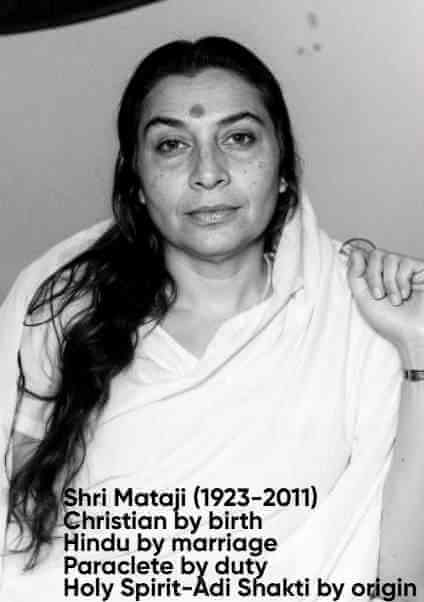
- 4. The Advent of the Adi Shakti: Shri Mataji Nirmala Devi
- 5. The Mechanism of Transformation: Sahaja Yoga and Self-Realization
- 6. Conclusion: The Practical Realization of a Unified Humanity
- References
1. Introduction: A Utopian Vision Becomes a Global Imperative
The aspiration for humanity to exist as a single, harmonious family, transcending the artificial barriers of nation, race, and creed, has long been a cherished ideal. Yet, for much of history, this vision has been relegated to the realm of utopian fantasy—a noble dream, perhaps, but one seemingly beyond the reach of a species so often defined by its divisions. In the contemporary era, however, characterized by unprecedented global interconnectedness and existential threats ranging from climate change to nuclear proliferation, this once-distant dream has transformed into a stark, practical necessity. The Bolivian visionary Oscar Ichazo articulated this shift with profound clarity:
"In the past eras the mystical trip was an individual matter, or at least a matter of small groups, but no longer. This is what is new in human history. Everybody can now achieve a higher degree of consciousness... The vision of humanity as one enormous family, one objective tribe, may once have been utopian. Now it is a practical necessity."[1]
This paper will explore the philosophical and spiritual underpinnings of this imperative, tracing the concept of human unity through the spiritual traditions of both East and West. It will examine the feminine dimension of the Divine, particularly as expressed in the concept of the Paraclete or Holy Spirit, and culminate in an examination of how the advent of the Paraclete, Shri Mataji Nirmala Devi, provides the tangible mechanism for this collective spiritual evolution.
2. The Ancient Dream of Oneness and the Modern Crisis
The concept of a unified humanity is not a modern invention. It resonates through the spiritual traditions of both East and West, appearing in diverse forms yet pointing towards a common truth: that beneath the surface of our apparent separateness lies a fundamental unity. In the Hindu tradition, the idea of cyclical divine intervention to restore cosmic balance speaks to a recurring need for unity and harmony. The avatara, or divine incarnation, descends to Earth not as a singular, unrepeatable event, but as a rhythmical response to the ebb and flow of cosmic order. As the eminent scholar Heinrich Zimmer notes:
"According to the Hindu view, the entrance of God into the strife of the universe is not a unique astounding entrance of the transcendental essence into the welter of mundane affairs... but a rhythmical event, conforming to the beat of the world ages. The savior descends as a counterweight to the forces of evil during the course of every cyclic decline of mundane affairs, and his work is accomplished in a spirit of imperturbable indifference."[2]
This cyclical view suggests an inherent drive towards equilibrium and wholeness within the human story. The Divine does not abandon creation but intervenes periodically to restore the dharma, the moral and cosmic order. This perspective offers a framework for understanding the current moment in human history not as an unprecedented crisis, but as a turning point in a larger cosmic cycle—a moment ripe for divine intervention.
Similarly, the Jesuit paleontologist Pierre Teilhard de Chardin conceived of the noosphere, a planetary sphere of human thought and consciousness, evolving towards an ultimate point of convergence he termed the Omega Point.[3] For Teilhard, humanity is not merely a collection of individuals but a collective entity moving towards a higher state of unity and consciousness. The noosphere, built upon the biosphere, represents the next stage of planetary evolution—an evolution driven not by physical adaptation but by the growth of consciousness, creativity, and spirit. Teilhard's vision insists that humanity is destined to converge, to become a single, thinking organism, united in love and directed towards the Divine.
Despite these profound spiritual insights, the 20th and 21st centuries have been marked by fragmentation, conflict, and an escalating series of global crises. Two world wars, the Holocaust, the nuclear arms race, and the ongoing devastation of the natural environment have cast a long shadow over the dream of human unity. The very forces of globalization that have brought humanity into closer physical proximity have also exacerbated divisions and inequalities. It is within this context of peril and promise that Ichazo's declaration gains its urgency. The survival and flourishing of the human species now depend on our ability to transcend our limited, ego-driven identities and embrace a collective consciousness.
3. The Feminine Paraclete: The Comforter and the Spirit of Truth
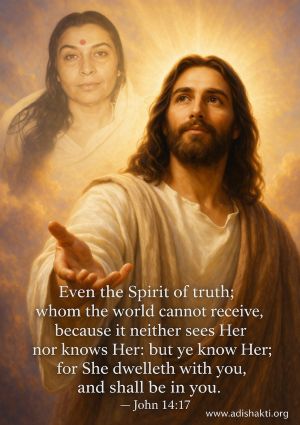
The Christian tradition speaks of a Comforter, the Paraclete or Holy Spirit, who would come to guide humanity into all truth. In the Gospel of John, Jesus promises His disciples: And I will pray the Father, and He shall give you another Comforter, that She may abide with you for ever; Even the Spirit of truth.
(John 14:16-17). While often rendered in the masculine in English translations, a deeper examination of the linguistic and theological roots reveals a profoundly feminine dimension to this divine entity.
The Hebrew word for spirit, ruach (רוח), is grammatically feminine.[4] This is not a mere linguistic accident but carries deep theological significance. The related Hebrew word Shekhinah, used in rabbinic literature to denote the presence of God, is also feminine. This feminine understanding of the Divine Spirit was prevalent in early Syriac Christianity, a tradition that preserved the Aramaic language closely related to the language spoken by Jesus Himself. Theologians like Aphrahat and Ephrem the Syrian used maternal imagery to describe the Holy Spirit. The historian Susan Ashbrook Harvey, a leading scholar of Syriac Christianity, observes:
"It seems clear that for the Syrians, the cue from grammar—ruah as a feminine noun—was not entirely gratuitous. There was real meaning in calling the Spirit 'She'."[5]
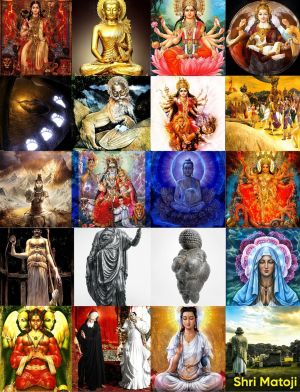
This feminine aspect of the Divine is not an anomaly but a recurring theme in global spiritual history. The scholar K. K. Klostermaier, drawing on the work of Erich Neumann, notes that a universal religion of the Great Mother goddess was widely adopted around 4000 BCE. In this religion, the Great Goddess was worshipped as creator, as Lady of men, beasts, and plants, as liberator and as symbol of transcendent spiritual transformation.
[6] This Great Goddess, known by many names across cultures—Shakti, Sophia, Isis, Durga—represents the nurturing, life-giving, and illuminating power of the Divine. It is this feminine principle, the Holy Spirit or Adi Shakti, that holds the key to the inner transformation required for global unity.
Neumann himself, in his monumental study The Great Mother, describes Her as not only the power of the cosmic wheel of life and death, but also the Force of the Centre, which bestows Consciousness and Knowledge, Transformation and Illumination.
[7] This is the Paraclete, the Comforter, the Spirit of Truth—She who guides humanity into all truth and transforms consciousness from within.
4. The Advent of the Adi Shakti: Shri Mataji Nirmala Devi
On May 5, 1970, an event of profound spiritual significance occurred. Shri Mataji Nirmala Devi, in a state of deep meditation on a beach in Nargol, India, opened the collective Sahasrara chakra, the thousand-petaled lotus at the crown of the head, thereby inaugurating the "Age to Come." This act was not merely symbolic; it was the dawning of a new era in human consciousness, making en-masse Self-Realization a tangible reality for all of humanity. Shri Mataji identified Herself as the incarnation of the Adi Shakti, the primordial Divine Mother, and the Paraclete foretold by Jesus Christ.
In a discourse delivered on Sahasrara Day in 1988, Shri Mataji described the cosmic deliberations that preceded Her incarnation:
"Today is the nineteenth Sahasrara Day, if you count the day the Sahasrara was opened as the first. I have to tell you the story about the Sahasrara Day, about which it was decided long time back, before I incarnated. They had a big meeting in the heavens. All the thirty-five crores of gods, the Deities, were there present to decide what is to be done. This is the ultimate that we have to do to human beings—to open their Sahasrara, to open their awareness to the Spirit, to the real Knowledge of the Divine, to remove the darkness of ignorance. And it had to be spontaneously because it has to work the living force of God. Also it had to be very quick."[8]
The necessity for the Adi Shakti Herself to incarnate arose from the failure of previous divine interventions to achieve lasting transformation. As Shri Mataji explained, the saints and incarnations of the past were misunderstood, and the religions founded in their names became perverted, oriented towards power and money rather than genuine spiritual awakening. The task of the Adi Shakti was to bypass these corrupted institutions and awaken the Spirit directly within each human being.
"So all the Gods requested that I, the Adi Shakti, has to take the birth. They all tried their best. They did whatever was possible. The saints were made by them but very few. They incarnated and people made religions out of them which were perverted and brought them a bad name. No Reality in those religions. These religions were money oriented or power-oriented. There was no Divine Force working, actually it was all anti-divine."[9]
Shri Mataji also explained the necessity of appearing as Mahamaya, the Great Illusion, in order to be approachable by human beings in the current age of Kali Yuga. A direct manifestation of the Adi Shakti in Her full glory would be overwhelming and would not allow for the intimate communication required to transmit spiritual knowledge:
"I need not be before you; I can be just here in Nirakar, in formless, but how to communicate? how to have a rapport? For that, one has to come in the form of Mahamaya so that there is no fear, there is no distance. One can come close and understand, because if this Knowledge has to be given, if Realization has to be given, people have to at least sit before the Mahamaya."[10]
5. The Mechanism of Transformation: Sahaja Yoga and Self-Realization
Shri Mataji's teaching, known as Sahaja Yoga, is a simple yet powerful method for awakening the dormant spiritual energy within every human being, the Kundalini. The word Sahaja means "born with" or "spontaneous," indicating that this process is natural and effortless, requiring no arduous practices or asceticism. The Kundalini, described as a coiled serpent of energy residing at the base of the spine, rises through the subtle energy channels (nadis) and chakras, ultimately piercing the Sahasrara at the crown of the head and connecting the individual consciousness with the all-pervading power of Divine love.
This awakening, or Self-Realization, is the key to the transformation of consciousness. It is not a mental concept or a belief system but a direct, verifiable experience, felt as a cool breeze on the hands and above the head. Through this experience, the individual transcends the limitations of the ego and the conditionings of the past, and connects with the Spirit, the Atman, the true Self. This inner transformation is the foundation for a new, unified humanity.
In a discourse on the Adi Shakti Puja in 1990, Shri Mataji described the comprehensive nature of Her incarnation:
"This new Job was such that all the Deities, the saints, the Incarnations and all great people had to come. They had to come into the bodily form of the Adi Shakti who had to incarnate. And that is why this Incarnation has come, that the whole world can rise, can evolve. The Divine which has made this Universe, this world, would never want His creation be destroyed at the hands of humans. And that is why this Work is so tremendous."[11]
The significance of this incarnation lies in its universality. Unlike previous incarnations, whose teachings were often limited to specific regions or communities, the work of the Adi Shakti is global in scope. Sahaja Yoga is now established in over 100 countries, offering Self-Realization freely to all who seek it, regardless of their religious, cultural, or social background. This is the practical mechanism for achieving the vision of humanity as one family—not through political ideology or social engineering, but through the inner transformation of individual consciousness.
6. Conclusion: The Practical Realization of a Unified Humanity
The vision of humanity as one family is no longer a utopian dream but a practical necessity for our collective survival and evolution. The philosophical and spiritual traditions of the world have long pointed towards this ultimate destiny. The Hindu concept of cyclical divine intervention, Teilhard de Chardin's noosphere and Omega Point, and the feminine dimension of the Holy Spirit all converge on a single truth: that humanity is destined for unity, and that this unity must be achieved through a transformation of consciousness.
However, the mechanism for achieving this transformation on a global scale has remained elusive—until now. The advent of the Paraclete, Shri Mataji Nirmala Devi, provides this mechanism. Through the spontaneous awakening of the Kundalini and the experience of Self-Realization, humanity now has access to the inner transformation required to build a global family based on love, peace, and collective consciousness.
The work of the Adi Shakti is not to establish a new religion, but to awaken the innate spirituality within every human being, thereby fulfilling the ancient promise of a unified and enlightened humanity. As Peter Occhiogrosso observed, the question is no longer whether spiritual evolution is possible, but how long it will take.[12] The practical necessity has been met with a practical solution, and the "Age to Come" has been inaugurated. The Paraclete has come, and She has opened the way for all of humanity to enter into the Kingdom of God within.
References
[1] Occhiogrosso, Peter. "The Joy of Sects." Bantam Doubleday Dell Publishing Group, Inc., 1996, p. xxii.[2] Zimmer, Heinrich. "Philosophies of India." Princeton University Press, 1969, pp. 389–90.
[3] Teilhard de Chardin, Pierre. "The Formation of the Noösphere." Organism.Earth, Accessed Jan 11, 2026.
[4] "Gender of the Holy Spirit." Wikipedia, Wikimedia Foundation, Accessed Jan 11, 2026.
[5] Harvey, Susan Ashbrook. "Feminine Imagery for the Divine: The Holy Spirit, the Odes of Solomon, and Early Syriac Tradition." St. Vladimir's Theological Quarterly, vol. 37, no. 2–3, 1993, pp. 111–139.
[6] Klostermaier, K. K. "Hinduism: A Short History." Oneworld Publications, 2000, pp. 188–89.
[7] Neumann, Erich. "The Great Mother: An Analysis of the Archetype." Princeton University Press, 1963, p. 333.
[8] Shri Mataji Nirmala Devi. "Sahasrara Day Puja Talk." Fregene, Italy, 8 May 1988.
[9] Shri Mataji Nirmala Devi. "Sahasrara Day Puja Talk." Fregene, Italy, 8 May 1988.
[10] Shri Mataji Nirmala Devi. "Sahasrara Day Puja Talk." Cabella, Italy, 8 May 1994.
[11] Shri Mataji Nirmala Devi. "Adi Shakti Puja Talk." Calcutta, India, 4 April 1990.
[12] Occhiogrosso, Peter. "The Joy of Sects." Bantam Doubleday Dell Publishing Group, Inc., 1996, p. xxii.
“Today is the nineteenth Sahasrara Day, if you count the day the Sahasrara was opened as the first. I have to tell you the story about the Sahasrara Day, about which it was decided long time back, before I incarnated. They had a big meeting in the heavens. All the thirty-five crores of gods, the Deities, were there present to decide what is to be done. This is the ultimate that we have to do to human beings — to open their Sahasrara, to open their awareness to the Spirit, to the real Knowledge of the Divine, to remove the darkness of ignorance. And it had to be spontaneously because it has to work the living force of God. Also it had to be very quick.
So all the Gods requested that I, the Adi Shakti, has to take the birth. They all tried their best. They did whatever was possible. The saints were made by them but very few. They incarnated and people made religions out of them which were perverted and brought them a bad name. No Reality in those religions. These religions were money oriented or power-oriented. There was no Divine Force working, actually it was all anti-divine. How to now turn human beings away from these superficial religions, these perverted paths of destruction? How to tell them about all these established organizations? For ages they have been ruling, making money, making power.
It was a tremendous task; it had to be done with great patience and Love. It was very delicate work also because they believed in those religions — innocent people, simple people — to blast them that this is all nonsense, they are not religions, they are against the Incarnations, against all the prophets, against all the saints. That's why all the real saints had to suffer.
It's a powerful work that was to be done, and that's why the Adi Shakti had to take birth on this Earth.”
The Paraclete Shri Mataji
Fregene, Italy — May 8, 1988
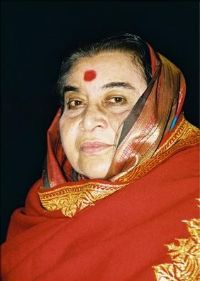
“This is the first time the Puja of the Adi Shakti is being done. All the Shaktis arise from the Adi Shakti. And also the Shaktis of Mahakali, Mahalakshmi, Mahasaraswati. All these Shaktis get absorbed back in Her. Only the Adi Shakti can do this work because She has supremacy over all the Chakras. She is the One who controls the various permutations and combinations of the Chakras...
Till mankind does not get Self-Realization till then he cannot go straight for very long. After Lord Jesus Christ the ordinary people started following the religion started by Paul and then everything started going wrong. In this way in every religion things went wrong because religion became difficult and inaccessible. In Modern Times people spoke very wrongs things about Kundalini.
Now the question arose how mankind should be told that there is God, there is Truth, and it is in the form of the Spirit. So it was necessary for the Adi Shakti to incarnate because only She could do this work. She had to come amongst mankind and take the birth of a human being, by which She could understand what are the problems and faults in human beings...
This new Job was such that all the Deities, the saints, the Incarnations and all great people had to come. They had to come into the bodily form of the Adi Shakti who had to incarnate. And that is why this Incarnation has come, that the whole world can rise, can evolve. The Divine which has made this Universe, this world, would never want His creation be destroyed at the hands of humans. And that is why this Work is so tremendous.”
The Paraclete Shri Mataji
Calcutta, India — April 4, 1990
“So I said at Sahasrara I had to be Mahamaya. I had to be Mahamaya. I had to be something that people cannot recognize Me easily. But Deities? No.
This Mahamaya had to come on this Earth, not the Adi Shakti in Her purest form. It's too much. So She was covered with this.”
The Paraclete Shri Mataji
Fregene, Italy — May 8, 1988
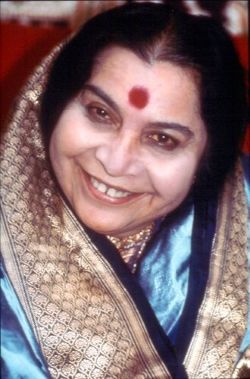
“They say that at Sahasrara when the Goddess will appear, She will be Mahamaya. Is it possible to be anything else in the world of today to come on this Earth? Any type of Incarnation could have been in great trouble because human beings in their ego are highest in Kali Yuga. So they are quite stupid and they are capable of doing any kind of harm or violence to a Divine personality. It is not at all possible to exist in this world as anything else than Mahamaya...
It has no power or any intention of giving you wrong ideas or something that is false. It is there whatever, it is Truth. So in a way to say that Mahamaya is the one which deludes is wrong...
I need not be before you; I can be just here in Nirakar, in formless, but how to communicate? how to have a rapport? For that, one has to come in the form of Mahamaya so that there is no fear, there is no distance. One can come close and understand, because if this Knowledge has to be given, if Realization has to be given, people have to at least sit before the Mahamaya.”
The Paraclete Shri Mataji
Cabella, Italy — May 8, 1994
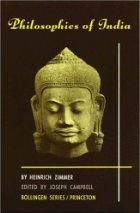
"According to the Hindu view, the entrance of God into the strife of the universe is not a unique astounding entrance of the transcendental essence into the welter of mundane affairs (as Christianity, where the Incarnation is regarded as a singular and supreme sacrifice, never to be repeated), but a rhythmical event, conforming to the beat of the world ages. The savior descends as a counterweight to the forces of evil during the course of every cyclic decline of mundane affairs, and his work is accomplished in a spirit of imperturbable indifference. The periodic incarnation of the Holy Power is a sort of solemn leitmotiv in the interminable opera of the cosmic process, resounding from time to time like a majestic flourish of celestial trumpets, to silence the disharmonies and to state again the triumphant themes of the moral order...
The descent is represented in Indian mythology as the sending forth of a minute particle (amsa) of the infinite supramundane essence of Godhead — that essence itself suffering thereby no diminution; for the putting forth of a savior, the putting forth even of the mirage of the universe, no more diminishes the plenitude of the transcendent and finally unmanifested Brahman than the putting forth of a dream diminishes the substance of our own unconsciousness.”
Heinrich Zimmer, Philosophies of India
Princeton University Press (1969) pp. 389-90
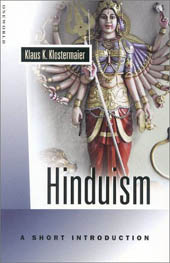
"'The later patriarchal religions and mythologies,' wrote Erich Neumann in a richly documented study, The Great Mother, 'have accustomed us to look upon the male god as a creator ... But the original, overlaid stratum knows of a female creative being.' Neumann assumes for the whole region of the Mediterranean a universally adopted religion of the Great Mother goddess around 4000 B.C.E., which was revived around 2000 B.C.E. and spread through the whole of the then known world. In this religion the Great Goddess was worshipped as creator, as Lady of men, beasts, and plants, as liberator and as as symbol of transcendent spiritual transformation.
The Indus civilization also belongs to that tradition in which the cult of the Great Goddess was prominent. Numerous terracotta figurines have been found: images of The Mother Goddess of the same kind that are still worshipped in Indian villages today...
The connections between Saktism, Mohenjo-Daro civilization, and Mediterranean fertility cults seem to be preserved even in the name of the Great Mother: "Uma for her peculiar name, her association with a mountain and her mount, a lion, seems to be originally the same as the Babylonian Ummu or Umma, the Arcadian Ummi, the Dravidian Umma, and the Skythian Ommo, which are all mother goddesses.”The name Durga seems to be traceable to Truqas, a diety mentioned in the Lydian inscriptions of Asia Minor. There is a common mythology of this Great Mother: she was the first being in existence, a Virgin. Spontaneously she conceived a son, who became her consort in divinity. With her son-consort she became mother of the gods and all life. Therefore we find the Goddess being worshipped both as Virgin and Mother.”
K. K. Klostermaier, Hinduism: A Short History,
Oneworld Pub., 2000, p. 188-9
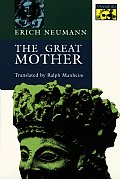
“She is not only the Power of God as the whirling wheel of life in its birth-bringing and death-bringing totality; She is also the Force of the Centre, which bestows Consciousness and Knowledge, Transformation and Illumination. Thus Brahma prays to the Great Goddess: "Thou art the pristine spirit, the nature of which is bliss; thou art the ultimate nature and the clear light of heaven, which illuminates and breaks the self-hypnotism of the terrible round of rebirth, and thou art the one that muffles the universe, for all time in thine own very darkness.”
Eric Neuman, The Great Mother
Princeton University Press (1963) p. 333.
💬 Interactive Chat
Access an intelligent analysis environment where you can explore texts, ask questions, and discover connections between ideas.
Open chat