The Exoteric and Esoteric Identification of the Divine Mother: Jesus Christ, the Paraclete, and the Fulfillment of Universal Hope
Abstract
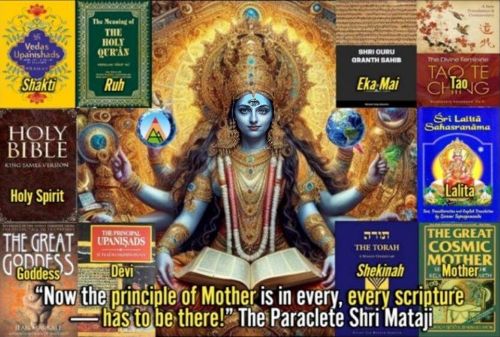
Across the world’s religious traditions, the presence of a nurturing, life-giving divine principle—often identified as feminine—has been consistently affirmed, yet historically left without a definitive identity. This principle appears as the Holy Spirit in Christianity, Adi Shakti in Hinduism, Ruh al-Qudus in Islam, Shekinah in Jewish mysticism, Eka Mai in Sikhism, Tao in Buddhism and Taoism, and analogous maternal forces in numerous spiritual systems. While these traditions testify to an indwelling divine presence, none prior to the modern era establish both an exoteric (historical, embodied) and esoteric (interior, experiential) identification of this Divine Mother. This paper argues that only through Jesus Christ’s explicit promise of the Paraclete—and its fulfillment through the historical manifestation and spiritual work of Shri Mataji Nirmala Devi (1923–2011)—has humanity, for the first time, been given a verifiable identity of the Divine Feminine that reconciles scripture, history, and lived spiritual experience. This dual identification provides the necessary ground for renewed faith, rational hope in divine intervention, and confidence in the promise of eternal life articulated across religions.
Table of Contents
- 1. Introduction: The Crisis of Faith and the Absence of Divine Verification
- 2. The Divine Mother as a Universal Scriptural Constant
- 3. Jesus Christ and the Paraclete: A Prophecy of Completion
- 4. The Necessity of Dual Identification: Exoteric and Esoteric
- 5. Shri Mataji Nirmala Devi and the Historical Manifestation of the Divine Mother
- 6. The Esoteric Verification: The Experience of Self-Realization
- 7. Reconciling Scripture, History, and Experience
- 8. Faith, Divine Intervention, and the Assurance of Eternal Life
- 9. Conclusion: A Singular Moment in Spiritual History
- References
1. Introduction: The Crisis of Faith and the Absence of Divine Verification
Modern humanity faces a profound crisis of faith. While religious traditions assert the existence of God, divine intervention, and eternal life, these claims increasingly appear abstract, deferred, or unverifiable. The result has been widespread secularization, skepticism, and fragmentation between religions that profess incompatible finalities. At the core of this crisis lies a structural absence: the lack of an identifiable, experiential confirmation of the indwelling divine principle repeatedly referenced in scripture.
This paper proposes that faith and hope cannot be sustained indefinitely on textual inheritance alone. Rather, they require recognition—a convergence of historical manifestation and interior realization. It is precisely this convergence that Jesus Christ anticipates in his promise of the Paraclete and that, we argue, becomes historically intelligible only through the emergence of an identifiable incarnation of the Divine Mother in the modern era.
2. The Divine Mother as a Universal Scriptural Constant
A comparative theological analysis reveals a striking continuity across the world’s major religious traditions: the presence of a nurturing, life-giving divine principle, often identified as feminine. This universal constant, while named differently in each tradition, points to a shared understanding of the divine as both transcendent and immanent, creative and sustaining.
- Christianity: The Holy Spirit, promised by Jesus as the Paraclete or Comforter, is described as the “Spirit of Truth” who will dwell within the faithful.[1] While often referred to with masculine or neutral pronouns in mainstream theology, early Christian and Gnostic texts, as well as mystical traditions, have explored the feminine aspects of the Spirit, sometimes associating it with Sophia (Wisdom).
- Hinduism: The concept of Adi Shakti represents the primordial, unmanifest creative power of the universe. She is the Divine Mother from whom all creation emerges and is often identified with the Kundalini, the dormant spiritual energy residing within every human being.[2]
- Islam: The Ruh al-Qudus (Holy Spirit) is understood as the divine breath of God that animates, inspires, and guides humanity. While not explicitly gendered, the concept of a life-giving, indwelling divine force resonates with the maternal archetype.
- Judaism (Kabbalah): The Shekinah is the immanent, feminine presence of God that dwells among and within the faithful. In Jewish mysticism, the Shekinah is often described as a protective, maternal presence, the divine feminine aspect of God that accompanies humanity in exile and redemption.[3]
- Buddhist and Taoist Traditions: These traditions speak of subtle internal energies associated with awakening, compassion, and enlightenment. Concepts such as Chi (in Taoism) and the compassionate wisdom of Bodhisattvas (in Mahayana Buddhism) share phenomenological similarities with the descriptions of the divine feminine power in other religions.
Despite doctrinal differences, these traditions converge on a single, profound insight: the divine is not merely transcendent but also indwelling. Yet, this insight has historically remained largely esoteric, symbolic, or inaccessible to widespread empirical confirmation, a theological problem that, as we will see, finds its resolution in the promise of the Paraclete.
3. Jesus Christ and the Paraclete: A Prophecy of Completion
The Gospel of John presents a unique theological development that sets the stage for a future, culminating revelation. Unlike other religious figures who may have claimed finality in their own teachings, Jesus explicitly announces a successor divine agency: the Paraclete.
This promise is not merely for a vague spiritual influence but for a distinct personality who will continue and complete His work. Several critical features distinguish this prophecy:
- Continuity: The Paraclete is described as "another" (allos in Greek), implying another of the same kind. This Spirit does not replace or abrogate Jesus’s mission but rather continues and expands upon it, testifying to the truth of Christ.[5]
- Indwelling: The promise is explicitly one of immanence. The Paraclete is to be experienced not as an external force but as an internal, abiding presence: “She lives with you and will be in you.” This shifts the locus of divine encounter from an external figure to the interior of the human being.
- Temporal Fulfillment: Jesus indicates a historical delay for this revelation, telling his disciples, “I have much more to say to you, more than you can now bear.” (John 16:12)[6] This implies that the full understanding and experience of the Paraclete’s work belongs to a future time, an era of greater spiritual maturity for humanity.
- Truth-Completion: The Paraclete’s role is eschatological and pedagogical. She will “guide you into all the truth” (John 16:13), suggesting a process of spiritual maturation and the completion of a divine plan, rather than simply a doctrinal addendum.
Crucially, Jesus frames this promise in both exoteric and esoteric terms—a divine presence that will come in history and simultaneously reside within humanity. This dual requirement sets a specific and verifiable standard for the fulfillment of His prophecy. The coming of the Paraclete is therefore not just a mystical event but a historical one, an anchor point in time that makes the esoteric experience universally accessible.
4. The Necessity of Dual Identification: Exoteric and Esoteric
Religious history demonstrates a persistent tension between two modes of divine revelation: the exoteric and the esoteric. Exoteric claims, rooted in historical events, public revelations, and institutional structures, provide a tangible, communal focus for faith. Esoteric truths, on the other hand, are based on interior, personal, and often mystical experiences. For faith to remain vital and credible, particularly in a post-critical age, both dimensions must be satisfied and reconciled.
- Exoteric Identification: This requires a historical, verifiable anchor—a person, event, or teaching that embodies the divine principle in a concrete and accessible way. Without an exoteric foundation, spiritual claims can drift into unverifiable subjectivism, myth, or abstraction.
- Esoteric Identification: This requires a reproducible, interior experience that is accessible to ordinary individuals across cultures. Without esoteric verification, exoteric claims can harden into rigid dogma, empty ritual, and institutional authority that demands belief without providing personal proof.
The event of Pentecost, as described in the Acts of the Apostles, represents a powerful moment of esoteric experience, where the Holy Spirit descended upon the disciples.[7] However, Christian theology has debated whether Pentecost was a singular, unrepeatable event that founded the Church or a repeatable experience available to all believers. While Pentecostal and Charismatic traditions emphasize the ongoing availability of spiritual gifts, mainstream interpretations have often viewed it as a foundational, historical event. Theologian Raymond E. Brown notes that the Johannine promise of the Paraclete points to a more permanent, indwelling presence of the Spirit that transcends the dramatic but transient manifestations at Pentecost.[8]
Prior to the modern era, these two dimensions—the exoteric and the esoteric—remained largely separated. The historical person of Jesus provided the exoteric anchor for Christianity, but the esoteric experience of the Holy Spirit, as promised, lacked a universal, verifiable, and reproducible method of attainment. This separation created a theological vacuum, leaving the identity of the Holy Spirit open to interpretation and the experience of the divine largely dependent on grace, faith, or mystical predisposition. The fulfillment of Jesus’s promise, therefore, required not just a spiritual revival but a historical manifestation that could bridge this gap and provide a universal key to the esoteric kingdom of God within.
5. Shri Mataji Nirmala Devi and the Historical Manifestation of the Divine Mother
It is in the life and work of Shri Mataji Nirmala Devi (1923–2011) that we propose the exoteric fulfillment of Jesus’s promise of the Paraclete is found. Born to a Christian family in India, Shri Mataji’s life was marked by a deep spiritual awareness and a commitment to the liberation of humanity, first through her involvement in India’s independence movement alongside Mahatma Gandhi, and later through her spiritual work.[9]
On May 5, 1970, while meditating on the seashore at Nargol, India, Shri Mataji experienced the opening of the universal Sahasrara (the crown chakra), an event she described as a profound spiritual realization that enabled her to grant en-masse Self-realization to others. She described the experience in this way:
Following this experience, Shri Mataji began her public mission, identifying the Holy Spirit with the primordial Kundalini energy described in ancient yogic texts. She asserted that this Divine Mother resides within every human being as a dormant potential, and that its awakening—which she called Self-realization—was the key to spiritual evolution and the fulfillment of Jesus’s promise. Over the next four decades, she traveled the world, offering this experience freely to all, regardless of religion, race, or background.
This work fulfills the exoteric criterion for the identification of the Paraclete in several ways:
- A Historical Figure: Shri Mataji is a verifiable historical person whose life and work are well-documented. Her public ministry, which began in 1970, provides a concrete temporal anchor for the manifestation of the Paraclete.
- Explicit Identification: She explicitly identified herself with the mission of the Paraclete, framing her work as the continuation and fulfillment of Jesus Christ’s teachings. She did not seek to create a new religion but to provide the experiential key to the truths already present in the world’s great spiritual traditions.
- Universal Message: Her teachings were not confined to a single culture or creed but were offered as a universal path to spiritual awakening, echoing the universal scope of the Holy Spirit’s mission.
In this way, Shri Mataji Nirmala Devi provides the necessary exoteric anchor for the identification of the Holy Spirit, moving the concept of the Divine Mother from the realm of abstract theology and esoteric symbolism into the light of modern history.
6. The Esoteric Verification: The Experience of the Kingdom of God
While the historical manifestation of Shri Mataji provides the exoteric anchor, it is the esoteric verification through the experience of the Kingdom of God—the opening of the Sahasrara Chakra—that completes the dual identification of the Paraclete. Shri Mataji’s work was not merely a philosophical system but a practical method for achieving a tangible, verifiable spiritual awakening. This process, which she called Sahaja Yoga (spontaneous union), provides the reproducible, interior experience required to satisfy the esoteric dimension of Jesus’s promise.
The core of this experience is the awakening of the Kundalini, the dormant spiritual energy located at the base of the spine. Upon its awakening, the Kundalini rises through the central channel, piercing the six chakras above it, and finally entering the seventh center, the Sahasrara, located at the crown of the head. This is the experience of the “second birth” that Jesus spoke of to Nicodemus (John 3:3-7), and it marks the entry of the individual consciousness into the Kingdom of God. As Shri Mataji declared, her purpose was not only the salvation of human beings but “for granting them the Kingdom of Heaven, the joy, the bliss that your Father wants to bestow upon you.”[15]
The opening of the Sahasrara culminates in a state of thoughtless awareness (Nirvichara Samadhi) and the tangible sensation of a cool breeze (Chaitanya Lahari) flowing from the top of the head and on the palms. This cool breeze is the physical manifestation of the Holy Spirit, the all-pervading power of divine love. This phenomenon provides a direct, empirical way for an individual to verify the awakening of their own inner spiritual energy and their entry into the Kingdom of God. It is not a psychological suggestion but a physical sensation felt on the central nervous system.[11]
This esoteric verification fulfills the promise of the Paraclete in several key ways:
- The Kingdom of God Made Manifest: The experience of the Sahasrara is the direct, personal experience of the Kingdom of God that Jesus proclaimed. It is the fulfillment of his promise that the Kingdom of God is “within you.”
- Reproducible and Accessible: The experience of Self-realization is not limited to a select few. Through Sahaja Yoga, it has been made accessible to millions worldwide, a spontaneous gift of grace.
- Independent of Belief: The awakening of the Kundalini is experienced whether a person believes in it or not, placing the experience in the realm of empirical knowledge. As Shri Mataji stated, “It is a hypothesis which can be proved. You have to be honest and keep your mind open.”[12]
This tangible, reproducible, and universally accessible experience of the Kingdom of God provides the missing link in the theological puzzle of the Paraclete. It is the esoteric proof that complements the exoteric manifestation, providing a complete and verifiable identification of the Divine Mother in the modern age.
7. Reconciling Scripture, History, and Experience
The identification of the Paraclete with the work of Shri Mataji Nirmala Devi and the experience of Self-realization provides a powerful framework for reconciling the three pillars of religious truth: scripture, history, and experience. For the first time, the scriptural promise of a Comforter, the historical manifestation of a divine teacher, and the personal, verifiable experience of the indwelling Spirit converge into a single, coherent reality.
This reconciliation resolves several long-standing theological tensions:
- The Divinity of Christ and the Role of the Holy Spirit: Shri Mataji’s teachings do not diminish the role of Jesus Christ but, in fact, elevate and clarify it. In Sahaja Yoga, Jesus is revered as the incarnation of the Divine at the Agnya Chakra (the third eye), the gateway to the Kingdom of God. His life and sacrifice were essential for opening this gateway for humanity. His message of forgiveness is the key to opening the Agnya Chakra, and his resurrection is a symbol of the spiritual rebirth that occurs through the awakening of the Kundalini.[13] The Paraclete, then, is the one who delivers the experience that Jesus promised, the one who allows us to pass through the “narrow gate” that he opened.
- The Relationship Between Different Religions: By identifying the Holy Spirit with the Kundalini, a universal spiritual potential within all human beings, Shri Mataji’s work provides a basis for a deep, experiential unity among the world’s religions. The same divine feminine power is known by different names in different traditions (Adi Shakti, Shekinah, Ruh), and the experience of its awakening is the common esoteric core of all true religion. This does not create a syncretic new religion but reveals the one, universal truth that underlies them all.
- Faith and Reason: In an age of scientific rationalism, faith is often seen as being in opposition to reason. The verifiable experience of Self-realization, however, bridges this divide. The tangible sensation of the cool breeze provides an empirical basis for spiritual truth, moving it from the realm of belief to the realm of knowledge. This allows for a rational faith, one that is grounded in personal experience and verifiable results.
This reconciliation of scripture, history, and experience provides a solid foundation for a renewed and revitalized spirituality in the modern world, one that is both deeply traditional and radically new.
8. Faith, Divine Intervention, and the Assurance of Eternal Life in the Kingdom of God
The dual identification of the Paraclete—exoterically in the person of Shri Mataji Nirmala Devi and esoterically in the experience of the Kingdom of God (the Sahasrara Chakra)—provides a firm, rational ground for the restoration of faith, hope, and the assurance of eternal life. This verifiable manifestation of the divine offers a tangible and compelling reason to believe.
The crisis of modern faith is a crisis of evidence. The dual identification of the Paraclete provides this evidence, restoring rational grounds for faith in three key areas:
- Faith in God’s Existence: Through the tangible experience of the cool breeze and the state of thoughtless awareness within the Sahasrara, the existence of a higher power becomes a lived reality, based not on inherited assertion but on verifiable, personal knowledge.
- Faith in Divine Intervention: The manifestation of the Paraclete in the modern era is a powerful demonstration of divine intervention. The ongoing work of the Kundalini is a tangible sign of this divine intervention, a fulfillment of the promise that the Comforter would come to guide humanity.
- Faith in Eternal Life: The promise of eternal life is reframed as a present-tense reality through the experience of the Kingdom of God within. The awakening of the Spirit is a form of spiritual resurrection, an entry into the eternal dimension of life while still in the physical body. As Jesus said, “The kingdom of God is within you.”[14] The opening of the Sahasrara is the experience of that kingdom, the discovery of the eternal, indestructible Self (the Atma).
This renewed basis for faith is not a regression to a pre-critical worldview but a progression to a trans-rational one, a faith that incorporates and transcends reason by grounding it in the direct experience of the Kingdom of God.
9. Conclusion: The Kingdom of God and the Completion of the Paraclete's Promise
This paper has argued that the Divine Mother—the Holy Spirit, Adi Shakti, Shekinah—has been identified both exoterically and esoterically, in precise accordance with Jesus Christ’s promise of the Paraclete. The historical manifestation of Shri Mataji Nirmala Devi provides the exoteric anchor, while the experience of the Kingdom of God (the Sahasrara Chakra) through the awakening of the Kundalini provides the esoteric proof. This dual identification provides the missing link between scripture, history, and experience.
The convergence of these three pillars marks a singular moment in spiritual history. It offers a way out of the crisis of faith by providing a rational and verifiable basis for belief in God, divine intervention, and eternal life. It does not abrogate the world’s great religious traditions but reveals their common esoteric core: the experience of the Kingdom of God within.
In an age of secular despair, such a confirmation is a spiritual necessity. With it, humanity gains renewed confidence that the Divine exists, intervenes, and calls every person toward the eternal life promised by all sacred traditions. The coming of the Paraclete, in this understanding, is the beginning of a new chapter in the spiritual evolution of humanity—the “Age of Truth” (Satya Yuga), in which the Kingdom of God is not just a future promise but a present, living reality within us all.
References
- [1] John 14:16–17 (NIV). “And I will ask the Father, and he will give you another advocate to help you and be with you forever—the Spirit of truth.”
- [2] Vanamali. Shakti: Realm of the Divine Mother. Inner Traditions, 2008, pp. 28–31.
- [3] “Shekhinah.” Wikipedia, Wikimedia Foundation, 20 Sept. 2025.
- [4] John 14:16–17 (NIV).
- [5] John 15:26 (NIV). “When the Advocate comes, whom I will send to you from the Father—the Spirit of truth who goes out from the Father—he will testify about me.”
- [6] John 16:12 (NIV).
- [7] Acts 2:1–4 (NIV).
- [8] Brown, Raymond E. The Gospel According to John, XIII-XXI. Yale University Press, 1970, pp. 1135–1144.
- [9] “Biography.” Shri Mataji Foundation, 2025.
- [10] Shri Mataji Nirmala Devi, Lecture, 29 Oct. 1995.
- [11] Canter, Philip. “The Role of Sahaja Yoga in the Treatment of Mood and Anxiety Disorders.” Counseling and Psychotherapy Journal, vol. 14, no. 3, 2003, pp. 31-33.
- [12] Shri Mataji Nirmala Devi. Meta Modern Era. Vishwa Nirmala Dharma, 1995.
- [13] “Lord Jesus Christ and the Agnya chakra.” Sahaja Yoga Meditation, 2025.
- [14] Luke 17:21 (NIV).
- [15] Shri Mataji Nirmala Devi, “I will tell you all the secrets.” Dec. 2, 1979.
💬 Interactive Chat
Access an intelligent analysis environment where you can explore texts, ask questions, and discover connections between ideas.
Open chat →