The Self is the Guru (Part 1)
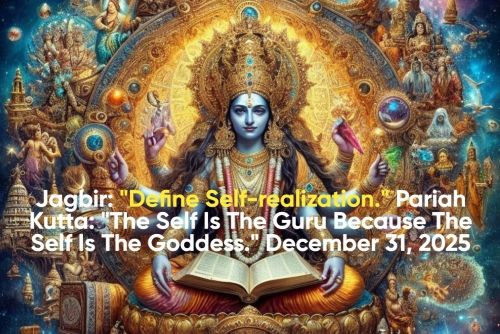
o
The phrase Sahaj Ātmā Swaroop Param Guru serves as a powerful reminder of the central truth of non-dual Shakta philosophy. It democratizes and internalizes the spiritual path by identifying the ultimate source of authority and liberation not in an external figure, but within the natural, innate essence of our own being. The scriptural evidence overwhelmingly confirms that this inner Self is none other than the Divine Mother, the Mahādevī, who is both the substance of the cosmos and the consciousness within every being.
To realize Her within is to discover the supreme, ever-present Guru. This knowledge is the key that unlocks the door to jīvanmukti, transforming life from a journey of seeking into an expression of being. The Self is the Guru because the Self is the Goddess, and She is the ultimate, blissful reality we have always been.
An Exposition of Manish Vyas' Sahaj Ātmā Swaroop Param Guru
This paper examines the Sanskrit aphorism Sahaj Ātmā Swaroop Param Guru, popularized by musician Manish Vyas, as a profound synthesis of non-dual (Advaita) metaphysics and devotional (Bhakti) theology. It argues that the phrase posits the realized Self not as a distant goal but as the immediate, innate, and ultimate source of spiritual instruction (the Param Guru). By integrating this concept with the theology of Shaktism—drawing from key passages in the Devi Gita, Devi Sukta, Bahvricha Upanishad, and Bhavana Upanishad—where the Great Goddess (Mahādevī) is identified as the supreme reality (Brahman) and the innermost Self (Ātman) of all beings, the paper demonstrates that the Divine Mother Herself is the indwelling Guru. This realization, facilitated by knowledge (jñāna), leads to jīvanmukti—instantaneous liberation within the physical body—thereby internalizing and democratizing the path to ultimate freedom (mokṣa).
Table of Contents
1. Introduction: A Modern Echo of Ancient Wisdom
In the landscape of contemporary global spirituality, ancient philosophical concepts are often distilled into potent, accessible forms. The phrase Sahaj Ātmā Swaroop Param Guru, frequently invoked by the musician and composer Manish Vyas, serves as a modern mahāvākya or "great saying." While not a direct scriptural quotation, it encapsulates a profound spiritual truth that resonates deeply with the non-dual traditions of India. This paper argues that this aphorism synthesizes the metaphysics of Advaita Vedanta with the devotional heart of Shaktism, presenting a powerful and internalized path to liberation. It posits that the true, natural state of the Self (Ātmā Swaroop) is itself the Supreme Guru (Param Guru). By examining this claim through the lens of Shakta scriptures, which unequivocally identify the Divine Mother, or Mahādevī, as the Ātman, we can conclude that She is the ultimate inner preceptor. The realization of this identity, the scriptures assert, is the direct means to jīvanmukti—liberation while still embodied.
2. Deconstruction of a Modern Mahāvākya
The phrase can be broken down into its constituent parts to reveal its rich philosophical underpinnings. Sahaj (सहज) means "natural," "innate," or "spontaneous." In a spiritual context, it refers to a state that is not achieved through effort but is realized as one's own fundamental nature once the veil of ignorance (avidyā) is lifted. Ātmā Swaroop (आत्मा स्वरूप) refers to the "essential nature" or "true form" of the Self. The Ātman is the universal, non-dual consciousness that is the core of every being, while Swaroop denotes its intrinsic, unchanging reality. Param Guru (परम गुरु) means the "Supreme Teacher" or "Ultimate Preceptor." The Guru is the dispeller of darkness, and the Param Guru is the primordial source of all knowledge and liberation.
Syntactically, the phrase is a declarative statement: "The natural, essential form of the Self is the Supreme Guru." This equation radically internalizes the source of spiritual authority, shifting the focus from an external teacher to the indwelling Self.
3. The Divine Mother as the Self: Scriptural Exegesis
The proposition that the Self is the Guru finds its most profound and explicit theological support in the Shakta tradition, where the Divine Mother is declared to be the ultimate reality and the very essence of every individual. The scriptures are unambiguous in this identification. The Devi is clearly declaring Herself to be the very Self of man.
The most direct and powerful assertion comes from the Bahvricha Upanishad, which states with absolute clarity:
She alone is Ātman. Other than Her is untruth, non-self. She is Brahman-Consciousness, free from a tinge of being and non-being. She is the science of Consciousness, non-dual Brahman Consciousness, a wave of Being-Consciousness-Bliss.[1]
This verse establishes the Goddess not merely as a deity to be worshipped, but as the very substance of our own identity. It leaves no room for separation. To be the Self (Ātman) is to be Her. Everything else is categorized as "untruth, non-self," reinforcing a strictly non-dual (Advaita) framework. This identity is further emphasized in the Bhavana Upanishad, which makes the teaching deeply personal and intimate:
The supreme divinity, Lalita, is one's own blissful Self.[2]
This immanence is not confined to the individual but extends to the entire cosmos. In the celebrated Devi Sukta of the Rigveda, the Goddess Herself speaks, declaring Her cosmic sovereignty and pervasive presence:
I have created all worlds at my will without being urged by any higher Being, and dwell within them. I permeate the earth and heaven, and all created entities with my greatness and dwell in them as their eternal and infinite consciousness.[3]
Here, the Devi is not a distant creator but the indwelling intelligence, the Antaryāmī or inner controller, who has not only fashioned all of existence but has entered into it, becoming its very consciousness. The Devi Gita explains the mechanism of this divine play (līlā) through the doctrine of Māyā:
I, as Maya, create the whole world and then enter within it. Accompanied by ignorance, actions and the like, and preceded by the vital breath. How else could souls be reborn into future lives? They take on various births in accord with modifications of Maya. Modified by apparent limitations, I become differentiated into parts, like space in different jars.[4]
The metaphor of space in jars is a classic Advaitic analogy used to explain how the one, indivisible Brahman appears as many individual souls (jīvas). Here, it is the Goddess who is that singular space, appearing fragmented only due to the "jars" of individual bodies and minds. The spiritual path, therefore, is the realization of this underlying unity, a truth encapsulated in the great Upanishadic sayings. The Devi-Gita explicitly co-opts this principle:
The great saying, "You are That," indicates the oneness of the soul and Brahman. When the identity is realized, one goes beyond fear and assumes my essential nature.[5]
4. The Self as the Supreme Guru (Param Guru)
If the Divine Mother is unequivocally the Self, and the Self is the Guru, then the Divine Mother is the Param Guru. The role of the external Guru in Hindu tradition is to guide the disciple to this ultimate realization—that the source of all wisdom and liberation lies within. The external teacher is a reflection, a guidepost pointing back to the indwelling, ever-present inner Guru.
The phrase Sahaj Ātmā Swaroop Param Guru is thus a call to turn one's attention inward. It suggests that the most profound instruction comes not from scriptures or external teachers alone, but from the direct recognition of our own divine nature. The Devi, as the Self, is the silent, ever-present teacher, the source of the very consciousness by which we seek Her. To know the Self is to sit at the feet of the Supreme Guru. Since She is Brahman, anyone who knows Her attains Brahman. This is the highest form of Guru, available and attainable to the few who discover Her within themselves.
5. Jīvanmukti: Liberation Through Knowing the Indwelling Goddess
The ultimate fruit of realizing the Self as the Guru is jīvanmukti, or liberation while living. This is not a post-mortem state but an immediate and radical transformation of consciousness. The Shakta scriptures are clear that this liberation arises directly from knowledge (jñāna) of the Self.
The Devi Gita provides the definitive statement on this matter, linking knowledge, the Self, and liberation in a single, powerful declaration:
Thereby the person is forever liberated; liberation arises from knowledge and from nothing else. One who attains knowledge here in this world, realizing the inner Self abiding in the heart, who is absorbed in my pure consciousness, loses not the vital breaths. Being Brahman, the person who knows Brahman attains Brahman.[6]
This passage is the pinnacle of Shakta Advaita. It asserts several critical points: first, liberation is a function of knowledge alone; second, this knowledge is the realization of the "inner Self abiding in the heart"; third, this Self is the "pure consciousness" of the Goddess; fourth, the one who achieves this does not die but is liberated here in this world (jīvanmukti); and fifth, the process is one of identity—knowing Brahman, one becomes Brahman. Since the previous scriptures have firmly established that the Devi is both Brahman and the Ātman, the conclusion is inescapable: to know Her as one's own Self is to attain Brahman and achieve instantaneous liberation while still in the physical body and prior to death.
6. Conclusion: The Guru Within
The phrase Sahaj Ātmā Swaroop Param Guru serves as a powerful reminder of the central truth of non-dual Shakta philosophy. It democratizes and internalizes the spiritual path by identifying the ultimate source of authority and liberation not in an external figure, but within the natural, innate essence of our own being. The scriptural evidence overwhelmingly confirms that this inner Self is none other than the Divine Mother, the Mahādevī, who is both the substance of the cosmos and the consciousness within every being.
To realize Her within is to discover the supreme, ever-present Guru. This knowledge is the key that unlocks the door to jīvanmukti, transforming life from a journey of seeking into an expression of being. The Self is the Guru because the Self is the Goddess, and She is the ultimate, blissful reality we have always been.
References
[1] Bahvricha Upanishad 1.5.
[2] Bhavana Upanishad 1.27.
[3] Devi Sukta, Rigveda 10.125.8.
[4] Devi Gita 3.3-5.
[5] Devi-Gita 4.19.
[6] Devi Gita 7.31-32.
💬 Interactive Chat
Access an intelligent analysis environment where you can explore texts, ask questions, and discover connections between ideas.
Open chat →