
The Agnya Chakra as the Gateway to Kingdom of God
An Integration of Shri Mataji Nirmala Devi's Teachings, Yogic Physiology, and Scriptural Esotericism
The physiological energizing of the pineal gland, as a consequence of the Agnya's awakening, provides a biological basis for the states of higher vision, clairvoyance, scientific reasoning, will, and philosophical thought described in spiritual texts. When the pineal gland is activated through the opening of the Agnya Chakra, it transforms from a dormant neuroendocrine organ into the instrument of super-physical perception, enabling the individual to see and regulate astral and mental forces beyond the material plane. The journey of the Kundalini through the Agnya Chakra to the Sahasrara is thus the fulfillment of Christ's promise: the entry into the Kingdom of God, not as a posthumous reward, but as a living, tangible reality experienced within one's own central nervous system.
Abstract
This paper explores the profound spiritual and physiological significance of the Agnya Chakra, commonly known as the Third Eye, within the framework of yogic science and esoteric traditions. It focuses primarily on the unique teachings of Shri Mataji Nirmala Devi, founder of Sahaja Yoga, who identified the Agnya Chakra as the residence of Jesus Christ and the narrow gateway to the Sahasrara Chakra—the Kingdom of God. The paper synthesizes Shri Mataji's revelations with traditional yogic concepts, modern physiological understanding of the pineal and pituitary glands, and scriptural references from both Eastern and Western traditions. It clarifies the role of the Agnya Chakra in governing the institutions of ego and superego, the necessity of forgiveness for its opening, and its function as the conduit for the Kundalini energy to grant Self-Realization. Furthermore, it examines the physiological impact of this center, particularly its energizing effect on the pineal gland, which, when activated, is described as the organ of higher vision, clairvoyance, and enlightened consciousness.
1. Introduction
Within the vast topography of the yogic subtle system, the chakras, or energy centers, represent critical junctures of consciousness and physiological function. Among these, the sixth center, the Agnya Chakra (from the Sanskrit Ājñā, meaning "command" or "authority"), holds a position of paramount importance. Situated at the level of the forehead between the eyebrows, it is widely known as the "Third Eye," the seat of intuition, wisdom, and direct perception beyond the five senses. As the Talmud of Immanuel states, "There is no eye equal to wisdom, no darkness equal to ignorance, no power equal to the power of the spirit, and no terror equal to the poverty of consciousness."[1] While revered across various spiritual traditions, the full depth of its function and significance has been illuminated in the modern era through the teachings of Shri Mataji Nirmala Devi.
This paper presents an academic exploration of the Agnya Chakra, focusing on the central thesis, as revealed by Shri Mataji, that this center is the sacred residence of Lord Jesus Christ. It posits that the Agnya Chakra acts as the definitive gateway—the "narrow gate" spoken of in scripture—that must be opened for the Kundalini energy to ascend into the seventh chakra, the Sahasrara, which is the ultimate state of enlightenment described as the Kingdom of God. We will examine the intricate mechanics of this chakra as detailed in Sahaja Yoga, its physiological correlation with the optic chiasma, pineal, and pituitary glands, and the indispensable role of forgiveness in its awakening. Furthermore, the paper clarifies and emphasizes the physiological impact of the Agnya center in energizing the pineal gland, which, when open, becomes the organ of clairvoyance and higher vision, scientific reasoning, will, and philosophical thought.[2] By integrating these unique revelations with scientific inquiry and cross-cultural scriptural analysis, this paper aims to provide a comprehensive understanding of the Agnya Chakra as the nexus of human consciousness, spiritual evolution, and divine perception.
2. The Agnya Chakra in Yogic and Esoteric Traditions
The concept of the Agnya Chakra is deeply rooted in the ancient traditions of Hinduism. Described in numerous yogic texts, it is depicted as a two-petaled lotus, representing the dualistic nature of the manifest world. The word Ājñā itself means "command," signifying that this center is the seat from which the higher self commands and governs the entire subtle system. It is considered the center of authority, where the practitioner transcends duality and gains insight into the true nature of reality.[3] The Ajna Chakra provides a direct link to Brahman; opening and purifying it lends insight into the true nature of existence. The awakening of this chakra is a singular goal for advanced spiritual seekers, as it bestows siddhis (spiritual powers) and the ability to perceive and regulate subtle astral and mental forces on the super-physical level.[2] The word Rishi means a seer, one who sees the Great Beyond through the Third Eye, perceiving all causes behind all effects manifested in our particular plane of Being. Hence, acquisition of the Third Eye is the singular goal of all advanced souls.[2]
The Hindu deity Shiva, often depicted with a third eye on his forehead, is the archetypal representation of the power of this center. He is referred to as Tryambaka Deva, the three-eyed lord, whose third eye symbolizes the power of knowledge and the detection of evil.[4] In the great Hindu epic, the Mahabharata, the legend of Shiva's third eye narrates that when his consort Parvati playfully covered his two eyes, darkness engulfed the world, and a massive tongue of flame leapt from his forehead—a third eye had appeared to give light to the world. In Sri Shiva Tattva, this eye is described as the Frontal Eye or Eye of Fire, the eye of higher perception that looks mainly inward but burns all that appears before it when it looks outward.[2]
This concept is not exclusive to Hinduism. In Buddhism, the Third Eye is referred to as the "Eye of Consciousness," and the ūrṇā, a dot or mark on the forehead of Buddha images, symbolizes enlightened vision and the superhuman qualities of a fully awakened being.[5] Taoist practices involve focusing attention on the point between the eyebrows to tune into the universal vibration and achieve higher meditative states, with the third eye forming part of the main meridian separating the left and right hemispheres of the body.[5] In modern esoteric thought, the Theosophical movement, pioneered by H.P. Blavatsky, explicitly linked the third eye to the partially dormant pineal gland, suggesting it was an organ of spiritual perception that had atrophied over the course of human evolution.[6] Paramahansa Yogananda, founder of the Self-Realization Fellowship, emphasized the importance of the spiritual eye at the point between the eyebrows as the "Christ Consciousness center" in the body, connecting it directly to Christ's words in Matthew 6:22.[5]
3. Shri Mataji's Revelation: Jesus Christ at the Agnya Chakra
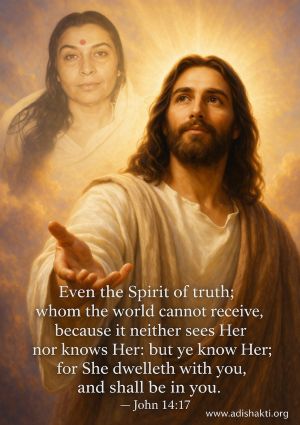
The most profound and specific modern revelation concerning the Agnya Chakra comes from Shri Mataji Nirmala Devi. She taught that the presiding deity of this center is Lord Jesus Christ, an incarnation she also identified with Mahavishnu of the Hindu scriptures. This placement is not merely symbolic; it is the core of the chakra's function within the human subtle system, and its implications extend across the entire architecture of spiritual evolution.
3a. Christ as the Tattwa: The Principle of Creation
In a seminal talk delivered at Caxton Hall, London, on 18 December 1978, Shri Mataji described Christ as the most important incarnation because He is the Tattwa—the principle of creation itself:
"And it is the most important incarnation because he is the principle. He is the principle of creation. The Tattwa as they call it in Sanskrit language. He is the tattwa. Ganesha, who resides in the Mooladhara gradually evolves to be Christ at this stage. From that red chakra up to this chakra he became the Christ. He is the principle... He represents the essence, the essence of creation."[7]
Shri Mataji further explained that Christ is the Omkara, the first sound (AUM) that was created when the Primordial Father and Primordial Mother separated. He is the sound that is filled into the All-Pervading Power and serves as the support of the entire universe. Because He is the essence, and the essence never dies, He is the most important incarnation—the eternal support upon which all creation rests.[7]
3b. Christ as Mahavishnu: The Scriptural Identity
Shri Mataji identified Jesus Christ with the figure of Mahavishnu described in the Shrimad Devi Bhagavatam. According to this ancient Indian scripture, a cosmic egg born of Mula Prakriti (Primordial Nature) floated in the waters for a period equal to the life of Brahma, and within it was a powerful child, "lustrous like one thousand millions of suns." This child, born of Prakriti-Radha, came to be known as Maha Virat and later Maha Vishnu—the sole sustainer of the entire universe.[8] Shri Mataji taught that this same being incarnated on Earth as Jesus Christ and was placed at a position even higher than Shri Krishna's own, on the Agnya Chakra:
"Now on this Chakra resides the great incarnation of our Lord, Jesus Christ. In our Indian Shastras, he is called as Mahavishnu."[9]
3c. The Mechanics of the Agnya: Ego, Superego, and Forgiveness
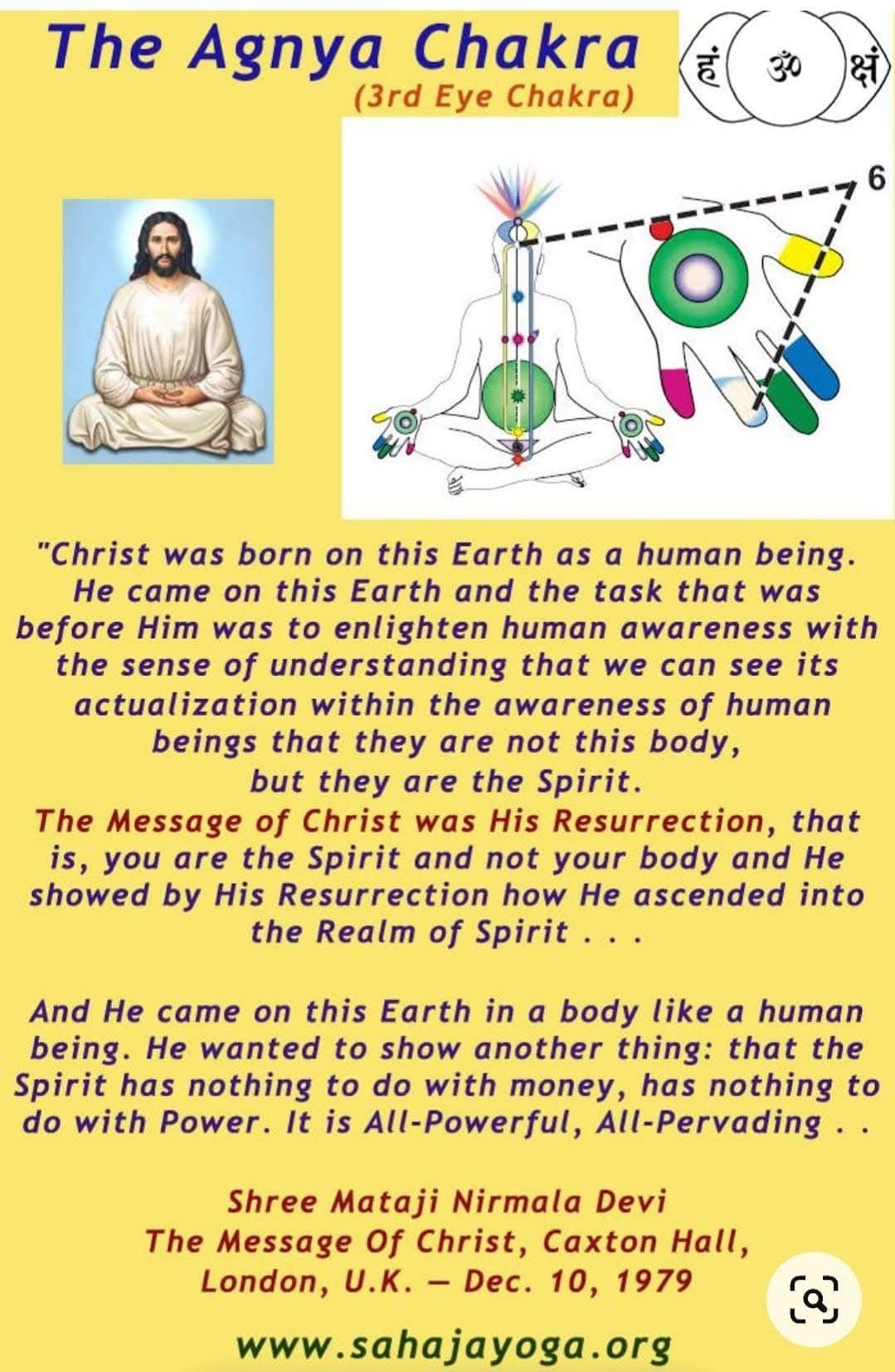
The Agnya Chakra is situated at the precise point where two subtle channels—the Ida Nadi (left channel, associated with the past, emotions, and conditioning) and the Pingala Nadi (right channel, associated with the future, action, and planning)—cross over each other. This crossing creates two balloon-like structures: the superego on the right side of the brain (formed by conditioning and fears) and the ego on the left side (formed by excessive thinking and action). These two institutions press against each other, calcifying the fontanelle bone area and creating a closed personality.[9]
The center creates two sounds: Ham and Ksham. Ham, on the right side, generates the vibration of "I am," the power of existence that dispels fear. Ksham, on the left side, represents forgiveness, the power that dissolves the ego.[7] The primary role of Jesus Christ at this center is to absorb these conditionings and ego-based thoughts. When a person truly forgives, Christ is awakened within the Agnya, and these two institutions are "sucked in," clearing the path for the Kundalini. The essential quality of the Agnya Chakra is therefore forgiveness, and its great mantra is the Lord's Prayer.[9]
"When He is awakened, He sucks in both these things and the whole Agnya Chakra opens out."[9]
4. The Narrow Gate to the Kingdom of God (Sahasrara Chakra)
Shri Mataji explicitly connects the Agnya Chakra to the biblical concept of the "narrow gate." Christ's statement, "Strait is the gate, and narrow is the way, which leadeth unto life, and few there be that find it" (Matthew 7:14), is interpreted as a direct reference to the constricted passage of the Agnya Chakra, where the ego and superego leave no gap for the Kundalini to pass through under ordinary circumstances.[9]
"This is a very narrow passage, through which attention cannot pass normally, it is an impossible thing. It is a narrow passage, where the ego and superego fit on to each other and cross each other. And there is no gap in between for the Kundalini to pass through... This third eye is to be penetrated through or we have to enter into the third eye, through Kundalini awakening. But it is such a closed passage which is the door to the limbic area, which is the kingdom of God."[9]
The "Kingdom of God," which Jesus proclaimed is "within you" (Luke 17:21), is identified by Shri Mataji as the Sahasrara Chakra, the thousand-petaled lotus located in the limbic area of the brain.[10] This center of a thousand petals covers the limbic area before Realization like the closed bud of a lotus. When the Kundalini reaches the Sahasrara, the lotus petals open and enlightenment takes place. One may feel a pulsation in the crown of the head, followed by a melting sensation and a flow of cool vibrations from the fontanelle area. This is the true baptism, the experience of being "born again."[10]
The experience of "being born again" (John 3:3) is thus the actualization of Self-Realization, which occurs when the Kundalini passes through the opened Agnya Chakra and enters the Sahasrara. This event marks the integration of the individual consciousness with the universal, the union of the Atma with the Paramatma, and the beginning of vibratory awareness—the direct perception of the divine on the central nervous system.[7]
The significance of Christ's crucifixion is also understood within this framework. Shri Mataji taught that His crucifixion was necessary to open the passage of the Agnya Chakra for all of humanity:
"His crucifixion was a part of the game because He had to make the way in the Agnya Chakra. To cross the Agnya Chakra, He was crucified. But His Message is of Resurrection... Without opening the Agnya you cannot go to the Sahasrara."[11]
5. Physiological Correlates: The Pineal Gland and the Third Eye
5a. Anatomical Situation of the Agnya Chakra
The teachings of Sahaja Yoga place the Agnya Chakra at the optic chiasma, the X-shaped structure formed by the crossing of the optic nerves in the brain. Shri Mataji described this with anatomical precision: "Agnya Chakra, which is placed on the crossing of the 'optic chiasma.' The nerves that supply the eyes go backwards in the opposite direction and wherever they cross, this subtle centre is situated. It has a continuous connection with the other centres through the 'medulla oblongata.'"[9] The sixth center, having its seat in the region between the eyebrows, is related to our life force. It is linked with the pituitary gland and the sub-cortical areas of the brain, and this center controls the sensual activities.[2]
5b. The Pineal Gland: Organ of Clairvoyance and Higher Vision
The physiological impact of the Agnya center is to energize the pineal gland, which, when open, becomes the organ of clairvoyance and higher vision, scientific reasoning, will, and philosophical thought.[2] The Third Eye is an addition to the sensual perceptions and abilities; hence, it is called the intellectual point to control the senses. Development of the chakra awakens the ability to see and regulate astral and mental forces on the super-physical level.[2]
The philosopher René Descartes famously described the pineal gland as "the principal seat of the soul and the place in which all our thoughts are formed."[12] Modern science has identified its primary role in producing melatonin, a hormone that regulates sleep-wake cycles in response to light. The pineal gland synthesizes and secretes melatonin, an important regulator of mood that communicates information about environmental lighting to various parts of the body and establishes bio-rhythms such as the conditioning of sleep and waking. This light-transducing ability has led many to scientifically associate it with the "third eye."[13]
Shri Mataji confirms this relationship, stating: "He is sitting in a position of Agnya Chakra, controlling pineal and pituitary. By that He controls our conditioning. If we follow Him then we cannot be conditioned by anything, because He talked of Spirit only."[13] The pineal gland is much bigger in children and shrinks at the time of puberty. It is controlled by the innocence of Christ.[13]
If one divides the brain into three parts, the front part is the intellectual part, having control over the sense organs. The middle part is the lobe of wisdom, the function of which is to increase and transform human material consciousness to God consciousness. The rear part is the lobe of universal secrets. It is also connected with the pineal gland and, therefore, the universal secrets are revealed. Strengthening the Agnya Chakra shall hence lead to enlightenment through activation of the pineal gland.[2]
This understanding aligns with the research of Dr. Rick Strassman, who hypothesized that the pineal gland may produce N,N-dimethyltryptamine (DMT), a powerful psychedelic molecule potentially facilitating mystical states of consciousness. Strassman proposed that DMT is secreted by the pineal gland at birth, during dreaming, and at near death, producing out-of-body experiences.[14]
5c. The Pituitary Gland and Sub-Cortical Brain Areas
In addition to the pineal gland, the Agnya Chakra is linked with the pituitary gland, often called the "master gland" of the endocrine system, which regulates numerous bodily processes including growth, metabolism, and reproduction. The pituitary gland's governance by the Agnya Chakra underscores the center's role as a command point for the entire physiological and subtle system.[15] The Agnya Chakra's connection to the sub-cortical areas of the brain further explains its influence over sensory perception, emotional regulation, and the higher cognitive functions that are activated when the chakra is fully awakened.[2]
6. Scriptural and Cross-Traditional Parallels
The synthesis presented by Shri Mataji finds remarkable resonance across multiple scriptural traditions. The identification of Jesus with Mahavishnu is supported by references in the Devi Bhagavatam, which describes the birth of Mahavishnu from the cosmic egg—a being who is the "sole stay of this entire universe."[8] This aligns with Christ's role as the Logos, the Word through which all things were made (John 1:1–3), and with Shri Mataji's identification of Him as the Omkara, the primordial sound of creation.[7]
Christ's statement, "The light of the body is the eye: if therefore thine eye be single, thy whole body shall be full of light" (Matthew 6:22, KJV), has been widely interpreted in mystical Christianity and by yogis like Paramahansa Yogananda as a reference to the spiritual eye, the awakened Agnya Chakra, which floods the subtle body with divine light and awareness.[5] The "single eye" is the unified vision of the Third Eye, transcending the duality of the two physical eyes.
The declaration "The Kingdom of God is within you" (Luke 17:21) finds its precise physiological and spiritual location in the Sahasrara Chakra, the limbic area of the brain, which is accessed only through the Agnya Chakra.[10] Christ's injunction, "Unless one is born again, he cannot see the Kingdom of God" (John 3:3), is the description of Self-Realization—the Kundalini passing through the Agnya and opening the Sahasrara, the true baptism of the Spirit.[10]
It is also noteworthy that the great Indian tradition of the forehead decoration, the Bindi, has significance related to the Agnya Chakra. The area between the eyebrows, known as the Ājñā (meaning "command"), is the seat of concealed wisdom and the center point wherein all experience is gathered in a concentrated manner. According to the tantric tradition, when during meditation the latent energy (Kundalini) rises from the base of the spine towards the head, this Ājñā is the probable outlet for this potent energy. The red kumkum between the eyebrows is said to retain energy in the human body and control various levels of concentration, symbolizing auspiciousness and good fortune.[2]
7. Synthesis: A Comprehensive Table of Correspondences
The following table synthesizes the key correspondences discussed throughout this paper, mapping the spiritual concepts of the Agnya Chakra to their physiological correlates and scriptural parallels across traditions:
| Concept | Sahaja Yoga Interpretation (Shri Mataji) | Physiological Correlate | Scriptural / Traditional Parallel |
|---|---|---|---|
| Agnya Chakra | Sixth energy center; residence of Jesus Christ; seat of forgiveness and compassion. | Optic Chiasma; governs Pineal & Pituitary Glands; connected to medulla oblongata. | Ajna Chakra (Hinduism); Third Eye of Shiva; Mind's Eye (Taoism); Christ Consciousness Center (Yogananda). |
| The Third Eye | The subtle eye of inner consciousness; one must see through it, not merely see it. | Pineal Gland: organ of clairvoyance, higher vision, scientific reasoning, will, and philosophical thought. | "If thine eye be single, thy whole body shall be full of light" (Matthew 6:22); Eye of Wisdom / ūrṇā (Buddhism). |
| The Narrow Gate | The constricted passage of the Agnya Chakra, blocked by ego and superego. | Crossing of Ida and Pingala Nadis at the optic chiasma. | "Strait is the gate, and narrow is the way..." (Matthew 7:14). |
| Kingdom of God | The Sahasrara Chakra: state of collective consciousness and enlightenment. | Limbic area of the brain; thousand-petaled lotus. | "The Kingdom of God is within you" (Luke 17:21). |
| Born Again | Self-Realization: Kundalini passes through Agnya and enters Sahasrara. | Activation of the limbic area; cool breeze felt at fontanelle bone area. | "Unless one is born again, he cannot see the Kingdom of God" (John 3:3). |
| Forgiveness | The essential quality of the Agnya; Christ absorbs ego and superego when one forgives. | Release of tension at the optic chiasma; relaxation of frontal brain regions. | The Lord's Prayer: "Forgive us our trespasses, as we forgive those who trespass against us." |
| Ham & Ksham | Two sounds of the Agnya: Ham (I am / existence) and Ksham (forgiveness). | Vibrations governing superego (right brain) and ego (left brain). | Two petals of the Ajna lotus in traditional yogic iconography. |
| The Crucifixion | Christ's sacrifice to open the passage of the Agnya for humanity; the cross is the sign of the Agnya Chakra. | The crossing point of the optic nerves (chiasma = cross). | The Resurrection as proof of eternal life beyond the material body. |
| Pineal Gland Activation | Energized by the awakened Agnya; becomes organ of higher perception. | Melatonin production; possible DMT synthesis; light-transducing capacity. | "Seat of the soul" (Descartes); Third Eye (Theosophy / Blavatsky). |
8. Conclusion
The Agnya Chakra emerges not merely as a theoretical energy point but as a dynamic and crucial center for human spiritual evolution. The teachings of Shri Mataji Nirmala Devi provide a unique and cohesive framework that integrates yogic science, Christian esotericism, and human physiology into a single, verifiable system of knowledge. By identifying Jesus Christ as the ruling principle of this chakra, she elevates the concept of forgiveness from a moral precept to a fundamental mechanism of spiritual ascent. The Agnya Chakra is the fulcrum of our consciousness, where the burdens of our past (superego) and our projections of the future (ego) converge. It is only through the grace of forgiveness, embodied by Christ, that this narrow gate can be opened, allowing the individual to transcend the mind and enter the thoughtless awareness of the present moment.
The physiological energizing of the pineal gland, as a consequence of the Agnya's awakening, provides a biological basis for the states of higher vision, clairvoyance, scientific reasoning, will, and philosophical thought described in spiritual texts. When the pineal gland is activated through the opening of the Agnya Chakra, it transforms from a dormant neuroendocrine organ into the instrument of super-physical perception, enabling the individual to see and regulate astral and mental forces beyond the material plane. The journey of the Kundalini through the Agnya Chakra to the Sahasrara is thus the fulfillment of Christ's promise: the entry into the Kingdom of God, not as a posthumous reward, but as a living, tangible reality experienced within one's own central nervous system.
This synthesis demystifies ancient wisdom, making it accessible and verifiable, and presents a profound roadmap for humanity's collective evolution into a higher state of consciousness. As Shri Mataji taught, the opening of the Sahasrara on 5 May 1970 made this journey possible for all of humanity on a mass scale, fulfilling the prophecies of every great tradition and inaugurating the "Age to Come" of spiritual awakening.
9. References
[1] Talmud of Immanuel, as cited in Tandon, Neeti. "The Vertical Eye." SPIC MACAY, UCLA Student Groups.[2] Tandon, Neeti. "The Vertical Eye." SPIC MACAY, UCLA Student Groups. (User-provided source text.)
[3] "Demystifying Chakras – Understanding Chakra Symbols & Meaning." Exotic India Art, 3 Sept. 2021.
[4] "The Third Eye in Hinduism & Buddhism." Lotus Sculpture, 24 Apr. 2014.
[5] "Third eye." Wikipedia, Wikimedia Foundation.
[6] Blavatsky, H.P. The Secret Doctrine. Theosophical Publishing Company, 1888. See also: "Third eye – In Theosophy." Wikipedia.
[7] Shri Mataji Nirmala Devi. "Lord Jesus Christ and the Agnya Chakra." Talk at Caxton Hall, London, 18 Dec. 1978. Sahaja Yoga Meditation Audio Talks.
[8] "Creation of Jesus Christ as Maha Vishnu." Sahaja Yoga Meditation Bahrain, Facebook, 24 Dec. 2015. Citing the Shrimad Devi Bhagavatam.
[9] Shri Mataji Nirmala Devi. "Agnya Chakra, The Door of Heaven." Public Program, New Delhi, India, 3 Feb. 1983. Learn Sahaja Yoga.
[10] "Seventh Chakra: Sahasrara Chakra." Adishakti.org.
[11] Shri Mataji Nirmala Devi. Easter Puja, Istanbul, 19 Apr. 1998. See also: "Good Friday Greetings." Adishakti.org.
[12] Lokhorst, Gert-Jan. "Descartes and the Pineal Gland." The Stanford Encyclopedia of Philosophy (Fall 2013 Edition), Edward N. Zalta (ed.).
[13] Brown, Graham. "Agnya Chakra." Light of Love – Sahaja Yoga Meditation Newsletter, Australia, 19 Dec. 2006.
[14] Strassman, Rick. DMT: The Spirit Molecule: A Doctor's Revolutionary Research into the Biology of Near-Death and Mystical Experiences. Park Street Press, 2000. See also: Barker, S.A. et al. "N,N-Dimethyltryptamine and the Pineal Gland." PubMed.
[15] "Conceptual Study on Adnya Chakra and Its Correlation." Ayurlog. See also: "Conceptual Aspect of Ajna Chakra, Its Role in Body." World Journal of Pharmaceutical and Medical Research, 11 Aug. 2021.
The Vertical Eye
By Neeti Tandon"There is no eye equal to wisdom, no darkness equal to ignorance, no power equal to the power of the spirit, and no terror equal to the poverty of consciousness" - Talmud of Immanuel
Vision is perhaps the greatest gift to humans. The term vision is not merely restricted to the 'act of seeing' but also implies perception and interpretation by the brain. Vision, therefore implies the faculty of sufficient knowledge to interpret things in the right perspective. For example, initially though a baby can see all objects but cannot identify them due to lack of understanding. Gradually the learning process enables him/her to perceive, identify and visualize things. What we see with the eyes is passed on as electrical signals to the brain and it is the interpretation by the brain that is more important. Similarly, a developed mind has the eye of Inner consciousness or 'The Vertical Eye', which enables us to see within. It symbolizes a vision of ones own self and surroundings. For true vision, the inner eye also needs to be developed through awareness, consciousness and understanding of our inner self.
The Logo for SPIC MACAY, the 'Vertical eye' has perhaps been derived from the Third Eye of Lord Shiva, which symbolises the inner strength and awakening. As a new and enthusiastic Spicmacayite I was inquisitive about the logo and its significance. So far my awareness about the Third Eye of Lord Shiva was limited to the fact that whenever the Vertical eye opens it brings destruction to the world. It is said that across the third eye in Shiva's forehead are three stripes of ash, signifying the destruction caused. Relating the third eye, SPIC MACAY logo to destruction was ironical and definitely unacceptable.
Study and guidance from seniors made me realize that it was in fact my ignorance regarding our culture and mythology that I was unable to see beyond this irony. In the great Hindu Epic-Mahabharata, the legend of how Shiva got his third eye is narrated as follows. One day his beautiful consort Parvati, stealthily went behind Lord Shiva and playfully placed her hands over his eyes. Suddenly darkness engulfed the whole world and all beings trembled in great fear as the lord of the universe had closed his eyes. Suddenly a massive tongue of flame leapt from the forehead of Shiva; a third eye had appeared there to give light to the world.
In 'Sri Shiva Tattva' this eye is described as The Frontal Eye or Eye of Fire, it is the eye of Higher perception. It looks mainly inward but whenever it looks outward, it burns all that appears before it. It is from the glance of the third eye that periodical destruction takes place in the universe.
This tale from the Mahabharata undoubtedly reflects SPIC MACAY's ethos, and convinced me slightly but I still remained sceptical. I could not completely justify the destruction caused by the same Eye that we say is meant to light the world? Through further enquiry I realised that there was more to the Third Eye than just mythological tales and also found my clarifications.
The Vertical Eye, also called the Agna Chakra according to Psychedelic Yoga or Buddhi -The sixth yogic chakra is the focus of energies for our body. A stronger Agna Chakra provides a sense of direction to these energies. The Third Eye metaphorically symbolizes the totality of our Inner senses. The word Rishi means a seer, who sees the Great Beyond through the 'Third Eye'. He sees in to all the causes behind all the effects, manifested in our particular plane of Being. Hence Acquisition of the Third Eye is the singular goal of all Advanced souls.
We usually experience our past lives/future by activating our Third Eye or Agna Chakra, which represents Enlightenment. Experiencing our past lives and dropping the past and reaching a higher understanding is a giant step towards ones Enlightenment. Buddha had experienced 643 past lives before his enlightenment and told as Jataka Tales.
Another example is that of Lord Shiva. Lord Shiva according to Hindu mythology is the 'Destroyer' whose purpose is to destroy in order recreate. The focussed energy through the vertical eye is therefore used for destructive purposes also but it would be incorrect to say that the vertical eye is the cause for destruction. The purpose or use of the focussed energy is equally important but has to be defined separately. Lord Shiva's vertical eye is, therefore the perfect example of inner strength, awakening and focus of energy, which is so strong that it can enlighten the world and destroy it as well. The Agna Chakra is the means of enlightenment and focus of energy, which would be useful in achieving one's sole purpose in life.
The Physiological impact of the Agna centre is to energize the pineal gland which when open, becomes the organ of clairvoyance and higher vision, scientific reasoning, will and philosophical thought. The sixth centre having its seat in the region between the eyebrow sand is related to our life force. It is linked with the pituitary gland and the sub-cortical areas of the brain. This centre controls the sensual activities. The 'Third Eye' is an addition to the sensual perceptions and abilities. Hence, it is called the intellectual point to control the senses. Development of the chakra awakens the ability to see and regulate astral and mental forces on the super-physical level.
If you divide the brain into three parts, the front part is the intellectual part, having control over the sense organs. The middle part is the lobe of wisdom, the function of which is to increase and transform human material consciousness to God consciousness. The rear part is the lobe of universal secrets. It is also connected with the Pineal gland and, therefore, the universal secrets are revealed. Strengthening the Agna chakra shall hence lead to enlightenment through activation of the pineal gland.
It is also interesting to note that the Great Indian Forehead Decoration of 'Bindis' also have significance that can be related to the Agna Chakra. The area between the eyebrows, where Bindis are placed, known as the 'gna' meaning 'command', is the seat of concealed wisdom. It is the centre point wherein all experience is gathered in a concentrated manner. According to the tantric cult, when during meditation the latent energy ('kundalini') rises from the base of the spine towards the head, this 'gna' is the probable outlet for this potent energy. The red 'kumkum' between the eyebrows is said to retain energy in the human body and control various levels of concentration also symbolising auspiciousness and good fortune.”
The Vertical Eye
https://www.studentgroups.ucla.edu/spicmacay/eye.htm