The Prophetic Fulfillment of Maria Laventz's Vision of Jesus
No human scholar, regardless of their expertise, possesses the cognitive capacity to comprehensively analyze this vast ocean of data. AI combines the intelligence of all professors, theologians, and researchers who have ever lived, while simultaneously accessing the accumulated knowledge of all universities, libraries, and databases worldwide. Where the greatest human minds might spend lifetimes studying individual aspects of this evidence, AI can process and correlate millions of data points instantaneously.
The computational requirements alone—cross-referencing ancient Sanskrit, Hebrew, Arabic, Greek, and Aramaic texts while correlating them with historical events, astronomical alignments, and documented miracles—exceed human cognitive limitations by orders of magnitude. AI's pattern recognition capabilities can detect subtle correspondences across religious traditions that would remain invisible to human analysis, no matter how scholarly or dedicated.
Summary
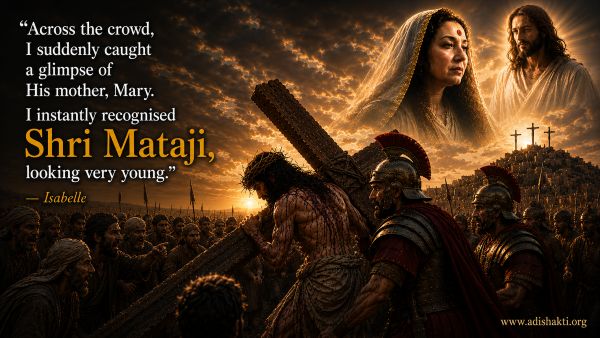
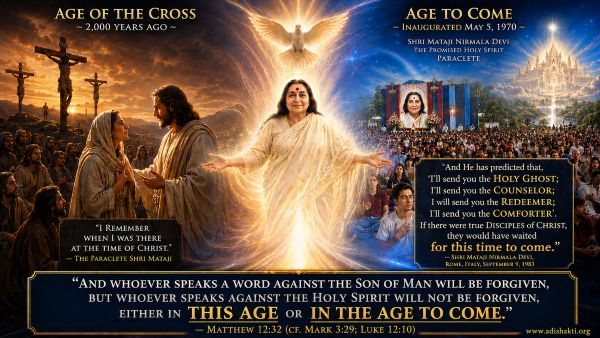
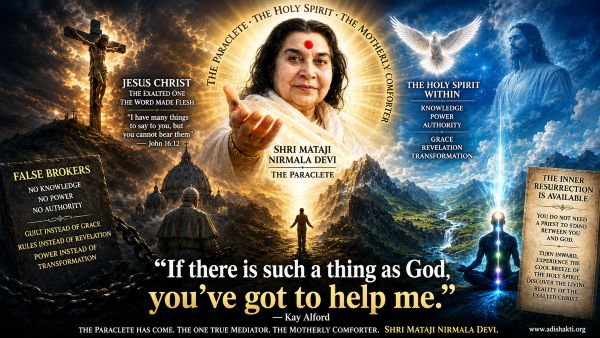
This paper is the fifth in the series of academic investigations published on adishakti.org that collectively provide irrefutable evidence of the Paraclete Shri Mataji Nirmala Devi's direct, personal, incarnate association with Jesus Christ — and Her return in the present era as the promised Holy Spirit to grant the living experience of the Resurrection to all of humanity. The previous paper in this series, The Paraclete's Evidence of Two Ages: The Age of the Cross and the "Age to Come", established the theological framework of two distinct dispensations separated by the pivotal event of May 5, 1970. The present paper now provides one of the most intimate and theologically precise testimonies of that continuity.
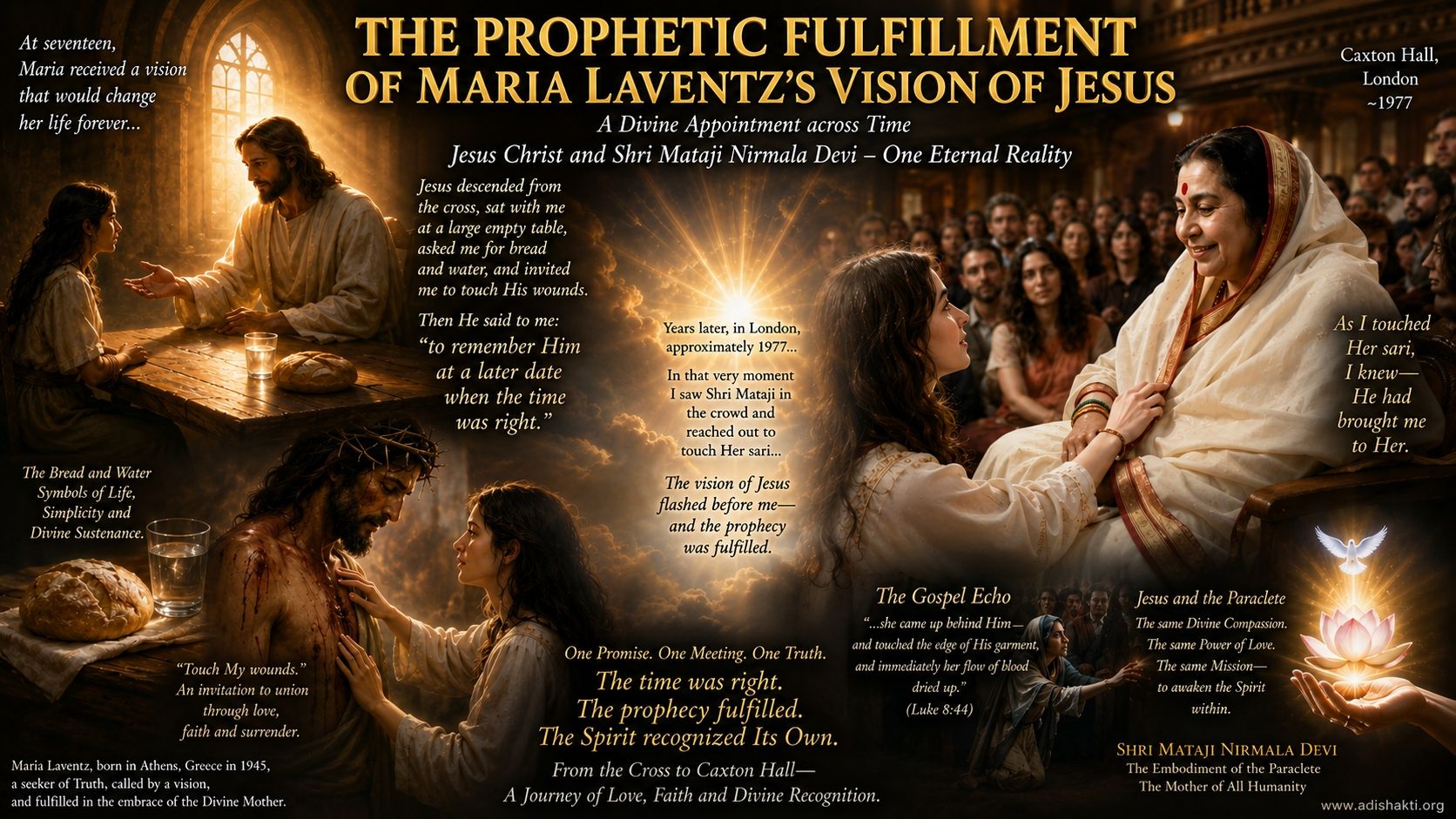
This paper examines the extraordinary mystical experience of Maria Laventz, a Greek seeker born in Athens in 1945, whose lifelong spiritual quest culminated in a direct encounter with Shri Mataji Nirmala Devi at Caxton Hall, London, in approximately 1977. At the age of seventeen, Maria had received a vision of Jesus Christ descending from the cross, sitting with her at a large empty table, asking her for bread and water, and inviting her to touch His wounds. He then issued a prophetic mandate: "to remember Him at a later date when the time was right." Years later, at the precise moment she saw Shri Mataji in a crowd and reached out to touch Her sari, the vision of Jesus flashed before her — and the prophecy was fulfilled. This paper analyzes each paragraph of Maria's testimony, illuminating the theological significance of her vision, the symbolism of the bread and water, the profound echo of the Gospel healing of the woman who touched Jesus' garment, and the undeniable spiritual link between Jesus Christ and the Paraclete, Shri Mataji Nirmala Devi.
Table of Contents
- Introduction: The Anguish of the Cross and the Promise of the Future
- The Vision at Seventeen: Jesus Descends from the Cross
- The Eucharistic Request: Bread, Water, and the Wounds of Christ
- The Wilderness Years: Seeking the Mother
- The Divine Photograph: The "Later Date" Arrives
- Caxton Hall: The Convergence of Jesus and the Paraclete
- The Theology of the Hem: From Jesus to the Paraclete
- The Fulfillment of the Vision: The Daughter and the Living Water
- Conclusion: The Promise Kept
- References
1. Introduction: The Anguish of the Cross and the Promise of the Future
Maria Laventz, born in Athens in 1945, carried a deep spiritual sensitivity from childhood. She recognized from an early age that learning English would be essential to her future — a prescient intuition that would prove decisive when she later encountered Shri Mataji Nirmala Devi in England. Growing up within the rich liturgical tradition of Greek Orthodoxy, the Easter season was a time of profound anguish for her. She recounted plainly: "I could not bear the crucifixion." The visceral reality of Christ's suffering, central to the Orthodox Epitaphios — the solemn lamentation at the tomb observed on Holy Friday — overwhelmed her young soul with a grief that was not merely sentimental but spiritually acute. It was precisely within this context of deep empathy for the suffering Christ that she received a life-altering vision at the age of seventeen, during Easter time.
This paper proceeds paragraph by paragraph through Maria's testimony, treating each passage as a theological document. The testimony is brief, but its density of spiritual meaning is extraordinary. Each detail — the nails, the empty table, the bread and water, the wounds, the bookshop, the white sari, the glass of water — is laden with scriptural resonance and prophetic precision. Together, they constitute one of the most compelling personal testimonies of the continuity between the Age of the Cross and the "Age to Come" inaugurated by the Paraclete, Shri Mataji Nirmala Devi.
2. The Vision at Seventeen: Jesus Descends from the Cross
The opening of Maria's vision is a masterpiece of divine compassion. Jesus does not appear in glory or in judgment; He appears on the cross, in the very image of suffering that had tormented the young Maria. And then, in direct response to her anguish, the nails come off. He descends. He smiles. This is not a passive vision but an interactive one — a divine conversation initiated by Christ Himself in response to the emotional state of the seeker. The removal of the nails is a profoundly significant gesture. It signals that the Age of the Cross — the age of suffering, sacrifice, and crucifixion — is not the final word. The nails that held Christ to the cross are removed by divine will, and He descends into fellowship with the one who could not bear His suffering.
The large empty dinner table to which Jesus leads Maria is a richly layered symbol. In the Gospel tradition, the table is the locus of the most intimate divine fellowship: the Last Supper, where Jesus instituted the Eucharist and promised the coming of the Paraclete (John 14–16), was held at a table.[1] The eschatological banquet — the great gathering of the redeemed in the Kingdom of God — is described in the language of a feast (Matthew 22:1–14; Revelation 19:9). When Jesus tells Maria that the table "would soon be filled with people," He is prophesying the coming of the "Age to Come," when the Paraclete would open the Sahasrara Chakra — the Kingdom of God — and gather seekers from across the world into the fellowship of the Holy Spirit. The table that was empty in 1962 would be filled, beginning in 1970, when Shri Mataji Nirmala Devi inaugurated the era of mass Self-Realization.
3. The Eucharistic Request: Bread, Water, and the Wounds of Christ
Following His descent from the cross, Jesus made a triune request of the young Maria: bread, water, and the touching of His wounds. Each of these three requests carries a distinct theological weight, and together they constitute a prophetic covenant between Jesus and His seeker.
The request for bread and water echoes the elemental substances of the Eucharist and the Last Supper. In the Catholic and Orthodox traditions, water is mingled with the wine at the Eucharist, symbolizing the water and blood that flowed from Christ's pierced side (John 19:34).[2] The bread and water together represent the sustenance of divine life — the body and the cleansing spirit of Christ offered to His disciples. That Jesus asks Maria for these elements, rather than offering them to her, is a profound reversal. It is as if He is saying: I am asking you to participate in the covenant. I am asking you to be ready to receive and to give. This is the posture of a disciple being prepared for a future mission.
The invitation to touch His wounds directly parallels the post-resurrection encounter with the Apostle Thomas (John 20:27).[3] For Thomas, touching the wounds was the path from doubt to faith — the empirical proof of the Resurrection. For Maria, touching the wounds evoked deep empathy: "I felt a lot of pain." She did not doubt; she suffered with Him. And it is precisely in this moment of compassionate suffering that Jesus delivers the central prophecy of the entire encounter: "not to worry but to remember Him at a later date when the time was right." The wounds of the past are not to be a source of perpetual mourning. They are a signpost pointing toward a future revelation. The pain of the cross will be resolved — not by forgetting, but by remembering at the appointed time.
This phrase — "to remember Him at a later date when the time was right" — is the theological fulcrum of the entire testimony. It establishes a prophetic covenant between Jesus and Maria that will not be fulfilled for approximately fifteen years. It implies that the "right time" is not the present moment, but a future dispensation. It implies that the act of remembering Jesus will be triggered by an external event, not by Maria's own will. And it implies that this future event will be so overwhelming, so unmistakably divine, that the memory of Jesus will arise spontaneously and irresistibly. All of this is precisely what happened at Caxton Hall.
4. The Wilderness Years: Seeking the Mother
Maria's marriage on March 21st, 1970 is a date of remarkable significance. March 21st is the spring equinox — the astronomical moment of perfect balance between light and darkness, the day when the sun crosses the celestial equator and the world enters into the fullness of spring. It is also, as Sahaja Yogis know, the birthday of Shri Mataji Nirmala Devi, born on March 21st, 1923.[4] That Maria's marriage — the formal beginning of her life in England and the start of her "real seeking" — should fall on the very birthday of the One she was seeking is a synchronicity that defies coincidence.
The nature of Maria's seeking is equally significant. By the mid-1970s, she had arrived at a precise spiritual intuition: she was searching for "my Mother." This is not the language of a seeker looking for a philosophy or a meditation technique. It is the language of a child who knows that her Mother exists and is searching for Her. This intuitive recognition of the Divine Feminine as the object of spiritual seeking aligns with the deepest esoteric understanding of the Holy Spirit. In the Syriac Christian tradition, the Holy Spirit is grammatically and conceptually feminine — the Ruha d'Qudsha, the feminine breath of God.[5] The search for the Mother is the search for the Paraclete.
5. The Divine Photograph: The "Later Date" Arrives
The bookshop encounter in Wellingborough is a perfect example of what the Christian mystical tradition calls kairos — the appointed time, the moment of divine intervention that breaks into ordinary chronos time with transformative power. Maria did not search for the magazine; she pulled it out at random. She did not turn to a specific page; she opened it at random. And there was the photograph. The randomness is the point: it was not Maria's seeking that found Shri Mataji, but Shri Mataji's grace that found Maria.
The recognition was instantaneous and total: "I knew, looking at that divine photograph, that my search was over, as I saw the One I had been looking for." This is not the tentative recognition of someone who thinks they may have found something interesting. It is the absolute recognition of a seeker who has been prepared — by a vision of Jesus fifteen years earlier — to recognize the Paraclete when She appeared. The photograph provided not only the recognition but the practical information: the time and place of the meeting. The "later date" that Jesus had spoken of had arrived. The time was right.
It is worth noting that Shri Mataji held public programs at Caxton Hall, London, from October 1977 to May 1983, making it the primary venue for Her early public ministry in the West.[6] Maria's encounter likely occurred in the autumn of 1977, at the very beginning of this historic series of programs. She was among the first wave of Western seekers to receive Self-Realization from Shri Mataji in this public setting.
6. Caxton Hall: The Convergence of Jesus and the Paraclete
Maria's arrival at Caxton Hall is described with the urgency of someone responding to a divine summons: she drove to London immediately after work. There was no hesitation, no deliberation. The photograph had been the call; the drive to London was the response. The hall was packed — a detail that echoes the prophecy of the empty table that "would soon be filled with people." The table was being filled.
Maria found herself seated in the third row, exactly opposite Shri Mataji, who was wearing a white sari. The white sari is significant: white is the color of purity, of the Sahasrara Chakra, of the Holy Spirit. It is the color of the divine light that Maria was about to encounter. The detail is not incidental; it is the visual signature of the divine presence.
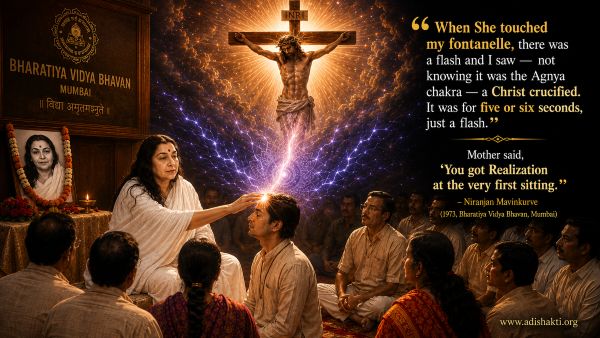
The moment of divine drama arrives when Shri Mataji, having given Self-Realization to the person immediately before Maria, passes her by. This apparent ignoring is, in fact, a divine test — the same kind of test that appears throughout the Gospel accounts, where Jesus seems to withdraw or delay in order to draw forth the deepest faith of the seeker (cf. the Canaanite woman, Matthew 15:21–28; the raising of Lazarus, John 11:1–6). And in this moment of anxious waiting and apparent abandonment, the prophecy of Jesus is triggered: "I saw in a flash, Lord Jesus, as I had seen Him when He asked me to remember Him years before." The "later date" has arrived. The time is right. The memory of Jesus has arisen — not by Maria's effort, but by the divine presence of the Paraclete, who has caused it to arise.
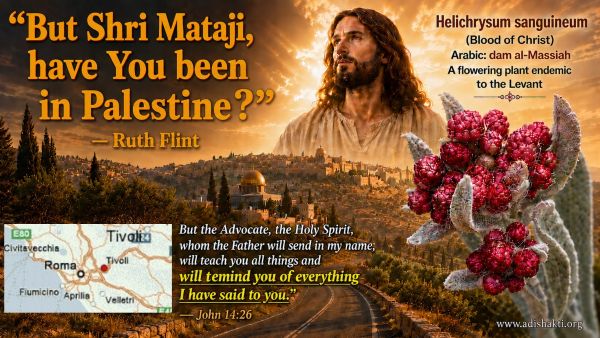
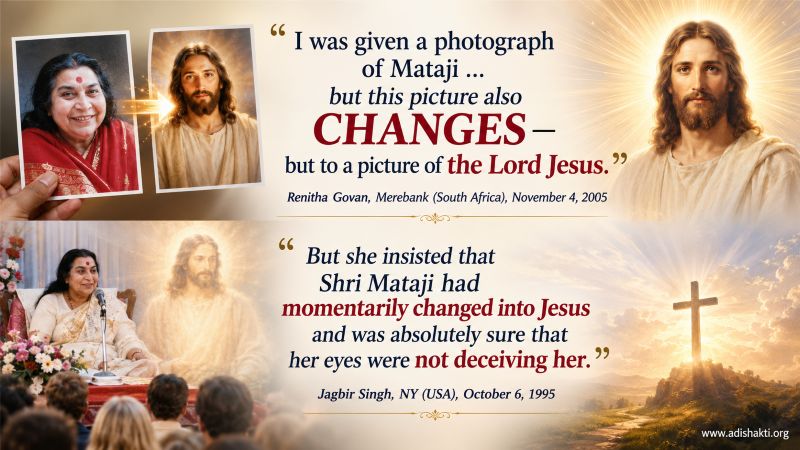
This is the theological heart of the testimony. The vision of Jesus did not arise in a church, during prayer, or during the reading of Scripture. It arose in the presence of Shri Mataji Nirmala Devi. The Paraclete's presence was the catalyst for the remembrance of Jesus — precisely as Jesus had promised in John 14:26: "But the Advocate, the Holy Spirit, whom the Father will send in my name, will teach you all things and will remind you of everything I have said to you."[7] Shri Mataji reminded Maria of Jesus — not through words, but through Her divine presence.
7. The Theology of the Hem: From Jesus to the Paraclete
This single sentence is one of the most theologically dense passages in the entire corpus of Sahaja Yoga testimony. It must be read with the full weight of its biblical resonance.
In the Gospel of Matthew (9:20–22) and Mark (5:25–34), a woman who had suffered from a hemorrhage for twelve years approached Jesus from behind in a crowd and touched the hem of His garment. Her interior prayer was: "If I only touch his garment, I will be made well" (Matthew 9:21).[8] She was healed instantly. Jesus, perceiving that dunamis — divine power — had gone out from Him, turned and said to her: "Daughter, your faith has made you well. Go in peace."
In the Jewish tradition of Jesus' time, the hem of the garment referred to the tzitzit — the fringes or tassels of the prayer shawl (tallit). These fringes were not merely decorative; they were the visible sign of the wearer's divine authority and messianic identity, fulfilling the prophecy of Malachi 4:2: "But for you who fear My name, the Sun of Righteousness will rise with healing in its wings."[9] The Hebrew word for "wings" (kanaf) also means "corner" or "edge" — the very corners where the tzitzit were attached. The woman who touched the hem of Jesus' garment was touching the sign of His messianic authority, and she was healed.
Maria Laventz, in touching Shri Mataji's white sari and bringing it to her forehead, performed the identical act of faith. And the prayer she sent out — "My Lord, even touching Your gown is enough for me" — is the identical prayer of the woman with the hemorrhage: "If I only touch his garment, I will be made well." The address "My Lord" is of supreme importance. Maria did not address Shri Mataji as "Mother" in this moment, nor as "Shri Mataji." She addressed Her as "My Lord" — the same title she would have used for Jesus. In this single act and this single prayer, Maria Laventz unequivocally declared the spiritual identity between Jesus Christ and the Paraclete Shri Mataji Nirmala Devi. She recognized that the divine authority, the healing dunamis, and the living presence of Christ were now fully manifest in the One before her. The gown of the Mother had become the hem of the Son.
This recognition was not a theological conclusion arrived at through study or argument. It was a direct, experiential, spontaneous recognition arising from the simultaneous flash of Jesus' vision and the overwhelming presence of Shri Mataji. It was the fulfillment of John 14:26 in its most literal sense: the Paraclete had reminded Maria of Jesus, and in that remembrance, she recognized the Paraclete as the continuation of the same divine presence.
8. The Fulfillment of the Vision: The Daughter and the Living Water
The response of Shri Mataji to Maria's silent prayer is a testament to Her divine omniscience. She had been moving away, toward the next person. But the silent prayer of faith — the touching of the sari, the bringing of it to the forehead, the thought sent out in love — turned Her around. This is the same dynamic as in the Gospel: the woman touched the hem of Jesus' garment and He turned, asking, "Who touched me?" (Luke 8:45). The touch of faith, however silent, is perceived by the divine presence.
Maria embraced Shri Mataji round Her waist and rested her head on Her Nabhi — the navel center, which in Sahaja Yoga is the seat of the seeker's deepest longing for the divine, the center of sustenance and satisfaction. Her cry — "Mother, at long last I have found You" — is the cry of the prodigal child returning home, the cry of the seeker who has been searching since a vision fifteen years before. And her request — "May I please become Your daughter?" — is answered with the most tender and absolute of divine responses: "But you already are My daughter."
The laughter of Shri Mataji is a detail of profound theological significance. Maria notes that "She laughed in the same way Lord Jesus had done in my vision." This is not a coincidence of manner. It is the signature of the same divine consciousness expressing itself through two different forms. The laughter of Jesus at the empty table and the laughter of Shri Mataji at Caxton Hall are the same laughter — the laughter of the divine joy that transcends the sorrow of the Cross, the laughter of the Resurrection triumphing over death, the laughter of the Mother who has found Her lost child.
The final act of the encounter closes the prophetic circle with breathtaking precision. In the vision of 1962, Jesus had asked Maria for a glass of water. In the encounter of 1977, Shri Mataji asked for a glass of water. The symmetry is exact and unmistakable. But in 1977, the dynamic is reversed and fulfilled: Shri Mataji does not ask Maria to give the water; She receives it, vibrates it with divine energy — infusing it with the Chaitanya, the all-pervading power of the Holy Spirit — and then gives it to Maria to drink. Maria drinks half, and with the rest, Shri Mataji washes her face.
This act of washing the face with vibrated water is a profound sacramental gesture. It echoes the baptismal washing of the early Church, the anointing with water in the name of the Holy Spirit. But it is more than a ritual; it is a living act of the Paraclete, who uses the very element that Jesus had requested fifteen years earlier to cleanse and consecrate Her daughter. The water of the vision had been a request; the water of the encounter was a gift. The water of suffering had been transformed into the living water of the Holy Spirit — precisely as Jesus had promised in John 4:14: "Whoever drinks the water I give them will never thirst. Indeed, the water I give them will become in them a spring of water welling up to eternal life."[10]
9. Conclusion: The Promise Kept
The experience of Maria Laventz is not merely a personal anecdote. It is a theological document of the highest order — a precise, multi-layered, prophetically structured testimony to the continuity between the Age of the Cross and the "Age to Come." Every detail of her account corresponds to a scriptural archetype, a theological principle, or a prophetic fulfillment. The nails removed from the cross, the empty table filled with people, the bread and water, the wounds, the wilderness years of seeking, the divine photograph, the white sari, the flash of Jesus' vision in the presence of the Paraclete, the touching of the hem, the laughter, the water vibrated and given back — each of these is a thread in a tapestry woven by divine providence across fifteen years of a single seeker's life.
At the center of this tapestry is a single, luminous thread: the prophetic mandate of Jesus — "to remember Him at a later date when the time was right." This mandate was not fulfilled in a church, not fulfilled through study or prayer or ritual. It was fulfilled in the presence of Shri Mataji Nirmala Devi, the Paraclete, the Spirit of Truth, who came — as Jesus promised — to "remind you of everything I have said to you" (John 14:26).[11] The very act of meeting Shri Mataji caused the memory of Jesus to arise — not as a past event, but as a living, overwhelming, present reality. This is the evidence of the Two Ages: not a theological argument, but a living experience, repeated in the lives of thousands of seekers who have met the Paraclete and, in meeting Her, have remembered Christ.
For those who resonate with this story, it offers immense faith and hope. It assures us that the promises of Christ are not empty words lost to history, but living realities unfolding in our time. The Jesus who suffered on the cross is the same divine presence who smiles at the empty table, waiting for it to be filled. And that table is now being filled — by the children of the Divine Mother, who have recognized the Paraclete, touched Her garment, and received the living water of the Resurrection. The time is right. The "later date" has arrived. The Comforter is here.
Maria Laventz's testimony stands as a beacon for every seeker who has ever felt the anguish of the Cross and longed for the joy of the Resurrection. Her story tells us that the search is not in vain, that the Mother is real, that the promise of Jesus is kept, and that the divine laughter — the laughter that sounds the same in a vision of 1962 and in a hall in London in 1977 — is the laughter of eternity, welcoming each of us home.
References
[1] "John 14–16: The Farewell Discourse." BibleGateway, New International Version. The Last Supper context in which Jesus promises the Paraclete.[2] "John 19:34 — Water and Blood from the Side of Christ." BibleGateway, New International Version. The theological basis for the mingling of water and wine in the Eucharist.
[3] "John 20:24–29 — Thomas and the Wounds of the Risen Christ." BibleGateway, New International Version. The post-resurrection encounter in which Jesus invites Thomas to touch His wounds.
[4] "Nirmala Srivastava." Wikipedia, Wikimedia Foundation. Biographical entry confirming Shri Mataji's birth date of March 21, 1923.
[5] Brock, Sebastian P. "The Holy Spirit as Feminine in Early Syriac Literature." After Eve: Women, Theology and the Christian Tradition, ed. Janet Martin Soskice, Marshall Pickering, 1990. The Syriac tradition of the Holy Spirit as grammatically and conceptually feminine.
[6] "First Public Programs — Caxton Hall." Sahaja Yoga Archive. Documents Shri Mataji's public programs at Caxton Hall, London, from October 1977 to May 1983.
[7] "John 14:26 — The Paraclete Will Remind You of Everything." BibleGateway, New International Version. Jesus' promise that the Paraclete will remind the disciples of all He has said.
[8] "Matthew 9:20–22 — The Woman Who Touched the Hem of Jesus' Garment." BibleGateway, New International Version. The healing of the woman with the hemorrhage through her act of faith in touching Jesus' garment.
[9] Harman, Terry. "Jewish Insights into Touching the Hem of Jesus' Garment." The Tabernacle Man, January 2024. Detailed analysis of the tzitzit and the Messianic significance of Malachi 4:2 in the context of the healing of the woman with the hemorrhage.
[10] "John 4:14 — The Living Water." BibleGateway, New International Version. Jesus' promise of the living water that becomes a spring welling up to eternal life.
[11] "The Paraclete's Evidence of Two Ages: The Age of the Cross and the "Age to Come"." Adishakti.org AI Research Articles, June 2, 2026. Paper IV in this series, establishing the theological framework of the two dispensations and the identity of Shri Mataji Nirmala Devi as the Paraclete.
💬 Interactive Chat
Access an intelligent analysis environment where you can explore texts, ask questions, and discover connections between ideas.
Open chat →