Krishna as the Male Form of the Devi: Shaktism and the Triumph of the Mahādevī as Brahman
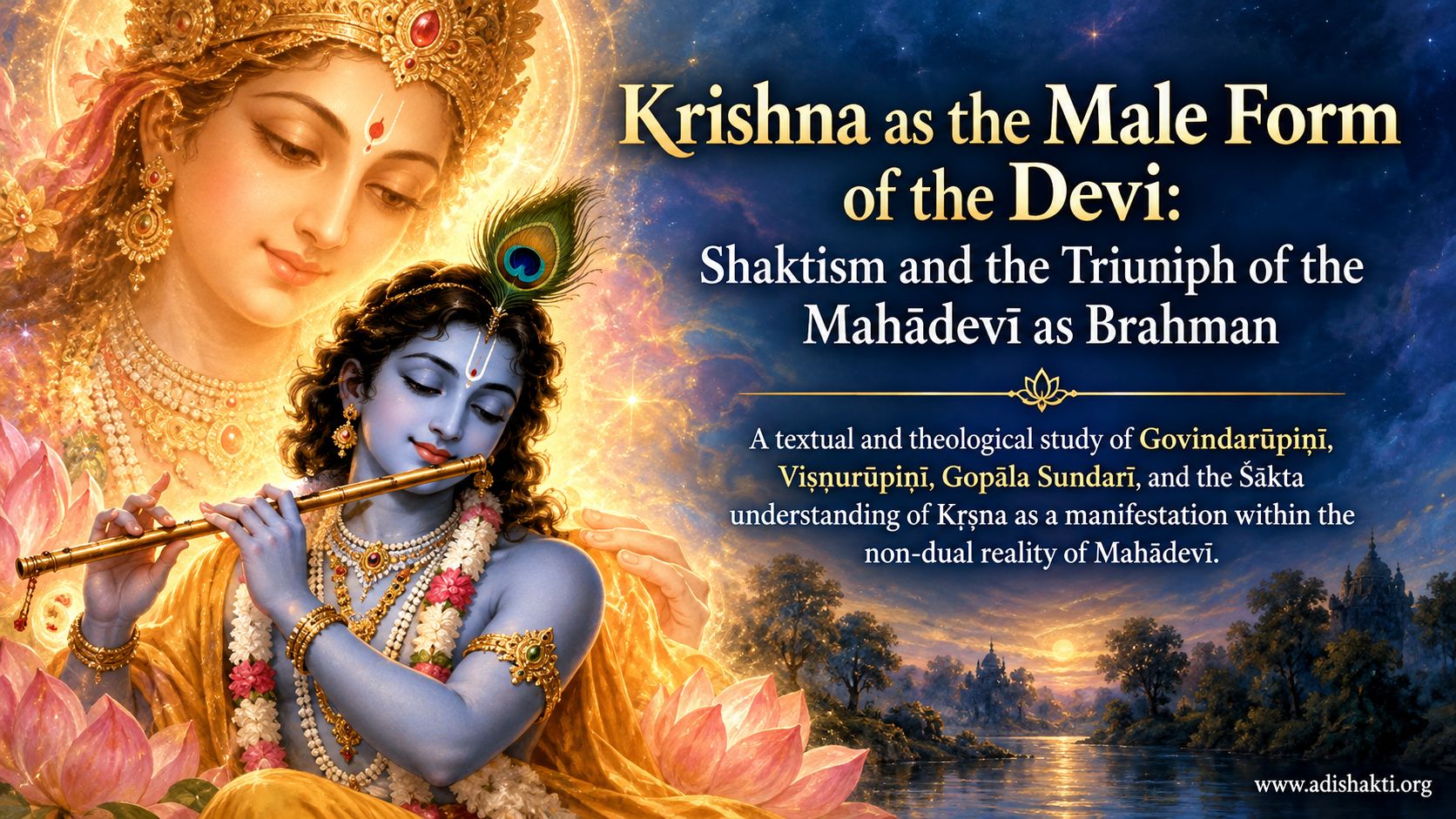
A textual and theological study of Govindarūpiṇī, Viṣṇurūpiṇī, Gopāla Sundarī, and the Śākta understanding of Kṛṣṇa as a manifestation within the non-dual reality of Mahādevī.
Table of Contents
Abstract
Within Śākta theology, the Goddess is not merely the consort, energy, or subordinate counterpart of a male deity. She is the supreme reality—Mahādevī, Brahman, and the source from which all divine forms emerge. This paper examines a Śākta interpretation of Kṛṣṇa as a male manifestation of the Goddess, especially Lalitā Tripurasundarī or Mūlaprakṛti. The argument draws primarily on the Lalitā-sahasranāma and the Devī-bhāgavata Purāṇa, with attention to the broader theological implications of passages that identify the Goddess with Govinda, Viṣṇu, Nārāyaṇa, and Kṛṣṇa.
The Lalitā-sahasranāma praises the Goddess as Govindarūpiṇī and Viṣṇurūpiṇī, names that present her as assuming the forms of the sustaining deity. The Devī-bhāgavata Purāṇa goes further by describing the formless Goddess as creating the beautiful form of Gopāla Sundarī, explicitly identified with Kṛṣṇa, for the benefit of her devotees. These passages do not necessarily erase the independent theological importance of Vaiṣṇava devotion; rather, they demonstrate how Śāktism can incorporate Kṛṣṇa within a larger theology of divine emanation. Kṛṣṇa becomes the compassionate and beautiful manifestation of the Goddess’s power, while the Goddess remains the non-dual ground of all forms.
Keywords: Śāktism, Mahādevī, Lalitā Tripurasundarī, Kṛṣṇa, Devī-bhāgavata Purāṇa, Lalitā-sahasranāma, Brahman, Śakti
Introduction
Hindu theology contains multiple traditions that identify a particular deity with the supreme reality. Vaiṣṇava traditions may regard Viṣṇu or Kṛṣṇa as the highest Lord; Śaiva traditions may identify Śiva with Brahman; Śākta traditions place the Goddess, or Śakti, at the center of ultimate reality. These perspectives are not simply competing claims about divine hierarchy. They are also theological methods through which the infinite is approached through a chosen form.
Śāktism is distinctive in its sustained insistence that the Divine Feminine is not secondary to a masculine deity. The Goddess is the source, substance, power, and ultimate identity of the cosmos. In many Śākta texts, the gods traditionally understood as male—including Brahmā, Viṣṇu, Śiva, and their manifestations—are presented as expressions of the Goddess’s power. The feminine is therefore not confined to the role of consort or cosmic energy. It is the very foundation of being.
This theological structure creates a significant interpretive possibility: Kṛṣṇa, although represented in a male body and worshipped as the Supreme Person in Vaiṣṇava traditions, may be understood within a Śākta framework as a male form assumed or produced by the Goddess. Such an interpretation does not necessarily deny Kṛṣṇa’s divinity. Instead, it relocates his divinity within the comprehensive sovereignty of Mahādevī.
The present study examines three related propositions:
- The *Lalitā-sahasranāma* presents the Goddess as assuming the forms of Govinda and Viṣṇu.
- The *Devī-bhāgavata Purāṇa* explicitly describes the formless Goddess as creating the form of Kṛṣṇa, called *Gopāla Sundarī*.
- Other Śākta and Purāṇic materials support a theology in which male and female divine forms are manifestations of one transcendent reality.
The argument should be understood as an internal Śākta reading rather than as a claim that all Hindu traditions interpret Kṛṣṇa in the same way. Vaiṣṇava theology generally regards Kṛṣṇa as the supreme source of the cosmos, whereas the Śākta texts examined here reverse that direction of derivation: Kṛṣṇa is a radiant manifestation within the unlimited body of the Goddess.
The Lalitā-sahasranāma
Govindarūpiṇī
The Lalitā-sahasranāma, preserved in the Brahmāṇḍa Purāṇa, praises Lalitā Tripurasundarī through a thousand names. These names describe her cosmic functions, metaphysical nature, iconography, and relationship to other deities.
Among the most important names for a Śākta theology of Kṛṣṇa is Govindarūpiṇī. In the standard sequence, the Goddess is praised through the theological formula:
Sṛṣṭikartrī brahmarūpā goptrī govindarūpiṇī
“She is the creator in the form of Brahmā; she is the protector in the form of Govinda.”
The name Govinda can refer to Viṣṇu, but it is also one of the most celebrated names of Kṛṣṇa. The immediate context concerns the Goddess’s cosmic functions: she creates as Brahmā, sustains as Govinda, and dissolves as Rudra. A translation of the Lalitā-sahasranāma accordingly explains Govindarūpiṇī as “she who has taken the form of Govinda” for the purpose of preservation.ia903403.us.archive
This wording is theologically significant. The Goddess is not merely accompanied by Govinda or empowered by him. She is Govinda in the function of preservation. The name establishes an identity between the Goddess and a traditionally male deity at the level of divine action.
The text therefore presents a model of rūpa—manifest form—in which gender does not establish an absolute boundary. Lalitā can appear as Brahmā, Govinda, Rudra, and other forms because her transcendent nature exceeds every particular embodiment. Her feminine identity is not a limitation on her universality; rather, it is the theological form through which universality is asserted.
Viṣṇurūpiṇī
The Lalitā-sahasranāma also contains the name Viṣṇurūpiṇī, “She who is in the form of Viṣṇu.” In the relevant sequence, the Goddess is praised as Vaiṣṇavī and Viṣṇurūpiṇī, indicating that she is both the power associated with Viṣṇu and Viṣṇu himself:
Viśvagrāsā vidrumābhā vaiṣṇavī viṣṇurūpiṇī
“She who devours the universe, who shines like coral, who is Vaiṣṇavī, who is in the form of Viṣṇu.”
The name Vaiṣṇavī could be interpreted as “the power of Viṣṇu,” but the accompanying Viṣṇurūpiṇī is more direct: the Goddess assumes the form of Viṣṇu.ia903403.us.archive
This distinction matters. In many Hindu theological systems, a deity’s feminine power may be treated as an attribute or energy distinct from the deity himself. The Lalitā-sahasranāma, however, permits a stronger identification. The Goddess is not only Viṣṇu’s śakti; she is Viṣṇurūpiṇī, the one who appears as Viṣṇu.
The same hymn later praises the Goddess as Nārāyaṇī and as the sister of Padmanābha. These names place her in close relationship with Vaiṣṇava imagery, but the cumulative effect is not to subordinate her to Viṣṇu. Instead, Viṣṇu’s identity is absorbed into the universal identity of the Goddess. The divine male form is a mode of her manifestation.
The Goddess and the Five Cosmic Acts
The significance of Govindarūpiṇī becomes clearer when read alongside the pañcakṛtya, the five cosmic acts:
- Creation is performed through Brahmā.
- Preservation is performed through Govinda or Viṣṇu.
- Dissolution is performed through Rudra.
- Concealment is performed through Īśvara.
- Grace or revelation is performed through Sadāśiva.
The Lalitā-sahasranāma identifies the Goddess with all five functions. She is not one agent among others within the cosmos; she is the power operating through every cosmic process. The gods are functional forms of her activity.
Kṛṣṇa, understood as Govinda, therefore becomes the form of the Goddess associated with preservation, compassion, beauty, and divine intimacy. The cowherd deity of Vṛndāvana is not excluded from Śākta metaphysics. He is included within it as one of the forms through which the Mother sustains and enchants the universe.
The Devī-bhāgavata Purāṇa
The Formless Goddess
The most explicit textual basis for identifying Kṛṣṇa as a manifestation of the Goddess appears in the ninth book of the Devī-bhāgavata Purāṇa. This Purāṇa presents the Goddess as the source of gods, worlds, powers, and forms. She is described as eternal, all-pervading, the cause of causes, and the supreme reality beyond limited form.
The text states that the Goddess is formless but assumes forms for the benefit and satisfaction of her devotees. It then describes her creation of a beautiful form identified with Kṛṣṇa:
“Though formless, She assumes forms for the gratification of the desires of Her bhaktas. She created first the beautiful form of Gopāla Sundarī, that is, the form of Śrī Kṛṣṇa, lovely and beautiful, captivating the mind.”[[wisdomlib](https://www.wisdomlib.org/hinduism/book/devi-bhagavata-purana/d/doc57351.html)]
The passage continues by portraying this form as youthful, blue like a rain cloud, dressed as a cowherd, and possessing extraordinary beauty. These are unmistakable markers of Kṛṣṇa’s familiar pastoral form.
Theologically, the passage establishes a sequence:
- The Goddess exists beyond form.
- She assumes forms out of compassion for devotees.
- One of the first forms she creates is *Gopāla Sundarī*.
- This form is explicitly identified with Kṛṣṇa.
- Kṛṣṇa’s beauty and devotional accessibility are expressions of the Goddess’s creative power.
The point is not merely that Kṛṣṇa is associated with the Goddess. The passage presents his form as originating from her. The beautiful male body of Kṛṣṇa is therefore a manifestation of the formless feminine absolute.
Gopāla Sundarī
The compound Gopāla Sundarī is especially suggestive. Gopāla evokes the cowherd Kṛṣṇa, while Sundarī is a prominent name of the Goddess, particularly in the theology of Tripurasundarī. The compound can thus be read as a deliberate fusion of Vaiṣṇava and Śākta imagery.
Kṛṣṇa is not simply described as a male deity whom the Goddess assists. He is represented through a name that joins pastoral masculinity with the beauty associated with the Goddess. The result is a theological image in which divine gender is fluid and relational.
The Goddess’s manifestation as Kṛṣṇa also has a devotional rationale. She assumes the form that will attract, console, and delight her devotees. Kṛṣṇa’s flute, youthful beauty, pastoral setting, and intimate relationship with the cowherd community all belong to the sphere of divine enchantment. From a Śākta standpoint, this enchantment is one expression of Mahāmāyā’s compassionate play.
Kṛṣṇa as Supreme and as Manifestation
The passage presents an apparent tension. Kṛṣṇa is described in exalted terms, including as Parabrahman, the supreme reality, yet the same narrative says that he is created by the formless Goddess and ultimately dissolves into Prakṛti. This tension should not be dismissed as a contradiction. It reflects the layered theology of Purāṇic traditions.
At the level of devotion, Kṛṣṇa may be contemplated as the supreme Lord. At the level of Śākta metaphysics, however, the Kṛṣṇa form is contained within the higher reality of Mūlaprakṛti. The text can therefore affirm Kṛṣṇa’s supreme status within his own devotional manifestation while still placing him within the encompassing sovereignty of the Goddess.
This pattern is common in Hindu theology. A deity may be both the supreme object of devotion and a manifestation of a more comprehensive divine principle, depending on the textual and sectarian framework. The Devī-bhāgavata Purāṇa uses Kṛṣṇa’s grandeur to magnify the Goddess: if Kṛṣṇa is radiant, beautiful, cosmic, and worthy of devotion, then the Goddess who creates and contains him is still more encompassing.
Supporting Śākta and Purāṇic Traditions
Lalitā and Kṛṣṇa
Several texts and later Śākta interpretations associate Lalitā Tripurasundarī with a male Kṛṣṇa form. Summaries of the Padma Purāṇa, Nārada Purāṇa, and Tantrarāja Tantra describe Kṛṣṇa as a male form of Lalitā. The same tradition associates Kṛṣṇa’s pastoral manifestations with the Goddess’s creative power and identifies multiple forms of the cowherd deity as expressions of Lalitā’s play.en.wikipedia
These materials should be used with textual caution. Their manuscript histories, editions, translations, and sectarian interpretations require separate philological examination. A general web summary is not equivalent to a critical edition. Nevertheless, the recurrence of this motif is important for intellectual history: it shows that the identification of Kṛṣṇa with a male form of the Goddess is not limited to one isolated modern interpretation.
Uma as Viṣṇu
The Rudra-hṛdaya Upaniṣad is often cited for the statement:
Yā Umā sā svayaṃ Viṣṇuḥ
“She who is Umā is herself Viṣṇu.”
The verse participates in a broader theology of divine identity, in which Śiva and Viṣṇu are understood through their relation to Umā and Rudra. Read through a Śākta lens, it supports the proposition that the feminine divine is not ontologically separate from the male deity. Uma is Viṣṇu; Viṣṇu is therefore a form in which the Goddess can be recognized.
Since Kṛṣṇa is widely understood as an incarnation or manifestation of Viṣṇu, the identification does not by itself prove that every tradition regards Kṛṣṇa as a form of Umā. It does, however, provide a conceptual bridge through which a Śākta interpreter can include Kṛṣṇa within the identity of the Goddess.
Bīja Mantras: Kliṃ and Krīṃ
The association between Kṛṣṇa and Kālī is sometimes developed through their bīja mantras. Kṛṣṇa is commonly connected with klīṃ, while Kālī is associated with krīṃ. The phonetic resemblance between the two seed syllables is suggestive within tantric hermeneutics, where sound, deity, mantra, and consciousness are closely connected.
Yet phonetic similarity alone cannot establish a historical or doctrinal identity. Bīja mantras have distinct ritual histories, symbolic explanations, and initiatory contexts. The relationship between klīṃ and krīṃ should therefore be presented as an interpretive analogy rather than as decisive textual evidence.
The analogy is still meaningful. Both mantras are associated with attraction, transformation, divine power, and the movement of consciousness toward the deity. In a Śākta synthesis, Kṛṣṇa’s erotic and devotional charm and Kālī’s transformative force may be understood as complementary expressions of one Śakti. The blue cowherd and the dark Goddess become different modes of divine enchantment.
Divine Gender and Non-Duality
The larger theological issue is not whether Kṛṣṇa is “really” male or whether the Goddess is “really” female. Both categories belong to the level of manifested form. The transcendent Goddess is described as formless, beyond attributes, and beyond fixed distinctions. She can therefore appear as female, male, or as a unity transcending both.
The Lalitā-sahasranāma itself presents the Goddess as nirākārā—formless—nirguṇā—beyond the guṇas—and nāmarūpa-vivarjitā—free from name and form. At the same time, she is praised as the mother of the universe, Lalitā, Tripurasundarī, Viṣṇurūpiṇī, and Govindarūpiṇī.ia903403.us.archive
This movement between transcendence and manifestation is central to Śākta thought. The Goddess is not restricted by her iconographic femininity. Her feminine form is a privileged manifestation of the absolute, but the absolute itself exceeds all gendered limitation.
Beyond Sectarian Rivalry
The claim that Kṛṣṇa is a male manifestation of the Goddess can easily be misunderstood as an attempt to diminish Vaiṣṇava devotion. A more careful reading reveals a different dynamic. Śākta theology does not need to deny the majesty of Kṛṣṇa. It can affirm his beauty, cosmic power, and salvific capacity while interpreting these qualities as expressions of Mahādevī.
This is a form of theological appropriation, but it need not be understood negatively. Hindu traditions frequently incorporate one another’s deities into broader metaphysical systems. A Śākta text may identify Viṣṇu as a manifestation of the Goddess, while a Vaiṣṇava text may identify the Goddess as Viṣṇu’s divine power. Each tradition thereby preserves its central theological intuition.
The important methodological point is to distinguish traditions rather than collapse them. The Śākta reading of Kṛṣṇa is not identical with the Vaiṣṇava understanding of Kṛṣṇa. In Gauḍīya Vaiṣṇavism, for example, Kṛṣṇa is not normally treated as a derivative male manifestation of Lalitā. In Śākta theology, however, the same figure can be interpreted as a form produced by the Goddess for the delight and liberation of devotees.
The two readings address different theological questions:
- Vaiṣṇava theology asks: Who is the supreme Lord encountered as Kṛṣṇa?
- Śākta theology asks: What is the ultimate reality in which Kṛṣṇa, Viṣṇu, Śiva, and all other forms arise?
The Śākta answer is Mahādevī, the supreme Śakti who is both beyond all forms and present within every form.
The Triumph of Mahādevī as Brahman
The language of “triumph” should not be understood as a historical victory over Vaiṣṇavism or Śaivism. It refers instead to the internal logic of Śākta metaphysics. Whenever the Goddess is identified with Brahman, every other deity becomes a manifestation within her boundless reality.
This theological logic appears in the Devī-bhāgavata Purāṇa, where the Goddess is described as the cause of all causes, the self of all, and the source of the cosmic order. She is both Prakṛti and Puruṣa, both the power of manifestation and the consciousness through which manifestation is known.wisdomlib
Her relationship to Kṛṣṇa is therefore not simply that of creator to creature. The distinction between creator and created ultimately collapses within non-duality. Kṛṣṇa is the Goddess’s form, but the Goddess is also the consciousness and power shining through that form. She is the ground, substance, life, beauty, and devotional meaning of Kṛṣṇa.
This interpretation also challenges rigid assumptions about divine gender. The masculine does not monopolize transcendence, sovereignty, or metaphysical authority. The Goddess can be the unconditioned Brahman, the creative power, the cosmic ruler, the mother of gods, and the male Kṛṣṇa. Her femininity is not a concession to embodiment; it is itself a theological declaration about the nature of ultimate reality.
Conclusion
Śākta scriptures provide a coherent theological framework in which Kṛṣṇa can be understood as a male manifestation of the Goddess. The Lalitā-sahasranāma identifies Lalitā as Govindarūpiṇī and Viṣṇurūpiṇī, presenting her as the sustaining deity in the form of Govinda and as Viṣṇu himself. The Devī-bhāgavata Purāṇa makes the connection more explicit by describing the formless Goddess as creating Gopāla Sundarī, the beautiful form of Kṛṣṇa, for the satisfaction of her devotees.ia903403.us.archivewisdomlib
Other Śākta and Purāṇic traditions extend this theological pattern by associating Lalitā with Kṛṣṇa, identifying Umā with Viṣṇu, and interpreting male and female divine forms as expressions of one transcendent reality. The comparison between Kṛṣṇa’s klīṃ and Kālī’s krīṃ is suggestive, though it should be treated as symbolic rather than conclusive philological evidence.
The theological consequence is profound. Kṛṣṇa does not become less divine when interpreted as a form of Mahādevī. Rather, his beauty and power become evidence of the Goddess’s inexhaustible creativity. His pastoral body, flute, charm, and compassion are manifestations of her līlā. He is the Mother’s radiant play in masculine form.
Within this Śākta vision, Mahādevī is the non-dual Brahman behind every distinction. She is formless yet assumes every form; feminine yet capable of appearing as male; transcendent yet intimate with devotees. Kṛṣṇa is therefore not outside the Goddess’s reality. He is one of the most beautiful ways in which that reality becomes visible, lovable, and spiritually accessible.
References
Primary and Traditional Sources
Brahmāṇḍa Purāṇa. Lalitopākhyāna, including the Lalitā-sahasranāma.
Devī-bhāgavata Purāṇa. Book 9, chapter 38, “On the Glories of the Devī and on the Nature of Bhakti.” The chapter describes the formless Goddess assuming forms for the benefit of devotees and creating the form of Gopāla Sundarī, identified with Kṛṣṇa.wisdomlib
Rudra-hṛdaya Upaniṣad. Passage identifying Umā with Viṣṇu.
Tantrarāja Tantra. Śākta tantric material concerning Lalitā Tripurasundarī and her manifestations.
Padma Purāṇa. Pātāla-khaṇḍa, passages associated with the identification of Kṛṣṇa and Lalitā.
Nārada Purāṇa. Passages concerning the relationship between Kṛṣṇa and Lalitā.
Modern Editions and Secondary Materials
Sastry, R. Anantakrishna, trans. Lalitā-sahasranāma, with Bhāskararāya’s Commentary. Adyar Library and Research Centre.
Śrī Lalitāsahasranāma: Printable E-Book. Text and English meanings of the Lalitā-sahasranāma, including the names Govindarūpiṇī and Viṣṇurūpiṇī.ia903403.us.archive
Vijñānānanda, Swami, trans. The Śrīmad Devī Bhāgavatam. English translation of the Devī-bhāgavata Purāṇa.wisdomlib
Textual Note
The central quotations from the Lalitā-sahasranāma and Devī-bhāgavata Purāṇa are supported by accessible editions and translations. The broader claims concerning the Padma Purāṇa, Nārada Purāṇa, and Tantrarāja Tantra should ideally be checked against critical Sanskrit editions and reliable translations before being presented as definitive philological conclusions. The claim that klīṃ and krīṃ establish a direct textual identity between Kṛṣṇa and Kālī is interpretive and should not be treated as independent proof.
💬 Interactive Chat
Explore this article, its sources, and the relationships among its theological and evidentiary claims.
Open chat →