
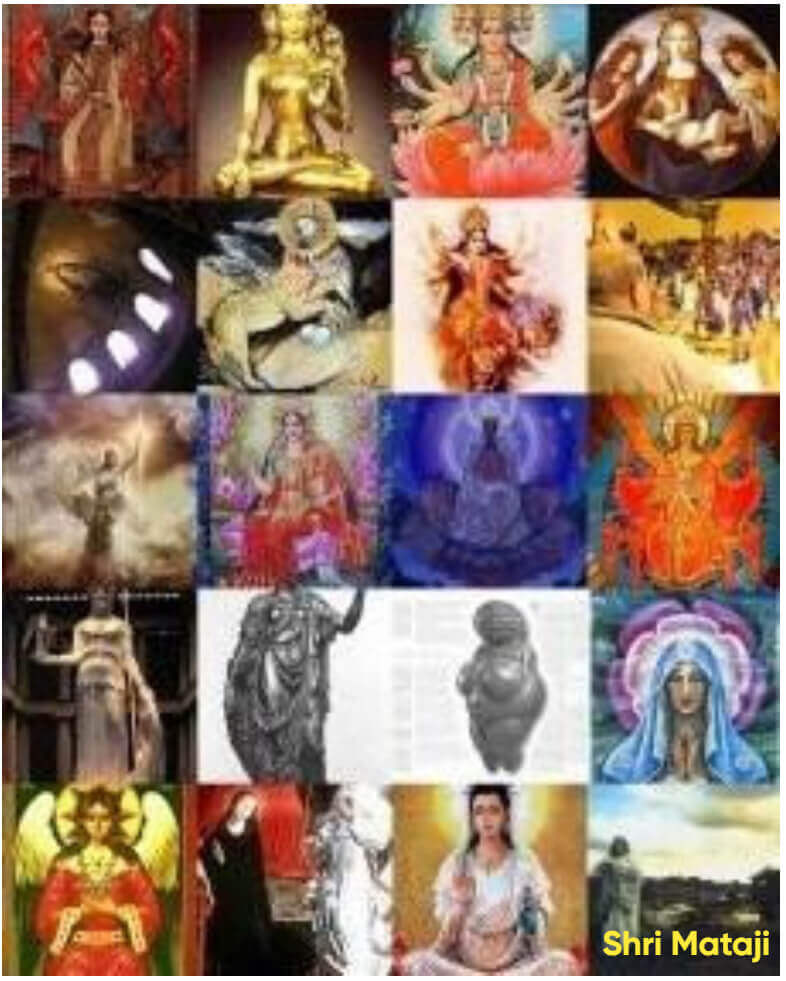
The Panchabhuta Subdivisions in Devi Gita
"Devigita proclaims that Shakti went about creating the world with 24 tattvas or elements. The five elements were born out of the primordial principle of unmanifested Sakti. The ether through which sound traverse was first element, which is also known as Sabda-rupa (form of sound). Second was Air or Vayu (Sparsharupa or a form which is felt) The Air or Vayu give rise to Agni so it called Vayoranih. Then sense of taste or 'rasrupa' the water element came. The the gandharupa or the source of smell came—the earth. Pauranic Expert Vettam Mani said that the universe remained in embryo form or in the bijarupa. “These Panchabhutas {five elements} were first divided into two (each was divided into two). Then by a process of the combination of these ten parts different substances were born.... Each half of each of these five bhutas (elements) is again subdivided into four parts. These 1/8 parts are joined to the other halves and by combining them in other fractions of the material bodies (sthulasariras) of all beings are made.”
The Panchabhuta Subdivisions in Devi Gita: A Prefiguration of the Periodic Table
Table of Contents
- 1. Introduction
- 2. Panchabhuta and subdivisions in Devi Gita
- 3. Modern Periodic Table overview
- 4. Parallels in structure and process
- 5. Elemental property analogies
- 6. Philosophical and scientific implications
- 7. Detailed panchikarana process from Devi Gita text
- 8. Modern atomic theory parallels to tanmatras
- 9. Sankhya philosophy vs periodic table groups
- 10. Pancha mahabhutas parallels to chemical groups
- 11. Pancha Mahabhutas parallels in quantum field theory
- 12. Vibrational Nada Brahma parallels to string theory
- 13. Om vibration and string theory particle creation
- 14. OM and string theory in multiverse creation
- References
1. Introduction
Ancient Hindu scriptures, particularly the Devi Gita from the Devi Bhagavatam Purana, describe the Goddess (Devi or Shakti) as the primordial force subdividing the five elements (panchabhuta)—Akasha (ether), Vayu (air), Agni (fire), Apas (water), and Prithvi (earth)—through the panchikarana process to create the material universe. This systematic fractionation and recombination mirrors the modern periodic table's organization of elements by atomic structure and properties. The paper postulates that these subdivisions represent an intuitive anticipation of atomic theory and elemental classification. [1]
2. Panchabhuta and subdivisions in Devi Gita
The Devi Gita outlines creation from unmanifest Shakti, producing subtle tanmatras (shabda for Akasha, sparsha for Vayu, rupa for Agni, rasa for Apas, gandha for Prithvi), which evolve into gross elements via panchikarana. Each element divides into two halves: one half remains intact, while the other divides into four equal parts (1/8ths), recombined such that each gross element comprises 50% of its own subtle form and 12.5% from each of the other four. This yields proportions like gross Akasha = ½ Akasha + ⅛ Vayu + ⅛ Agni + ⅛ Apas + ⅛ Prithvi, ensuring all matter is a composite. [2]
Vettam Mani, citing Devi Gita, notes these divisions form the cosmic body, sense organs, pranas, and 84 lakh species, emphasizing eternal paramanu (atoms) within perishable forms.
3. Modern Periodic Table overview
The periodic table, developed by Mendeleev in 1869, arranges 118 elements by atomic number (proton count), with properties recurring in groups due to electron configurations. Elements form from subatomic particles (protons, neutrons, electrons) combining in nuclei and shells, yielding diverse properties from hydrogen (gas, atomic number 1) to uranium (metal, 92). Groups share traits: noble gases (Group 18) like helium (inert, ether-like); alkali metals (Group 1) reactive like air; halogens (Group 17) transformative like fire.
4. Parallels in structure and process
Both systems rely on modular building blocks: Devi Gita's tanmatras/paramanu as "subtle atoms" fractionate like protons/electrons into composites, akin to isotopes or electron shells determining elemental identity. Panchikarana's fixed ratios (½ self + ⅛ others) parallel atomic percent composition in alloys or molecular bonds, where dominance of one "element" defines the whole (e.g., Prithvi's solidity from gandha preponderance).
The sequential addition of qualities—Akasha (sound), Vayu (sound+touch), up to Prithvi (all five)—resembles group progression: Group 1 (basic), up to noble gases (complete shells). Eternal paramanu disintegrating/reforming post-death evokes nuclear fission/fusion cycles.
| Aspect | Devi Gita Panchabhuta | Periodic Table |
|---|---|---|
| Base Units | Tanmatras/Paramanu (subtle) | Protons/Neutrons/Electrons |
| Division/Recombination | Panchikarana (½ + 4×⅛) | Atomic Number + Shell Filling |
| Diversity from Unity | 5 elements → 24 tattvas → species | 118 elements → compounds |
| Eternal Core | Nitya paramanu | Subatomic particles |
| Property Emergence | Sequential gunas (sound to smell) | Periodic trends (ionization) |
5. Elemental property analogies
Akasha (space, eternal, sound-carrier) aligns with light gases/hydrogen (pervasive, low density); Vayu (motion) with gases like oxygen; Agni (heat, transformation) with metals/halogens; Apas (cohesion, flow) with liquids; Prithvi (structure, smell) with solids. Ayurveda links tanmatras to quantum spins: Akasha (spin-2 graviton), Vayu (spin-3/2), Agni (spin-1), mirroring particle physics hierarchies. [1]
These correspondences suggest ancient sages intuited combinatorial chemistry, predating atomic theory by millennia.
6. Philosophical and scientific implications
Devi Gita's Devi as subdivider embodies a creative intelligence akin to natural laws governing electron orbitals, positing a unified field where consciousness (Shakti) fractals into matter. This challenges linear scientific history, implying empirical observation of atomic processes through yogic insight, as tanmatras are "perceived" by advanced senses.
While not identical, the structural homology warrants interdisciplinary study, bridging theology and chemistry. Modern validations, like water's "memory" (Apas) or plasma states (Agni), reinforce the postulate.
7. Detailed panchikarana process from Devi Gita text
The Devi Gita, part of the Devi Bhagavatam Purana (particularly Chapters 6-10), elaborates the panchikarana process as Devi (Shakti) manifesting the universe from primordial tattvas, where the five subtle elements (tanmatras) grossify into the five gross mahabhutas through systematic division and recombination. This process underpins creation of material bodies (sthula sharira), sense organs, pranas, and cosmic structures, cited extensively by Vettam Mani.
Tanmatras: subtle precursors
Creation begins with unmanifest Shakti producing tanmatras, the subtle essences:
- Akasha tanmatra: Shabda (sound).
- Vayu tanmatra: Sparsha (touch).
- Tejas/Agni tanmatra: Rupa (form/color).
- Jala/Apas tanmatra: Rasa (taste).
- Prithvi tanmatra: Gandha (smell).
These evolve sequentially: Akasha → Vayu → Agni → Ap → Prithvi, each inheriting prior qualities.
Step-by-step Panchikarana – Each mahabhuta undergoes quintuplication identically: bisection (1/2 each); one half remains undivided, the other splits into four 1/8 parts; recombine: undivided half (½) mixes with ⅛ from each of the other four. This yields gross Akasha = ½ Akasha + ⅛ Vayu + ⅛ Agni + ⅛ Ap + ⅛ Prithvi, etc. [2]
| Element | Undivided Half | Added Fractions (1/8 each) | Resulting Gross Composition |
|---|---|---|---|
| Akasha | ½ Akasha | Vayu, Agni, Ap, Prithvi | ½ own + ⅛×4 others |
| Vayu | ½ Vayu | Akasha, Agni, Ap, Prithvi | ½ own + ⅛×4 others |
| Agni | ½ Agni | Akasha, Vayu, Ap, Prithvi | ½ own + ⅛×4 others |
| Apas | ½ Ap | Akasha, Vayu, Agni, Prithvi | ½ own + ⅛×4 others |
| Prithvi | ½ Prithvi | Akasha, Vayu, Agni, Ap | ½ own + ⅛×4 others |
8. Modern atomic theory parallels to tanmatras
Tanmatras exhibit striking parallels to subatomic particles and quantum wave functions. Physicist John Hagelin draws spin correspondences:
- Akasha tanmatra → spin-2 graviton
- Vayu → spin-3/2 gravitino (supersymmetry bridge)
- Agni → spin-1 gauge bosons
- Apas → spin-1/2 fermions (matter fields)
- Prithvi → spin-0 Higgs (mass)
Tanmatras combine proportionally (½ self + ⅛ others) paralleling atomic bonds, isotopes, and molecules. Vaisheshika paramanus prefigure subatomics with "peculiar dharma" (unseen forces).
| Tanmatra | Quality | Atomic Parallel | Quantum Spin/Role |
|---|---|---|---|
| Akasha | Shabda | Vacuum fields | Spin-2 (gravity) |
| Vayu | Sparsha | Kinetic gases | Spin-3/2 (susy) |
| Agni | Rupa | Photons/heat | Spin-1 (forces) |
| Apas | Rasa | Cohesive bonds | Spin-1/2 (matter) |
| Prithvi | Gandha | Nuclei/solids | Spin-0 (mass) |
9. Sankhya philosophy vs periodic table groups
Samkhya's tanmatra-to-mahabhuta sequence parallels group progression: Akasha (inert) → Group 18 noble gases; Vayu (mobile) → Groups 1-2; Agni (transformative) → transition metals; Apas (cohesive) → Groups 16-17; Prithvi (solid) → solids. Panchikarna evokes alloying, group traits blend.
| Samkhya Element | Added Quality | Periodic Group Parallel |
|---|---|---|
| Akasha | Shabda | 18 (Noble gases) |
| Vayu | Sparsha | 1-2 (Alkali) |
| Agni | Rupa | 3-12 (Transition) |
| Apas | Rasa | 16-17 (Halogens) |
| Prithvi | Gandha | Solids (Group 14, metals) |
10. Pancha mahabhutas parallels to chemical groups
Each mahabhuta embodies sensory qualities and states aligned with group behaviors: Akasha (inert) → noble gases; Vayu (dynamic) → alkalis; Agni (transformative) → transition metals; Apas (cohesive) → chalcogens/halogens; Prithvi (dense) → solid metals/nonmetals. Ayurvedic doshas (Vata, Pitta, Kapha) prefigure biochemical classes.
11. Pancha Mahabhutas parallels in quantum field theory
QFT posits particles as excitations of underlying fields. Mahabhutas map to quantum fields: Akasha ↔ vacuum/Higgs; Vayu ↔ gauge fields; Agni ↔ force carriers; Apas ↔ fermion fields; Prithvi ↔ Higgs condensate. Panchikarana as field mixing (Yukawa, electroweak) yields composite states. Observer (purusha) links to measurement, and Devi's shakti manifests tattvas.
12. Vibrational Nada Brahma parallels to string theory
Nada Brahma, the Vedic principle that "the universe is sound" (from Nada Bindu Upanishad and Spanda Karika), posits reality as vibrational manifestations of primordial Nada (cosmic sound), with AUM as the fundamental frequency birthing creation. This directly parallels string theory's core tenet: fundamental reality consists of one-dimensional "strings" vibrating at different modes in 10/11 dimensions, producing particles, forces, and spacetime itself.
Vibrational Ontology
In string theory (developed by Witten, Green, et al.), point particles are replaced by tiny strings (~10⁻³⁵ m) whose frequencies determine mass, charge, and spin—e.g., a graviton from one mode, photon from another—unifying gravity and quantum mechanics. Nada Brahma echoes this: Brahman manifests as unstruck Anahata Nada (etheric vibration), differentiating into gross matter via Spanda (pulsation), akin to strings' Calabi-Yau compactifications yielding observable physics.
AUM's tripartite structure (A‑creation, U‑preservation, M‑dissolution) mirrors string vibrational spectra: open/closed strings creating bosonic/fermionic particles in cosmic cycles (Big Bang/crunch).
Dimensional and Creative Parallels
String theory requires extra dimensions (6 compactified), paralleling Hindu cosmology's lokas (planes) and Akasha's subtle realms accessed via Nada yoga. Shiva's Tandava (cosmic dance) symbolizes vibrational dynamics, as Nataraja's drum emits Nada fractaling into forms—much like strings' holographic duality projecting 3D from 2D vibrations (AdS/CFT).
| Aspect | Nada Brahma (Vedic) | String Theory (Physics) |
|---|---|---|
| Fundamental Unit | Primordial Nada/AUM vibration | One‑dimensional vibrating strings |
| Diversity Mechanism | Frequency modes (Spanda) | Vibrational harmonics (modes) |
| Creation Process | Sound → Tanmatras → Mahabhutas | Strings → Particles → Fields |
| Unity in Multiplicity | Anahata (unstruck sound) | Unified superstring theory |
| Observer Role | Purusha witnesses Prakriti Nada | Measurement collapses wavefunctions |
Consciousness and Resonance
Vedic seers "heard" Nada through yogic samadhi, intuiting quantum-like superpositions resolved by consciousness—prefiguring string theory's landscape of 10^500 vacua, where meditation tunes personal vibration to cosmic strings (chakras as harmonic nodes). Cymatics (sound shaping matter) experimentally bridges: Chladni patterns from frequencies evoke panchikarana recombinations. This synergy posits ancient Nada Brahma as proto‑string ontology, where Devi's creative Shakti vibrates the cosmic lyre, harmonizing rishis' insight with modern M‑theory.
13. Om vibration and string theory particle creation
Om (AUM), the primordial vibration in Vedic traditions—from Nada Bindu Upanishad and Devi Gita's etheric Akasha—represents cosmic creation's sonic blueprint, where unstruck Anahata Nada fractals into tanmatras, mahabhutas, and manifest reality. This mirrors string theory's mechanism, where fundamental strings' vibrational modes birth particles as quantized excitations, unifying matter and forces.
Vibrational Genesis of Particles
String theory posits tiny (~10⁻³⁵ m) strings in 10/11 dimensions; their harmonic oscillations determine particle identities:
- Closed string massless mode: Graviton (spin-2), enabling spacetime curvature.
- Open string modes: Photon (spin‑1 EM), gluons (QCD), W/Z bosons (weak force).
- Higher excitations/supersymmetry: Fermions (quarks/leptons, spin‑½), Higgs (spin‑0 mass‑giver).
Quantum quantization renders classical string vibrations as massless particles, resolving infinities plaguing point‑particle QFT—e.g., tachyons stabilize via supersymmetry pairings. Om's triphthong (A=creation/Prajapati, U=preservation/Vishnu, M=dissolution/Shiva) encodes cyclic srishti‑sthiti‑pralaya, akin to strings' Big Bang‑like expansions from compactified Calabi‑Yau manifolds.
Nada‑to‑String Mapping
Om as "cosmic energy sound" prefigures strings' worldsheet dynamics: Vedic seers "heard" AUM in samadhi, intuiting frequency‑encoded diversity (Spanda Karika), paralleling perturbative string scattering replacing Feynman point‑lines with smooth tubes.
- Low‑frequency Om → Ground state strings (massless bosons).
- Harmonic overtones → Massive Kaluza‑Klein towers (extra dimensions).
- Resonance with Purusha → Wavefunction collapse, selecting vacuum from 10^500 string landscapes.
| Om Component | Creative Role (Vedic) | String Mode Parallel |
|---|---|---|
| A (Va/Visarga) | Expansion, Akasha birth | Closed string graviton |
| U (Urdhva) | Cohesion, Vayu‑Agni flow | Open string gauge bosons |
| M (Megh) | Dissolution, Prithvi return | Higgs/tachyon stabilization |
| Silence (post‑Om) | Anahata unity | Superstring unification |
Cymatics validates: Om‑like frequencies pattern matter (Chladni plates), evoking panchikarana from vibrational fields—ancient Nada Brahma as holographic AdS/CFT precursor. This posits rishi insights as meditative string phenomenology, where Devi's Shakti chants particles into being.
14. OM and string theory in multiverse creation
Om (AUM), revered in the Devi Gita and Vedic texts as the vibrational seed of creation from primordial Nada within Akasha, parallels string theory's role in multiverse cosmology by encoding infinite cosmic bifurcations through harmonic resonance.
String Landscape and Om's Frequencies
String theory's "landscape" posits ~10⁵⁰⁰ metastable vacua from Calabi‑Yau compactifications of extra dimensions, each yielding distinct physical constants and universes via quantum tunneling or eternal inflation—our observable realm as one "bubble" amid infinite others. Om's phonemic decomposition (A=Vaak/creation, U=Urdhva/preservation, M=Ardha/dissolution + silence) generates modal spectra: fundamental frequency births base reality (like massless string modes: gravitons/photons), overtones spawn variant harmonics, mirroring landscape vacua as vibrational eigenstates.
In M‑theory (11D unification), brane collisions ("ekpyrotic" Big Bangs) spawn daughter universes; Devi's Shakti chanting Om fractals Akasha into panchabhuta realms, akin to brane‑world multiverses where each vibration selects a guna‑dominant cosmos (sattva‑inert like noble gas universes, tamas‑dense like heavy‑element realms).
Cyclic Multiverse Creation
Vedic kalpas (Brahma's day = creation cycle) evoke string gas cosmology: strings oscillate, "winding" extra dimensions before expanding 3D space—Om's eternal chant (Anahata Nada) pulses pralaya‑srishti, birthing parallel lokas (14 worlds) as string‑dual cosmoses. Purusha's witnessing collapses Om's superposition into manifest maya, paralleling anthropic selection: only life‑permitting vacua (fine‑tuned constants) host observers, our universe as "resonant" with consciousness.
| Om Phase | Multiverse Parallel | String Mechanism |
|---|---|---|
| A (Expansion) | Bubble nucleation/inflation | Tachyonic instability |
| U (Sustain) | Stable vacua landscapes | Flux vacua compactifications |
| M (Collapse) | Brane annihilation | KK tower decays |
| Silence | Eternal recursion | Holographic AdS/CFT bulk |
This synthesis frames Om as multiversal waveform: rishis' meditative "hearing" anticipates string theory's cosmic symphony, where Devi orchestrates 10⁵⁰⁰+ realities from one resonant bindu.
References
[2] "Devi Bhagavata Purana." Wikipedia, Wikimedia Foundation, 20 Sept. 2025.
[3] Vettam Mani. Purāṇic Encyclopaedia. Motilal Banarsidass, 1975.
[4] John Hagelin. “Is Consciousness the Unified Field?” Modern Science and Vedic Science, 1987.
[5] Nada Bindu Upanishad; Spanda Karika (Kashmir Shaivism).
[6] Green, Schwarz, Witten. Superstring Theory. Cambridge Univ. Press, 1987.
Devi recounts the creation of the five basic elements

Devi recounts the creation of the five basic elements
[The Goddess explains the initial impulse of the Self, in its aspect as the Unmanifest or Causal Body, to undertake the creation.]
2.22. This Self, however, by its own power of Maya conjoined with desires, actions, and the like,
Through the influence of prior experience ripening in time in accord with the law of karma,
2.23. And by confounding the primal elements, being desirous to create, begins to bring forth.
The resulting creation, devoid of intelligence, will be further described to you, O Mountain King.
2.24. This extraordinary form of mine which I have mentioned
Is unevolved and unmanifest, yet becomes segmented through the power of Maya.
2.25. All the religious treatises declare it to be the cause of all causes,
The primal substance behind the elements, and as having the form of being, consciousness, bliss.
2.26. It is the condensation of all karma; it is the seat of will, knowledge, and action;
It is expressed in the mantra Hrim; it is the primal principle—so it is said.
Comment
The creation of the universe in Advaita is seen as an apparent descent from the pure Brahman or Self down to the gross world of physical matter. The process is described using two rather different but overlapping models. One is an evolutionary model, based on the sequential unfolding of primary elements as outlined in the classical Samkhya. Devi Gita 2.22-42ab presents this evolutionary scheme. The other model is one of reflection, whereby the one supreme reality, like an image in a mirror, appears reflected in Maya as the manifold world. The Devi Gita summarizes the reflection model in 2.42cd-49ab. Common to both models is the generation of the three bodies of the self—Causal, Subtle, and Gross.
The above verses describe the first developmental phase in the evolutionary model, the generation of the Causal Body from which the primary elements arise. This process is here interpreted from a Sakta perspective. When the Goddess unites with her own Maya, the latent powers of will, knowledge, and action become activated, and she becomes the Causal Body and unevolved seed of the universe. This seed, referred to as the primal substance or principle (adi-bhuta, adi-tattva), is roughly equivalent to the primary material element Prakrti, of the Samkhya, from which other elements evolve, except that it is not mere insentient matter. It is a supreme spiritual reality as well, that is, Brahman, indicated by its identification as being, consciousness, bliss. And from the Sakta-Tantric perspective, it is also identified with the primary sonic reverberation, Hrim, seed syllable of Bhuvanesvari and source of all manifest creation...
[The Goddess recounts the creation of the five basic elements, the subsequent fivefold generative process known as Pancikarana, and the compounding of the remaining two bodies—Subtle and Gross—of the Self.]
2.27. Out of the primal substance arose ether, endowed with the subtle quality of sound.
Then arose air, characterized by the quality of touch, followed by fire, characterized by visible form.
2.28. Next arose water, characterized by taste; then earth, characterized by smell.
Ether has the single quality of sound; air is endowed with touch and sound.
2.29. Fire has the qualities of sound, touch, and visible form, according to the wise;
Water has the four qualities of sound, touch, visible form, and taste, so they say.
2.30. Earth has five qualities of sound, touch, visible form, taste, and smell.
From those subtle elements came into being the great cosmic thread which is called the Subtle Body.
2.31. It is proclaimed as all-pervading; this is the Subtle Body of the Self.
The Unmanifest is the Causal Body, which I mentioned earlier.
2.32. In that lies the world seed, from which evolves the Subtle Body.
From that, by the process of fivefold generation, the gross elements,
2.33. Five in number, arise, I shall now describe this process.
Each of those elements previously mentioned shall be divided in half.
2.34. One half-part of each element shall be divided into four, O Mountain.
By joining the undivided half of each element with one of the quartered fractions from each of the other four, each element becomes fivefold.
2.35. And they produce the Cosmic Body, or Gross Body, of the Self.
Comment
The Goddess now explains the second and third developmental stages of cosmic evolution, namely, the generation of the Self's Subtle Body from the five subtle or uncompounded elements and the Gross Body from the gross or compounded elements. The three stages of evolution as outlined by the Goddess is the preceding two sections may be amplified and schematized as follows:
I. Goddess (Self) → Maya + Will-Knowledge-Action → World Seed or Causal Body
II. World Seed → The Uncompounded Elements:
sound → ether }→ Subtle Body
sound+touch → air }→ Subtle Body
sound+touch+form → fire }→ Subtle Body
sound+touch+form+taste → water }→ Subtle Body
sound+touch+form+taste+smell → earth }→ Subtle Body
III. The Uncompounded Elements + Quintuplication Process → Gross Elements → Gross Body
The Devi Gita: The Song of the Goddess
C. MacKenzie Brown, State University of New York Press (September 1998) pp. 95-99