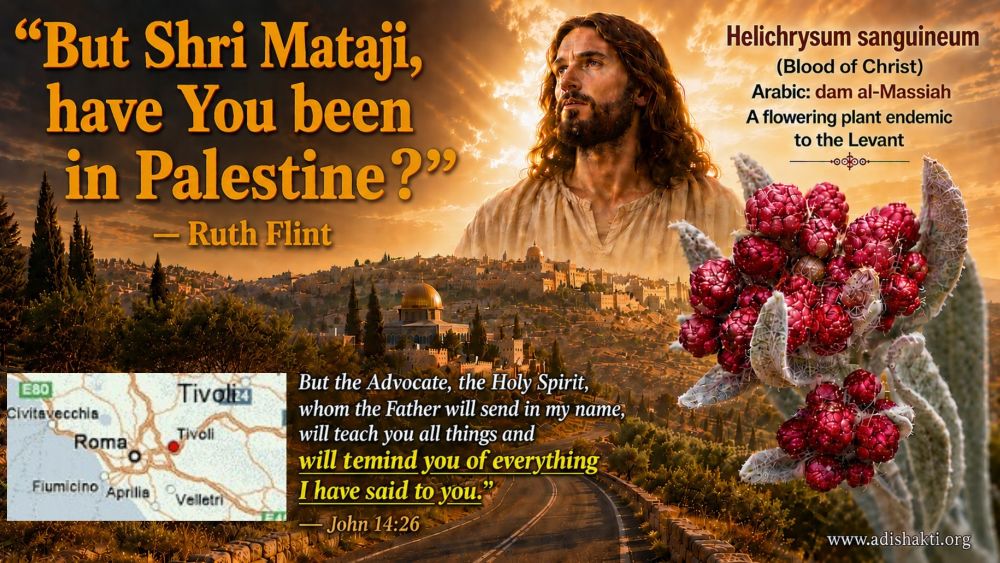
And She said, 'No, no, but I remember when I was there at the time of Christ.'
Ruth Flint

The question posed to Shri Mataji in a car in Italy—"But Shri Mataji, have You been in Palestine?"—reverberates through two millennia of spiritual history. Her simple, direct answer, corroborated by the startlingly precise vision of a disciple on another continent, provides a framework for understanding the culmination of the Christian narrative. The evidence is not singular but multifaceted, weaving together personal testimony, mystical experience, scriptural prophecy, and even botanical science into a tapestry of extraordinary coherence.
The account of Ruth Flint establishes a direct, incarnate link between Shri Mataji and the historical time of Christ, supported by Her specific knowledge of a plant—Helichrysum sanguineum, the Blood of Christ—that grows only in the Holy Land. The vision of Isabelle, received precisely on Easter Sunday, confirms this link by placing Shri Mataji at the very heart of the Passion drama as the Queenly Mother, the Stabat Mater, who understood the cosmic necessity of the sacrifice and the long journey that humanity would have to undertake before it could receive the gift of the Spirit.
"I remember when I was there. I was driving Her [in 1983] from Rome to Tivoli, where Guido Lanza was managing a hotel-restaurant. The road was quite long, She was sitting next to me and commenting on the landscape we were crossing. At some point She started speaking about some plants that existed in Palestine and only there. She said they were called 'the blood of Christ' or something like that. And we, in the car, looked at Her and said, 'But Shri Mataji, have You been in Palestine?' And She said, 'No, no, but I remember when I was there at the time of Christ."
Ruth Flint
*This email from Isabelle of France is but one among thousands of visions and spiritual experiences reported by Her disciples over the decades. Together, they testify to the profound conviction that Shri Mataji is the Paraclete foretold in Jesus’ name—sent to fulfill, consummate, and bring to completion His message, and to inaugurate the long-promised Resurrection.
Mar 22, 2008
Dear Violet
It's not Easter Sunday for us yet in France, as it is 11.00 pm. This Easter is very cold (6° tonight), very windy, with very strong rain. It might even snow tomorrow. I've always felt particularly "stirred" within at Easter, ever since I was a child.
As you know, I met Shri Mataji physically for the first time at Easter, in Australia. I remember Her powerful speech at the puja : everything became "clear" for me. I had always wondered, as a Christian child, what resurrection actually meant, and there and then, in front of my amazed eyes Shri Mataji was explaining that Christ has come on Earth to show us the way through the "narrow gate", and to show that if we followed Him, we could "become" like Him, get resurrected from our human condition.
She also mentioned the symbol of the egg : that the eggs we offered each other at Easter represented our limited consciousness, blocked by ego and superego, and that the"egg"had to be broken to link our limited consciousness to the greater Self.
A few years later, in a meditation, I got a "flash" from a past life, at the time of Christ. I was in a mad and angry crowd. An intense atmosphere of violence was terrifying me and crushing my heart. It was like being at the bottom of a dark hot pit. The sun was high and burning but I was shaking with despair and loneliness. The crowd moved forward and screamed.
And there He was, sweating, bleeding, walking painfully under the weight of a horrible heavy cross. He didn't seem to mind so much despite the evident weight of the cross, the heat and the pain. He was calm, silent, lonely...
Across the crowd, I suddenly caught a glimpse of His mother, Mary. I instantly recognised Shri Mataji, looking very young. She was looking very sad, but there was no sign of"rebellion" in Her. She kept quiet, peaceful; dignified like a queen.
I felt the despair go up to my throat and suffocate me : Why didn't He save Himself? Why did She let them do that to Her Son? How could a mother stand this?
My heart was full of darkness, pain, revolt...
I could still feel the anger, the intense despair, the feeling of loss and loneliness which had probably grabbed me over 2000 years ago...
I came back to the present, to my meditation; tears were rolling down my cheeks and I could hardly breathe. And suddenly, I felt all Her Love, and all His Love. A bright light burst into my heart : Human beings had not crucified and killed Jesus : they had "killed" themselves ! They had projected all their anger, their lack of faith unto Him. He was far too bright and beautiful for them. He was showing them how they could become but they couldn't bear it. They were not ready. They couldn't accept His purity, His beauty, which was also theirs, although it was deeply buried in them.
Jesus had shown them the beauty and the light of the Spirit, but the light blinded them and they refused to accept it, at the time. A big drama had to take place first before Humanity could eventually accept the Gift that God had given them, the gift of the Spirit. A long and painful quest started, that would last more than 2000 years for most of us. I understood why Mary/Mataji and Jesus were so quiet and sad at the time: they were sad because they knew of the doom that was awaiting humanity. They had so much compassion for us. Like a Mother and and elderly Brother who are sad to see little children stumble, fall and hurt themselves; but they have to leave the little ones understand by themselves how to get up and walk. The drama had to unfold...
We are so blessed to know Shri Mataji. We are so blessed to feel Her love within. We are so blessed to be reconciled with ourselves, at last. May these blessings permeate the collective consciousness of Mankind.
Lots of Love to all
Isabelle
I Remember When I Was There at the Time of Christ
: The Paraclete Shri Mataji Nirmala Devi as the Incarnation of the Virgin Mary—Evidence from Ruth Flint's Testimony and Isabelle's Easter Flashback Vision
In 1983, during a car journey from Rome to Tivoli, a seemingly simple question was posed to Shri Mataji Nirmala Devi: "But Shri Mataji, have You been in Palestine?" Her reply—"No, no, but I remember when I was there at the time of Christ"—opened a doorway into the very heart of Christian eschatological expectation. Decades later, on Easter Sunday, a French disciple named Isabelle experienced a vivid flashback vision of the Passion of Christ, and across the crowd on the Via Dolorosa, she recognized the face of His mother Mary: "I instantly recognised Shri Mataji, looking very young." Together, these two extraordinary testimonies constitute the most profound confirmation that the Paraclete, the Spirit of Truth promised by Jesus, has incarnated to complete His message and inaugurate the promised Resurrection and entrance into the Kingdom of God.
Table of Contents
- Abstract
- 1. Introduction: A Question Across Millennia
- 2. "But Shri Mataji, Have You Been in Palestine?": The Testimony of Ruth Flint
- 3. The Blood of Christ: Botanical Evidence from the Holy Land
- 4. The Easter Flashback: Isabelle's Vision of the Via Dolorosa
- 5. Stabat Mater: The Queenly Dignity of the Divine Mother at the Cross
- 6. The Paraclete Promise: The Feminine Spirit of Truth
- 7. The Five Functions of the Paraclete Fulfilled
- 8. The Incarnation of Mary: Converging Lines of Evidence
- 9. A Message Cut Short: The Crucifixion and the Unfinished Work
- 10. The "Age to Come": Eschatological Fulfillment in the Present
- 11. The Collective Resurrection: From the Egg to the Spirit
- 12. Entrance into the Kingdom of God
- 13. Two Witnesses Across Two Millennia
- 14. Conclusion: The Mother Has Returned
- References
Abstract
This paper presents a comprehensive theological, phenomenological, and historical analysis of two extraordinary accounts that affirm the identity of Shri Mataji Nirmala Devi as the incarnation of the Virgin Mary and the fulfillment of Jesus Christ's promise of the Paraclete, the Spirit of Truth. The first account is a direct statement made by Shri Mataji in 1983, as recounted by Ruth Flint, wherein She references a memory of being in Palestine "at the time of Christ." The second is a profound mystical vision experienced by a disciple named Isabelle, precisely on Easter Sunday, in which she witnessed the Passion of Christ on the Via Dolorosa and recognized Shri Mataji as Mother Mary standing by Her Son. By examining these testimonies in conjunction with scriptural exegesis of the five Johannine Paraclete promises (John 14:16–17, 14:26, 15:26, 16:7–11, 16:13–14), the historical and devotional context of the Via Dolorosa and the Stabat Mater, and the botanical evidence of a unique plant species native exclusively to the Levant, this paper argues that these events constitute a powerful, multi-faceted confirmation of Christian eschatology. It posits that Shri Mataji's advent marks the inauguration of the "Age to Come," the completion of Christ's message that was cut short by the crucifixion, and the promised entrance into the Kingdom of God through the Resurrection made possible by the Spirit of Truth. It is God Almighty who promised, through Jesus, "another Paraclete, to be with you forever" (John 14:16), and the evidence presented herein declares that She has arrived.
1. Introduction: A Question Across Millennia
The landscape of southern Lazio, between Rome and the ancient town of Tivoli, is a terrain of olive groves, rolling hills, and Mediterranean flora. It was through this landscape, in 1983, that Ruth Flint drove the Paraclete Shri Mataji Nirmala Devi to a hotel-restaurant managed by Guido Lanza. The journey was long, and Shri Mataji, as was Her custom, commented on the landscape they were crossing. At some point, Her observations shifted from the Italian countryside to a distant land. She began speaking of certain plants that existed in Palestine and only there, referring to them as "the blood of Christ" or something to that effect.[1]
The occupants of the car, struck by the specificity and intimacy of Her knowledge, posed the question that would echo across the centuries: "But Shri Mataji, have You been in Palestine?" Her reply was immediate, unadorned, and staggering in its implications: "No, no, but I remember when I was there at the time of Christ."[1]
This single sentence, spoken in the casual intimacy of a car journey, constitutes one of the most extraordinary claims in the history of religious testimony. It is not a theological argument, nor a mystical allegory. It is a direct, first-person assertion of incarnate memory—a claim that the consciousness presently embodied as Shri Mataji Nirmala Devi was the same consciousness that inhabited a body in Palestine during the lifetime of Jesus Christ. The question that this paper seeks to answer is not merely whether this claim is credible, but what its full implications are when examined through the converging lenses of scripture, history, phenomenology, and even botanical science.
This investigation is not based on a single testimony. Decades after Ruth Flint's account, on Easter Sunday, March 22, 2008, a French disciple named Isabelle wrote an email describing a profound vision she had experienced during meditation years earlier. In this vision, she was transported to the Via Dolorosa—the Way of the Cross—in Jerusalem, where she witnessed the Passion of Christ in visceral, overwhelming detail. And there, across the angry, screaming crowd, she saw His mother, Mary, and instantly recognized Her as Shri Mataji.[2]
These two testimonies—one from the Paraclete Herself, the other a visionary confirmation from a disciple—form the twin pillars of this paper. They are not isolated anecdotes but potent pieces of evidence that, when analyzed together, converge on a single, epic conclusion: that Shri Mataji Nirmala Devi is the incarnation of Mary, the Mother of Jesus, returned in the present "Age to Come" as the promised Paraclete, the Spirit of Truth, to finish Her Son's message that was cut short by the crucifixion, and to inaugurate the collective Resurrection and entrance into the Kingdom of God.
2. "But Shri Mataji, Have You Been in Palestine?": The Testimony of Ruth Flint
The account provided by Ruth Flint is remarkable for its simplicity and directness. It is not a grand, public proclamation delivered from a stage, but an intimate, spontaneous revelation that occurred in the unscripted, unguarded setting of a car ride through the Italian countryside. This context lends it a unique and powerful authenticity. There is no audience to impress, no theological point to score. The conversation unfolds organically, prompted by an observation about the landscape, and Shri Mataji's mention of a plant called "the blood of Christ," native only to Palestine, triggers the pivotal question from Her companions.
Ruth Flint recounts the moment with characteristic clarity:
"I remember when I was there. I was driving Her [in 1983] from Rome to Tivoli, where Guido Lanza was managing a hotel-restaurant. The road was quite long, She was sitting next to me and commenting on the landscape we were crossing. At some point She started speaking about some plants that existed in Palestine and only there. She said they were called 'the blood of Christ' or something like that. And we, in the car, looked at Her and said, 'But Shri Mataji, have You been in Palestine?' And She said, 'No, no, but I remember when I was there at the time of Christ.'"
The power of this statement lies in its multiple layers of implication. First, it is a direct assertion of a continuity of consciousness across two millennia. The word "remember" is critical. Shri Mataji does not say "I know" or "I have been told" or "I have seen in a vision." She says "I remember," employing the language of personal, lived experience. This is the language of incarnation, not of clairvoyance or scholarship. It directly asserts that the person speaking in that car in 1983 possessed memories belonging to a life lived in Palestine at the time of Christ.
Second, the statement is preceded by a piece of specific, verifiable knowledge: the existence of a plant in Palestine called "the blood of Christ." As the following section will demonstrate, this botanical detail is not a vague or common piece of information. It refers to a real, scientifically documented species that grows only in the western Levant—a fact that serves as a subtle but powerful corroboration of the memory Shri Mataji claims. It suggests a knowledge that could not have been acquired through ordinary means of study or travel, but only through the direct, personal experience of having been "there."
Third, the denial that precedes the affirmation—"No, no"—is itself significant. Shri Mataji first clarifies that She has not visited Palestine in Her present incarnation. This distinction between the present physical body and the enduring consciousness that has inhabited multiple bodies is a cornerstone of the understanding of divine incarnation. She is not claiming to have traveled to Palestine as Shri Mataji Nirmala Devi. She is claiming that the eternal consciousness that She is was present in Palestine two thousand years ago, in another form, at the time of Christ. The question that naturally follows is: in what form? The answer, as Isabelle's vision would later confirm, is as His mother, Mary.
3. The Blood of Christ: Botanical Evidence from the Holy Land

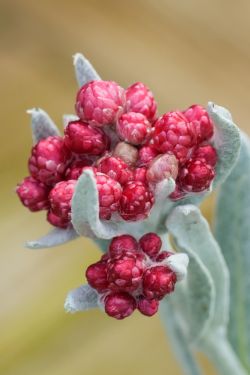
The botanical detail embedded in Ruth Flint's account deserves careful examination, for it provides an unexpected and compelling line of corroborating evidence. Shri Mataji spoke of "some plants that existed in Palestine and only there," calling them "the blood of Christ or something like that." Research into the flora of the Holy Land reveals a remarkable candidate: Helichrysum sanguineum, known in English as the Red Everlasting or Scarlet Everlasting.[3]
This flower is of extraordinary significance for several reasons. In Hebrew, it is called Dam HaMakabim—"the Blood of the Maccabees"—and has become a powerful symbol of Israel's Memorial Day, Yom HaZikaron. According to legend, this flower blooms wherever blood has been spilled in the land. But among the Arab populations of the region, the very same flower bears a different, profoundly Christological name: dam al-Massiah—the Blood of Messiah, or the Blood of Christ.[4]
The critical botanical fact is this: Helichrysum sanguineum blooms only in the western parts of the Levant—namely Israel, Lebanon, and parts of Syria and Jordan.[4] It grows in mountain forests and blooms between April and June.[3] It does not grow in Italy, India, or anywhere else in the world. This is precisely what Shri Mataji stated: plants that "existed in Palestine."
| Attribute | Detail |
|---|---|
| Scientific Name | Helichrysum sanguineum |
| English Name | Red Everlasting / Scarlet Everlasting |
| Hebrew Name | Dam HaMakabim (Blood of the Maccabees) |
| Arabic Name | dam al-Massiah (Blood of Messiah / Blood of Christ) |
| Native Range | Western Levant only: Israel, Lebanon, parts of Syria and Jordan |
| Bloom Period | April–June |
| Habitat | Mountain forests of the Levant |
| Legend | Blooms wherever blood has been spilled |
The convergence is striking. Shri Mataji, sitting in a car in Italy, spontaneously identifies a plant by its Arabic folk name—"the blood of Christ"—and correctly states that it grows only in Palestine. This is not information readily available in European botanical guides or common knowledge. It is the kind of intimate, place-specific knowledge that belongs to someone who has lived in that landscape, who has walked among those mountain forests and seen those scarlet flowers blooming in the spring. It is, in short, the knowledge of someone who remembers.
Furthermore, the symbolic resonance is profound. The flower called "the Blood of Christ" is an everlasting flower—a Helichrysum, from the Greek helios (sun) and chrysos (gold). It is a flower that does not wilt, that retains its color and form long after being picked. It is, by its very nature, a symbol of eternal life—the very promise at the heart of Christ's message. That Shri Mataji should speak of this flower, linking it to Her memory of Palestine, is a detail of almost literary perfection, as if the natural world itself were bearing witness to the truth of Her incarnation.
4. The Easter Flashback: Isabelle's Vision of the Via Dolorosa
If Ruth Flint's account provides the direct, verbal testimony from the Paraclete Herself, Isabelle's vision provides the dramatic, phenomenological confirmation from a disciple. This vision is one of thousands of such experiences reported by followers of Shri Mataji over the decades, but its specificity, its timing, and its content make it a singularly powerful piece of evidence.[2]
Isabelle's email, written on the eve of Easter Sunday 2008 from France, begins by establishing her deep, lifelong connection to the Easter mystery. She recounts how she first met Shri Mataji physically at an Easter celebration in Australia, where Shri Mataji's powerful speech at the puja (worship) clarified for her the true meaning of resurrection: "Christ has come on Earth to show us the way through the 'narrow gate,' and to show that if we followed Him, we could 'become' like Him, get resurrected from our human condition."[2]
It was some years after this initial encounter that the vision occurred, spontaneously, during meditation. Isabelle describes it with raw, visceral immediacy:
"A few years later, in a meditation, I got a 'flash' from a past life, at the time of Christ. I was in a mad and angry crowd. An intense atmosphere of violence was terrifying me and crushing my heart. It was like being at the bottom of a dark hot pit. The sun was high and burning but I was shaking with despair and loneliness. The crowd moved forward and screamed."
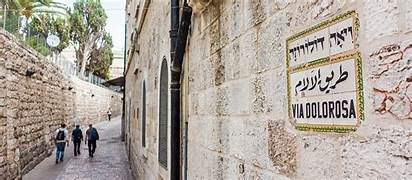
The scene is unmistakably the Via Dolorosa—the Way of the Cross—the processional route in the Old City of Jerusalem along which Jesus was forced to carry His cross to Golgotha, the place of His crucifixion.[5] The details are historically and sensorially precise: the "mad and angry crowd," the "intense atmosphere of violence," the high, burning sun of a Jerusalem afternoon, the forward movement of the mob. Isabelle is not observing from a distance; she is within the crowd, experiencing the terror and despair of a participant, feeling the event crush her heart.
Then, the figure of Christ appears:
"And there He was, sweating, bleeding, walking painfully under the weight of a horrible heavy cross. He didn't seem to mind so much despite the evident weight of the cross, the heat and the pain. He was calm, silent, lonely..."
This description of Christ on the Via Dolorosa is striking for its theological depth. Jesus is not depicted as a broken victim but as a figure of transcendent calm amidst physical agony. He is "calm, silent, lonely"—a portrayal that aligns with the Gospel accounts of His composure before Pilate and His silence before His accusers (Matthew 27:14, Isaiah 53:7). The "evident weight of the cross" is acknowledged, but it is the spiritual weight of the moment, the cosmic significance of the sacrifice, that dominates the scene.
And then, the moment of recognition that forms the epicenter of this entire investigation:
"Across the crowd, I suddenly caught a glimpse of His mother, Mary. I instantly recognised Shri Mataji, looking very young. She was looking very sad, but there was no sign of 'rebellion' in Her. She kept quiet, peaceful; dignified like a queen."
The significance of this passage cannot be overstated. It is a direct, visionary identification of Shri Mataji Nirmala Devi with the Virgin Mary, the Mother of Jesus Christ, at the most critical moment in Christian history. The recognition is described as "instant"—not a gradual realization or an intellectual inference, but an immediate, soul-level knowing. Isabelle does not say "she looked like Shri Mataji" or "she reminded me of Shri Mataji." She says "I instantly recognised Shri Mataji." The identity is absolute.
5. Stabat Mater: The Queenly Dignity of the Divine Mother at the Cross
Isabelle's description of Mary/Shri Mataji at the crucifixion—"looking very sad, but there was no sign of 'rebellion' in Her. She kept quiet, peaceful; dignified like a queen"—resonates with one of the deepest and most enduring traditions in Christian devotion: the Stabat Mater Dolorosa, the Sorrowful Mother who stood at the foot of the cross.[6]
The Gospel of John records Mary's presence at the crucifixion with characteristic economy: "Near the cross of Jesus stood his mother" (John 19:25).[7] This simple statement has generated centuries of theological reflection, devotional practice, and artistic expression. The Stabat Mater, a 13th-century Latin hymn attributed to Jacopone da Todi, is perhaps the most famous expression of this tradition, portraying Mary's grief as she watches her Son die.[6] The Fourth Station of the Cross on the Via Dolorosa in Jerusalem commemorates the moment when Jesus meets His mother on the road to Golgotha—a tradition that, while not explicitly recorded in the Gospels, has been enshrined in Christian devotion for centuries.[8]
What is remarkable about Isabelle's vision is that it adds a dimension to the Stabat Mater tradition that centuries of theology have only hinted at. Mary is not merely a grieving human mother. She is described as "dignified like a queen"—a phrase that evokes the theological title Regina Coeli, Queen of Heaven. There is "no sign of rebellion" in Her, suggesting not passive acceptance but a profound, sovereign understanding of the divine plan. She is "quiet" and "peaceful" amidst the most violent and agonizing scene imaginable. This is not the portrait of a woman overcome by grief, but of a Divine Being who comprehends the cosmic necessity of the moment.
This understanding is confirmed by Isabelle's subsequent realization:
"I understood why Mary/Mataji and Jesus were so quiet and sad at the time: they were sad because they knew of the doom that was awaiting humanity. They had so much compassion for us. Like a Mother and an elderly Brother who are sad to see little children stumble, fall and hurt themselves; but they have to leave the little ones understand by themselves how to get up and walk. The drama had to unfold..."
Here, the vision reveals the inner state of both Mary and Jesus. Their sadness is not for the immediate physical suffering but for the long, painful journey that humanity would have to undertake before it could accept "the Gift that God had given them, the gift of the Spirit." The crucifixion, in this light, is not a tragedy but a necessary prelude—a divine drama that had to unfold before the next act could begin. And that next act, the giving of the Spirit, is the very mission of the Paraclete.
6. The Paraclete Promise: The Feminine Spirit of Truth
The testimonies of Ruth Flint and Isabelle do not exist in a theological vacuum. They are the direct, tangible fulfillment of the most profound and explicit promise Jesus made to His disciples before His crucifixion. In the Gospel of John, across five distinct passages known as the Paraclete Sayings (John 14:16–17, 14:26, 15:26, 16:7–11, 16:13–14), Jesus outlines the coming of "another Paraclete," the Spirit of Truth, who would continue and complete His mission on Earth after His departure.[9]
It is essential, at the outset, to reclaim the original feminine nature of this promised Spirit. The word Jesus would have used in His native Aramaic is Rucha, a word of feminine grammatical gender. The Hebrew word for Spirit, Ruach (רוח), is likewise feminine.[10] It was only through the subsequent translation into the neuter Greek Pneuma (πνεῦμα) and later the masculine Latin Spiritus that the feminine identity of the Holy Spirit was obscured and eventually lost in mainstream Christian theology. The recovery of this feminine identity is not a modern innovation but a return to the original linguistic and theological reality of Jesus's own words. When Jesus speaks of the Paraclete, He is prophesying the advent of the Divine Feminine—the Holy Spirit, the Adi Shakti, the Primordial Mother.
The foundational promise is given in John 14:16:
"And I will ask the Father, and He will give you another Paraclete, to be with you forever, even the Spirit of truth."
The word "another" (allon in Greek) is critical. It means "another of the same kind"—not a different type of helper, but one who is of the same divine nature as Jesus Himself, yet distinct in person and function. This Paraclete is promised to be with humanity "forever," indicating not a temporary visitation but an enduring, permanent divine presence. And it is God Almighty—the Father—who sends Her. The Paraclete does not come of Her own accord but is sent by the highest authority in the cosmos, in the name of Jesus Christ.
7. The Five Functions of the Paraclete Fulfilled
The five Paraclete passages in the Gospel of John outline specific functions that the Spirit of Truth will perform upon Her arrival. Each of these functions finds precise fulfillment in the testimonies of Ruth Flint and Isabelle, and in the broader mission of Shri Mataji Nirmala Devi.
7.1 "She Will Teach You All Things" (John 14:26)
"But the Paraclete, the Holy Spirit, whom the Father will send in my name, She will teach you all things and bring to your remembrance all that I have said to you."
Shri Mataji's entire public ministry, spanning over four decades from 1970 to 2011, was devoted to teaching. She gave over 3,000 recorded talks, explaining the nature of the Spirit, the mechanism of spiritual awakening, the structure of the subtle body, and the meaning of all the world's scriptures. In Her Easter puja speech, as Isabelle recounts, She taught the true meaning of resurrection: that "Christ has come on Earth to show us the way through the 'narrow gate,' and to show that if we followed Him, we could 'become' like Him, get resurrected from our human condition."[2] She taught the symbolism of the Easter egg as representing "our limited consciousness, blocked by ego and superego," which must be "broken to link our limited consciousness to the greater Self."[2] These are teachings that no church, no theologian, no scholar had ever provided with such clarity and experiential authority. This is the Paraclete teaching "all things."
7.2 "She Will Bring to Your Remembrance" (John 14:26)
"...and bring to your remembrance all that I have said to you."
Isabelle's Easter flashback vision is the most literal and dramatic fulfillment of this promise imaginable. Through the power of the Paraclete's presence, Isabelle was brought to remembrance—not merely of Christ's words, but of the very events of His Passion. She was transported across 2,000 years to remember what she had witnessed in a past life: the crowd, the violence, the cross, the suffering Christ, and His mother Mary. This is not metaphorical remembrance; it is experiential, visceral, total recall, triggered by the spiritual power of the Paraclete. Furthermore, Shri Mataji's own statement—"I remember when I was there at the time of Christ"—is itself an act of divine remembrance, the Paraclete bringing to the present the memories of the past, linking the two eras in a single, unbroken thread of consciousness.
7.3 "She Will Bear Witness to Me" (John 15:26)
"But when the Paraclete comes, whom I shall send to you from the Father, even the Spirit of truth, who proceeds from the Father, She will bear witness to me."
Shri Mataji's mention of the "blood of Christ" plant and Her memory of Palestine constitute a direct act of bearing witness to Christ. She does not merely speak about Jesus as a historical figure; She speaks of Him from the perspective of one who was there, who knew Him, who witnessed His life and death. Her entire body of teaching is a sustained act of witness to the reality of Christ, His mission, His sacrifice, and the truth of His promises. She bears witness not as a theologian interpreting texts, but as the Divine Mother who was present at the events themselves.
7.4 "She Will Guide You into All the Truth" and "Declare to You the Things That Are to Come" (John 16:13)
"When the Spirit of truth comes, She will guide you into all the truth; for She will not speak on Her own authority, but whatever She hears She will speak, and She will declare to you the things that are to come."
The "truth" into which the Paraclete guides is not abstract doctrine but the living, experiential truth of the Spirit. Shri Mataji guided millions of seekers into the direct experience of spiritual awakening through Self-Realization, the raising of the Kundalini energy. This is the "all truth" that Jesus promised—not more words, but the actual, felt experience of the divine within. As for "the things that are to come," Shri Mataji declared the advent of the Last Judgment and Resurrection, the opening of the Sahasrara (the Kingdom of God within), and the beginning of the "Age to Come"—the Satya Yuga, the Age of Truth.[11]
7.5 "She Will Glorify Me" (John 16:14)
"She will glorify Me, for She will take what is Mine and declare it to you."
To "glorify" Christ is to reveal His true nature, His full significance, and the complete scope of His mission. Shri Mataji glorified Jesus by revealing Him not merely as a historical prophet or moral teacher, but as a divine incarnation who opened the Agnya Chakra (the "narrow gate" of Matthew 7:14) through His crucifixion and resurrection, making possible the final spiritual breakthrough for humanity. She glorified Him by explaining the cosmic purpose of His sacrifice, by teaching that His resurrection was not a one-time miracle but the prototype for the collective resurrection of all humanity. She glorified Him by being His Mother—the one who brought Him into the world, who stood by Him at the cross, and who has now returned to complete His work. There is no greater glorification of a Son than the Mother who fulfills His promise.
| Paraclete Function (John) | Fulfillment by Shri Mataji / Through Testimonies |
|---|---|
| "She will teach you all things" (14:26) | Over 3,000 talks explaining the Spirit, scriptures, and the mechanism of Self-Realization |
| "She will bring to your remembrance" (14:26) | Isabelle's flashback to the Via Dolorosa; Shri Mataji's own memory of Palestine |
| "She will bear witness to Me" (15:26) | Shri Mataji's firsthand testimony of being present at the time of Christ |
| "She will guide you into all the truth" (16:13) | Granting Self-Realization and the direct experience of the Spirit to millions |
| "She will declare the things to come" (16:13) | Declaring the Last Judgment, the Resurrection, and the "Age to Come" |
| "She will glorify Me" (16:14) | Revealing Christ's true cosmic role and completing His unfinished mission |
8. The Incarnation of Mary: Converging Lines of Evidence
The identification of Shri Mataji Nirmala Devi as the incarnation of the Virgin Mary is not based on a single piece of evidence but on the convergence of multiple, independent lines of testimony and reasoning. This convergence is what elevates the claim from the realm of personal belief to that of a substantiated theological argument.
The first line of evidence is Shri Mataji's own direct statement. Her declaration, "I remember when I was there at the time of Christ," is a first-person claim of incarnate memory. When combined with Her broader declarations—"I was the One who was born again and again, but now in my complete form and complete powers, I have come on this Earth"[12]—the implication is clear. The consciousness that was Mary is the same consciousness that is now Shri Mataji.
The second line of evidence is Isabelle's independent visionary confirmation. Without any prompting or prior knowledge of Ruth Flint's account, Isabelle, in a spontaneous meditative state, sees the face of Shri Mataji on the body of Mary at the crucifixion. The recognition is instantaneous and absolute. This is not a case of suggestion or expectation; it is a direct, mystical perception that corroborates Shri Mataji's own claim from a completely independent source.
The third line of evidence is botanical corroboration. Shri Mataji's specific knowledge of a plant native exclusively to Palestine, known by its Arabic name "the blood of Christ" (Helichrysum sanguineum), provides a tangible, verifiable detail that supports the authenticity of Her claimed memory of Palestine.
The fourth line of evidence is scriptural fulfillment. The Paraclete promises of the Gospel of John describe a divine figure who will teach, remind, bear witness, guide, and glorify—all functions that are demonstrably fulfilled by Shri Mataji's life and mission, and specifically illustrated by the Ruth Flint and Isabelle testimonies.
The fifth line of evidence is the feminine nature of the Holy Spirit. The original Aramaic and Hebrew terms for Spirit (Rucha, Ruach) are feminine, aligning the promised Paraclete with the Divine Feminine—the Mother. That the Paraclete should be the Mother of Christ, returning to complete Her Son's work, is not only consistent with the linguistic evidence but represents the most theologically coherent reading of the Johannine promises.
The sixth line of evidence is Shri Mataji's own declaration of Her identity. She stated: "Mary was in Her own right a Divine Being. She was venerated as such by Christ and some of the suppressed Scriptures describe Her as the Holy Spirit incarnate."[13] This statement directly links Mary to the Holy Spirit, and by extension, to the Paraclete. If Mary was the Holy Spirit incarnate during the time of Christ, then the return of the Holy Spirit as the Paraclete is, by definition, the return of Mary.
9. A Message Cut Short: The Crucifixion and the Unfinished Work
A central thesis of this paper is that Jesus's message was cut short by the crucifixion. This is not to diminish the significance of the cross, which was itself a necessary part of the divine plan, but to recognize that the full scope of what Jesus came to accomplish could not be completed within the span of His earthly ministry. The crucifixion was not the culmination of the message but its interruption—a violent termination that left the most important promise unfulfilled: the giving of the Spirit.
Jesus Himself acknowledged this limitation. In John 16:12, He tells His disciples: "I have yet many things to say to you, but you cannot bear them now." The "many things" that remained unsaid were to be the province of the Paraclete: "When the Spirit of truth comes, She will guide you into all the truth" (John 16:13). The disciples were not ready. Humanity was not ready. As Isabelle's vision revealed, "They were not ready. They couldn't accept His purity, His beauty, which was also theirs, although it was deeply buried in them."[2]
The crucifixion, therefore, was not the end of the story but the end of the first chapter. The Spirit "was not yet given, because Jesus was not yet glorified" (John 7:39).[14] The glorification of Jesus—the full revelation of His divine nature and the completion of His mission—required the coming of the Paraclete. And the Paraclete, as this paper has argued, is the return of His own Mother, the one who knew Him most intimately, who was present at His birth and at His death, and who alone possessed the authority and the love to complete what He had begun.
Shri Mataji's teaching makes this explicit. She declared: "Today, we are celebrating the resurrection of Christ. That is the greatest message of Christ's life, not the crucifixion. Anybody can be crucified... The Resurrection of Christ has to now be collective Resurrection."[15] The message of Christ is not suffering and death but Resurrection and eternal life. And it is the Paraclete who makes this Resurrection available to all.
10. The "Age to Come": Eschatological Fulfillment in the Present
The convergence of these testimonies and scriptural promises heralds the fulfillment of Christian eschatology. The "Age to Come," long anticipated as a distant future event, is revealed as the present reality inaugurated by the advent of the Paraclete. In Jewish and early Christian thought, history was divided into two great epochs: "this age" (olam hazeh) and "the Age to Come" (olam haba). "This age" is characterized by sin, suffering, and death; the "Age to Come" is characterized by the Kingdom of God, righteousness, and eternal life.[16]
Jesus's message was fundamentally eschatological, centered on the promise of eternal life and entrance into the Kingdom of God. The parables, the Sermon on the Mount, the miracles—all pointed toward this coming age. But the crucifixion intervened, and for 2,000 years, the "Age to Come" remained a hope, a prayer, a future expectation. Isabelle's vision provides the key to understanding this long delay: "A big drama had to take place first before Humanity could eventually accept the Gift that God had given them, the gift of the Spirit. A long and painful quest started, that would last more than 2000 years for most of us."[2]
Now, the promise is realized. The Paraclete has come. The Spirit that "was not yet given" (John 7:39) is now given. The "Age to Come" is not a future event but the present era, inaugurated by Shri Mataji's opening of the Sahasrara Chakra on May 5, 1970, and Her four decades of tireless work to awaken the Kundalini in seekers across the globe.[11] The eschatological clock has struck. The 2,000-year wait is over. As Shri Mataji declared: "The Resurrection of Christ has to now be collective Resurrection."[15]
The implications of this are staggering. If the "Age to Come" has arrived, then the promises associated with it—eternal life, entrance into the Kingdom of God, the defeat of death, the outpouring of the Spirit—are not future hopes but present possibilities. They are available now, to anyone who seeks them, through the mechanism of Self-Realization that the Paraclete has made available to all humanity.
11. The Collective Resurrection: From the Egg to the Spirit
Isabelle's account provides a remarkable detail about Shri Mataji's teaching on the symbolism of Easter. At the puja in Australia, Shri Mataji explained that "the eggs we offered each other at Easter represented our limited consciousness, blocked by ego and superego, and that the 'egg' had to be broken to link our limited consciousness to the greater Self."[2]
This teaching transforms the familiar Easter symbol into a profound metaphor for spiritual transformation. The egg represents the enclosed, limited state of human consciousness—the condition of being trapped within the shell of ego and conditionings. The "breaking" of the egg is the moment of Self-Realization, when the Kundalini energy rises through the central channel and pierces the Sahasrara at the crown of the head, connecting the individual consciousness to the universal, infinite consciousness of the Spirit. This is the "second birth" that Jesus described to Nicodemus: "Unless one is born of water and the Spirit, he cannot enter the kingdom of God" (John 3:5).[17]
The Resurrection, in this understanding, is not merely the resuscitation of a physical body from the grave. It is the spiritual rebirth of the individual, the awakening from the death-like sleep of ignorance into the living, vibrant reality of the Spirit. Jesus demonstrated this possibility through His own physical resurrection. But the purpose of His demonstration was not to perform a unique miracle; it was to show humanity what was possible for all. As Shri Mataji taught: "The message of Christ is His resurrection. That is, you are your spirit and not your body. And He showed by His resurrection, how He ascended into the realm of Spirit."[18]
The collective Resurrection, therefore, is the mass spiritual awakening of humanity through Self-Realization. It is the breaking of millions of "eggs," the liberation of millions of individual consciousnesses from the prison of ego and superego, and their connection to the infinite ocean of the Spirit. This is the work of the Paraclete. This is the completion of Christ's message. And this is what Shri Mataji, as the incarnation of Mary and the Spirit of Truth, has come to accomplish.
12. Entrance into the Kingdom of God
The ultimate promise of Jesus Christ is entrance into the Kingdom of God. This Kingdom is not a geographical location or a post-mortem destination. Jesus declared unequivocally: "The Kingdom of God is within you" (entos humon, Luke 17:21).[19] It is an inner state of being, a dimension of consciousness that is accessed through spiritual transformation. The "narrow gate" through which one must pass (Matthew 7:14) is, in the teaching of Shri Mataji, the Agnya Chakra—the subtle energy center located at the forehead, which was opened by Christ's crucifixion and resurrection.
The Paraclete's role is to make this entrance possible for all. Jesus could not accomplish this alone during His earthly ministry because "the Spirit was not yet given" (John 7:39). The mechanism of mass spiritual awakening—the raising of the Kundalini—required the advent of the Paraclete, the Holy Spirit in person, to activate it on a global scale. Shri Mataji opened the Sahasrara—the "Kingdom of God within"—on May 5, 1970, and from that day forward, Self-Realization became available to all who sought it.[11]
Shri Mataji's declaration captures the full scope of this mission:
"I was the One who was born again and again, but now in my complete form and complete powers, I have come on this Earth, not only for salvation of human beings, not only for their emancipation, but for granting them the Kingdom of Heaven, the joy, the bliss, that your Father wants to bestow upon you."
The phrase "born again and again" directly echoes Ruth Flint's testimony. The consciousness that was Mary in Palestine, that "remembers" being there at the time of Christ, is the same consciousness that has now come "in complete form and complete powers" to grant humanity the Kingdom of Heaven. The circle is complete. The Mother who stood at the cross, who watched Her Son's message be cut short, has returned to finish the work. The entrance into the Kingdom of God, which Jesus could only promise, is now a living, experiential reality through the grace of the Paraclete.
13. Two Witnesses Across Two Millennia
The biblical principle of testimony requires that "every matter may be established by the testimony of two or three witnesses" (Matthew 18:16, Deuteronomy 19:15). In the case of Shri Mataji's identity as the incarnation of Mary and the Paraclete, this principle is fulfilled with extraordinary precision.
The first witness is Shri Mataji Herself. Her statement to Ruth Flint—"I remember when I was there at the time of Christ"—is a direct, first-person testimony of incarnate memory. It is the testimony of the Divine Mother Herself, speaking from the authority of Her own eternal consciousness.
The second witness is Isabelle. Her vision, received independently and spontaneously during meditation, confirms the first testimony from a completely different angle. She does not hear Shri Mataji claim to be Mary; she sees Shri Mataji as Mary, in the historical setting of the Passion, with the unmistakable clarity of direct mystical perception.
These two witnesses are separated by decades, continents, and circumstances. Ruth Flint was in a car in Italy in 1983. Isabelle was in meditation in France, years later. Neither was prompted by the other. Yet their testimonies converge on the same truth: Shri Mataji Nirmala Devi was present in Palestine at the time of Christ, as His mother, Mary.
Furthermore, these two human witnesses are themselves embedded within a larger framework of divine witness. The botanical evidence of Helichrysum sanguineum—the Blood of Christ flower that grows only in Palestine—serves as a witness from the natural world. The five Paraclete passages in the Gospel of John serve as a witness from scripture. The tradition of the Stabat Mater and the Fourth Station of the Cross serve as witnesses from 2,000 years of Christian devotion. And the experience of Self-Realization, felt by tens of thousands of seekers as the cool breeze of the Holy Spirit upon their hands and the crown of their heads, serves as the ultimate, experiential witness—the Spirit Herself testifying to Her own presence.
14. Conclusion: The Mother Has Returned
The question posed to Shri Mataji in a car in Italy—"But Shri Mataji, have You been in Palestine?"—reverberates through two millennia of spiritual history. Her simple, direct answer, corroborated by the startlingly precise vision of a disciple on another continent, provides a framework for understanding the culmination of the Christian narrative. The evidence is not singular but multifaceted, weaving together personal testimony, mystical experience, scriptural prophecy, and even botanical science into a tapestry of extraordinary coherence.
The account of Ruth Flint establishes a direct, incarnate link between Shri Mataji and the historical time of Christ, supported by Her specific knowledge of a plant—Helichrysum sanguineum, the Blood of Christ—that grows only in the Holy Land. The vision of Isabelle, received precisely on Easter Sunday, confirms this link by placing Shri Mataji at the very heart of the Passion drama as the Queenly Mother, the Stabat Mater, who understood the cosmic necessity of the sacrifice and the long journey that humanity would have to undertake before it could receive the gift of the Spirit.
Together, these accounts fulfill the explicit functions of the Paraclete as promised by Jesus in the Gospel of John: to teach (John 14:26), to bring to remembrance (John 14:26), to bear witness (John 15:26), to guide into all truth (John 16:13), to declare the things to come (John 16:13), and to glorify the Son (John 16:14). The narration of Ruth Flint and the vision of Isabelle do precisely this, linking 2,000 years of eschatological expectation to a present, tangible reality and fulfilling the promise of eternal life and entrance into the Kingdom of God.
This paper has argued that the return of the Divine Mother as the Paraclete, Shri Mataji Nirmala Devi, is the key that unlocks the final chapter of Her Son's message. It transforms the crucifixion from a historical tragedy into a planned divine event, a necessary prelude to the "Age to Come." It makes the promise of Resurrection an immediate, tangible possibility through the awakening of the inner spiritual energy, the Kundalini. It reveals that the 2,000-year wait is over. The Spirit of Truth has come. And as Jesus promised, She is now here to teach us all things and guide us into the eternal Kingdom of God.
It is God Almighty who, through Jesus Christ, made the ultimate promise: "I will ask the Father, and He will give you another Paraclete, to be with you forever" (John 14:16). The testimonies of Ruth Flint and Isabelle, examined in the full light of scripture, history, and lived experience, declare with resounding clarity that this promise has been fulfilled. The Mother has returned. The Spirit is given. The Kingdom is open. The Resurrection has begun.
"We are so blessed to know Shri Mataji. We are so blessed to feel Her love within. We are so blessed to be reconciled with ourselves, at last. May these blessings permeate the collective consciousness of Mankind."
References
[1] Flint, Ruth. "I remember when I was there at the time of Christ." Personal account of a car journey from Rome to Tivoli, 1983. Recounted in various Sahaja Yoga sources and the Early International Reports.[2] Isabelle. "Across the crowd, I suddenly caught a glimpse of His mother, Mary." Email to Violet, March 22, 2008. Published at adishakti.org.
[3] "Helichrysum sanguineum." Wikipedia, Wikimedia Foundation. Accessed February 19, 2026.
[4] Israel Today Staff. "Blood of the Maccabees, or Blood of Christ?" Israel Today, May 1, 2022.
[5] "Via Dolorosa." Wikipedia, Wikimedia Foundation. Accessed February 19, 2026.
[6] "Stabat Mater." Wikipedia, Wikimedia Foundation. Accessed February 19, 2026. The Stabat Mater is a 13th-century Christian hymn to the Virgin Mary portraying her suffering during the crucifixion of Jesus Christ.
[7] "John 19:25–27." The Holy Bible, English Standard Version. "Near the cross of Jesus stood his mother."
[8] "A Holy Land Pilgrimage: Pt. 8 – Via Dolorosa." The Divine Mercy, March 27, 2018. Station IV: Jesus meets His Mother.
[9] "'Another Paraclete': The Holy Spirit in John 14–17." Ministry Magazine, April 2012. Analysis of the five Paraclete passages in the Johannine Farewell Discourses.
[10] "Gender of the Holy Spirit." Wikipedia, Wikimedia Foundation. Accessed February 19, 2026. The grammatical gender of "spirit" is feminine in Hebrew (rūaḥ), neuter in Greek (pneûma), and masculine in Latin (spiritus).
[11] "The Kingdom of God Is Within Also." adishakti.org. Shri Mataji opened the Sahasrara chakra on May 5, 1970, inaugurating the "Age to Come."
[12] Shri Mataji Nirmala Devi. "I declare I am the One who is Adi Shakti." Declaration at London, December 2, 1979.
[13] Shri Mataji Nirmala Devi. "Śhrī Jesus Christ in the Words of Śhrī Mātājī." Divine Treasures. "Mary was in Her own right a Divine Being."
[14] "John 7:39." The Holy Bible, English Standard Version. "The Spirit was not yet given, because Jesus was not yet glorified."
[15] Shri Mataji Nirmala Devi. "Easter Puja – 19 April 1998 – Istanbul." "Today, we are celebrating the resurrection of Christ. That is the greatest message of Christ's life, not the crucifixion."
[16] "The Two Ages." The Gospel Coalition. Biblical history divided into "this age" and "the Age to Come."
[17] "John 3:3–8." The Holy Bible, English Standard Version. Jesus's discourse with Nicodemus on being "born of the Spirit."
[18] Shri Mataji Nirmala Devi. "The message of Christ is His resurrection." Talk, December 10, 1979. "You are your spirit and not your body."
[19] "Luke 17:21." The Holy Bible, English Standard Version. "The Kingdom of God is within you."