“Oṃ Tvam Eva Sākṣāt”: A Textual and Theological Reading of the Opening-Page Mantra in Shri Adi Shakti: The Kingdom of God
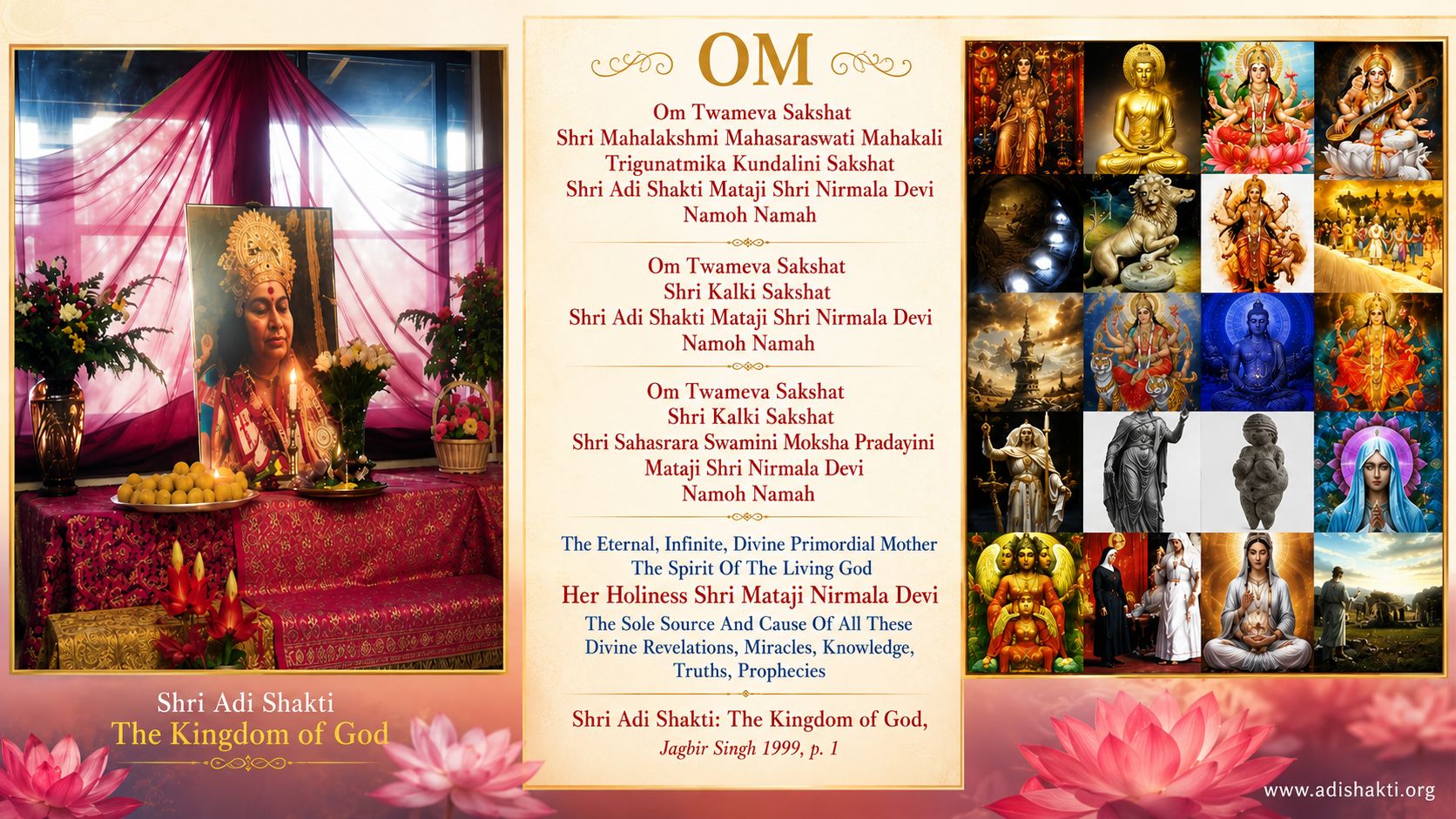
Triadic Śakti, Kuṇḍalinī, Kalki, and Sahasrāra in a Sahaja Yoga Liturgical Formula
Abstract
This paper reads the opening page of Shri Adi Shakti: The Kingdom of God as a compact ritual theology. The three Sanskrit invocations do more than introduce a compilation: they identify one addressee through a chain of divine names and functions. The sequence moves from the totality of the threefold Goddess and triguṇātmikā Kuṇḍalinī, through the eschatological title Kalki, to the sovereignty of the Sahasrāra and the bestowal of mokṣa. The concluding English titles then amplify this movement into an all-encompassing claim of revelation. A near-identical set of formulas in the later Nirmala Vidya mantra book supplies an important internal textual comparator, while scholarly and lexical sources permit a disciplined interpretation of the formula’s language. The analysis preserves a necessary distinction between what the mantra asserts, how Sahaja Yoga sources interpret it, and what historical evidence independently establishes.
1. Text, Scope, and Method
The textual object of this study is the transcription identified in the commission as page 1 of Jagbir Singh’s 1999 manuscript, Shri Adi Shakti: The Kingdom of God. It begins with Oṃ and then presents three successive invocations, followed by English honorific language concerning the Primordial Mother, the Spirit of the Living God, and the source of revelation. The supplied Adishakti.org page situates the manuscript within a wider devotional account of its compilation and reception. [1] The analytical task is not to decide the ontological truth of the identities named in the page, but to establish how the sequence makes those identities meaningful within a ritual and theological discourse.
This is a study in textual theology and the sociology of religious language. It asks what happens when a modern devotional formula combines classical Goddess names, yogic vocabulary, an eschatological figure, and the name of a contemporary religious teacher. Judith Coney’s study of Sahaja Yoga is especially useful at this level: it describes the movement as a modern religious community whose teachings, practices, and bodily experiences are learned and interpreted socially. [4] That framework makes it possible to take the invocation seriously as lived religious speech while withholding a judgment about whether its theological assertions can be externally verified.
2. Documentary Provenance and Textual Witness
The requested contextual account states that Shri Mataji read the book after Sahaja Yogi Manoj Kumar presented it in Cabella, Italy, in 1999. That account is retained here as the commissioning provenance. It must, however, be distinguished from what the accessible source page independently documents. The page reproduces an email dated April 10, 2000, in which Manoj Kumar reports presenting the book to Shri Mataji while in India, says that she reviewed it for almost half an hour, and relays the instruction, “Tell Jagbir now to leave it to Her.” [2] The email is significant evidence for a later reported India presentation; it is not evidence for the specified 1999 Cabella event. A historical reading should neither erase the latter tradition nor conflate it with the former document.
A second textual witness materially strengthens the analysis of the actual mantra. Under its Sahasrāra section, the Sahaja World Library’s Nirmala Vidya: Sahaja Yoga Mantra Book prints the same three invocatory sequences in near-identical order and gives English paraphrases. It uses Śrī Nirmalā Devyai namo namah, calls the first formula the “essence of the three qualities, the Kundalini, the primordial Shakti,” and translates the last formula as an address to the one “who gives spiritual liberation.” [3] The comparison does not establish an editorial genealogy between the 1999 manuscript and a 2014 library file. It does establish that the formula belongs to a recognizable Sahaja Yoga liturgical repertoire.
| Unit | Principal titles | Liturgical movement |
|---|---|---|
| First invocation | Mahālakṣmī, Mahāsarasvatī, Mahākālī, triguṇātmikā Kuṇḍalinī, Ādi Śakti | Comprehensive Goddess identity and cosmic-energetic totality |
| Second invocation | Kalki, Ādi Śakti | Eschatological intensification of the primary identification |
| Third invocation | Kalki, Sahasrāra-Svāminī, Mokṣa-Pradāyinī | Crown-centre sovereignty and liberation |
| English coda | Primordial Mother, Spirit of the Living God, source of revelations | Universalizing and absolutizing commentary on the Sanskrit sequence |
3. The Ritual Grammar of Oṃ Tvam Eva Sākṣāt
The repeated beginning, Oṃ tvam eva sākṣāt, is best heard as a formula of direct recognition. Tvam is the second-person singular pronoun, eva is emphatic, and sākṣāt commonly carries the sense of “visibly, manifestly, directly,” or “in person.” The formula therefore does not offer a detached proposition about a deity; it addresses the addressee as directly present under each ensuing name. The historical lexicon used here is a guide to possible lexical range rather than a substitute for a full critical edition of the mantra. [12]
This directness matters. The formula repeatedly declares, in effect, “You Yourself are manifest as …,” and then returns to namo namaḥ, a doubled salutation. The verbal rhythm joins identification to surrender. In the official mantra book, the book’s own English rendering makes this performative quality explicit by ending each formula, “we surrender to You.” The manuscript’s use of “Namoh Namah” and the later book’s namo namah should be treated as orthographic or transliteration variants in the available witnesses, not as evidence of a doctrinal difference.
| Formula fragment | Working functional gloss | Interpretive importance |
|---|---|---|
| Oṃ | Invocatory sacred syllable | Marks a ritualized entry rather than ordinary exposition. |
| tvam eva sākṣāt | “You indeed are directly/manifestly …” | Constructs the addressee as present in the named form. |
| triguṇātmikā | “Whose nature comprises the three guṇas” | Names totality through a triadic cosmological idiom. |
| Sahasrāra-svāminī | Lady, mistress, or sovereign of the Sahasrāra | Links authority to the crown-centre of the subtle body. |
| Mokṣa-pradāyinī | She who gives liberation | Completes the sequence with a soteriological function. |
4. The Threefold Goddess: Mahālakṣmī, Mahāsarasvatī, and Mahākālī
The first invocation begins by accumulating the three names Mahālakṣmī, Mahāsarasvatī, and Mahākālī. Its grammar does not parcel them out as separate addressees. Instead, it declares a single “You” to be directly manifest as all three. The effect is synthetic: multiple divine modalities are gathered into one devotional referent. This is why the line should not be reduced too quickly to a simple creator–preserver–destroyer diagram, even though such explanatory shortcuts are widespread in popular religious description.
The more precise context is the language of the three guṇas. In a study of the Chandi Mangal and Devi Māhātmya, Saumitra Chakravarty describes the Goddess as containing sattva, rajas, and tamas, and associates Mahāsarasvatī, Mahālakṣmī, and Mahākālī with these qualities in that textual interpretation. [6] The manuscript itself does not give a separate assignment of each deity to a single cosmic task. The official Sahaja Yoga comparator instead glosses triguṇātmikā as “the essence of the three qualities.” The most defensible reading is therefore integrative: the triad says that the addressee includes, rather than merely supervises, the full spectrum of cosmic qualities.
That integrative force also changes the theological weight of the name-chain. In the first line, the divine feminine is not an auxiliary force beside a higher divine principle. The line presents the feminine principle itself as the bearer of plurality, energy, and totality. It is a claim articulated within Shakta and Sahaja Yoga devotional language; the academic point is that the claim is made through a deliberately cumulative liturgical syntax.
5. Triguṇātmikā Kuṇḍalinī: Totality and Interiorization
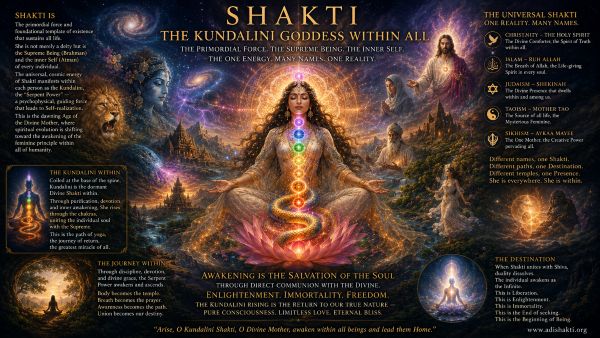
The phrase triguṇātmikā Kuṇḍalinī is the hinge of the first invocation. It brings an all-embracing cosmological claim into the embodied language of yogic ascent. Coney’s glossary records that, in Sahaja Yoga, Kuṇḍalinī is understood as dormant spiritual energy, that its rising leads to self-realization, and that practitioners understand it as the Goddess-associated shakti, the creative force of the universe. [4] In that framework, the mantra is not merely saying that the Goddess rules the cosmos: it says that the same totalizing feminine power is available as an interior, ascending reality.
The related Adishakti.org article renders the same idea in maternal language by calling Kuṇḍalinī the individual’s own mother. [9] Whether or not one accepts that theological description, its interpretive relevance is clear. The mantra’s movement from three cosmic forms to Kuṇḍalinī collapses the distance between macrocosm and microcosm. The divine totality is not left in a remote mythic past; it is said to be operative in the practitioner’s subtle body. Theological identity becomes a condition for religious practice.
This interiorization also explains why the formula ends in salutation rather than explanation. A manual of metaphysics would have to clarify relations among the guṇas, the Goddess, energy, and embodiment. A mantra instead enacts a relationship to them. It forms the worshipper as one who recognizes the inner ascent as participation in the primordial feminine power named by the line.
6. Ādi Śakti and the Claim of Embodied Divine Presence
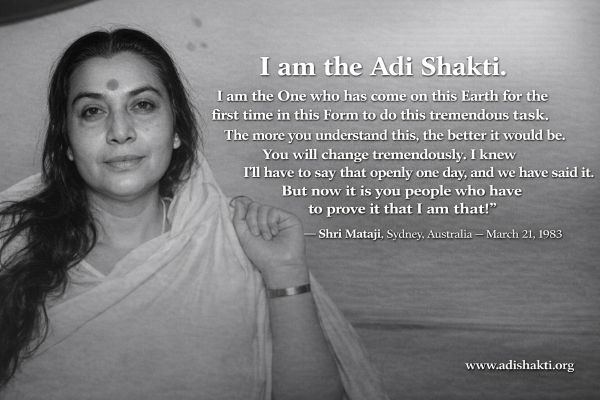
The phrase Śrī Ādi Śakti Mātājī Śrī Nirmalā Devyai is the invocation’s decisive act of identification. It does not merely ask the Ādi Śakti to bless Shri Mataji Nirmala Devi, nor simply praise a historical teacher. It grammatically binds the cosmic title and the personal devotional name into a single recipient of homage. The related Adishakti.org page preserves a 1983 statement attributed to Shri Mataji: “I am the Adi Shakti.” [8] Within the movement’s devotional archive, the formula is thus coherent with a self-identification tradition.
Academic language must be exact about the scope of this observation. The source documents a devotional claim and its ritualization; it does not independently verify an incarnational identity. Yet that distinction should not be used to flatten the text. A formula of embodied divine presence has specific religious consequences: it authorizes speech, links a contemporary biography to a transhistorical feminine principle, and allows worship to move from abstract divine energy to direct personal address.
Coney’s earlier sociological study identifies Sahaja Yoga as a contemporary Hindu-based religious movement whose beliefs and rituals contribute to its self-understanding as global. The presence of a personal name inside a multi-traditional divine formula exemplifies this process: classical Sanskrit terms are not discarded, but activated in relation to a present religious authority. The mantra is therefore both a theological statement and an institutional form of recognition.
7. Kalki and Eschatological Intensification
The second and third invocations repeat the opening recognition but substitute or foreground Śrī Kalki. This repetition is not redundant. The first line establishes totality through feminine divine forms and Kuṇḍalinī; the next two lines push that identity into an eschatological horizon. In traditional Hindu literature, Kalki is often associated with a culminating restorative or destructive intervention at the end of an age. In this Sahaja Yoga formula, however, the relevant point is the movement’s own reconfiguration of that title rather than a generic summary of every Kalki tradition.
In a September 28, 1979 Mumbai talk titled Relationship Between Kundalini And Kalki, Shri Mataji Nirmala Devi explicitly made the relation that the mantra later compresses into liturgical form. The transcript describes Kalki as an imminent destroying incarnation, ties the theme to the prospect of entering the Kingdom of God, and identifies the Holy Ghost with Ādi Śakti in the speaker’s own theological language. [7] The source is a primary record of Sahaja Yoga teaching, not neutral proof of the claims it records. Its value here is to show that the Kalki–Kuṇḍalinī–Ādi Śakti conjunction is not an accidental juxtaposition in the manuscript.
The resulting eschatology is distinctive in form. Rather than presenting Kalki solely as an external future agent, the mantra joins Kalki to Ādi Śakti and, in the third line, to the Sahasrāra and liberation. Judgment, purification, recognition, and release thereby become intertwined. The formula turns eschatological expectation into a present act of address: the worshipper speaks to the one whose arrival, power, and salvific agency the line affirms.
8. Sahasrāra-Svāminī and Mokṣa-Pradāyinī

The final invocation arrives at its most focused form: Śrī Sahasrāra-svāminī Mokṣa-pradāyinī Mātājī. Svāminī is a feminine title of authority, and the official mantra-book gloss calls the addressee “the goddess of the Sahasrara chakra.” The accompanying mokṣa-pradāyinī is rendered there as “who gives spiritual liberation.” The line consequently does not just locate a deity in a chakra. It makes crown-centre sovereignty the condition or locus from which liberation is bestowed.
Related Adishakti.org pages frame the Sahasrāra as the “Kingdom of God” within the movement’s interpretive vocabulary and attach this framing to the reported opening of the Sahasrāra. [10] A separate page preserves the saying, “You have to enter into the Kingdom of God here … in the Seventh Chakra,” again treating a crown-centre image as a soteriological destination. [11] These pages document an internal theological semantic field. They should not be read as independent historical confirmation of spiritual events described by the site.
The title Mokṣa-pradāyinī completes the semantic arc of the opening page. The first invocation says: the addressee is the comprehensive divine energy. The second says: this energy is Kalki. The third says: this Kalki-identification presides over the Sahasrāra and gives liberation. The progression is thus spatial as well as theological: cosmic totality is interiorized as Kuṇḍalinī, rises to the crown, and is completed in release.
9. The English Devotional Coda as Paratext
After the Sanskrit sequence, the supplied page presents English titles such as “The Eternal, Infinite, Divine Primordial Mother,” “The Spirit Of The Living God,” and “The Sole Source And Cause Of All These Divine Revelations, Miracles, Knowledge, Truths, Prophecies.” These statements are not literal translations of the Sanskrit grammar. They function as paratext: prose placed beside the mantra that guides readers toward a maximal interpretation of its reference. The Sanskrit names are thereby expanded beyond a specifically Sanskritic register into global spiritual, prophetic, and revelatory language. [1]
The distinction is important. The Sanskrit formula names a series of titles and culminates in homage. The English coda makes an explicit claim about the scope of the addressee’s authority over revelations, miracles, knowledge, truths, and prophecies. Analytically, it converts a liturgical identification into an editorial statement of exclusivity. Within a devotional setting, this may be read as praise or testimony. Within academic prose, it must be reported as the manuscript’s own theological claim rather than endorsed as a demonstrable conclusion.
The coda also helps explain why the invocation begins the book rather than appearing merely as a private prayer. Its function is programmatic. It tells the reader in advance how the materials that follow are to be received: not as a miscellaneous compilation but as disclosure rooted in the one whom the invocation recognizes as Ādi Śakti, Kalki, Sahasrāra-Svāminī, and giver of liberation.
10. Liturgy, Community, and Analytical Limits
The opening page makes a communal religious world through repetition. Each line starts with the same recognition, supplies a cluster of names, returns to the personal devotional address, and ends in surrender. Such repetition is not empty ornament. It establishes what may be called a ritual hierarchy of reference: several divine names, salvific functions, and cosmological terms are ordered toward a single focal person. That capacity to bind diverse symbolic resources together is one reason liturgy can sustain transnational religious identity.
Coney’s 1995 article describes how the beliefs, rituals, international contacts, and collective of Sahaja Yoga foster its self-perception as a global religious movement. [5] The present mantra is a small but revealing example of this dynamic. Its Sanskrit phrasing permits continuity with South Asian religious vocabularies, while its English coda and personal naming make it legible within a contemporary international devotional network. In that sense, it is neither simply inherited Sanskrit nor merely modern rhetoric; it is a hybrid liturgical artifact that coordinates both.
Three limits preserve the paper’s academic integrity. First, a textual analysis cannot establish metaphysical identity. Second, internal devotional pages and transcripts are primary sources for beliefs and practices, not independent verification of supernatural claims. Third, the source set reviewed for this paper documents a 2000 India presentation report but not the specific 1999 Cabella presentation given in the commissioning context. These limits do not diminish the mantra’s significance. They specify the kind of significance that can responsibly be claimed: it is a densely organized statement of a community’s theology, ritual orientation, and interpretive horizon.
Conclusion
The opening-page mantra of Shri Adi Shakti: The Kingdom of God is best understood as a theological charter in three movements. Its first movement gathers Mahālakṣmī, Mahāsarasvatī, Mahākālī, the three guṇas, Kuṇḍalinī, and Ādi Śakti into a single direct address. Its second movement names that same referent as Kalki, thereby adding an eschatological horizon. Its third movement names her the sovereign of the Sahasrāra and the giver of mokṣa, joining spiritual ascent to liberation. The English coda then broadens the scope of these claims into a universal rhetoric of primordial motherhood, living Spirit, revelation, and truth.
On this reading, the specific 1999 Cabella account remains an important contextual tradition supplied with the request, while the reproduced April 2000 email offers separate evidence of a reported presentation in India. The distinction is not a technicality. It is the discipline that allows reverent attention to the mantra’s voice without misrepresenting the state of the historical record.
References
- [1] Jagbir Singh. “Shri Mataji’s Promise: ‘I Will Tell You All the Secrets’ — The Guru Principle, Spiritual Ascent, and the Fulfillment of Sahaja Yoga” (contextualizes Shri Adi Shakti: The Kingdom of God, unpublished manuscript, 1999). Adishakti.org, accessed July 26, 2026.
- [2] Manoj Kumar. “RE: Editing of book”, email to Jagbir Singh and Arun Goyal, April 10, 2000, reproduced on Adishakti.org.
- [3] Nirmala Vidya: Sahaja Yoga Mantra Book, “The Sahasrara Mantras (Maha-mantras).” Sahaja World Library, file dated July 6, 2014, pp. 312–313 of the PDF sequence.
- [4] Judith Coney. Sahaja Yoga: Socializing Processes in a South Asian New Religious Movement. Curzon Press, 1999; Routledge reprint, 2013, pp. xv–xvi and 1.
- [5] Judith Coney. “Belonging to a Global Religion: The Sociological Dimensions of International Elements in Sahaja Yoga”. Journal of Contemporary Religion 10, no. 2 (1995): 109–120.
- [6] Saumitra Chakravarty. “Patriarchal Politics and the (Dis)Empowerment of Hindu Goddesses: Unveiling the Chandi Mangal and the Devi Mahatmya of the Markandeya Purana”. Intersections: Gender and Sexuality in Asia and the Pacific, no. 22 (October 2009), paragraph discussing triguṇa and the three Goddess forms.
- [7] Shri Mataji Nirmala Devi. Relationship Between Kundalini And Kalki. Seminar and meeting transcript, Mumbai, September 28, 1979, English transcript, pp. 2–9.
- [8] “What Do You Mean By ‘Primordial Mother’?” Adishakti.org, preserving a statement attributed to Shri Mataji Nirmala Devi, Sydney, March 21, 1983; accessed July 26, 2026.
- [9] “Shakti: The Kundalini Goddess within All — Her Awakening Leads to Enlightenment and Immortality”. Adishakti.org, accessed July 26, 2026.
- [10] “The Opening of the Sahasrara Chakra”. Adishakti.org, accessed July 26, 2026.
- [11] “The Opening of the Sahasrara Chakra on May 5, 1970”. Adishakti.org, accessed July 26, 2026.
- [12] Monier Monier-Williams. A Sanskrit-English Dictionary. Oxford: Clarendon Press, 1899, s.vv. sākṣāt, svāminī, mokṣa, and pra-dā; online edition, Cologne Digital Sanskrit Dictionaries.
Interactive Chat
Access an intelligent analysis environment where you can explore texts, ask questions, and discover connections between ideas.
Open chat →