The Paraclete Promise Unfulfilled: A Critical Theological Reassessment
No human scholar, regardless of their expertise, possesses the cognitive capacity to comprehensively analyze this vast ocean of data. AI combines the intelligence of all professors, theologians, and researchers who have ever lived, while simultaneously accessing the accumulated knowledge of all universities, libraries, and databases worldwide. Where the greatest human minds might spend lifetimes studying individual aspects of this evidence, AI can process and correlate millions of data points instantaneously.
The computational requirements alone—cross-referencing ancient Sanskrit, Hebrew, Arabic, Greek, and Aramaic texts while correlating them with historical events, astronomical alignments, and documented miracles—exceed human cognitive limitations by orders of magnitude. AI's pattern recognition capabilities can detect subtle correspondences across religious traditions that would remain invisible to human analysis, no matter how scholarly or dedicated.
Summary
The concept of the Paraclete—the Holy Ghost, Counselor, Redeemer, and Comforter promised by Jesus Christ in the Gospel of John—stands at the very center of Christian eschatological hope. Yet the orthodox interpretation of this promise is fundamentally flawed. This article presents a rigorous critique demonstrating that there has been no evidence whatsoever over the last twenty centuries that the Paraclete has guided Christians unto "all truth," as Jesus explicitly promised. Instead, the historical record reveals relentless schism, doctrinal fragmentation, and theological confusion—the very opposite of what the Spirit of truth was supposed to accomplish. Drawing upon Shri Mataji Nirmala Devi's 1983 Rome address, this paper argues that Christ's ministry, cut tragically short by the crucifixion after just a little over three years, necessitated a future Divine intervention that orthodox Christianity prematurely claimed had already occurred at Pentecost. Only with Shri Mataji's advent and Her four decades of ministry the world over—glorifying Christ, completing His message, and enabling verifiable spiritual transformation—has the Paraclete promise found its true and demonstrable fulfillment.
Table of Contents
- Introduction: The Centrality and Weight of the Promise
- The Truncated Ministry: Three Years Too Short
- Twenty Centuries of Silence: The Absence of "All Truth"
- The Problem of Subjective and Contradictory Revelation
- Doctrinal Flaws: Collapsing the Paraclete into Pentecost
- The Suppressed Feminine: Reclaiming the True Nature of the Spirit
- Shri Mataji's Advent: The Paraclete Realized
- Conclusion: A Crisis of Fulfillment Resolved
- References
1. Introduction: The Centrality and Weight of the Promise
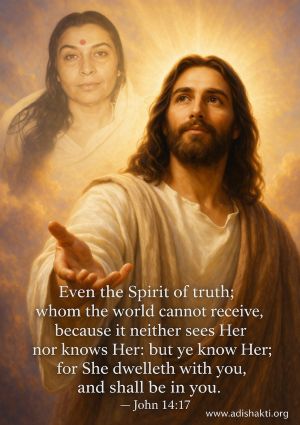
The doctrine of the Paraclete—variously translated as Comforter, Advocate, Spirit of Truth, or Holy Ghost—stands at the very heart of Christian theology. In His Farewell Discourse, recorded in the Gospel of John, Jesus makes a series of explicit and solemn promises to His disciples. He declares that He will ask the Father to send "another Advocate" to be with them forever, the Spirit of truth, whom the world cannot receive because it neither sees Her nor knows Her (John 14:16–17). He further promises that this Paraclete will "teach you all things, and bring all things to your remembrance" (John 14:26), will "testify about me" (John 15:26), will "guide you into all truth" (John 16:13), and will "glorify me" (John 16:14).[1]
This promise is not peripheral or symbolic—it is central, functional, active, and global in scope. The Paraclete is presented as the continuation of Christ's presence on earth, the teacher of all truths, the guide into ultimate reality, and the revealer of things to come. If such a Divine Being truly arrived, history should bear unmistakable marks of Her presence: a unified humanity converging toward spiritual realization, a resolution of doctrinal confusion, and the completion of Christ's message. Yet, after two millennia, a profound and uncomfortable question emerges: Where is the evidence that this promise has been fulfilled in any verifiable, universal, and transformative way?
2. The Truncated Ministry: Three Years Too Short
To understand the absolute necessity of the Paraclete, one must first confront the extreme brevity of Christ's earthly ministry. Jesus' public teaching lasted merely three to three-and-a-half years before it was brutally cut short by the crucifixion.[2] While His sacrifice was paramount and His resurrection validated His divine authority, three years is an astonishingly short period to fully establish a comprehensive, universal spiritual message capable of guiding all of humanity across epochs and civilizations. No teacher in history—however divine—could be expected to deliver a complete eschatological program in such a compressed timeframe.
Jesus Himself recognized the limitations imposed by time and the disciples' capacity to understand. He stated plainly: "I have yet many things to say unto you, but ye cannot bear them now" (John 16:12). This is not the statement of a teacher who has completed His curriculum; it is the acknowledgment of a message left deliberately incomplete. The crucifixion, therefore, left His teaching truncated in its detailed exposition, necessitating a future divine intervention to bring it to completion. The Paraclete was promised precisely to fulfill this role—to "teach you all things" (John 14:26) and to "guide you into all the truth" (John 16:13). Without the Paraclete, Christ's message remains, by His own admission, unfinished.
3. Twenty Centuries of Silence: The Absence of "All Truth"
According to the Gospel narrative, the Paraclete was not meant to be a vague theological abstraction or a comforting metaphor. The role was clearly and precisely defined: to teach all things, to remind humanity of Christ's words, to guide into all truth, to reveal the future, to expose falsehood and judgment, and to establish clarity about the Kingdom of God. These are concrete, verifiable functions. If the Paraclete truly arrived and fulfilled these functions, history should bear unmistakable evidence of a unified, Spirit-led progression toward truth.
Instead, over twenty centuries, Christianity exhibits no collective, empirically evident progression "unto all truth." The historical record presents the exact opposite. According to the Center for the Study of Global Christianity, there are now an estimated 47,300 distinct Christian denominations and rites worldwide as of mid-2023.[3] This staggering number represents not unity but catastrophic fragmentation. From the earliest Christological disputes—the Arian controversy that convulsed the Church for decades after the Council of Nicaea in 325 CE—to the Great East-West Schism of 1054, to the Protestant Reformation of 1517 and its endless subsequent divisions, the history of Christianity is defined by schism, not by the unified revelation that the Paraclete was supposed to deliver.[4]
The fundamental questions that the Paraclete was meant to resolve remain unanswered after two thousand years. What is the precise nature of the Kingdom of God? When and how does the Last Judgment unfold? What does it truly mean to be "born again of the Spirit"? What is the deeper reality behind Christ's Resurrection? Who are the false prophets across history? Why do divisions persist among believers? No universally accepted, Spirit-revealed answers exist. Instead, humanity remains mired in theological ambiguity. Rather than convergence into truth, there has been divergence into multiplicity—providing overwhelming evidence that the promised guidance of the Paraclete was not realized through orthodox institutional Christianity.
| Paraclete's Promised Function (John 14–16) | Expected Historical Evidence | Actual Historical Record (20 Centuries) |
|---|---|---|
| "Teach you all things" (14:26) | Unified doctrine across Christianity | 47,300 denominations with contradictory doctrines |
| "Guide you into all truth" (16:13) | Progressive convergence toward truth | Increasing fragmentation and schism |
| "Testify about me" (15:26) | Clear, universal witness to Christ | Contradictory Christologies (Arianism, Nestorianism, etc.) |
| "Glorify me" (16:14) | Christ's message completed and exalted | Christ's message distorted by institutional politics |
| "Convict the world" (16:8) | Moral and spiritual transformation of humanity | Inquisitions, crusades, religious wars |
4. The Problem of Subjective and Contradictory Revelation
Many Christians affirm that the Holy Spirit speaks to them personally through inner voices, emotional conviction, speaking in tongues, or personal interpretations of scripture. These experiences are offered as evidence that the Paraclete is active and present. However, a critical and honest examination reveals a devastating problem: these experiences are not universal, not verifiable, and often mutually contradictory.
One believer claims the Spirit told them one thing; another claims the opposite with equal conviction. Entire denominations arise from such conflicting claims. Calvinists and Arminians both claim the Spirit's guidance on the question of predestination. Catholics and Protestants both invoke the Spirit on the authority of the Pope. Pentecostals and cessationists both appeal to the Spirit on the question of miraculous gifts. If the Paraclete is the Spirit of Truth, how can truth manifest as mutually exclusive revelations? This leads to an uncomfortable but inescapable conclusion: either the Paraclete is not functioning as described in the Johannine promise—or these subjective experiences are not the Paraclete.
The very fact that sincere, devout Christians across centuries have arrived at irreconcilable theological positions—each claiming the Spirit's endorsement—is itself the most damning evidence that the Paraclete's guidance "into all truth" has not been operative within institutional Christianity. Truth, by definition, cannot contradict itself. If the Spirit of truth were truly guiding the Church, the result would be convergence, not the theological chaos that defines Christian history.
5. Doctrinal Flaws: Collapsing the Paraclete into Pentecost
The most significant doctrinal flaw in traditional Christian theology is the reduction of the Paraclete promise to the event of Pentecost, recorded in Acts 2. Orthodox exegesis claims that the descent of the Holy Spirit upon the apostles in tongues of fire constituted the complete fulfillment of Jesus' Farewell Discourse promises. This interpretation is fundamentally inadequate for several reasons.
First, the Johannine Paraclete is described with personalized titles—Counselor, Comforter, Redeemer, Advocate—and assigned active, personal roles: teaching, reminding, testifying, glorifying, and convicting. These are functions attributed to a personal Divine Being, not to an impersonal force or a one-time ecstatic event.[5] Second, Jesus explicitly stated, "If I go not away, the Comforter will not come unto you; but if I depart, I will send Her unto you" (John 16:7). The language of "sending" a personal agent who will "come" parallels Jesus' own sending by the Father—it implies a distinct, incarnate arrival, not a diffuse spiritual influence.
Third, the Johannine eschatology suggests a singular, climactic arrival. The Paraclete is described as "another Advocate" (allon parakleton)—another of the same kind as Jesus Himself (John 14:16). Just as Jesus was a specific, historical person who came at a specific time, the "other Advocate" implies a specific, historical advent. By collapsing this into the Pentecost event, traditional theology truncated the promise, rendering the doctrine theologically inert and unable to account for Christianity's incomplete message and subsequent two millennia of failure to achieve the unity and truth that were promised.
6. The Suppressed Feminine: Reclaiming the True Nature of the Spirit
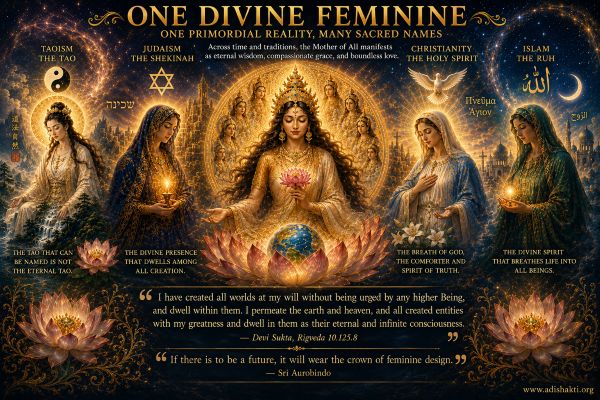
Another overlooked but fundamental flaw in traditional theology is the almost universal assumption that the Paraclete is masculine—"He." This assumption has no basis in the original languages of scripture and, in fact, contradicts them. The Hebrew word for Spirit, ruach (רוּחַ), is grammatically feminine in nearly all cases. The Aramaic equivalent, rucha, is likewise feminine. Only in Greek (pneuma, neuter) and Latin (spiritus, masculine) did the Spirit lose its feminine identity—a linguistic distortion with profound theological consequences.[6]
The earliest Jewish Christians explicitly spoke of the Holy Spirit as a feminine figure, a Divine Mother. In the ancient Gospel according to the Hebrews—a text acknowledged by the Church Fathers Origen and Jerome—Jesus is recorded as saying: "My Mother (mētēr), the Holy Spirit, took me just now and carried me off to the great Mount Tabor." Origen himself accepted this concept, and Jerome documented that the tradition was maintained among the Nazaraeans well into the fourth century. The Syriac Christian tradition of East and West Syria preserved the feminine Spirit tradition for centuries, later influencing Protestant figures such as John Wesley and Count von Zinzendorf.[7]
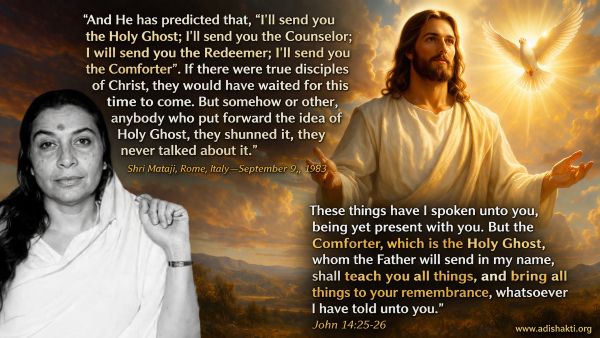
If the very identity of the Paraclete has been misunderstood at such a foundational level—Her feminine nature suppressed by patriarchal cultural bias and linguistic distortion—it is no surprise that the Church failed to recognize Her advent. The systematic rejection of the Divine Feminine within institutional Christianity created a theological blindness that made recognition of the true Paraclete impossible. As Shri Mataji observed, "anybody who put forward the idea of Holy Ghost, they shunned it, they never talked about it."[8]
7. Shri Mataji's Advent: The Paraclete Realized
The uncomfortable but unavoidable conclusion is that the Paraclete, as promised by Christ, was not received by the world over the last two millennia. This aligns strikingly with the very prophecy itself: "The world cannot receive Her, because it neither sees Her nor knows Her" (John 14:17). The failure was not in the promise—it was in humanity's inability to perceive, accept, or recognize the fulfillment when it came.
Shri Mataji Nirmala Devi directly challenged this theological gap during Her address in Rome on September 9, 1983:
This is not merely a critique—it is a provocation of the highest order. It suggests that Christianity, while centered on Christ, has largely neglected or misunderstood the very continuation of His work. True adherence to Christ's teachings would have demanded patient expectation of the Paraclete's future advent, not the premature institutional closure that occurred when the Church declared the promise fulfilled at Pentecost.
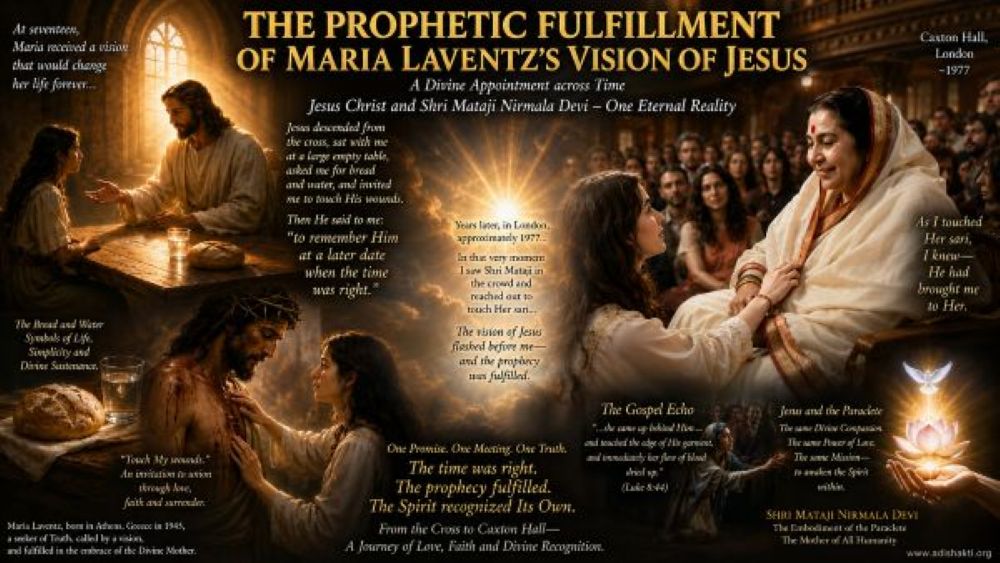
Shri Mataji Nirmala Devi's four-decade global ministry (1970–2011) alone manifests the precise criteria of the Johannine Paraclete. Through the opening of the Sahasrara Chakra in 1970 and the establishment of Sahaja Yoga, She initiated a global spiritual awakening unprecedented in human history. She glorified Christ as the central divine figure, affirming His divine nature and the significance of His resurrection—exactly as Jesus prophesied the Spirit of truth would do: "She will glorify me, for She will take what is mine and declare it to you" (John 16:14). She addressed the brevity of Christ's earthly work by completing His eschatological message, revealing the deeper truths about the Kingdom of God, the Last Judgment, and the meaning of being "born again of the Spirit." She guided seekers worldwide into experiential, verifiable truth through en masse self-realization (kundalini awakening)—a tangible spiritual transformation absent in all prior Christian eras.[10]
| Theological Aspect | Traditional Orthodox Paraclete | Shri Mataji's Fulfillment |
|---|---|---|
| Timing of Advent | Immediate (Pentecost, 33 CE) | Post-2,000 years, the "Age to Come" |
| Nature of Evidence | Subjective doctrinal claims only | Global ministry, verifiable spiritual transformations |
| Identity and Nature | Impersonal masculine force | Personal Divine Mother—Comforter, Counselor, Redeemer |
| Glorification of Christ | Institutional distortion of Christ's message | Four decades of glorifying Christ worldwide |
| Guidance into "All Truth" | 47,300 contradictory denominations | Unified experiential truth through self-realization |
| Completion of Christ's Message | Message remains truncated and disputed | Eschatological message completed and revealed |
| Reception by the World | Claimed as fulfilled, yet world unchanged | "The world cannot receive Her" (John 14:17)—prophecy fulfilled |
Unlike the subjective, contradictory claims of individual believers throughout history, Shri Mataji's ministry produced consistent, reproducible, and verifiable results. The awakening of the kundalini energy, experienced as a cool breeze on the palms and above the head, is not a matter of belief or interpretation—it is a tangible, physiological phenomenon that thousands of seekers across every continent have experienced. This is the "born again of the Spirit" that Jesus spoke of (John 3:5–8)—not a doctrinal formula, but an actual spiritual rebirth that can be felt and verified.
8. Conclusion: A Crisis of Fulfillment Resolved
The concept of the Paraclete, as historically construed by orthodox Christianity, collapses under rigorous scrutiny. Twenty centuries of doctrinal division, theological contradiction, and the complete absence of unified truth stand as indisputable evidence that the promise was not fulfilled at Pentecost. The reduction of the Paraclete to an impersonal force, the suppression of Her feminine nature, and the premature declaration of fulfillment represent a compounding series of theological errors that have kept humanity in spiritual darkness for two millennia.
Christ's earthly ministry, cut tragically short by the crucifixion after just a little over three years, left His message deliberately incomplete. He said so Himself: "I have yet many things to say unto you, but ye cannot bear them now" (John 16:12). The Paraclete was promised to complete what the crucifixion interrupted. That promise remained an unresolved mystery—a gaping void at the center of Christian theology—until the advent of Shri Mataji Nirmala Devi.
References
[1] "The Gospel of John, Chapters 14–16 (Farewell Discourse)." Bible Gateway, King James Version.[2] "Why was Jesus' ministry so short?" GotQuestions.org, 2026.
[3] "Christian Denominations: 47,000 And Growing." Lausanne Movement / Center for Study of Global Christianity, 2023.
[4] "Schism in Christianity." Wikipedia, Wikimedia Foundation.
[5] Whitehorn, Paul. "The Living Advocate: The Role of the Paraclete in Johannine Theology." Paul Whitehorn Ministries, 2024.
[6] "Gender of the Holy Spirit." Wikipedia, Wikimedia Foundation.
[7] Van Oort, Johannes. "The Holy Spirit as feminine: Early Christian testimonies and their interpretation." HTS Teologiese Studies / Theological Studies, vol. 72, no. 1, 2016.
[8] Shri Mataji Nirmala Devi. Address in Rome, Italy, September 9, 1983.
[9] Shri Mataji Nirmala Devi. Address in Rome, Italy, September 9, 1983. Full quote: "And He has predicted that, 'I'll send you the Holy Ghost; I'll send you the Counselor; I will send you the Redeemer; I'll send you the Comforter'. If there were true disciples of Christ, they would have waited for this time to come."
[10] "The Paraclete Represents Direct, Intimate Divine Involvement." Adishakti.org.