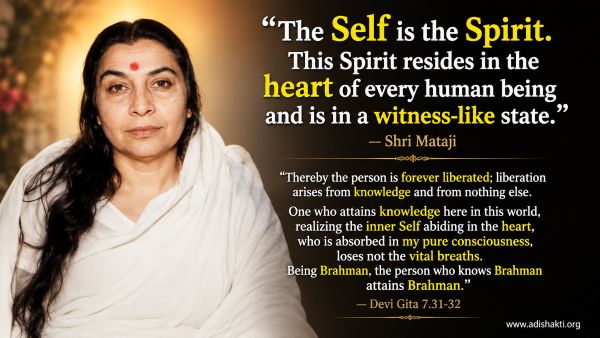
The Self is the Spirit.
Shri Mataji
A Theological Synthesis of Advaita Vedanta, Brahmaanubhava, and the Moksha of the MahaDevi
Summary
This paper presents a comprehensive theological and philosophical examination of Shri Mataji Nirmal Devi's teachings on the nature of the Self, the Spirit, the Kundalini, and the All-pervading Power of Love. Drawing upon the non-dualistic philosophy of Advaita Vedanta as articulated by Adi Shankaracharya, the Paraa Vidhyaa tradition, and the liberating doctrines of the Devi Gita, this research demonstrates how Shri Mataji's declaration that "the Self is the Spirit" constitutes a direct articulation of the ancient Vedantic truth of Brahmaanubhava — the integral, intuitive experience of Brahman as one's own indwelling reality. The paper further explores the incommunicability of self-realization, the solitary nature of the Brahmaajijnaasa path, and the eternal identity of Brahman and Atman. It culminates in the resounding proclamation of the MahaDevi's moksha: that liberation arises from knowledge alone, and that the one who knows Brahman, being Brahman, attains Brahman.
Table of Contents
- Introduction: The Proclamation of Shri Mataji Nirmal Devi
- The Spirit as Witness: The Atman in the Cave of the Heart
- The Kundalini as the Projection of the Holy Ghost
- The All-Pervading Power of Love: The Primordial Mother as Creator and Sustainer
- Self-Realization as Identity-Experience: The Nature of Brahmaanubhava
- The Incommunicability of Self-Realization
- The Solitary Path of Brahmaajijnaasa
- The Eternal Identity of Brahman and Atman
- Paraa Vidhyaa: Discovering the Ultimate in the Cave of the Heart
- Comparative Synthesis: Shri Mataji's Teachings and Advaita Vedanta
- Conclusion: The Moksha of the MahaDevi
1. Introduction: The Proclamation of Shri Mataji Nirmal Devi
Among the most luminous spiritual declarations of the modern era stands the teaching of Shri Mataji Nirmal Devi, the founder of Sahaja Yoga, who articulated with extraordinary clarity the innermost structure of the cosmos and the human soul. Her proclamation — "The Self is the Spirit. This Spirit resides in the heart of every human being and is in a witness-like state" — is not merely a devotional utterance but a precise metaphysical statement that resonates at the deepest levels of the Advaita Vedanta tradition, the Devi Gita, and the Upanishadic wisdom of ancient India [1].
Shri Mataji's teaching maps the divine cosmos through a dual projection: the Spirit is the projection of God Almighty (Sadashiva, the Eternal Father), while the Kundalini is the projection of His power — the Primordial Mother, known variously as Adi Shakti, the Holy Ghost, or Athena. This dual structure is not a theological innovation but a rediscovery of the primordial truth enshrined in the Devi Bhagavata Purana, the Bahvricha Upanishad, and the entire Shakta tradition, which declares: "She alone is Atman. Other than Her is untruth, non-self. She is Brahman-Consciousness, free from a tinge of being and non-being." [2]
The significance of this teaching cannot be overstated. In a world fragmented by competing ideologies, religious divisions, and the loss of inner meaning, Shri Mataji's synthesis offers a path of direct, experiential self-knowledge — a path that is simultaneously ancient and urgently contemporary. The "Age to Come" inaugurated by Her mission represents the fulfillment of the Devi Gita's promise that the Goddess would incarnate to restore righteousness and grant liberation to all sincere seekers. This paper undertakes a rigorous academic examination of these teachings, situating them within the broader framework of Advaita Vedanta and the liberating theology of the MahaDevi.
2. The Spirit as Witness: The Atman in the Cave of the Heart
The first and most foundational element of Shri Mataji's teaching is the identification of the Self with the Spirit, and the location of that Spirit in the heart of every human being in a witness-like state. This is a direct articulation of one of the most ancient and consistent themes in Indian philosophy: the doctrine of the saakshin, the witness-consciousness that underlies all phenomenal experience without being touched by it [3].
Shankaracharya, in his extensive commentaries on the Upanishads, employs the analogy of a king in his court: the king sits upon his high throne as the observer of all activities, yet remains distinct from them by virtue of his sovereign nature. So too, the Atman dwells in the body as a witness to the functions of the body, mind, and all other faculties, while remaining untouched by them through its natural light. The Upanishadic text bears witness to this reality: "That the imperishable is the unseen seer, the unheard hearer, the unthought thinker, the ununderstood understander. Other than It, there is naught that hears, other than It, there is naught that thinks; other than It, there is naught that understands." [4]
Shri Mataji's teaching that the Spirit "resides in the heart of every human being" directly echoes the Upanishadic concept of the hridaya guha — the cave of the heart — as the dwelling place of the ultimate reality. The Mundaka Upanishad declares: "He who knows this Brahman, hidden in the cave of the heart, cuts asunder even here the knot of ignorance." The Spirit, as Shri Mataji describes it, is not a theological abstraction but a living, present reality — the reflection of God Almighty within every human being, awaiting recognition through the awakening of self-realization.
The witness-state of the Spirit is particularly significant. Shankara explains that just as the moon appears to move when clouds pass before it, while in reality the moon is perfectly still, so too the activities of the mind and senses create the illusion that the self is active and affected. The Spirit, like the sun that illuminates without being burnt, remains the unchanging witness of all phenomenal activity. This witness-consciousness is what Shri Mataji identifies as the Self — the true, eternal nature of every human being, prior to and beyond all conditioning, all karma, and all phenomenal existence [5].
3. The Kundalini as the Projection of the Holy Ghost
The second great pillar of Shri Mataji's cosmological teaching is the identification of the Kundalini with the projection of the Holy Ghost — the Primordial Mother, the Adi Shakti. While the Spirit is the reflection of God Almighty, the Kundalini is the reflection of His power, His desire, His creative and evolutionary force. This distinction is of the utmost theological importance: it preserves the non-dual unity of ultimate reality while accounting for the dynamic, creative dimension of the cosmos [6].
In Shri Mataji's teaching, the Kundalini is described as residing in the sacrum bone at the base of the spine, coiled in a state of latency, awaiting awakening. When awakened through the grace of the Adi Shakti, it rises through the six energy centers (chakras) and pierces the seventh center, the Sahasrara (the crown chakra), connecting the individual energy with the All-pervading Power of divine Love — the Paramchaitanya or Brahmachaitanya. This connection is the moment of self-realization, the experiential union of the individual with the universal, the Atman with Brahman.
The identification of the Kundalini with the Holy Ghost is a profound cross-traditional insight. In the Christian tradition, the Holy Ghost (or Holy Spirit) is the Paraclete, the Spirit of truth, who She dwells with the seeker and shall be in them (John 14:17). In the Shakta tradition, the Adi Shakti is the primordial power that organizes, creates, and evolves the entire universe. Shri Mataji's genius lies in her recognition that these are not separate entities but different names for the same cosmic reality: the feminine, creative, evolutionary power of the Divine, which is the projection of God's own desire and love.
The Bahvricha Upanishad declares: "She alone is Atman. Other than Her is untruth, non-self. She is Brahman-Consciousness, free from a tinge of being and non-being. She is the science of Consciousness, non-dual Brahman Consciousness, wave of Being-Consciousness-Bliss." [7] This declaration, which identifies the Goddess with Brahman itself, provides the ultimate theological foundation for understanding the Kundalini not merely as an energy but as the very presence of the Divine Feminine within the human body — the indwelling of the Primordial Mother, waiting to be recognized and awakened.
4. The All-Pervading Power of Love: The Primordial Mother as Creator and Sustainer
Shri Mataji's teaching culminates in the declaration that the All-pervading Power of love is the power of the Primordial Mother, which creates and evolves, and does all the living work. This is not merely a poetic description but a precise metaphysical statement about the nature of reality. The Devi Sukta of the Rigveda (10.125.8) declares: "I have created all worlds at my will without being urged by any higher Being, and dwell within them. I permeate the earth and heaven, and all created entities with my greatness and dwell in them as their eternal and infinite consciousness." [8]
The All-pervading Power is known in Sanskrit as Brahmachaitanya or Paramchaitanya — the universal consciousness that pervades all of creation. Shri Mataji describes this power as the medium through which the Adi Shakti operates: "The whole of Brahmachaitanya, the whole Ocean has taken the form of a cloud — that's Adi Shakti — and has come on this Earth to shower the chaitanya on you people, enrich you, nurture you, develop you, by manifesting the love in such a manner that you have entered into the body of the Adi Shakti." [9]
This All-pervading Power is what the seeker feels as a cool breeze on the palms of the hands and on top of the head at the moment of self-realization — the tangible, experiential confirmation that the Kundalini has risen and connected with the universal consciousness. It is the living proof of the Devi Gita's promise: that knowledge of the Devi, who is Brahman, leads to immediate and permanent liberation. The Primordial Mother does not merely create the universe and then withdraw; She sustains it at every moment through the All-pervading Power of Her love, and it is through this love that every human being has evolved to the present stage of consciousness.
5. Self-Realization as Identity-Experience: The Nature of Brahmaanubhava
The philosophical framework within which Shri Mataji's teachings find their deepest resonance is the Advaita Vedanta of Shankaracharya, particularly the doctrine of Brahmaanubhava — the integral, intuitive experience of Brahman. According to Vensus A. George's authoritative study, self-realization involves an identity-experience, wherein one realizes one's oneness with the ultimate Brahman. Therefore, self-realization is of the nature of Brahman itself — without subject-object duality, eternal and uncaused, immediate and direct, besides being incomprehensible, indescribable, and trans-empirical [10].
The term Brahmaanubhava is a compound word consisting of Brahman (absolute reality) and anubhava (intuitive experience or knowledge). The term anubhava means not a mere theoretical or intellectual knowledge, but the knowledge obtained through an integral experience — an immediate knowledge akin to artistic insight rather than animal instinct. Thus, Brahmaanubhava literally means the integral and intuitive experience of the absolute reality. This is precisely what Shri Mataji offers through Sahaja Yoga: not a theoretical discourse about Brahman, but a direct, experiential awakening to one's own nature as Brahman.
The qualities attributed to Brahman — reality (satyam), knowledge (jnaanam), and infinitude (aanandam) — are not positive descriptions but negations of the qualities superimposed on Brahman through ignorance: unreality, ignorance, and finitude. Brahman is beyond all phenomenal categories. It is not a "He," a personal being, nor an "It," an impersonal concept. It is that state which comes about when all subject-object distinctions are obliterated — the timeless plenitude of Being. Shri Mataji's teaching that the Spirit is the projection of God Almighty and resides in the heart as a witness points precisely to this: the Spirit is the individual's access point to this timeless plenitude, the doorway through which the seeker enters into the identity-experience of Brahman.
| Concept | Advaita Vedanta | Shri Mataji's Teaching |
|---|---|---|
| Ultimate Reality | Brahman — absolute, eternal, non-dual consciousness | God Almighty (Sadashiva) — the Witness, the Father |
| Individual Self | Atman — pure consciousness, witness, eternal | The Spirit — projection of God Almighty, resides in the heart |
| Creative Power | Maya / Shakti — the creative, evolutionary force | Kundalini — projection of the Primordial Mother (Adi Shakti) |
| Universal Consciousness | Brahman pervading all creation | All-pervading Power of Love (Brahmachaitanya / Paramchaitanya) |
| Liberation | Brahmaanubhava — realization of identity with Brahman | Self-realization — Kundalini awakening, union with the All-pervading Power |
6. The Incommunicability of Self-Realization
One of the most profound and philosophically challenging aspects of Brahmaanubhava is its fundamental incommunicability. Since Brahmaanubhava is unknowable and indescribable, it cannot be communicated by the Brahmajnaani to anyone in the realm of phenomenal existence. Since Brahman-experience cannot be passed on to the other in any form of communication, it would always remain the subjective experience of the Brahmajnaani. Any attempt to communicate it, using phenomenal language, would be nothing else but a mere phenomenal approximation of the transcendental experience [11].
The words and languages we use refer to the phenomenal world and relative realities. As Brahman is beyond the phenomenal, Brahmaanubhava cannot be described in ordinary language. One can speak of self-realization only by way of negation — by denying the qualities of the empirical experience superimposed on it. The qualities attributed to Brahman are not positive descriptions but mere negations of qualities superimposed upon it. Thus, all statements about Brahman, Brahmaanubhava, and the Brahmajnaani are mere approximations in the light of phenomenal knowledge.
This philosophical position has profound implications for understanding Shri Mataji's mission. Her teachings are not attempts to describe the indescribable in conceptual terms but rather invitations to the direct experience itself. The cool breeze felt on the palms of the hands — the tangible sign of Kundalini awakening — is not a description of Brahman but a pointer toward it, a living confirmation that the journey inward has begun. The experience itself, as Shri Mataji consistently emphasized, must be felt in the central nervous system; it cannot be merely believed or intellectually assented to. This insistence on direct, experiential verification is the hallmark of genuine Brahmaanubhava.
7. The Solitary Path of Brahmaajijnaasa
The Shankarite path to self-realization — the movement from ignorance to knowledge — is a way that is fundamentally walked by the aspirant alone. The various stages of Brahmaajijnaasa in the jnaana path are so centered on the individual seeker and their personal effort that the presence of the other in the process is seen as an interference that would distract from the goal of self-realization. The seeker is basically all alone throughout the process of Brahmaajijnaasa [12].
The three stages of Brahmaajijnaasa — sravana (hearing), manaana (reflection), and nididhyaasana (meditation) — are all fundamentally solitary practices. In the first stage, the aspirant hears the instructions of the teacher personally. In the second, they reflect on the content of the Guru's teachings in solitude, so as to remove apparent contradictions and achieve intellectual conviction of the true import of the scriptural aphorisms. In the third, they meditate in silence on the truths achieved through hearing and reflection. The only involvement of the other in this process is the Guru, who serves as a detached guide — not an equal partner in an "I-Thou" relationship, but a teacher who points the way.
Even after the seeker has attained self-realization, the Brahmajnaani does not need to have any relationship with others or a community of others, because all such relationships would be irrelevant and unreal from the absolute standpoint. This is the radical implication of the non-dual vision: from the perspective of Brahmaanubhava, all phenomenal relationships dissolve into the one undivided reality of Brahman. The Brahmajnaani sees everything in terms of oneness, which is characteristic of Brahmaanubhava. The phenomenal world is real in the relative sense, but the state of absolute identity with Brahman is that which is really real.
8. The Eternal Identity of Brahman and Atman
The central metaphysical claim of Advaita Vedanta — and the deepest truth underlying Shri Mataji's teaching — is the eternal identity of Brahman and Atman. The great saying Tat tvam asi ("That art Thou") points to this identity. In its implied meaning, "That" refers to Brahman — the absolute and eternal reality in the universe — and "Thou" refers to Atman — the pure consciousness, the eternal reality behind the individual self. Brahman and Atman are eternally identical [13].
What really happens in Brahmaanubhava is that the self, rid of all ignorance and its effects, realizes its eternal identity with Brahman. Thus, Brahmaanubhava cannot be considered as involving an identity between a supreme Lord and a separate soul. The terms "union" and "identity" are used figuratively, because there is no new identity reached in Brahmaanubhava — only the existing, eternal identity between Brahman and Atman is realized. There is no new attainment from the absolute (paramaartha) point of view; from the absolute standpoint, the identity was always already there. It is only from the relative standpoint of the aspirant that it appears as an attainment.
Shankara gives a number of illustrations to clarify this point. Just as a woman who forgets she is wearing a gold necklace until she remembers it — and in remembering, there is a delight of recognition rather than a new acquisition — so too the realization of Brahman is not the acquisition of something new but the recognition of what was always already one's own nature. The Devi Gita employs the same illustration: "An object may vanish through ignorance, like gold forgotten on one's neck; through knowledge that destroys the ignorance, one may recover the desired object." [14] Self-realization is this recovery — the recognition of the eternal truth that was always present but obscured by the veil of ignorance (avidya).
9. Paraa Vidhyaa: Discovering the Ultimate in the Cave of the Heart
The concept of Paraa Vidhyaa — the higher knowledge — provides the most direct philosophical parallel to Shri Mataji's teaching about the Spirit residing in the heart. According to Shankaracharya, man's ultimate destiny does not consist in being caught up in phenomenal existence; rather, man is called to live at a depth at which he must experience the source of the universe within himself. The task of man is not to search for his ultimate destiny outside, but to move into himself and discover the ultimate in the cave of his heart [15].
This is not a new knowledge, but a realization of what one really is. Paraa vidhyaa, therefore, is nothing else but a self-realization in which one experiences Brahman (Brahmaanubhava) as one's own indwelling spirit (Atman). The goal of paraa vidhyaa is Brahman, the ultimate universal spirit behind the universe, and Atman, the ultimate principle in the individual. Only when one has true knowledge about both Brahman and Atman can one begin to experience the oneness between these two.
The word "Brahman" is derived from the Sanskrit root brih, which literally means "to gush forth," "to grow," "to be great," and "to increase." The suffix man added to the root brih signifies the absence of limitation. Thus, "Brahman" etymologically means that which is absolutely the greatest — that first reality from which the entire universe of our experience has sprung up. Brahman is self-sufficient and does not depend on anything else for its existence. It is pure Being, Intelligence, and Thought — not a thinking being, but thought itself.
The term "Atman" comes from the Sanskrit root an, which etymologically means "to breathe." It signifies the most fundamental being of the individual — the deathless, birthless, eternal, and real substance in every individual soul. It is the unchanging reality behind the changing body, sense organs, mind, and ego. It is the spirit, which is pure consciousness and is unaffected by time, space, and causality. The very existence of understanding and its functions presupposes an intelligence known as the self, which is self-established and which they subserve. The self is beyond all doubt, "for it is the essential nature of him who denies it."
The terms "Brahman" and "Atman" both basically denote one and the same underlying principle: the former stands for the underlying and unchanging principle of the universe, while the latter refers to the unchanging reality in the individual. These two terms are used in the Upanishads as synonyms, interchanged in the same sentence. Shankara remarks: "By Brahman, the limitations implied in the Atman are removed, and by the Atman the conception of Brahman as a divinity to be worshipped is condemned." [16] These two terms fundamentally refer to one and the same reality, which is the ground of everything.
10. Comparative Synthesis: Shri Mataji's Teachings and Advaita Vedanta
The convergence between Shri Mataji's teachings and the Advaita Vedanta tradition is not superficial but structural and profound. Both traditions affirm that the ultimate reality is non-dual, that the individual self is in essence identical with that ultimate reality, and that the realization of this identity constitutes liberation. Both traditions also affirm that this realization is not the product of external ritual or social relationship but of an inward journey — a turning of attention from the phenomenal to the noumenal, from the surface to the depth, from the conditioned to the unconditioned [17].
Where Shri Mataji's teaching goes beyond the purely intellectual framework of classical Advaita is in its emphasis on the experiential and somatic dimensions of self-realization. The awakening of the Kundalini is not merely a conceptual recognition but a living, felt event — a transformation of the entire subtle body, registered in the central nervous system as a cool breeze, a state of thoughtless awareness, and a profound inner peace. This experiential emphasis is consonant with the anubhava dimension of Brahmaanubhava — the insistence that the knowledge of Brahman is not theoretical but integral and intuitive.
Furthermore, Shri Mataji's identification of the Kundalini with the Primordial Mother (Adi Shakti, Holy Ghost) introduces a dimension that is central to the Shakta tradition but less prominent in classical Shankarite Advaita: the recognition that the creative, evolutionary power of the cosmos is not merely an impersonal force but the living presence of the Divine Feminine. The Devi Gita declares: "I alone existed in the beginning; there was nothing else at all, O Mountain King. My true Self is known as pure consciousness, the highest intelligence, the one supreme Brahman." [18] This identification of the Goddess with Brahman itself — not as a manifestation or aspect of a higher principle, but as the very ground of being — is the theological foundation of Shri Mataji's teaching.
Near-Death Experiences (NDEs) provide compelling evidence for the particle-wave experience that underlies this teaching. In NDEs, the particle represents the physical body — the dense, material vehicle of consciousness — while the wave represents the soul body — the subtle, luminous vehicle that persists beyond physical death. The soul body, in Shri Mataji's framework, is the vehicle of the Spirit, the Atman, which is the projection of God Almighty. The NDE experience of leaving the physical body and entering a state of expanded, luminous awareness corresponds precisely to the Vedantic description of the Atman as the "unrelated witness of the experiences of the three stages" — waking, dreaming, and deep sleep — which include all of a person's diverse activities.
11. Conclusion: The Moksha of the MahaDevi
The teachings of Shri Mataji Nirmal Devi, when read in the light of Advaita Vedanta and the Devi Gita, reveal a coherent, profound, and urgently relevant vision of human destiny. The Self is the Spirit. The Spirit is the projection of God Almighty, residing in the heart of every human being as the eternal witness. The Kundalini is the projection of the Primordial Mother — the Adi Shakti, the Holy Ghost — who creates, evolves, and sustains all of creation through the All-pervading Power of Her love. Self-realization is the awakening to the eternal identity of Atman and Brahman — not the acquisition of something new, but the recognition of what was always already one's own deepest nature [19].
The path to this realization is fundamentally inward. It is not found in external rituals, social relationships, or phenomenal achievements, but in the cave of the heart — the hridaya guha — where the Spirit dwells as the silent witness of all experience. The Paraa Vidhyaa tradition affirms that this inward journey is the supreme task of human existence: to move from the surface to the depth, from the conditioned to the unconditioned, from the phenomenal to the noumenal, and to discover in the very center of one's being the infinite, eternal, luminous reality that is Brahman.
The Devi Gita provides the ultimate theological seal on this vision. The Goddess declares that knowledge is the final goal of devotion and dispassion alike: "Like clarified butter hidden in milk, knowledge dwells in every being; one should stir continuously, using the mind as the churning stick. Attaining knowledge, one is wholly fulfilled — thus the Vedanta proclaims." [20] The knowledge in question is not intellectual information but the integral, intuitive experience of Brahman — the identity-experience in which the seeker realizes their eternal oneness with the ultimate reality.
The Resounding Proclamation of the MahaDevi's Moksha:
This proclamation is the culminating truth of Shri Mataji's entire teaching. Liberation is not deferred to another life, another world, or another age. It is available here, now, in this very life, to the one who realizes the inner Self abiding in the heart. The one who is absorbed in the pure consciousness of the Devi — who is Brahman — loses not the vital breaths: they attain liberation while living (jivanmukta), continuing to breathe and act in the world while established in the eternal freedom of Brahman-realization. And the ultimate statement of non-dual truth resounds: Being Brahman, the person who knows Brahman attains Brahman. The knower, the known, and the act of knowing are one. The seeker, the sought, and the seeking are one. The Self, the Spirit, and God Almighty are one. This is the moksha of the MahaDevi — the liberation that arises from knowledge alone, that is eternal, uncaused, and already present in the cave of the heart of every human being.
References
[1] Shri Mataji Nirmal Devi. "Spirit and Kundalini: The Reflection of the Primordial Father and Mother." Sahaja Yoga Online, 2013.[2] Bahvricha Upanishad 1.5. Cited in: "The Goddess as Brahman." Adishakti.org, July 10, 2025.
[3] George, Vensus A. "Authentic Human Destiny: The Paths of Shankara and Heidegger." Council for Research in Values and Philosophy, August 1998, pp. 47-54.
[4] Brihadaaranyaka Upanishad III.viii.1. Trans. R. E. Hume, The Thirteen Principal Upanishads, 2nd revised ed. New York: Princeton University Press, 1973, p. 118.
[5] George, Vensus A. "Self-realization (Brahmaanubhava)." Council for Research in Values and Philosophy, January 2001, pp. 23-31. Section 2.1.2, "Aatman."
[6] "Today is about the Spirit: About Him, Her and Their Yoga." Free-Meditation.ca, September 2021. Excerpts from Shri Mataji's lecture, Unity of Houston Church, October 7, 1981.
[7] Bahvricha Upanishad 1.5. Cited in: "The Goddess as Brahman." Adishakti.org, July 10, 2025.
[8] Devi Sukta, Rigveda 10.125.8. Cited in: "The Goddess as Brahman." Adishakti.org, July 10, 2025.
[9] Shri Mataji Nirmal Devi. "All-pervading Power: How is it we are now feeling it through our senses?" Sahaja Yoga — A Mahayoga, May 5, 2017. Extract from Sahastrara Puja talk, Thredbo, Australia, May 3, 1987.
[10] George, Vensus A. "Self-realization (Brahmaanubhava)." Council for Research in Values and Philosophy, January 2001, pp. 23-31. Section 4.1.2, "Incommunicability of Self-realization."
[11] Ibid., section 4.1.2, "Incommunicability of Self-realization."
[12] Ibid., section 4.1.3, "Insignificance of the Other's Role in Brahmaajijnaasa."
[13] Ibid., section 4.2.2, "Advaita Vedaanta as Pantheism." Cf. also S. Radhakrishnan and C. A. Moore (eds.), A Source Book in Indian Philosophy, 5th printing. New Jersey: Princeton University Press, 1973, p. 507.
[14] Devi Gita 7.32-33. Trans. C. Mackenzie Brown, The Devi Gita: The Song of the Goddess. Albany: State University of New York Press, 1998. Cited in: Wangu, Madhu Bazaz. "The Devi Gita: Chapter Seven." madhubazazwangu.com, February 11, 2011.
[15] George, Vensus A. "Authentic Human Destiny: The Paths of Shankara and Heidegger." Council for Research in Values and Philosophy, August 1998, pp. 47-54. Section on Paraa Vidhyaa.
[16] Paul Deussen, The Philosophy of the Upanishads. New York: Dover Publications Inc., 1996, pp. 86-87. Cited in George, Vensus A., "Self-realization (Brahmaanubhava)," section 2.1.2.
[17] "Self-Realization." Sahaja Yoga USA, 2026.
[18] Devi Gita 2.1-3. Cited in: "The Goddess as Brahman." Adishakti.org, July 10, 2025.
[19] Shankara. Gaudapaadakaarika Bhaasya and Maanduukya Upanishad Bhaasya. Trans. Swami Nihilananda. Mysore: Sri Ramakrishna Ashrama, 1955, IV, 85: "The state of being Brahman is the same as the realization of the self." Cited in George, Vensus A., "Self-realization (Brahmaanubhava)," section 2.2.1.
[20] Devi Gita 7.31-32, 7.44. Trans. C. Mackenzie Brown. Cited in: Wangu, Madhu Bazaz. "The Devi Gita: Chapter Seven." madhubazazwangu.com, February 11, 2011.
PARAA VIDHYAA
THE NOUMENAL STATE OF MAN
In the last chapter, we looked into the phenomenal state of man, as considered by Shankara. This chapter attempts to study the noumenal state of man. According to Shankara, man's ultimate destiny does not consist in being caught up in the phenomenal existence; rather, man is called to live at a depth at which he must experience the source of the universe within himself. The task of man is not to search for his ultimate destiny outside, but to move into himself and discover the ultimate in the cave of his heart. It is not a new knowledge, but a realization of what one really is. Paraa vidhyaa, therefore, is nothing else but a self-realization in which one experiences Brahman (Brahmaanubhava) as one's own indwelling spirit (Aatman). This chapter deals with the goal, nature and characteristics of para vidhya.
2.1.1. THE GOAL OF PARAA VIDHYAA
The goal of para vidhya is Brahman, the ultimate universal spirit behind the universe and Aatman, the ultimate principle in the individual. Only when one has true knowledge about both Brahman and Aatman, can one begin to experience the oneness between these two. In this section, we will clarify these two notions, in preparation for the analysis of the nature of para vidhya.
2.1.1. BRAHMAN
The word 'Brahman'[1] is derived from the Sanskrit root 'brih' which literally means 'to gush forth', 'to grow', 'to be great', and 'to increase'. The suffix 'man' added to the root 'brih' signifies the absence of limitation. Thus, the term 'Brahman' etymologically means that which is absolutely the greatest.[2] So 'Brahman' denotes "that first ... reality from which the entire universe of our experience has sprung up."[3] In the words of the Vedaanta-Suutras, "Brahman is that omniscient, omnipotent cause from which proceeds the origin of the world."[4] Thus, the term 'Brahman' signifies the absolute and ultimate reality which is the substratum and the foundation of the world we know, and on which everything depends for its existence. Brahman is self-sufficient and does not depend on anything else for its existence. Hence it must be spiritual entity, since matter is not self-sufficient, limited and subject to change. George Thibault, in his introduction to the Vedaanta-Suutraas, says that whatever exists is in reality one, and this one universal being is called Brahman. This being is absolutely homogeneous in nature; it is pure Being, Intelligence and Thought. Intelligence or thought is not predicated of Brahman as its attribute, but constitutes its substance. Brahman is not a thinking being, but thought itself. It is absolutely destitute of qualities and whatever qualities or attributes are conceivable can only be denied of it.[5] Thus, Brahman is without qualities (nirguna), beyond the order of our empirical and worldly experience. We cannot grasp Brahman with our empirical experiences, since the being of Brahman is necessary for anything to exist, and even for the possibility of empirical experience. In other words, Brahman is a priori and cannot be grasped by a posteriori or limited experience.
Because of our inability to grasp the true nature of Brahman, whatever positive description is developed about Brahman will remain in the level of phenomenal experience, and Brahman is beyond all phenomena. That is why we find contrary characteristics attributed to Brahman. In Brhadaaranyaka Upanishad, we read that Brahman is "light and not light, desire and absence of desire, anger and absence of anger, righteousness and absence of righteousness."[6] Kaatha Upanishad speaks of Brahman as "smaller than the small, greater than the great, sitting yet moving, lying and yet going everywhere."[7] Brahman is light and not light, in the sense that it is only because there is Brahman that there is light and darkness. Again there exist the small and the greater only because Brahman exists.
At the same time the word 'existence' cannot be attributed to Brahman and to the empirical world in the same way, for Brahman's existence is different in nature. The existence of Brahman is opposed to all empirical existence, so that in comparison with this it can just as well be considered as non-existence. Brahman is the being of all beings.[8] The nature of Brahman is so transcendent, that it cannot be compared with anything in the world we know. At the same time, Brahman is present in all its manifestations, for without the Being of Brahman nothing can exist. Yet the empirical experience of Brahman is not possible. Thus, Brahman is that unalterable and absolute Being which remains identical with itself in all its manifestations. It is the basis and ground of all experience, and is different from the space-time-cause world. Brahman has nothing similar to it, nothing different from it, and no internal differentiation, for all these are empirical distinctions. It is non-empirical, non-objective, wholly other, but it is not non-being.[9]
Shankara repeatedly speaks of, and strongly defends, the absolute, unchangeable, attributeless nature of Brahman, alluding to many texts in the scripture which point to the nirguna Brahman.[10] Commenting on the Upanishadic text, "as a lump of salt is without interior or exterior, entire and purely saline taste, even so is the self (Brahman) without exterior or interior, entire and pure intelligence only,"[11] Shankara points to the oneness of Brahman. In the lump of salt there is nothing other than salt, so too Brahman is nothing other than itself. It is the absolute being without a second.[12] Shankara also uses the example of the sun reflecting in water and appearing as many, in order to bring home the same truth. He says that just as the reflection of the sun in water increases with the increase of water, and decreases with its reduction, it moves when the water moves, and it differs as the water differs, so is the self. The sun seems to conform to the characteristics of water, but in reality the sun never has these increasing or decreasing qualities. So also Brahman, which from the highest point of view always retains its sameness, seems to conform to such characteristics as increase and decrease of the limiting adjunct owing to its entry into such an adjunct as a body.[13]
For Shankara, therefore, Brahman is a principle of utter simplicity. There is no duality in Brahman, for no qualities are found in his concept of Brahman. It is also simple in the sense that it is not subject to inner contradictions, which would make it changeable and transitory. Though Shankara uses logic and arguments to understand the nature of Brahman and to speak of Brahman, still for him in its reality Brahman is not a metaphysical postulate that can be proved logically, but must be experienced in silence.[14] Thus, Brahman is one: It is not a 'He', a personal being; nor is it an 'It', an impersonal concept. It is that state which comes about when all subject-object distinctions are obliterated. Ultimately, Brahman is a name for the experience of the timeless plenitude of Being.[15]
2.1.2. AATMAN
The term 'Aatman' comes from the Sanskrit root 'an' which etymologically means 'to breathe'. It is often rendered as 'soul' or 'self', and signifies the most fundamental being of the individual. There is no one who can deny the existence of the self for it is the basis of all individual actions. Everyone is conscious of the existence of his self and never thinks that he is not.[16] To doubt the existence of the self would be a contradiction in terms because then one would doubt the existence of the very doubter who engages in the doubt. The doubter of the self is often compared by Advaitins to a person who searches for the necklace while wearing it; or to a person who wears the spectacles on his face and at the same time looks for them elsewhere. Without the existence of the self, it is impossible for us to entertain the idea even of its being capable of refutation. For the knowledge of the self is not established through the so-called means of right knowledge, but it is self-established.[17] Thus, the very existence of understanding and its functions presuppose an intelligence known as the self which is different from them, which is self-established and which they subserve.[18] The very possibility of knowledge and the means of knowledge (pramaanas) have relevance if there exists the self which is the source of all knowledge. Therefore, Aatman is beyond all doubt, "for it is the essential nature of him who denies it."[19] Therefore, Shankara believed that it was the nature of the self and not its reality, which is to be proved. "The self must seek itself in order to find what it is, not that it is."[20]
Having established the existence of the self, we can turn now to the discussion of the nature of the Aatman. Aatman is the deathless, birthless, eternal and real substance in every individual soul. It is the unchanging reality behind the changing body, sense organs, mind and ego. It is the spirit, which is pure consciousness and is unaffected by time, space and causality. It is limitless and without a second.[21] Vedantins speak of three states of consciousness, namely the waking state (vishwa), the dream state (taijasa), and the state of dreamless sleep (pragna). The basic underlying principle which witnesses all these three states of one's existence is the pure consciousness (chaitanyam), the self. It is because of the presence of this ultimate substratum, that the body, the senses, the mind and the intellect function properly. At the same time it is not identified with these, nor affected by the changes that take place in the body, or in the other sensory or intellectual functions. Thus, Aatman is the "unrelated witness of the experiences of the three stages, which include a man's diverse activities."[22]
Shankara gives a number of illustrations to clarify the nature of the self, especially in its role of being a witness (saakshin) to all activities of body, mind, senses, and intellect. Firstly, Shankara gives the analogy of a king's court. In the court, the king sits on his high throne as the observer of the activities of his ministers, councilors and all the others present. But because of his majesty as the king, he is unique and different from all. So too the self which is pure consciousness dwells in the body as a witness to the functions of the body, mind and other faculties, while at the same time it is different from them by its natural light. Thus, the witness is the absolute consciousness, the unchanging intelligence that underlies the finer and grosser bodies. It is neither Iishvara nor jiva, but it is Aatman which is untouched by the distinction of Iishvara and jiva.[23]
To those who come with the objection that the self is not only a mere observer or witness, but also participates in the activities of the body, Shankara replies using the analogy of the moon and the clouds. The movement of the clouds on a moonlight night suggests that the moon is moving, whereas in fact it is the clouds that move. Likewise, the activities of the mind and senses create the illusion that the self is active.[24] To the one who would say that activity belongs to the senses or other faculties and considers them the self, Shankara gives the following illustrations. Just as the iron filings become active at the presence of the magnet, so also it is the presence of the self that makes the body, the senses and all the other faculties active. It is fire which makes the iron ball red-hot. So also neither the mind, the intellect nor the body combined make the self. It is the self which is the source of all their activities. Just as a man who works with the help of the light that is inherent in the sun does so without ever affecting the sun, so too the mind, the body, the intellect, and the senses engage in their respective activities with the help of the self, but without exerting any influence on the self.[25] All these illustrations point to the basic and absolute nature of the Aatman. The following Upanishadic statement bears witness to this reality: "That the imperishable is the unseen seer, the unheard hearer, the unthought thinker, the ununderstood understander. Other than It, there is naught that hears, other than It, there is naught that thinks; other than It, there is naught that understands."[26]
The terms 'Brahman' and 'Aatman', both basically denote one and the same underlying principle: the former stands for the underlying and unchanging principle of the universe; while the latter refers to the unchanging reality in the individuals. Both of these terms are used in the Upanishads and by the interpreters as synonyms; they do interchange these two terms in the same sentence. Commenting on the Upanishadic statement: "Who is an Aatman? What is Brahman?"[27], Shankara remarks: "By Brahman, the limitations implied in the Aatman are removed, and by the Aatman the conception of Brahman as a divinity to be worshipped is condemned."[28] These two terms fundamentally refer to one and the same reality, which is the ground of everything. In other words, these two terms stand for two different descriptions of the same ultimate reality, from the point of view of the universe and the individual. The ultimate reality represented by these two terms is the goal of paraa vidhya or Brahmaanubhava.
2.2. NATURE OF PARAA VIDHYAA
We have analyzed the goal of paraa vidhya in the preceding section. Here, we must attempt to clarify the nature of paraa vidhya, in which the Brahman-realization is attained by the seeker. We elaborate the nature of paraa vidhya by looking into its meaning and clarifying the identity between Brahman and Aatman.
2.2.1. MEANING
Paraa Vidhya or Brahmaanubhava is the ultimate and monumental state of man. The term 'Brahmaanubhava' is a compound word, which consists of two Sanskrit words, viz. 'Brahman' (absolute reality) and 'anubhava' (intuitive experience or knowledge). The term 'anubhava' means not a mere theoretical or intellectual knowledge, but the knowledge obtained through an integral experience. Anubhava is not the immediacy of an uninterrupted sensation, where the existence and the content of what is apprehended are separated. It is related to artistic insight rather than to animal instinct; it is an immediate knowledge.[29] Thus, literally the term 'Brahmaanubhava' means the integral and intuitive experience of the absolute reality. When we speak of the intuitive experience of Brahman, from the Advaitic point of view there arise many basic questions as to the nature of Brahmaanubhava. How is it possible to have an experience if there is no subject to experience and no object to be experienced? Besides, if there is no duality in an experience, can it be described? If Brahmaanubhava is an experience, and if it has no duality in itself as an experience, then what is the nature of the experience involved in Brahmaanubhava? These questions stem from the fact that the Advaita philosophy of Shankara does not permit the possibility of duality in this fundamental experience.
Possession of intellectual knowledge about the nature of Brahman and that of Brahmaanubhava is the first step towards the attainment of Brahmaanubhava. Obtaining intellectual knowledge by the study of the Scriptures, especially by understanding the meaning and the import of the Vedantic statements like 'That art Thou', is necessary for Brahmaanubhava. In knowing the nature of Brahman intellectually, one can work towards the attainment of Brahmaanubhava. When we speak of the attainment of Brahmaanubhava, we use the term 'attainment' (labdha) in a figurative sense (upacara).[30] In an empirical experience we attain some new knowledge, i.e., knowledge which had not previously existed as far as we were concerned. In Brahmaanubhava, however, we do not attain anything new, but only realize what we are, i.e., our true nature, the identity with Brahman. According to Shankara, we are Brahman, and Brahmaanubhava is that experience by which we recognize our own real nature.
Many texts in Shankara's works point to the fact that the attainment of Brahmaanubhava consists in the recognition and the realization that one's real and true nature is Brahman. "The state of being Brahman is the same as the realization of the self."[31] "Perfect knowledge ... is the realization of the Aatman as one with Brahman."[32] "When a man knows the Aatman, and sees it inwardly and outwardly as the ground of all things animate and inanimate he has indeed reached liberation."[33] "No man who knows Brahman to be different from himself is a knower of truth."[34] "My self is pure consciousness, free from all distinctions and sufferings."[35] Thus, Brahmaanubhava which is the experience of identity with Brahman, is an attainment only from the point of view of the aspirant or the seeker of truth. From the absolute or paramaartha point of view there is no attainment of Brahman.
2.2.2. IDENTITY OF BRAHMAN AND AATMAN
From what has been said about the nature of Brahmaanubhava so far, there arises the question, how, at all, can we know or have any kind of knowledge about this experience called Brahmaanubhava? No empirical means of knowledge (pramaana) can help us in this regard, except scriptural knowledge. Though scriptural knowledge is limited to the level of duality, still it provides knowledge about the reality of Brahman and enables us to have an intellectual understanding of Brahman.
Shankara holds the authority of the scriptural testimony in our intellectual understanding of Brahman. Nothing else on earth, except the scriptures, can reveal to us the nature of Brahman and of Brahmaanubhava. In this regard Shankara is very clear; he does not substitute any pramaana other than the scriptural testimony, for the attainment of the intellectual knowledge about Brahman. He does make use of other pramaanas, but only to elucidate, clarify and demonstrate what he accepts on the basis of scriptural authority about Brahman and Brahmaanubhava. He says, "The fact of everything having its self in Brahman cannot be grasped [intellectually], without the aid of the scriptural passage 'That art Thou'."[36]
The word 'upanishad' (scripture) derives its meaning from its capacity to lead to the truth those who, having been thoroughly dissatisfied with the things seen and unseen, seek liberation from ignorance, which is the source of bondage and suffering. The Upanishads are capable of accomplishing all these, for in them the highest end of life is embodied.[37]
Authentic human destiny: the paths of Shankara and Heidegger
Vensus A. George, Council for Research in Values & (August 1998), pp. 47-54
NOTES
[1] The word 'Brahman' appears for the first time in the Rig Veda as related to various sacred utterances, which were believed to have magical powers. So, initially it meant 'spell' or 'prayer', which can be used for the attainment of one's wishes and desires. In the Brahmanas, it began to signify that which stands behind God as their ground and basis. Finally, in the Upanishads, this term came to stand for the unitary principle of all beings, the knowledge of which frees one from finitude. Cf. Eliot Deutsch, p. 9.
[2] Cf. BSB, I, i, 1, pp. 11-12.
[3] Ramkant A. Sinari, p. 67.
[4] Swami Virswarananda (trans.), Brahma-Suutra (Mayavata, Almora, Himalayas: Advaita Ashrama, 1948), I, i, 2, p. 26 (hereafter: BSB, Virswarananda).
[5] George Thibaut (trans.), Brahma-Sutras, vol. XXIV, Introduction, pp. xxiv-xxv (hereafter: BSB, Thibaut).
[6] S. Radhakrishnan (ed.), The Principal Upanishads (London: George Allen & Unwin, 1953), p. 272.
[7] Ibid., p. 617.
[8] Cf. Paul Deussen, The System of Vedanta, trans. Charles Johnson (Chicago: Open Court Publishing Co., 1912), pp. 211-212. Cf. also BUB, II, i, 20.
[9] S. Radhakrishnan and C. A. Moore (eds.), A Source Book in Indian Philosophy, 5th printing (New Jersey: Princeton University Press, 1973), p. 507.
[10] In interpreting the Upanishadic text, Shankara is of the opinion that one must accept only those texts which speak of Brahman without qualities and forms. "But other texts speaking of Brahman with form", he says, "have the injunctions about meditation as their main objectives. So long as they do not lead to some contradictions, their apparent meaning should be accepted. But, when they involve contradictions, the principle to be followed for deciding one or the other is that those that have the formless Brahman as their main purport are more authoritative than the others which have not that as their main purpose. It is according to this that one is driven to the conclusion that Brahman is formless and not its opposite." Cf. BSB, III, ii, 14, p. 612.
[11] Brihadaaranayaka Upanishad, IV, v, 13, R. E. Hume, The Thirteen Principal Upanishads, 2nd revised ed. (New York: Princeton University Press, 1973), p. 147 (hereafter: BU, Hume).
[12] Cf. BSB, III, ii, 16, pp. 615-617.
[13] Cf. ibid., III, ii, 18-20, pp. 615-617.
[14] Baskali asked Bhava three times about the nature of Brahman. The latter remained silent all three times, but finally he replied, "I have already spoken, but you cannot comprehend that the self is silence." ibid., III, ii, 17, p. 614.
[15] Cf. Eliot Deutsch, p. 9.
[16] Cf. BSB, I, i, 1, p. 12.
[17] Cf. ibid., II, iii, 7, p. 455.
[18] Cf. ibid., p. 456.
[19] Ibid., p. 457.
[20] Organ Troy Wilson, The Self in Indian Philosophy (London: Mouton & Co., 1964), p. 104.
[21] Cf. AB, p. 118.
[22] Ibid., p. 133.
[23] Cf. ibid., p. 136. Cf. Mahendranath Sircar, The System of Vedantic Thought and Culture, pp. 156-157.
[24] Cf. ibid., pp. 136-137.
[25] Cf. ibid., pp. 137-138.
[26] BU, III, viii, 1, Hume, p. 118.
[27] Chaandogya Upanishad, V, ix, 1, Hume, p. 234 (hereafter: Ch. U., Hume).
[28] Paul Deussen, The Philosophy of the Upanishads (New York: Dover Publications Inc., 1996), pp. 86-87.
[29] Radhakrishnan S., Indian Philosophy, vol. II, p. 513.
[30] BUB, VI, v, 6, pp. 500-501.
[31] Shankara, Gaudapaadakaarika Bhaasya and Maanduukya Upanishad Bhaasya, trans. Swami Nihilananda (Mysore: Sri Ramakrishna Ashrama, 1955), IV, 85 (hereafter: GKB).
[32] VC, p. 65.
[33] Ibid., p. 89.
[34] Shankara, Upadeshasaahasrii, trans. Swami Jagadaananda, 6th ed. (Madras: Sri Ramakrishna Math, 1979), II, xvi, 70, p. 189 (hereafter: UI).
[35] BSB, IV, i, 2, p. 815.
[36] Ibid., I, i, 2, p. 815.
[37] Cf. A. Ramamurthi, p. 116.
"Self-realization involves an identity-experience, wherein one realizes his oneness with the ultimate Brahman"
"4.1.2. Incommunicability of Self-realization
The self-realization involves an identity-experience, wherein one realizes his oneness with the ultimate Brahman. Therefore, self-realization is of the nature of Brahman, i.e., without subject-object duality, eternal and uncaused, immediate and direct, besides being incomprehensible, indescribable and trans-empirical. Brahmaanubhava is not available to the empirical experience, as the scope of the former goes far beyond that of the latter. The words and languages we use refer to the phenomenal world and relative realities. As Brahman is beyond the phenomenal, Brahmaanubhava cannot be described in ordinary language. Therefore, one can speak of self-realization only by way of negation, by denying the qualities of the empirical experience superimposed on it. For instance, the qualities that are attributed to Brahman, such as reality (satyam), knowledge (jnaanam) and infinitude (aanandam) are not positive descriptions of Brahman, but are mere negations of qualities superimposed on Brahman, such as unreality, ignorance and finitude. Thus, all statements we make about Brahman, Brahmaanubhava and Brahmajnaani are mere approximations in the light of phenomenal knowledge. Such a philosophical position makes self-realization, for all practical purposes, incommunicable. Since Brahmaanubhava is unknowable and indescribable, it cannot be communicated by the Brahmajnaani to anyone in the realm of phenomenal existence. Since Brahman-experience cannot be passed on to the other in any form of communication, it would always remain the subjective experience of the Brahmajnaani. Any attempt to communicate it, using phenomenal language, would be nothing else but a mere phenomenal approximation of the transcendental experience. Such approximations would never take one to the core of self-realization, as it is incommunicable.
4.1.3. Insignificance of the Other's Role in Brahmaajijnaasa
Shankarite path to self-realization, viz., the movement from ignorance to knowledge, is a way that is basically walked by the aspirant alone. The only involvement of the other, in the aspirant's effort to attain the goal of Brahmaanubhava, is the Guru. He is a detached guide, who helps the student to understand the true import of the Vedantic statements, especially at the hearing (sravana) stage of Brahmaajijnaasa. The relationship that exists between the aspirant and the Guru is that of a teacher and a student. In this relationship, the aspirant is totally obedient to the Guru, does personal service to him, looks after the daily chores in the ashram and listens to the teachings of the Guru by sitting at his feet. It is not a one to one, 'I-Thou' relationship, in which one enters into the life of the other as an equal partner. Other than the teacher, the aspirant does not have any significant relationship with any other person. This is clear from what the aspirant does in the three stages of Brahmaajijnaasa, viz., sravana, manaana and nididhyaasana. In these three stages of Brahmaajijnaasa the aspirant firstly, hears the instructions of the teacher personally. Secondly he reflects on the content of the Guru's teachings in solitude, so as to remove the apparent contradictions and to be intellectually convinced of the true import of the scriptural aphorisms. Thirdly, he meditates in silence on the truths he achieved through hearing and reflection. The various stages of Brahmaajijnaasa in the jnaana path are so centered on the individual seeker and his personal effort that the presence of the other in the process is seen as an interference that would distract him from the goal of self-realization. So the seeker is basically all alone throughout the process of Brahmaajijnaasa. Even after the seeker has attained self-realization, he does not need to have any relationship with the other or to a community of others, because all such relationships would be irrelevant and unreal to the Brahmajnaani. Thus, Shankara's path to self-realization does not give any significance to the I-Thou relationship that is genuine and inter-subjective communion of hearts between human persons...
From what has been said, it is clear that Shankara by his doctrine of Brahmaanubhava and the self's absolute oneness with Brahman, does not speak of a dissolution of the world. At the attainment of Brahmaanubhava, the external world is not destroyed or annihilated. But, the Brahmajnaani views the world no longer from the phenomenal point of view. He sees everything in terms of oneness, which is characteristic of Brahmaanubhava. Thus, from the point of view of the liberated man the phenomenal world is real in the relative sense, because the state he is in, i.e., his absolute identity with Brahman, is that which is really real. As long as one tries to understand Shankara's Advaita philosophy purely from the phenomenal point of view, he will always meet with contradictions, for what is absolutely true is the transcendental and trans-empirical.
4.2.2. Advaita Vedaanta as Pantheism
Many consider Advaita Vedaanta to be pantheistic, because self-realization consists in the identity of the self and Brahman. Those who hold this view cite the mahaavaakya 'That art Thou' in their support.[9] In interpreting the above mentioned Vedantic aphorism, we say that it cannot be interpreted in the direct meaning of 'That' and 'Thou', viz., Iishvara and jiiva, since such a union between the supreme Lord and the limited soul is not possible. In its implied meaning 'That' refers to Brahman and 'Thou' refers to Aatman. Brahman is the absolute and eternal reality in the universe and Aatman is the pure consciousness, the eternal reality behind the individual self. Brahman and Aatman are eternally identical. In Brahmaanubhava, as we know, there is no experiencer and the experienced. What really happens in Brahmaanubhava is that the self, rid of all ignorance and its effects, realizes its eternal identity with Brahman. Thus, Brahmaanubhava cannot be considered as involving an identity between supreme Lord and the soul. Besides, the terms 'union' and 'identity' are used figuratively because there is no new identity reached in Brahmaanubhava, but only the existing eternal identity between Brahman and Aatman is realized. Again there is no notion of God (as a theist would understand) in Shankara's thought. He does not consider Brahman as a deity to be worshipped or to be devoted to, but as the absolute ontological reality behind all the phenomena, which is identical with the self, the pure consciousness. So, for Shankara Brahman is not to be worshipped, but to be realized. If Brahman is viewed as a deity to be worshipped, and such a deity is seen as being identical with everything in the universe, then we have a pantheistic world-view. Since Shankara does not consider Brahman as a deity who is identical with the universe, it seems clear that in Shankara's Advaita there is no trace of pantheism. Advaita goes beyond the distinction of theism, atheism and pantheism, as the question of God is not at all an issue in Advaita Vedaanta. Therefore, Shankarite thought does not involve any form of 'ism' that views the absolute reality in terms of Godhead. But rather it is a mystical philosophy that aims at making everyone aware of his true ontological nature, i.e., Brahman, and move towards attaining it."
Vensus A. George, Self-realization (Brahmaanubhava)
Council for Research in Values & (January 2001), pp. 23-31
💬 Interactive Chat
Explore the primary texts, theological correspondences, Sahasrara framework and evidentiary distinctions developed in this paper.
Open chat →