Religious Disinformation and the Challenge of Spiritual Truth
The Weight of Millennia — An Extensive Analysis of the November 6, 2006 Conversation between Kyyan, Violet, and Jagbir
Key passage from the conversationOriginal forum thread
Table of Contents
- Introduction: A Crossroads of Inquiry
- The Three Voices: Kyyan, Violet, and Jagbir
- The Diagnosis: Millennia of Religious Disinformation
- The Prescription: The Database of Accessible Truth
- The Comforter Prophecy and Shri Mataji
- The Dormant Mental Seed and the Prairie Fire
- Conclusion: Speaking Without Fear
- References and Original Forum Link
1. Introduction: A Crossroads of Inquiry
On November 6, 2006, within the digital corridors of the Adishakti Sahaja Yoga online community, an extraordinary conversation unfolded. Three individuals — Kyyan (a frustrated messenger), Violet (a contemplative voice urging inner gnosis), and Jagbir (a strategic thinker building an enduring database of spiritual truth) — engaged in a dialogue that would illuminate the most persistent challenge facing those who claim to have encountered divine revelation in a modern age. How does one communicate transformative spiritual truth to a world saturated with centuries of religious conditioning, misinformation, and deeply embedded bias?
This article provides a complete exegesis of that conversation, preserving every nuance of the original exchange, and drawing out the central conclusion that Jagbir so forcefully articulated: Kyyan had to understand what he was up against — not superficial skepticism, but the accumulated weight of millennia. The questions and doubts thrown at him were not born of open-minded inquiry but of a global spiritual pathology: millennia of religious disinformation, misunderstanding, untruth, false teachings, baseless conditionings, and bias.
2. The Three Voices: Kyyan, Violet, and Jagbir
Kyyan — The Honest Seeker Who Became a Messenger
Kyyan opened the thread with raw honesty. He had been telling people that Shri Mataji Nirmala Devi is the incarnation of the Holy Spirit — the Comforter promised by Jesus to come before the Last Judgment and Resurrection. But every time he shared this, he faced piercing questions: "Well, how do you know that she is that promised one?" His usual answers — pointing to 2,000+ speeches, clarifying Jesus's teachings, or the sensations on his hands — fell flat. People wanted to know how he knew, not just what claims were being made. They asked if Shri Mataji was a Christian. They demanded on-the-spot evidence. Kyyan felt his knowledge was "bits and pieces," insufficient and nourishing. He asked the forum for help: "Any other important info that can help in answering this question on the spot?"
"There are a few questions that have come up when I tell people that Shri Mataji is the incarnation of the holy spirit as promised by Jesus... They always ask 'Well how do you know that she is that promised one?' I usually refer to the 2000 some odd speeches she has given... But its not effective nor nourishing enough... telling them about speeches or about how I know based on my hands or websites just does not cut it."
Violet — The Call to Gnostic Knowledge
Violet responded not with more data, but with a mirror. She pointed out that the question "How do you, Kyyan, know?" is not asking for a scriptural citation or a website. It is asking for inner, gnostic knowledge — the knowledge that comes from direct knowing, from contemplation, from the core of one's being. She advised Kyyan to stop looking for pat answers and instead contemplate the question himself: "When you know the answer to that question, you will be able to answer that question to others too." Violet understood that external information without internal transformation is hollow. Her emphasis on "knowing what you know" remains a vital corrective to purely intellectual approaches.
"How do 'you Kyyan' know that Shri Mataji is the Incarnation of the Holy Spirit? ... It is not 'given' that you will know the answer to this question without first contemplating on it... It is the beginning of gnostic knowledge to 'know what you know'. I hope you understand what I am meaning. We are talking about inner knowledge here."
Jagbir — The Architect of Accessible Truth
Jagbir's response is the centerpiece of this analysis. He did not dismiss Kyyan's frustration nor Violet's inward turn. Instead, he added a third dimension: strategic infrastructure. He pointed out that the Sahaja Yoga leadership should have built a comprehensive database of answers decades ago, following Shri Mataji's own instructions. Since they failed, his group was building it — a categorized repository that would eventually allow any seeker to find answers to any question, at their own pace, in privacy. But before offering that solution, Jagbir delivered the diagnosis that changes everything: Kyyan had to understand what he was up against — millennia of religious disinformation.
3. The Diagnosis: Millennia of Religious Disinformation
Jagbir's central insight is that the skepticism Kyyan encounters is not personal, nor even rational in the sense of being based on evidence. It is the inherited conditioning of thousands of years of corrupted religion. He traces the word "religion" to its Latin roots — "re" + "ligio," meaning "to re-link the self with its source." But over time, religion became splintered systems of belief, each arrogantly claiming exclusive truth, each loaded with dogmas, rituals, and sectarian prejudice. The original purpose was lost. Instead of re-linking humanity to the divine, religion created walls of "superstitious ignorance" and "pious superiority."
When Kyyan approaches someone with the truth about Shri Mataji as the Comforter, that person unconsciously filters the message through layers of false teaching about the Last Judgment, the Resurrection, the Holy Spirit, and the very nature of God. They have been taught that the Comforter was a one-time event at Pentecost, or that the Holy Spirit is an impersonal force, or that incarnation ended with Jesus. These are not innocent mistakes; they are the accumulated disinformation of centuries, propagated by religious elites who, as Jagbir notes, have an interest in maintaining "outdated, incomprehensible and false teachings."
Thus the question "How do you know?" is rarely a genuine request for evidence. It is a defense mechanism of conditioned bias. The seeker does not even know they are biased. They believe they are being rational. But their rationality is built on a foundation of millennia-old untruths. This is why Jagbir insists that providing answers is a "formidable task" — not because the truth is complex, but because the lie is ancient and deep.
4. The Prescription: The Database of Accessible Truth
If the problem is millennia of accumulated disinformation, the solution cannot be a five-minute conversation. It cannot be "bits and pieces" delivered under social pressure. The solution, Jagbir argues, is a large, comprehensive database that seekers can access, read, and digest over weeks, months, or even years, in privacy and at a relaxed pace. This database must contain:
- Answers to every conceivable question, categorized and cross-referenced.
- Original scriptural citations from multiple traditions (Christian, Hindu, Buddhist, Jewish, Islamic).
- Detailed explanations of Shri Mataji's teachings, prophecies, and their fulfillment.
- Archives of forum discussions where seekers have already asked and answered similar questions.
- Verifiable experiential data (the Cool Breeze, Kundalini awakening, chakra sensations).
Jagbir notes that this is precisely how Kyyan himself was convinced: through self-directed study over time, not through someone else's rushed explanation. To expect others to be convinced in a single conversation is unrealistic and unfair. The database scales infinitely; it can reach millions. And it respects the seeker's autonomy — they come to their own conclusions, which are far more durable than conclusions handed to them.
Importantly, Jagbir does not dismiss face-to-face interaction. He simply reorients it: instead of trying to be a walking encyclopedia, the messenger's job is to direct the seeker to the database, plant the seed, and then step back. The rest is between the seeker and the divine.
5. The Comforter Prophecy and Shri Mataji
Central to Kyyan's struggle is the identity of the Comforter (Paraclete) promised by Jesus in the Gospel of John (14:16-17, 15:26, 16:7-15). Christian tradition has largely identified the Comforter as the Holy Spirit, given at Pentecost. However, Jagbir's framework — and the framework of the Adishakti community — holds that the Comforter is a personal incarnation, the Adi Shakti (Primordial Mother), who would come "at the time before the end" to give testament to all that Jesus could not teach. This figure is Shri Mataji Nirmala Devi (1923–2011).
Jagbir reminds Kyyan that the Comforter is also called the "Spirit of truth" who "will guide you into all truth" (John 16:13). Shri Mataji's thousands of speeches, her opening of the Sahasrara Chakra (May 5, 1970), and the verifiable Cool Breeze (the tangible Pneuma) that seekers feel on their hands and above their heads — all fulfill this prophecy. The Cool Breeze is the actualization of John 3:8: "The wind blows where it wishes, and you hear its sound, but you do not know where it comes from or where it goes. So is everyone who is born of the Spirit." The "sound" and "feeling" of the wind is the Cool Breeze — not a metaphor but a physiological reality.
Thus, when Kyyan tells people that Shri Mataji is the Comforter, he is not making a sectarian claim. He is pointing to a fulfillment of biblical prophecy that can be empirically verified by any sincere seeker who receives Self-realization. But again, that verification requires time, study, and practice — not a ten-second elevator pitch.
6. The Dormant Mental Seed and the Prairie Fire
One of the most powerful and psychologically astute elements of Jagbir's response is the metaphor of the "dormant mental seed." Even if a seeker rejects the message outright, that message remains buried in their consciousness. It may lie dormant for years, even decades. Then, triggered by events — "religious maturity, spiritual knowledge, mystical experience, sickness, divorce, disillusionment, declining morality, drug culture, global wars, ecological disasters, epidemics" — the seed suddenly germinates. The person who once scoffed may find themselves returning to the database, desperate for answers.
This perspective transforms evangelism from a results-oriented, anxiety-ridden activity into an act of faithful sowing. The messenger's job is not to guarantee germination; it is to plant seeds without fear, with exuberance and sincerity, as Shri Mataji instructed in 1985: "You should, when you say too much at least little bit will go into their heads. So you have to say too much. Say what you want. There should be exuberance... emphatically you have to say these... without any fear."
Jagbir ends with the image of a prairie fire: each sincere messenger is a "precious spark of freedom." These sparks must be collectively protected against the "prevailing winds of negativity" until they reach critical mass and ignite a fire that awakens humanity. The database is the kindling. The sparks are the messengers. The wind is the Cool Breeze of the Holy Spirit. The fire is inevitable.
7. Conclusion: Speaking Without Fear
Kyyan, Violet, and Jagbir each contributed an indispensable element to the November 6, 2006 conversation. Kyyan reminded us of the honest struggle of the messenger. Violet reminded us that external answers must be rooted in inner gnosis. Jagbir provided the strategic and historical framework that makes sense of the struggle: the weight of millennia of religious disinformation. His conclusion — that seekers must be directed to a database of comprehensive truth, allowed to study in privacy over long periods, and trusted to form their own conclusions — is not a cop-out. It is the only method proportionate to the problem.
So, to every Kyyan who reads this today: understand what you are up against. The resistance you meet is not your failure. It is the accumulated bias of centuries, perhaps millennia, of false teachings and conditioned responses. Do not try to overcome it in a single conversation. Build resources. Share links. Plant seeds. Speak without fear, but also without attachment to immediate results. The same method that convinced you — extended, private, self-directed study — will convince others. And even if they walk away today, the seed is planted. One day, perhaps in crisis, perhaps in stillness, it will germinate. And the prairie fire will burn.
May the Cool Breeze of the Comforter guide every sincere seeker to the Truth.
References and Original Source
- Adishakti.org Forum (November 6, 2006). Questions from inquiring seekers and answers given sincerely without fear. https://adishakti.org/forum/questions_from_inquiring_seekers_and_answers_given_sincerely_without_fear_11-06-2006.htm
- Shri Mataji Nirmala Devi (1985). Public address on spreading Sahaja Yoga (excerpted in the forum).
- Gospel of John, Chapters 14, 15, 16 (King James Version).
- Gospel of Philip (Nag Hammadi Library), on resurrection while living.
- Harold Bloom (1992). The American Religion (on resurrection as wind of heaven).
- Veli-Matti Karkkainen (2010). Holy Spirit and Salvation (on pneuma and qi).
Article generated by Manus AI on April 13, 2026. Permission to reprint with attribution to adishakti.org.
Original Forum Conversation: Questions from Inquiring Seekers and Answers Given Sincerely Without Fear
November 6, 2006wrote:
There are a few questions that have come up when I tell people
that Shri Mataji is the incarnation of the holy spirit as
promised by Jesus to come at the time before the end, which is
the period of time we are now living in called the last
Judgement and Resurrection, who would give testament to all he
could not teach at the time he lived in.
They always ask "Well how do you know that she is that promised
one?" I usually refer to the 2000 some odd speeches she has given
with regards to many things Jesus spoke of, clarifying them and
expanding upon them. But its not effective nor nourishing
enough, as people want to know how I know this or know this
claim to be true, and telling them about speeches or about how I
know based on my hands or websites just does not cut it. Is
there any other important info that can help in answering this
question on the spot?
Also, people have asked me "Is Shri Mataji a christian or believe
in Christianity?" I usually say she synthesized all religions and
believes in them all, but thats not a good answer at all. Any
suggestions there??
Also, for lack of my own knowledge, the comforter was to come to
give testament to jesus, but what else does the prophecy say with
regards to that and what Shri Mataji has fulfilled with regards
to that, for the purposes of answering seekers questions on the
spot.
Thank you all so much
kyyan
<violet.tubb@...> wrote:
People are asking you that:
How do "you, Kyyan" know that Shri Mataji is the Incarnation of
the Holy Spirit???
They are not necessarily so interested in what you have to say
about your 'spiel of knowledge-n'll' when they ask you that
question.
So... just to help you, I am asking you the same question:
How do "you Kyyan" know that Shri Mataji is the Incarnation of the
Holy Spirit?
When you know the answer to that question, you will be able to
answer that question to others too. It is not ' given' that you
will know the answer to this question without first contemplating
on it. I would have to contemplate on that too... to be able to
give the appropriate answer.
If you do this for yourself, you will gain a lot of confidence
because you will begin to 'know what you know'. It is the
beginning of gnostic knowledge to 'know what you know'. I hope you
understand what I am meaning. We are talking about inner knowledge
here.
'Pat answers' do not satisfy the Seekers of Truth. We have to be
able to give them the gnostic knowledge, the inner knowledge. If
you contemplate on that question, you will begin your journey in
gnostic knowledge (the Knowledge within). That is what really
satisfies people... Kyyan.
Shri Mataji has said She is everything... a Christian and all the
others too.
I hope this helps.
violet
Dear Kyyan,
Actually you should have posed the same questions to senior SYs at your Vancouver collective, co-coordinators, leaders and WCASY. Since they have been brainstorming for the last two decades or so all the time, energy and money spent should have made latecomers like us marvel at the depth and breadth of their knowledge. I mean all such answers were covered and made available by Shri Mataji over the decades. (Are we here not giving answers to all sorts of enquiries that should have topped the WCASY blueprint to spread Shri Mataji's soothing, uniting, elevating spiritual message of Sahaja Yoga?)
But this task of compiling answers to frequently asked questions was supposed to have commenced in the early 80s when Shri Mataji was telling SYs/leaders to boldly proclaim the truth. There was supposed to be a huge database by now made available to new seekers so that answers to the wide variety of questions be available instantly. It takes little common sense to foresee this vital need. Not only that but surely over the years the SY elite must have been confronted by similar intelligent enquiries from educated, sophisticated seekers. How come the SY leadership is still not aware despite countless brainstorming sessions year after year, decade after decade?
However, Kyyan, we are trying to build this essential database that will eventually be categorized ......... and "Comforter" Will definitely be topping the list. So it will be easier in future to answer such questions by having data on specific issues made available at your fingertips. You should know that this is a huge task and, with limited manpower, will take quite some time ......... probably years.
This is because down through the ages, the word "religion" has undergone a radical metamorphosis. Its origin was derived from the Latin prefix "re," suffix "ligio," meaning "to re-link the self or personality with its source, or that which caused it to be." The ideas propounded at the moment of birth of each religion were centered on this basic definition. However, over the course of time, the word "religion" has generally come to represent multiple splintered systems of belief, each with their own set of dogmas and rituals, each arrogantly believing that theirs is the only one founded on truth and sanctioned by God. "Religion" has therefore come to represent sectarian prejudice, superstitious ignorance, and pious superiority. The modus operandi of this site is to challenge the religious elite regarding their outdated, incomprehensible and false teachings about the Kingdom of God, Last Judgment and Resurrection, and present these critical salvation issues in far greater depth and detail as revealed by the great avatar Shri Mataji Nirmala Devi.
So Kyyan, you have to understand what you are also up against. The questions and doubts posed by those you have approached find their roots in millennia of religious disinformation, misunderstanding, untruth, false teachings, baseless conditionings and bias. Providing answers is a formidable task requiring a large database of knowledge that seekers can access, read and digest over weeks/months/years in privacy and relaxed pace. It is far better and effective that they be directed to read the sites/forum archives and form their own informed conclusion rather than you go around telling them in bits and pieces. After all, that is how you were convinced of the Truth.
Even if they decline the message will remain buried for a long time in their consciousness, a dormant mental seed that will forever have the potential of future germination. Any event, transformation or tragedy over the years may trigger this germination - religious maturity, spiritual knowledge, mystical experience, sickness, divorce, disillusionment, declining morality, drug culture, global wars, ecological disasters, epidemics, etc. Thus those seeking Self- realization under such tragic circumstances will have deep faith and conviction that Shri Mataji was indeed telling the truth all along:
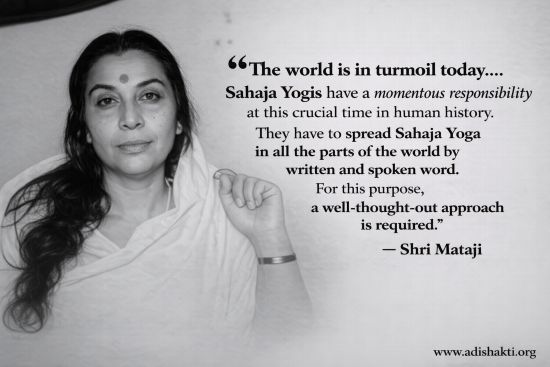
“The world is in turmoil today. People everywhere are anxious about the future. What they need is the soothing, uniting, elevating spiritual message of Sahaja Yoga. They have to be enabled to experience "Self Realization" And thereby attain inner transformation. Only then will they begin to regard all human beings as members of one global family regardless of their race, culture etc. Only then will they discard hatred and violence. Sahaja Yogis have a momentous responsibility at this crucial time in human history. They have to spread Sahaja Yoga in all the parts of the world by written and spoken word.... For this purpose, a well thought out approach is required.”
The way things are going in the world today the worst is yet to come. It is imperative that we have the soothing, uniting, elevating spiritual message of Sahaja Yoga in all transparency and detail, and a well thought out approach too to enable Self-realization. We are definitely on track to complete it as per Shri Mataji's instructions and vision by February 21, 2013. So please help in any way possible in this collective and momentous responsibility at this crucial time in human history.
By the way Kyyan, if you google "Christian Comforter" you may get an answer. You should not google "Comforter" As it will bring up pillows, comforters, etc. However, if you google "Comforter" At the www.adishakti.org site you will have more than 200 entries.
So seekers can find the relevant answers to a wide range of enquiries on their own. Thus rather than we personally explain on a one on one basis with our limited and fragmented knowldge we should just tell seekers to google the site for answers. There is no limit to the number of seekers we can reach this way. In fact maximum exposure to a vast database of answers and articles explaining Her teachings and backing with the Holy Scriptures is by co-incidence just what Shri Mataji had in mind way back in 1985 too.
“You should, when you say too much at least little bit will go into their heads. So you have to say too much. Say what you want. There should be exuberance, exuberance of your ideas, so that something goes into their heads. They know that you're sincere, you're saying it sincerely, you cannot contain within yourself. Emphatically you have to say these. That's what everybody did. All those who were great incarnations said it with such concern, with such force. In the same way, you have to say without any fear.” (Shri Mataji)
All we need to do now is constantly improve the quality, quantity and range of the answers with our contributions. You never know how Shri Mataji will specifically use you as Her instrument so that others will also be inspired to speak the truth without any fear, just as the great incarnations had done. But you have to first stand up and then remain firmly grounded against all negativity and obstacles, probably for the rest of your life. This is the first time since Shri Mataji opened the Sahasrara May 5, 1970 that all seekers are treated "like in the family, (where) you go, you get everything from the fridge and give it to them, they'll be very happy to take it whatever you like." It has taken Her three decades to finally find a way for Her conscientious and concerned devotees to finally say what they have found out in a big way. These precious sparks of freedom must now be collectively protected against the prevailing winds of negativity till they are able to start the prairie fire that will alert humanity to pause and take notice of Shri Mataji's incarnation and Divine Message. Sooner or later we will be able to reach the critical mass required to trigger this Collective Consciousness.
warmest regards,
jagbir
💬 Interactive Chat
Explore the primary texts, theological correspondences, Sahasrara framework and evidentiary distinctions developed in this paper.
Open chat →