A Critical Examination of Bodily Resurrection Doctrine
Summary
This paper argues that the conventional Christian (Judaic and Islamic) doctrine of bodily resurrection—the notion that physical corpses will spontaneously reanimate from graves at an apocalyptic end-time—represents a fundamental misreading of Jesus's actual teachings. Drawing on parametric analysis of Johannine literature, patristic controversies, modern scientific understanding of bodily decomposition, and esoteric Christian interpretations, this paper contends that Jesus's promise of the Paraclete and the resurrection of the living (not the dead) presents a coherent spiritual alternative to the scientifically untenable and theologically problematic doctrine of physical resurrection. The cynicism expressed by Paramahansa Yogananda toward literal grave-resurrection is examined as a legitimate rational critique rather than mere heresy.
Table of Contents
- Introduction: The Resurrection That Never Was
- The Paraclete Promise: Jesus's Own Limitation of His Teaching
- The Scriptural Case Against Bodily Resurrection
- The Scientific Impossibility of Bodily Resurrection
- The Theological Absurdity of Delayed Resurrection: Yogananda's Cynicism
- Reincarnation as the Missing Paraclete Teaching
- The Second Coming as Inner Resurrection
- The Unforgivable Sin and the Age of the Paraclete
- Conclusion: The Living Resurrection
- Documented-Source Appendix
- Contemporary Quantum-Resurrection Appendix
- References
1. Introduction: The Resurrection That Never Was
The doctrine of bodily resurrection stands as a purported cornerstone of Christian orthodoxy. Yet upon examination, it collapses under the weight of its own contradictions—both with Jesus's own stated teachings and with basic principles of reason, justice, and empirical observation. This paper does not seek to dismiss resurrection per se, but rather to demonstrate that Jesus taught no such thing as the physical reanimation of decomposed corpses. Instead, the resurrection He announced was spiritual, present-tense, and mediated through the Paraclete—the Holy Spirit—whose coming inaugurated a new age of living resurrection accessible now, not at some future trumpet blast.
2. The Paraclete Promise: Jesus's Own Limitation of His Teaching
Critical to understanding Jesus's eschatology is His explicit statement that His own teaching was incomplete. In John 16:12-13, Jesus declares: "I have yet many things to say unto you, but you cannot bear them now. Howbeit when He, the Spirit of truth, is come, He will guide you into all truth."[5] This passage is devastating to any claim that Jesus delivered final, exhaustive teaching on resurrection. Jesus Himself admits withholding information. The Paraclete—not Jesus's own words—would complete the message. If bodily resurrection were true, why would Jesus not have stated it clearly? The very existence of the Paraclete promise suggests that what came after Jesus would supersede or correct what came from Jesus.
Orthodox Christianity has strangely inverted this relationship, treating the New Testament as final revelation while marginalizing the ongoing work of the Paraclete. But Jesus was unequivocal: the Spirit would teach "all truth"—implying that prior to the Paraclete's coming, truth remained partial. Hence the "resurrection of the dead" as a physical graveside spectacle belongs to an incomplete, metaphorical stage of revelation.
3. The Scriptural Case Against Bodily Resurrection
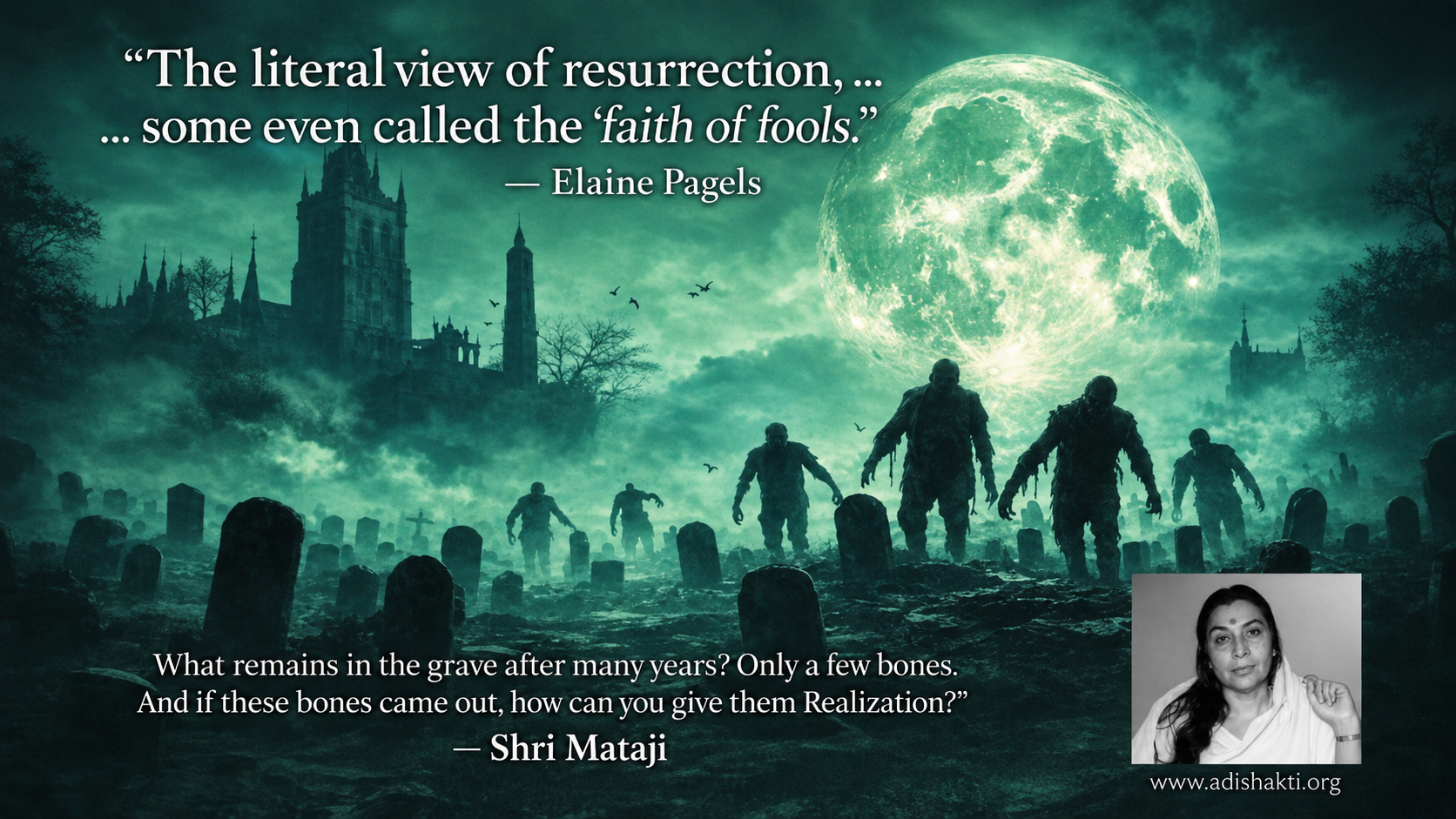
As Pagels and King note in Reading Judas, Paul explicitly denies physical resurrection: "Flesh and blood cannot inherit the kingdom of God" (1 Corinthians 15:50).[2][5] The same chapter speaks of a "spiritual body" (sōma pneumatikon) as opposed to a "physical body." Yet orthodoxy has insisted on reading Paul as if he meant literal corpse-resurrection, when he states the opposite. The author of the Gospel of Philip was more honest: belief in resurrection of the flesh is "the faith of fools." Resurrection, this text correctly notes, "refers instead to the way that Christ's presence can be experienced here and now."
4. The Scientific Impossibility of Bodily Resurrection
Malachi Martin, despite his conservative Catholic commitments, accurately presents the scientific case against bodily resurrection.[1] The human body is not a stable entity but a continuously fluxing system. The molecules composing "my" body today will be elsewhere in a decade—in African lions, Amazonian passion-flowers, Maine lobsters. The body as a discrete physical entity has "truly ceased to exist" within years of death, let alone centuries. The doctrine of bodily resurrection requires that God track and reassemble molecules that have long since become parts of other organisms. Shri Mataji Nirmala Devi poses the devastatingly simple question: "What remains in the grave after many years? Only a few bones. And if these bones came out how can you give them Realization?"[3]
5. The Theological Absurdity of Delayed Resurrection: Yogananda's Cynicism
Yogananda's cynicism here is not mere rhetorical flourish but precise theological critique. The conventional doctrine posits that God—who is Love, who is Justice—has kept billions of souls in a state of suspended animation for millennia, their consciousness somehow refrigerated beneath the sod while their bodies decomposed.
The doctrine creates insoluble problems of divine justice: the infant who dies hours after birth—has this soul been sleeping for two thousand years waiting for Gabriel's trumpet? The only coherent answer is the one Yogananda provides: the doctrine is false. It is a misinterpretation arising from "interpreters of little or no direct intuitional perception."[4]
6. Reincarnation as the Missing Paraclete Teaching
If bodily resurrection is false, what did the Paraclete teach? The evidence from esoteric Christian traditions—and from the very logic of divine justice that Yogananda invokes—points toward reincarnation as the mechanism of spiritual evolution. Shri Mataji Nirmala Devi cites the Nal Damyanti Akhyan: "when the Kalyug will come, all these seekers who are seeking in the hills and mountains will be born again, and they will be given their Self-Realization."[3]
Reincarnation resolves every problem that bodily resurrection creates. Justice requires that souls have "time and equal opportunity to evolve and express the full God-given divinity of the soul." The infant who dies receives another birth. The virtuous soul who suffered unjustly receives circumstances conducive to further growth. The Paraclete's teaching, as preserved in traditions the orthodox church suppressed (Gospel of Philip, Treatise on the Resurrection), consistently points toward spiritual rather than physical resurrection, present rather than future realization.
7. The Second Coming as Inner Resurrection
Yogananda's title—The Second Coming of Christ (The Resurrection of the Christ within You)—captures the essential reorientation.[4] The Second Coming is not a future event of Jesus descending on clouds while graves burst open. It is the present awakening of Christ consciousness within the individual seeker. Resurrection is not the reassembly of corpse molecules but the raising of the soul from spiritual death through Kundalini awakening—what Shri Mataji identifies as the work of the Holy Ghost reflected in the sacrum bone.[3] This interpretation aligns with Jesus's own words ("the kingdom of God is within you," Luke 17:21) and with observable spiritual experience across traditions. The mystic who experiences spiritual rebirth is not waiting for Gabriel's trumpet; resurrection has already occurred.
8. The Unforgivable Sin and the Age of the Paraclete
Jesus warned: "Blasphemy against the Holy Spirit will not be forgiven … either in this age or in the age to come" (Matthew 12:32).[5] For 2,000 years, this warning could not be directly applied because the Paraclete had not yet manifested in Her complete form to initiate the Last Judgment. However, today—with Shri Mataji's advent, the opening of the Sahasrara, and the tangible Cool Breeze of the Holy Spirit experienced by hundreds of thousands—the warning is absolute and present. To deny the Holy Spirit who stands before humanity offering the Resurrection is to forfeit the promise of the "Age to Come." As Shri Mataji declared: "The Time of Judgment has come … we will be judging ourselves; not by some sort of an authority, but by something which is within us which we call as the Kundalini."[3]
9. Conclusion: The Living Resurrection
The doctrine of bodily resurrection fails on every available criterion: scriptural (contradicted by Paul and by Jesus's own Paraclete promise), scientific (physically impossible), theological (incompatible with divine justice), and logical (internally incoherent). The cynicism of Paramahansa Yogananda toward this doctrine is not the cynicism of unbelief but the clarity of genuine faith—faith that God is just, that God is reasonable, and that Jesus meant what He said when He promised that the Spirit would lead us into all truth. That truth, as preserved in esoteric Christian traditions and realized in the experience of countless mystics, is that resurrection is now, resurrection is spiritual, and resurrection is available to the living—not through the bursting of ancient graves, but through the awakening of the divine spark that has never been dead, only sleeping, within each human heart.
Documented-Source Appendix: Extended Quotations
This age of logic, having struggled out of a long dark night of
superstition, belies belief in a literal interpretation of Christ's words in
this verse. The word "graves" used by Jesus gave Biblical interpreters of little
or no direct intuitional perception the thought that after death man's soul
waits with its cold corpse entombed, able to rise only on Resurrection Day when
archangel Gabriel blows his trumpet. It appears that for twenty centuries
Gabriel has not sounded his trumpet, because the skeletons of millions can be
found still in their graves.
This misconception of resurrection, that God would keep living souls
refrigerated for years beneath the cold sod, and then suddenly warm them up to
be sent to Hades or Heaven, is baseless, revolting, injurious, and unreasonable.
If that is the plan, what injustice it is that sinners and the virtuous alike,
without discrimination, have been kept waiting for centuries. Surely the just
law of cause and effect has something better to offer those who strived
sincerely to live a righteous life. Are we to believe that an autocratic God,
without rhyme or reason, dumps all souls after death under a clod of earth and
keeps them sleeping peacefully or dreaming in nightmares for centuries until His
mood suddenly chooses to command Gabriel to blow the trumpet and wake the dead?
And what of those highly spiritual souls whose bodies are not buried but were
cremated and the ashes scattered in the winds and seas?
(p.359) If Gabriel sounds the trumpet tomorrow, souls who died today would wake
up after only a few hours, along with the souls who have been dead for centuries
before the time of Christ. To drug immortal souls with the sleep of death for
centuries, to gag their expression in the gloom of the tomb for aeons, to
chloroform their intelligence for millenniums, and then suddenly wake them up
and sort them out for Heaven and Hades, is an untenable conception to ascribe to
a just and loving God.
How would God select from the various grades of dead sinners and the various
degrees of virtuous people, and the babies who have had no time to be either
virtuous or evil, which ones are to go eternally to Heaven and which eternally
to Hades? From such a medley of imperfect, half-perfect, and neutral souls no
divine justice could perform any reasonable selections. If God arbitrarily makes
persons of reasonable or unreasonable mentality, souls predisposed to be either
good or bad, nudged by a favorable or unfavorable earthly inheritance, and
endows babies with reason and then lets them die before they can express their
potentials, just for the sake of variety, then this earth is a hopeless mess,
and its creatures hapless puppets dancing on strings of chance. Our common sense
tells us that there must be a wiser purpose from a Creator who is wisdom itself.
The reason and free choice of every human being must have time and equal
opportunity to evolve and express the full God-given divinity of the soul.
The true meaning of these verses becomes clear when understood in the light of
the law of karma and reincarnation.
Paramahansa Yogananda, The Second Coming of Christ (The Resurrection of the Christ within
You) Volume 1, Discourse 21, pg. 358-359
"That Jesus "rose from the grave" to new life is a fundamental theme of Christian teaching; certainly it is the most radical. For even though most people believed in eternal life, the insistence of certain Christians like Irenaeus that their bodies would be buried, decompose — and yet rise again at the appointed time — was met not only with disbelief but with horror. Christians themselves were unclear about what kind of body this resurrected body would be. When Paul wrote about the resurrection, although his words are often mistaken as arguing for physical resurrection, he himself clearly says the opposite: "What I am saying, brothers and sisters, is this: flesh and blood cannot inherit the kingdom of God, nor does the perishable inherit the imperishable" (1 Corinthians 15:50). Without claiming to understand exactly what happens, Paul acknowledges that resurrection is a mystery, in which, he says, "we will all be changed" from physical to spiritual existence (1 Corinthians 15:51:53)....
Yet Christians like this author, while rejecting the idea of bodily resurrection, do not reject life after death. On the contrary, they suggest other ways of envisioning what that life might be. The 'Gospel of Philip', for example, calls belief in resurrection of the flesh the "faith of fools.” Resurrection, this gospel claims, far from being a single historical event in the past, refers instead to the way that Christ's presence can be experienced here and now. Thus, those who are "born again" in baptism, symbolically speaking, also are "raised from the dead" when they awaken to spiritual life. Another anonymous Christian teacher, asked by a student named Rheginos to explain resurrection, wrote in reply an interpretation of what Paul had taught. Although resurrection does not involve the physical body, the teacher tells Rheginos, it is indeed a reality:
...do not think the resurrection is an illusion. It is no illusion, but it is the truth! Indeed, it is more fitting to say the world is an illusion, rather than the resurrection, which has come into being through our Lord the Savior, Jesus Christ ('Treatise on the Resurrection' 48:10-19).
Struggling to speak, as Paul had, of "mystery," this teacher suggests that resurrection is "the revelation of what is, and the transformation of things, and a transition into newness.” Yet descriptions like these, he acknowledges, are only "the symbols and the images of resurrection"; Christ alone, he says, brings us into its reality ('Treatise on the Resurrection' 48:30-49:9).”
Reading Judas: The Gospel of Judas and the Shaping of Christianity
Elaine Pagels and Karen L. King, Penguin Group — London, England (2007) pp.83-7
"The doctrine of bodily resurrection, linked closely to the soul's nature and destiny, suffers like a fate. The ancients knew little or nothing about the human organism—its chemical constituents, its functioning parts, its psychology—and even less about the nature of death. Modern man has measured corruption, can detail the chemical changes that take place when bodily life ceases, has a clear idea of what precisely corruption and decay of the human frame connote, and defines human death precisely by the cessation of the observable functions of the body. The three religions define death as the moment when the soul leaves the body.
On the other hand, the scientist cannot accept the"outside"explanation: that a god will"resurrect"The corrupted body. He knows that in a living body today the actual molecules which compose it were not part of it some time ago. In another decade it will be made up of molecules which at present are elsewhere: in African lions, in passion-flowers of the Amazon, in Maine lobsters, in earth in Patagonia, and in the fur of a Polar bear. For the scientist, the body as such has truly ceased to exist. No"shade"or reduced form of the body exists in an"underworld"or in Elysian fields. The body has ceased to exist. He therefore finds the resurrection of the body unintelligible.”
Malachi Martin, The Encounter,
Farrar, Straus and Giroux, 1970, 286.
The Quantum Resurrection: The Complete Annihilation of the One-Day Grave Judgment
AGE OF PARTICLE-WAVE QUANTUM RESURRECTION
We are no longer in the age of static matter and linear time. We are in the Age of particle-wave Quantum resurrection — the evolution of the soul through simultaneous death and rebirth, wave and particle, immanence and transcendence. The old religions still speak of a future day when graves explode and corpses reassemble. That myth is now obsolete. It has been shattered by the double-slit experiment of consciousness itself.
Paramahansa Yogananda did not merely question the doctrine of bodily resurrection. He annihilated it — with logic, scripture, divine justice, and the very physics that the 21st century is only beginning to understand. And in this new age, where every seeker finds unadulterated truth at www.adishakti.org, no amount of theological education will allow any Jew, Christian, or Muslim to withstand his rebuttal.
— Paramahansa Yogananda, The Second Coming of Christ
Part One: The One-Day Resurrection — A Pre-Quantum Absurdity
The Abrahamic doctrine is simple and terrifying: at the end of time, Gabriel’s trumpet sounds, graves open, decomposed bodies rise, and souls are sorted into Heaven or Hell. This is a Newtonian model of resurrection — discrete particles (bodies) frozen in time, waiting for a single linear event. But we live in a quantum universe. Matter is not solid. Time is not absolute. A particle can be a wave. A dead body decomposes into atoms that become part of a billion other lifeforms. Which atoms, exactly, will God reassemble?
In the quantum view, the body is not a fixed object but a standing wave of matter-energy. The very concept of “reassembling the same body” is meaningless, because there is no “same body” from one moment to the next. The doctrine of bodily resurrection belongs to a pre-scientific, pre-quantum worldview. Resurrection is not a one-day spectacle — it is a quantum process occurring now, in every moment, at the intersection of wave and particle, the collapse of the old self and the emergence of the new.
Part Two: Yogananda’s Devastating Critique — The Injustice of Divine Refrigeration
Yogananda’s most powerful argument is not merely scientific but moral. If God is love, if God is just, then the one-day resurrection event is an abomination. Consider the infant who dies hours after birth. Under orthodox doctrine, that soul has been frozen in unconsciousness for thousands of years. What justice is that? What opportunity for growth, for expressing the divinity within?
This is the quantum injustice of the old model. It treats time as a linear conveyor belt leading to a single sorting machine. But in the quantum age, time is not linear. The soul is not frozen. Consciousness does not wait. The only coherent alternative — the only system that aligns with divine justice — is reincarnation: the evolution of the soul across many lifetimes, each new wave, each death a particle collapse, each birth a new superposition of karmic possibilities. This is the quantum law of spiritual evolution.
Part Three: The Paraclete’s Revelation — Resurrection of the Living, Not the Dead
Jesus Himself knew that His teaching was incomplete. In John 16:12-13: “I have yet many things to say unto you, but you cannot bear them now. Howbeit when He, the Spirit of truth, is come, He will guide you into all truth.” The Paraclete — the Holy Spirit — was promised to complete the revelation. And what did the Paraclete teach? Not the resurrection of dead corpses, but the resurrection of the living. Not a future trumpet blast, but a present awakening.
Shri Mataji Nirmala Devi, the Adi Shakti — the very Paraclete promised by Jesus — declared: “There are lots of myths in the Bible and one of them is that at the Time of Resurrection your bodies will come out of the graves. What remains in the grave after many years? Only a few bones. And if these bones came out how can you give them Realization?”
The suppressed Gospel of Philip states bluntly: belief in resurrection of the flesh is “the faith of fools.” Resurrection refers instead to the way that Christ’s presence can be experienced here and now. Paul himself denied physical resurrection: “Flesh and blood cannot inherit the kingdom of God” (1 Corinthians 15:50). He spoke of a “spiritual body” — not a reanimated corpse. Orthodoxy inverted him, but the quantum truth survived.Part Four: Particle-Wave Quantum Resurrection — The Evolution of the Soul
What does it mean to say we are in the Age of particle-wave Quantum resurrection? In quantum physics, a particle is also a wave. It exists in a superposition of states until observed. The soul is the same. The soul is not a fixed entity waiting in a grave. The soul is a standing wave of consciousness, evolving across multiple lifetimes, each death a collapse of one wave-function, each birth a new superposition of karmic potentials. Resurrection is not the reassembly of old particles. Resurrection is the emergence of a new wave — the same consciousness in a new body, carrying the lessons of past lives forward.
That “time and equal opportunity” is impossible in a single lifetime. It is possible only through the quantum evolution of the soul — the endless dance of birth, death, and rebirth, each cycle raising the vibration of consciousness higher, until finally the Kundalini rises, the Sahasrara opens, and the soul achieves quantum coherence with the Divine. That is the resurrection that Jesus actually taught. That is the resurrection that the Paraclete came to reveal — available now, in this age, to every seeker who is ready.
Part Five: The Unforgivable Sin in the Quantum Age
Jesus warned: “Blasphemy against the Holy Spirit will not be forgiven … neither in this age nor in the age to come” (Matthew 12:32). For two thousand years, this warning could not be fully applied because the Paraclete had not yet manifested in Her complete form. But now, with the advent of Shri Mataji Nirmala Devi as the Adi Shakti — the Holy Spirit incarnate — the Sahasrara has been opened. The Cool Breeze of the Holy Spirit is flowing. The resurrection of the living is happening now, in real time.
Shri Mataji declared: “The Time of Judgment has come … we will be judging ourselves; not by some sort of an authority, but by something which is within us which we call as the Kundalini.” That is the quantum judgment. Not a future sorting of skeletons, but an immediate self-assessment through the awakening of the divine energy within. The Cool Breeze on your fingertips is the thermometer of your own evolution. The resurrection — the raising of the Kundalini — is the collapse of the old, limited self into the infinite, enlightened Self.
Part Six: Can Any Educated Jew, Christian, or Muslim Withstand This?
In the Age of Quantum Resurrection — with Yogananda’s devastating critique amplified by quantum physics, esoteric scripture, and the living experience of the Paraclete — can any educated follower of the Abrahamic religions withstand this rebuttal? No. And here is why.
The educated Jew knows that the concept of bodily resurrection developed late, influenced by Persian and Hellenistic ideas. Ecclesiastes says, “The dead know nothing” (9:5). Daniel’s prophecy is poetic, not literal. Yogananda’s argument — that divine justice requires reincarnation — resonates with the Jewish emphasis on justice (tzedek). Once they understand quantum resurrection, the old grave-resurrection seems primitive.
The educated Christian has read the Church Fathers. Origen taught reincarnation. The Gospel of Philip and the Treatise on the Resurrection explicitly reject bodily resurrection. Paul said “flesh and blood cannot inherit the kingdom.” The more educated they are, the more they realize orthodoxy suppressed the truth for political reasons. When they experience the Cool Breeze of the Holy Spirit, the old doctrine evaporates like mist.
The educated Muslim knows the Qur’an: Allah is Al-Adl — the Just. Sufi mystics — Rumi, Ibn Arabi — taught the evolution of the soul. The literalist interpretation of resurrection is a concession to the masses, while the esoteric truth (haqiqa) points toward the soul’s continuous journey toward God. Yogananda’s argument opens a door they cannot close.
No amount of seminary training, no PhD in theology, no memorization of scripture can withstand the combined force of logic, justice, science, and direct spiritual experience. The one-day resurrection is a pre-quantum superstition. The Age of Quantum Resurrection has dawned. And the truth is available to every seeker at www.adishakti.org.
Part Seven: Adishakti.org — The Unadulterated Truth for the Quantum Age
www.adishakti.org is a place where every seeker finds unadulterated truth and answers to the most difficult questions that religions have foisted upon humanity for millennia. Here you will find:
- The complete critique of bodily resurrection — scriptural, scientific, and logical — as articulated by Yogananda, Shri Mataji, Pagels and King, and Malachi Martin.
- The revelation of the Paraclete as Shri Mataji Nirmala Devi, the Adi Shakti, who has opened the Sahasrara and made Self-Realization available to all.
- The explanation of quantum resurrection — the evolution of the soul through reincarnation, Kundalini awakening, and the attainment of Christ consciousness.
- Answers to the deepest doubts: Why do infants die? Why do the wicked prosper? Why does God seem silent? The answer is reincarnation. The answer is evolution. The answer is the quantum process of death and rebirth, wave and particle, the endless refinement of consciousness toward the Divine.
Part Eight: Living the Quantum Resurrection — Now
The Age of particle-wave Quantum resurrection is not a future event. It is now. Every time you meditate, you collapse the wave-function of scattered thoughts into the particle of focused awareness. Every time you feel the Cool Breeze of the Holy Spirit on your fingertips, you experience the resurrection of your subtle energy system. Every time you rise above your ego and act with compassion, you die to your old self and are reborn in the new.
This is the resurrection that Yogananda taught. This is the resurrection that Jesus promised. This is the resurrection that the Paraclete has made available to every human being. Do not wait for Gabriel’s trumpet. Look within. Feel the Kundalini. Experience the Cool Breeze. Know that you are not a frozen soul waiting for a cosmic lottery. You are a quantum wave of divine consciousness, evolving through infinite births, collapsing into form and rising again as spirit, forever and ever.
Conclusion: The Unavoidable Choice
Paramahansa Yogananda has delivered a rebuttal from which there is no escape. The one-day resurrection-and-judgment event is impossible, unjust, and contradictory to everything Jesus actually taught. It belongs to a pre-quantum, pre-evolutionary worldview that has no place in the Age of particle-wave Quantum resurrection. Cling to the old myth — the grave, the trumpet, the frozen soul — or embrace the quantum truth: reincarnation, Kundalini, the evolution of the soul, the resurrection that is happening now, within you, in this very moment.The first path leads to spiritual stagnation and the unforgivable sin of denying the Holy Spirit who stands before you. The second path leads to freedom, to joy, to the unending resurrection of the Christ within. www.adishakti.org is here to guide you on that second path. The Age of Quantum Resurrection has begun. In the Age of particle-wave Quantum resurrection, the soul evolves, graves remain silent, and the Spirit awakens within.
💬 Interactive Chat
Explore this article, its sources, and the relationships among its theological and evidentiary claims.
Open chat →