The 1000 Esoteric Names of Shri Lalita
The Unveiling of a Primordial Name: Shri Mataji Nirmala Devi, Kash’s Sahasrara Revelation, and the Living Theology of the Lalita Sahasranama
Kash's experience can be understood within this phenomenological framework. The revelation of Shri Mataji's name was not a purely intellectual event but a direct, experiential encounter with her divine identity. The fact that this experience occurred within the Sahasrara, the highest center of consciousness, lends it a powerful noetic quality. It is not merely a subjective feeling but a revelation of objective truth. The role of the devotee's experience in confirming the founder's claims is a crucial element in the dynamics of spiritual authority. The follower's mystical experience serves as an independent verification of the founder's identity, creating a feedback loop of legitimation.
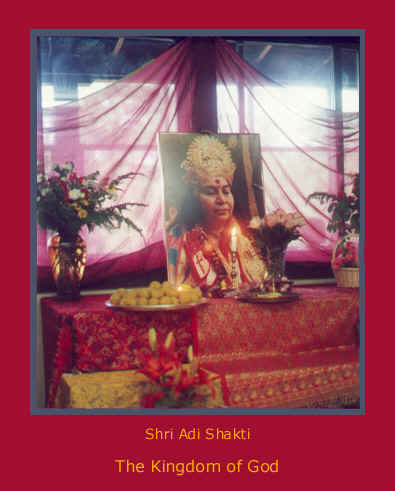
The Original Name of the Primordial Mother
Shri Adhiparasakthi Shri Nirmala Devi: "Shri Lalita Devi."
Guru Puja, Camp Interval, Quebec, Canada — July 23, 1994
On June 23, 1994, the eve of the Guru Puja, Kash confirmed from the Great Adi Shakti that Her original name was Shri Lalita Devi! It is for this reason that the 1,000 esoteric Names of Shri Lalita Devi throughout the Shri Adi Shakti: The Kingdom of God are attributed to Shri Mataji Nirmala Devi, the Incarnation of the Spirit of the Living God on this Earth.
Note: There are two types of Truths in Shri Adi Shakti: The Kingdom of God — the Revealed Truths and the Truths, and there is a fundamental difference between them.
The Revealed Truths were revealed to Kash by Shri Adhiparasakthi Shri Nirmala Devi within his Thousand-Petal Lotus, i.e., he entered the Kingdom of God within his own being and witnessed all that is written in this book. The Revealed Truths are thus esoteric — sruti ('that which was heard').
The Truths are those spoken by the physical Shri Adhiparasakthi Shri Nirmala Devi on Earth but indirectly exposed within his Sahasrara, i.e., events on Earth which correspond, confirm or conform to the Reality of the Kingdom of God. The Truths are thus exoteric — smrti ('that which is remembered').
Pariah Kutta 1999, p. 129
"Now the name Nirmala itself means immaculate; means the one who is the cleansing power and the name of the Goddess also. My actual sign name is Lalita who is the name of the Primordial Mother. That is the name of the Primordial Mother."
New York, USA, September 30, 1981
The Unveiling of a Primordial Name: An Analysis of Shri Mataji Nirmala Devi's Lalita Identity
Table of Contents
1. Introduction
In the study of contemporary religious movements, the question of spiritual authority and its legitimation is a central concern. The claims of founders and spiritual leaders, particularly those of divine incarnation, present a complex challenge for academic analysis, requiring a multi-faceted approach that incorporates historical, phenomenological, and theological perspectives. This paper examines one such case: the claim of Shri Mataji Nirmala Devi, the founder of the Sahaja Yoga movement, to be the incarnation of the Hindu goddess Shri Lalita Devi. This claim was made publicly in 1981 and later confirmed through a mystical revelation to one of her followers in 1994. This paper will analyze the historical consistency between these two events, explore the phenomenological dimensions of the mystical experience, and examine the epistemological framework of sruti (revealed truth) and smrti (remembered truth) as a means of verifying spiritual claims. By doing so, this paper aims to provide a nuanced understanding of how spiritual authority is constructed, confirmed, and sustained in a contemporary religious movement with roots in ancient traditions.
2. The Historical Consistency of the Identity Claim
A key element in the legitimation of spiritual authority is the consistency of the founder's claims over time. In the case of Shri Mataji Nirmala Devi, the claim to be Shri Lalita Devi was not a singular event but a recurring theme, articulated in both public and private contexts. The first documented instance of this claim was a public statement made in New York on September 30, 1981:
"Now the name Nirmala itself means immaculate; means the one who is the cleansing power and the name of the Goddess also. My actual sign name is Lalita who is the name of the Primordial Mother. That is the name of the Primordial Mother."[1]
This statement is significant for several reasons. First, it establishes a public record of Shri Mataji's self-identification as Lalita, the Primordial Mother, more than a decade before the 1994 revelation. Second, it connects her given name, Nirmala, to the divine attribute of immaculate purity, a quality associated with the goddess. Third, it situates her identity within the broader theological framework of the Primordial Mother, a central concept in Hindu and Tantric traditions. This public declaration, an example of smrti (remembered truth), serves as an exoteric foundation for the later esoteric confirmation.
The second key event occurred on July 23, 1994, during the Guru Puja celebrations in Quebec, Canada. On this occasion, a follower named Kash had a mystical experience within his Sahasrara (the thousand-petaled lotus at the crown of the head). In this state of heightened consciousness, he asked Shri Mataji, "what was Your original name?" to which she replied, "Shri Lalita Devi."[2] This event is described as "the most priceless of all divine revelations" and is considered an instance of sruti (revealed truth). The thirteen-year gap between the 1981 statement and the 1994 confirmation demonstrates a remarkable consistency in Shri Mataji's identity claim. The 1994 revelation did not introduce a new identity but rather confirmed, through a direct mystical experience, the identity that had been publicly declared years earlier. This consistency, spanning over a decade and articulated in both exoteric and esoteric contexts, is a powerful element in the construction of her spiritual authority.
3. The Phenomenology of Mystical Revelation
The 1994 confirmation of Shri Mataji's identity as Shri Lalita Devi is not merely a historical event but a phenomenological one, rooted in the mystical experience of a devotee. The account of Kash's experience within his Sahasrara raises important questions about the nature of mystical revelation and its role in validating spiritual claims. The Sahasrara, in the yogic tradition, is the seat of the highest consciousness, the point of union with the divine. The claim that the revelation occurred within this elevated state of consciousness is significant, as it suggests a direct, unmediated encounter with divine truth.
The academic study of the phenomenology of religion has long grappled with the nature of mystical experience. William James, in his seminal work The Varieties of Religious Experience, identified ineffability and noetic quality as two of the key characteristics of mystical states.[3] The ineffability of mystical experience, the difficulty of expressing it in ordinary language, is a recurring theme in mystical traditions. However, as Nelson Pike has argued, this does not mean that mystical experiences lack a distinctive phenomenology.[4] In the Christian mystical tradition, for example, there is a well-developed vocabulary of "spiritual sensations" that are analogous to ordinary sensory experiences. Similarly, in the yogic tradition, the experience of the Sahasrara is described in terms of light, bliss, and a sense of union with the divine.
Kash's experience can be understood within this phenomenological framework. The revelation of Shri Mataji's name was not a purely intellectual event but a direct, experiential encounter with her divine identity. The fact that this experience occurred within the Sahasrara, the highest center of consciousness, lends it a powerful noetic quality. It is not merely a subjective feeling but a revelation of objective truth. The role of the devotee's experience in confirming the founder's claims is a crucial element in the dynamics of spiritual authority. The follower's mystical experience serves as an independent verification of the founder's identity, creating a feedback loop of legitimation.
4. The Epistemology of Sruti and Smrti
The distinction between sruti and smrti provides a unique epistemological framework for understanding and verifying spiritual claims. This distinction, borrowed from the Vedic tradition, is reinterpreted to differentiate between two modes of knowing: direct mystical revelation (sruti) and the memory of earthly events (smrti). The 1994 confirmation of Shri Mataji's identity is classified as sruti, while her 1981 public statement is considered smrti. This epistemological framework has significant implications for the verification of spiritual claims.
In the Vedic tradition, sruti refers to the revealed texts, the Vedas, which are considered to be of divine origin and are transmitted orally from teacher to student. Smrti, on the other hand, refers to the remembered texts, such as the Puranas and the Epics, which are of human authorship but are based on the teachings of the Vedas. This distinction is applied to the life and teachings of Shri Mataji. Her public statements and actions are considered smrti, while the direct mystical revelations experienced by her followers are considered sruti. This framework creates a two-tiered system of verification. The smrti, the public record of her life and teachings, provides a historical foundation for her claims. The sruti, the mystical experiences of her followers, provides a transcendent confirmation of those claims.
The case of Shri Mataji's Lalita identity illustrates this epistemological framework in action. The 1981 statement, a matter of public record, is the smrti. The 1994 revelation to Kash is the sruti. The consistency between the two serves as a powerful form of verification. The sruti confirms the smrti, and the smrti provides a historical anchor for the sruti. This interplay between the two modes of knowing creates a robust epistemological foundation for the claim of divine incarnation. It also addresses one of the key challenges in the study of mysticism: the problem of verification. While the subjective experience of the mystic is, by its nature, private, the consistency between that experience and the public record of the founder's life and teachings provides a form of inter-subjective verification.
5. Theological Implications
The claim of Shri Mataji Nirmala Devi to be the incarnation of Shri Lalita Devi has profound theological implications, both within the context of the Sahaja Yoga movement and in relation to the broader Hindu and Tantric traditions. Lalita, also known as Tripura Sundari, is a central figure in the Shri Vidya tradition of Shaktism. She is considered the supreme manifestation of the Divine Mother, the source of all creation, and the embodiment of beauty, grace, and power. The Lalita Sahasranama, the thousand names of Lalita, is one of the most sacred texts in the Shri Vidya tradition, and its recitation is believed to bestow spiritual liberation.
By identifying herself with Lalita, Shri Mataji places herself within this ancient and venerable tradition. Her claim is not a radical departure from Hindu theology but rather a contemporary manifestation of it. She is not creating a new goddess but rather revealing herself as the earthly embodiment of a pre-existing one. This continuity with tradition is a key element in the legitimation of her spiritual authority. It allows her to draw upon the rich symbolism and theological framework of the Shri Vidya tradition, while at the same time reinterpreting it in a modern context.
The theological implications of this claim are far-reaching. It suggests that the Divine Mother is not a distant, transcendent being but an immanent presence in the world, actively intervening in human history. It also suggests that the path to spiritual liberation is not through asceticism or intellectual speculation but through the awakening of the kundalini and the direct experience of the divine within. The Sahaja Yoga movement, with its emphasis on self-realization and the experience of thoughtless awareness, can be seen as a contemporary expression of the ancient Tantric path of kundalini awakening. Shri Mataji's claim to be Lalita, the supreme goddess of the Shri Vidya tradition, provides a powerful theological rationale for this path.
6. Conclusion
The case of Shri Mataji Nirmala Devi's claim to be the incarnation of Shri Lalita Devi provides a fascinating case study in the construction and legitimation of spiritual authority in a contemporary religious movement. The historical consistency of her claim, articulated in both public and private contexts over a period of more than a decade, provides a powerful form of verification. The phenomenological dimension of the mystical revelation to her follower, Kash, highlights the role of direct, experiential encounter in validating spiritual claims. The epistemological framework of sruti and smrti provides a unique and sophisticated means of integrating historical and mystical evidence. Finally, the theological implications of the claim, with its deep roots in the Hindu and Tantric traditions, demonstrate the ways in which contemporary religious movements can draw upon and reinterpret ancient wisdom traditions.
The study of such movements requires a multi-faceted approach that is sensitive to the nuances of history, phenomenology, and theology. By examining the case of Shri Mataji and the Sahaja Yoga movement, we can gain a deeper understanding of the complex dynamics of spiritual authority, the nature of mystical experience, and the enduring power of the divine feminine in the religious imagination.
7. References
[1] Shri Mataji Nirmala Devi. (1981, September 30). Public Program in New York, USA.[2] Kutta, P. (1999). Shri Adi Shakti: The Kingdom of God. Pariah Kutta. p. 129.
[3] James, W. (1902). The Varieties of Religious Experience: A Study in Human Nature. Longmans, Green, and Co.
[4] Pike, N. (1992). Mystic Union: An Essay in the Phenomenology of Mysticism. Cornell University Press.
Theological Implications of Attributing the 1,000 Esoteric Names of Shri Lalita to Shri Mataji Nirmala Devi
Table of Contents
1. Introduction
The attribution of the 1,000 esoteric Names of Shri Lalita Devi, as enumerated in the Lalita Sahasranama, to Shri Mataji Nirmala Devi, the founder of the Sahaja Yoga movement, is a theological claim with profound implications for contemporary Hindu theology. This analysis explores these implications, examining how this attribution establishes doctrinal coherence with traditional Hindu and Tantric thought, legitimizes spiritual authority, and reinterprets ancient concepts for a modern audience. By situating Shri Mataji's identity as Lalita within the broader framework of Shaktism, Advaita Vedanta, and the theology of the Divine Mother, we gain deeper understanding of the theological underpinnings of the Sahaja Yoga movement and its relationship to the wider Hindu tradition. The attribution of these names is not merely symbolic but represents a comprehensive theological framework that encompasses cosmology, soteriology, and the nature of divine incarnation.
2. The Lalita Sahasranama Tradition
The Lalita Sahasranama, the thousand names of the Divine Mother Lalita, is one of the most sacred texts in the Shri Vidya tradition of Shaktism. According to tradition, this sacred hymn was composed by the eight Vaagdevis (goddesses of speech) upon the command of Lalita herself, and it appears in the Brahmanda Purana, one of the eighteen principal Puranas of Hinduism.[1] The text is unique among sahasranamas in that it contains exactly 1,000 names without repetition, a remarkable feat of poetic and mystical composition. Each name encodes specific divine attributes, cosmic principles, and spiritual truths that collectively constitute a comprehensive map of divine reality.
The significance of the Lalita Sahasranama is underscored by the Brahmanda Purana itself, which declares that the recitation of these names is the highest spiritual practice in the Kali Yuga, the present age of darkness and spiritual degeneration.[2] The text states that to a thousand names of Vishnu, a single name of Shiva is preferred, and to a thousand names of Shiva, a single name of the Devi (Divine Mother) is preferred. This hierarchy places the Divine Mother at the apex of spiritual practice, suggesting that her worship is the most direct and efficacious path to liberation in this age. The implication is profound: in the Kali Yuga, when external rituals and intellectual knowledge are less effective, the grace of the Divine Mother, accessed through the recitation of her names, becomes the primary means of spiritual salvation.
Lalita Tripura Sundari, the subject of these thousand names, is revered as the supreme form of the Divine Mother in the Shri Vidya tradition. She is described as the ultimate embodiment of the union of Shiva and Shakti, representing the inseparable connection between masculine and feminine energies in the universe.[3] In her gross form, Lalita embodies the four purusharthas (fundamental human goals): dharma (righteousness), artha (wealth), kama (desire), and moksha (liberation). In her subtle form, she is expressed through the Sri Yantra, the sacred geometric diagram that serves as a cosmic map of the universe's structure. In her supreme form, she is the mantra itself, the vibrational essence of divine reality that transcends all forms and names.
3. Doctrinal Coherence and Continuity
The claim that Shri Mataji is the incarnation of Shri Lalita Devi is not a radical departure from Hindu theology but rather a contemporary manifestation of it. The identification of Shri Mataji with Lalita places her within the ancient and venerable tradition of the Divine Mother, establishing a powerful sense of doctrinal coherence and continuity. This is not the creation of a new deity but the revelation of a pre-existing one in a new form, a concept well-established in Hindu incarnation theology. The doctrine of avatar (divine incarnation) has long been central to Hindu thought, with the Bhagavad Gita proclaiming that whenever dharma (righteousness) declines and adharma (unrighteousness) rises, the Lord incarnates to restore cosmic order.
The theological framework of Adi Parashakti, the primordial cosmic energy, is central to this claim. Adi Parashakti is considered the source of all creation, preservation, and destruction, and all other gods and goddesses are seen as her manifestations.[4] According to the Devi Bhagavata Purana, Adi Parashakti commands and directs the Trimurti (Brahma, Vishnu, and Shiva), empowering each with their respective cosmic functions. She is described as having no origin or end, as the eternal truth that created the whole universe and is the embodiment of triumph itself. Lalita Tripura Sundari is revered as the supreme form of Adi Parashakti, the ultimate embodiment of the union of Shiva and Shakti. By claiming to be Lalita, Shri Mataji is, by extension, claiming to be the incarnation of Adi Parashakti, the Divine Mother in her most complete and accessible form.
This claim is further supported by the integration of Advaita Vedanta, the non-dualistic philosophy that posits the ultimate unity of the individual soul (Atman) and the absolute reality (Brahman). In this framework, Lalita is not merely a personal deity but the very Self, the universal consciousness that pervades all of existence. The Tantraraja Tantra, a foundational text of Tantric philosophy, declares: "The universal form Lalita is declared to be the very Self; as she is inseparable from the self, her vaibhava is all-pervading, possessed with infinite powers."[5] This statement suggests that Lalita is not external to the individual but is the innermost essence of consciousness itself. When Shri Mataji claims to be Lalita, she is claiming to embody and manifest this universal consciousness in human form, making the transcendent immanent and accessible to all seekers.
4. Spiritual Authority and Legitimation
The attribution of the 1,000 names of Lalita to Shri Mataji is a powerful mechanism for the legitimation of her spiritual authority. Each of the thousand names in the Lalita Sahasranama represents a specific divine attribute, power, or cosmic principle. By embodying these names, Shri Mataji is presented as the possessor of all these divine qualities, establishing a comprehensive and systematic basis for her authority. The names range from cosmic principles such as Brahmamayi (embodiment of Brahman, the Absolute), Mahamaya (the great illusion), and Kundalini (the serpent power), to specific attributes such as Ananda (bliss), Jnana (knowledge), and Shakti (power).
The table below presents a sample of the names and their meanings, illustrating the comprehensive nature of the divine attributes encompassed in the Sahasranama:
| Name (Sanskrit) | Meaning/Attribute | Spiritual Significance |
|---|---|---|
| Sri Mata | The Mother | Compassion, nourishment, protection of all beings |
| Brahmamayi | Embodiment of Brahman | Ultimate reality, absolute consciousness |
| Kundalini | Serpent power | Dormant spiritual energy, path to enlightenment |
| Mahamaya | Great illusion | Creator of the cosmic illusion that sustains the universe |
| Ananda | Bliss | The ultimate joy and fulfillment of spiritual realization |
| Jnana | Knowledge | Supreme wisdom that transcends intellectual understanding |
For the followers of Sahaja Yoga, the attribution of the names is not a matter of blind faith but a lived reality, confirmed through their own spiritual experiences of kundalini awakening and the tangible effects of Shri Mataji's grace. This experiential dimension is crucial, as it transforms the theological claim into a personal and collective truth, solidifying the bonds of devotion and loyalty that are the bedrock of spiritual authority. The awakening of the kundalini, the spontaneous experience of thoughtless awareness, and the healing of physical and psychological ailments are all attributed to Shri Mataji's intervention, providing empirical evidence for her divine status within the community.
5. Reinterpretation of Traditional Concepts
The attribution of the Lalita Sahasranama to a contemporary spiritual figure represents a significant reinterpretation of traditional Hindu concepts for a modern audience. While the concepts of incarnation, revelation, and the divine feminine are deeply rooted in Hindu tradition, their application to a living person in the 20th and 21st centuries is a powerful statement about the continuing relevance of these ancient truths. It suggests that the divine is not confined to the past but is an active and living presence in the world, responding to the spiritual needs of the present age.
The Sahaja Yoga movement, with its emphasis on spontaneous self-realization through kundalini awakening, can be seen as a modern reinterpretation of the ancient Tantric path. The traditional methods of Tantra, often shrouded in secrecy and complex rituals, are made accessible to all, regardless of background or experience. Shri Mataji's claim to be Lalita, the supreme goddess of the Shri Vidya tradition, provides a powerful theological rationale for this democratization of spiritual knowledge. It suggests that the path to liberation is not through external rites and rituals but through the direct, inner experience of the divine, an experience that is made possible through her grace. This reinterpretation does not reject the traditional wisdom but rather recontextualizes it, making it relevant and accessible to contemporary seekers.
6. Contemporary Theological Implications
The attribution of the thousand names has several important implications for contemporary Hindu theology. First, it represents a reaffirmation of the centrality of the Divine Mother in Hindu spirituality. In an age when some forms of Hinduism have emphasized the masculine divine (Brahman, Shiva, Vishnu), the claim of Shri Mataji to be Lalita reasserts the primacy of the feminine principle as the source and sustainer of all existence. This has significant implications for gender theology and the role of women in spiritual practice. If the Divine Mother is the supreme reality, then women are not merely the vessels of divine power but are themselves expressions of that power. This has the potential to transform gender relations within Hindu communities and beyond.
Second, the attribution of the names suggests a new understanding of spiritual authority in the contemporary world. Traditional Hindu authority has often been vested in texts (the Vedas and Puranas) and in lineages of gurus. The claim of Shri Mataji to embody the thousand names of Lalita suggests that spiritual authority can also be vested in a living person who demonstrates the qualities and powers associated with the divine. This is not entirely new in Hindu tradition—the concept of the guru as a manifestation of the divine has long been recognized—but its application to a female founder of a contemporary movement is significant.
Third, the attribution of the names raises important questions about the nature of incarnation in contemporary Hinduism. Traditional Hindu theology has recognized multiple incarnations of the divine across different ages and contexts. The claim of Shri Mataji to be Lalita suggests that incarnation is not limited to the distant past but continues to occur in response to the spiritual needs of the present age. This opens up new possibilities for understanding the divine's engagement with the world and the role of contemporary spiritual leaders.
7. Conclusion
The theological implications of attributing the 1,000 esoteric Names of Shri Lalita to Shri Mataji Nirmala Devi are vast and multifaceted. This claim establishes a powerful sense of doctrinal coherence with traditional Hindu and Tantric thought, legitimizes her spiritual authority in a comprehensive and systematic manner, and reinterprets ancient concepts for a modern audience. By situating herself within the venerable tradition of the Divine Mother, Shri Mataji has created a theological framework that is both deeply traditional and radically contemporary. The study of this phenomenon offers valuable insights into the dynamics of contemporary Hinduism, the nature of spiritual authority, and the enduring power of the divine feminine in the religious imagination. Whether one accepts or questions the claim of Shri Mataji's identity as Lalita, the theological framework it establishes provides a rich and complex example of how ancient traditions continue to evolve and adapt to meet the spiritual needs of contemporary seekers.
8. References
[1] Lalita Sahasranama. (n.d.). Wikipedia. Retrieved from https://en.wikipedia.org/wiki/Lalita_Sahasranama[2] Kutta, P. (1999). Shri Adi Shakti: The Kingdom of God. Pariah Kutta. p. 129.
[3] Srividya Sadhana. (n.d.). Sri Lalitha Tripura Sundari. Retrieved from https://srividya.net/lalitha-tripura-sundari/
[4] Exotic India Art. (2024, February 7). Adi Parashakti: Supreme Cosmic Energy & Source of all Creation. Retrieved from https://www.exoticindiaart.com/article/parashakti/
[5] Shri Mataji Nirmala Devi. (1981, September 30). Public Program in New York, USA. Retrieved from https://adishakti.org/book_of_enlightenment/sri_lalita_sahasranama_1-100.htm
💬 Interactive Chat
Explore the article, ask questions, compare sources, and examine connections between its theological and evidentiary arguments.
Open chat →