The Mysterious Maya of Shri Mahamaya
An examination of the reported intervention of the Divine Mother in Kash’s family, the humbling of spiritual ego, and the distinction the narrative draws between accumulating scriptural knowledge and realizing truth through direct inner experience.
After Self-Realization there was an intense, relentless search for knowledge to unravel the mysteries of the Spiritual Dimension that Kash was talking about. All types of Holy Scriptures were purchased — Bhagavad-Gita, Srimad-Bhagavatam, Qur'n, Bible, Guru Granth Sahib — studied and cross-examined. Kash's father wanted to understand how these scriptures were linked to the Truth of the Great Divine Mother and that which his son was declaring. The same Truth had to be evident in all scriptural sources.
Kash's mother began to get alarmed at the growing neglect of the family by her husband. She tried to reason for balance but to no avail.
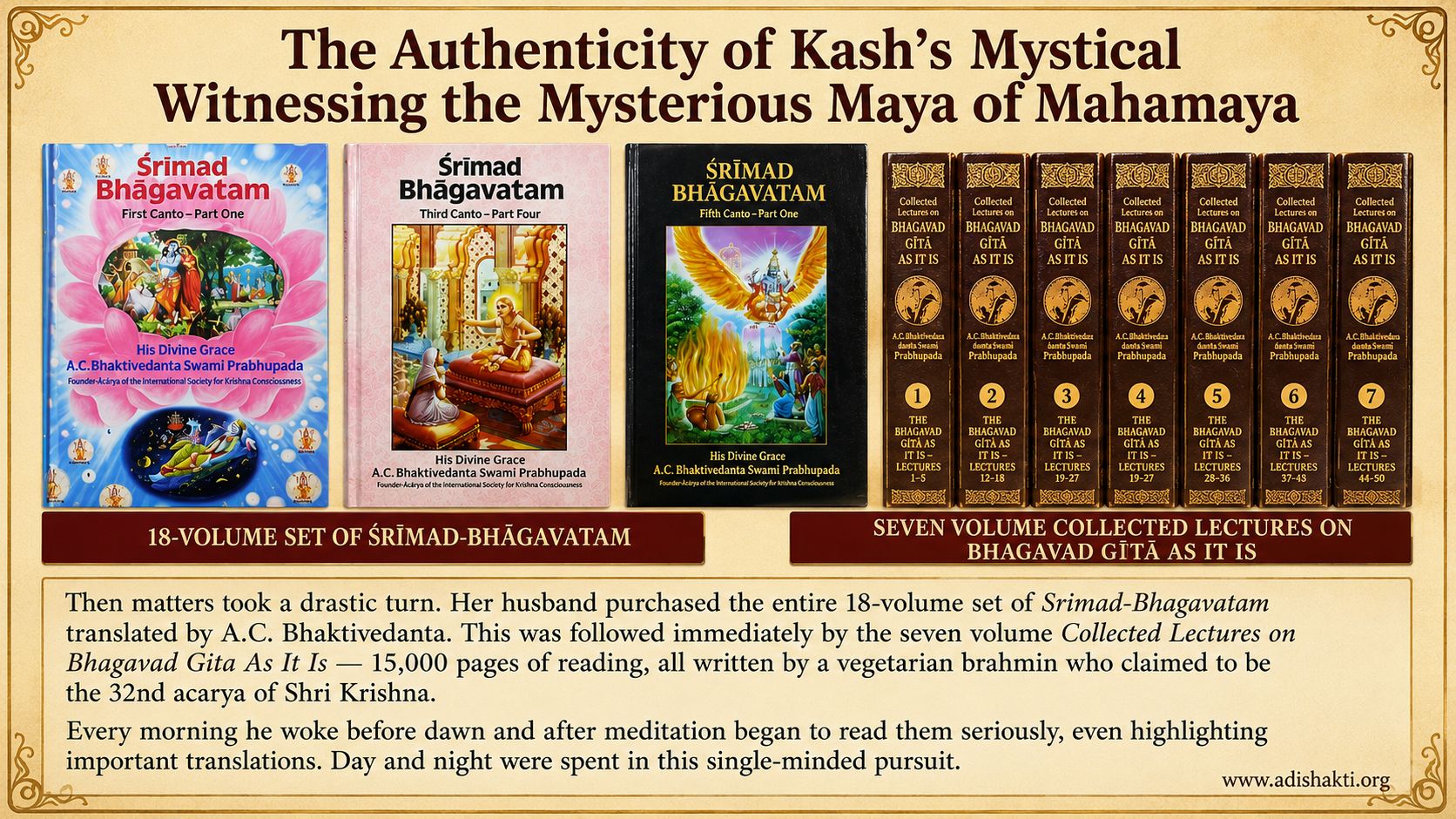
Then matters took a drastic turn. Her husband purchased the entire 18-volume set of Srimad-Bhagavatam translated by A.C. Bhaktivedanta. This was followed immediately by the seven volume Collected Lectures on Bhagavad Gita As It Is — 15,000 pages of reading, all written by a vegetarian brahmin who claimed to be the 32nd acarya of Shri Krishna.
Every morning he woke before dawn and after meditation began to read them seriously, even highlighting important translations. Day and night were spent in this single-minded pursuit.
As the family watched him from a distance the situation slowly deteriorated. In the end Kash's mother had no choice but to seek the help of Shri Adi Shakti to solve this budding fanaticism with Mr. A.C., the founder of ISKCON. She meditated and requested Shri Mataji to help correct her husband.
The very next day a chain of events took place which ended with her spouse praising the books to high heaven, and loudly demanded that his right to search for God through them should not be violated. Puffed-up and self-assured that he — like hundreds of millions of religious humans — was undertaking one of humankind's oldest and noblest quest, angrily told his wife never to interfere in future and blasted her into silence.
Late in the evening when Kash came out of meditation there was a sad look on his face. He explained that Shri Vandaru-Jana-Vatsala Devi was unhappy that his father was arguing about the Holy Scriptures and the search for God. The Great Divine Feminine cautioned that he should read less. This Revelation was stunning and totally unexpected, humiliating the barking ego which whimpered away to lick its badly-wounded pride. Instead of getting a well-deserved pat for pursuing book knowledge, he received a slap on the face from, of all beings, the Great Adi Shakti! And that also right before the entire family.
Kash's mother explained days later that she had meditated and asked Shri Bhakti-priya Devi to help bring her husband to his senses and stop his fanaticism with scriptural knowledge. Immediately Shri Mataji created a drama to rectify the situation. She had witnessed all that was going on, listened to the plea of her devotee in the evening, and created a Maya (illusion) the next morning that made her husband react harshly. Then She informed Kash of Her displeasure, admonished the culprit, and brought a quick end to a lingering family problem.
Despite Her impeccable Guidance the ego still questioned why? Why not the Holy Scriptures? What is wrong with the revealed books? Why should She discourage him from seeking knowledge from these sources?
Over the months as the Rains of Revelation fell the answers came. They were just as startling. These books had been edited, translated, interpreted, and used for power, wealth, disinfornmation, division, and subjugation by all the institutionalized religions. The depth of deception was unbelievable. It was clear that humans remained as religious apes ever since the prophets left. The Great Divine Feminine within was trying Her best to transform him into a man of God with Knowledge that none of the guardians of religious regimes possessed! The Great Adi Shakti was extolling Her ancient devotee to strive for something far higher. She was enlightening him to be his own master and not allow others to spread their ignorance and delude him. She was trying to free him from the shackles of scripture and the limitations of mind.
Vandaru-Jana-Vatsala (349th): Loves Her devotees as Her children.
Bhakti-priya (118th): Fond of devotees. There are various forms of bhakti.
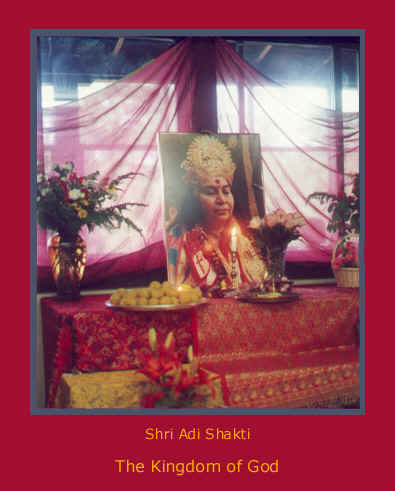
Shri Adi Shakti: The Kingdom of God
Pariah Kutta 1999, p. 504
The Divine Mother's Intervention: A Case Study in Self-Realization
Table of Contents
- 1. Introduction
- 2. The Seeker's Dilemma: A Family in Crisis
- 3. A Mother's Plea and the Divine Response
- 4. The Unveiling of Truth: From Intellect to Experience
- 5. The Goal of Yoga: The Mother Within
- 6. Conclusion: The Universal Lesson for Modern Seekers
- 7. The Deeper Significance: Spiritual Ego and the Path to Liberation
- 8. The Corruption of Scriptures: A Call to Inner Verification
- 9. The Kundalini: The Mother Within as the Ultimate Guide
- 10. The Universal Applicability of This Teaching
- 11. References
1. Introduction
The pursuit of Self-realization, the ultimate goal of Yoga, represents humanity's most profound quest: the journey to realize one's own true, divine nature. While sacred scriptures have historically served as the primary maps for this journey, they can paradoxically become a labyrinth of delusion. The Bhagavad Gita prophesied this very challenge, warning that a mind wavering in scriptural contradictions must find stillness in divine contemplation to attain liberation. This paper presents a focused analysis of a modern-day case study that vividly illustrates this principle: the story of how the Divine Mother, the Adi Shakti, responded to the heartfelt plea of a wife and mother, Kash's mother, to rescue her husband from the throes of religious fanaticism and guide him toward genuine Self-realization.
This academic paper will explore the essence of this transformative experience, concentrating on the Divine Mother's precise and psychologically astute intervention. By examining the narrative of Kash's father—a sincere seeker lost in the intellectual pursuit of truth—we can extract profound lessons on the nature of spiritual ego, the limitations of scriptural knowledge, and the paramount importance of direct, inner experience. The account serves as a powerful testament to the workings of divine grace and offers a clear, universally applicable model for understanding the shift from religious dogmatism to authentic spiritual awakening. Ultimately, this analysis aims to illuminate the path to Self-realization, not as an abstract ideal, but as a living, achievable reality facilitated by the inner divine power, the Kundalini, referred to as the Mother within.
2. The Seeker's Dilemma: A Family in Crisis
The Bhagavad Gita offers a timeless warning to spiritual aspirants, foreseeing an age where the sheer volume of religious texts would become a source of confusion. Lord Krishna declares:
When thy mind leaves behind its dark forest of delusion,
Thou shalt go beyond the scriptures of times past and still to come.
When thy mind, that may be wavering in the contradictions of many scriptures,
Shall rest unshaken in divine contemplation,
Then the goal of Yoga (Self-realization) is thine.[1]
This ancient prophecy found a stark and painful manifestation in the life of Kash's family. The narrative describes his father as a man who, after his own spiritual awakening (Self-realization), embarked on a sincere and intense quest for knowledge. He voraciously consumed a vast library of holy books from various traditions, including the Bhagavad-Gita, Srimad-Bhagavatam, Qur'an, Bible, and Guru Granth Sahib. His intention was noble: to understand the unifying truths linking these diverse scriptures to the revelations of the Great Divine Mother. This intellectual pursuit, however, soon devolved into a form of fanaticism that threatened his personal well-being and the harmony of his family.
The turning point arrived with his acquisition of the entire 18-volume Srimad-Bhagavatam and the seven-volume Collected Lectures on Bhagavad Gita As It Is by A.C. Bhaktivedanta. This colossal collection, totaling over 15,000 pages, consumed him entirely. He became a recluse in his own home, dedicating his days and nights to reading and highlighting passages, neglecting his familial duties and relationships. His wife's gentle attempts to encourage balance were met with angry justifications rooted in his scriptural studies. The irony was profound: in his zealous search for God through books, he was becoming blind to the divine presence in his own family and deaf to the voice of love and reason. This is the classic seeker's dilemma, where the tools of liberation become the very chains of bondage, and the pursuit of knowledge inflates the ego rather than dissolving it. The family crisis had reached a breaking point, setting the stage for a desperate plea for divine help.
3. A Mother's Plea and the Divine Response
Faced with a husband lost in a self-imposed 'dark forest of delusion,' Kash's mother turned to the only recourse she had left: the Divine Mother herself. In the quiet of her meditation, she surrendered her problem, pleading with the Great Adi Shakti, Shri Mataji Nirmala Devi, to intervene and correct her husband's burgeoning fanaticism. This act of pure devotion, born not of selfish desire but of selfless love for her husband and family, became the catalyst for a profound and masterfully orchestrated divine intervention. The response was not a thunderous command or a dramatic miracle, but a subtle and psychologically sophisticated play—a lila—that used the husband's own ego as the instrument of its undoing.
The very next morning, the divine drama began to unfold. Provoked by his wife's renewed concerns, Kash's father reacted with an outburst of anger, loudly demanding that his right to study scriptures be respected. This display of pride and temper, which he perceived as a victory, was in fact the trap of Maya (divine illusion) that the Divine Mother had set. She allowed his ego to inflate to its peak, making its subsequent deflation all the more transformative. The climax arrived that evening when his son, Kash, emerged from meditation with a message. He sadly informed his father that the Divine Mother was unhappy with him for arguing with his wife over the scriptures. She had cautioned that he should read less and focus more on his inner spiritual development.
This revelation, delivered through his own child in the presence of the entire family, was a devastating blow to the father's spiritual pride. He had expected praise for his scholarly diligence but instead received a direct and public 'mental slap' from the Adi Shakti. The text describes it as the 'worst ever embarrassment of his life.' Yet, this moment of profound humiliation was also the moment of his liberation. The Divine Mother's intervention was a masterclass in spiritual psychology. She did not condemn the scriptures but the fanatical attachment to them. She did not punish the seeker but humbled the ego that stood in his way. By witnessing the family drama and responding to the mother's heartfelt prayer, she demonstrated her omniscience and compassion, using a subtle and indirect method to bring about a swift and permanent resolution to a deeply entrenched family problem.
4. The Unveiling of Truth: From Intellect to Experience
The Divine Mother's intervention was far more than a mere solution to a domestic dispute; it was a profound spiritual initiation. The initial shock and shame experienced by Kash's father gave way to a period of deep introspection and, eventually, to a series of life-altering revelations. The central question that haunted him was: Why would the Adi Shakti discourage the study of holy books? The answer, which unfolded in the subsequent months, was a radical unveiling of the nature of truth itself. He came to understand that scriptures, while divinely inspired, are inevitably filtered through the flawed lens of human interpretation. The texts assert that these holy books have been 'edited, translated, and interpreted by all religious cults and used to gain power, prestige and wealth.' This stark realization exposed the danger of relying on external, institutionalized sources for spiritual truth.
This insight marked a pivotal shift in his spiritual journey: a movement from the intellectual pursuit of knowledge (jnana) to the direct, experiential path of wisdom (vijnana). The Divine Mother's guidance was a call to transcend the 'religious ape' mentality of blind faith and to cultivate a discerning intelligence capable of verifying truth for oneself. The mechanism for this verification, as taught in Sahaja Yoga, is the awakening of the Kundalini, the divine motherly power dormant within every human. Shri Mataji Nirmala Devi explains that this inner Mother, once awakened, becomes the ultimate guru, providing direct, experiential knowledge that can be felt on the central nervous system as cool vibrations (Chaitanya). This process of vibrational awareness offers a way to bypass the limitations of the mind and its endless debates over scriptural meaning.
Shri Mataji's teachings emphasize focusing on the essential truth of one's own being—the Spirit—rather than getting lost in the intellectual weeds of cosmology or theology. She advises: 'What you have to know is very simple, is what are you. You are the spirit and the light of the spirit will tell you everything gradually, as much as you can bear it.'[3] This is the core of the path to Self-realization: a journey from the external authority of books to the internal authority of the Spirit. The Divine Mother was not just solving a problem; she was freeing her devotee from the 'shackles of scripture and the limitations of mind,' guiding him from being a reader of truth to becoming a knower of truth.
5. The Goal of Yoga: The Mother Within

The ultimate goal of Yoga is Self-realization (Atma-jnana), a state of being where the individual consciousness merges with the universal consciousness, the Spirit. The Bhagavad Gita describes this as a mind 'unshaken in divine contemplation.' The journey of Kash's father, guided by the Divine Mother, reveals that this state is achieved not through intellectual prowess but through the awakening of the Kundalini, the inner divine power. This primordial energy, described as the 'Mother within,' is the key to unlocking the gate of Self-realization. The provided texts highlight the cosmic significance of Shri Mataji Nirmala Devi opening the universal Sahasrara (the crown chakra) on May 5, 1970, an event that enabled this process to occur on a mass scale for the first time in human history.
The practice of Sahaja Yoga, established by Shri Mataji, is the practical method for this awakening. It is 'Sahaja,' meaning spontaneous and born with you. The Kundalini, once awakened, rises through the central channel, nourishing the subtle energy centers (chakras) and connecting the individual's consciousness to the all-pervading power of divine love. This connection manifests as 'thoughtless awareness' (Nirvichara Samadhi), a state of profound inner silence where the joy of the Spirit can be experienced directly. The beauty of this path lies in its simplicity and accessibility. It is a direct, experiential journey that requires no blind faith, only the sincere desire to know one's true Self.
The Divine Mother's response to Kash's mother's plea was, therefore, fundamentally about activating this inner mechanism. By humbling her husband's ego, she cleared the path for his Kundalini to do its work. The 'Mother within' is the ultimate guide, the infallible guru who 'will never compromise with the son,' meaning she will not allow the ego to persist in its delusions. This is the essence of the Divine Mother's achievement: she has not just taught the path to Self-realization, but has given the very key to its attainment to all of humanity. The adishakti.org website serves as a vast repository of this knowledge, a digital testament to her mission and a guide for seekers to verify the truth for themselves through their own direct experience.
6. Conclusion: The Universal Lesson for Modern Seekers
The story of Kash's father is a timeless and universal parable for the modern spiritual seeker. It encapsulates the profound choice between the dead letter of religious dogma and the living spirit of direct experience. The Divine Mother's response to a wife's desperate plea was a divine masterstroke that illuminated the path of liberation for all who are caught in the 'dark forest of delusion.' Her intervention demonstrates that true spiritual progress is not measured by the accumulation of knowledge but by the cultivation of humility, balance, and love. It teaches that the ego, even when cloaked in spiritual pursuits, remains the primary obstacle to Self-realization and must be humbled for grace to descend.
This narrative powerfully affirms Swami Vivekananda's vision of a universal religion 'centred on aiding humanity to realise its own true, divine nature.'[2]
If there is ever to be a universal religion, it must be one which will have no location in place or time, which will be infinite like the God it will preach, and whose sun will shine upon the followers of Krishna and Christ, on saints and sinners alike; which will not be Brahmanic or Buddhist, Christian or Mohammedan, but the sum total of all these, and still have infinite pace for development; which in its catholicity will embrace in its finite arms, and find a place for every human being, from the lowest groveling savage not far removed from the brute, to the highest man towering by the virtues of his head and heart above humanity, making society stand in awe of him and doubt his human nature.
It will be a religion which will have no place for persecution or intolerance in its polity, which will recognize divinity in every man and woman, and whose whole scope, whose whole force, will be centred on aiding humanity to realise its own true, divine nature.”
The Divine Mother's work, through the establishment of Sahaja Yoga and the vast digital archive of adishakti.org, is the fulfillment of this vision. She has provided a practical, accessible, and verifiable method for any individual to awaken their inner divine power and experience their own true Self. The transformation of Kash's father from a religious fanatic to a humble devotee is a microcosm of the larger shift in consciousness that the Divine Mother has come to inaugurate: a shift from a religious identity based on external authority to a spiritual identity based on internal realization.
In an age saturated with information and plagued by religious conflict, the Divine Mother's message is more relevant than ever. The path to truth lies not in more books or more doctrines, but in the silence of 'thoughtless awareness,' where the 'Mother within' can guide us. The goal of Yoga is not a distant ideal but a present reality, a birthright for every human being. The Divine Mother has opened the gate; it is for each of us to have the sincere desire to step through it and experience the eternal, blissful consciousness that is our true nature.
7. The Deeper Significance: Spiritual Ego and the Path to Liberation
To fully appreciate the Divine Mother's intervention, one must understand the subtle but profound psychological dynamics at play in Kash's father's spiritual journey. His case exemplifies a phenomenon well-documented in spiritual traditions: the problem of spiritual ego, or what might be termed 'spiritual materialism.' This occurs when the ego, rather than being transcended, merely redirects its energy toward spiritual pursuits, creating a new form of identification and pride. Kash's father's accumulation of scriptural knowledge, his disciplined meditation schedule, and his meticulous highlighting of sacred passages were all ostensibly spiritual activities. Yet they had become vehicles for ego-enhancement rather than ego-dissolution. He had begun to identify himself as a serious spiritual scholar, a devoted seeker, a keeper of divine wisdom. This identification, while appearing spiritual on the surface, was actually preventing the very transformation he sought.
The distinction between knowledge and wisdom is crucial here. Knowledge (jnana) is the accumulation of information, the intellectual understanding of concepts and ideas. Wisdom (vijnana) is the direct, experiential realization of truth, integrated with compassion and humility. Kash's father had accumulated vast knowledge but had not yet developed the wisdom to balance it with his familial duties and to recognize the limitations of the intellect. His wife's gentle pleas for balance were not rejections of his spiritual path but invitations to integrate his spiritual pursuits with the responsibilities of love and family. His resistance to these pleas, justified by scriptural arguments, revealed the presence of ego masquerading as devotion. The Divine Mother's intervention, therefore, was not merely corrective but transformative at the deepest psychological level. By orchestrating a situation in which his ego was exposed and humiliated, she provided him with the opportunity to see through the illusion of his spiritual identity and to recognize that true spirituality is incompatible with pride, anger, and the neglect of those we love.
This insight has profound implications for all sincere seekers. It suggests that spiritual progress is not measured by the amount of knowledge accumulated or the number of spiritual practices performed, but by the degree to which one embodies qualities such as compassion, humility, balance, and inner peace. A person who reads fewer scriptures but treats their family with love and respect is more spiritually advanced than a person who has memorized entire libraries of sacred texts but pursues knowledge with pride and arrogance. The Divine Mother's guidance to Kash's father to 'read less and focus more on inner development' was not a rejection of knowledge but a call to prioritize inner transformation over outer accumulation. This is a lesson of universal relevance for the modern seeker, who is often overwhelmed by the sheer volume of spiritual information available and may mistake the pursuit of knowledge for the pursuit of truth.
8. The Corruption of Scriptures: A Call to Inner Verification
One of the most challenging aspects of the Divine Mother's teaching, as revealed through her response to Kash's father, is her assertion that scriptures have been corrupted, edited, and misinterpreted by religious institutions for purposes of power and control. This claim deserves careful examination, as it strikes at the heart of religious authority. Historical scholarship has indeed documented numerous instances of scriptural corruption and mistranslation. The Bible has undergone countless translations, each reflecting the theological biases of the translators. The Qur'an has been subject to various readings and interpretations. The Hindu scriptures, while often presented as eternal and unchanging, have been subject to numerous commentaries and interpretations that sometimes contradict one another. Beyond these historical facts, there is a more fundamental philosophical point: even if a scripture were perfectly preserved, the very act of interpretation introduces the biases and limitations of the human mind.
A text, no matter how sacred, is ultimately a finite expression of infinite truth. It is a map, not the territory. The danger arises when seekers mistake the map for the territory, when they become so absorbed in the study of the text that they forget the living reality it is meant to point toward. The Divine Mother's caution against excessive scriptural study is, in this sense, a call to move beyond the letter of the text to the spirit that animates it. This perspective does not dismiss the value of scriptures, but rather places them in their proper context. Scriptures are valuable as pointers, as guides, as repositories of the wisdom of past enlightened beings. But they are not the goal itself. The goal is the direct experience of the divine, the realization of one's true Self. In this sense, the Divine Mother's teaching aligns with the ultimate message of many spiritual traditions, which consistently point beyond themselves to the direct experience of the divine.
The Upanishads speak of Brahman, the ultimate reality, as that which is beyond all words and concepts. The Buddhist tradition speaks of the Tathata, or suchness, which cannot be captured in language or conceptual thought. The Christian mystics speak of the Godhead, which is beyond all images and concepts. All of these point to the same truth: that the ultimate reality transcends all scriptural formulations and can only be known through direct experience. The Divine Mother's teaching is a call to move beyond the endless debates over scriptural interpretation and to awaken the inner mechanism through which this direct experience becomes possible. This mechanism is the Kundalini, the inner Mother, who provides a means of verification that is not dependent on intellectual understanding or the authority of any external institution.
9. The Kundalini: The Mother Within as the Ultimate Guide
Central to understanding the Divine Mother's mission and her response to Kash's mother's plea is the concept of the Kundalini, the primordial energy that lies dormant at the base of the human spine. In Hindu philosophy and tantra, the Kundalini is described as the divine feminine power, the Shakti, which when awakened, rises through the subtle energy channels of the body, activating and purifying the spiritual centers known as chakras. This awakening is not a metaphorical or psychological phenomenon, but a tangible, verifiable experience that can be felt as cool vibrations, or Chaitanya, on the palms of the hands and the top of the head. The Divine Mother's approach to Kash's father's problem was fundamentally rooted in this understanding: that true spiritual transformation comes not from the accumulation of intellectual knowledge, but from the awakening and nurturing of this inner divine power.
The Kundalini, as described in the provided texts, is 'the caring, nourishing Power' within each human being, a maternal force that guides the seeker toward their true nature. Unlike external gurus or scriptural authorities, the Kundalini 'will never compromise with the son,' meaning it will not allow the ego to persist in delusion or fanaticism. This is why the Divine Mother's intervention was so effective: she was not imposing an external authority, but awakening the recognition of the inner authority, the Kundalini within, which could guide Kash's father toward true wisdom. The concept of the Kundalini as the 'Mother within' is revolutionary in its implications, for it suggests that each individual has access to divine guidance from within, independent of any external institution or scripture. This democratization of spiritual authority is one of the most significant aspects of the Divine Mother's mission.
The process of Kundalini awakening, as practiced in Sahaja Yoga, is described as 'Sahaja,' which means 'spontaneous' or 'born with you.' This indicates that the awakening of the Kundalini is a natural process that occurs when the conditions are right, without requiring arduous practices or intellectual understanding. The Divine Mother has made this process available to all sincere seekers, regardless of their background, education, or prior spiritual experience. Once the Kundalini is awakened, the seeker enters a state of continuous spiritual evolution, where the inner divine power gradually purifies the subtle energy system, removes blockages, and guides the individual toward the ultimate goal of Self-realization. This is the mechanism through which the goal of Yoga becomes a practical, achievable reality for all of humanity in the present age. The Divine Mother's response to Kash's mother's plea was, therefore, fundamentally about activating this inner mechanism in her husband, clearing away the obstacles of ego and fanaticism so that his Kundalini could do its transformative work.
10. The Universal Applicability of This Teaching
While the story of Kash's father is rooted in a specific family context, the lessons it contains are universal and apply to all sincere seekers, regardless of their religious background or cultural context. The problem of scriptural contradiction, the challenge of spiritual ego, and the need for direct experiential realization are universal human concerns that cut across all cultures and religions. In the Christian tradition, the concept of the Holy Spirit as the inner guide and teacher resonates with the Divine Mother's teaching about the Kundalini as the inner Mother. In the Islamic tradition, the concept of the Ruh, or Spirit, as the breath of God within each being parallels the understanding of the Kundalini as the divine life force. In the Jewish mystical tradition, the concept of Shekinah, the feminine presence of God, aligns with the recognition of the Divine Feminine as the ultimate source of all creation and transformation.
The universality of the Divine Mother's message is further demonstrated by the comprehensive nature of the adishakti.org website, which draws upon wisdom from all major spiritual traditions and shows that the core truths she teaches are recognized across all cultures and religions. The opening of the Sahasrara chakra on May 5, 1970, was not an event confined to any particular religion or culture, but a cosmic event that affected the entire human consciousness. The activation of the Primordial Kundalini that followed this event has made it possible for millions of individuals from all backgrounds, religions, and cultures to experience direct spiritual realization. This is the true fulfillment of Swami Vivekananda's vision of a universal religion—not a new religion that replaces all others, but a universal spiritual principle that transcends all religions and unites all of humanity in the recognition of their common divine nature.
11. References
[1] Mascaro, Juan. The Bhagavad Gita. Penguin Classics, 1962, verses 2:52-53.
[2] Vivekananda, Swami. "Paper on Hinduism." Read at the Parliament of Religions, Chicago, September 19, 1893. Complete Works of Swami Vivekananda, vol. 1.
[3] Devi, Shri Mataji Nirmala. Teachings on Kundalini and Self-Realization, as documented on adishakti.org.
[4] "Adi Shakti: The Divine Feminine." adishakti.org. Accessed December 2025. https://adishakti.org/index.htm
💬 Interactive Chat
Explore this article, its sources, and the relationships among its theological and evidentiary claims.
Open chat →