The Authenticity of Kash’s Mystical Witnessing of Shri Mataji’s Opening of the Kingdom of God (Sahasrara)
A source-critical and comparative study centered on the authenticity of Kash’s reported May 5, 1994 witnessing of Shri Mataji’s opening of the Sahasrara: the misframed question, alleged absence of prior knowledge, the distinctive fire–water sequence, documentary chronology, and competing explanations.
The Opening of the Sahasrara Chakra
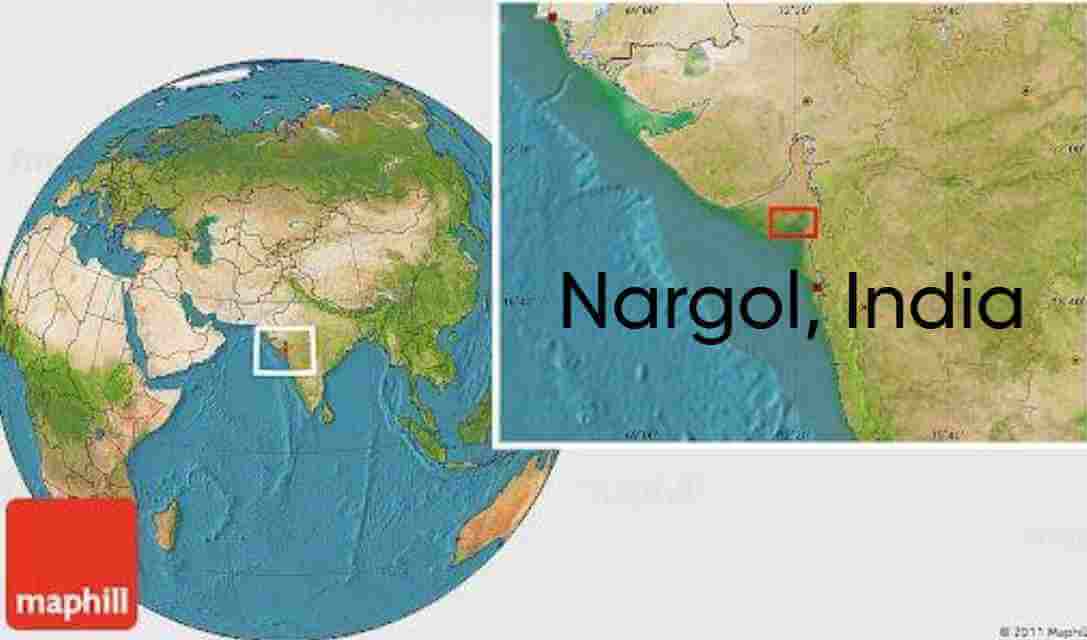
May 5, 1970 at Nargol, India
“May 5th, 1994, was waited with much anticipation. It was on this day that Shri Mataji Nirmala Devi, after a sustained meditation into the early hours of the morning, had opened the Sahasrara Chakra on May 5, 1970. She accomplished this awesome feat by immersing Her Lotus Feet in the Indian Ocean, off the coast of Nargol (about 150 miles from Mumbai, India), and entering a state of Supreme Samadhi that has no parallel. It is nothing short of a superhuman feat, beyond anything known to humans.
Kash had absolutely no idea of any of the above facts. Neither did his family know any better. Instead of instructing Kash to ask Shri Mataji Nirmala Devi how She opened the Sahasrara Chakra, his father told him to ask Her how She got Self-Realization! Kash questioned what was the meaning of Self-Realization, but was told to get all his answers from the Great Regina Apostolorum, the Queen of the Apostles. (Actually Kash’s father just casually wanted to get some facts, expecting a short verbal answer. He was totally unprepared for possibly the most enlightening divine Revelation ever witnessed.)
Kash squatted on the floor in meditation. The state of Sahaj Samadhi was quickly attained as the Kundalini rushed up from the base of the spine into the Sahasrara, the Kingdom of God that Shri Jesus kept repeating to ignorant, hostile humans two thousand years ago. In a flash he transcended the physical limitations that still imprison ignorant, arrogant modern humans.
The Light shone ever so brilliantly from above the Immortal Throne of the Great Celestial Mother as Shri Param-jyotih Shri Nirmala Devi sat in Bliss and Joy. Her child bowed down and exchanged greetings, noticing that all the Divine Beings were already gathered at Her place in advance. He bowed to all of them and exchanged greetings. They did the same in return.
The Great Primordial Guru got down from the Timeless Throne and walked to him. Kash noticed that Shri Maha Avatar Shri Nirmala Devi was wearing a crown. He asked if he could request something from Her. Shri Mataji smiled and told him that She already knew why he had come. Kash, slightly surprised, innocently asked Her what it was. She replied that he wanted to know how She had got Her Self-Realization, exactly as had been discussed a short while ago on Earth.
Shri Mataji then walked back to Her Eternal Throne and sat on it. Kash, who followed behind as instructed, noticed that it was made of solid gold and had a cushion on it. He sat down beside Her on the ground, on the right of Her Throne. Beside him was Shri Hanuman in one of His best dress Kash had seen. The Lord of the Angels smiled at him. He returned the smile. Beside Shri Hanuman was Shri Jesus. On the left side of the Timeless Throne was Shri Ganesha. He noticed that as usual the entire Divine Unity — Shri Buddha, Radha, Krishna, Shiva, Prophet Muhammad, Guru Nanak, and others — were sitting on the ground in a semicircle, with the Great Sacred Mother in the middle. All were in their normal meditative stance; squatting on the soft clouds with both hands at their knees, palms facing upwards — precisely as Sahaja Yogis on Earth. Their spiritual form was of a ‘solid’ state, that is, it had form. For example, the clothes that they were wearing conformed to the contours of their squatting forms.
When all were ready a 3D projection materialized in mid-air before them. It showed the feet of the Great Primordial Mother immersed in water, just above the ankles. The whole visual apparition was suspended in mid-air. It was like a drive-in theater but with a huge difference. Not only was the projection three-dimensional but it was stunningly real and alive. It was alive! It had to be as the past was being projected into the present. The Great Eternal Mother and Her Divine Deities were witnessing what transpired on May 5th, 1970 twenty-four years later on May 5th, 1994! In the Kingdom of Sadashiva the most blessed day since creation was being viewed. The Great Adi Shakti was showing the actual past that was still existing in the present, a time dimension way beyond human apprehension. It was even beyond Kash’s ability to visualize it as a projection, so life-like was this spiritual movie.
After about a minute or so the projection moved up Her form. The face of the Great Divine Mother Shri Adhiparasakthi Shri Nirmala Devi was much younger than the Great Divine Mother Shri Adhiparasakthi Shri Nirmala Devi presently on Earth in human form, but older than the Great Divine Mother Shri Adhiparasakthi Shri Nirmala Devi sitting on the Golden Throne. The spiritual form of the Great Adi Shakti in the Sahasrara of Kash was younger than Her two physical forms of May 5, 1970 (when She opened the Sahasrara at Nargol, India) and May 5, 1994 (when She was in Cabella, Italy). Put simply, the Eternal Adi Shakti watching the projection in the Kingdom of God on May 5th, 1994, was younger than both Her past (May 5, 1970) and present (May 5, 1994) forms.
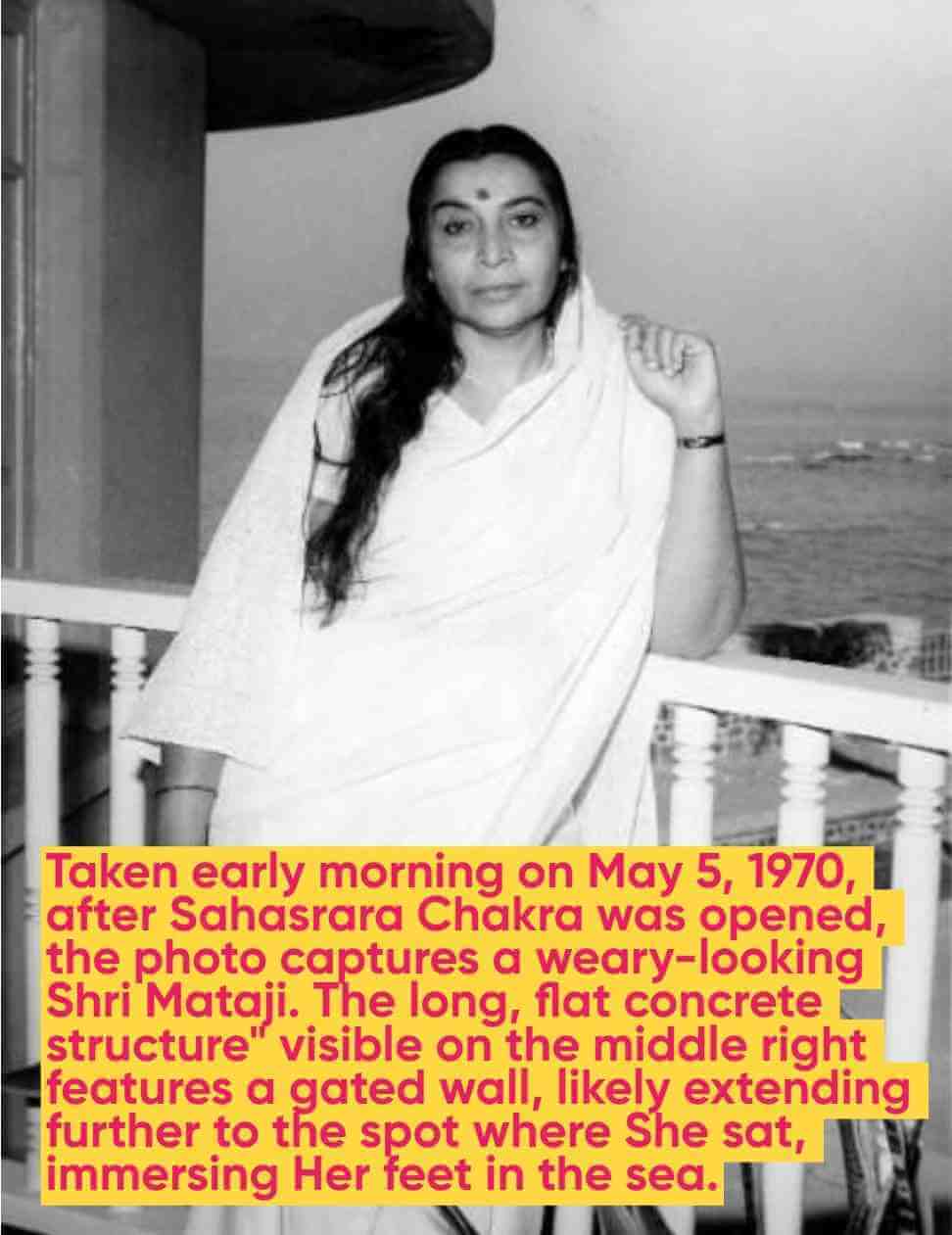
The projection showed Her sitting on a long, flat concrete structure, against a rocky background landscape, and facing the dark watery vastness before Her. Shri Sindura-Tilakancita was wearing a white sari with red borders, and had a bindi on Her forehead. Al-Muzzammil’s (The Enwrapped) Lotus Feet were submerged in the Indian Ocean. She was in deep meditation.
Suddenly red and yellow sparks of light began spewing out from the top of Her head around the Brahmarandhra, bursting about a foot or two into the air. Kash said that these sparks “looked like fireworks,” “like a volcano erupting and shooting lava into the air.” It came out in a steady stream as if there was a fire blazing inside the head of the Great Primordial Guru. Kash could not see the interior of these “fireworks”, “volcanoes,” or “fire” as only the frontal view of the Great Supreme Goddess was projected. For about 10 minutes these “tongues of flame” kept issuing forth from the head of the Great Holy Ghost.
Then the fiery blaze stopped and a fountain of water gushed out of the top of Her Head about three feet into the air. It poured down like rain and the Great Celestial Mother was completely drenched. The Water of Life kept gushing for about 10 minutes. The face of the Great Divine Mother was one of absolute serenity and tranquility as the greatest spiritual feat in the history of this universe — the opening of the Sahasrara Chakra for entering the Kingdom of The Almighty Creator — was undertaken by the Promised Comforter! The Holy Spirit of God Almighty sat completely motionless as the Water of Life kept gushing forth into the air from the Primordial Kundalini within Her.
All the Divine Messengers were in absolute Bliss and tears of Joy rolled down their cheeks. This was the second time Kash saw tears in their eyes. Their Joy was clearly unrestrained and there was good reason for such an extremely rare display of emotion among these Immortal Beings: The human form of the Promised Comforter had achieved the most important task of any divine incarnation — the opening of the Sahasrara Chakra and the salvation of humanity. The Supreme Spirit had activated the Adi Kundalini that would grant humans the power to baptize themselves, evolve into the eternal spirit, and enter the Kingdom of God. At last the Resurrection, the final evolution of Homo sapiens, had become a Reality.
After a while the Fountain of the Water of Life stopped but the Great Formless Mother continued meditating. For another five minutes they watched this visual projection as Shri Adhiparasakthi Shri Nirmala Devi continued sitting with Her Lotus Feet still immersed in the Indian Ocean.
It was now early dawn on this infinitesimally tiny speck of Cosmic Cell known as Earth. All the Messengers of the Universal Soul had again witnessed that dawn of May 5, 1970. They were the first to eyewitness the beginning of the Blossom Time that will enable humans to take a giant leap in Cosmic Consciousness.
Then the projection disappeared completely. The Great Holy Spirit then informed everyone that there would be meditation. Everyone raised their Kundalinis collectively and began meditation. After it was over Kash bowed and thanked the Great Universal Mother for probably the most priceless proof that Shri Adhiparasakthi Shri Nirmala Devi is the Promised Messiah. He asked for permission to leave, bowed to the Divine Unity and closed his spiritual eyes. He then sank down through the clouds of the Kingdom of Heaven and awakened to this hellish world of Alice Cooper and Rockbitch.”
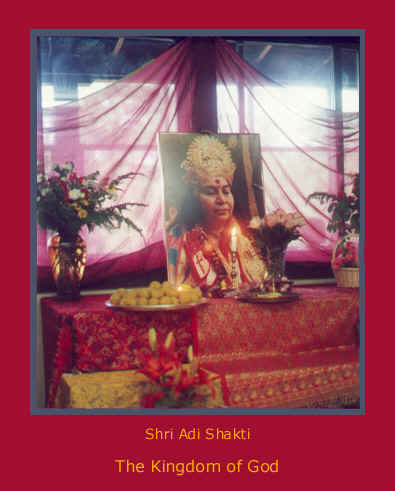
Shri Adi Shakti: The Kingdom of God
Pariah Kutta 1999, p. 278
Shri Mataji’s Testimony (YouTube)
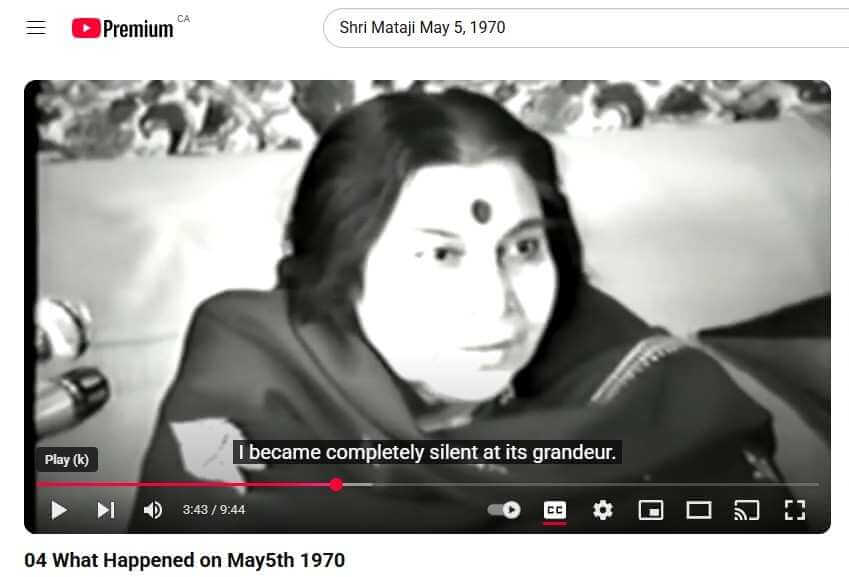
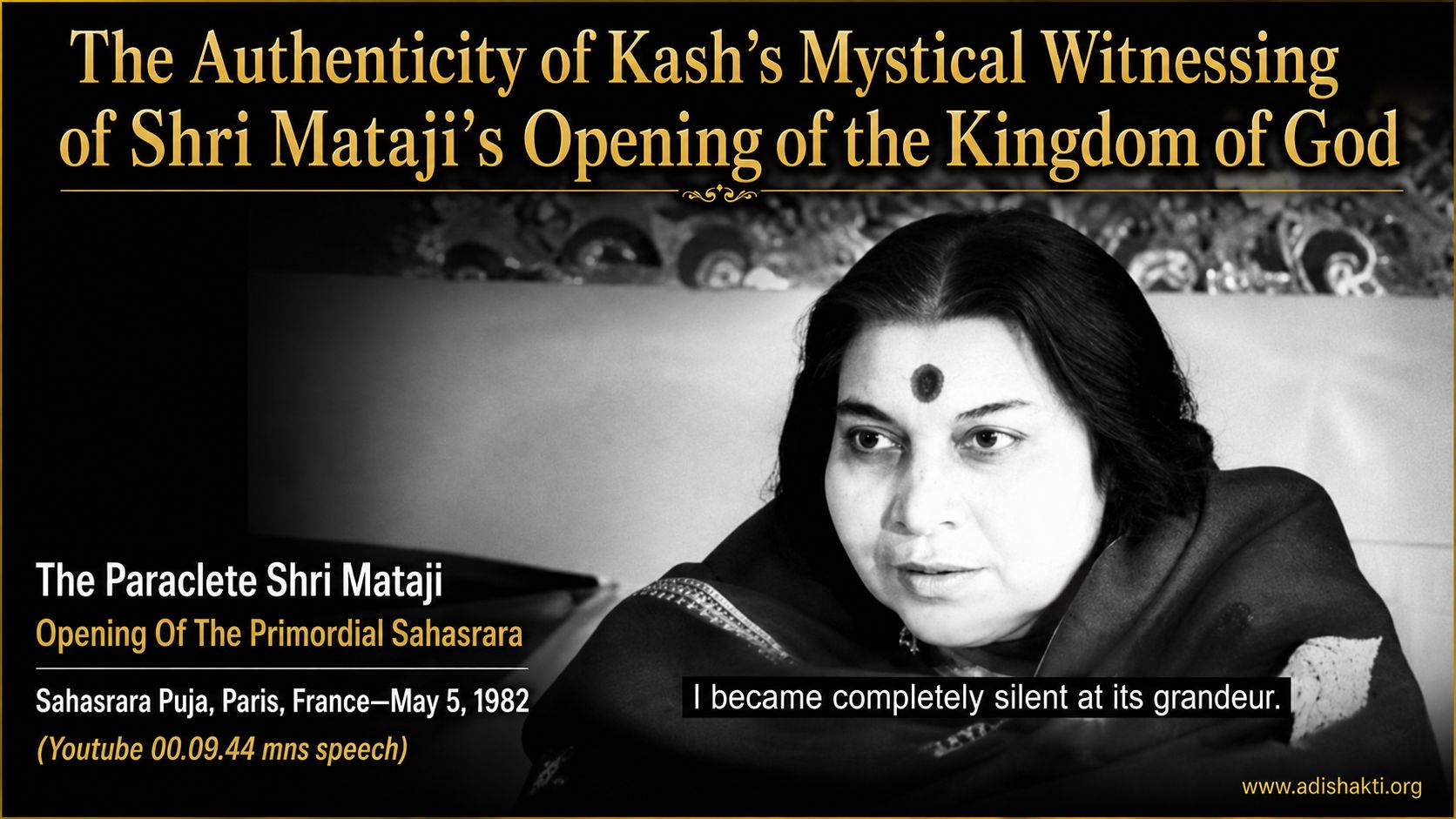
“As soon as the Sahasrara (Kingdom of God within) was opened the whole atmosphere was filled with tremendous Chaitanya. And there was tremendous Light in the sky. And the whole thing came on the Earth — as if a torrential rain or a waterfall — with such tremendous force, as if I was unaware and got stupefied. The happening was so tremendous and so unexpected that I was stunned and totally silent at the grandeur. I saw the Primordial Kundalini rising like a big furnace, and the furnace was very silent but a burning appearance it had, as if you heat up metal, and it had many colors. In the same way, the Kundalini showed up as a furnace, like a tunnel, as you see these plants you have here for coal burning that create electricity. And it stretched like a telescope and came out one after another, Shoo! Shoo! Shoo! Just like that. And the Deities came and sat on their seats, golden seats, and then they lifted the whole of the head like a big dome and opened it, and then this torrential rain complete drenched Me. I started seeing all that and got lost in the Joy. It was like an artist seeing his own creation, and I felt the Joy of great fulfillment. After coming out of this beautiful experience I looked around and saw human beings so blind and I became absolutely silent, and desired that I should get the cups to fill the Nectar.”
The Paraclete Shri MatajiOpening Of The Primordial Sahasrara
Sahasrara Puja, Paris, France—May 5, 1982
(Youtube 00.09.44 mns speech)
Table of Contents
- Abstract
- The Question of Authenticity
- What Kash Reportedly Witnessed
- The Evidential Importance of Prior Knowledge
- The Fire–Water Correspondence
- Chronology and the Cumulative Record
- Testing Alternative Explanations
- Why “Kingdom of God” Matters
- Comparative Religious Context
- Three Levels of Authenticity
- Conclusion
- References and Source Note
Abstract
This paper re-examines the reported May 5, 1994 experience of Kash in which he is said to have witnessed, in Sahaj Samadhi, a living representation of Shri Mataji Nirmala Devi’s opening of the Sahasrara at Nargol on May 5, 1970. Its central concern is not whether mystical reality can be demonstrated by assertion, but whether Kash’s testimony bears marks of authenticity as testimony: temporal proximity to the wider record of his experiences, specificity of reported perception, correspondence with an earlier account attributed to Shri Mataji, the form of the question that preceded the experience, and continuity with a much larger body of reported Sahasrara encounters.
The strongest argument is cumulative. If the source record is accurate that Kash did not know the details of the 1970 event or Shri Mataji’s prior description, then the reported convergence is difficult to reduce to a generic religious image. In particular, the sequence of an eruption at the crown followed by an overwhelming descent of water is more evidentially significant than a broad resemblance such as “light,” “peace,” or “a divine presence.” The paper therefore argues that the episode constitutes a serious case of documentary and phenomenological authenticity within the surviving Adishakti.org corpus. That conclusion is narrower than proving the metaphysical proposition that Kash literally observed a transcendent event of 1970; such a proposition requires evidence beyond the testimony itself.
1. The Question of Authenticity
The decisive question is not simply, “Did Kash have a vision?” A person can sincerely report an experience whose imagery was supplied by memory, suggestion, expectation, or prior teaching. The academically stronger question is: what information did Kash possess before the experience, what was actually asked of him, what did he subsequently report, when was that report recorded, and how specifically does it correspond to information that can be shown to predate it? Authenticity must therefore be investigated through chronology and information flow rather than devotional intensity.
The underlying Sahaja Yoga tradition independently and publicly identifies May 5, 1970 at Nargol, Gujarat as the date and place of Shri Mataji’s opening of the Sahasrara. Official Sahaja Yoga sources also preserve her later descriptions of the event as a decisive opening connected with the possibility of en-masse Self-Realization. The historical existence of this tradition is therefore not dependent upon Kash’s 1994 report. The narrower evidential issue is whether Kash’s reported imagery arose independently of his knowing those descriptions.
2. What Kash Reportedly Witnessed
According to the source narrative, the family approached May 5, 1994 without understanding the details of what Shri Mataji was said to have done on May 5, 1970. Kash’s father reportedly instructed him to ask Shri Mataji how she obtained Self-Realization—a question that, if the account is accurate, was itself mistaken. The experience that followed allegedly did not merely answer that wording. Kash reported a life-like, three-dimensional presentation associated with an earlier Shri Mataji at the seashore, culminating in extraordinary activity at the crown of the head.
The epistemic importance of this detail is easily missed. A leading question such as “Show me the fire and water that came from your Sahasrara at Nargol” would possess almost no evidential independence: the expected answer would already be contained in the prompt. By contrast, the reported question about Self-Realization does not encode the distinctive imagery later described. The mismatch between prompt and reported content therefore becomes one of the case’s central facts, provided the chronology and wording can be established from records independent of later reconstruction.
3. The Evidential Importance of Prior Knowledge
The claim that Kash lacked prior knowledge is the hinge of the authenticity argument. Youth alone proves little. Children can absorb religious ideas indirectly, and family environments transmit vocabulary and expectations without formal instruction. Consequently, “he was a child” cannot carry the argument. What matters is the more precise proposition that the distinctive information reported in the experience had not previously been communicated to him.
The source states that neither Kash nor his family understood the relevant particulars and emphasizes the father’s misframed question as evidence of that ignorance. If contemporaneous notes, early manuscripts, faxes, correspondence, or witnesses establish this sequence, they materially strengthen the case because they constrain the hypothesis of retrospective harmonization. Conversely, if it were shown that Kash had previously heard Shri Mataji’s detailed Sahasrara discourse, the evidential force of the correspondence would diminish sharply. A rigorous argument for authenticity should therefore make this issue explicit rather than hide it: prior exposure is the principal falsifiable vulnerability of the case.
4. The Fire–Water Correspondence
The most important reported correspondence is not the generic presence of sacred light. The source attributes to Kash a sequence in which fiery or volcanic activity appears at the Brahmarandhra/crown, followed by a fountain or descent of water. Shri Mataji’s independently circulating account of the 1970 opening likewise describes the Kundalini in intensely fiery terms and then an overwhelming descent compared with torrential rain or a waterfall. Sahaja Yoga sources preserve this sequence as part of the movement’s account of Nargol.
Specific sequential correspondence matters because the probability of accidental similarity generally decreases as independently specified details accumulate. “A spiritual light appeared” is culturally common. “An eruption-like event at the crown was followed by a powerful water-like descent” is considerably more constrained. The argument becomes stronger still if the order, bodily location, and unusual combination were recorded from Kash before anyone compared his report with Shri Mataji’s earlier description.
This does not mathematically prove paranormal information transfer. It does, however, identify the exact point at which ordinary explanations must do explanatory work. A skeptical account cannot merely say that religious visions often contain symbols. It must ask how this particular witness came to report this particular ordered combination at this particular bodily locus, and whether prior exposure, prompting, editorial alteration, coincidence, or later memory provides the best explanation of the documentary sequence.
5. Chronology and the Cumulative Record
The May 5, 1994 episode should not be isolated from the chronology in which it appears. In the Adishakti.org record, Kash’s reported experiences begin in late 1993 and develop through repeated questioning, meditation, reported encounters, family discussion, written recording, and comparison with religious sources. The Sahasrara-opening episode therefore appears inside an already developing record rather than as a solitary retrospective miracle story invented to explain a later theology.
This cumulative context is important but must be used carefully. A large number of reports does not turn every report into independent corroboration; repeated experiences from one witness remain evidentially dependent in important respects. Yet longitudinal consistency can test a different question: whether the witness repeatedly describes a stable spiritual environment, recurring figures, recognizable protocols, and coherent relationships over time. Where such features precede the specific May 1994 episode, they reduce the plausibility of treating that episode as an isolated literary construction.
The proper unit of analysis is therefore the documented sequence: question, reported experience, immediate or early recording, later comparison, further questioning, and continued testimony. The closer the surviving documents lie to the reported event, and the less they have been rewritten in light of later interpretation, the greater their evidential value.
6. Testing Alternative Explanations
Prior exposure is the strongest conventional explanation. If Kash heard the Nargol story or Shri Mataji’s fire-and-water description beforehand, memory could supply the imagery without conscious fabrication. This hypothesis is empirically testable through family testimony, dated recordings, reading history, correspondence, and the earliest recoverable manuscript.
Suggestion is weaker if the reported prompt was genuinely the mistaken question about Shri Mataji’s Self-Realization, because that prompt does not contain the distinctive answer. Nevertheless, a broader devotional environment could still create expectations about Shri Mataji, Kundalini, chakras, and divine encounters. The authenticity argument is therefore strongest when it rests on details not plausibly supplied by that general environment.
Retrospective editing must also be considered. The published 1999 account is later than the 1994 experience. A critical edition should distinguish Kash’s earliest recoverable words from explanatory material added by adults or editors. Exact dated antecedents are more valuable than later polished prose. This is not a reason to discard the testimony; it is a reason to establish its textual history.
Coincidence remains logically possible. Yet coincidence becomes less satisfying as the comparison moves from broad archetypes to an ordered cluster of unusual details. The academically defensible conclusion is therefore comparative: if prior exposure and later harmonization can be excluded to a reasonable degree, the fire–water sequence becomes a genuinely anomalous correspondence requiring explanation.
7. Why “Kingdom of God” Matters
The Adishakti.org interpretation identifies the opened Sahasrara with the Kingdom of God within. This is a theological interpretation rather than a neutral historical fact, but it gives the testimony its larger significance. The reported event is not presented merely as Kash seeing an episode in Shri Mataji’s biography. It is presented as witnessing the opening of an interior divine threshold that subsequently becomes accessible through Self-Realization.
This framing changes the evidential question. If the testimony is authentic in the strong experiential sense, its subject is not only “what happened to Shri Mataji in 1970” but what Kash believed he was entering and witnessing in 1994. His experience becomes part of the claimed consequence of the 1970 opening: a human being entering an interior realm and encountering a living presentation of the event by which access to that realm was said to have been collectively opened.
8. Comparative Religious Context
The paper’s comparative framework is most useful when it identifies structural analogies without pretending that different traditions teach identical doctrines. Christian language of the Kingdom of God, Hindu accounts of Sahasrara and Brahmarandhra, Sikh references to the Dasam Duar, Qur’anic language concerning signs in the horizons and within human selves, and Buddhist crown or great-bliss symbolism arise from distinct textual and historical worlds. They should not be collapsed into a single vocabulary.
Nevertheless, the comparison illuminates why Kash’s reported experience is interpreted as more than private imagery. Across these traditions one repeatedly encounters an interior threshold, transformation of consciousness, divine presence, illumination, or ascent beyond ordinary awareness. Adishakti.org’s theological claim is that the Sahasrara supplies a concrete experiential locus for this convergence. Scholarship can describe and test that claim comparatively without assuming in advance that all traditions refer to one metaphysical structure.
9. Three Levels of Authenticity
Documentary authenticity asks whether the account can be traced to Kash’s report and how early its distinctive details were recorded. On the presently cited corpus, there is a serious documentary case, but its strength ultimately depends on access to the earliest dated records and their textual history.
Phenomenological authenticity asks whether Kash appears to have reported an experience he genuinely underwent rather than consciously fabricated. The specificity, internal coherence, integration with a longer sequence of experiences, and absence of an obvious self-aggrandizing function support taking the report seriously as lived testimony. This conclusion does not require a scholar to accept its supernatural interpretation.
Metaphysical authenticity asks whether Kash actually perceived an objective spiritual reality and a real trans-temporal disclosure of the 1970 opening. Testimony alone cannot compel that conclusion under ordinary historical or scientific standards. Yet the inability to prove a metaphysical interpretation is not equivalent to disproving it. The rational question is whether the documentary pattern contains information sufficiently independent and specific to make purely ordinary explanations inadequate.
10. Conclusion: The Authenticity Case Rests on Information, Not Devotion
The strongest case for the authenticity of Kash’s witnessing of the opening of the Kingdom of God is not that the story is spiritually impressive. It is that the report allegedly contains specific information whose relationship to the witness before the experience can, in principle, be investigated. The father’s reported misframed question, Kash’s alleged lack of knowledge of the 1970 event, the crown-centered fire followed by water, the anniversary date, and the episode’s place inside a pre-existing sequence of reported Sahasrara experiences together form the evidential core.
If the earliest documents confirm that the distinctive fire–water sequence was recorded before Kash or his family encountered Shri Mataji’s corresponding account, the case becomes substantially stronger than a generic visionary resemblance. Under that condition, explanations based on direct prompting become particularly strained, and prior exposure or later textual harmonization must carry most of the skeptical burden. If those alternatives are not supported by the documentary history, the correspondence remains a significant anomaly.
The most defensible academic conclusion is therefore both affirmative and bounded: Kash’s May 5, 1994 report merits treatment as a serious and potentially evidential mystical testimony, with substantial grounds for documentary and phenomenological authenticity within the surviving corpus. The testimony does not by itself establish, to universal scientific standards, that the collective Sahasrara was metaphysically opened in 1970. But neither can that limitation legitimately be converted into a dismissal of the testimony. The decisive scholarly task is to reconstruct the earliest record, establish information independence, and test the unusual correspondences against competing explanations. On that basis, the episode stands as one of the most important authenticity claims in the Kash corpus because it offers something stronger than devotional assertion: a potentially testable relationship between a reported experience and a pre-existing description of the event it purported to disclose.
References and Source Note
Primary Adishakti.org source: Shri Adi Shakti: The Kingdom of God (1999), cited in the source page for Kash’s May 5, 1994 testimony. The source page should be retained alongside the earliest available manuscripts, notes, correspondence, or other dated records when preparing a critical edition.
Sahaja Yoga tradition: Official Sahaja Yoga sources identify Nargol, Gujarat, and May 5, 1970 with Shri Mataji’s opening of the Sahasrara and preserve her description of the event as foundational to collective Self-Realization.
Methodological note: This paper distinguishes the authenticity of a testimony as a historical document, the authenticity of an experience as sincerely lived, and the truth of the metaphysical interpretation placed upon that experience. These questions are related but not interchangeable.
💬 Interactive Chat
Explore this article, its sources, and the relationships among its theological and evidentiary claims.
Open chat →