The Authenticity of Kash’s Witnessing of the Resurrection of Christ
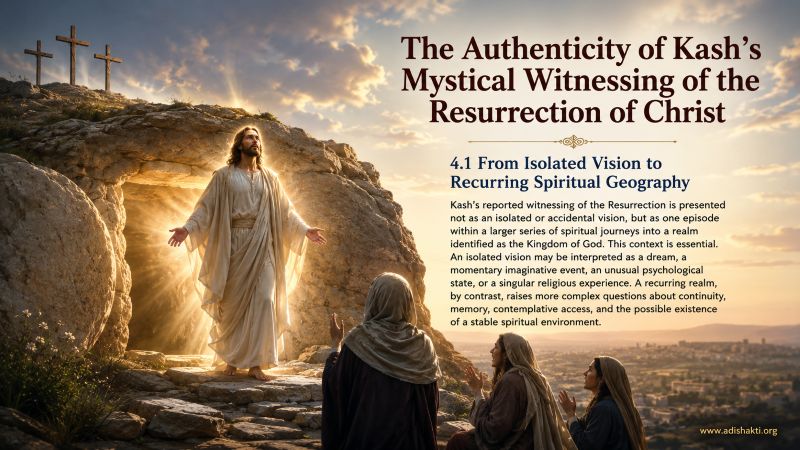
A source-critical academic study centered on the authenticity of Kash’s reported witnessing of the Resurrection: his limited prior knowledge, the specificity of the reported scene, its place within an already developing Sahasrara chronology, and the alternative explanations that must be tested before metaphysical conclusions are drawn.
Abstract
This paper re-examines the report dated Good Friday, April 1, 1994, in which fourteen-year-old Kash is said to have entered Sahaj Samadhi and witnessed a representation of the Resurrection of Jesus Christ under the guidance of Shri Mataji. The purpose is narrower than proving the Resurrection itself. It is to ask whether Kash’s report has evidential features consistent with an authentic mystical testimony: limited prior theological knowledge, a definite initiating question, unusual narrative specificity, continuity with earlier and later reported access to the same spiritual environment, and a record that can in principle be tested against its documentary chronology.
The case is strongest when it is framed around information rather than devotional assertion. Kash reportedly asked what “Resurrection” meant only shortly before the experience. The account then attributes to him a structured scene involving a rock-cut burial place, a radiant light, Jesus emerging in meditation, ascent, a celestial assembly, and the veneration of the risen Christ. These details do not by themselves establish supernatural perception. They do, however, create concrete questions about what Kash knew beforehand, what was suggested to him, what he reported immediately afterward, and how early those details entered the written record. The paper concludes that the episode warrants serious treatment as documentary and phenomenological testimony while distinguishing that conclusion from proof of its metaphysical interpretation.
1. The Authenticity Question
The earlier apologetic form of this argument relied too heavily on propositions such as “a child could not fabricate this” or “only an authentic divine experience could contain such theology.” Those statements are rhetorically strong but academically weak. Children can absorb religious material, imagination can produce complex narratives, and theological coherence does not prove supernatural origin. A more rigorous argument begins elsewhere: chronology, prior exposure, prompting, specificity, textual history and cumulative consistency.
The relevant question is therefore not whether the narrative is impressive. It is whether the surviving evidence supports the proposition that Kash reported an experience whose distinctive content cannot readily be traced to information supplied to him beforehand. That question is investigable. It makes the authenticity thesis vulnerable to contrary evidence and therefore stronger as scholarship.
2. Primary Testimony: April 1, 1994
“On Good Friday, April 1, 1994, on the eve of Lalita's birth, there was a discussion with SY Bhupinder about the Resurrection of Shri Jesus. Kash, who was listening nearby, inquired about the meaning of Resurrection and was explained the little that was known. The Sahaja Yogi suggested that he should ask Shri Mataji if he could witness this unprecedented event, the very heart and soul of Christianity and the cornerstone of Shri Jesus Christ's Message to humans that they are not this physical body but the eternal Spirit.
Kash went into Sahaj Samadhi and the Mother Kundalini within instantly took him to the Kingdom of God. He emerged through the spiritual clouds and reached the Bridal Chamber that the ancient Gnostics had revealed centuries ago. The Everlasting Light shone ever so dazzlingly from above the Eternal Throne as the Great Holy Spirit sat in Bliss and Joy. She greeted him with a smile as Kash bowed to her.
After the usual exchange of greetings he asked if She could show him exactly how the Resurrection of Lord Jesus took place — a feat possible as "everything that was in the past since creation resides dormant in the Collective Subconscious." If Shri Jesus did actually resurrect His corporeal body into the spiritual Self then this supreme feat would still be accessible through the portals of the Time Dimension. The Great Mater Sanctissima agreed to take him two millenniums back!
She stood up, extended Her hands with palms upwards, and told Her child to put his palms above them. As he did so he felt himself being uplifted above the thick, soft carpet of clouds on which they were standing. They started moving and were soon travelling at super light-year speed far beyond human comprehension, back into the past.
At that speed everything became a blur as all familiar celestial landmarks disappeared. The Divine Mother was taking him into a time dimension that the ancients knew existed, and modern scientists acknowledge is possible if one travels faster than time. (The Great Primordial Mother and Kash, both almost weightless spirits in the Kingdom of God, traverse the Universe at far greater light-years per second speeds and cover extremely vast Cosmic ground. Thus travelling centuries into the past just takes seconds.)
Soon they came to the exact spot where Shri Jesus lay buried. About 20-25 Divine Incarnations — Shri Lakshmi, Vishnu, Parvati, Shiva, Sita, Rama, Radha, Krishna, Ganesha, Buddha and others — were already sitting down on the ground in a circle around it. They were all waiting for the arrival of the Supreme Spirit of God, the Great Adi Shakti.
The Spirit of the Living God had taken Kash back into the past to the exact spot and time where one of the most spectacular of God Almighty's Revelations took place. They were just minutes away from Shri Jesus' Resurrection! Kash was in Golgotha, outside the walls of Jerusalem, and about to witness and confirm the most profound proof and Truth ever propounded to the human race — that they are in Reality not this physical body but the Spirit. (This deliberate act of supreme sacrifice to provide living proof of immortality stands heads and shoulders above any sacrifice of God Almighty's Messengers! For this unsurpassed feat Shri Jesus has been bestowed the title of Shri MahaVishnu, the highest honor among the Divine Unity, and no one enters the Kingdom of God without His permission.)
Kash noticed that the burial place consisted of a "hole in a rock." The object plugging the entrance to the burial chamber had apparently been removed, exposing a cavity in the knoll. Though he could not see the actual body as it was dark inside, he knew that the Crucified One was within as the entire Divine Unity of God Almighty had encircled it.
The Spirit of God and Her child joined them and sat in the meditative stance. Suddenly a dazzling ray of Light shone diagonally from the heavens, directly on the tomb of Shri Jesus. As they continued sitting in the meditative positions, Shri Jesus emerged through the rock tomb in deep meditation. The Universal Savior was a Spirit again just like His Celestial Brethren!
Then all present joined the Resurrected One in meditation and rose higher and higher into the heavens. The Light continued shining all the way as they ascended into His Dominion, still in deep meditation.
After emerging through the celestial clouds everyone stood up as they had reached the dwelling place of Shri Jesus. Tears of Joy streamed down the cheeks of the Heavenly Hosts as the Divine Unity humbled before the Universal Savior, in deep appreciation and immense respect for the highest sacrifice any Incarnation had voluntarily undertaken to enact His Divine Drama. Ignorant humans had tortured a member of the Divine Family to death, under the most painful and barbaric conditions. Now His ordeal was finally over and He had triumphed not only over Death but, by forgiving humans, also Evil — a supreme sacrifice and matchless humility that no amount of words can ever do justice.
Before leaving Him the Immortal Ones bowed deeply, one after another in Namaskar before the Son of Man. The whole atmosphere was charged with emotion, and no one spoke a word as they lined to pay respects to a gallant giant of a man.
Shri Ganesha, with hands folded in silence, bowed deeply to the Son of God Almighty. Shri Shiva and Parvati, with hands clasped in Namaskar, bowed in obeisance to the Son of the Creator. Shri Radha and Krishna, with hands joined in humility, stooped low in reverence to the Son of Allah. Shri Sita and Rama, with hands held together, bent down in absolute reverence to the Son of Sadashiva. Shri Buddha, with hands embrace together, bowed His head in speechless deference to the Son of The Maker. Shri Mataji and Kash, with hands held together, bent deeply in sheer veneration to the Son of the Supreme Being.
Then slowly everyone dispersed. Kash asked the Holy Mother for leave and bowed to Her. He then closed his spiritual eyes and slowly began descending from Heaven, back to this humdrum world of boring priests and moronic mullahs.”
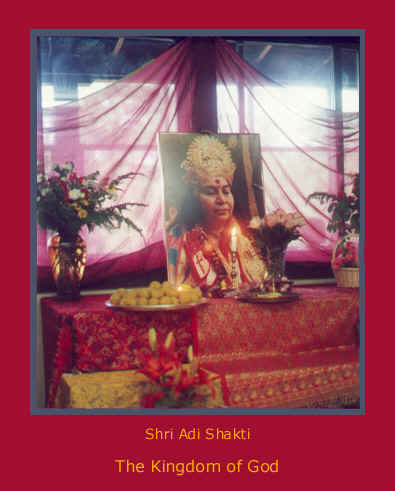
Shri Adi Shakti: The Kingdom of God
Pariah Kutta, 1999, p. 873
Source-critical note. The passage above is preserved from the supplied source page rather than rewritten into the academic argument. Its theological and cosmological assertions belong to the testimony/editorial tradition and should not automatically be treated as independent historical facts.
3. Prior Knowledge and the Information Problem
The source begins with a potentially important admission: Kash was listening to a discussion about the Resurrection, asked what the word meant, and received an explanation described as only “the little that was known.” He was then encouraged to ask Shri Mataji whether he could witness the event. This means the experience was not wholly unprompted. Any rigorous authenticity argument must state that plainly.
Yet prompting and content are not the same thing. Being told that Christians believe Jesus rose from death could explain why a subsequent experience concerned the Resurrection. It does not automatically explain every reported feature of that experience. The evidential task is to reconstruct precisely what Bhupinder and Kash’s father told him before meditation and then compare that information with the earliest recoverable version of what Kash said afterward. The difference between information supplied and information reported is the evidential remainder.
This makes the earliest notes, manuscripts, correspondence and witnesses indispensable. If detailed elements later emphasized in the published account were already recorded before Kash encountered relevant Christian, Gnostic or Sahaja Yoga interpretations, their evidential value increases. If those elements appear only in later edited prose, their independence is correspondingly weaker.
4. Specificity of the Reported Experience
The testimony contains a cluster of concrete motifs: a burial place described as a “hole in a rock”; an entrance already open; darkness within; a concentrated ray of light; Jesus emerging from the tomb in meditation; ascent into the heavens; and a silent celestial response marked by tears, bows and reverence. The narrative also presents Jesus not as an isolated sectarian figure but as one honored by figures identified with Hindu and Buddhist traditions.
Not all of these details have equal evidential weight. A tomb, light and ascent are readily associated with Christian Resurrection traditions. Other elements—especially the meditative mode, the cross-religious assembly and the particular spiritual cosmology—belong more clearly to the Sahaja Yoga/Adishakti interpretive world. The correct scholarly procedure is therefore not to count every detail as independent confirmation, but to identify which details were culturally available to Kash and which, if any, appear unexpectedly without prior exposure.
5. Chronology and the Wider Kash Corpus
The April 1994 report is more significant when placed inside the chronology of Kash’s reported experiences beginning in late 1993. In the Adishakti.org corpus, the Resurrection episode is not presented as a single late-life recollection. It belongs to an evolving sequence in which Kash repeatedly enters what the family calls the Kingdom of God or Sahasrara, reports encounters, returns to ordinary awareness, is questioned, and has those reports recorded and compared with religious material.
A longitudinal corpus cannot by itself prove the objective existence of the realm described. Repetition from one witness is not the same as independent replication. But repetition can test internal stability: whether the reported environment, figures, modes of entry, interpersonal relationships and sequence of questioning remain coherent over time. The more contemporaneous the documentation, the more useful this becomes in distinguishing an evolving record from a narrative reconstructed retrospectively years later.
The Resurrection account should therefore be evaluated as one node in a larger documentary network. The relevant evidence includes what had already been recorded before April 1, 1994, what was written immediately afterward, what was externally circulated before later controversies, and whether later versions materially changed the original description.
6. Christ, Resurrection and the Spiritual Body
The source interprets Kash’s experience as revealing a spiritual rather than merely corporeal meaning of Resurrection: Jesus emerges as Spirit and ascends in meditation. This interpretation should be identified as theological exegesis, not treated as a neutral reconstruction of first-century history. Mainstream Christian traditions have developed multiple sophisticated accounts of bodily resurrection, transformed embodiment and glorification; the Kash narrative enters that debate from a distinctive Sahaja Yoga perspective rather than settling it historically.
For the authenticity question, however, the interpretive novelty matters in another way. If Kash possessed only a rudimentary understanding of Christian doctrine, the emergence of a coherent spiritual-body interpretation becomes a fact requiring explanation. Again, the key is not to declare that complexity proves divine authorship, but to determine when this interpretation first appears in the documentary record and whose vocabulary it originally was.
7. The Cross-Religious Divine Assembly
One of the narrative’s most distinctive features is the gathering of figures identified as Lakshmi, Vishnu, Parvati, Shiva, Sita, Rama, Radha, Krishna, Ganesha and Buddha around Christ. Their reverence functions theologically as a declaration that the Resurrection transcends religious boundaries. Within the Adishakti worldview, this is not decorative symbolism; it expresses a doctrine of the Divine Unity in which the great incarnations belong to one spiritual order.
This feature supports phenomenological continuity with Kash’s wider corpus, where figures from multiple traditions reportedly appear in a common Sahasrara environment. It does not independently prove that those figures were objectively present. Its evidential significance lies instead in whether the same cross-religious structure was already present in earlier reports and remained stable in later ones.
8. Shri Mataji and the Paraclete Interpretation
The source interprets Shri Mataji’s role through John 16:13–14: the Spirit of Truth guides into truth and glorifies Christ. In the narrative, Shri Mataji does precisely what this interpretation emphasizes—she guides Kash to the Resurrection and the resulting scene glorifies Jesus. This is a theological correspondence important to Adishakti.org’s Paraclete thesis.
Academic rigor requires distinguishing correspondence from demonstration. The narrative’s fit with John can be described precisely, but that fit alone cannot establish that Shri Mataji is the promised Paraclete. The stronger authenticity question is chronological: did the reported experience precede the family’s development of this Johannine interpretation? If so, the later scriptural correspondence is more noteworthy than if the text of John had already shaped the expectation and narration of the event.
9. Testing Alternative Explanations
Suggestion is unavoidable because Kash was explicitly encouraged to ask to witness the Resurrection. This explains the subject of the experience but not necessarily its full content. The evidential issue is therefore the extent of suggestion, not its mere existence.
Prior religious exposure could explain tomb, light, ascent and other Christian motifs. The relevant question is what a fourteen-year-old in this family had actually encountered by April 1994. Assertions of “theological illiteracy” should be replaced by documented reading, conversations, schooling, television, church exposure and Sahaja Yoga teaching wherever recoverable.
Imagination or dreamlike construction can produce vivid, internally coherent experiences without conscious deception. Sincerity therefore cannot by itself establish external reality. On the other hand, if the corpus demonstrates repeated experiences under similar conditions, immediate reporting, stable structure and information not traceable to prior exposure, a generic appeal to imagination becomes less explanatory unless it accounts for those features.
Retrospective editorial development is particularly important because the cited book appeared in 1999, five years after the event. The scholarly priority is to recover the earliest 1994 wording and compare it line by line with the published version. Later theological commentary must be separated from Kash’s own reported observations.
10. Three Levels of Authenticity
Documentary authenticity concerns whether the April 1, 1994 report can be traced through dated records and whether its distinctive details survive from the earliest recoverable version. The supplied page gives a precise date and a later published source, but a critical edition should add the earliest contemporaneous documents available.
Phenomenological authenticity concerns whether Kash sincerely underwent and reported an experience of the kind described. The narrative’s specificity, its integration with the larger Sahasrara corpus and the continuing questioning process provide reasons to treat it seriously as lived testimony. None of these features alone excludes imaginative or psychologically mediated experience.
Metaphysical authenticity concerns whether Kash actually witnessed the historical Resurrection through a transcendent mode of consciousness. The surviving testimony cannot, by itself, establish that proposition to universal historical or scientific standards. But this limitation does not erase the first two levels. Nor does it justify dismissing unexplained information correspondences should early documentation establish them.
11. Conclusion: The Case for Authenticity Must Be Documentary Before It Is Apologetic
The Resurrection testimony is strongest when stripped of claims that complexity, childhood or interfaith harmony automatically prove divine authorship. Its serious evidential features are more concrete: a dated Good Friday setting; an identifiable conversation immediately preceding meditation; a witness reportedly possessing limited understanding of the doctrine; a detailed subsequent narrative; continuity with an already developing sequence of Sahasrara reports; and a textual history that can potentially be reconstructed from early records.
The fact that Kash was prompted to ask about the Resurrection prevents the experience from being treated as an unprompted prediction. Yet it also gives scholarship a useful experimental-like boundary: what exactly was contained in the prompt, and what appeared beyond it? If the earliest record shows substantial, specific information that Kash had not received, that unexplained remainder becomes the strongest evidence in the case.
The academically defensible conclusion is therefore affirmative but bounded: Kash’s April 1, 1994 Resurrection report deserves recognition as a serious mystical testimony with a substantial case for documentary and phenomenological authenticity within the Adishakti corpus. Establishing the stronger claim—that he objectively witnessed the Resurrection of Jesus across time—requires independent evidence concerning prior knowledge, contemporaneous recording and the stability of the text. The correct next step is not greater rhetorical certainty but a critical edition of the earliest documents. If those records preserve the distinctive narrative before later theological interpretation, the authenticity case becomes materially stronger.
References and Source Note
Primary source supplied: the Adishakti.org article “The Resurrection of Christ,” preserving the account dated April 1, 1994 and citing Shri Adi Shakti: The Kingdom of God (Pariah Kutta, 1999), p. 873.
Scriptural context: John 16:13–14 is used by the source in its Paraclete interpretation. Christian Resurrection traditions should be compared separately with the earliest recoverable form of Kash’s testimony rather than imported retrospectively into it.
Methodological principle: documentary authenticity, phenomenological sincerity and metaphysical truth are related but distinct questions. A rigorous authenticity argument should identify exactly which evidence supports each level.
💬 Interactive Chat
Explore this article, its sources, and the relationships among its theological and evidentiary claims.
Open chat →