“Voulez-Vous M'Aider?” — The Photograph of Reality, Spiritual Recognition, and the Problem of Discernment
A Documentary and Theological Study of Maxime Lapointe’s 1990s Letter in the Context of Shri Mataji Nirmala Devi’s Teachings on Paramchaitanya, Kundalini, and Self-Realization
Summary
This paper examines a short but unusually concentrated piece of testimony: a letter written by fifteen-year-old Maxime Lapointe after encountering a photograph of Shri Mataji Nirmala Devi on the Internet. Maxime reported that seeing the image produced a “shock” and that “all my cells vibrated,” describing it as one of his strongest spiritual experiences. The evidential significance of the episode does not lie in proving, by itself, that the photograph possessed supernatural properties. Rather, it lies in the striking correspondence between an unsolicited first-person report and Shri Mataji’s prior, independently stated teaching that her photograph could communicate what Sahaja Yoga calls vibrations or Paramchaitanya. Read critically, the episode therefore becomes a case study in spiritual recognition, mediated religious experience, and discernment: what can a powerful experience establish, what remains interpretive, and how does Sahaja Yoga propose that such an experience be tested and developed?
1. Introduction: A Letter as a Spiritual Document
Religious history is filled with accounts in which an apparently ordinary object—a face, icon, relic, word, sound, or sacred text—becomes the occasion for an extraordinary interior event. Such reports pose a recurring problem for the historian of religion. The experience is real as testimony in the minimal historical sense that a witness reports having undergone it; yet the metaphysical explanation of the experience cannot simply be assumed from the testimony itself. The “Voulez-Vous M'Aider?” episode is valuable precisely because this distinction can be maintained without emptying the event of significance. Maxime did not write an abstract theological essay. He wrote asking for help after something unexpected happened to him.
The earlier AdiShakti text preserves both the letter and a theological interpretation of it. It places Maxime’s words beside Shri Mataji’s teaching that her photograph is not merely a static representation but can transmit “vibrations.” The present paper develops that material more rigorously. It treats Maxime’s statement as primary testimony, Shri Mataji’s statements as the interpretive framework internal to Sahaja Yoga, and the conclusion that the event was an encounter with Paramchaitanya as a theological inference rather than an experimentally established scientific fact. This distinction strengthens rather than weakens the case: it allows the unusual correspondence between testimony and teaching to be examined without claiming more than the evidence itself warrants.
2. The Primary Testimony: What Maxime Actually Reported
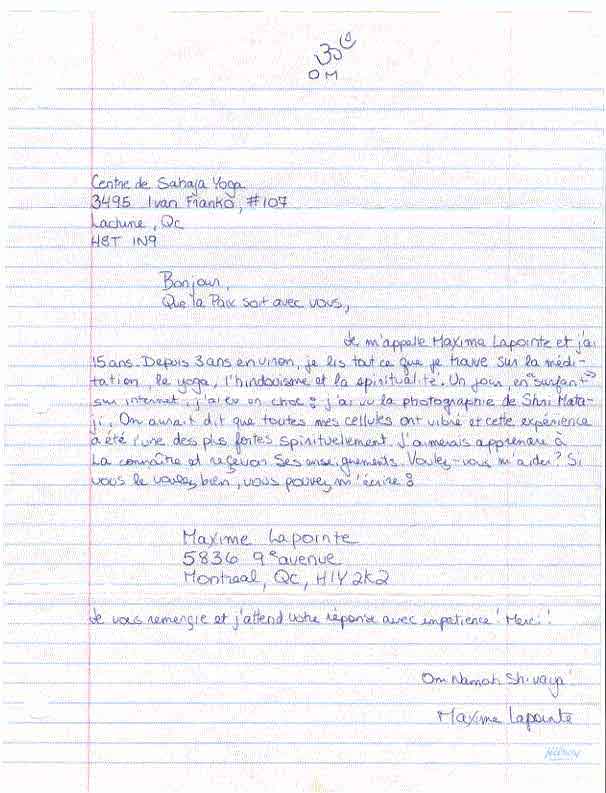
The core evidence is remarkably concise. Maxime identifies himself as fifteen years old and says that for approximately three years he had been reading about meditation, yoga, Hinduism, and spirituality. While browsing the Internet he encountered a picture of Shri Mataji. His response, as translated in the source, was immediate: he experienced a “shock,” felt as though all his cells vibrated, and ranked the event among his strongest spiritual experiences. He then asked to know Shri Mataji and receive her teachings. These details matter. The letter presents not a retrospective account written after years of membership in a religious movement, but a request generated by the experience itself.
“My name is Maxime Lapointe and I am 15 years old. For the past three years approximately, I read all that I can find on meditation, yoga, hinduism and spirituality.”
“One day, while ‘surfing on the internet,’ I had a shock: I saw the picture of Shri Mataji. It was as if all my cells vibrated and this experience was one of the strongest spiritually. I would like to learn to know her and receive her teachings. Can you help me?”

The evidential strength of the letter is therefore phenomenological and documentary. It records what Maxime believed he experienced and shows that the experience was strong enough to motivate contact. It does not tell us what physiological processes occurred in his cells, nor does the phrase “all my cells vibrated” require a literal cellular interpretation. In the language of mystical testimony, bodily metaphors frequently express experiences that are simultaneously somatic, emotional, and spiritual. What makes this case distinctive is what happens when Maxime’s language is compared with Shri Mataji’s own prior claims about photographs and vibrations.
3. “The Photograph of Reality”: Shri Mataji’s Interpretive Framework
In a 1989 discourse associated with Paramchaitanya Puja, Shri Mataji drew an explicit distinction between an ordinary image and a photograph of a person whom she described as having “become the Reality.” Her argument is analogical: a painted rainstorm resembles rain but cannot wet cloth or nourish plants; representation lacks the causal properties of the represented reality. She then claimed that her own photograph was different because it could give vibrations. Within Sahaja Yoga theology, this is intelligible through Paramchaitanya—the all-pervading divine power that becomes perceptible after Kundalini awakening.
Maxime’s report is striking when placed beside this teaching because he independently chose the language of vibration. The correspondence should not be exaggerated: the surviving text does not establish that he had never encountered Sahaja Yoga’s vocabulary, and his prior three-year spiritual reading makes absolute independence impossible to demonstrate. Yet the letter itself gives no indication that he was attempting to reproduce a Sahaja Yoga doctrinal formula. Instead, “all my cells vibrated” appears as his description of what prompted him to seek an explanation. Thus the episode possesses what may be called internal theological coherence: the reported phenomenon resembles the phenomenon the tradition says should be possible.
This is not the same as scientific corroboration. A controlled experiment would require predefined conditions, comparison images, blinded participants, reproducibility, physiological measurements, and independent analysis. None of those conditions exists here. The academic value of the episode is therefore different. It is a documentary convergence between a seeker’s spontaneous report and an already articulated religious claim. For the believer, that convergence may function as confirmation; for the historian, it is evidence of a noteworthy correspondence; for the scientist, it remains a hypothesis-generating anecdote rather than experimental proof.
4. Presence at a Distance: Photograph, Television, and Internet
The Maxime episode becomes more significant within Shri Mataji’s broader teaching about technologically mediated spiritual presence. In Bombay in 1979, before the public Internet, she said that Self-Realization could be given through television and attributed this possibility to something “emitting from My Being.” The conceptual claim is important: physical proximity to the teacher is not considered necessary. If divine power is all-pervading rather than spatially confined, a visual medium may become an occasion through which a receptive person turns attention toward that power.
Maxime’s encounter on the Internet can consequently be interpreted as a later technological instance of the principle Shri Mataji had articulated for television. The Internet did not need to be named in 1979 for the theological logic to apply: the medium carries an image; the image directs attention toward the represented person; and, according to Sahaja Yoga, Paramchaitanya is not generated by the electronic medium but can be perceived through the encounter. The important distinction is between transmission as theological explanation and ordinary electronic transmission. The website transmitted pixels and information in the conventional sense. The claim that it also mediated divine vibrations belongs to the spiritual interpretation of Maxime’s response.
This distinction also clarifies why the episode is relevant to contemporary religion. Digital media are often treated merely as channels for religious information. Here, however, the medium is understood sacramentally or charismatically: not simply as communication about a spiritual reality, but as a possible occasion of participation in it. Maxime’s letter therefore anticipates a central question of digital religion—whether technologically mediated presence can be experienced by participants as genuinely transformative rather than merely representational.
5. Experience Is Not Yet Interpretation: The Problem of Discernment
The earlier “Voulez-Vous M'Aider?” commentary asks why an experience of such intensity did not automatically settle the question for Maxime. That question deserves a more careful answer than attributing hesitation to ignorance or failure. An extraordinary experience and an interpretation of that experience are logically distinct. A person may be certain that something happened while remaining uncertain about what happened. Indeed, Maxime’s request—“Can you help me?”—is evidence of precisely this epistemic gap. He did not deny the experience. He lacked a framework within which to determine its meaning.
From a critical perspective, several explanations remain possible: expectation, emotional resonance, aesthetic response, autonomic bodily reaction, spiritual experience, or some combination of these. The supplied material does not permit us to eliminate those alternatives. From within Sahaja Yoga, however, discernment is not supposed to terminate in intellectual persuasion. Shri Mataji repeatedly directed seekers toward an experiential test: Kundalini awakening, perception of vibrations, meditation, and the manifestation of the Spirit in conscious awareness. Thus the relevant question is not simply whether Maxime should have believed an external claim about Shri Mataji. It is whether the initial event could have been followed by a stable and repeatable mode of spiritual perception.
6. From Momentary Recognition to Self-Realization
The original text is especially useful when it shifts from the photograph to Shri Mataji’s teaching about the Spirit. A transient experience, however powerful, is not presented as the goal. The stated goal is that the Spirit become manifest in consciousness and, in Shri Mataji’s formulation, in the central nervous system. Elsewhere in the supplied material she describes meditation as an “individual journey towards God,” followed by an expansion in which the practitioner becomes collective. This provides a developmental framework for reading Maxime’s experience: the event may be interpreted as an invitation or threshold, but it is not equivalent to mature realization.
This point also corrects a weakness in the earlier commentary. It is impossible, from the surviving letter alone, to know why Maxime apparently did not continue, whether he pursued Sahaja Yoga elsewhere, or what became of his spiritual life. Statements that he “failed” to nurture an awakening or continued looking for something better go beyond the documentary evidence unless supported by later correspondence. What the source actually states is narrower: standard Sahaja Yoga material was mailed to him and no further effort was made to persuade him. That restraint is itself relevant. It leaves the reported experience as an invitation to personal inquiry rather than a basis for coercive conversion.
Within Shri Mataji’s theology, the criterion of development is transformation rather than excitement. The inward journey should yield calm, peace, bliss, greater self-mastery, and ultimately a collective orientation toward others. The 1993 Philadelphia discourse in the source similarly describes human purpose as becoming the Spirit and entering the Kingdom of God. In this framework, therefore, Maxime’s shock before an image would matter not because intensity itself proves divinity, but because it could become the beginning of a testable spiritual discipline directed toward a lasting change of consciousness.
7. What the Episode Can and Cannot Establish
An academically responsible assessment can now be stated with precision. First, the document supports the claim that a fifteen-year-old seeker named Maxime Lapointe wrote describing a powerful reaction to seeing Shri Mataji’s picture and sought further guidance. Second, the language of his report corresponds closely to Shri Mataji’s teaching that her photographs may give “vibrations.” Third, Shri Mataji’s earlier statements about television establish that technologically mediated spiritual effects were already part of her teaching and were not invented solely to explain Maxime’s later Internet encounter. Fourth, the episode fits Sahaja Yoga’s wider model of spontaneous awakening followed by inward verification and spiritual maturation.
What the document does not establish by itself is equally important. It does not scientifically demonstrate that energy emanated from the photograph; it does not prove that Maxime underwent a full Kundalini awakening; it does not establish a physiological event in every cell; and it does not, standing alone, prove Shri Mataji’s theological identity as the Adi Shakti. Those are larger claims requiring broader evidence and, in the case of metaphysical identity, necessarily involve theological judgment. The case is strongest when presented for what it actually is: an unusually direct instance of reported spiritual response whose phenomenology corresponds to claims made by the person depicted.
That modest formulation does not render the event trivial. In historical and phenomenological research, a well-preserved first-person report can be significant without being a laboratory experiment. Indeed, the episode raises a sharper question precisely because it is not a formal demonstration: why did an image produce an experience intense enough for a young seeker to write asking for help, and why did he describe that experience in terms so consonant with the tradition’s language of vibration? Sahaja Yoga provides one answer—Paramchaitanya and the awakening of Kundalini. Other explanatory frameworks remain possible. The document invites comparison rather than allowing the historian simply to decree the metaphysical answer.
8. Archival Significance: Why the Letter Matters
The Maxime Lapointe letter has value beyond the theological interpretation placed upon it. As an archival document, it preserves the voice of a young seeker at the precise moment when an unexpected experience prompted him to initiate contact. That temporal proximity is important. Later testimony can be reshaped by memory, group identity, doctrinal education, or retrospective meaning-making; a contemporaneous letter is less vulnerable to some of those pressures. The document therefore deserves to be preserved not merely as devotional material but as a primary source in the history of digitally mediated religious experience.
The episode is also historically notable because the Internet was still a relatively new environment for religious encounter. Maxime’s experience illustrates an early form of what scholars now call digital religion: a spiritual encounter that begins not in a temple, church, ashram, or face-to-face meeting, but through an image encountered online. The letter thus belongs to a wider history of how religious authority, charisma, presence, and conversion have been reframed by electronic media. Within Sahaja Yoga, the theological claim is that Paramchaitanya is not confined by physical distance; historically, the letter shows how such a claim could become existentially meaningful to a seeker before any in-person relationship had been established.
For the Authenticity Series, the strongest use of this document is therefore cumulative rather than isolated. It should not be asked to bear the entire burden of proving Shri Mataji’s identity. Instead, it can be placed alongside other independent testimonies, dated declarations, photographs, letters, recorded experiences, and scriptural interpretations. Its contribution is specific: it documents a spontaneous response whose language closely resembles Shri Mataji’s own teaching about vibrations transmitted through her image. In a cumulative evidential framework, such correspondences gain significance through repetition, independence, chronology, and consistency.
9. Conclusion: Recognition, Verification, and the Freedom to Seek
“Voulez-Vous M'Aider?” is compelling because of its simplicity. Maxime did not present a doctrine; he presented a problem of recognition. He saw a photograph, experienced an unexpected bodily-spiritual shock, and asked to understand the person whose image had affected him. When that testimony is placed beside Shri Mataji’s prior declaration that her photograph could give vibrations and her earlier claim that Self-Realization could operate through television, a coherent Sahaja Yoga interpretation emerges: the photograph became an occasion through which a receptive seeker encountered Paramchaitanya.
Yet the deeper significance of the case lies beyond the initial sensation. Shri Mataji’s own teachings, as preserved in the supplied text, redirect attention from extraordinary phenomena to the realization of the Spirit. The photograph, on this reading, is not an idol demanding belief; it is potentially a doorway. The decisive movement is from an external image to internal verification—from seeing a face on a screen to discovering whether the Spirit can become a living reality in consciousness. This makes Maxime’s question, “Can you help me?”, more important than any attempt to turn his experience into instant proof.
The academically defensible conclusion is therefore twofold. Historically, the letter is documentary evidence of a powerful reported experience and of the seeker’s consequent desire for instruction. Theologically, within Sahaja Yoga, its close correspondence with Shri Mataji’s teaching on vibratory photographs gives it the character of a recognition event. The two conclusions should neither be confused nor artificially separated. Together they preserve both critical discipline and the existential force of the testimony. Maxime’s experience remains an invitation to investigate the central Sahaja Yoga proposition for oneself: that spiritual truth is ultimately not secured by argument alone but must become perceptible, transformative, and inwardly realized.
References and Documentary Sources
- Lapointe, Maxime. Letter reproduced in Shri Adi Shakti: The Kingdom of God, p. 138, and subsequently on AdiShakti.org, “Voulez-Vous M'Aider?”
- Shri Mataji Nirmala Devi. The Power That Contains Everything / Paramchaitanya Puja, Germany, 19 July 1989. Quoted in the supplied “Voulez-Vous M'Aider?” source.
- Shri Mataji Nirmala Devi. Kundalini and Kalki Shakti, Bombay, India, 28 September 1979. Quoted in the supplied source.
- Shri Mataji Nirmala Devi. Problems of Subconscious, United Kingdom, 13 May 1982. Quoted in the supplied source.
- Shri Mataji Nirmala Devi. Birthday Puja / Assume Yourself, Self-esteem, Sydney, Australia, 21 March 1983. Quoted in the supplied source.
- Shri Mataji Nirmala Devi. Philadelphia, USA, 15 October 1993. Quoted in the supplied source.
- Kutta, Pariah. Shri Adi Shakti: The Kingdom of God. 1999, pp. 138–139.
Interactive Chat
Explore this article, its sources, and the relationships among its theological and evidentiary claims.
Open chat →