2012: The Mayan Prophecy Explained
A source-critical guide to the Long Count, the Books of Chilam Balam, and the modern 2012 phenomenon
CONTENTS
- Summary
- The Question Hidden in the Popular Claim
- What 13.0.0.0.0 Actually Marks
- Tortuguero Monument 6: The Inscription at the Center
- Why the Long Count Did Not End
- The Books of Chilam Balam : Colonial Prophecy, Not a 2012 Script
- Crosses, Judgment, and the Colonial Archive
- Kukulkan, Quetzalcoatl, and Comparative Interpretation
- The Catastrophe Scenarios and the Scientific Record
- How a Calendar Date Became a Global Phenomenon
- Contemporary Maya Voices and a Challenge to the Reader
- Conclusion: A Calendar Station, Not an Ancient Doomsday Script
- References
Summary
Thesis. The date conventionally rendered as December 21, 2012 was a major Maya calendrical station, not a documented prophecy that the world would end or that a predetermined global awakening would occur. The popular narrative usually fuses four different bodies of material: the Classic Maya Long Count, colonial Yucatec k’atun writings, Aztec and broader Mesoamerican creation stories, and modern spiritual or catastrophic speculation. A careful reading leaves room for present-day ethical or spiritual reflection, while refusing to attribute modern expectations to ancient Maya authors without evidence.[2][4]
1. The Question Hidden in the Popular Claim
The supplied excerpt presents a familiar two-sided story: a period of scarcity, fear, political failure, catastrophe, and fire on one side; the return of Kukulkan, recovered wisdom, bodily energy, and a new age on the other. Its cited trade source, Synthia Andrews and Colin Andrews’s The Complete Idiot’s Guide to 2012, belongs to the popular literature through which 2012 acquired broad cultural visibility. Such material is valuable as evidence of what many readers hoped or feared; it is not, by itself, evidence of what ancient Maya scribes wrote.[1]
The central historical question is therefore narrower than the popular story: what do the surviving Maya sources actually say about the date? The answer requires keeping records from different centuries, languages, regions, and religious settings distinct. This paper uses Maya as the scholarly adjective in its prose; the word Mayan remains in the title because it reproduces the familiar phrase supplied for this article.
The word prophecy is often made to do several incompatible kinds of work. A dated inscription, a cyclical prediction, a colonial account of conquest, and a modern hope for spiritual transformation are not interchangeable. Each has its own authorial setting, intended audience, and evidentiary limits.
A responsible investigation asks four successive questions: what survives physically; how its language is deciphered; what the text meant in its historical setting; and what later readers have made of it. The last question is legitimate, but it must not be substituted for the first three.
2. What 13.0.0.0.0 Actually Marks
The Long Count was a system for reckoning elapsed time across very large intervals. In the standard notation, 13.0.0.0.0 marks the completion of thirteen b’ak’tunob, each a period of 144,000 days. The Smithsonian National Museum of the American Indian calculates that the associated thirteen-b’ak’tun span covers about 5,125.366 solar years and identifies the conventional correlation of its end with December 21, 2012. This was a substantial calendrical recurrence, not a sentence announcing the destruction of the world.[3]
Calendars regularly assign symbolic force to turning points. That fact does not transform every turning point into a terminal deadline. The decisive distinction is between a completion within a count and the extinction of the count itself. Modern readers often imported the latter meaning because a familiar odometer metaphor makes a row of zeroes feel final. Maya chronological practice does not warrant that inference.
The five principal Long Count positions represent b’ak’tun (144,000 days), k’atun (7,200), tun (360), winal (20), and k’in (one). Thus 13.0.0.0.0 identifies a particular numerical completion, not a claim that time has ceased. The commonly used Goodman–Martínez–Thompson correlation connects the station to December 21, 2012; calendar correlations are scholarly methods of matching distinct chronological systems.
Period endings mattered because time was not simply a neutral measuring instrument. Maya rulers and ritual specialists used commemorations to articulate legitimacy, continuity, obligation, and relations between human and sacred order. This cultural importance makes the date worth studying even though it was not an apocalyptic ultimatum.
3. Tortuguero Monument 6: The Inscription at the Center
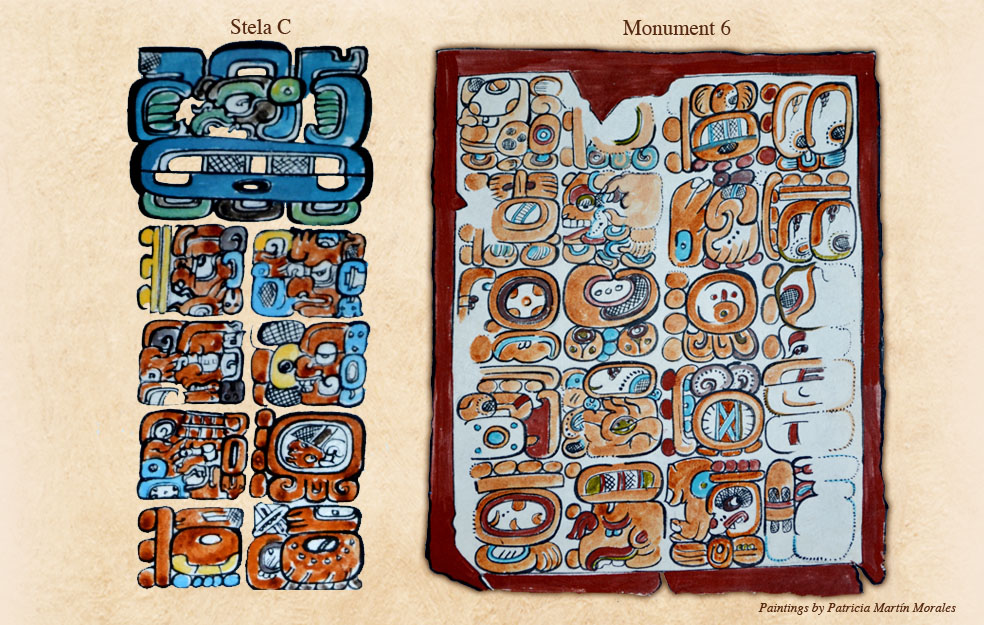
Most claims that the ancient Maya specifically foretold 2012 lead back to Tortuguero Monument 6, a damaged seventh-century inscription from Tabasco. David Stuart emphasizes that the relevant future-date passage is fragmentary and that the monument’s main concern is a local historical and ritual event: the dedication of a structure under the ruler B’ahlam Ajaw. On this reading, the forward reference to 13.0.0.0.0 functions as a rhetorical chronological anchor, not as an autonomous forecast of worldwide fate.[5]
The important methodological lesson is proportion. A damaged passage cannot responsibly bear a pyramid of predictions about volcanoes, planetary alignments, pole shifts, social collapse, or an inevitable rise in consciousness. Even the more tentative interpretations of the final glyphs do not yield a clear statement that the world will end. Historical uncertainty is not a license to fill gaps with whichever fear or hope is most attractive.
The damaged final portion of Monument 6 is especially susceptible to selective quotation. Discussions of the deity Bolon Yokte’ K’uh and a possible manifestation or ceremonial action must distinguish readable glyphs from restored signs and disputed grammatical constructions. A name associated with transition or ritual is not equivalent to an explicit prophecy of universal destruction.
The monument was produced in a specific political landscape, rather than as an anonymous global bulletin. Its historical narrative and dedicatory purposes constrain how the future date can be understood. The burden of proof belongs to anyone claiming that the inscription predicts an event beyond what its surviving words express.
4. Why the Long Count Did Not End
Simon Martin’s account of Maya calendrics makes the continuity point concrete. He notes that a Palenque text records a future completion of one piktun in 4772 CE and explains that the sequence moves beyond 13.0.0.0.0 through 14.0.0.0.0 and further values. The Long Count was capable of imagining time on scales vastly beyond 2012; it did not stop because a prominent cycle reached a recurrence.[6]
This does not make the date meaningless. Maya monuments often joined period endings to royal ritual, cosmic order, and the binding of stones. Significance, however, is not identical to catastrophe. A serious account allows the Maya their sophisticated theories of ordered, animated time without turning that sophistication into an oracle for modern geopolitics.
A further safeguard against the terminal-calendar reading is the presence of much longer chronological horizons in Maya inscriptions. Long-range dates demonstrate that Maya intellectual life could imagine immense stretches of time beyond any single prominent period ending.
A cycle can end without history ending. That distinction is familiar in the turn of a century, millennium, or liturgical year: the recurrence is significant because a new reckoning begins, not because the possibility of further reckoning disappears.
5. The Books of Chilam Balam: Colonial Prophecy, Not a 2012 Script
The Books of Chilam Balam are indispensable but frequently misused. They are colonial Yucatec Maya documents written in Latin characters during the seventeenth and eighteenth centuries. The Chumayel manuscript was compiled in 1782 by Juan José Hoil, and the Smithsonian catalogue notes that it includes passages evidently written or inspired by Spanish missionaries.[7]
These manuscripts preserve historical memory, calendrical material, ritual knowledge, and k’atun prophecies. A k’atun belongs to a recurrent twenty-year framework; its forecasts concern the character, burdens, rulers, weather, or social conditions associated with a named period. The series is therefore not a singular countdown to December 2012. In Roys’s translation, Katun 11 Ahau is explicitly connected to the arrival of foreigners and the beginning of Christianity, while its commentary records tribute, debt, and oppression under colonial conditions.[8]
The colonial manuscripts are neither pure survivals of an untouched preconquest religion nor merely Spanish texts disguised in Maya language. They are complex archives of continuity, negotiation, adaptation, and loss. Their value increases when those layers are recognized rather than stripped away.
The recurring names of k’atun periods can make history appear patterned and morally intelligible. Yet the social upheavals described in the texts must first be situated in Yucatán’s own historical experiences. A twentieth- or twenty-first-century application is an interpretive analogy, not a translation.
6. Crosses, Judgment, and the Colonial Archive
The supplied narrative invokes the “wooden cross,” the collapse of government and religion, and a divine judgment. In the Chumayel material, however, these motifs must be read in their colonial textual setting. The historical introduction to the k’atun prophecies speaks directly of Spanish ships, tribute, baptism, priests, bishops, and the Inquisition. It is a record of a society grappling with conquest and conversion, not a Classic-Maya prediction of a twenty-first-century apocalypse.[9]
The chapter titled “The Last Judgment” is even clearer. Roys’s note identifies it as an account of the Christian Last Judgment apparently written by a Spanish missionary and traces its central language to Matthew 25. Its presence is historically important: it shows Maya textual life under colonial pressure and creative adaptation. It cannot be detached from that history and assigned to the Long Count’s 2012 station.[10]
Recent scholarship reinforces this caution. Olivier Le Guen distinguishes traditional, transitional Christianized, and overtly Christianized k’atun prophecies, showing how authors and scribes reframed a transformed world through changing vocabulary and structure. That layered archive demands interpretation, not flattening.[11]
Christian imagery within these manuscripts can reflect coercive missionary influence, creative Indigenous reinterpretation, or both. The historian should not assume that every mention of a cross preserves an ancient prediction of Christianity, nor that every Christian phrase exhausts the agency of Maya scribes.
The distinction matters especially for Last Judgment passages. Similarities to Christian eschatology may reveal the entanglement of religious worlds after conquest; they do not automatically establish independent ancient foreknowledge of Christian doctrines.
7. Kukulkan, Quetzalcoatl, and Comparative Interpretation
Kukulkan and Quetzalcoatl are related feathered-serpent figures in a wider Mesoamerican field, yet relatedness does not erase regional, linguistic, chronological, or ritual difference. The Chumayel traditions do mention Kukulkan in connection with the Itzá and recurring k’atun frameworks; Roys’s notes also caution that a named Kukulkan may be a ruler’s title rather than a simple report of one god’s literal return.[12]
Contemporary comparative theology may draw spiritual resonances among Kukulkan, kundalini, the Paraclete, or other traditions. The directly relevant AdiShakti.org article “Quetzalcoatl: The Prophecy of the Return of a Supreme Being” offers precisely this kind of devotional synthesis. Such reflection should be named as comparative interpretation. It becomes historically misleading only when it is presented as proof that a Classic Maya inscription forecast the same universal event on a specific 2012 date.[16]
The same discipline applies to the Aztec sunstone, the Fifth Sun, and the Popol Vuh. Martin shows that modern 2012 discourse often fused these distinct traditions with the Long Count. Ancient Mesoamerican cultures did preserve rich accounts of creation, destruction, and renewal; they do not, on that account, supply a single pan-Mesoamerican 2012 prophecy.Martin’s comparative discussion identifies this conflation as a central source of error.
Comparative interpretation works best when it states the level of comparison. A feathered serpent, the imagery of rising life-energy, and a divine teacher can be juxtaposed as symbols of renewal without claiming that their traditions teach identical doctrines. The similarity is a question for interpretation, not a shortcut around historical evidence.
Within Adishakti.org’s devotional framework, the Paraclete Shri Mataji Nirmala Devi is understood as the fulfillment of an eschatological promise and as the agent of inner transformation. This is a clearly identifiable theological claim. The Maya evidence considered here does not independently establish that claim, and recognizing this distinction allows the comparison to be argued transparently rather than asserted as epigraphic fact.
A richer spiritual question follows: if the enduring concern is transformation of consciousness, what would count as its evidence? Ethical change, sustained self-knowledge, communal responsibility, and the testimony of practitioners are more relevant to that inquiry than attaching a spiritual event to a disputed calendrical deadline.
8. The Catastrophe Scenarios and the Scientific Record
Popular 2012 scenarios often added a supervolcano, worldwide earthquakes, magnetic-pole reversal, hidden planet, asteroid, solar storm, or once-in-an-age galactic alignment. Those are empirical claims, so they require empirical evidence. NASA Jet Propulsion Laboratory’s 2012 explanation found no basis for the alleged hidden planet, catastrophic planetary alignment, date-specific pole shift, or forecasted global solar disaster. Its key clarification is simple: a calendar cycle ended and another began.[13]
The Smithsonian’s technical discussion of the claims likewise distinguishes genuine natural processes from date-specific predictions. Earthquakes, volcanic activity, solar cycles, and magnetic changes are real phenomena. The mistake was to treat their reality as retrospective confirmation of a catastrophe for which neither the Maya inscriptions nor the scientific record supplied adequate evidence.
The scientific failure of date-specific catastrophe claims should not be confused with a denial that natural hazards exist. The planet remains subject to earthquakes, volcanism, geomagnetic variation, and solar weather; their study requires observation, physical models, and probabilistic assessment rather than symbolic readings of a calendar.
The December 2012 date passed without the advertised global extinction. This outcome decisively undercuts the literal doomsday scenarios. It does not adjudicate every possible spiritual interpretation, because those interpretations make different kinds of claims and require their own standards of assessment.
9. How a Calendar Date Became a Global Phenomenon
The 2012 story did not emerge from a single deciphered prophecy. Robert K. Sitler’s early academic study describes it as a New Age appropriation of an ancient Maya calendar, observing that a rapidly expanding literature and online culture attached global transformation to a date with little factual grounding in Maya culture.[14]
By 2012, the movement had become international. Sitler’s later reassessment notes the role of popular publishing, media, the film 2012, scholarly debate, and increasing participation by Maya authors and spiritual guides. This matters because it shifts the research question. Rather than asking only whether an ancient forecast succeeded or failed, historians can ask why the modern world invested a calendrical milestone with anxieties about ecology, inequality, technology, mortality, and renewal.[15]
The modern phenomenon was shaped by a feedback loop: a memorable date attracted speculative books; media coverage amplified dramatic scenarios; public anxiety made further coverage profitable; and the resulting attention was retrospectively mistaken for confirmation that an ancient prophecy had existed.
The story also exposes a paradox of modernity. Highly technological societies can become fascinated with a purported ancient deadline precisely when they feel unable to control ecological instability, war, social fragmentation, or rapid cultural change. Studying the reception of 2012 therefore illuminates modern concerns as much as ancient Maya history.
10. Contemporary Maya Voices and a Challenge to the Reader
There is no single, static “Maya view.” The Smithsonian’s collection of Maya opinions on 2012 documents perspectives from Tzeltal, Yucatec, K’iche’, Itzá, and Kaqchikel contributors. Alonso Méndez, a Tzeltal Maya cultural astronomer, described the recurrence as a moment of enlightenment in which many Maya were attending anew to their past. That is a contemporary voice about cultural renewal, not a warrant for outsiders to invent a uniform ancient prediction.
Timothy J. Smith’s account of ceremonies at Iximché makes a similar point. He reports that spiritual guides described the occasion as an ending and beginning, a new count, and a setting for cultural and political action; he also cautions that the apocalypse narrative was amplified through outside commercial fascination. Respectful study therefore listens to living Maya communities, specifies who is speaking and from where, and resists the temptation to turn Indigenous traditions into a generic screen for non-Indigenous dread or desire.[17]
Contemporary Maya speakers and communities are not a single interpretive authority. Their perspectives differ across language, place, religious practice, and political circumstance. Responsible scholarship quotes identifiable voices, respects disagreement, and avoids making one individual speak for an entire civilization.
A productive contemporary interpretation might treat the date as an invitation to renew cultural knowledge, care for the earth, and repair relationships. Such a reading can be meaningful on its own terms, provided that it is acknowledged as a contemporary response rather than a mandatory prediction inherited intact from antiquity.
11. Conclusion: A Calendar Station, Not an Ancient Doomsday Script
The 2012 event was real in the most precise sense: a major Long Count recurrence occurred. The claim that the ancient Maya predicted global destruction, a guaranteed planetary transformation, the return of a specific teacher, or a scientifically defined catastrophe is not sustained by the surviving evidence. Tortuguero Monument 6 is limited and damaged; the Long Count continues; the Books of Chilam Balam are colonial and textually layered; and the scientific catastrophes were unsupported.
References
[1] Andrews, Synthia, and Colin Andrews. “The Complete Idiot’s Guide to 2012: An Ancient Look at a Critical Time.” Alpha Books, 2008, 352 pp.
[2] Smithsonian National Museum of the American Indian. “The Meaning of 2012.” Living Maya Time, n.d.
[3] Stuart, David. “Q & A about 2012.” Maya Decipherment, October 11, 2009.
[4] Martin, Simon. “Time, Kingship, and the Maya Universe: Maya Calendars.” Expedition Magazine, vol. 54, no. 1, 2012.
[5] Stuart, David. “More on Tortuguero’s Monument 6 and the Prophecy that Wasn’t.” Maya Decipherment, October 4, 2011.
[6] Martin, Simon. “Time, Kingship, and the Maya Universe: Maya Calendars.” Expedition Magazine, vol. 54, no. 1, 2012, section “The Maya and 2012.”
[7] Smithsonian Libraries and Archives. “The Book of Chilam Balam of Chumayel.” Smithsonian Institution, 1967 record for the 1933 Carnegie edition.
[8] Roys, Ralph L., trans. “A Prophecy for Katun 11 Ahau.” The Book of Chilam Balam of Chumayel, Carnegie Institution of Washington, 1933, pp. 77–79.
[9] Roys, Ralph L., trans. “A Series of Katun-Prophecies.” The Book of Chilam Balam of Chumayel, Carnegie Institution of Washington, 1933, pp. 133–134.
[10] Roys, Ralph L., trans. “The Last Judgment.” The Book of Chilam Balam of Chumayel, Carnegie Institution of Washington, 1933, pp. 163–164.
[11] Le Guen, Olivier. “The Chilam Balam, the Rulers and God: A New Perspective on the Christianization of the K’atun Prophecies of the Chilam Balam.” Ancient Mesoamerica, vol. 36, no. 3, 2026, pp. 424–436.
[12] Roys, Ralph L., trans. “A Book of Katun-Prophecies.” The Book of Chilam Balam of Chumayel, Carnegie Institution of Washington, 1933, pp. 145–162.
[13] NASA Jet Propulsion Laboratory. “12-21-2012 Just Another Day.” Jet Propulsion Laboratory, March 7, 2012.
[14] Sitler, Robert K. “The 2012 Phenomenon: New Age Appropriation of an Ancient Mayan Calendar.” Nova Religio, vol. 9, no. 3, 2006, pp. 24–38.
[15] Sitler, Robert K. “The 2012 Phenomenon Comes of Age.” Nova Religio, vol. 16, no. 1, 2012, pp. 61–87.
[16] AdiShakti.org. “Quetzalcoatl: The Prophecy of the Return of a Supreme Being.” AdiShakti.org, n.d.; page cites Gerald Benedict, The Mayan Prophecies for 2012, Watkins, 2008.
[17] Smith, Timothy J. “Untangling the Myths and Misconceptions Behind the Maya ‘Apocalypse.’” Princeton University Office of the Dean for Research, February 13, 2013.
The enduring lesson is methodological as well as spiritual. Historical records should be allowed to say what they say, including where they remain damaged or uncertain. Spiritual reflection need not be abandoned; it becomes more intellectually credible when its interpretive steps are openly declared.
The Maya Long Count provides a remarkable witness to the human effort to situate existence within vast cycles. Its 2012 station is historically important precisely without the fabricated certainty of a doomsday script. The possibility of personal or collective renewal remains a present responsibility, not a forecast guaranteed by a date.