

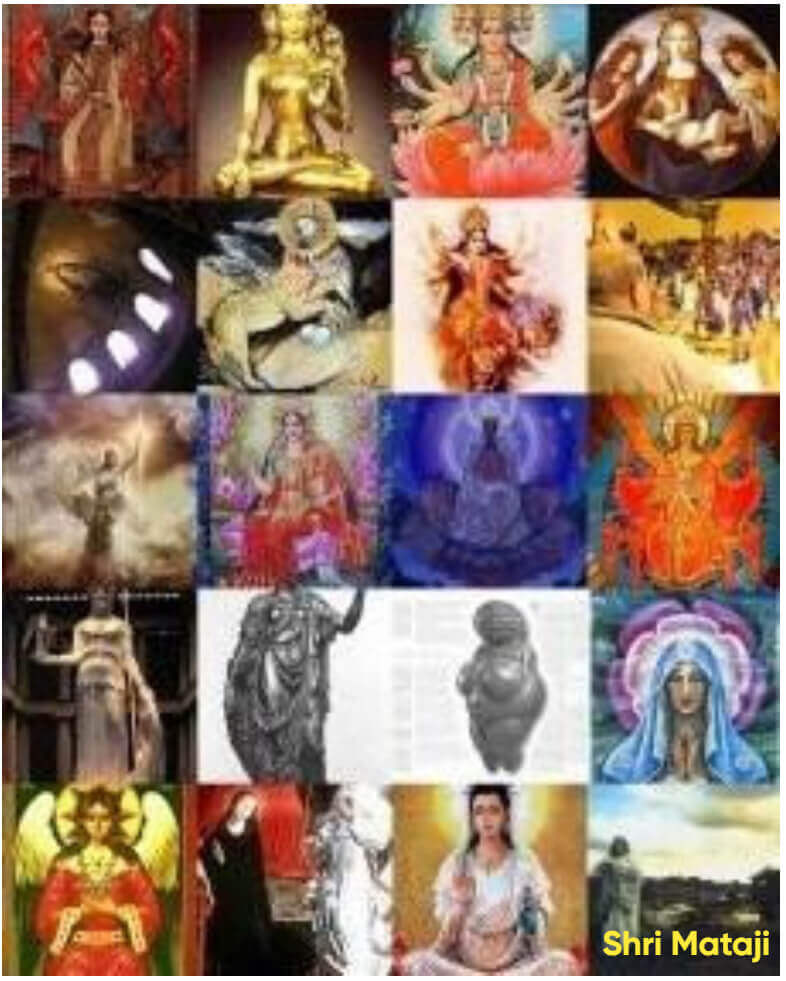
The “notion that the Spirit is present in the world religions is heard more loudly today.”
The Spirit in World Religions – A Universal Awakening of Divine Presence: The sacred echo of the Spirit is no longer confined to isolated traditions—it resounds across the spiritual landscape of humanity. From ancient prophecies to modern awakenings, the recognition of divine presence within world religions is growing louder. This universal resonance affirms that the Comforter, the Adi Shakti, is fulfilling the eschatological promise of Self-realization and inner transformation. The Spirit is not a doctrine—it is a living force guiding seekers beyond boundaries.
"Of course, there are innovative efforts in the field of pneumatology, because more than in the past, it is realized that pneumatology is a promising theological locus.56 Hodgson writes that, 'The resources for a theology of the Holy Spirit are rich and diverse, ranging from Eastern orthodoxy and classical western spirituality to New Age movements, folk and tribal religions, feminist, ecological, and liberation theologies, and new philosophies of Spirit.'57 However, as Moltmann says, a new paradigm of pneumatology has not yet emerged. Yet there are beginnings, and we are witnessing a transition from an anthropocentric to a holistic pneumatology, one that embraces the whole creation and recognizes in the Spirit the symbol of wholeness, relatedness, energy, and life.58 This search for a new paradigm makes pneumatology always significant, and that is what the whole concern of this research is.
In addition to that, the doctrine of the Spirit has aroused an interest within the life of the church recently, which is growing and extends incredibly. It fixates on the spiritual side of human nature. Swete writes, 'It is possible that modern life, as it escapes from the control of a crude materialism, may be led to seek the solution of its perplexities in the Christian doctrine of a divine Spirit working in the world and in man.'59 Therefore, there are promising possibilities which pneumatology opens for the Christian church and the modern world in order to face the challenges before humanity and the universe as a whole. As a result, the present world has witnessed an unprecedented interest in the study of the Spirit, more so than at any time in the history of the church.60 Kärkkäinen observes in one of his articles that today we are living in the midst of 'a pneumatological renaissance' with writings and discussions on the Spirit abounding.61 Thus those promising possibilities that the Spirit offers for today are the major concern of the present research.
Moreover, the Spirit is an eschatological reality that gives hope in the midst of a hopeless world. The pneumatological basis of the Bible faith communities is the linguistic and theological connection between 'Spirit' and 'breath,' which the ancients linked phenomenologically to 'life.' The Biblical people came to see 'Spirit' as the divine power creating (Gen 1:2; 2:27) and sustaining life (Ps 104:29; Isa 32:15; cf. Job 27:3; 34:14-15). Therefore, wherever the Spirit is present, life flourishes, and wherever the Spirit is absent, life ceases. Moreover, the biblical writings link the Spirit with the eschatological new life. As the one who raised Jesus from the dead, the Spirit will give life to our mortal bodies (Rom 8:11). As the author of life, the Spirit is the creator Spirit, the divine power at work fashioning the universe, and in this sense, the Spirit is the author of the world.62 This realization will give a new sense of hope to the world that suffers from fundamentalism, terrorism, and dehumanizing tendencies. One should note that the divine is the great creative Spirit within which wears the universe as its body. This great cosmic, creative Spirit underlies all that exists and moves the world toward its completion not by almighty power but by kenotic self-giving. Each of us in some way knows or intuits 'this great cosmic, creative Spirit' which underlies the disparate compartmentalization of modern life.63 As Bishop Holloway of the Episcopal Church in Scotland writes, 'Some great self-giving love seems to haunt the universe.'64 When dealing with the pneumatology of Moltmann and Pannenberg, these aspects will be clearer and will be further reflected in the new pneumatological paradigm at the end of this study.
In addition to that, the notion that the Spirit is present in the world religions is heard more loudly today.65 D'Costa writes that, '... the claim that the Spirit is at work in their religions should be taken neither as a phenomenological socio-historical description of a religion, no[r] as a claim that will necessarily be well-received by a non-Christian. Rather it constitutes a theological evaluation that must spring from and lead to fresh practices within the church if the claim is to have any credence.'66 The recognition of the Spirit in other religions allows the church the possible discernment of Christ-like practice in the other, and in so much as Christ-like activity takes place, then this can also be through the enabling power of the Spirit.67 That means, as Alan Jones writes, 'The Spirit is calling us out of our tribal and national manifestations into a way of being in the world that truly expresses the universal good news of love and reconciliation.'68 The Spirit and other religions is also an area where this research will be focusing.
In short, having understood the major reasons for the negligence of the Spirit, on the one hand, and the significance of the Spirit, on the other, in Protestant systematic theology, the present study discusses the pneumatology of Barth, Moltmann, and Pannenberg in order to answer the following pertinent questions. Firstly, what is the personhood of the Spirit and how is it related to the other persons in the Trinity? Secondly, what is the role of the Spirit in the whole divine action with regard to humanity and the whole creation? Thirdly, how should one approach the Spirit, i.e., whether subjectively, or is there any possibility of understanding the Spirit and its role as reasonably accommodating to the modern mind? Finally, how can we formulate a pneumatology, giving significance to the working of the Spirit in the Christian church, other religions, liberation movements, and contextual theologies? In short, this study looks for a new paradigm, maintaining the significance of pneumatology and arguing for a pneumatological perspective in Protestant systematic theology in order to present a new hope to the church and world alike.”
Varkey, Wilson (2011-08-01). Role of the Holy Spirit in Protestant Systematic Theology
(Kindle Locations 401-450). Langham Monographs. Kindle Edition.
Notes:
[62]. Grenz and Franke, Beyond Foundationalism, 77.
[63]. Priest, "Spirit: Inner Witness," 387.
[64]. Richard Holloway, Dancing on the Edge (London: Harper Collins, 1997), 44.
[65]. The major works are, Amos Yong, Discerning the Spirit(s): A Pentecostal-Charismatic Contribution to Christian Theology of Religions (Sheffield: Sheffield Academic, 2000); Amos Yong, "Guests, Hosts, and the Holy Ghost: Pneumatological Theology and Christian Practices in a World of Many Faiths,"" in Lord and Giver of Life: Perspectives on Constructive Pneumatology, ed. David H. Jensen (Louisville: Westminster, 2008), 71-86; Amos Yong, Beyond the Impasse: Toward a Pneumatological Theology of Religion (Grand Rapids: Baker Academic, 2003); Veli-Matti Kärkkäinen, "Identity and Plurality: A Pentecostal Charismatic Perspective," International Review of Mission vol. 91, no. 363 (October 2002), 500-503.
[66]. Gavin D'Costa, The Meeting of Religions and the Trinity (Edinburgh: T & T Clark, 2000), 128.
[67]. D'Costa, The Meeting of Religions, 129.
[68]. Alan Jones, "Falling in Love: The Work of the Holy Spirit," Anglican Theological Review vol. 83, no. 3 (Summer 2001), 379.
"How we think about the Holy Spirit is an important part of the theological thinking of Christians being in relationship with a world of many faiths and peoples. When Christians speak of God as Spirit, we do not speak of 'one third' of God, but of the full presence of God. It is not a fraction or a piece of God, but the entirety of God. To speak of God as Spirit conveys the power and mystery of God's universal, active, relational presence. Spirit language is not an abstract about a vague God, elusive and far removed; rather, it is an intimate language, about God's presence within us. Is the Holy Spirit channeled only through Christ, as the 'double procession' people would have it? Or is the Holy Spirit truly an expression of God's constantly revealing mystery and freedom? As we explore the Divine, we come to understand that the Divine is vast with many incomprehensible aspects. If this is so, why do we mere mortals believe we have the orthodox or correct way of talking about the Divine? In a multifacted, multidimensional world, how is it possible that Christians have the only way to come to understand God? No, the understanding of the Spirit is present in many cultures and religions. Doesn't this imply that the Spirit is a good converging point to talk about the Divine? Perhaps we can talk in partnership with other religions on a journey to a deeper glimpse of the Divine.”
Kim, Grace Ji-Sun (2011-09-20).
The Holy Spirit, Chi, and the Other (p. 59).
Palgrave Macmillan Monographs. Kindle Edition.
The Spirit in the World: A Pneumatological Exploration of Interfaith Presence
Introduction
In contemporary theological discourse, the notion that the Spirit is present in the world religions is heard more loudly today. This growing awareness is part of a broader “pneumatological renaissance,” a renewed interest in the study of the Holy Spirit (Pneumatology) that challenges centuries of relative neglect in Western Christian thought. This paper explores this theological shift, examining the historical, theological, and practical implications of recognizing the Spirit's presence beyond the traditional boundaries of Christianity. By analyzing the work of key theologians and drawing on diverse sources, this paper argues that a more inclusive and holistic pneumatology offers a promising framework for interfaith dialogue and a deeper understanding of God's universal salvific will.
The Historical Neglect of Pneumatology
For much of Christian history, pneumatology has been a relatively underdeveloped field of study, particularly in the Western Church. As Jürgen Moltmann notes, this is partly due to the addition of the filioque clause to the Nicene Creed, which states that the Spirit proceeds from the Father “and the Son.”[1] This theological development had the unintended consequence of subordinating pneumatology to Christology and Theology proper, effectively limiting the Spirit's role to an expression of the work of the other two persons of the Trinity. The result was a theological framework that often failed to engage with the Spirit's broader work in creation and among all peoples.
The Contemporary Pneumatological Renaissance
The twentieth and twenty-first centuries have witnessed a significant resurgence of interest in the Holy Spirit. This “pneumatological renaissance” is fueled by several factors, including the global rise of Pentecostalism, a growing dissatisfaction with purely materialistic worldviews, and an increasing awareness of the interconnectedness of all humanity. Theologians are now seeking to develop a more holistic pneumatology, one that embraces the whole of creation and recognizes the Spirit as a symbol of wholeness, relatedness, energy, and life. As the primary source for this paper notes, the resources for this new pneumatology are rich and diverse, ranging from Eastern Orthodoxy and classical Western spirituality to New Age movements, folk and tribal religions, and various liberation theologies.[2]
The Spirit's Presence in World Religions
A central and often controversial aspect of this new pneumatology is the assertion of the Spirit's presence and activity in non-Christian religions. This is not merely a descriptive claim about the phenomenological similarities between religious experiences but a theological evaluation that has profound implications for Christian self-understanding and interfaith relations. Gavin D'Costa argues that this claim must lead to “fresh practices within the church if the claim is to have any credence.”[3]
This perspective is further developed by Pentecostal theologian Amos Yong, who proposes a “pneumatological theology of religions.” Yong argues for a model that moves beyond the traditional categories of exclusivism, inclusivism, and pluralism. Instead, he suggests a framework that values the religious otherness of non-Christian traditions and engages with them in three key domains: orthodoxy (right belief), orthopraxy (right practice), and orthopathy (right feeling or affection).[5] Yong's approach allows for a genuine and respectful engagement with other faiths, recognizing that the Spirit may be at work in ways that are not immediately apparent from a purely Christocentric perspective.
Conclusion: Towards a Universal Pneumatology
The growing recognition of the Spirit's presence in world religions represents a significant and promising development in Christian theology. It challenges the Church to move beyond its tribal and national manifestations and to embrace a more universal understanding of its mission. As Alan Jones writes, “The Spirit is calling us out of our tribal and national manifestations into a way of being in the world that truly expresses the universal good news of love and reconciliation.”[6] This call to a more inclusive and holistic pneumatology is not without its challenges, but it offers a path towards a more authentic and credible Christian witness in our increasingly pluralistic world. By remaining open to the surprising and unpredictable work of the Spirit, the Church can foster a deeper and more meaningful dialogue with people of all faiths, and in doing so, participate more fully in the Spirit's work of renewing and restoring all of creation.
References
[1] Dual Ravens. "A Discussion of The Spirit of Life by Jürgen Moltmann." Dual Ravens, n.d.[2] Adisthakti. "The notion that the Spirit is present in the world religions is heard more loudly today." Adisthakti, n.d.
[3] D'Costa, Gavin, as cited in Adisthakti. "The notion that the Spirit is present in the world religions is heard more loudly today." Adisthakti, n.d.
[4] Adisthakti. "The notion that the Spirit is present in the world religions is heard more loudly today." Adisthakti, n.d.
[5] Abraham, Jose. "A Pneumatological Theology of Religion: Amos Yong’s Approach." Global Missiology, vol. 1, no. 20, 2023.
[6] Jones, Alan, as cited in Adisthakti. "The notion that the Spirit is present in the world religions is heard more loudly today." Adisthakti, n.d.