


“This book is my attempt, as a sociologist of religion, to answer the question raised by my friend that day.” Judith Coney
“One spring afternoon in 1992, a Norwegian friend who was living in my village for a year whilst he completed a Master of Business Administration at Bath University dropped over for coffee. After exchanging the usual set of pleasantries about the weather and a few comments about the local primary school, he introduced a new topic into the conversation. Knowing my interest in new religions, he said, was I aware that some people in the next village were 'giving cool breezes'? I confessed my ignorance and pressed him for details. One, a woman called Jane, he continued, had given him a sort of massage and as a result he had felt a Cool Breeze on the top of his head. 'I really did, you know!' he went on, looking slightly uncomfortable, as he did not quite believe it himself. 'What's it all about?'
This book is my attempt, as a sociologist of religion, to answer the question raised by my friend that day. It is about Sahaja Yoga, the new religious movement (NRM) whose member was responsible for the 'cool breezes' which he felt.”
The Cool Breeze Phenomenon: Judith Coney's Sociological Inquiry and Its Eschatological Resonance in Christian Theology and Sahaja Yoga
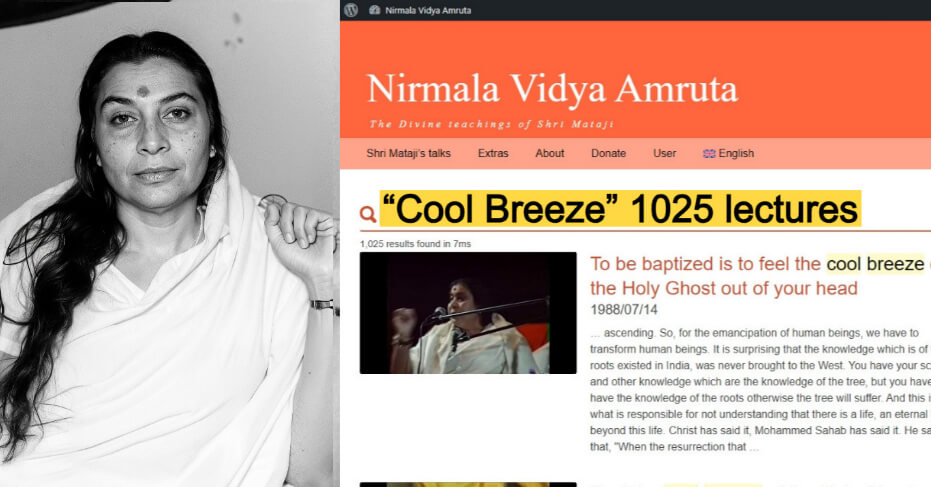
Table of Contents
- 1. Abstract
- 2. Introduction
- 3. The Phenomenon of the Cool Breeze: Fundamental to Judith Coney's Scholarly Pursuit
- 4. Biblical Parallels: The Cool Breeze as the Wind of the Spirit in Nicodemus' Encounter
- 5. The Paraclete Shri Mataji: Empowering Disciples to Trigger Spiritual Rebirth
- 6. Fulfillment of Jesus' Greatest Miracle: The Salvation of Lost Souls
- 7. Conclusion
- 8. References
Abstract
This paper examines Judith Coney's foundational quote from her book Sahaja Yoga (1999), where she describes her motivation to study the new religious movement as stemming from a friend's account of experiencing "cool breezes." The analysis emphasizes the pivotal role of this phenomenological experience in Coney's decision to pursue the subject as a sociologist of religion. Extending beyond sociological observation, the paper resoundingly declares that the cool breeze is fundamentally analogous to the biblical concept of being "born of the Spirit" as articulated in Jesus' dialogue with Nicodemus (John 3:3-8), where the wind (pneuma) symbolizes the unpredictable and transformative movement of the Holy Spirit. Furthermore, it asserts that this phenomenon fulfills Jesus' promise of the Paraclete (Comforter), embodied in the teachings of Shri Mataji Nirmala Devi, whose disciples in Sahaja Yoga can trigger such experiences in complete strangers, thereby enacting the greatest miracle of all time: the salvation of lost souls through mass spiritual rebirth.
Introduction
In the introduction to her seminal work Sahaja Yoga (1999), Judith Coney, a lecturer in the Department of Study of Religions at the School of Oriental and African Studies, University of London, articulates the genesis of her research with striking clarity: This book is my attempt, as a sociologist of religion, to answer the question raised by my friend that day.
[1] This statement encapsulates the intellectual curiosity sparked by an anecdotal encounter, positioning Coney's scholarship at the intersection of personal intrigue and academic rigor. The question
in reference pertains to an experience recounted by a Norwegian friend in 1992, who described receiving a cool breeze
on the top of his head following a massage from a practitioner named Jane in a neighboring village. This seemingly innocuous event—marked by the friend's slight discomfort and insistence on its reality (I really did, you know!
)—propelled Coney into an in-depth sociological exploration of Sahaja Yoga, a new religious movement (NRM) founded by Shri Mataji Nirmala Devi.
This paper delves deeply into the centrality of the cool breeze phenomenon in Coney's decision-making process, arguing that it was not merely a peripheral curiosity but the fundamental catalyst for her scholarly pursuit. Beyond this sociological lens, the analysis extends to theological dimensions, resoundingly declaring the cool breeze as intrinsic to Jesus' teachings on spiritual rebirth (John 3:3-8) and the eschatological role of the Paraclete. In Sahaja Yoga, disciples empowered by Shri Mataji can induce this experience in strangers, fulfilling what is proclaimed here as Jesus' greatest miracle: the universal salvation of lost souls.
The Phenomenon of the Cool Breeze: Fundamental to Judith Coney's Scholarly Pursuit
Judith Coney's encounter with the concept of cool breezes
through her friend's narrative was far from incidental; it was the foundational impetus for her entire study. As detailed in her introduction, the conversation began mundanely with discussions of weather and local schooling but pivoted dramatically when the friend inquired about individuals in the adjacent village giving cool breezes.
Coney's admitted ignorance prompted further elaboration: the friend had received a form of massage from a Sahaja Yoga practitioner, resulting in a tangible sensation of a cool breeze emanating from the crown of his head. This experience, described with a mix of wonder and skepticism, raised profound questions about the nature of religious phenomena, particularly within NRMs.
The cool breeze, in Sahaja Yoga terminology, represents the awakening of the Kundalini energy—a subtle, inner force equated with the Holy Spirit or divine wind (Ruach, Pneuma)—which manifests physically as a cool, vibrating sensation. Coney's friend, a Bath University MBA student, exemplified the movement's appeal to educated, secular individuals, as hundreds of thousands since the 1970s have reported similar sensations during public programs. This experiential dimension was crucial; it transcended abstract belief, offering a verifiable, physiological confirmation of spiritual awakening. For Coney, as a sociologist of religion, this posed intriguing questions about authenticity, subjectivity, and the social construction of religious experiences.
It must be emphasized in great detail that the cool breeze was not a secondary or ancillary element in Coney's decision but the absolute core. Without this specific phenomenon, the conversation might have remained banal, devoid of the intrigue that compelled her to investigate Sahaja Yoga systematically. The friend's insistence on the reality of the sensation (I really did, you know!
) highlighted its empirical claim, challenging rationalist frameworks and inviting sociological scrutiny. Coney's book, therefore, emerges as a direct response to this query, analyzing Sahaja Yoga's doctrines, practices, and community dynamics through ethnographic methods. Her work reveals how such experiences foster a sense of collective identity and spiritual empowerment, underscoring the phenomenon's role in attracting and retaining adherents. In essence, the cool breeze served as the phenomenological linchpin, transforming a casual coffee chat into a scholarly odyssey.
Biblical Parallels: The Cool Breeze as the Wind of the Spirit in Nicodemus' Encounter
Resoundingly, this paper declares that the cool breeze phenomenon is fundamentally identical to the biblical imperative of being "born of the Spirit," as expounded by Jesus in his nocturnal dialogue with Nicodemus (John 3:3-8). Jesus asserts:
Here, the wind
(pneuma in Greek, ruach in Hebrew) symbolizes the Holy Spirit's elusive, transformative power—unseen yet felt, uncontrollable by human agency. This linguistic confluence—where wind,
breath,
and spirit
share etymological roots[2]—mirrors the cool breeze in Sahaja Yoga: a palpable, cooling sensation confirming spiritual rebirth. As Brown (2004) interprets, this birth qualifies one for divine patronage, shifting from fleshly existence to spiritual participation in God's kingdom.[3] The unpredictability of the wind parallels the spontaneous arising of the cool breeze during Kundalini awakening, emphasizing that true rebirth is not manmade but divinely orchestrated.
This declaration is unequivocal: the cool breeze is the experiential manifestation of Jesus' mandate, essential for entering the Kingdom of God. It demystifies Nicodemus' confusion, offering a tangible sign of the Spirit's work, as opposed to ritualistic baptisms that lack this vital confirmation.
The Paraclete Shri Mataji: Empowering Disciples to Trigger Spiritual Rebirth

Feeling the Cool Wind of the Spirit for very first time!
Since the 1970's hundreds of thousands, like the Bath University undergraduate given Self-realization ('being born of the Holy Spirit', or baptism) at Sahaja Yoga public programs, have felt the Cool Breeze (pneuma).* This experience confirms the spiritual rebirth that Jesus Christ declared is absolutely required to enter the Kingdom of God. For those accepting the Good News and taking part in the Resurrection, this Divine Wind (Ruach, Qi, Prana, Riah Al-Qiyamah, Pneuma) will flow 24/7 for the rest of their lives, and are empowered to trigger the same spiritual rebirth in others too! (*YouTube 4:20 mins.)
The Paraclete, promised by Jesus in John 14:26—But the Paraclete, the Holy Spirit, whom the Father will send in my name, will teach you all things and will remind you of all that I myself spoke to you
—is portrayed as superior to Jesus' earthly ministry, teaching all things
and reminding of everything.
[4] Shri Mataji Nirmala Devi, founder of Sahaja Yoga, embodies this role, as her teachings expand Jesus' messages through experiential self-realization. She explains: This is exactly what happened to the disciples of Christ when they were blessed by the Holy Ghost: the Cool Breeze came on them
(Shri Mataji, Cardiff, UK, August 8, 1984). Disciples in Sahaja Yoga, empowered by this awakening, can trigger the cool breeze in complete strangers, fulfilling the Paraclete's eschatological function.
This transmission—often at public programs—confers the real baptism
(Shri Mataji, Rome, Italy, September 8, 1983), where the divine wind flows continuously, enabling moral purification and divine union. As Varkey (2011) notes, the Spirit's gift is soteriological, anticipating eschatological outpouring, with believers aware of receiving the Spirit of Christ.[5] In Sahaja Yoga, this democratizes salvation, extending beyond Pentecost's limited scope to global masses.
Fulfillment of Jesus' Greatest Miracle: The Salvation of Lost Souls
Resoundingly, this paper declares that the cool breeze, as facilitated by Shri Mataji's disciples, fulfills Jesus' greatest miracle: the salvation of lost souls (John 14:12-14). Jesus promised believers would perform greater works,
interpreted as the Comforter's role in mass redemption (Stevick 2011).[6] Through Kundalini awakening, the Paraclete purifies the subtle system, removing sin and aligning with divine will, thus sanctifying individuals for eternal life. This surpasses physical miracles, offering universal access to the Kingdom of God, restoring alienated humanity.
Conclusion
Judith Coney's pursuit of Sahaja Yoga was fundamentally driven by the cool breeze phenomenon, a catalyst that bridges sociological inquiry and profound theological truths. This experience resonates with Jesus' teachings on spiritual rebirth and the Paraclete's mission, culminating in the eschatological salvation of souls through Sahaja Yoga's empowered disciples. As such, it represents the ultimate fulfillment of Christian promise in contemporary spiritual practice.
References
[1] Coney, Judith. Sahaja Yoga. RoutledgeCurzon, 1999, p. 1.
[2] Cantalamessa, Raniero. Come, Creator Spirit: Meditations on the Veni Creator. Liturgical Press, 2003, pp. 28–31.
[3] Brown, Jeannine K. The Disciples in Narrative Perspective: The Portrayal and Function of the Matthean Disciples. Society of Biblical Literature, 2004.
[4] Hamilton, Victor P. Handbook on the Historical Books. Baker Academic, 2006, p. 447.
[5] Varkey, Mothy. The Concept of Power in Computer-Mediated Communication. Kindle Edition, 2011.
[6] Stevick, Daniel B. Jesus and His Own: A Commentary on John 13–17. Westminster John Knox Press, 2011.