
The Future of Faith Book Reviews
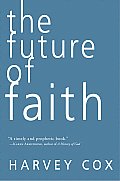
"Faith, according to Cox," starts with awe. It begins with a mixture of wonder and fear all human beings feel toward the mystery that envelops us. But awe becomes faith only as it ascribes some meaning to that mystery.”This Christian theologian sees Jesus' faith as focused on the new order which he called"The kingdom of God.”Cox says that it was"The heartbeat of his life, his constant concern and preoccupation.”... We are now living in"The Age of the Spirit," which began 50 years ago and is continuing now to shake the foundations of the previous era of hierarchical, patriarchal, and institutionalized religion.”
S&P Book Awards:
One of the Best Spiritual Books of 2009
Book Review
By Frederic and Mary Ann Brussat
The Future of Faith
Harvey Cox
HarperOne 09/09 Hardcover $24.99
ISBN: 9780061755521
Harvey Cox is the Hollis Professor of Divinity emeritus at Harvard, where he has
taught since 1965, both at Harvard Divinity School and in the Harvard Faculty of
Arts and Sciences. He is the author of many books including The Secular City,
published in 1965, which became an international bestseller and has sold over
one million copies. His most recent work was When Jesus Came to Harvard: Making
Moral Decisions Today. The Future of Faith is being released to coincide with
Cox's retirement: it charts the three major periods in the history of
Christianity and the shift that is taking place today away from religious
beliefs and dogma to an emphasis on spirituality and social justice. The author
can always be relied upon to deliver a thoughtful and sturdy theological
interpretation and commentary on religion and the contemporary scene.
Faith, according to Cox," starts with awe. It begins with a mixture of wonder
and fear all human beings feel toward the mystery that envelops us. But awe
becomes faith only as it ascribes some meaning to that mystery.”This Christian
theologian sees Jesus' faith as focused on the new order which he called"The
kingdom of God.”Cox says that it was"The heartbeat of his life, his constant
concern and preoccupation.”
The faith of the earliest Christians was oriented around this hope for the new
world of shalom that Jesus personified. Their emphasis was on community rather
than creeds or clergy. The first three centuries of Christianity demonstrated
theological variety, spiritual fellowship, and an anti-imperial stance. All of
that changed in what Cox calls"The Age of Belief"from the fourth to the
twentieth century when faith became identified with creeds, orthodoxy and
"correct doctrine.”The imperialization of the church under Constantine also
resulted in the glorification of bishops and widespread ecclesiastical
corruption.
We are now living in"The Age of the Spirit," which began 50 years ago and is
continuing now to shake the foundations of the previous era of hierarchical,
patriarchal, and institutionalized religion. Cox gives examples of the last
gasps of the old paradigm: an interview he did with Cardinal Joseph Ratzinger
before he became Pope Benedict, and a look at how Protestants are struggling to
move beyond fundamentalism. He has some sympathy for this embattled conservative
movement since he once was part of it but also laments the fundamentalists'
closemindedness and clinging to non-negotiable beliefs. Cox ponders the growing
interfaith movement, the de-westernization of Christianity, liberation theology,
and the tsunami of Pentecostalism.
The world's religions are all undergoing reforms and in the last chapter of this
book, the author charts a few of them in Islam, Buddhism, and Judaism. Cox
comments on the"emerging church movement"And its impact on mainline churches
in America. In general, religious people are becoming"less dogmatic and more
practical ... more interested in ethical guidelines and spiritual disciplines
than in doctrine.”All these are positive signs that the future of faith is
open, expansive, and hopeful.
https://www.spiritualityandpractice.com/books/books.php?id=19287
The Future of Faith - The rise and fall of belief and the coming age of the Spirit
A celebrated scholar argues that religious fundamentalism is dying throughout the world, and being replaced by grassroots movements rooted in social justice and spiritual experience.
There is an essential change taking place in what it means to be"religious"today. Religious people are more interested in ethical guidelines and spiritual disciplines than in doctrines. The result is a universal trend away from hierarchical, regional, patriarchal, and institutional religion. As these changes gain momentum, they evoke an almost point-for-point fundamentalist reaction.
Once suffocated by creeds, hierarchies, and the disastrous merger of the church with the Roman Empire, faith—rather than belief—is once again becoming Christianity's defining quality. This recent move away from dogmatic religion is best explained against the backdrop of three distinct periods of church history:
The Age of Faith: The first three centuries of Christianity, when the early church was more concerned with following Jesus' teachings than enforcing what to believe about Jesus.
The Age of Belief: Marking a significant shift between the fourth and twentieth centuries when the church focused on orthodoxy and"correct doctrine.”
The Age of the Spirit: A trend that began fifty years ago and is increasingly directing the church of tomorrow, whereby Christians are ignoring dogma and breaking down barriers between different religions— spirituality is replacing formal religion.
The Future of Faith is a major statement and a hopeful look at a movement that is surfacing within Christianity and other religious traditions by one of the most revered theologians today.
Editorial Reviews
Review: The Future of Faith (Publishers Weekly)
What shape will the Christian faith take in the 21st century? In the midst of fast-paced global changes and in the face of an apparent resurgence of fundamentalism, can Christianity survive as a living and vital faith? With his typical brilliance and lively insight, Cox explores these and other questions in a dazzling blend of memoir, church history and theological commentary. He divides Christian history into three periods: the Age of Faith, during the first Christian centuries, when the earliest followers of Jesus lived in his Spirit, embraced his hope and followed him in the work he had begun; the Age of Belief, from the Council of Nicaea to the late 20th century, during which the church replaced faith in Jesus with dogma about him; and the Age of the Spirit, in which we're now living, in which Christians are rediscovering the awe and wonder of faith in the tremendous mystery of God. According to Cox, the return to the Spirit that so enlivened the Age of Faith is now enlivening a global Christianity, through movements like Pentecostalism and liberation theology, yearning for the dawning of God's reign of shalom. Cox remains our most thoughtful commentator on the religious scene, and his spirited portrait of our religious landscape challenges us to think in new ways about faith.
Review: The Future of Faith (Booklist)
The future of faith, Cox argues, is spiritual rather than credal or dogmatic, egalitarian and hands-on rather than mediated by a hierarchical clergy. Christianity, in particular, has arrived at an age of the spirit, in which the term spiritual is increasingly preferred to religious, the vast numbers of conversions worldwide are made outside church establishments, and Christ-like behavior is considered more meaningful than doctrinal precision, Mother Teresa is more admirable than the pope. Apprehension of the divine arrives for more people through experiences of wonder and awe and the appreciation of mystery, not out of study, reasoning, and formal professions of belief. In the center of this lucid and congenial book, Cox retraces organizational Christianity from the earliest communities of Christians through the long career of the church within Roman imperial and later political systems to the structural devolution of the church since the Reformation. He is not alone, but he is most cogent, in thinking that the content of Christian faith is becoming more like that of the early church, rooted in personal and communal behavior, and its expression more syncretistic and secular than ever before. A book full of good news.—Ray Olson
Review
“A lucid and congenial book ... [Cox] is not alone, but he is most cogent, in thinking that the content of Christian faith is becoming more like that of the early church ... A book full of good news.” (Kirkus Reviews (starred review) )
"At this crucial turning point in history, Harvey Cox reminds us of essential religious values and imperatives ... A timely and prophetic book" (Karen Armstrong, author of A History of God )
"Celebrated religious scholar Cox argues that we are witnessing the dawn of a third epoch in Christian history ... Cox's work is intriguing, and there is certainly truth in his observations about global Christianity and the rise of Pentecostalism and liberation theology.” (Kirkus Reviews )
"For the last four decades, Harvey Cox has been the leading trend spotter in American religion.” (Stephen Prothero, author of Religious Literacy )
"Harvey Cox has been a voice of both reason and faith in our cynical times. Now, he offers a fresh vision for the resurrection of a new global Christianity that will restore our faith both in ourselves and the divine.” (Deepak Chopra, author of Jesus: A Story of Enlightenment )
"The Future of Faith is a tour de force. As passionate and challenging as his classic, The Secular City, Cox's new book invites the faithful, the skeptical, and the fearful into a spirit-filled vision of Christianity that can renew a hurting world.” (Diana Butler Bass, author of A People's History of Christianity )
"The Future of Faith is insightful, provocative, and inspiring—I even found myself uttering a hearty evangelical"Amen"At many points!" (Richard Mouw, President of Fuller Theological Seminary and author of Calvinism in the Las Vegas Airport )
"This important book has not only helped me understand the past, present, and future of this amazing phenomenon called Christianity ... it has also motivated me to keep working to help make actual the possible future Cox envisions.” (Brian McLaren, author of A New Kind of Christian )
"With its overarching themes, Cox's new book can be viewed as the culmination of his life's scholarship.” (Boston Globe )
"With typical brilliance and lively insight, Cox explores questions in a dazzling blend of memoir, church history and theological commentary ... Cox remains our most thoughtful commentator on the religious scene, and his spirited portrait of our religious landscape challenges us to think in new ways about faith.” (Publishers Weekly )
What shape faith is taking in the 21st century?
Recently I listened attentively to Professor Harvey Cox as he discussed The Future of the Christian Faith, while he examines the status of other world beliefs, on the PBR. Parallel to his fine book, he traced the evolutionary development of the faith through two phases, 'The Age of Faith' and 'The Age of Belief.' In his book, Cox argues that Christianity is entering an age of more experience applicable mode. One basic focus is on social justice, led by South American theologians. World's great religions are undergoing reformative evolution, which he discussed in the last chapter of his book, where he tabulates few examples in Buddhism, Judaism, and Islam. Cox comments on the 'emerging church movement' and its influence on mainstream churches in America, simply as," religious people are becoming less dogmatic and more practicing more aware of ethical issues and spiritual guidelines than in religious Dogma.”He looks more optimistic than his early time of 'The secular City,' wishful that the future of faith is forward expansive, transparent, and hopeful.
The Age of the Spirit:
The faith of the early Christians was knitted around the hope for the new kingdom of peace that Jesus preached and practiced. As their Jewish ancestors, early Christians emphasized community rather than creeds or rituals. The pre Constantine Christianity demonstrated a religious faith variety, with charity and fellowship, against an imperial Roman pagan character.”The Age of Belief," as Cox calls it, from the fourth to the twentieth century, faith became entangled with rituals, liturgies and creeds, orthodox theology replaced personal religion, which resulted in the glorification of clergy and a history of mundane Church corruption. According to Cox, following WW II," The Age of the Spirit," began, half a century ago, and continues to shake the foundations of patriarchal corporate religion. The prophetic author, gives examples of the last gasps of the old model. He has little sympathy for this outdated conservatism, even he wrote against the remaining part of it, clinging to petrified beliefs. In the midst of fast paced globalization and facing an apparent revival of fundamentalism, Cox ponders the de-Hellenization of Christianity, the growth of the interfaith movement, the surge of Pentecostalism, and the just cause of liberation theology.
Harvey G. Cox:
This eminent Harvard theologian sees Christian faith as focused by Christ on the new order which he called"The kingdom of God.”Cox says that it was"The heartbeat of his life, his constant concern and preoccupation," well presented by many books including The Secular City, 1965, an international bestseller. His most recent work"The Future of Faith"Is released to coincide with Cox's retirement.
The Future of Faith by Harvey Cox
12 January 2010
Bill Dhal
Harvey Cox is Professor of Divinity Emeritus at Harvard University. He retired from the faculty in 2009, where he has taught since 1965.
I am fascinated by this book. It is truly the epic summary of the life's work of one of the most profound theological thinkers and teachers for the past 50+ years — an American one at that.
The book begins with a question: "What does the future hold for religion, and for Christianity in particular?”Cox proceeds by guiding the reader through three phases of the evolution of Christianity: The Age of Faith, The Age of Belief and the Age of the Spirit. Throughout each phase Cox provides an incredibly rich context for the points he is illuminating. This approach gives the texture of the book one that is logically presented, easy to follow — and maintains the reader's hunger for more. I found I was unable to put it down and when I did, came back hungry for another helping.
Where does Cox end up at the conclusion? Listen to these excerpts: All signs suggest we are poised to enter a new Age of the Spirit and that the future will be a future of faith" (p.224).”Faith is resurgent, while dogma is dying. The spiritual, communal and justice- seeking dimensions of Christianity are now its leading edge as the twenty-first century hurtles forward, and this change is taking place along with similar reformations in other world religions" (p.212).
Yet, it would be inappropriate to simply leave you with the bottom- line conclusions of this epic contribution. It is the richness of the writing, the masterful, insightful weaving of history, and the sharing of attention grabbing wisdom that accompanies the reader throughout this entire book, that makes it apparent that you are in the midst of a story being shared by a very wise and leaned friend. Allow me to share a few more excerpts to illustrate this important point:
"People turn to religion more for support in their efforts to live in this world and make it better, and less to prepare for the next" (pp.2-3) Cox makes an important distinction between faith and beliefs throughout the book while weaving the weight of history into support his positions. According to Cox, Faith is about deep-seated confidence — vital for the way we live — it is primordial — hope and assurance that translates into the way we live our lives — each and every day (pp.3-5). Belief, according to Cox, is more like opinion — We can believe something to be true without it making much difference to us. Creeds are clusters of beliefs. Christianity is the story of a people of faith who sometimes cobbled together creeds out of beliefs. It is also the history of equally faithful people who questioned, altered and discarded those same creeds" (pp.3-5).
For the author," To be a Christian meant to live in his Spirit, embrace his hope, and to follow him in the work that he had begun" (p.5). So, where are we today?”We stand on the beautiful threshold of a new chapter in the Christian story — Christians on five continents are shaking off the residues of the second phase (the Age of Belief) and negotiating a bumpy transition into a fresh era for which a name has not yet been coined. I would like to call it the Age of the Spirit" (p.8).
As we"transition"Into this new Age of The Spirit that Cox clearly observes (and provides ample evidence to support said observations), he provides some insights, challenges and suggestions:
"How the new can grow out of the old without wasting time trying to dismantle it" (p.173).
Faith is returning to become"A primary life orientation" (p. 179) — not intellectual assent to a box of beliefs, creeds, doctrine and dogma.
"Christianity came to birth in the midst of a cultural change — it is a movement born to travel — it takes on life with each succeeding cultural transition — But for this to happen again, some old wineskins must be discarded, and the incubus of a self serving and discredited picture of Christian origins must be set aside" (p.184)
"The fact that the most fruitful and exciting movements in Christianity today are taking place on the margins of existing ecclesial structures should not surprise anyone. Historically speaking," schism"And"heresy"have often heralded the deepening and extension of the faith. Sometimes they are condemned, sometimes honored, and sometimes both, starting with the first and only later ending up with the second" (p.197).
"One clear Christian example of the both the renaissance of spirituality and the transmutation in the nature of religiousness is what is being called the emerging church" (p.218)....emphasis is mine.
What does Cox conclude?“A religion based on subscribing to mandatory beliefs is no longer viable" (221).”The wind of the Spirit is blowing. One indication is the upheaval that is shaking and renewing Christianity. Faith, rather than beliefs, is once again becoming its defining quality" (p.223).
I can live with that. Can you? A priceless treasure. DEVOUR it!
https://www.billdahl.net/book-reviews/the-future-of-faith-by-harvey-cox/
The Future of Faith by Harvey Cox
The Dawning of the Age of the Spirit
A review by Chris Faatz
In book after book, Harvard University's Harvey Cox has proven himself one of the most astute observers of contemporary religious life. From The Secular City to Fire from Heaven, from Feast of Fools to The Silencing of Leonardo Boff, Cox has persuasively demonstrated depth of knowledge, acquaintance with relevant texts and movements, and an overall inspiring level of both passion and compassion for the peoples of the world and their journeys through the landscape of belief. In his new book, The Future of Faith, Cox takes his wisdom and commitment one step further, painting an engaging and convincing portrait of a Christianity on the verge of something utterly new, completely transformative, and thoroughly grounded in the very best that 2,000 years of the religion has to offer.
Cox's thesis, in short, is that there have been three great ages in the history of Christianity. The first of these, which he calls the Age of Faith, roughly corresponds to the early days of the Christian movement, when followers were less concerned with doctrinal orthodoxy than with living out the great message of liberation and transformation of Jesus of Nazareth. This was a radical and exciting time in the history of the church, the time of martyrs and great theologians, and a period when people of very different ways of practicing Jesus' message coexisted in a broad and diffuse movement. In Cox's words," as the Christian movement entered the second century, it continued to thrive, sometimes in the face of severe persecution, with a polyglot of theologies and numerous different styles of governance.”
The second age, according to Cox, was the Age of Belief. This period was launched in the fourth century with the Church's cozying up to the Roman state in the form of the emperor Constantine, the revolutionary—or reactionary—impact of the Council of Nicaea which focused on doctrinal orthodoxy and the reining in of those on the fringes of what was considered theologically proper, and the first persecutions of"heretics"of whatever stripe. The Age of Belief lasted roughly through the middle of the 20th century, and was highlighted by its Eurocentric nature, its commitment to hierarchy and doctrinal correctness, and a commitment to uniform and universal beliefs as set forth in creedal form by the religious powers of the day.
In some ways, this Age of Belief was deeply schizophrenic. While inherently extremely conservative, it also contained such remarkable outpourings of a true and revolutionary faith as the movement launched by Saint Francis of Assisi.
Mystics always make prelates nervous, but it seems they are always with us. They have appeared and reappeared both within the Catholic Church and around its edges every century, sometimes to be banished, sometimes to be burned at the stake, and other times (after they are safely dead), to be canonized.
Overall, though, the Age of Belief was marked by caution and conservatism in the theological arena, a commitment to traditional hierarchies in the area of governance, and a fear of enthusiasm and upheaval in popular religious life. Both fundamentalism and conservative evangelical Christianity arose in the context of the Age of Belief.
But, according to Cox, all of that is set to bust wide open, as we enter the new Age of the Spirit.
The Age of the Spirit is delineated by a new discovery of the reality of the prophetic movement of God in people's lives. it's discernable by the explosive growth of the church in the global south, and by a new and profound commitment to social justice on the part of believers everywhere. Don't get me wrong: the hallmarks of the emerging Age of the Spirit are not universally the same. Rather, it's a kind of return to Cox's"polyglot"of the early church, a movement typified by the coexistence of such diverse trends as Liberation Theology and the massive growth of Pentecostal and Charismatic churches throughout the world. Change is coming fast. [D]uring the past few decades the demography of Christianity has changed, shifting dramatically to the south and east. The population numbers tell the story. In 1900, fully 90 percent of Christians lived in Europe or the United States. Today 60 percent live in Asia, Africa, or Latin America, and that figure will probably rise to 67 percent by 2025. About 1975, Christianity ceased to be a"Western"religion. Cox goes on to assert:
This is not just a geographical issue. It means that the new homelands of the faith of Jesus of Nazareth are not the inheritors of either Greek philosophy or Roman civilization. They have minimal interest in the metaphysical issues that obsessed such early Christian theologians as Origen and Athanasius. In Asia their cultures have been nurtured not by Homer and Plato, but by the Ramayana, the Sutras, and the Tao Te Ching. In Africa they have been maintained by a congeries of local rituals, customary healing rites, and the veneration of ancestors. Nor is this recent dislocation mainly cultural or religious. It also has to do with justice. Since the vast majority of people in this"new Christendom"Are neither white nor well-off, their theological questions center less on the existence or nonexistence of God or the metaphysical nature of Christ than on why poverty and hunger still stalk God's world. It is little wonder that liberation theology, the most creative theological movement of the twentieth century, did not originate in Marburg or Yale, but in the tar-paper shacks of Brazil and the slums of South Korea. One of the highlights of this book is just this, Cox's commitment to, and his elaboration of, the prophetic vision of social justice as a core element of this new movement of the spirit. We're tempted to think in boxes, and while it's easy and logical to recognize the commitment of such religious radicals as adherents of Liberation Theology to such a vision, we're unlikely to see such a perspective in movements of charismatic or Pentecostal Christians. This, however, has changed in the last several decades. Pentecostals in Africa and Latin America, thoroughly committed to the leadership of the Holy Spirit in all things, are also finding themselves thoroughly committed to the radical discipleship modeled by Jesus of Nazareth and his followers, challenging structures of power and oppression in a multitude of new and creative ways.
The Future of Faith is a slim book, but it's huge in scope. It ranges widely, and cogently argues a case for our entering a new Age of the Spirit where the reality of God's Kingdom of Shalom, his reign of peace and justice, is becoming more and more a central commitment for believers of all stripes. We are moved by and in the Spirit to transform our lives in the image of Jesus; we are moved by and in the Spirit to transform the world in the image of justice. This is a beautiful and deeply inspiring vision, one that excites believers internationally, and challenges them to rise above the dusty bounds of tradition. Early in the book, Cox proclaims: The Old Testament cycle begins with creation and ends with the renovation of the world into a commonwealth of shalom, a place of justice and peace. This is a very large promise for which the promised land of Canaan is mere foreshadowing, a sort of down payment. This enlarged promise is not just to Jews, but to everyone. Also, according to some of the most lyrical passages in the Hebrew scriptures, it includes the whole creation, the plants and animals, the seas and stars. This means that one way to see the mystery of space-time is to view it as an unfinished narrative, a work in progress. It can be seen as a process in which the new, the surprising, and the unexpected constantly emerge. It means we live in a world whose potential is yet to be fulfilled. And to this, a hearty Amen.
Disclaimer: Our material may be copied, printed and distributed by referring to this site. This site also contains copyrighted material the use of which has not always been specifically authorized by the copyright owner. We are making such material available to our readers under the education and research provisions of "fair use" in an effort to advance freedom of inquiry for a better understanding of religious, spiritual and inter-faith issues. The material on this site is distributed without profit. If you wish to use copyrighted material for purposes other than “fair use” you must request permission from the copyright owner.

