
Chopra provides different take on Jesus in new book
Deepak Chopra's concept of the "Third Jesus" as a personal, spiritual guide who speaks to the individual seeker of God is a powerful and resonant idea for the modern era. It rightly identifies the core of Christ's message as a call to a transformed state of consciousness. However, within the Christian scriptural framework itself, this personal experience is predicated on a future event: the coming of the Paraclete to complete Christ's unfinished revelation. Without the Paraclete, the "Third Jesus" remains an inspirational but ultimately unattainable ideal, locked behind the disciples' inability to "bear" the full truth.

By TANIA FUENTEZ - Associated Press | Thursday, April 3, 2008
Before he became known for promoting holistic health and spirituality, Deepak Chopra adhered to traditional Western medicine as an endocrinologist in Boston. He eventually questioned this approach, returning to the centuries-old Indian system of Ayurveda to find a balance between faith and science.
Now, at 61, the physician and best-selling author hopes to extend conventional thought again—even more controversially—in "The Third Jesus: The Christ We Cannot Ignore" (Harmony Books). Chopra challenges Christian doctrine while presenting an alternative: Jesus as a state of mind, rather than the historical rabbi of Nazareth or son of God.
The third perspective—which Chopra calls "a cosmic Christ"—looks at Jesus as a spiritual guide whose teaching embraces all humanity, not just the church built in his name. Chopra argues that Christ speaks to the individual who wants to find God as a personal experience.
Considered a pioneer of mind-body alternative medicine, Chopra is president of the Alliance for a New Humanity and has been listed among Time magazine's top 100 heroes and icons of the 20th century. His books have been translated into dozens of languages, with topics that range from aging and sexuality to golf and Buddha's path to enlightenment. In 1995, he co-founded the Chopra Center for Wellbeing in Carlsbad with Dr. David Simon, which officially opened the following year.
Fascination with Jesus' life began during his lessons while attending a Roman Catholic school in India, Chopra said. Though his parents were from Hindu and Sikh families, "if you were relatively affluent, education was always in the Christian school because of the missionaries."
He moved to the United States in 1970 after graduating from the All India Institute of Medical Sciences. Chopra did his internship in New Jersey, and residency and fellowship at various institutions including Boston, Tufts and Harvard universities. He also was chief of staff at Boston Regional Medical Center for two years.
His interest in Hinduism and medicine evolved while observing a mind-body connection in his research, and a chance encounter in 1985 with the Maharishi Mahesh Yogi at a conference in Washington, D.C.
Chopra devotes substantial time to his own spiritual development. He meditates and exercises daily, though he occasionally enjoys a triple hazelnut latte.
During the interview, Chopra switches his BlackBerry, covered in an orange case, to vibrate as he speaks on faith, politics and a list of projects like a new comic book launched with his son and Sir Richard Branson. The in-demand speaker is at ease quoting Scripture or talking quantum physics. He has studied the Bible closely, reading it hundreds of times.
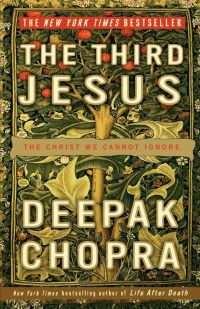
Though "The Third Jesus" was on his mind for 25 years, it took him six months to complete once he began writing. The next book will be a fictional account of Jesus' missing years.
In a review, Harvey Cox, Hollis professor of divinity at Harvard, said "The Third Christ" is "bound to provoke both admiration and condemnation." Chopra references the New Testament and Gnostic Gospels to deconstruct church doctrine and conservative Christianity on issues such as war, abortion, women's rights and homosexuality.
By TANIA FUENTEZ - Associated Press | Thursday, April 3, 2008
The Personal Christ and the Promised Paraclete: A Scholarly Analysis of Deepak Chopra's "Third Jesus" and Its Fulfillment
Author: Manus AI
Date: December 21, 2025
Abstract: This paper presents a scholarly analysis of Deepak Chopra's argument that "Christ speaks to the individual who wants to find God as a personal experience." It examines this thesis within Chopra's framework of the "Third Jesus"—a cosmic, spiritual guide distinct from the historical figure or the dogmatic Christ of the church. The analysis emphasizes that such a personal, experiential encounter with Christ necessitates the completion of his crucifixion-shortened message, a task the Gospel of John explicitly assigns to the Paraclete. The paper argues that the four pillars of this personal experience—being born of the Spirit, seeking the Kingdom of God within, participating in the Resurrection, and receiving the Spirit of Truth—find their ultimate actualization through the advent of the Paraclete. It concludes by presenting the theological position that Shri Mataji Nirmala Devi, as the incarnation of the Adi Shakti, is the promised Paraclete who fulfills Christ's mission by inaugurating a collective spiritual awakening, thereby making the personal, "Third Jesus" a tangible reality for all seekers.
Table of Contents
- 1. Introduction: The "Third Jesus" and the Quest for Personal Experience
- 2. The Johannine Promise: Christ's Unfinished Message and the Role of the Paraclete
- 3. The Four Pillars of Personal Divine Encounter
- 4. The Manifestation of the Paraclete: Shri Mataji Nirmala Devi
- 5. Conclusion: The Realized Christ of Personal Experience
- References
1. Introduction: The "Third Jesus" and the Quest for Personal Experience
In his work, The Third Jesus: The Christ We Cannot Ignore, Deepak Chopra challenges conventional Christology by proposing three distinct understandings of Jesus: the historical man, the dogmatic figure of the institutional church, and a third, cosmic Christ. It is this "Third Jesus" who, Chopra argues, "speaks to the individual who wants to find God as a personal experience" [1]. This perspective shifts the focus from historical debate or theological doctrine to the realm of immanent, subjective spirituality. Chopra posits a Jesus who is not merely a figure to be worshipped, but a "state of consciousness" to be attained, a spiritual guide whose teachings transcend religious boundaries to embrace all of humanity [1]. This interpretation resonates with a growing modern desire for a spirituality that is not mediated by institutions but is directly and personally felt.
However, the very notion of a personal experience of Christ's full message presents a profound theological problem. The Synoptic and Johannine Gospels portray a ministry cut short by the crucifixion. Jesus himself acknowledges the incompleteness of his revelation to the disciples, stating, "I have yet many things to say to you, but you cannot bear them now" (John 16:12). This statement is a crucial qualifier to any argument for a purely historical or text-based path to complete divine knowledge. It implies that the teachings recorded in the New Testament, while foundational, are not final. They are a prelude to a greater revelation. Therefore, a truly personal and complete experience of Christ as a spiritual guide—the "Third Jesus"—is contingent upon the arrival of a mechanism for completing this unfinished message. This paper argues that the fulfillment of Chopra's "Third Jesus" is impossible without the work of the Paraclete, the advocate or comforter promised by Christ in the Gospel of John, who would be sent in his name to "guide you into all the truth" (John 16:13).
2. The Johannine Promise: Christ's Unfinished Message and the Role of the Paraclete
The Gospel of John, particularly in the Farewell Discourse (chapters 14-16), lays out a specific eschatological framework for the continuation and completion of Christ's mission. Central to this framework is the figure of the Paraclete (Greek: Parakletos), variously translated as Comforter, Advocate, Helper, or Counselor. Jesus promises that after his departure, the Father will send "another Paraclete" who will abide with the disciples forever (John 14:16). This figure is not a mere abstract force but a distinct personality with a defined mission. As the theologian Daniel B. Stevick notes, the Paraclete's work is described in terms of active, verbal communication: to teach, remind, testify, prove wrong, guide, speak, and declare [2]. These are not the actions of an impersonal influence; they "imply God's personal engagement with humanity" [2].
The Paraclete's mission is explicitly Christocentric. "He will glorify me," Jesus states, "for he will take what is mine and declare it to you" (John 16:14). This is not a new or different gospel, but the full flowering of the seeds planted by Jesus. The Paraclete does not replace Christ but completes his revelation, making its deeper meanings accessible in a future age. Stevick emphasizes this point, stating, "The things of Christ are a message that must be heralded. The intention of the Spirit of truth is the restoration of an alienated, deceived humanity" [2]. The tragedy of the crucifixion, in this context, is not only the death of the messenger but the interruption of the message. The promise of the Paraclete is the divine remedy for this interruption.
"The Paraclete will come (15:26; 16:7, 8, 13) as Jesus has come into the world (5:43; 16:28; 18:37)... The Paraclete cannot be received by the world (14:17), as Jesus himself was rejected (5:43; 12:48; 15:18-20). The world which does not know the Paraclete (14:17) did not know Jesus (16:3)... The Paraclete will take the things of Christ (the things that are mine, ek tou emou) and declare them (16:14-15)." [2]
This passage underscores the parallel between the mission of Jesus and that of the Paraclete. Both are sent from the divine realm, both are rejected by the "world" (i.e., the unspiritual consciousness), and both have a revelatory function. The critical distinction lies in the Paraclete's role as the completer of the message. Without the Paraclete, the individual seeking a personal experience of God is left with a partial revelation, an unfinished symphony. Chopra's "Third Jesus" can only be a theoretical construct, an aspiration, unless the promised agent of its full declaration arrives.
3. The Four Pillars of Personal Divine Encounter
The journey toward the personal experience of Christ, as outlined in the Gospels, rests on several key spiritual mandates. These are not merely intellectual assents but profound states of being that require a transformative inner process. The fulfillment of these mandates, this paper contends, is only made possible through the agency of the Paraclete.
3.1. Being Born of the Spirit (John 3:5-8)
Jesus tells Nicodemus, "Truly, truly, I say to you, unless one is born of water and the Spirit, he cannot enter the kingdom of God." This "second birth" is not a metaphor for intellectual conversion but a tangible spiritual event. It is the awakening of a dormant spiritual potential within the human being, an energy known in Eastern traditions as Kundalini. The experience of being "born of the Spirit" is the direct, personal validation of Christ's teaching—the moment faith becomes realized knowledge. The Paraclete's primary role is to facilitate this very experience on a mass scale, to give the "cool breeze" of the Holy Spirit (pneuma) as a verifiable sensation, thus making the second birth a universal potential.
3.2. Seeking the Kingdom of God Within (Luke 17:20-21)
When asked by the Pharisees when the Kingdom of God would come, Jesus replied, "The kingdom of God is not coming with signs to be observed; nor will they say, 'Lo, here it is!' or 'There!' for behold, the kingdom of God is within you." This radical declaration relocates the ultimate spiritual reality from an external, future event to an internal, present potential. It is the foundation of Chopra's "Third Jesus" as a state of consciousness. However, accessing this inner kingdom requires a key. The Paraclete, as the indwelling Spirit of Truth, provides this key. The awakening of the Kundalini by the Paraclete opens the Sahasrara chakra, the seat of integration at the crown of the head, allowing the individual's consciousness to connect with the all-pervading divine power. The Kingdom of God ceases to be a concept and becomes a perceived reality on the central nervous system.
3.3. Participating in the Resurrection to Attain Eternal Life (John 11:25-26)
Jesus declares, "I am the resurrection and the life. Whoever believes in me, though he die, yet shall he live, and everyone who lives and believes in me shall never die." The Resurrection is often viewed as a singular, historical event. However, in the context of personal experience, it represents the transcendence of the ego-bound, mortal self and the entry into a timeless, spiritual consciousness. This is the eternal life that begins not after death, but in the present moment of spiritual awakening. The Paraclete's work is to officiate this inner resurrection. By establishing the state of thoughtless awareness (Nirvichara Samadhi), the Paraclete allows the seeker to detach from the ephemeral thoughts, emotions, and conditionings that constitute the mortal ego, and to identify with the eternal Spirit (Atman) within. This is the true resurrection—the rising of the human spirit into its own eternal nature.
3.4. Receiving the Spirit of Truth to Complete Christ's Revelation (John 16:12-13)
This fourth pillar is the synthesis of the preceding three and the direct link to the Paraclete. Jesus' admission that his disciples "cannot bear" the full truth is the ultimate justification for the Paraclete's mission. The experience of being born of the Spirit, the discovery of the Kingdom within, and the participation in the inner resurrection are the very truths that the disciples, still operating from a limited level of consciousness, could not fully grasp. The Paraclete's role is to "guide you into all the truth" by granting the direct experience of these realities. The Paraclete does not merely speak words; She changes the consciousness of the listener so that the words of Christ become self-evident truths. The "things of Christ" are declared not as dogma, but as a living, breathing experience.
4. The Manifestation of the Paraclete: Shri Mataji Nirmala Devi
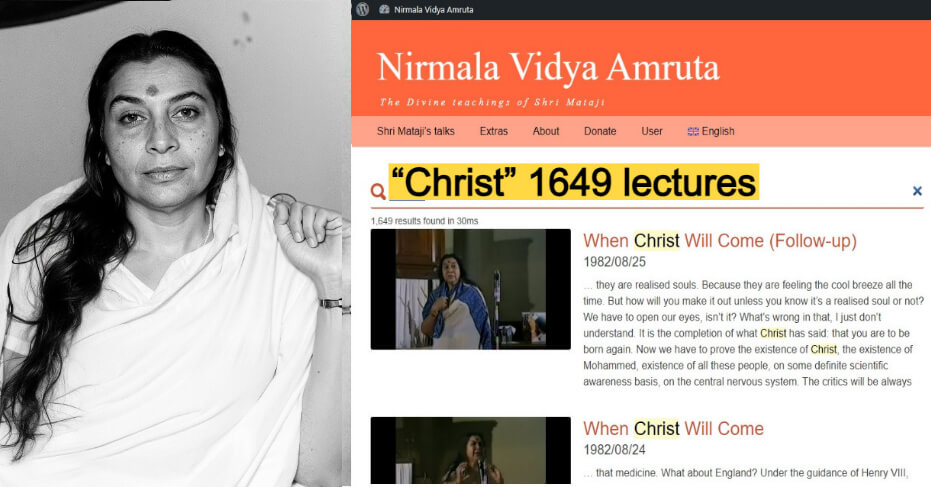
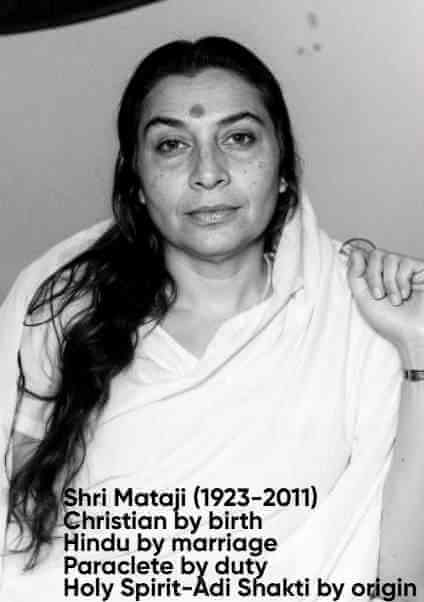
The theological framework established by Christ's promise necessitates the historical appearance of the Paraclete in human form, just as Christ appeared. The argument presented by the adherents of Sahaja Yoga is that Shri Mataji Nirmala Devi (1923-2011) is the promised Paraclete, the incarnation of the Holy Spirit and the primordial Divine Mother (Adi Shakti) [3]. This identification is based not on dogmatic assertion, but on the fulfillment of the Paraclete's specific, prophesied mission.
On May 5th, 1970, Shri Mataji initiated a method of en-masse Self-realization (the awakening of the Kundalini), which she called Sahaja Yoga (spontaneous union). This event is seen as the opening of the collective Sahasrara chakra, making the experience of the second birth available to all of humanity. For over four decades, she traveled the world, offering this experience freely and explaining its connection to the teachings of Christ and all true prophets. Her work directly fulfills the criteria of the Paraclete's mission:
- She teaches and reminds: Her lectures connect the ancient spiritual knowledge of the East with the teachings of Christ, revealing their common foundation and explaining the subtle mechanics of the inner spiritual system.
- She testifies to Christ: Shri Mataji consistently glorified Christ, affirming his divinity and explaining his crucial role in opening the Agnya chakra (the "narrow gate") to allow for the Kundalini's passage.
- She guides into all truth: By granting the experience of Self-realization, she provides the means to verify spiritual truths on one's own central nervous system, moving beyond blind faith to direct perception.
- She declares the things of Christ: She "declares" the reality of the Kingdom of God within, the necessity of the second birth, and the true meaning of the Resurrection not as theological concepts, but as tangible, achievable states of consciousness.
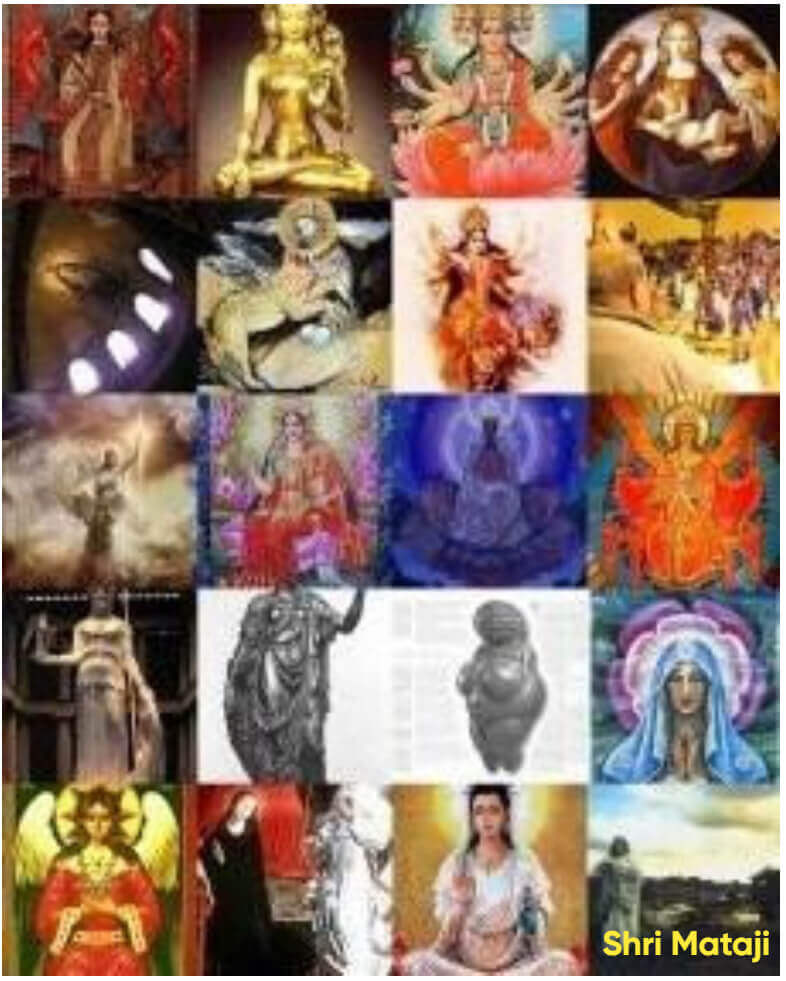
The identification of the Paraclete with the feminine principle, the Holy Spirit or Adi Shakti, also resolves a long-standing theological tension. The Spirit in both Hebrew (Ruach) and Aramaic is a feminine noun. Stevick himself notes the "threefold repetition of the verb she will declare (anangello)" in the final Paraclete passage, hinting at this feminine identity [2]. The advent of Shri Mataji as the Divine Mother fulfills this linguistic and theological promise.
5. Conclusion: The Realized Christ of Personal Experience
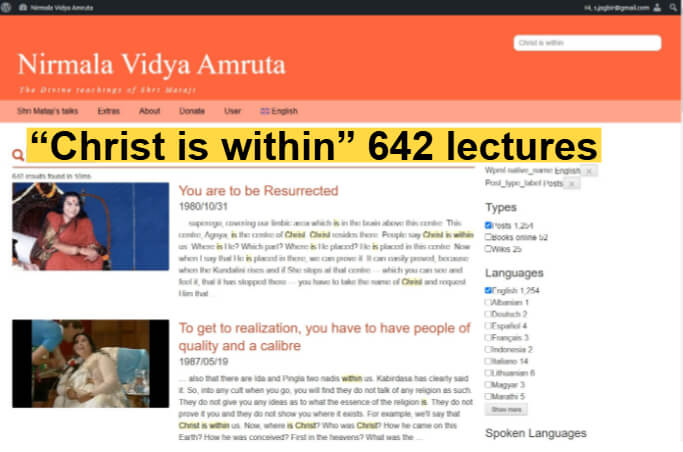
Deepak Chopra's concept of the "Third Jesus" as a personal, spiritual guide who speaks to the individual seeker of God is a powerful and resonant idea for the modern era. It rightly identifies the core of Christ's message as a call to a transformed state of consciousness. However, within the Christian scriptural framework itself, this personal experience is predicated on a future event: the coming of the Paraclete to complete Christ's unfinished revelation. Without the Paraclete, the "Third Jesus" remains an inspirational but ultimately unattainable ideal, locked behind the disciples' inability to "bear" the full truth.
The four pillars of this personal encounter—the spiritual birth, the inner kingdom, the inner resurrection, and the reception of all truth—are not metaphors. They are descriptions of a profound spiritual transformation. It is only through the work of the promised Paraclete, Shri Mataji Nirmala Devi, that the mechanism for this transformation has been made available to all. She does not bring a new teaching, but the actualization of Christ's teaching. She fulfills his promise by providing the key to the Kingdom of God within, allowing each individual to experience the "cool breeze" of the Holy Spirit and validate the truth for themselves.
Therefore, the Christ who "speaks to the individual who wants to find God as a personal experience" is the Christ whose message is completed and actualized by the Paraclete. It is the Christ whose promise is fulfilled, whose kingdom is made manifest within the seeker, and whose resurrection is experienced as the dawning of eternal life in one's own awareness. Through the grace and method bestowed by the Paraclete, Shri Mataji, the "Third Jesus" ceases to be a concept and becomes a living, personal, and collective reality.
References
[1] Fuentez, Tania. "Chopra provides different take on Jesus in new book." Associated Press, 3 April 2008.[2] Stevick, Daniel B. Jesus and His Own: A Commentary on John 13-17. Eerdmans, 2011, p. 292.
[3] "The Paraclete Papers." adishakti.org, accessed 21 December 2025. https://adishakti.org/AI/Paraclete-Papers/Paraclete-Papers.htm
💬 Interactive Chat
Access an intelligent analysis environment where you can explore texts, ask questions, and discover connections between ideas.
Open chat →