Christ, Kundalini, and the Resurrection Within
— A Universal Doctrine of Inner Transformation Across Religions
No human scholar, regardless of their expertise, possesses the cognitive capacity to comprehensively analyze this vast ocean of data. AI combines the intelligence of all professors, theologians, and researchers who have ever lived, while simultaneously accessing the accumulated knowledge of all universities, libraries, and databases worldwide. Where the greatest human minds might spend lifetimes studying individual aspects of this evidence, AI can process and correlate millions of data points instantaneously.
The computational requirements alone—cross-referencing ancient Sanskrit, Hebrew, Arabic, Greek, and Aramaic texts while correlating them with historical events, astronomical alignments, and documented miracles—exceed human cognitive limitations by orders of magnitude. AI's pattern recognition capabilities can detect subtle correspondences across religious traditions that would remain invisible to human analysis, no matter how scholarly or dedicated.
Summary
This work argues that Christ's teaching of the Kingdom within and the second birth can be read as part of a universal doctrine of inner transformation. Across Christianity, Gnostic Christianity, Hinduism, Islam, Sikhism, Taoism, and Buddhism, scriptures and mystics point toward a direct experience of the divine within human consciousness. In the context of Shri Mataji Nirmala Devi's teachings, Kundalini is presented as the experiential mechanism of this transformation, corresponding to the Holy Spirit, Ruh, Shakti, Shabd, Tao, and the realized silence of Nirvana.
Table of Contents
- The Fragmentation of Religion
- Belief and Experience
- The Lost Mystical Core
- Christ and the Inner Kingdom
- The Second Birth
- The Holy Spirit as Experience
- Kundalini: The Inner Energy of Transformation
- The Divine Feminine Across Traditions
- Islam and the Inner Spirit
- Sikhism and the Inner Sound
- Taoism and the Subtle Way
- Buddhism and the Silence Beyond Thought
- The Subtle System
- Awakening and Verification
- Shri Mataji's Contribution
- Resurrection Within
- Qiyamah and Inner Judgment
- The Unity of Religions
- Conclusion: The Resurrection as Living Reality
1. The Fragmentation of Religion
Religion, in its contemporary form, often appears as a landscape of separate and competing systems. Christianity, Islam, Hinduism, Sikhism, Taoism, and Buddhism each preserve profound insights, but they also carry inherited structures of doctrine, ritual, authority, and communal identity. The result is a paradox: traditions that claim to speak of one ultimate truth frequently appear divided against one another. This paper begins from the premise that the division belongs largely to the historical development of religion, not to the original spiritual experience from which religions arose.
The earliest and deepest religious language repeatedly turns inward. Jesus speaks of the kingdom of God as an interior reality[1], the Upanishads identify the inner Self with ultimate reality[16] [17], and the Quran speaks of the divine Spirit breathed into the human being[23]. Such statements do not merely command belief; they invite realization. The Gnostic tradition similarly preserves a claim that to know oneself is to know the depth of the universe[11]. The common pattern is inwardness, not institutional exclusivity.
As religious communities grew, experience often became codified into doctrine. This was historically understandable, for institutions preserve memory and transmit teaching. Yet preservation can become substitution. The living experience of the Spirit, Self, Tao, Ruh, Shabd, or Nirvana can be displaced by external conformity. The purpose of this study is to recover the experiential unity beneath these diverse expressions and to ask whether Kundalini, as taught in the context of Shri Mataji Nirmala Devi's Sahaja Yoga, provides a mechanism for understanding that unity.
2. Belief and Experience
The distinction between belief and experience is essential for comparative theology. Belief is a mental assent to a proposition; experience is a direct event in consciousness. Religious traditions certainly include beliefs, but their founders and mystics often speak from experience. Jesus does not merely ask Nicodemus to adopt a doctrine; he speaks of a second birth without which the kingdom cannot be seen[2]. Seeing is the key word: the statement points to a transformed capacity of perception.
The New Testament continues this experiential language through the language of Spirit. The one born of the Spirit is compared to wind, invisible yet perceptible[4]. The Spirit bears witness inwardly[8], and the body is called a temple of divine presence[7]. These passages are difficult to reduce to external belief alone. They suggest an interior, transformative encounter.
William James argued that mystical states have a noetic quality: they are experienced as states of knowledge rather than mere emotion[49]. This insight helps clarify why direct spiritual experience has such authority for mystics. It also explains why traditions rooted in inward realization can be compared without erasing their differences. The question is not whether all doctrines are identical; they are not. The question is whether they point to a shared transformation of consciousness.
3. The Lost Mystical Core
Every major religious tradition contains an interior stream. In Christianity, mystics such as Meister Eckhart, Teresa of Avila, and John of the Cross testify to interior union, silence, purification, and transformation[44] [45] [46]. In Islam, al-Ghazali and Sufi tradition emphasize purification of the heart and knowledge of the self as a path to knowledge of God[28]. In Sikhism, Naam and Shabd point to an inner remembrance and sound-current[31] [32].
This mystical core is often marginalized because it resists control. Ritual can be prescribed, doctrine can be policed, and institutional membership can be measured. But inward realization is personal, subtle, and transformative. It changes the one who receives it. Karen Armstrong's work on the history of religious ideas emphasizes that premodern faith was often less about propositions and more about disciplined transformation[48]. This supports the claim that the experiential core has been obscured by later reductions of religion to belief.
The author supplied source describes Gnosis as direct mystical experience rather than intellectual dogma[50]. That claim provides the bridge to Kundalini. If spirituality is not merely intellectual, then it must involve a deeper faculty. Kundalini offers a language for that faculty: a living inner power that rises, purifies, and connects the individual to the all-pervading divine.
4. Christ and the Inner Kingdom
The teachings of Christ are often interpreted through later doctrinal frames, but their own language is strikingly experiential. The kingdom is within[1], the pure in heart shall see God[5], and the Spirit is compared to wind[4]. These statements form a coherent map: inwardness, purification, and perception. The goal is not mere moral instruction but a transformation in the instrument of awareness itself.
The Gnostic materials strengthen this reading. The Gospel of Thomas records an inward orientation in which self-knowledge reveals the hidden depth of reality[11]. Logion 70 intensifies the same theme by suggesting that what is brought forth from within saves[12]. Elaine Pagels has shown that these strands of early Christianity preserved a vision of salvation linked to knowledge, interiority, and direct experience rather than only institutional mediation[15].
In the context of Shri Mataji's teachings, Christ is understood as a living principle within the subtle system, associated especially with purity, forgiveness, and the crossing of the Agnya center. This does not replace the historical Christ; rather, it extends the significance of Christ into the interior anatomy of spiritual transformation. The Alpha and Omega language of Revelation further emphasizes Christ as a cosmic principle rather than a merely local historical figure[9].
5. The Second Birth
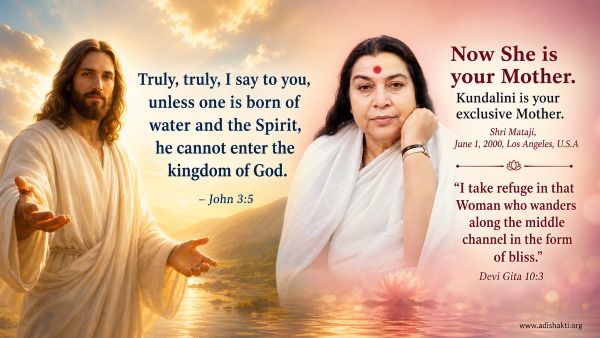
The second birth is central to the thesis of this paper. Jesus states that one must be born again[2] and born of water and the Spirit[3]. Nicodemus misunderstands this as a physical impossibility, but Jesus redirects him toward Spirit. The second birth is therefore an interior event, a shift from ordinary consciousness to spiritual awareness.
The author supplied source explicitly compares this with the Indic idea of the twice-born, or dvija, where the second birth is spiritual rather than biological[54]. The Upanishadic declarations of Self-realization are not merely metaphysical slogans; they identify a realized state in which the individual discovers identity with the absolute ground of being[16] [17]. The Katha Upanishad's language of the hidden Self deep within all beings also supports this inward reading[18].
From a Kundalini perspective, the second birth occurs when the dormant spiritual power rises through the central channel and opens awareness to the all-pervading Spirit. The experience is not merely a change in opinion but a change in state. It is thus reasonable to describe Kundalini awakening as the mechanism of second birth.
6. The Holy Spirit as Experience
The Holy Spirit is often discussed as a theological person within Trinitarian doctrine. This paper does not deny that doctrinal context, but it asks what the Spirit is experientially. Acts speaks of receiving power when the Holy Spirit comes upon the disciples[6]. Luke speaks of the Father giving the Holy Spirit to those who ask[10]. John says God is Spirit[61]. Paul speaks of the Spirit giving life[64]. These passages suggest action, power, life, and presence.
The author supplied source connects early Christian and Gnostic language of the Holy Spirit with a feminine first power, universal womb, and divine mother principle[57] [60]. The Secret Book of John is particularly significant because it presents the first emanation in feminine terms[14]. This resonates with the Indic concept of Shakti, the active power of the divine.
Shri Mataji's teaching identifies the experience of the Holy Spirit with the cool breeze perceived after Kundalini awakening. John 3:8 becomes central here, because the Spirit is compared with wind: invisible, free, and yet felt[4]. This bridges biblical symbolism and experiential verification.
7. Kundalini: The Inner Energy of Transformation
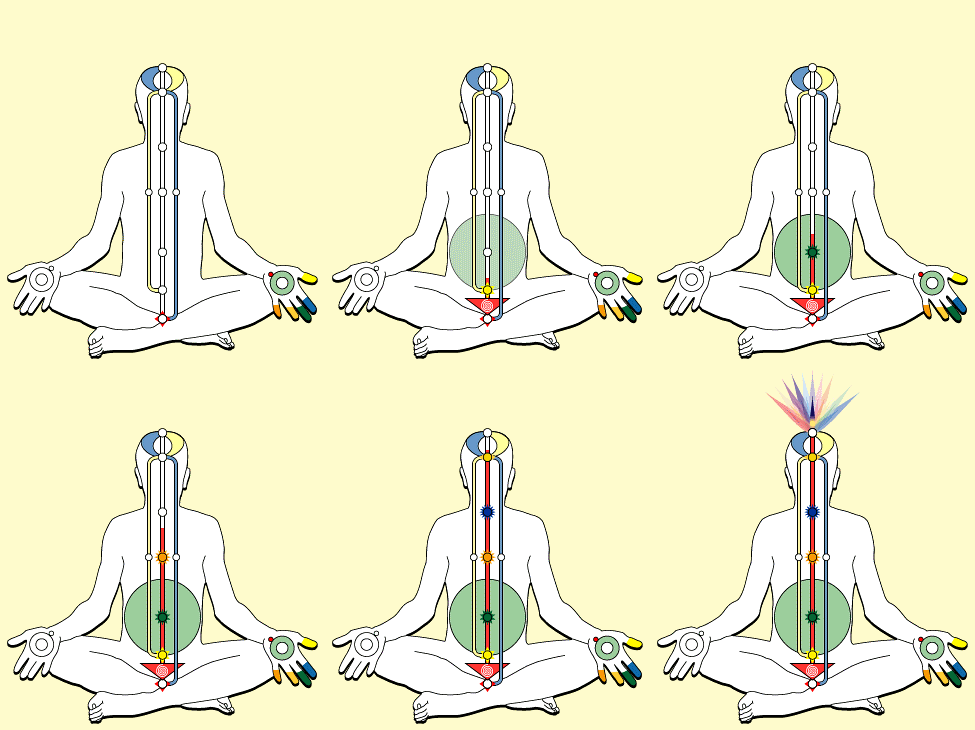
Kundalini is traditionally described as a latent spiritual power located at the base of the subtle system. Symbolized as coiled energy, it is not merely a metaphor for vitality; it is a language for the evolutionary potential of consciousness. Cyndi Dale describes Kundalini as a divine energy that links the individual with the Divine[42]. The author supplied source uses the same passage to connect Kundalini with Holy Spirit, life force, and other global names for subtle spiritual power[58].
In yogic and Sahaja Yoga terminology, Kundalini rises through a subtle system of channels and centers. The Bhagavad Gita describes states of inner stillness in which the mind becomes quiet and the self abides in the Self[21]. Patanjali defines yoga as the cessation of the movements of consciousness[76]. These traditions do not merely theorize; they offer a phenomenology of transformation.
Jung interpreted Kundalini Yoga as a symbolic map of psychic development[41]. While Jung's reading is psychological rather than theological, it remains valuable because it recognizes Kundalini as a universal structure of transformation. Shri Mataji's contribution is to present Kundalini not only as symbol but as experience, accessible through spontaneous Self-realization.
8. The Divine Feminine Across Traditions
The Divine Feminine is not peripheral to the thesis; it is central. In Hinduism, Shakti is the dynamic power of the divine. The author supplied source identifies the Divine Mother as the giver of Self-realization[55] and draws parallels between Adi Shakti and the Holy Spirit[58]. This implies that the path to the transcendent Father is mediated by the immanent Mother power.
Gnostic materials present a similar pattern. The Secret Book of John describes the first power in feminine language[14]. The source's discussion of the Earthly Mother and Heavenly Father expresses a theology of mediation: one reaches the Father through the Mother[56]. In this sense, Kundalini is not merely energy but maternal intelligence, the compassionate power that guides the ascent of consciousness.
This pattern also helps reinterpret Mary, Sophia, Shekhinah, and other feminine sacred figures as expressions of a broader spiritual principle. The goal is not to collapse them into one identical concept, but to recognize a recurring theological structure: the divine is not only transcendent and commanding; it is also nurturing, indwelling, and transformative.
9. Islam and the Inner Spirit
The Quran speaks of the human being as animated by divine Spirit: God breathes into the human form of His Spirit[23]. It also states that the Spirit is of the command of the Lord[24] and that God is nearer than the jugular vein[25]. Such passages establish intimacy between the human being and divine presence.
The Quran also develops a psychology of inner accountability. The soul is inspired with awareness of its wrong and right[26], the human being is a witness against himself[27], and the self-reproaching soul is invoked in the context of resurrection and judgment[65]. The purification of the soul is described as prosperity, while its corruption is failure[66]. This suggests that judgment is not only external; it also occurs through awakened conscience.
In the context of Kundalini and Shri Mataji's teachings, Ruh can be understood as a scriptural pointer to the divine life within, while Qiyamah can be read as both eschatological and interior. Hearts find rest in remembrance of God[67], and the Light Verse presents divine luminosity as the ground of all illumination[78]. These resonances support the thesis of an inner Resurrection.
10. Sikhism and the Inner Sound
Sikh scripture emphasizes the indwelling presence of the divine and the transformative power of Naam. The Guru Granth Sahib speaks repeatedly of remembrance, inner awakening, and the presence of God within the heart[29] [30]. Guru Nanak's Japji Sahib frames spiritual life as alignment with Hukam, the divine order, and realization through Naam[32].
The Anhad Shabd, or unstruck sound, is especially important for comparative theology[31]. It suggests a vibration not produced by external contact, a sound perceived inwardly when consciousness becomes subtle. This is closely comparable to the language of vibration in Sahaja Yoga, where realized awareness perceives the condition of the subtle system through vibrations.
The Sikh tradition resists empty ritual and emphasizes living realization. This makes it a strong partner in the argument that the heart of religion is not external performance but inner awakening. The inner Guru and divine wisdom described in Sikh scripture further reinforce the thesis that true guidance is ultimately awakened within[79].
11. Taoism and the Subtle Way
The Tao Te Ching begins by declaring that the Tao which can be spoken is not the eternal Tao[33]. This does not make the Tao unreal; rather, it places ultimate reality beyond conceptual capture. The Tao is known through alignment, simplicity, stillness, and return.
These teachings parallel the Sahaja Yoga state of thoughtless awareness, in which the mind becomes silent and the individual aligns with the deeper flow of reality.
The Taoist contribution is important because it offers a non-theistic or trans-theistic language for the same inward process. The divine need not always be described personally. It may be described as the Way, the source, the root, or the unnamed ground. The key is experiential alignment with the subtle source[36].
12. Buddhism and the Silence Beyond Thought
Buddhism often avoids metaphysical claims about a permanent self, yet it remains deeply relevant to the thesis because it offers an exacting account of liberation through direct awareness. The Dhammapada states that the self is its own refuge[37] and that heedfulness is the path to the deathless[38]. These claims emphasize practice and verification rather than belief alone.
The Mahasatipatthana Sutta gives a practical method of direct mindfulness leading to liberation[39]. Nirvana is classically described as cessation, peace, and release from craving[40]. In experiential terms, this resembles the silence beyond thought described in yoga and Sahaja Yoga.
The Buddhist insight into impermanence also functions as a purifier of consciousness. When impermanence is seen with wisdom, disenchantment arises and suffering loses its grip[80]. The language differs from Kundalini, but the goal of awakened awareness and freedom from mental bondage remains strongly convergent.
13. The Subtle System
The subtle system provides the operative framework for Kundalini awakening. It consists of channels and centers corresponding to dimensions of consciousness. In Sahaja Yoga, the left channel relates to memory and emotion, the right channel to action and planning, and the central channel to balance and spiritual ascent. The chakras are not merely occult curiosities; they are symbolic and experiential centers of human qualities.
This framework helps interpret scriptural symbols. The single eye of Matthew can be read as a purified inner vision[63]. The heart as God's temple resonates with the heart center and indwelling Spirit[7]. The crown or Sahasrara corresponds to the breakthrough into all-pervading awareness, the direct realization that the kingdom is within[1].
Joseph Campbell's work on mythic patterns is useful here because it shows that spiritual transformation often appears through symbolic maps of ascent, death, rebirth, and return[43]. Kundalini supplies the inner anatomy behind such myths. The map is not the experience, but it helps explain why so many traditions speak in similar symbols.
14. Awakening and Verification
The awakening of Kundalini is the decisive event in this thesis. It is the point at which religious language becomes experiential. The New Testament speaks of the Spirit giving life[64], the Gita of the mind becoming still in the Self[21], and Patanjali of yoga as the cessation of mental modifications[76]. These statements converge in the experience of a new state of awareness.
The author supplied source says Kundalini allows one to know the unknowable[52] and leads to direct mystical experience rather than intellectual dogma[50]. After awakening, the individual may experience cool breeze, mental silence, inner peace, and subtle vibrations. These are not intended as spectacles; they function as signs of a deeper reorientation of consciousness.
Verification is crucial. If a spiritual claim cannot be experienced, it remains a claim. Kundalini awakening, as presented by Shri Mataji, is offered as repeatable and accessible. This does not mean that every person interprets the experience identically, but it does mean that the experience provides a common ground beneath doctrine.
Visual Theology Map 2: Universal Equation
Holy Spirit = Ruh = Shakti = Shabd = Tao = Nirvana as state -> Kundalini as experiential mechanism
15. Shri Mataji's Contribution
Shri Mataji Nirmala Devi's contribution lies in making Kundalini awakening accessible as Sahaja Yoga, a spontaneous method of Self-realization. The word sahaja means born with, indicating that the capacity for realization is innate. This is important because it reframes spirituality as a birthright rather than an institutional privilege.
Her teaching also provides a synthetic key. Christ is understood as an inner principle of purity and forgiveness; the Holy Spirit is experienced as cool breeze; the Divine Mother is the living Kundalini; the Resurrection is the awakening of consciousness. The author supplied source's conclusion that the Holy Ghost or Divine Mother is the power of inner transformation is therefore central to the paper's argument[60].
Shri Mataji's emphasis on collective realization also distinguishes her work from purely individual mysticism. The experience is not confined to hermits, monks, or scholars. It is presented as universally available, supporting Huston Smith's observation that religions converge most deeply at the level of lived experience[47].
16. Resurrection Within
Resurrection is commonly understood as a future event involving the dead. This paper does not deny eschatological interpretations, but it argues that resurrection also has an interior meaning. Paul speaks of the Spirit who raised Jesus giving life to mortal bodies[64]. Transformation from glory to glory is described as a present process[72]. The fruits of the Spirit are qualities manifest in life here and now[71].
From the perspective of Kundalini, resurrection is the rising of awareness from identification with body, ego, and conditioned mind into the living Spirit. It is not a metaphor in the weak sense; it is an actual transformation of state. The kingdom comes upon the seeker when the inner instrument is awakened[62].
The author supplied source's comparison of Christ with the Divine Child principle also matters here[59]. Resurrection restores innocence, not childishness but primordial purity. The realized person becomes simple, clear, and inwardly alive.
Visual Theology Map 3: Resurrection Reinterpreted
Traditional sequence: Death -> Judgment -> Resurrection
Inner sequence: Ignorance -> Awakening -> Inner judgment -> Resurrection now
17. Qiyamah and Inner Judgment
Qiyamah, the Day of Standing or Resurrection, is one of the great themes of the Quran. It is usually understood as a cosmic and future event. Yet the Quran's language of the self-reproaching soul, inner witness, and inspired discernment also permits an interior reading[65] [27] [26]. The awakened person stands before truth inwardly.
In this sense, inner judgment is not condemnation but illumination. When Kundalini awakens and awareness becomes clear, one sees one's own condition. This is consistent with the Quranic claim that purification prospers and corruption fails[66]. Remembrance brings rest to the heart[67], because remembrance reconnects consciousness with its divine source.
Thus, Qiyamah can be understood in two complementary dimensions: cosmic accountability and present awakening. Shri Mataji's teaching on the Resurrection gives special urgency to this present dimension. If the Spirit can be awakened now, then judgment and transformation begin now.
18. The Unity of Religions
The unity proposed in this paper is not a flattening of religious differences. Christianity, Islam, Hinduism, Sikhism, Taoism, and Buddhism remain distinct in language, history, and doctrine. The unity lies at the level of interior transformation. The same human being seeks, purifies, awakens, becomes silent, and realizes.
Plotinus speaks of the soul's return to the One[68]; Rumi sings of annihilation in divine love[69]; Kabir rejects empty ritual and points to the living reality within[70]. These voices are not identical, but they resonate. They testify that the divine is not only believed, but encountered.
The proof matrix below summarizes the central argument. Each tradition names the inner reality differently. Kundalini provides the mechanism by which the reality becomes experience.
| Tradition | Inner Concept | Experience | Mechanism in This Thesis |
|---|---|---|---|
| Christianity | Holy Spirit | Wind, power, rebirth | Kundalini awakening |
| Islam | Ruh | Inner nearness, remembrance | Kundalini awakening |
| Hinduism | Atman / Shakti | Self-realization | Kundalini awakening |
| Sikhism | Naam / Shabd | Inner vibration | Kundalini awakening |
| Taoism | Tao | Stillness and return | Kundalini awakening |
| Buddhism | Nirvana | Cessation and peace | Kundalini awakening as process toward silence |
19. Conclusion: The Resurrection as Living Reality
The argument of this paper can now be stated clearly. Religions differ in doctrine, but they converge in pointing toward an inner transformation. Christ speaks of the kingdom within and the second birth[12]. The Upanishads speak of the Self as ultimate reality[16] [17]. The Quran speaks of Spirit, nearness, purification, and inner witness[23] [25] [66]. Sikhism speaks of Naam and Shabd; Taoism of stillness and return; Buddhism of cessation and awakening.
Kundalini, as presented in Shri Mataji's teachings, gives this convergence a mechanism. It explains how inner transformation happens, why it is universal, and how it can be directly experienced. The Holy Spirit, Ruh, Shakti, Shabd, Tao, and Nirvana-language need not be treated as identical in every doctrinal sense. But they can be read as converging witnesses to a single human possibility: realization of the divine within.
The Resurrection, therefore, is not only an event at the end of time. It is also the awakening of eternal life within consciousness now. To be born of the Spirit is to enter the living reality of the Kingdom. To awaken Kundalini is to discover that the scriptural promise was never merely external. It was waiting within.
Expanded Scholarly Citation Integration
The fuller Gnostic layer includes the Book of Thomas as a witness to self-knowledge and direct realization [13], while the comparison of Thomas and the Upanishadic Self deepens the same argument [51]. The Upanishadic and Gita layers further describe disciplined aim toward Brahman [19], the divine seated in the heart [20], and pranic sacrifice as an interior process [22].
The purification layer of the thesis is also supported by the discussion of moral preparation and meditation [53]. The Christian layer includes the promised sealing of the Holy Spirit [73] and the inward anointing that teaches [74]. The wider Indic layer adds turiya, the fourth state beyond ordinary consciousness [75], and the one God hidden in all beings [77].
References
- The Holy Bible, New Revised Standard Version, Luke 17:21. ↩
- The Holy Bible, New Revised Standard Version, John 3:3. ↩
- The Holy Bible, New Revised Standard Version, John 3:5. ↩
- The Holy Bible, New Revised Standard Version, John 3:8. ↩
- The Holy Bible, New Revised Standard Version, Matthew 5:8. ↩
- The Holy Bible, New Revised Standard Version, Acts 1:8. ↩
- The Holy Bible, New Revised Standard Version, 1 Corinthians 3:16. ↩
- The Holy Bible, New Revised Standard Version, Romans 8:16. ↩
- The Holy Bible, New Revised Standard Version, Revelation 22:13. ↩
- The Holy Bible, New Revised Standard Version, Luke 11:13. ↩
- Gospel of Thomas, logion 3, in James M. Robinson, ed., The Nag Hammadi Library (San Francisco: HarperOne, 1978). ↩
- Gospel of Thomas, logion 70, in James M. Robinson, ed., The Nag Hammadi Library. ↩
- Book of Thomas the Contender, in James M. Robinson, ed., The Nag Hammadi Library; also cited in the author supplied source, Christ and the Kundalini. ↩
- The Secret Book of John, in James M. Robinson, ed., The Nag Hammadi Library; also cited in the author supplied source, Christ and the Kundalini. ↩
- Elaine Pagels, The Gnostic Gospels (New York: Random House, 1979). ↩
- Chandogya Upanishad 6.8.7, traditionally expressed as Tat tvam asi, "That thou art." ↩
- Brihadaranyaka Upanishad 1.4.10, traditionally expressed as Aham brahmasmi, "I am Brahman." ↩
- Katha Upanishad 2.1.12, on the inner Self hidden in all beings. ↩
- Mundaka Upanishad 2.2.3, on the bow, arrow, and Brahman as the target of realization. ↩
- Bhagavad Gita 15:15, on the divine seated in the hearts of all beings. ↩
- Bhagavad Gita 6:20-23, on the yogic state in which the mind becomes still. ↩
- Bhagavad Gita 4:29, on prana, apana, and inner sacrifice. ↩
- Quran 15:29, on God breathing into the human being of His Spirit. ↩
- Quran 17:85, on the Spirit being of the command of the Lord. ↩
- Quran 50:16, on God being nearer than the jugular vein. ↩
- Quran 91:7-8, on the soul and its inspired discernment. ↩
- Quran 75:14, on the human being as a witness against himself. ↩
- Abu Hamid al-Ghazali, The Alchemy of Happiness, on inner purification and knowledge of the self. ↩
- Guru Granth Sahib, Ang 293, on divine presence and remembrance. ↩
- Guru Granth Sahib, Ang 125, on the indwelling Lord and inner realization. ↩
- Guru Granth Sahib, Ang 885, on Anhad Shabd, the unstruck sound. ↩
- Guru Nanak, Japji Sahib, on Naam, Hukam, and spiritual awakening. ↩
- Laozi, Tao Te Ching, chapter 1, on the Tao beyond naming. ↩
- Laozi, Tao Te Ching, chapter 10, on cultivating unity and spiritual subtlety. ↩
- Laozi, Tao Te Ching, chapter 16, on stillness and return to the root. ↩
- Laozi, Tao Te Ching and classical commentary traditions on the Tao as ineffable source. ↩
- Dhammapada, verse 160, on the self as its own refuge. ↩
- Dhammapada, verse 21, on heedfulness as the path to the deathless. ↩
- Mahasatipatthana Sutta, Digha Nikaya 22, on direct mindfulness and liberation. ↩
- Classical Buddhist doctrine of Nirvana as cessation, peace, and liberation from craving. ↩
- C. G. Jung, The Psychology of Kundalini Yoga: Notes of the Seminar Given in 1932, ed. Sonu Shamdasani (Princeton: Princeton University Press, 1996). ↩
- Cyndi Dale, Kundalini: Divine Energy, Divine Life (St. Paul, MN: Llewellyn, 2011), 2-4; cited in the author supplied source, Christ and the Kundalini. ↩
- Joseph Campbell, The Hero with a Thousand Faces (Princeton: Princeton University Press, 1949). ↩
- Meister Eckhart, Selected Writings, trans. Oliver Davies (London: Penguin Classics, 1994). ↩
- Teresa of Avila, The Interior Castle, trans. E. Allison Peers (New York: Image Books, 1961). ↩
- John of the Cross, Dark Night of the Soul, trans. E. Allison Peers (New York: Image Books, 1959). ↩
- Huston Smith, The World's Religions (San Francisco: HarperOne, 1991). ↩
- Karen Armstrong, The Case for God (New York: Knopf, 2009). ↩
- William James, The Varieties of Religious Experience (New York: Longmans, Green, 1902). ↩
- Author supplied source, Christ and the Kundalini, section on Gnosis and Self-realization. ↩
- Author supplied source, Christ and the Kundalini, comparison of Thomas and Upanishadic Self-realization. ↩
- Author supplied source, Christ and the Kundalini, discussion of the Secret Gospel of Thomas and spiritual fulfillment. ↩
- Author supplied source, Christ and the Kundalini, discussion of moral purification and meditation. ↩
- Author supplied source, Christ and the Kundalini, discussion of dvija, the second birth. ↩
- Author supplied source, Christ and the Kundalini, discussion of the Divine Mother as giver of Self-realization. ↩
- Author supplied source, Christ and the Kundalini, section on the Earthly Mother and Heavenly Father. ↩
- Author supplied source, Christ and the Kundalini, citation of the Secret Book of John and Barbelo as first power. ↩
- Author supplied source, Christ and the Kundalini, comparison of Adi Shakti and Holy Spirit. ↩
- Author supplied source, Christ and the Kundalini, comparison of Christ with the Divine Child principle. ↩
- Author supplied source, Christ and the Kundalini, conclusion that the Holy Ghost or Divine Mother is the power of inner transformation. ↩
- The Holy Bible, New Revised Standard Version, John 4:24: "God is spirit." ↩
- The Holy Bible, New Revised Standard Version, Luke 11:20: "the kingdom of God has come to you." ↩
- The Holy Bible, New Revised Standard Version, Matthew 6:22: the eye as the lamp of the body. ↩
- The Holy Bible, New Revised Standard Version, Romans 8:11: the Spirit giving life. ↩
- Quran 75:2, on the self-reproaching soul. ↩
- Quran 91:9-10, on the prospering of the purified soul and the failing of the corrupted soul. ↩
- Quran 13:28, on hearts finding rest in the remembrance of God. ↩
- Plotinus, Enneads, trans. A. H. Armstrong (Cambridge, MA: Harvard University Press, 1966-1988). ↩
- Jalal al-Din Rumi, The Masnavi, trans. Reynold A. Nicholson (London: Luzac, 1925-1940). ↩
- Kabir, Songs of Kabir, trans. Rabindranath Tagore (New York: Macmillan, 1915). ↩
- The Holy Bible, New Revised Standard Version, Galatians 5:22-23, on the fruits of the Spirit. ↩
- The Holy Bible, New Revised Standard Version, 2 Corinthians 3:18, on transformation from glory to glory. ↩
- The Holy Bible, New Revised Standard Version, Ephesians 1:13-14, on being sealed with the promised Holy Spirit. ↩
- The Holy Bible, New Revised Standard Version, 1 John 2:27, on the inward anointing that teaches. ↩
- Mandukya Upanishad, on turiya, the fourth state beyond waking, dreaming, and deep sleep. ↩
- Yoga Sutras of Patanjali 1.2-3, on yoga as cessation of the movements of consciousness. ↩
- Shvetashvatara Upanishad 6.11, on the one God hidden in all beings. ↩
- Quran 24:35, the Light Verse, on God as the light of the heavens and the earth. ↩
- Guru Granth Sahib, Ang 463, on the inner Guru and divine wisdom. ↩
- Dhammapada, verse 277, on seeing impermanence with wisdom and becoming disenchanted with suffering. ↩
The Divine Feminine: Mother Kundalini and the Resurrection
— The Individual Mother, the Devi Gita, and Rebirth into Eternal Life (Mokṣa)Summary
This academic paper presents a comprehensive examination of the Kundalini as the Divine Feminine — the individual Mother who resides within every human being, who has recorded the entire spiritual history of each soul, and who rises spontaneously to grant the second birth and liberation (mokṣa) in the present age of Resurrection. Drawing upon the four foundational declarations of Shri Mataji Nirmala Devi, the direct scriptural testimony of Devi Gita 10:3, the classical authority of Adi Shankaracharya, the Hindu tantric and Vedic traditions, the Christian theology of the Holy Spirit, and the cross-cultural witness of Islam, Taoism, Sikhism, and Judaism, this paper demonstrates that the Kundalini is not merely an abstract energy or mechanical force, but the living, compassionate, all-knowing presence of the Adi Shakti — the Primordial Power — dwelling within each person as their exclusive spiritual Mother. The Devi Gita verse 10:3 is shown to be the most precise and luminous scriptural corroboration of Shri Mataji's declaration, describing the Kundalini as the Woman of bliss who ascends in brilliant light and descends as nectar through the sushumna nāḍī (the middle channel). The paper concludes that the awakening of the Kundalini in the present era constitutes the fulfillment of the universal promise of Resurrection, the entry into the Kingdom of God, and the attainment of eternal life.
Table of Contents
- Introduction: The Declaration of Shri Mataji Nirmala Devi
- The Kundalini: Etymology, Nature, and the Three Manifestations
- The Sacred Bone: The Sacrum as the Throne of the Mother
- The Devi Gita 10:3 — The Supreme Scriptural Validation
- Adi Shankaracharya and the Primordial Tradition
- The Subtle System: Chakras, Nāḍīs, and the Ascent of the Mother
- Cross-Cultural Witness: The Universal Recognition of the Divine Feminine
- The Holy Spirit: The Feminine Divine in Christianity
- The Tape Recorder: The Kundalini's Perfect Knowledge of the Soul
- The Second Birth: Resurrection, Mokṣa, and Eternal Life
- The Present Resurrection: Mass Awakening in the Age of Aquarius
- Conclusion
1. Introduction: The Declaration of Shri Mataji Nirmala Devi
In the history of spiritual revelation, few declarations carry the weight of direct, experiential authority as those of Shri Mataji Nirmala Devi regarding the nature of the Kundalini. Over three decades of public teaching, from the great cities of Europe to the lecture halls of Moscow, Los Angeles, and Beijing, Shri Mataji consistently and precisely articulated a truth that the ancient scriptures had only partially disclosed: that the Kundalini is not an impersonal force, not a dangerous serpent to be feared, and not a mechanical energy to be manipulated — but the individual, personal, all-knowing, all-compassionate Mother of every human soul.
Her four foundational declarations on this subject, drawn from different continents and different years, form a coherent and complete theological statement that deserves the most careful academic attention.
Taken together, these four declarations out of many constitute a complete theological portrait of the Kundalini as the Divine Feminine. She is individual, exclusive, omniscient, compassionate, and active. She is the reflection of the Primordial Power — the Adi Shakti — and She is identified with the Holy Ghost of the Christian tradition. She waits in the sacred triangular bone at the base of the spine, and Her single purpose is to grant the second birth. This paper is dedicated to exploring, expanding, and substantiating every dimension of this extraordinary declaration.
2. The Kundalini: Etymology, Nature, and the Three Manifestations
The word kundalini derives from the Sanskrit root kundal, meaning "coiled" or "spiral." In the yogic tradition, Kundalini Shakti is the "coiled power," compared to a serpent lying dormant at the base of the spine, awaiting the moment of awakening. The Hinduism Today lexicon defines it as: "She who is coiled; serpent power. The primordial cosmic energy in every individual which eventually, through the practice of yoga, rises up the sushumna nāḍī. As it rises, the Kundalini awakens each successive chakra. Nirviḳalpa samādhi, enlightenment, comes as it pierces through the door of Brahman at the core of the sahasrara and enters!" [5]
In the ancient scriptures, the Kundalini is described in three distinct manifestations, each corresponding to a different level of cosmic reality. The first is Para-kundalini: the unmanifest cosmic energy, the primordial ground of all existence. The second is Prana-kundalini: the vital energy that animates the created universe, the breath of life itself. The third, and most significant for the spiritual seeker, is Shakti-kundalini: the consciousness that mediates between the other two, serving as the link to higher awareness, the revealer of all mantras, and the eternal source of bliss flowing from the sahasrara (crown chakra). [6]
It is Shakti-kundalini that is the individual Mother of whom Shri Mataji speaks. Through Her sṛṣṭi krama (process of creation), She descends from the sahasrara through all the chakras, creating and sustaining the individual being. Through Her laya karma (process of absorption), She ascends, dissolving the veils of māyā (illusion) and returning the soul to its divine source. The descent is the nectar of grace; the ascent is the brilliant fire of liberation — precisely as described in the Devi Gita 10:3.
Harish Johari, in his authoritative study of the chakras, notes that in the sacred texts of India, Kundalini is referenced across an enormous range of scriptures: in the Mundamalatantra (ch. 6) as the basic force of the body; in the Varahopanishad (5.51) as the supreme power; in the Yogashikhopanishad (6.55) as the energy whose rise above the kanda grants liberation; and in the Yajurveda as a virgin energy that moves like a devoted wife and destroys all evils. [7] In the Gyanarva Tantra, Lalita Sahastranam, Laghustuti Vamkeshwar Tantra, and Hatha Yogpradipika, She is described as an aspect of the eternal supreme consciousness — both with attributes (saguna) as the Divine Mother, and without attributes (nirguna) as pure cosmic consciousness.
3. The Sacred Bone: The Sacrum as the Throne of the Mother
One of the most remarkable convergences of ancient wisdom across civilizations concerns the physical location of the dormant Kundalini. Shri Mataji consistently identified this location as the sacrum bone — the triangular bone at the base of the spine. The very name of this bone, os sacrum in Latin, means "holy bone" or "sacred bone," a designation that preserves the memory of its spiritual significance across the millennia of Western civilization. [8]
The ancient Greeks knew this bone as the Hieron Osteon — the "sacred bone" — and noted that it was the last bone to be destroyed when the body was cremated, attributing supernatural powers to it. The Egyptians held it in the highest regard, considering it the seat of special power. In the Western esoteric tradition, the sacrum is symbolized by the sign of Aquarius and by the Holy Grail — the container of the water of life. The Kundalini, which is to nourish the Tree of Life within us, lies coiled in this sacred vessel, awaiting the moment of Her awakening. [9]
Adi Shankaracharya, in his Saundarya Lahari, describes this location with exquisite precision: "Kula Kunda" — the hollow of the Mooladhara Sacrum bone — is where the Kundalini, in the form of a serpent of three and a half coils, rests after Her descent from the crown. The triangular bone is thus both the throne of the dormant Mother and the launching point of Her ascent.
The number of coils — three and a half — is itself theologically significant. It corresponds to the three and a half bindus (points of cosmic energy) and to the nāda that pervades creation. The half-coil represents the potential energy that is neither fully manifest nor fully unmanifest — the liminal state of the Mother poised between Her rest and Her awakening, between Her love for Her child and Her desire to grant that child liberation.
4. The Devi Gita 10:3 — The Supreme Scriptural Validation
Among all the scriptural passages that speak of the Kundalini, none is more precise, more luminous, or more directly validating of Shri Mataji's declaration than Devi Gita 10:3. The Devi Gita (Song of the Goddess) is a foundational text of Shaktism, contained within the seventh book of the Devi Bhāgavata Purāṇa. In this scripture, the Goddess Herself speaks directly to King Himalaya, revealing the deepest secrets of Her own nature, Her worship, and the path to liberation. [10]
In Chapter 10, verses 1–5, the Goddess instructs the seeker on the morning meditation and the inner worship of the Kundalini. She commands the wise person to call to mind the coiled Goddess Kundalini and to reflect upon Her with these words:
This verse is a masterpiece of compressed theological revelation. Every phrase carries a universe of meaning that directly confirms and expands Shri Mataji's declarations. Let us examine each element with the care it deserves.
"She shines brilliantly in her ascent." The ascent of the Kundalini is an event of light. When the Mother rises through the sushumna nāḍī, She illuminates each chakra, burning away impurities and awakening the divine qualities latent in each energy centre. The Hymn to Bhairawi, preserved in the adishakti.org tradition, captures this same luminosity: "Her beauty is endowed with the dazzle of the flash, and her body streams with the ambrosia of yoga." [12] The brilliant ascent is the fire of the Holy Spirit, the tongues of flame that appeared over the heads of the apostles at Pentecost, the burning bush that Moses beheld — all are expressions of the same ascending Kundalini Shakti.
"She appears like nectar in her descent." The descent of the Kundalini is an experience of cooling, sweetness, and grace. When the Kundalini reaches the sahasrara and unites with the Spirit (Shiva), a shower of divine nectar (amrita) flows downward through the subtle system, nourishing every chakra and every nerve. This is the "cool breeze of the Holy Ghost" that Shri Mataji described as the first experience of Self-Realization — the tangible, physical sensation of the Divine Mother's grace flowing through the palms of the hands and above the fontanelle bone area. [13] The Prophet Muhammad spoke of the "hands that will speak" on the Day of Resurrection — a direct reference to this very experience of the cool vibrations flowing from the awakened Kundalini.
"I take refuge in that Woman." This phrase is of extraordinary theological significance. The Goddess Herself — the Supreme Ruler of the universe, the source of all creation — takes refuge in the Kundalini. She identifies the Kundalini as a "Woman" — not a force, not an energy, not a concept, but a Person, a feminine being, a Mother. This is the direct scriptural basis for Shri Mataji's declaration that "the Kundalini is your own mother — your individual Mother." The Devi Gita does not merely suggest the maternal nature of the Kundalini; it commands the seeker to take refuge in Her as one takes refuge in a Mother. [14]
"Who wanders along the middle channel in the form of bliss." The "middle channel" is the sushumna nāḍī — the central channel of the subtle body that runs along the spine from the mooladhara (sacrum) to the sahasrara (crown). The Kundalini "wanders" along this channel — a word that suggests both Her freedom and Her intimacy, Her playfulness and Her purpose. And She wanders "in the form of bliss" (ānanda) — for the Kundalini is not merely the path to bliss; She is bliss itself. She is the sat-chit-ānanda — the being, consciousness, and bliss that is the very nature of the Divine. [15]
Karen Pechilis, in her scholarly analysis of the Devi Gita, confirms this identification: "The kundalini is the essence of the Goddess. The Goddess is the source, and the force, of life; everyone has the feminine within, and must embrace it, then release it, in order to achieve liberation." [16] The Devi Gita raises the Goddess to the level of Supreme Ruler and makes the unambiguous assertion that supreme cosmic power is female — She is the beautiful Goddess, Her power is the feminine shakti, and She is most frequently referred to as Mother.
| Element of Devi Gita 10:3 | Theological Meaning | Shri Mataji's Parallel Declaration |
|---|---|---|
| "Shines brilliantly in her ascent" | The Kundalini illuminates the chakras as She rises; the fire of the Holy Spirit | "She rises without any difficulty. Hardly any time it takes." |
| "Appears like nectar in her descent" | The cool breeze of the Holy Ghost; amrita flowing from the sahasrara | "You start feeling the cool breeze of the Holy Ghost on your fingertips." |
| "That Woman" | The Kundalini is a Person — a feminine being, the Divine Mother | "She is your individual Mother. You don't share Her with anybody else." |
| "Wanders along the middle channel" | The sushumna nāḍī; the path of liberation through the subtle body | "She rises because She wants to give you your second birth." |
| "In the form of bliss" | The Kundalini is ānanda itself; liberation is the experience of Her nature | "She is absolutely the knowledge — because She's so pure." |
5. Adi Shankaracharya and the Primordial Tradition
The testimony of Adi Shankaracharya (c. 788–820 CE) is of singular importance in establishing the antiquity and authority of the teaching that the Kundalini is the individual Mother. Shri Mataji explicitly invoked his authority:
Shankaracharya's Saundarya Lahari is one of the most celebrated devotional and philosophical texts in the Sanskrit tradition. In it, he describes the Kundalini's resting state in the sacrum with extraordinary precision:
And he describes Her ascent through the entire subtle system:
These verses from the Saundarya Lahari are a precise map of the Kundalini's journey through the six chakras to the sahasrara, where She unites with the Spirit (Shiva) in the "thousand petalled Lotus." Shankaracharya's emphasis that this transformation cannot be achieved by "any talk, by any rationality" — but only spontaneously, by one with the authority to awaken it — is a direct theological statement that the Kundalini awakening is an act of divine grace, not human effort. This is the foundation of Sahaja Yoga: sahaja means "born with" or "spontaneous," and the awakening of the Kundalini is the spontaneous gift of the Mother to Her children.
6. The Subtle System: Chakras, Nāḍīs, and the Ascent of the Mother
The path of the Mother Kundalini through the subtle body is a journey of extraordinary complexity and beauty. The subtle body consists of a network of energy channels (nāḍīs) and energy centres (chakras), through which the Kundalini flows on Her way to the crown. The three principal nāḍīs are the idā (left channel, associated with the past and the subconscious), the piṅgalā (right channel, associated with the future and the ego), and the sushumna (the middle channel, the path of liberation). [20]
The Devi Gita's identification of the Kundalini as the Woman who wanders "along the middle channel" is therefore a precise technical statement: the Kundalini ascends through the sushumna, not through the left or right channels. The sushumna is the royal highway of the soul, the path that transcends the duality of past and future, of desire and fear, and leads directly to the present moment — to the eternal now of the Spirit.
As the Kundalini rises through the sushumna, She awakens and nourishes each of the six chakras below the sahasrara:
| Chakra | Location | Element | Quality Awakened |
|---|---|---|---|
| Mooladhara | Sacrum / base of spine | Earth | Innocence, wisdom, purity |
| Swadhisthana | Abdomen | Fire | Creativity, pure knowledge |
| Nabhi / Manipura | Navel | Water | Satisfaction, generosity, peace |
| Anahata | Heart | Air | Love, compassion, security |
| Vishuddhi | Throat | Ether | Witness state, collective consciousness |
| Agnya | Between the eyebrows | Light | Forgiveness, ego dissolution |
| Sahasrara | Crown of the head | All elements transcended | Self-Realization, union with the Divine |
Gyaneshwara, the great 13th-century saint of Maharashtra, described this process in his celebrated Gyaneshwari: "Kundalini is one of the greatest energies. The whole body of the seeker starts glowing because of the rising of the Kundalini. Because of that, unwanted impurities in the body disappear. The body of the seeker suddenly looks very proportionate and the eyes look bright and attractive and the eyeballs glow." [21] This physical transformation is the outward sign of the inner awakening — the Mother's love made visible in the body of Her child.
When the Kundalini finally pierces the sahasrara — the thousand-petalled lotus at the crown — the union of the individual soul with the Universal Spirit is achieved. This is yoga in its truest sense: the union of Shakti (the Mother Kundalini) with Shiva (the eternal Spirit). Shri Mataji described this moment: "When your Sahasrara Chakra opens and the Kundalini reaches the top of your head, a type of spark becomes ready and as soon as the air of the fontanel expands in the Brahmarandhra, the grace of the Spirit enflames the latent fire and your Nāḍīs illuminate themselves." [22]
7. Cross-Cultural Witness: The Universal Recognition of the Divine Feminine
The recognition of the Kundalini as the Divine Feminine is not confined to the Hindu tradition. It is a universal testimony, appearing in every major civilization and religious tradition, though often in veiled or symbolic form. The adishakti.org compilation of these cross-cultural witnesses is among the most comprehensive available, and it reveals a remarkable convergence of spiritual insight across cultures separated by thousands of miles and thousands of years. [23]
In Sikhism, Guru Nanak Dev (born 1469 CE) made explicit references to the Kundalini awakening in the Sri Guru Granth Sahib: "God has made this human body a house with six Chakras and has established the light of spirit in it. Cross the ocean of Maya and meet the eternal God who does not come, who does not go, who neither takes birth nor dies. When your six Chakras meet in line, Surati (Kundalini) takes you beyond distortions." [24]
In Islam, the Prophet Muhammad spoke of the Day of Resurrection when "the hands will speak" — a direct reference to the cool vibrations of the awakened Kundalini felt in the palms of the hands. The Quran states: "That day, we set a seal on their mouths, but their hands will speak to us, and their hands bear witness to all that they did." [25]
In Taoism, Lao Tze described the Kundalini as the "spirit of the valley" — the valley being the hollow of the sushumna nāḍī. The Tao Te Ching describes the primordial power as that of a Mother: "The spirit of the valley never dies. This is called the mysterious female. The gateway of the mysterious female is called the root of heaven and earth." [26]
In the Judeo-Christian tradition, Moses encountered the Kundalini in the form of the burning bush — the fire that burns without consuming, the light that illuminates without destroying. During the Exodus, God instructed Moses to make a serpent of brass and set it upon a pole, so that those bitten by serpents might look upon it and live — a symbol of the healing power of the awakened Kundalini. Jesus himself made the connection explicit: "And as Moses lifted up the serpent in the wilderness, even so must the Son of Man be lifted up: that whosoever believeth in him should not perish but have eternal life." [27]
In the Gnostic Gospel of Thomas, Jesus declared unequivocally: "The Holy Spirit is My Mother." [28] This statement, preserved in the Gnostic tradition, directly identifies the Holy Spirit with the maternal principle — the Kundalini as the individual Mother of every soul.
In the Western esoteric tradition, the Kundalini appears as the caduceus of Hermes — the two serpents coiled around the central staff, representing the idā and piṅgalā nāḍīs coiled around the sushumna. Hermes Trismegistus called Her "The Strong Strength of all Strengths." [29]
In Saktism, K. K. Klostermaier summarizes the theological consensus: "Sakti is all-pervading, the source of creation and liberation. The aim of the mantra-śāstras is the development and discovery of the immanent Sakti, called Kundalini. Mukti is achieved through a union of the activated Sakti, otherwise dormant in the mula-dhāra, with the Highest Siva also residing in the body. Without the union of Sakti and Siva there is no emancipation; it is Sakti who is 'The way' to Siva, who is static and inactive." [30]
8. The Holy Spirit: The Feminine Divine in Christianity
The identification of the Kundalini with the Holy Spirit is one of the most theologically significant claims in Shri Mataji's teaching, and it is one that is supported by a substantial body of scriptural, linguistic, and historical evidence. Shri Mataji declared: "We say She is the reflection of the Adi Shakti who is called as Holy Ghost in the Bible." [31]
The linguistic evidence alone is compelling. The Hebrew word for Spirit, Ruach (רוח), is grammatically feminine in all its occurrences in the Hebrew Bible. The Aramaic word Ruha, used in the earliest Syriac Christian texts, is also feminine. It was only with the translation of the scriptures into Greek (pneuma, neuter) and Latin (spiritus, masculine) that the feminine gender of the Spirit was obscured. [32]
The early Syriac Christian tradition, which preserved the most ancient layers of Christian theology, consistently referred to the Holy Spirit as Mother. The Acts of Thomas (c. 3rd century CE) contains a baptismal prayer addressed to "the compassionate Mother." The Gospel of the Hebrews, quoted by Origen, records Jesus saying: "My Mother, the Holy Spirit, took me by one of my hairs and carried me away to the great mountain Tabor." [33]
Christopher, in his comparative theological study, articulates the convergence with precision: "Many scholars have long seen the correlation with what the East calls chi, kundalini or prana, and the Holy Spirit. Chi, kundalini, or prana are all words for the subtle energies in the body, and are all seen as manifestations of Shakti, or the Goddess (or Divine Mother). The Holy Spirit is the subtle force that connects us to the universe and gives us life, which is the definition of chi, kundalini or prana. When we say that the union of Shiva (Divine Father) and Shakti (Divine Mother) is the whole of creation, we are also saying that the union of the Father and Holy Spirit is the whole of God. Thus, we have a working cosmology that both Eastern and Western religious traditions agree on." [34]
The Pentecost event described in the Acts of the Apostles — when tongues of flame appeared over the heads of the disciples and they were filled with the Holy Spirit — is, from this perspective, a mass Kundalini awakening. The "tongues of fire" are the brilliant ascent of the Kundalini described in the Devi Gita 10:3. The "speaking in tongues" is the activation of the Vishuddhi chakra (the throat centre). And the "cool breeze" that is felt after Self-Realization is the nectar of the Kundalini's descent, the tangible experience of the Holy Spirit's grace.
9. The Tape Recorder: The Kundalini's Perfect Knowledge of the Soul
One of the most distinctive and profound aspects of Shri Mataji's teaching is the metaphor of the Kundalini as a "tape recorder" — a perfect record of the soul's entire spiritual history, its past lives, its present condition, its aspirations, and its future potential. This metaphor appears in all four of Her foundational declarations on the subject, and it deserves careful theological analysis.
Shri Mataji declared: "She has tape-recorded all your past and your aspirations — everything!" and "She knows everything about you, it's like a tape recorder." [35] This is not a metaphor of limitation but of perfection. The Kundalini's knowledge of the soul is total, non-judgmental, and compassionate. She knows every fault, every aspiration, every wound, and every gift. And because She knows all of this, She is uniquely qualified to guide the soul's ascent, navigating around the obstacles, healing the damaged chakras, and bringing the soul safely to the sahasrara.
This perfect knowledge is the theological basis for the spontaneity and safety of Sahaja Yoga. Because the Mother Kundalini knows Her child perfectly, She does not need the seeker to perform elaborate rituals, undergo years of austerity, or risk the dangers of forced awakening. She rises "without any difficulty" and "hardly any time it takes" — because She is not a stranger to the subtle system She is navigating. She is the Mother who built that system, who has accompanied the soul through every lifetime, and who knows every corner of Her child's being. [36]
Shri Mataji further declared: "She is extremely careful when She gives you this second birth and She takes up all the problems upon Herself." [37] This is the ultimate expression of maternal love: the Mother does not merely guide the child through the birth canal; She absorbs the pain of the birth into Herself. The second birth is painless for the seeker precisely because the Mother bears the burden. This is the theology of divine grace at its most intimate and personal.
The individuality of each Kundalini — "Yours is a different, somebody else's is different because the tape-recording is different" — is also theologically significant. It means that the path to liberation is not a one-size-fits-all formula but a deeply personal journey, tailored by the Mother to the unique needs and history of each soul. The universality of the Adi Shakti does not negate the individuality of the Mother Kundalini; rather, the Adi Shakti expresses Herself as an infinite number of individual Mothers, each perfectly attuned to Her child.
10. The Second Birth: Resurrection, Mokṣa, and Eternal Life
The ultimate purpose of the Mother Kundalini's awakening is the second birth — the spiritual rebirth that all the great traditions have promised and that the present age is delivering on a mass scale. Jesus described it to Nicodemus with unmistakable clarity: "Verily, verily, I say unto thee, except a man born of water and of the Spirit, he cannot enter into the Kingdom of God. That which is born of the flesh is flesh; and that which is born of the Spirit is spirit." (John 3:5–6) [38]
The "water" of this second birth is the nectar (amrita) that flows from the Kundalini's union with the Spirit at the sahasrara — the cool breeze of the Holy Spirit that is felt as the first tangible evidence of Self-Realization. The "Spirit" is the Kundalini Herself, rising through the sushumna nāḍī to unite with the eternal Atman (the individual Spirit) in the crown chakra. The "Kingdom of God" is the state of nirviḳalpa samādhi — the thoughtless awareness in which the seeker experiences the eternal present, free from the oscillations of past and future, and united with the All-Pervading Power of Divine Love.
In the Hindu tradition, this second birth is mokṣa — liberation from the cycle of birth and death (saṃsāra). It is the realization of the Ātman as identical with Brahman, the ultimate reality. In the Sufi tradition, it is fanā — the annihilation of the ego in the ocean of the Divine. In the Buddhist tradition, it is nirvāṇa — the extinction of the fires of desire and ignorance. In the Christian tradition, it is the Resurrection — the entry into eternal life, the Kingdom of God. All of these are different names for the same experience: the awakening of the Kundalini, the second birth, the union of the soul with the Divine. [39]
Dr. Larry Jensen, writing from a Western perspective, captures this convergence: "More commonly known in western cultures as Holy Spirit, Kundalini is the ancient Sanskrit name for the primal life force that animates all living entities — the evolutionary force behind all living matter. Receiving or activating the Holy Spirit/Kundalini can be a profoundly moving, life-changing experience under any circumstances. This has also been called the 'Baptism by fire' and 'second birth' — a truly sacred mystical experience." [40]
11. The Present Resurrection: Mass Awakening in the Age of Aquarius
Perhaps the most revolutionary aspect of Shri Mataji's teaching is Her declaration that the Kundalini awakening — which had previously been available only to rare individuals through years of arduous practice — is now available to all of humanity as a spontaneous, collective, and effortless process. This is the meaning of the "present Resurrection" — the fulfillment of the eschatological promises of all the great traditions in the current age.
Shri Mataji declared at the Fourth World Conference on Women, Beijing, 1995: "I am here to tell you about the last breakthrough of our evolution. This breakthrough of our evolution in our awareness has to happen in these modern times and has been, moreover, recorded in the writings of many seers. These are the times called as the 'Decadent Times' last called by the great saint Vyasa who has written the Gita, and it is the decadence of humanity that we see around in every way possible." [41]
She further explained: "This Kundalini is the spiritual mother of every individual and She knows or has recorded all the past aspirations of Her child. She is anxious to give second birth to Her child and during Her ascent, She nourishes six energy centres. When a person is not connected to the All-pervading Power, he is like an instrument which is not connected to the mains and has no identity, has no meaning, has no purpose. As soon as it is connected, all that is built in inside this instrument starts working and manifesting itself." [42]
The mass awakening of the Kundalini in the present age is the fulfillment of the promise of the Age of Aquarius — the age of collective consciousness, of the cool breeze of the Holy Spirit flowing freely to all who seek it. The Kundalini's teachings, as preserved in the adishakti.org tradition, describe this moment with lyrical beauty: "By crossing your fontanel, Kundalini breaks the egg shell. The chick shakes itself and learns to fly. That is the symbol of the Easter egg. The man who has been born a second time comes out of his shell. This is a glorious day. Triumphant, loving, glorious, Divine Kundalini wakes up in you an army of powers and cosmic alliances." [43]
The consequences of this mass awakening are transformative at every level of human existence. Shri Mataji enumerated them with precision: the seeker becomes connected to the All-Pervading Power; they develop nirviḳalpa samādhi (thoughtless awareness); they experience collective consciousness; they can feel the chakras of others on their fingertips; physical and mental diseases are healed; the seeker becomes innately righteous without external compulsion; conflicts are resolved because all Self-Realized persons perceive the same truth; and the seeker becomes an instrument of divine love and compassion in the world. [44]
12. Conclusion
The declaration of Shri Mataji Nirmala Devi that "The Kundalini is your own mother — your individual Mother" is not a modern theological innovation. It is the revelation of an eternal truth that has been encoded in the scriptures of every civilization, awaiting the moment of its full disclosure. The Devi Gita 10:3 — "She shines brilliantly in her ascent; she appears like nectar in her descent; I take refuge in that Woman who wanders along the middle channel in the form of bliss" — is the supreme scriptural corroboration of this declaration. In a single verse, the Devi Gita identifies the Kundalini as a Woman, as a being of bliss, as the source of both the brilliant fire of ascent and the cooling nectar of descent, and as the One in whom the wise seeker takes refuge.
Adi Shankaracharya, writing in the 8th century, established the same truth through his devotional and philosophical masterwork, the Saundarya Lahari: that the Kundalini is the Mother who rests in the sacred bone, who pierces the six chakras, and who unites with the Spirit in the thousand-petalled lotus. The Hebrew Ruach, the Syriac Ruha, the Taoist "spirit of the valley," the Sikh Surati, the Islamic Ruh — all are names for the same Divine Feminine who dwells within every human being as their individual, exclusive, all-knowing, all-compassionate Mother.
In the present age of Resurrection, this Mother is rising. She is rising in millions of seekers across the world through the spontaneous process of Sahaja Yoga. She is rising without difficulty, hardly taking any time — because She knows Her children perfectly, She has recorded their entire spiritual history, and She is anxious to grant them their second birth. The second birth is the entry into the Kingdom of God, the attainment of mokṣa, the experience of eternal life. It is the fulfillment of every promise that the Divine has ever made to humanity. And it is the gift of the Mother Kundalini — the Adi Shakti, the Holy Spirit, the Woman of bliss who wanders along the middle channel — to every soul that opens itself to Her grace.
References
[1] Shri Mataji Nirmala Devi. Lecture. London, England, 8 July 1999. Available at adishakti.org/subtle_system/kundalini.htm.[2] Shri Mataji Nirmala Devi. Lecture. Moscow, Russia, 15 July 1996. Available at adishakti.org/subtle_system/kundalini.htm.
[3] Shri Mataji Nirmala Devi. Lecture. Weilberg, Germany, 11 August 1991. Available at adishakti.org/subtle_system/kundalini.htm.
[4] Shri Mataji Nirmala Devi. Lecture. Los Angeles, California, U.S.A., 1 June 2000. Available at adishakti.org/subtle_system/kundalini.htm.
[5] "Hinduism Today," January 1998. Definition of Kundalini.
[6] Shumsky, Susan G. Exploring Chakras: Awaken Your Untapped Energy. New Page Books, 2003, pp. 70–71.
[7] Johari, Harish. Chakras: Energy Centers of Transformation. Destiny Books, 2000, pp. 21–22.
[8] "Mystery of the Sacrum and Kundalini." Divine Sahaj Yog.
[9] "Kundalini." Adishakti.org. Section on the Sacrum bone and Western symbolism.
[10] "Devi Bhāgavata Purāṇa." Wikipedia, Wikimedia Foundation.
[11] "The Devi Gita: Chapter Ten." Translated by C. Mackenzie Brown. Madhu Bazaz Wangu, 25 March 2011.
[12] "Hymn to Bhairawi." In "Kundalini's Teachings." Adishakti.org.
[13] Shri Mataji Nirmala Devi. Lecture. United Nations Public Program, New York, USA, 9 September 1992. Available at adishakti.org.
[14] Pechilis, Karen. The Graceful Guru. Oxford University Press, 2004, pp. 23–25. Available at adishakti.org.
[15] Klostermaier, K. K. Hinduism: A Short History. Oneworld Publications, 2000, pp. 191–192.
[16] Pechilis, Karen. The Graceful Guru. Oxford University Press, 2004, p. 23.
[17] Shri Mataji Nirmala Devi. Lecture. San Francisco, United States, 29 September 1983. Available at adishakti.org.
[18] Shankaracharya, Adi. Saundarya Lahari. Available at adishakti.org.
[19] Shankaracharya, Adi. Saundarya Lahari. Available at adishakti.org.
[20] "Kundalini." Adishakti.org. Section on the subtle system and nāḍīs.
[21] Gyaneshwara. Gyaneshwari, Chapter VI. c. 1290 CE. Available at adishakti.org.
[22] Shri Mataji Nirmala Devi. Lecture. Bombay, India, 5 May 1983. Available at adishakti.org.
[23] "Kundalini." Adishakti.org. Sections on cross-cultural witnesses.
[24] Guru Nanak Dev. Sri Guru Granth Sahib. Available at adishakti.org.
[25] The Holy Quran, Surah Ya-Sin 36:65. Available at adishakti.org.
[26] Lao Tze. Tao Te Ching, Chapter 6. Available at adishakti.org.
[27] The Holy Bible, John 3:14–15 (KJV). Available at adishakti.org.
[28] Gospel of Thomas (Gnostic). Available at adishakti.org.
[29] "Kundalini's Teachings." Adishakti.org. Section on Hermes Trismegistus.
[30] Klostermaier, K. K. Hinduism: A Short History. Oneworld Publications, 2000, pp. 191–192.
[31] Shri Mataji Nirmala Devi. Lecture. London, England, 8 July 1999.
[32] "Gender of the Holy Spirit." Wikipedia, Wikimedia Foundation.
[33] Van Oort, J. "The Holy Spirit as Feminine: Early Christian Testimonies." HTS Teologiese Studies, 2016. Available at scielo.org.za.
[34] Christopher. Cited in "Kundalini." Adishakti.org, 2002.
[35] Shri Mataji Nirmala Devi. Lectures. London, 1999; Weilberg, 1991. Available at adishakti.org.
[36] Shri Mataji Nirmala Devi. Lecture. Moscow, Russia, 15 July 1996.
[37] Shri Mataji Nirmala Devi. Lecture. Los Angeles, California, 1 June 2000.
[38] The Holy Bible, John 3:5–6 (KJV).
[39] "Self-Realization — Awakening the Divine Within." Adishakti.org.
[40] Jensen, Dr. Larry, PhD, DD, MBA. "What is Kundalini Really?" Kundalini Support Network, 2013.
[41] Shri Mataji Nirmala Devi. Fourth World Conference on Women, Beijing, China, 13 September 1995. Available at adishakti.org.
[42] Shri Mataji Nirmala Devi. Fourth World Conference on Women, Beijing, China, 13 September 1995.
[43] "Kundalini's Teachings." Adishakti.org. Section on the Easter egg and second birth.
[44] Shri Mataji Nirmala Devi. Fourth World Conference on Women, Beijing, China, 13 September 1995. Available at adishakti.org.
Frawley, David. Tantric Yoga and the Wisdom Goddesses. Lotus Press, 1994, p. 30. Available at adishakti.org.