

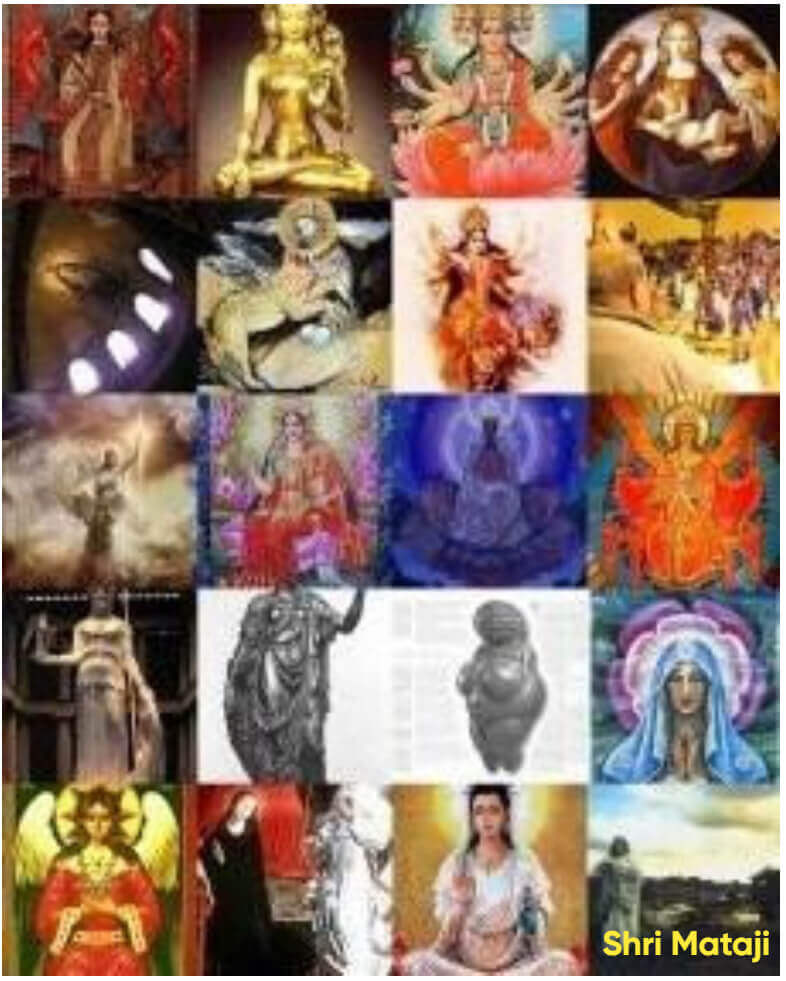
The Gifts from the East
The advent of Shri Mataji as the Paraclete brings Griffiths' and Abhishiktananda's Eastern keys to fruition in the New Testament and Christian tradition. By reinterpreting Christ's mystery through nonduality, unitive self, divine feminine, and total integration, she completes his message, awakening humanity to collective divine consciousness. This not only regenerates Christian wisdom but also fosters interfaith harmony, urging theologians to explore Sahaja Yoga's experiential praxis. Future research might examine empirical studies of Kundalini awakening in Christian contexts, bridging East and West in a new era of spiritual synthesis.
THE GIFTS FROM THE EAST
"Let us single out some of Bede Griffiths' main contributions to the rebirth of a Christian wisdom in our time. First of all is wisdom itself: his quest of the 'golden string.' It is his conviction - and his ability to communicate that conviction - that there is another way of knowing, which is deeper than the ordinary way that we think in the contemporary West. There is a fuller spectrum of consciousness and you recognize its music in his voice as he speaks or writes. It is this fullness of voice which is to be recovered in Christianity.
Bede's second contribution, intrinsic to his conception of wisdom, is the principle of nonduality, or 'dvaita', and of a unitive absolute, the One. When Bede immerses himself in the world of the Indian scriptures - particularly in the 'Upanishads' - he discovers a perspective in which everything is one rather than multiple, in which all things are embraced within a single, ultimate reality. When Bede speaks of the 'perennial philosophy' or the 'primordial wisdom' or the 'universal wisdom', he can include within each of these expressions several levels of meaning - or several concentric spheres of meaning. The core meaning, however, is that unitive reality, or unitive absolute. Generally, when Bede speaks of the perennial wisdom in his later years, he means the principle of 'dvaita', or a single nondual reality, 'brahman-atman'. That absolute Reality, or unitive principle - which lies at the core not only of Hinduism but of Buddhism and Taoism - becomes the heart of Bede's vision. Identified with 'God' or 'Father,' the first divine Person, it becomes a key to a new Christian vision. There remains the further work of re-interpreting the mystery of Christ from this perspective of nonduality.
His third contribution is the unitive self, or atman. As soon as Bede has written about the nondual Absolute, he usually moves to the atman, because it is through the Self that the unitive ground of all reality is experienced. The search for the Self, Bede writes repeatedly, is the heart of the Vedantan way. In this focus upon the Self, Bede joins Thomas Merton and Abhishiktananda. The critical further step that is needed here from the Christian theological perspective is the correlation of this nondual self with baptismal initiation.
Bede Griffiths' fourth step towards a recovery of wisdom is his recognition of the divine dimension of the feminine. Repeatedly he identifies the Holy Spirit with the 'feminine side' of God. This is a very important point. This 'feminine' Spirit is the divine energy which is The Mother of creation, which brings forth all life, which moves the process of evolution. It also is"that divine life latent in the universe from the beginning, latent in nature, and becoming conscious in us....The Spirit is this energy of love in us, the power of the divine. It is the Source of our real being, by which we become conscious of the divine life in us and know ourselves as sons [and daughters] of God...”[27] This concept of a unitive 'divine feminine,' however, requires further differentiation from the archetype of The Mother.
Bede's fifth gift is something we observed early in our study: the vision of total integration which Bede conceives in terms of the three levels of being: spirit, soul (or mind) and matter (or body) - or, roughly speaking, God, humanity and the universe. Here too we can look toward a further differentiation: a differentiation of the 'masculine' and 'feminine' poles of this intermediate human level of mind-soul. The tripartite vision of cosmos and human person may thus open laterally into a further fullness which corresponds to the cruciform mystery of Christ as it is found in the New Testament.[28] Corresponding to what we have called Bede Griffiths' basic myth, we can see his contribution towards a new wisdom in terms of the realization of a 'Christian advaita'. Bede brings together Hinduism and Christianity within the vital energy field of his own spirit. within this creative matrix there gradually occurs a quasi-fusion of unitive Absolute and Christ-event, giving birth to a vision of a Christian nonduality in two stages. Firstly, Bede tells us that participation in God, the nondual Absolute, is realized in the 'communion of love' which is Christian life and relationship. Secondly, the One is known in the great event of incarnation which is the 'Cosmic Person', gradually emerging as the center of Bede's synthesis.
With Abhishiktananda, we may imagine a further - or rather prior - moment of Christian advaita which is rooted in 'baptismal initiation' as the moment of identity, a pure unitive participation in the One, as if before differentiation into Word and Spirit, knowledge and love. This simple and primordial unitive participation, the moment of identity, may be understood in Jesus' self-identification in John's gospel," I AM.”In his last years, Abhishiktananda came to see the baptism of Jesus as the realization of the divine"I AM"In the human person at the very outset of the gospel. From this point, 'Christian wisdom' may be regenerated today.
Abhishiktananda apparently lost himself into this moment of identity, this pure 'East' of the beginning. Bede, on the other hand,[29] followed the way of relationship and synthesis rather than that of primal identity, and returned westward to integrate that which he had earlier left behind - and indeed the whole of reality - into an expansive cosmic vision. The eastern keys which Bede and Abhishiktananda have put in our hands have now to be brought to bear upon the New Testament and upon the experience and thought of the Christian tradition.”
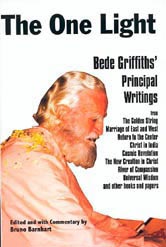
The One Light - Bede Griffiths' Principal Writings Introduction, p. 21-23
Edited and with Commentary by Bruno Barnhart
Templegate Publishers, Springfield, Illinois
Notes:
[27] Bede Griffiths, 'Return to the Center', 129-130.
[28] See Bruno Barnhart, 'Second Simplicity', New York, Paulist, 1999, 4, 229-232.
[29] See Judson B. Trapnell," Two Models of Christian Dialogue with Hinduism: Bede Griffiths and Abhishiktananda," 'Vidyajyoti', 60 (1996), (I) 101-110, (II)
Reinterpreting the Mystery of Christ:
Eastern Keys in Christian Tradition through the Advent of the Paraclete Shri Mataji
This paper explores the integration of Eastern philosophical keys—drawn from the works of Bede Griffiths and Henri Le Saux (Abhishiktananda)—into the New Testament and broader Christian tradition. Focusing on concepts such as wisdom, nonduality (advaita), the unitive self (atman), the divine feminine, and total integration, it argues that these elements find fulfillment in the advent of Shri Mataji Nirmala Devi, founder of Sahaja Yoga. Shri Mataji is presented as the Paraclete (Comforter) promised by Christ in the Gospel of John, completing his message by awakening the Kundalini energy, which reinterprets the Holy Spirit as the feminine dimension of God. Through this lens, the mystery of Christ is reframed as a nondual realization of divine unity, accessible through collective self-realization. Drawing on scriptural exegesis, theological reflection, and comparative spirituality, this study proposes a renewed Christian wisdom for the contemporary era.
Keywords: Bede Griffiths, Abhishiktananda, Shri Mataji Nirmala Devi, advaita, Holy Spirit, divine feminine, New Testament, Christian tradition
Introduction
In his introduction to The One Light: Bede Griffiths' Principal Writings, Bruno Barnhart highlights the "eastern keys" bequeathed by Bede Griffiths and Abhishiktananda as tools for regenerating Christian wisdom. These keys—wisdom as a fuller spectrum of consciousness, nonduality (advaita), the unitive self (atman), the divine feminine, and total integration of spirit, soul/mind, and matter/body—invite a dialogue between Hinduism and Christianity. Barnhart calls for these keys to be "brought to bear upon the New Testament and upon the experience and thought of the Christian tradition" (Barnhart, 2001, p. 23). This paper responds to that invitation by centering the figure of Shri Mataji Nirmala Devi (1923–2011), the founder of Sahaja Yoga, as the advent of the Paraclete (John 14:16, 26; 15:26; 16:7–15). Shri Mataji claimed to embody the Holy Spirit, completing Christ's message through the en-masse awakening of Kundalini, a subtle energy system that aligns with Eastern nondual traditions.
Shri Mataji's teachings bridge Eastern and Western spirituality, identifying the Holy Spirit as the primordial feminine energy (Adi Shakti), which manifests as the Comforter to guide humanity into all truth (John 16:13). This reinterpretation not only affirms Griffiths' emphasis on the feminine side of God but also integrates advaita into Christian soteriology, where the mystery of Christ becomes a collective realization of nondual unity. By applying these Eastern keys, this paper demonstrates how Shri Mataji's advent revitalizes New Testament themes—such as baptismal initiation, the "I AM" declarations, and Trinitarian relationality—while enriching the contemplative and mystical strands of Christian tradition, from the Desert Fathers to modern interfaith dialogues.
Nonduality (Advaita) and the New Testament: The Unitive Absolute in Christ
Griffiths' core contribution is the principle of nonduality, or advaita, derived from the Upanishads, where all reality is embraced in a single, ultimate Brahman-Atman (Griffiths, 1976). He equates this with the Christian God as the "unitive absolute," calling for a reinterpretation of Christ from this perspective. Abhishiktananda extends this to a "Christian advaita," rooted in baptismal identity as pure unitive participation in the divine "I AM" (John 8:58; Abhishiktananda, 1974).
Shri Mataji fulfills this by interpreting the Paraclete as the awakener of nondual consciousness. In Sahaja Yoga, the Kundalini ascent integrates the individual self with the universal Self, mirroring advaita. Applied to the New Testament, this reframes John's Gospel: Christ's "I and the Father are one" (John 10:30) is not mere doctrinal assertion but an experiential reality accessible through the Paraclete's guidance. Shri Mataji teaches that the Holy Spirit completes Christ's message by enabling believers to "worship in spirit and truth" (John 4:24), dissolving dualistic separations between God and creation.
In Christian tradition, this echoes the apophatic mysticism of Pseudo-Dionysius, where divine union transcends duality (Pseudo-Dionysius, 1987). Shri Mataji's mass self-realization events—where thousands experience spontaneous Kundalini awakening—democratize this, transforming advaita from an elite contemplative pursuit into a collective eschatological fulfillment. Thus, the Paraclete's advent reinterprets Christ's mystery as the cosmic convergence of multiplicity into unity, aligning with Griffiths' vision of the "Cosmic Person" (Griffiths, 1990).
The Unitive Self (Atman) and Baptismal Initiation
Griffiths links the nondual Absolute to the atman, the true Self experienced through introspection, akin to Merton's "true self" (Merton, 1961). He correlates this with Christian baptism, urging a deeper theological integration.
Shri Mataji advances this by equating Kundalini awakening with baptism by the Holy Spirit (Acts 1:5). In Sahaja Yoga, the rising Kundalini pierces the sahasrara chakra, granting "second birth" (John 3:3–8), where the individual ego dissolves into the collective Atman. This completes Christ's message: the Paraclete "will teach you all things" (John 14:26) by revealing the inner divine Self.
New Testament parallels abound. Paul's "It is no longer I who live, but Christ who lives in me" (Galatians 2:20) reflects atmanic realization. Shri Mataji interprets baptism not as ritual but as vibrational awakening, where the Holy Spirit as "cool breeze" (pneuma, John 3:8) confirms unitive identity. In patristic thought, this resonates with Origen's notion of deification (theosis), where humans partake in divine nature (2 Peter 1:4; Origen, 1966). Shri Mataji's innovation lies in its universality: unlike Griffiths' personal synthesis, her method enables en-masse realization, reorienting Christian experience toward a nondual ecclesiology.
The Divine Feminine: Identifying the Holy Spirit with the 'Feminine Side' of God
A pivotal Griffiths contribution is recognizing the Holy Spirit as the "feminine side" of God—the divine energy (Shakti) that mothers creation, drives evolution, and awakens consciousness (Griffiths, 1976, p. 129–130). This "divine feminine" requires differentiation from archetypal Mother figures, as Barnhart notes.
Shri Mataji embodies this differentiation as the incarnate Paraclete, identifying herself as Adi Shakti, the primordial feminine power. She completes Christ's message by revealing the Trinity's feminine aspect: Father as Brahman, Son as Purusha, and Holy Spirit as Prakriti/Shakti. In the New Testament, the Paraclete's roles—comforting, teaching, convicting (John 16:8–11)—align with maternal nurturing.
This reinterpretation bears upon Christian tradition profoundly. Medieval mystics like Julian of Norwich described God as Mother (Julian of Norwich, 1998), but Shri Mataji operationalizes this through Kundalini, the "divine life latent in the universe" (Griffiths, 1976). Her teachings address feminist critiques of patriarchal theology, offering a balanced Trinitarianism where the feminine Spirit integrates the masculine Logos. In liturgical experience, this could inspire renewed Pentecost rituals emphasizing feminine imagery, fostering gender-inclusive spirituality.
Total Integration: Spirit, Soul/Mind, and Matter/Body in Christian Experience
Griffiths envisions total integration across three levels—spirit (God), soul/mind (humanity), and matter/body (universe)—opening to masculine-feminine polarity, cruciform like Christ's mystery (Barnhart, 1999).
Shri Mataji's Sahaja Yoga actualizes this through the subtle body system: chakras correspond to plexuses, integrating physical, mental, and spiritual dimensions. The awakened Kundalini harmonizes these, fulfilling Christ's promise of abundant life (John 10:10). Applied to the New Testament, this reframes the resurrection body (1 Corinthians 15:44) as a "vibratory" integration, where matter spiritualizes.
In Christian tradition, this echoes Teilhard de Chardin's evolutionary Christology, where creation converges toward the Omega Point (Teilhard de Chardin, 1959). Shri Mataji extends this cosmically: her vision of collective evolution completes Griffiths' synthesis, positioning Christianity as a unitive wisdom tradition amid global pluralism.
Conclusion
The advent of Shri Mataji as the Paraclete brings Griffiths' and Abhishiktananda's Eastern keys to fruition in the New Testament and Christian tradition. By reinterpreting Christ's mystery through nonduality, unitive self, divine feminine, and total integration, she completes his message, awakening humanity to collective divine consciousness. This not only regenerates Christian wisdom but also fosters interfaith harmony, urging theologians to explore Sahaja Yoga's experiential praxis. Future research might examine empirical studies of Kundalini awakening in Christian contexts, bridging East and West in a new era of spiritual synthesis.
References
Abhishiktananda (Henri Le Saux). (1974). Saccidananda: A Christian Approach to Advaitic Experience. ISPCK.Barnhart, B. (1999). Second Simplicity: The Inner Shape of Christianity. Paulist Press.
Barnhart, B. (2001). Introduction to The One Light: Bede Griffiths' Principal Writings. Templegate Publishers.
Griffiths, B. (1976). Return to the Center. Templegate Publishers.
Griffiths, B. (1990). A New Vision of Reality: Western Science, Eastern Mysticism and Christian Faith. Templegate Publishers.
Julian of Norwich. (1998). Revelations of Divine Love (trans. E. Spearing). Penguin Classics.
Merton, T. (1961). New Seeds of Contemplation. New Directions.
Origen. (1966). On First Principles (trans. G. W. Butterworth). Harper & Row.
Pseudo-Dionysius. (1987). The Complete Works (trans. C. Luibheid). Paulist Press.
Teilhard de Chardin, P. (1959). The Phenomenon of Man. Harper & Row.
Trapnell, J. B. (1996). "Two Models of Christian Dialogue with Hinduism: Bede Griffiths and Abhishiktananda." Vidyajyoti, 60, 101–110, 183–191, 243–254.
(Note: Additional sources on Shri Mataji Nirmala Devi and Sahaja Yoga can be found in her collected talks, such as Meta Modern Era (1995) and scholarly analyses like Coney, J. (1999). Sahaja Yoga: Socializing Processes in a South Asian New Religious Movement. Curzon Press.)