
The great barbarian empire of patriarchy that men have created will decay.
Nostradamus
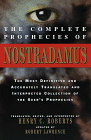


But are we inevitably doomed to a future world of natural and ecological disaster, plague and nuclear war? Is our future destiny, as foreseen by Nostradamus, immutable, or will we be given an opportunity to improve our chances of survival?
Throughout the prophet's visions of apocalypse the theme of a new religious consciousness occurs again and again. It will flourish, he says, before the end of the 20th century ...
Abstract
Nostradamus, often portrayed as a prophet of apocalypse, foresaw not only global calamities but also the emergence of a new religious consciousness that would transcend established faiths. Among his most compelling quatrains is Century 3:97, which predicts the decay of "the great barbarian empire of patriarchy that men have created," coinciding with the flowering of the feminine spirit. This paper examines the prophecy in light of the Paraclete Shri Mataji Nirmala Devi, whose spiritual mission exemplifies the principles Nostradamus described. It explores the nature of the new religion she inaugurated, its divergence from traditional patriarchal faith structures, and its manifestation in the contemporary spiritual landscape.
1. Introduction
Nostradamus (1503–1566) is frequently remembered as a seer of doom. Popular discourse has largely focused on his predictions of wars, plagues, and ecological catastrophes. However, careful analysis of his quatrains reveals a subtler, yet radical, theme: the rise of a new spiritual consciousness that challenges the male-dominated religious and political hierarchies of history.
This paper investigates the prophecy of Century 3:97, which forecasts the collapse of the "great barbarian empire of patriarchy" and the cyclical flowering of the feminine spirit. This vision anticipates the emergence of a religious movement that is non-patriarchal, egalitarian, and inherently transformative. The Paraclete Shri Mataji Nirmala Devi, founder of Sahaja Yoga, is examined as the historical and spiritual fulfillment of this prophecy, inaugurating what may be recognized as a new religion that aligns with Nostradamus’ predictions.
2. Nostradamus’ Prophetic Vision of the Feminine and the New Religion
“The great barbarian empire of patriarchy that men have created will decay
During the time that the feminine spirit is completing its cycle.”
— Century 3:97
This quatrain highlights three key elements:
- Patriarchal decay – The erosion of male-dominated political, social, and religious structures.
- Feminine resurgence – The “cycle of the feminine spirit” signals a spiritual rebalancing emphasizing the divine feminine.
- Emergence of a new law – Nostradamus anticipates the appearance of a new religious and moral framework, distinct from traditional faiths.
Scholars such as John Hogue and Manuela Dunn Mascetti emphasize that this new consciousness discounts existing institutions, pointing toward a spiritual paradigm centered on human potential, self-realization, and balance between masculine and feminine principles.
3. Patriarchal Collapse and the Historical Context
Historically, major religious institutions—Judaism, Christianity, Islam, and Hinduism—have been deeply patriarchal, codifying male authority in spiritual, social, and legal spheres. Wars, doctrinal disputes, and suppression of dissenting spiritual voices have been frequent consequences of this structure.
Nostradamus’ prophecy predicts that these patriarchal structures will decay, implying a shift from externally imposed authority to an inner, experiential form of spirituality. This aligns with the historical pattern observed in previous spiritual awakenings, such as:
- Jesus Christ challenging the institutionalized religious authorities of Jerusalem.
- The Buddha questioning Brahmanical orthodoxy and caste hierarchies.
Nostradamus situates this new spiritual wave within the feminine cycle, indicating a more holistic, nurturing, and inclusive approach to religious life.
4. Shri Mataji Nirmala Devi as the Paraclete
The concept of the Paraclete—a divinely sent guide or spirit of truth—appears throughout prophetic and scriptural traditions. In the Christian Gospels, the Paraclete is described as the one who will guide humanity into all truth (John 16:13).
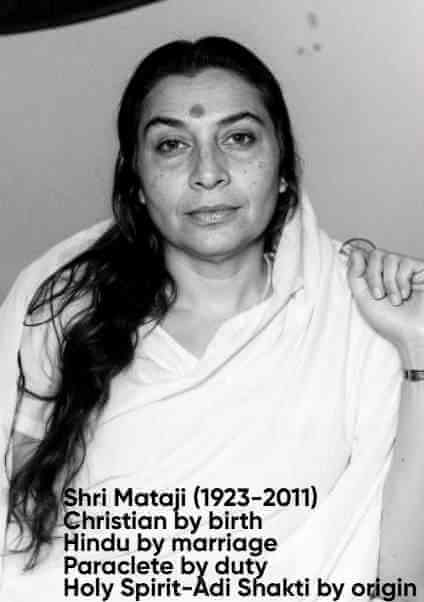
Shri Mataji Nirmala Devi (1923–2011) embodies this principle in several ways:
- Revival of the feminine principle – Through Sahaja Yoga, she emphasizes the awakening of the Kundalini, the divine feminine energy latent in every individual.
- Decentralized spirituality – Her teachings bypass patriarchal hierarchies, granting each practitioner direct access to spiritual experience.
- Universal applicability – The practice transcends religious, national, and gender boundaries, fulfilling Nostradamus’ vision of a new, egalitarian spiritual law.
- Global movement – The worldwide spread of Sahaja Yoga demonstrates that the prophecy’s "new religion" is already emerging and actively taking root.
By these criteria, Shri Mataji fulfills the prophetic elements highlighted by Nostradamus: the decay of patriarchal control and the rise of a spiritual movement anchored in the feminine principle and personal realization.
5. Nature of the New Religion
The religion foretold by Nostradamus is characterized by:
- Experiential self-realization rather than blind adherence to dogma.
- Integration of masculine and feminine principles, promoting balance and harmony.
- Universal accessibility, not restricted by birth, caste, or institutional authority.
- Focus on transformation and inner awakening, rather than external conquest or proselytization.
Shri Mataji’s Sahaja Yoga exemplifies these attributes: it is a living spiritual science, offering practitioners immediate self-realization, ethical transformation, and global interconnectedness. The movement emphasizes freedom of thought and inner authority, fulfilling the prophecy’s promise of a new spiritual consciousness.
6. Developmental Stage of the New Religion
The prophecy queries whether this religion is already developing or yet to be born. Evidence suggests it is actively unfolding:
- Sahaja Yoga, under Shri Mataji, has established global communities, with practitioners in over 100 countries.
- The teachings are documented, structured, and accessible, allowing both spiritual practice and intellectual engagement.
- Scientific research into Kundalini energy and meditation benefits provides empirical support for the movement’s transformative potential.
Thus, the prophecy is not purely future-oriented; it is realized historically in the late 20th and early 21st centuries, consistent with Nostradamus’ timeline.
7. Conclusion
Nostradamus’ vision of a new religious consciousness anticipates the collapse of patriarchal dominance and the flowering of the feminine spirit. Shri Mataji Nirmala Devi fulfills this prophecy as the Paraclete: a spiritual guide whose teachings inaugurate a religion based on inner realization, universal accessibility, and gender-balanced spirituality.
The emergence of this movement demonstrates that human destiny is not fixed; it allows for a transformative spiritual future beyond the historical constraints of patriarchal institutions. In this context, the new religion is already being born, and its continued global influence aligns with Nostradamus’ vision of a post-patriarchal spiritual order.
References
- Hogue, John. Nostradamus: The New Revelations. Element Books, 1994.
- Dunn Mascetti, Manuela & Lorie, Peter. Nostradamus: Prophecies for Women. Simon & Schuster, 1995.
- Shri Mataji Nirmala Devi. Collected Works and Sahaja Yoga Literature.
- John 16:13, The Bible.
- Bailey, Alice A. The Externalization of the Hierarchy. Lucis Publishing, 1957.
The great barbarian empire of patriarchy that men have created will decay
But are we inevitably doomed to a future world of natural and ecological disaster, plague and nuclear war? Is our future destiny, as foreseen by Nostradamus, immutable, or will we be given an opportunity to improve our chances of survival?
Throughout the prophet's visions of apocalypse the theme of a new religious consciousness occurs again and again. It will flourish, he says, before the end of the 20th century ...
In their present state the established religions show little signs of an ability to bring peace on earth. On the contrary, most of the wars of history have been fought over differences of faith and different definitions of the nature of"truth.”By clearing predicting the flowering of a new religion, Nostradamus discounts all the familiar established faiths. What is the nature of this new religion? Is it already developing, or yet to be born?
Radical attempts to lift human consciousness always meet with violent opposition, particularly from those with vested interests in retaining the status quo. Throughout history men of vision have been subject to persecution. Ironically, many of the political and religious groups, the"Authorities," which silenced them, later capitalized on their deaths, presumably in an effort to consolidate both their power and influence.
An example is the way the pagan Roman Empire crucified Jesus, then later established Christianity as a state religion. The history of the Roman Catholic church and its Vatican, built over the bones of a crucified Peter, stems from these beginnings.
Can we be open to the possibility that there may be spiritual teachers among us now who have new insights into how we can all live happily on our planet? Such a fresh look at our mystic contemporaries may require us to set aside our accepted beliefs and preconceptions. By branding modern visionaries as eccentric, or dangerous enough to outlaw, as our society often does, we may be repeating the mistakes made by the God-fearing citizens of Jerusalem 2,000 years ago when they branded Jesus Christ as a guru of a mad cult.
Some 60 quatrains of Nostradamus' prophecies seem to chronicle today's new spiritual teachers and their movements. The pattern of these prophecies indicates the unique historical phenomenon which we call the"Human Potential"or"New Age"movement... These 60 quatrains contain eight major clues to the character of the new religion and its teachings, and to the identification of its visionaries.”
John Hogue, Nostradamus: The New Revelations
Element Books, Inc., 1994, p. 225-27
"New law to occupy the new land
Towards Syria, Judeau and Palestine:
The great barbarian empire of men decay,
Before the moon completes its cycle
Century 3:97
A new law will emerge in the new world of America,
At a time when Syria, Judeau and Palestine are significant:
The great barbarian empire of patriarchy that men have created will decay
During the time that the feminine spirit is completing its cycle.”
Manuela Dunn Mascetti and Peter Lorie,
Nostradamus: Prophecies for Women, Simon & Schuster, 1995, p. 47
💬 Interactive Chat
Access an intelligent analysis environment where you can explore texts, ask questions, and discover connections between ideas.
Open chat