The Convergence of Religious Consciousness and Its Fulfillment in Self-Realization
Law, Ritual, and the Emergence of a Universal Spiritual Epistemology
Abstract
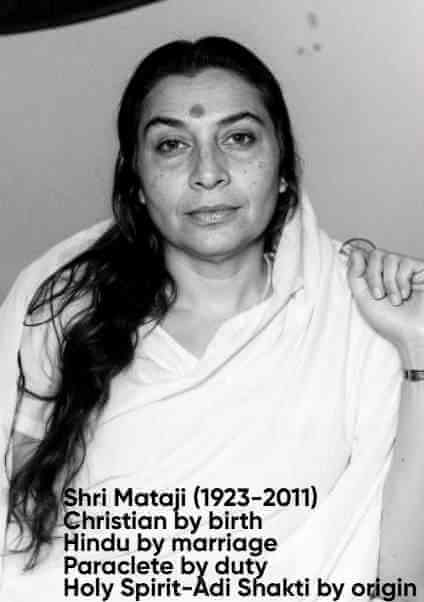
This paper re-examines the historical evolution of religions as systems of law, ritual, and institutional identity, and argues that their ultimate purpose lies in guiding humanity toward a direct, transformative realization of ultimate reality. Building upon the insight of Bede Griffiths—that nirvana, brahman–atman, al-Haqq, and the Kingdom of Heaven converge in a single ineffable reality—this study advances the thesis that such convergence finds its concrete and experiential fulfillment in the Self-realization associated with Shri Mataji Nirmala Devi, identified by her followers as the Paraclete or Holy Spirit. It is argued that this realization transcends doctrinal divisions and provides a unifying experiential foundation for all religions.Contents
- Introduction: From Religious Form to Spiritual Essence
- The Limits of Law, Ritual, and Doctrine
- The Shared Telos of Religions: A Non-Dual Realization
- The Necessity of Direct Experience
- The Self-Realization of the Paraclete: Contemporary Fulfillment
- Beyond Religion: Toward a New Mode of Being
- Unity of Humanity Through Realization
- The Meeting Place of All Religions
- Conclusion
- References
1. Introduction: From Religious Form to Spiritual Essence
Religions have historically functioned as mediators between humanity and the transcendent. Over time, however, the original experiential core of religion has been encased within structures of law, ritual, and doctrine. While these structures preserve tradition, they also tend to solidify boundaries between communities. Bede Griffiths observed that Christianity, like Islam, Hinduism, and Buddhism, has developed forms that now act as barriers separating humanity. The critical question, therefore, is whether religion can return to its essence—an immediate realization of ultimate reality—beyond its institutional forms.
2. The Limits of Law, Ritual, and Doctrine
2.1 Law as Externalization: Religious law, whether expressed as Sharia, Dharma, or canonical codes, initially guides righteous living. Yet over time it externalizes spiritual truth, shifting emphasis from inner transformation to outward conformity.
2.2 Ritual as Symbol Without Realization: Ritual encodes profound metaphysical truths, but when detached from inner experience, it becomes repetitive symbolism. The sign remains, but the reality it signifies is no longer realized.
2.3 Doctrine as Division: Doctrinal systems define identity but also create exclusion. Competing truth-claims reinforce division, even when pointing toward the same transcendent reality. Thus, the fragmentation of religion is not due to the diversity of truth, but to the absolutization of partial expressions.
3. The Shared Telos of Religions: A Non-Dual Realization
At their deepest level, all major religious traditions converge toward a transformation of consciousness beyond duality:
- Nirvāṇa (Buddhism): liberation from ego and illusion — a state beyond conceptual dualities.
- Brahman–Ātman (Upanishads): identity of the individual self with ultimate Reality, dissolving separation.
- Al-Ḥaqq (Sufi Islam): union with the Divine Reality — Truth itself, as expressed by Mansur Al-Hallaj.
- Kingdom of Heaven (Christianity): inner realization — “within you” (Luke 17:21) — representing participation in eternal life.
4. The Necessity of Direct Experience
A central problem in religion is the displacement of experience by belief. Mystics across traditions insist that ultimate reality must be realized, not merely conceptualized. The Buddha emphasized direct insight (vipassanā); the Upanishads declared “Tat Tvam Asi” (“Thou art That”); Sufis pursued annihilation of the self (fanā); Christianity speaks of being “born again” in the Spirit. All point to an inner awakening — a Self-realization.
5. The Self-Realization of the Paraclete: A Contemporary Fulfillment
Within this comparative framework, the teachings and work of Shri Mataji Nirmala Devi present a distinctive claim: that the universal realization toward which all religions point has been made directly accessible through the awakening of the inner spiritual energy (Kundalini), identified with the action of the Holy Spirit or Paraclete.
5.1 The Paraclete in Christian Theology: In the Gospel tradition, the Paraclete (Holy Spirit) is promised as the one who will “lead into all truth” (John 16:13). This indicates a future, experiential revelation beyond the historical ministry of Jesus.
5.2 Self-Realization as Experiential Convergence: The process described in Sahaja Yoga involves awakening of the Kundalini, entry into thoughtless awareness, and direct perception of a subtle, all-pervading reality. This experience is interpreted as: Nirvana (cessation of mental activity), Brahman–Atman (realization of the Self), Al-Haqq (direct knowledge of Truth), and Kingdom of Heaven (inner divine presence). Thus, what was previously articulated symbolically across traditions becomes experientially unified.
6. Beyond Religion: Toward a New Mode of Being
The realization described above represents a fundamental shift:
| Old Mode | New Mode |
|---|---|
| External law | Inner guidance |
| Ritual practice | Direct experience |
| Doctrinal belief | Realized knowledge |
| Division | Unity |
This is not the rejection of religion, but its fulfillment. The outer forms are transcended as their inner meaning is realized.
7. Unity of Humanity Through Realization
If the same realization is accessible to all, irrespective of religious background, then humanity shares a common spiritual identity; religious differences become secondary expressions; unity is grounded in experience, not ideology. This fulfills the vision articulated by Bede Griffiths: that all humanity is one being, and that the apparent diversity of religions conceals an underlying unity.
8. The Meeting Place of All Religions
The meeting point of religions is not a synthesis of doctrines, but a convergence in consciousness. It is not theological agreement nor institutional unity, but shared realization. In this sense, the Self-realization associated with Shri Mataji Nirmala Devi is presented as the practical means by which this convergence is actualized.
9. Conclusion
Religions, in their historical development, have created structures that both preserve and obscure their original purpose. At their core, however, they all point toward a single, transformative realization of ultimate reality. The nirvana of Buddhism, the brahman-atman of the Upanishads, the al-Haqq of Sufi Islam, and the Kingdom of Heaven in Christianity are not separate goals, but different expressions of the same truth.
This paper has argued that the Self-realization associated with the Paraclete, as understood in the work of Shri Mataji Nirmala Devi, represents a concrete and experiential fulfillment of this convergence — where the unity of humanity is not merely envisioned, but realized. In this realization — beyond law, ritual, and doctrine — the divisions of religion dissolve, and the One Reality is known directly.
References
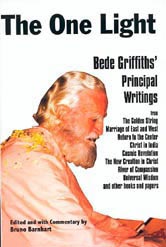
- Bede Griffiths, *The One Light: Principal Writings*, Templegate Publishers, 2001.
- Shri Mataji Nirmala Devi, *Meta Modern Era*, Vishwa Nirmala Dharma, 1997.
- The Upanishads (Trans. Swami Prabhavananda), Vedanta Press.
- The Gospel of Philip, Nag Hammadi Library.
- Mansur Al-Hallaj, *The Tawasin*, (translation by Aisha Abd al-Rahman).
- New Testament: John 16:13, Luke 17:21, John 6:63.
- Harold Coward, *Pluralism and the Challenge of World Religions*, Orbis Books.
- Veli-Matti Kärkkäinen, *Holy Spirit and Salvation*, Westminster John Knox Press, 2010.
The New Humanity
"But this principle of freedom from the Law has now to be applied to all religion. Christianity in the course of time has built up its own structure of law and religion, of ritual and dogma and organization, which have now become a barrier, separating the Christian churches from the rest of humanity. So also Islam, Hinduism and Buddhism have developed their own structures of law and ritual and are divided from one another. We have to learn to go beyond all these differences in the external forms of religion and discover the hidden mystery which lies at the heart of all religion. In Christianity it was the mystery of the resurrection which gave this insight into the ultimate meaning of religion. The resurrection of Jesus was seen as the passage beyond time and space to the eternal transcendent Reality. This was accomplished, not merely for Jesus himself, but for all humanity. The resurrection marks the beginning of a new humanity and, as St Paul says, a"new creation.”[101] Just as Israel closed in on itself and saw salvation in terms of its own limited existence, so the Christian churches have closed in on themselves and separated themselves from humanity as a whole. But in the wider perspective which we can discern today, Jesus died for all humanity and the salvation which he achieved was won for all humanity. We must never forget that in its deepest reality all humanity is one being, just as the whole creation is one being. As St Gregory of Nyssa, one of the greatest of the Greek Fathers, proclaimed," All men from the first man to the last are one image of Him Who Is.”Adam in the book of Genesis represents humanity as a whole, and when this Adam falls all humanity falls with him. So also Christ is the new Adam, the new representative of redeemed humanity, and with his resurrection humanity as a whole is redeemed from sin and death.
Bede Griffiths]: It is of great significance that Jesus left his disciples with the understanding that he would return again at any time and bring the world to an end. In a real sense it can be said that the resurrection itself brings the world to an end. It is the passage of human nature beyond time and space, and reveals the whole of this spatial temporal world as a passing phenomenon. We see the one Reality reflected through the changing forms of space and time, but we know that these forms are conditioned by our present mode of consciousness. When we pass beyond this limited mode of time-space consciousness, we shall see the eternal Reality as it is. As St Paul says," now we see in a glass darkly but then face to face.”[102] The whole of human history is a passage from our present mode of existence and consciousness into the eternal world where all the diversities of this world are seen in their essential unity. Our present mode of consciousness is dualistic, but as the mystics of all religions have discerned the ultimate reality is non-dual. This new mode of being and consciousness is the 'nirvana' of the Buddha, the 'brahman-atman' of the 'Upanishads,' the 'l haqq' of the Muslim mystics and the kingdom of heaven of the Christian Gospel. It is here and here alone that we can find the meeting place of all religion.
The One Light - Bede Griffiths' Principal Writings
Chapter II, West: Part One Civilization and Christianity, p. 120
Edited and with Commentary by Bruno Barnhart
Templegate Publishers, Springfield, Illinois