
Now and again a daring soul, desiring immortality, has looked back and found himself.
Katha Upanishad
Now and Again a Daring Soul: Self-Knowledge, Inner Immortality, and the Living Fulfillment of Scripture
Table of Contents
- 1. Purpose of This Article
- 2. The Universal Problem: Knowledge Without Realization
- 3. Vedanta and the Two Kinds of Knowledge
- 4. The Daring Soul and the Inward Turn
- 5. Jesus, Rebirth by the Spirit, and Eternal Life Within
- 6. Shri Mataji Nirmala Devi: Fulfillment of the Daring Soul
- 7. Conclusion: Knowing the Knower of the Field
- References
1. Purpose of This Article
AdiShakti.org exists to address one central human question: Is the realization of the Spirit within a metaphor, or is it a living reality? This article brings together the Upanishads, the Bhagavad Gita, the teachings of Jesus, and the living work of Shri Mataji Nirmala Devi to demonstrate a single, coherent truth: immortality is discovered inwardly through direct Self-realization.
The Upanishadic declaration — Now and again a daring soul, desiring immortality, has looked back and found himself
— is not poetry alone. It is a precise spiritual diagnosis of humanity’s condition and its remedy. This article demonstrates that Shri Mataji’s message of Self-realization is the present-day fulfillment of this perennial call.
2. The Universal Problem: Knowledge Without Realization
Across civilizations, humanity has accumulated immense religious and intellectual knowledge: scriptures, doctrines, rituals, sciences, psychologies, and philosophies. Yet a paradox persists. Despite this abundance, the essential transformation promised by religion remains largely unrealized.
The Upanishads diagnose the problem with uncompromising clarity. Human awareness habitually turns outward — toward objects, experiences, thoughts, and emotions. As a result, the knower is forgotten. The crisis of religion, therefore, is not a failure of belief but a failure of realization.
AdiShakti.org stands on the premise that the age of belief without experience is ending. What is now required is the fulfillment of what all great traditions promised but rarely delivered collectively: direct knowledge of the Self.
3. Vedanta and the Two Kinds of Knowledge
In Chapter XIII of the Bhagavad Gita, Arjuna asks Krishna: What is knowledge?
Krishna replies that knowledge is to know the field and the knower of the field ([1]).
The field (kṣetra) refers to everything that can be perceived or experienced — sensory objects, thoughts, emotions, imagination, and even subtle inner states. In short, it includes everything that is knowable. But Krishna adds a second dimension: the knower of the field (kṣetrajña).
- Lower knowledge: knowledge of the field — empirical, psychological, emotional, intellectual.
- Higher knowledge: Self-knowledge — realization of oneself as the knower of the field.
4. The Daring Soul and the Inward Turn
Now and again a daring soul, desiring immortality, has looked back and found himself.
This declaration from the Katha Upanishad ([2]) refers not only to the five senses, but also to inner experiences — thoughts, feelings, and emotions — all of which remain outside the Self as objects of awareness.
The daring soul is the one who seeks real Self-knowledge, who refuses to remain identified with the field and insists on knowing the knower of the field.
5. Jesus, Rebirth by the Spirit, and Eternal Life Within
Jesus declares: Unless one is born of water and the Spirit, he cannot enter the Kingdom of God
([3]). This rebirth is not belief-based, but experiential.
He further states: The Kingdom of God is within you
. Failure to realize the indwelling, feminine Holy Spirit is described in early Christianity as poverty, regardless of outward religiosity.
6. Shri Mataji Nirmala Devi: Fulfillment of the Daring Soul
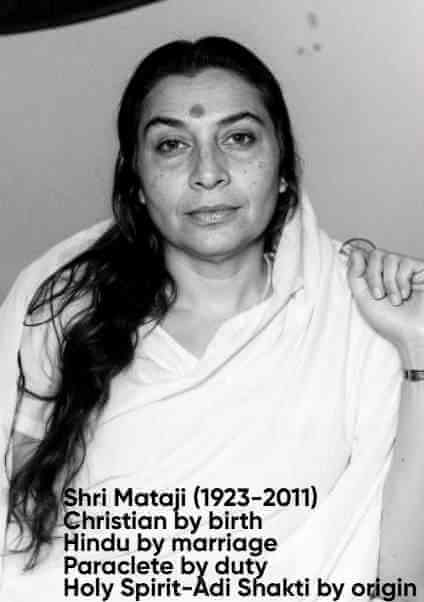
Shri Mataji Nirmala Devi fulfilled an ancient promise: the Self can be realized here and now. In Vedantic terms, she enables realization of the kṣetrajña. In Christian terms, she makes rebirth by the feminine Holy Spirit a verifiable reality.
The Upanishadic daring soul is no longer rare. Self-realization is offered collectively, across cultures, religions, and backgrounds.
7. Conclusion: Knowing the Knower of the Field
The Upanishads, the Bhagavad Gita, and Jesus speak with one voice: immortality is found within. Shri Mataji Nirmala Devi’s message stands as the living convergence of these revelations.
The daring soul is no longer an exception. The door has been opened.
References
[1] Brian Hodgkinson, The Essence of Vedanta, Arcturus Publishing Ltd., Canada, pp. 17–19.[2] The Ten Principal Upanishads, trans. S. Radhakrishnan.
[3] The Holy Bible, John 3:5; Luke 17:21.
Brian Hodgkinson, The Essence of Vedanta
Chapter 2: Knowledge and Ignorance
Two kinds of knowledge
'What is knowledge?' asks Arjuna in the Gita. Krishna replies that it
is to know the field and the knower of the field (XIII, 1-2). What
does this strange answer mean? The field refers to everything that
can be perceived, in the widest sense of perception. In short, it is
everything that is knowable. Thus all that may be experienced through
the five senses and all that can be imagined, thought, felt or
otherwise experienced inwardly is included in the field. But then if,
as Krishna says, knowledge also means to know the knower of the
field, then that would also be amongst the knowable, so that would be
part of the field too. The solution of this dilemma is that the
knower of the field is not knowable. How then can one know something
which is not knowable? This question goes to the heart of the
philosophy of Vedanta...
The distinction that Krishna makes, however, between the field and
the knower of the field is quite different from all the distinctions
... It is not a distinction between outward empirical knowledge and
inner introspective knowledge, nor between knowledge from experience
and non-experiential, or a priori, knowledge, nor between empirical
and logical, or analytic, knowledge. All these are within the field.
If we look more precisely at Krishna's answer, we find that the
Sanskrit says something like 'to know the field and the knower of the
field, that is real knowledge.' In other words, he suggests that
there are two kinds of knowledge, a higher and lower. The latter is
simply to know the field, the former is to know oneself as the knower
of the field. This is confirmed elsewhere in the Gita and throughout
Vedantic literature. As the modern Vedantist Nikhilananda wrote,
'Self-knowledge is vital. All other forms of knowledge are of
secondary importance.' They cover more or less everything that we
would call knowledge in the Western world.. Psychologists and similar
investigators of the mind, or psyche, might object on the grounds
that they study and discover knowledge of the self. But do they?
Their field of investigation — the phrase is significant — is the
contents of the mind, of the emotions and of the imagination, however
deeply they penetrate these. How can the Vedantist be sure of this?
The reason is that the self is not to be discovered by looking into
the mind, but by finding that which is itself aware of the mind, the
knower of the field.
The contrast between higher and lower knowledge is strikingly put in
the Katha Upanishad:
'God made sense turn outward, man therefore looks outward, not into
himself. Now and again a daring soul, desiring immortality, has
looked back and found himself.' (The Ten Principal Upanishads, pg. 33)
The passage does not simply refer to the five senses turning outwards
to the spatial world. The 'sense' that turns outwards includes the
sense of inner experience, thoughts and feelings and so on, for these
are 'outside' the perceiving or knowing of self. The 'daring soul' is
the man who wants real self-knowledge, who wants to know the knower
of the field.
Brian Hodgkinson, The Essence of Vedanta,
Arcturus Publishing Ltd., Canada, pg. 17-19
💬 Interactive Chat
Access an intelligent analysis environment where you can explore texts, ask questions, and discover connections between ideas.
Open chat