
On being liberated from the dualities of pleasure and pain
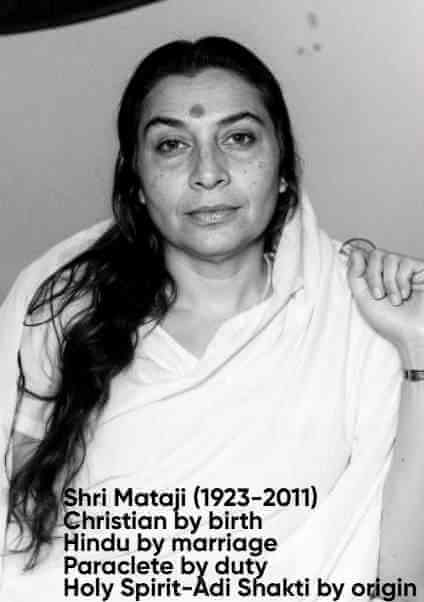
In summary, the teachings of Shri Mataji Nirmala Devi offer a profound and practical realization of the core questions of self-realization articulated by A. M. Halliday. Whereas Halliday presents a compelling intellectual framework for grasping the non-dual nature of reality, Shri Mataji reveals a direct and experiential means of embodying that truth within oneself. Their convergence around the aim of non-dual consciousness, alongside their divergence in method, underscores the essential complementarity of intellect and lived experience on the spiritual path. Halliday's inquiry refines and prepares the mind, while Shri Mataji's Sahaja Yoga enables the immediate realization of what the mind has discerned. Together, they articulate a holistic vision of the perennial human search for meaning, purpose, and joy—one that harmonizes reason and realization, thought and transformation. Ultimately, the response to Halliday's questions does not lie in texts or discourse, but in the quiet, blissful, and life-altering experience of the awakened Self.
“In this age, where the pressures of outer life crowd in so strongly upon us as
individuals, and the influence of the media on our thinking is so potent, we
need all the more to introduce the higher technology into dealing with the mind.
We cannot simply leave it to its own devices. We need to establish our own
independence and to remain aware and awake to our own spiritual strength. And we
can only do that if we have a sense of this inner unity which we share with all,
of our real nature as independent of the passing appearances and the trivial but
often disturbing experiences of everyday life. We cannot maintain that balanced
judgement and wisdom which we need to live well if we allow ourselves to be
subjected and bullied by appearances into accepting a role consistent with the
fragmentary appearances which the mind, in its raw state, tries to impose on us.
Nowadays, everyone has a refrigerator, a television set and a food processor.
But what we really need is a mood processor, a technique which allows us to
reduce all negative thinking, criticism and prejudice in the mind and creates
from experience a nourishing soup, which strengthens us for the struggle of
life. We have to smooth out all the lumps, the remnants of wrong ideas and
complexes which the scars of past experience have left in the mind. In a word,
we have to learn to live with love and with wisdom, not a slave to instinct and
passion, but imbued with a living spirit of unity with all. The good of the
individual cannot ultimately be separated from the good of the whole.
So long as man feels himself to be a fragment, a bit, he will oscillate like a
penduulum between the two extremes of feeling that he, as an individual, is
all-important, or that he is a non-entity. When we are on top of the world, as
we say, we feel that what we want is easily attainable, that the world is our
oyster, and that achieving success will be a piece of cake! At other times, when
we are depressed and discouraged, anything worth-while seems utterly
unattainable and beyond reach. Then the world is a land of lost content to us
and we cry with Omar Khayyam:
O Love, could thou and I with fate conspire,
To grasp this sorry scheme of things entire,
Would we not shatter it to bits, and then
Remould it nearer to the heart's desire?
But shattering it to bits will not help. The real trouble is that we are already
living a fragmentary life, that we are only a bit, oscillating between zero and
one. As long as we are one insignificant unit lost in an endless array of
others, we shall not solve our problems in any permanent way. In fact we can
only live truly in unity by discarding our role as number one.
In his last play, Jean Anouilh presents an aging author, disillusioned and in
failing health, who sits in his study trying to write another play, while a
stream of friends and relatives come to distract him from the work in hand, each
and all of them only really interested in what they can get out of him. It is,
so to speak, a play about egocentricity, and it was appropriately entitled
'Number One' in its English version. Those who come to borrow money from him are
the first to accuse him of lack of feeling, of not caring for anyone else but
himself, but their complaints don't inhibit them in any way from prizing
anything they can get out of him. It is a good illustration of the maxim
enunciated in the Upanishad: 'Not for the sake of themselves are the friend, the
husband, the father of the loved object dear, but for the sake of the self are
they dear'!
But the fact is, as the yogis tell us, that we can live in unity only by
discarding this number one stance, this fragmentary view of ourselves.
Let us therefore decide to take the bit between our teeth! We have to get down
to the problem of discovering the answer to the question: Who am I? What is the
purpose of life? How can I achieve the happiness I desire? As Shri Shankara says
in his Commentary to the Gita, this enquiry will lead man to discover that the
Self, which at the outset seems to be the limited fragmented individual,
confined in the physical body, turns out in the end to be nothing other than the
supreme Self, at one with the reality behind the whole universe. What is the
result of this realisation? In the words of Swami Rama Tirtha:
It is an indescribable sense of equality, beaming sweetness and divine
recklessness. It is the seeing of the All in all we see. It is seeing your own
Self wherever your eyes fall. It is to realise that all is beauty and that 'I am
That' - Tat twam asi or 'That thou art'.
In the Commentary by Shri Shankara on the verse in the fifteenth chapter of the
Gita which speaks of the individual soul as a fragment of the Lord, an objection
is raised to this teaching. 'How can there be a portion of the supreme Self Who
has no parts? If He has parts, He would be liable to destruction on the
separation of the parts.'
What the objector is very reasonably saying is that if you have something which
is fragmented, then it can be destroyed. As Shelley says:
When the lamp is shattered
The light in the dust lies dead -
When the cloud is scattered
The rainbow's glory is shed.
When the lute is broken,
Sweet tones are remembered not;
When the lips have spoken,
Loved accents are soon forgot.
But Shri Shankara makes it clear in answer to this objection that the fragment
of Himself, of which the Lord speaks, is not a real fragment. It is only the
appearance of a fragment set up by the mind and matter. The jiva is not really a
small part of the Lord, he is identical with the Lord Himself, only this
identity is hidden under the thick veil of the empirical personality.
And Shri Shankara gives two
illustrations to convey what is meant here. The jiva, he says, is an integral
part of the Lord Himself, manifesting Himself as the individual soul in the
world in each and every individual, in the form of the doer and the enjoyer of
experience. He is like the sun reflected in water. The reflected sun is merely a
fragment of the real sun, but not a real fragment, an apparent fragment, and on
the removal of the water the reflected sun returns to the original sun and
remains as that very sun. Just as the image of the sun gets distorted as the
surface of the water becomes disturbed, but becomes more like itself as the
water becomes calm and tranquil, so the jiva, reflected in the mind as the doer
and enjoyer, appears to undergo innumerable vicissitudes [fluctuations], joys
and woes, fears and hopes, and to be raised to great heights and cast to great
depths, as his individual interests wax or wane. But these are reflections of
the passions and moods disturbing the surface of the mind. And when the mind
becomes clear and tranquil, free from the pairs of opposites which disturb it
and set it into oscillation, then the nature of the jiva as the supreme
consciousness becomes apparent and he recognises the unreal nature of this
reflected self, and his real identity as the supreme Self, Paramatman,
changeless and beyond the reach of time and space and empirical circumstances.
Shri Shankara also gives a second illustration. Or, he says, the 'jiva' is like
the space in the jar, which is limited by the shape and form of the jar (called
the 'upadhi' in Sanskrit). The space within the jar is only a portion of the
infinite space, and it is never separated from that space. It becomes one with
that universal space on the destruction of the jar which is the cause of
limitation. The space is not contained in the jar. On the contrary, it is the
jar which is contained within the universal space. So it is, says Shri Shankara,
that there is an appearance of fragmentation when the Lord enters into empirical
life as the 'jiva', but it is not a real fragmentation, it is only a phenomenal
state, which does not in any way compromise or affect the eternal, divine nature
of the 'jiva' as the supreme Self, Paramatman.
Him who departs, or who stays and enjoys,
who is (apparently) cojoined with the qualities of nature (the gunas),
the deluded perceive not;
they see who possess the eye of knowledge.
Those who strive, endued with Yoga,
perceive Him dwelling in the self;
though striving, those of unrefined self,
devoid of wisdom, perceive Him not.
That light which residing in the sun illumines the whole world,
that which is in the moon and in the fire,
that light do thou know to be Mine.
(Gita 15.10-12)
The same light of consciousness abides in all living beings, and (although we
are not aware of it) it is immanent also in all that we call non-living. It is
this universal light which, entering into the body and taking on the qualities
of the mind and personality, becomes the individual soul. The aim of Yoga is to
awaken to that truth.
A further verse from the fifteenth chapter of the Gita sums up the process:
Those who are freed from pride and delusion, who have conquered the evil of
attachment, who, all desires stilled, are ever devoted to the supreme Self, who
are liberated from the dualities of pleasure and pain and are undeluded, reach
that eternal goal. (Gita 15.5)"
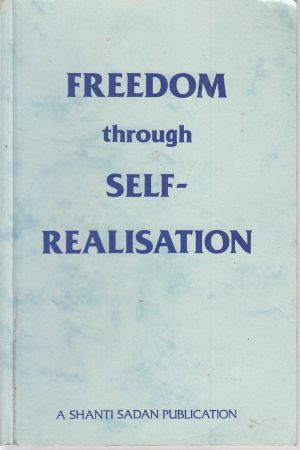
A.M. Halliday, Freedom through Self-Realisation
A Shanti Sadan Publication - London, Pgs. 21-26
The Convergence of Intellect and Experience: A Comparative Analysis of A.M. Halliday and Shri Mataji Nirmala Devi on the Fulfillment of Self-Realization
Abstract
This paper examines the extent to which the teachings of Shri Mataji Nirmala Devi, founder of Sahaja Yoga, fulfill the fundamental questions of self-realization as articulated by the philosopher A.M. Halliday. Drawing upon Halliday's framework rooted in Advaita Vedanta and Shankara's commentaries, this analysis compares his intellectual and philosophical approach with Shri Mataji's experiential and practical methodology. The paper argues that while both perspectives converge on the ultimate goal of non-dual consciousness and the transcendence of the fragmented ego, they offer distinct yet complementary paths to achieving this state. Halliday provides the philosophical foundation, while Shri Mataji offers a direct, accessible means of experiencing the ultimate reality. The paper will explore the core tenets of both teachings, analyze their points of convergence and divergence, and conclude with a synthesis that highlights the symbiotic relationship between intellectual understanding and direct spiritual experience in the pursuit of self-realization.
Table of Contents
1. Introduction
The perennial human quest for meaning, purpose, and happiness has been the driving force behind countless philosophical and spiritual traditions throughout history. In the modern era, amidst the cacophony of materialism and the fragmentation of individual identity, these questions have become even more pressing. The philosopher A.M. Halliday, in his work Freedom through Self-Realisation, encapsulates this timeless inquiry with three fundamental questions: Who am I? What is the purpose of life? How can I achieve the happiness I desire?
[1] Halliday, drawing upon the profound wisdom of Advaita Vedanta and the commentaries of Shri Shankara, posits that the answer to these questions lies in the realization of the Self—the discovery that the limited, fragmented individual is, in reality, the supreme Self, one with the ultimate reality of the universe. This paper will explore the extent to which the teachings of Shri Mataji Nirmala Devi, the founder of the Sahaja Yoga movement, provide a practical and experiential fulfillment of Halliday's philosophical framework. While Halliday offers a profound intellectual and philosophical roadmap to self-realization, Shri Mataji provides a direct, accessible, and experiential path to the same ultimate truth. This comparative analysis will demonstrate that these two perspectives, one rooted in intellectual inquiry and the other in direct spiritual experience, are not mutually exclusive but rather complementary, offering a holistic approach to the timeless quest for self-realization.
2. A.M. Halliday's Framework for Self-Realization
A.M. Halliday's philosophical framework for self-realization is deeply rooted in the non-dualistic tradition of Advaita Vedanta, as expounded by the great Indian philosopher Shri Shankara. Halliday posits that the fundamental human predicament stems from a case of mistaken identity: we perceive ourselves as limited, fragmented individuals, separate from the world around us. This perception, he argues, is the root cause of our suffering, our anxieties, and our unfulfilled desires. The path to liberation, therefore, lies in a profound inquiry into our true nature, an inquiry that leads to the realization of our oneness with the ultimate reality, or Brahman.
The Fundamental Questions of Existence
Halliday frames this inquiry around three fundamental questions that have echoed through the ages: Who am I? What is the purpose of life? How can I achieve the happiness I desire?
[1] These are not mere intellectual curiosities for Halliday; they are the very keys to unlocking the door to a life of freedom, peace, and lasting fulfillment. He argues that a sincere and sustained inquiry into these questions will inevitably lead to the discovery that the Self, which initially appears to be a limited and fragmented individual, is in fact the supreme Self, one with the reality that underlies the entire universe.
The Influence of Shankara and Advaita Vedanta
Halliday's framework is built upon the solid foundation of Shankara's Advaita Vedanta, a non-dualistic philosophy that asserts the ultimate reality is a singular, undifferentiated consciousness known as Brahman. According to this view, the individual soul, or Atman, is identical to Brahman. The apparent separation between the individual and the ultimate reality is an illusion, or Maya, created by the mind and the senses. Halliday, following Shankara, uses powerful metaphors to illustrate this concept. The individual self, or jiva, is likened to the reflection of the sun in a pot of water. The reflection appears to be a separate and distinct entity, but it is merely a reflection of the one true sun. When the water is disturbed, the reflection appears distorted, but the sun itself remains unchanged. Similarly, the vicissitudes of life, the joys and sorrows, hopes and fears, are merely disturbances on the surface of the mind, while the true Self, the Atman, remains eternally serene and unaffected.[1]
The Fragmented Self and the Supreme Self
The core of Halliday's argument is the distinction between the fragmented, egoic self and the supreme, universal Self. The fragmented self is the product of our identification with the body, the mind, and the ever-changing circumstances of our lives. This self is in a constant state of flux, oscillating between feelings of self-importance and worthlessness, elation and despair. It is this fragmented self that experiences the world as a sorry scheme of things
and longs to shatter it to bits, and then remould it nearer to the heart's desire.
[1] However, Halliday asserts that this is a futile endeavor. The real solution lies not in changing the world, but in changing our perception of ourselves. We must, as he puts it, take the bit between our teeth
and embark on the journey of self-discovery.[1]
The Result of Realization: Unity Consciousness
The culmination of this journey, according to Halliday, is a profound shift in consciousness, a realization of our true nature as the supreme Self. This is not a mere intellectual understanding but a direct, experiential knowing. The result of this realization is an indescribable sense of equality, beaming sweetness and divine recklessness.
[1] It is the experience of seeing the Self in all things and all things in the Self. It is the realization of the great Vedantic truth, Tat tvam asi—That thou art.
In this state of unity consciousness, the fragmented self dissolves, and with it, the anxieties, fears, and desires that once plagued it. One is liberated from the dualities of pleasure and pain, success and failure, and abides in a state of eternal peace and joy.
3. Shri Mataji's Teachings on Self-Realization
Shri Mataji Nirmala Devi, the founder of Sahaja Yoga, offers a path to self-realization that is both deeply rooted in the spiritual traditions of India and remarkably accessible to the modern seeker. Her teachings, while resonating with the philosophical depth of Advaita Vedanta, emphasize a direct, experiential approach to spiritual awakening. For Shri Mataji, self-realization is not a distant goal to be achieved through years of arduous effort, but an innate potential within every human being, waiting to be spontaneously awakened. This awakening, she taught, is the key to answering the fundamental questions of existence and achieving a state of lasting peace and joy.
The Spontaneous Awakening of Kundalini
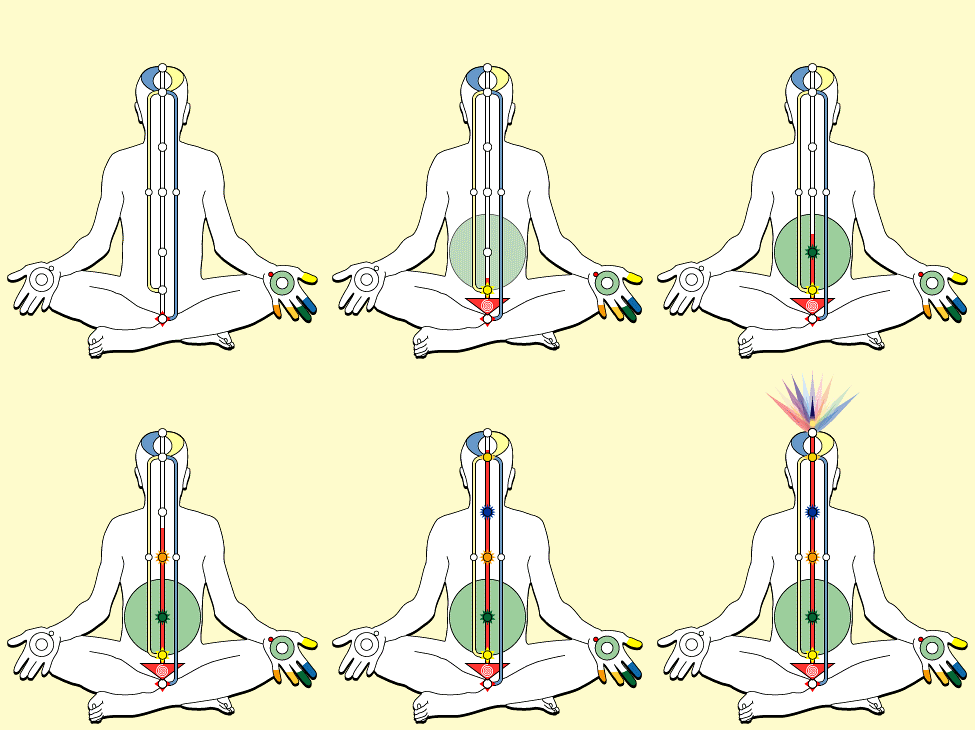
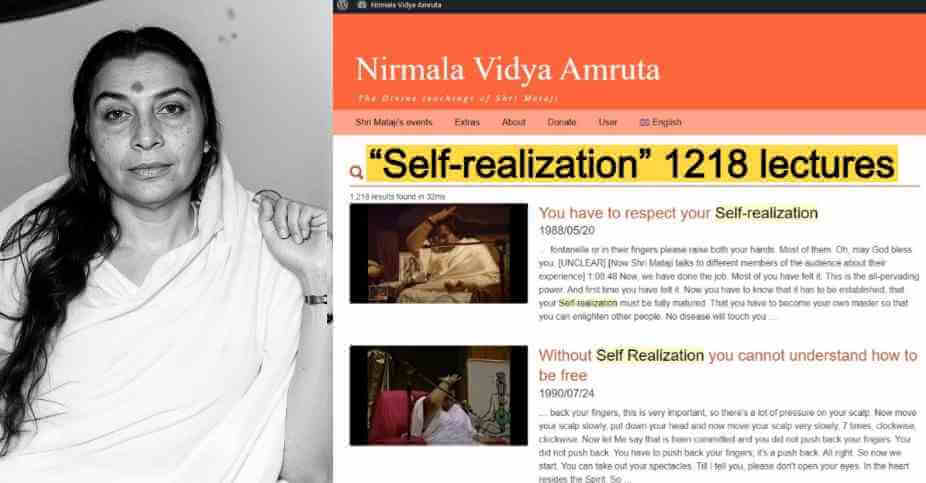
At the heart of Shri Mataji's teachings is the concept of the Kundalini, a motherly, spiritual energy that lies dormant at the base of the spine in the sacrum bone. This energy, known in many ancient cultures, is the power of pure desire, the desire for union with the divine. Shri Mataji's unique contribution was her discovery of a method for awakening this energy spontaneously and en masse, an experience she called Self-Realization. She often compared this to lighting one candle from another; once a person's Kundalini is awakened, they can, in turn, awaken the Kundalini of others.[2] This spontaneous awakening is the first step on the path of Sahaja Yoga, a journey of inner transformation that unfolds naturally from within.
The Nature of the Atma (Self)
Shri Mataji's teachings on the Atma, or the Self, are in perfect alignment with the Vedantic understanding of the term. The Atma, she explained, is our eternal Spirit, a reflection of the primordial being that resides in our hearts. It is the silent witness to our lives, the unchanging reality that underlies the ever-changing panorama of our thoughts, emotions, and experiences. The Atma does not evolve; rather, it is the goal of our evolution to reach the state of the Spirit. Through the process of Self-Realization, the awakened Kundalini rises through the subtle system and enlightens the Atma, allowing us to experience its innate quality of pure joy and peace.[3]
The Purpose of Life: Becoming a Vehicle for the Divine
In a 1983 radio interview, Shri Mataji addressed the question of the purpose of life directly. You are specially made by God,
she explained. You are specially chosen by God to be human beings and you are here with a very great purpose.
[4] This purpose, she elaborated, is twofold. Firstly, it is to become a vehicle for God's powers, to allow the divine to flow through us and transform the world into a Garden of Allah.
Secondly, it is to claim our rightful place in the Kingdom of God, to ascend to the throne that has been prepared for us. This, she explained, is the culmination of the human journey, the fulfillment of the promise that was broken with the original sin.
[4]
The Experience of Thoughtless Awareness and Joy
The result of Self-Realization, according to Shri Mataji, is a state of thoughtless awareness, a state in which the mind is in complete repose, yet one is perfectly aware of the present moment. In this state, the incessant chatter of the mind, the constant stream of thoughts, worries, and plans, comes to a halt. One is established in the silent space between two thoughts, a space of profound peace and stillness. This is not a state of unconsciousness, but a heightened state of awareness, an awareness that is free from the limitations of the ego and the conditioning of the past. It is in this state of thoughtless awareness that one experiences the true joy of the Self, a joy that is not dependent on external circumstances, but flows from the depths of one's own being.[2]
4. Comparative Analysis: Intellect and Experience
A comparative analysis of the teachings of A.M. Halliday and Shri Mataji Nirmala Devi reveals a fascinating interplay between the intellectual and experiential dimensions of self-realization. While both point to the same ultimate truth—the realization of the non-dual Self—they approach this truth from different yet complementary perspectives. Halliday, the philosopher, provides a rigorous intellectual framework for understanding the nature of reality and the Self, while Shri Mataji, the spiritual teacher, offers a direct, experiential path to awakening the divine within.
Convergence on the Goal: Non-Dual Consciousness
The most striking point of convergence between Halliday and Shri Mataji is their shared understanding of the ultimate goal of human existence: the attainment of non-dual consciousness. Both teach that our true nature is not the limited, fragmented ego, but the infinite, eternal Self, which is one with the ultimate reality of the universe. Halliday, drawing on Shankara, describes this as the realization that the jiva is not a real fragment of the Lord, but is identical with the Lord Himself.[1] Similarly, Shri Mataji teaches that through Self-Realization, our individual Atma connects with the all-pervading universal power, and we are drenched in the bliss of being at one with ourselves and the power which pervades the universe.[3] Both describe this state as one of profound peace, joy, and freedom from the dualities of life.
Divergence in Methodology: Philosophical Inquiry vs. Experiential Practice
The primary point of divergence between Halliday and Shri Mataji lies in their respective methodologies. Halliday's approach is one of philosophical inquiry, of using reason and intellect to deconstruct the false identification with the ego and to arrive at an understanding of our true nature. He encourages a deep reflection on the teachings of Advaita Vedanta and a sincere inquiry into the fundamental questions of existence. Shri Mataji's approach, on the other hand, is one of experiential practice. She taught that the intellect, while useful, is limited and cannot, by itself, lead to Self-Realization. The mind, she explained, is a product of the ego and the superego, and is therefore part of the illusion that we are trying to transcend. The key to Self-Realization, she taught, is not to think about it, but to experience it directly through the awakening of the Kundalini.
The Role of Grace and Spontaneity in Shri Mataji's Teachings
A key element in Shri Mataji's teachings that distinguishes them from a purely philosophical approach is the emphasis on grace and spontaneity. While Halliday's framework implies a process of self-effort, of using the will and the intellect to achieve Self-Realization, Shri Mataji taught that the awakening of the Kundalini is a spontaneous event, a gift of grace. It is not something that can be forced or achieved through effort, but something that happens naturally when the conditions are right. This emphasis on spontaneity and grace makes the path of Sahaja Yoga accessible to everyone, regardless of their intellectual capacity or spiritual background. It is a path that is open to all who have a sincere desire to know their true Self.
The Complementary Nature of Both Perspectives
Despite their differences in methodology, the teachings of Halliday and Shri Mataji can be seen as complementary. Halliday's philosophical framework provides a valuable intellectual context for understanding the experience of Self-Realization. It can help to clarify the nature of the goal and to provide a roadmap for the journey. Shri Mataji's experiential approach, on the other hand, provides the means to directly experience the truth that Halliday describes. The intellect can take us to the door, but it is the awakened Kundalini that opens it. As one recent academic study on Sahaja Yoga notes, the practice commences with self-realization, offering a unique perspective that can foster resilience, meaning, and purpose.[5] In this sense, the intellectual understanding provided by Halliday and the experiential realization offered by Shri Mataji can be seen as two wings of the same bird, both of which are necessary for the flight to the ultimate reality.
5. Conclusion
In conclusion, the teachings of Shri Mataji Nirmala Devi provide a profound and practical fulfillment of the fundamental questions of self-realization as articulated by A.M. Halliday. While Halliday offers a powerful intellectual framework for understanding the non-dual nature of reality, Shri Mataji provides a direct, experiential path to realizing this truth within oneself. The convergence of their teachings on the ultimate goal of non-dual consciousness, and their divergence in methodology, highlight the symbiotic relationship between intellect and experience in the spiritual journey. Halliday's philosophical inquiry prepares the mind for the truth, while Shri Mataji's Sahaja Yoga provides the means to experience it directly. Together, they offer a holistic approach to the timeless human quest for meaning, purpose, and happiness, demonstrating that the path to self-realization is one that engages both the head and the heart, the intellect and the spirit. The ultimate answer to Halliday's questions, it seems, is not to be found in books or in lectures, but in the silent, joyful, and transformative experience of the awakened Self.
6. References
[1] Halliday, A.M. Freedom through Self-Realisation. A Shanti Sadan Publication, pp. 21-26.[2] Shri Mataji Nirmala Devi. "Self Realization." shrimataji.org.
[3] Shri Mataji Nirmala Devi. "Atma." shrimataji.org.
[4] Shri Mataji Nirmala Devi. "Radio Interview - Santa Cruz USA 1983." sahajayoga.net.au, 28 Aug. 2025.
[5] Patil, Shivani. "Exploring the Relationship between Resilience and Self-Realisation as Understood by Young Adults Practicing Sahaja Yoga." IntechOpen, 2025.