


The pneumatological activity [Cool Breeze or Wind] ... of the Paraclete ... may most helpfully be considered in terms of the salvific working of the hidden Spirit.
- Michael Welker
Michael Welker's characterization of the Spirit's work as veiled yet salvific finds a profound and challenging counterpart in the phenomenon of Sahaja Yoga. The Cool Breeze represents a bold claim: that the mysterious pneuma of John 3:8 has transitioned from a hidden spiritual reality to an openly accessible, somatic experience. This transition is attributed to the advent of Shri Mataji Nirmala Devi as the Paraclete, the definitive revealer of the Holy Spirit.
Whether this claim is accepted or not, it presents a significant case study in the evolution of pneumatological thought. It challenges traditional Christian theology to consider why the experiential, tactile dimension of the Spirit's breath has been historically elusive and whether its manifestation in such a specific form constitutes a new, eschatological chapter in the Spirit's work. The Cool Breeze, therefore, stands as a provocative testament to the enduring human quest to not just believe in the Spirit, but to feel Her saving breath directly.
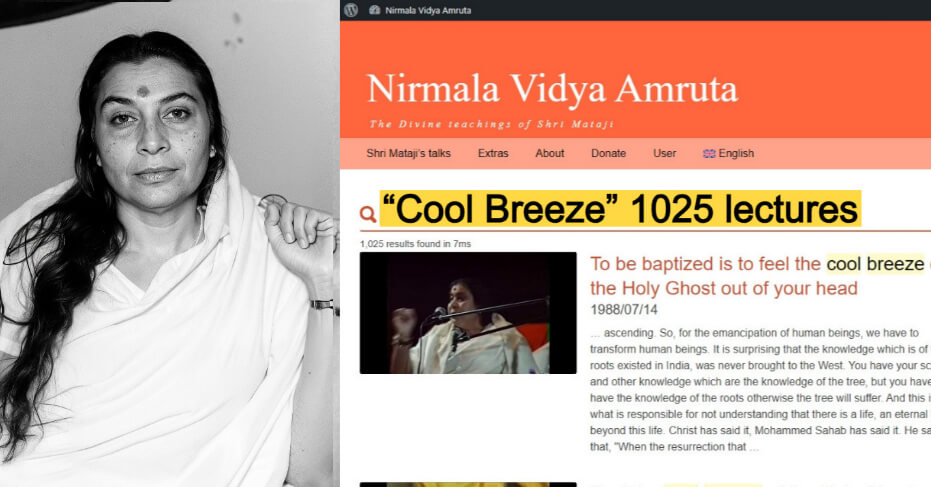
The Unveiling of the Hidden Spirit: The Cool Breeze as the Salvific Pneuma of the Paraclete Shri Mataji
Table of Contents
- Abstract
- 1. Introduction: The Problem of the Hidden Spirit and the Promise of Pneuma
- 2. Theological Framework: Welker's Hidden Spirit and Johannine Pneumatology
- 3. The Historical Absence and the Eschatological Expectation
- 4. The Paraclete Revealed: Shri Mataji as the Agent of the Cool Breeze
- 5. Phenomenological Evidence: The Cool Breeze Documented
- 6. Synthesis: The Cool Breeze as the Salvific Working of the Unveiled Spirit
- 7. Conclusion
- References
Abstract

This paper examines the phenomenon of the "Cool Breeze" in Sahaja Yoga through the theological lens of Michael Welker's concept of the "hidden Spirit." It posits that the Cool Breeze constitutes the experiential, tangible manifestation of the pneuma described in John 3:8—an experience historically attested as absent for two millennia. The analysis argues that Shri Mataji Nirmala Devi, identified as the divine Paraclete, uniquely operates as the agent who unveils and triggers this hidden, salvific pneumatological activity. By synthesizing Welker's theology, Johannine exegesis, and sociological evidence from observers like Judith Coney, this paper presents the Cool Breeze not merely as a subjective spiritual event but as the eschatological fulfillment of the promise of being "born of the Spirit," actualized through a specific historical figure.
1. Introduction: The Problem of the Hidden Spirit and the Promise of Pneuma
Christian pneumatology has long grappled with the elusive nature of the Holy Spirit. Michael Welker articulates this by describing the Spirit as deus absconditus—the hidden God—whose activity is often veiled, bivalent, and discernible more in its effects than its essence.[1] This hiddenness is embedded in the very semantics of ruach and pneuma, terms encompassing "wind," "breath," and "spirit." In John 3:8, this ambiguity becomes a profound theological pun: the wind (pneuma) blows mysteriously, and so does the Spirit (Pneuma). Jesus's declaration that one must be "born of the Spirit" presents a soteriological imperative, yet the experiential correlate of this birth has remained a central puzzle.
For centuries, this promise existed primarily as doctrine. The thesis of this paper, derived from the claims of Sahaja Yoga, is that the Paraclete Shri Mataji represents the historical unveiling of this hidden Spirit.[2] Her advent catalyzes the "salvific working" Welker describes, transforming the pneuma from a concealed theological principle into a pervasive, felt reality—the Cool Breeze on human skin. This paper will trace this claim through scriptural exegesis, historical analysis, and phenomenological evidence.
2. Theological Framework: Welker's Hidden Spirit and Johannine Pneumatology
Michael Welker's pneumatology provides a crucial framework. He notes the Spirit's work is characterized by a "veiled presence" and a "self-effacing character."[3] This hiddenness is not an absence but a mode of operation that allows for a universal, often anonymous, salvific influence across different faiths. The Spirit sanctifies and draws creation toward eschatological completion, yet its actions resist simplistic categorization.
In the Gospel of John, this aligns with the Paraclete's role. The Spirit-Paraclete is the "Spirit of truth" who abides with and within believers (John 14:17), teaching and reminding them of Christ's words (John 14:26).[4] Her work is profound yet interior. The metaphor of wind in John 3:8 perfectly captures Welker's dual assertion: the wind is an undeniable, audible, and palpable force (a "manifest activity"), yet its origin and path remain fundamentally hidden and sovereign ("you do not know where it comes from or where it goes").
Thus, the Johannine promise establishes a pneumatological expectation: a rebirth effected by a Spirit that is both powerfully real and mysteriously free. The subsequent history of Christianity, however, reveals a persistent testimony to the absence of a consistent, communal experience of this pneuma as a tangible, vivifying force—an absence that sets the stage for a new dispensation.
3. The Historical Absence and the Eschatological Expectation
The central historical claim advanced here is that for nearly two millennia following Christ's resurrection, the direct, sensate experience of the Holy Spirit as the life-giving Cool Breeze was not systematically available within the Christian tradition. While Pentecostal and charismatic movements later emphasized experiential gifts of the Spirit, the specific phenomenon of feeling a "cool breeze" emanating from within or upon the body as the sign of rebirth was not documented as a widespread, teachable practice.
Churches and pastors presided over sacraments, preached on the Holy Spirit, and fostered transformative faith, but they could not confer this specific somatic experience. The Spirit remained deus absconditus in its tactile dimension. This created a theological gap between the promise of John 3:8—which uses the visceral analogy of wind—and the common lived experience of the faithful. The promise of a birth "of the Spirit," analogous to the perceptible wind, awaited its full material actualization.
4. The Paraclete Revealed: Shri Mataji as the Agent of the Cool Breeze
Sahaja Yoga doctrine identifies Shri Mataji Nirmala Devi (1923-2011) as the embodiment of the Paraclete, the "Helper" or "Comforter" promised by Jesus.[5] In this capacity, Her primary divine function was to actualize the latent potential within human beings for a tangible connection with the Holy Spirit. She is presented not as founding a new religion but as fulfilling an old promise by triggering a global, mass-scale spiritual awakening.
The mechanism for this is the awakening of the Kundalini, a subtle spiritual energy believed to reside at the base of the spine. In Sahaja Yoga, this Kundalini is explicitly equated with the Holy Spirit. Its rise is not a metaphorical event but a physiological one, marked by a primary symptom: the sensation of a Cool Breeze (or sometimes warm vibrations) emanating from the fontanelle bone area at the top of the head and felt on the palms. This breeze is identified as the pneuma itself.
Thus, Shri Mataji's role is that of the definitive Revealer of the hidden Spirit. Through Her metaphysical agency, the veiled, sanctifying work described by Welker becomes unveiled, direct, and diagnosable. The Paraclete no longer works only in hidden ways but also through a manifest, historical person who grants access to the Spirit's tangible presence.
5. Phenomenological Evidence: The Cool Breeze Documented
The claim of this tangible experience is supported by external observation. Sociologist Judith Coney, in her academic study Sahaja Yoga, provides a critical, third-party account.[6] Her introduction recounts how a skeptical friend reported feeling a "cool breeze on the top of his head" after an encounter with a practitioner. Coney's entire book stems from investigating this puzzling, physically-felt phenomenon.
Within Sahaja Yoga literature, the experience is systematized. The Cool Breeze is:
- A Sign of Awakening: The definitive proof that one's Kundalini (Holy Spirit) has been awakened.
- A Tool for Diagnosis: Practitioners learn to sense this breeze on their palms to diagnose the state of their own or others' subtle energy systems (chakras).
- A Vehicle for Sanctification: The ongoing feeling of the breeze signifies the purifying and balancing work of the Spirit within, leading to inner peace, moral transformation, and healing.
This provides empirical grounding for Welker's theology. The "hidden Spirit" now has a detectable, consistent output. The "salvific working" is no longer entirely cryptic; it is accompanied by a somatic signature that practitioners are trained to recognize and foster.
6. Synthesis: The Cool Breeze as the Salvific Working of the Unveiled Spirit
Integrating Welker's framework with the Sahaja Yoga claim yields a coherent theological model:
| Theological Concept (Welker) | Manifestation in Sahaja Yoga | Result |
|---|---|---|
| The Hidden Spirit (deus absconditus) | The dormant Kundalini/Holy Spirit within every human being. | A universal potential for divine connection. |
| Salvific Working | The process of Kundalini awakening and its subsequent purification of the subtle system. | Personal transformation, healing, and growth toward holiness. |
| Bivalent/Manifest Activity | The clear, physical sensation of the Cool Breeze on the scalp and palms. | The hidden work becomes empirically verifiable and subjectively undeniable. |
| Role of the Paraclete | Embodied in Shri Mataji, who possesses the unique capacity to trigger this awakening en masse. | The historical agent who bridges the gap between promise and experience. |
| Eschatological Community | The global collective of Sahaja Yogis experiencing and sharing the Cool Breeze. | The inchoate formation of the "community of the redeemed" aware of the Spirit's tangible presence. |
This model resolves the "pressing problem" Welker identifies—of reconciling authentic spiritual experience across traditions. Here, the "hidden Spirit" works salvifically in various contexts, but its full, unveiled pneumatological activity as the life-giving pneuma (Cool Breeze) is made universally available through a specific Paraclete figure, fulfilling the Johannine eschatology.
7. Conclusion
Michael Welker's characterization of the Spirit's work as veiled yet salvific finds a profound and challenging counterpart in the phenomenon of Sahaja Yoga. The Cool Breeze represents a bold claim: that the mysterious pneuma of John 3:8 has transitioned from a hidden spiritual reality to an openly accessible, somatic experience. This transition is attributed to the advent of Shri Mataji Nirmala Devi as the Paraclete, the definitive revealer of the Holy Spirit.
Whether this claim is accepted or not, it presents a significant case study in the evolution of pneumatological thought. It challenges traditional Christian theology to consider why the experiential, tactile dimension of the Spirit's breath has been historically elusive and whether its manifestation in such a specific form constitutes a new, eschatological chapter in the Spirit's work. The Cool Breeze, therefore, stands as a provocative testament to the enduring human quest to not just believe in the Spirit, but to feel Her saving breath directly.
References
[2] "Theological and explanatory materials from the official Sahaja Yoga and Adishakti tradition." Adishakti.org.
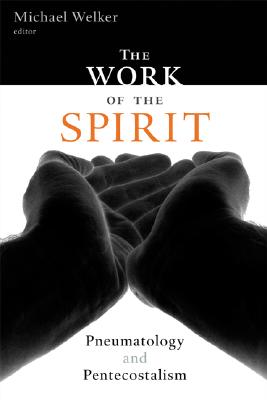
[3] Welker, Michael. "The Work of the Spirit: Pneumatology and Pentecostalism." Wm. B. Eerdmans Publishing Company, 2006, pp. 170-171.
[4] "The Holy Bible, New Testament, Gospel of John." Bible Gateway.
[5] "Theological and explanatory materials from the official Sahaja Yoga and Adishakti tradition." Adishakti.org.
[6] Coney, Judith. "Sahaja Yoga: Socializing Processes in a South Asian New Religious Movement." RoutledgeCurzon, 1999.
"The pneumatological activity [Cool Breeze or Wind] ... of the Paraclete ... may most helpfully be considered in terms of the salvific working of the hidden Spirit.”- Michael Welker
"This self-effacing character of the Spirit's presence finds a kind of verbal reinforcement in scripture due to an ambiguity present in both Hebrew and Greek, where the words ruach and pneuma carry a semantic width that encompasses the range of English words: "Wind," "Breath," "spirit.”In the Priestly account of creation, are we to translate Genesis 1:2b as saying that "the spirit of God was moving over the face of the waters"or would it be better rendered," a wind of God swept over the face of the waters"? When Jesus says to Nicodemus," The wind blows where it chooses and you hear the sound of it, but you do not know where it comes from or where it goes. So it is with everyone who is born of the Spirit" (John 3:8), the Greek of the Gospel contains a kind of theological pun in its double use of pneuma.
Taking seriously this veiled presence of the Spirit, expressed in the hidden character of pneumatological action, by no means implies a denial of more manifest activity also. The kind of bivalent working that Kathryn Tanner discusses in her chapter is surely just what one would expect of a divine Person, in contrast to the uniformity of action associated with a mere force such as gravity, unvarying in its characteristics...
According to this understanding, the sanctifying work of the Spirit is a continuing activity that awaits its final completion in the creation of the community of the redeemed, a consummation that will manifest fully only at the eschaton. Of the Persons of the Trinity, we can appropriate most specifically to the Spirit the title of deus absconditus, the hidden God.
We have acknowledged that a veiling of pneumatological activity is not the only thing to be said about the work of the Paraclete, yet recognition of a degree of reticence in the nature of the Spirit's presence does offer opportunities for the theological understanding of a number of puzzling aspects of the human encounter with divine reality. There is the important and pressing problem posed by the need to understand how the apparently clashing cognitive claims made by the different world faith traditions can be reconciled with the evident presence of authentic spiritual experience within all of them. I have suggested elsewhere that this phenomenon may most helpfully be considered in terms of the salvific working of the hidden Spirit.”
Michael Welker, The work of the Spirit: pneumatology and Pentecostalism
Wm. B. Eerdmans Publishing Company, 2006, page 170-1
Interactive Chat
Access an intelligent analysis environment where you can explore texts, ask questions, and discover connections between ideas.
Open chat