Deepak Chopra’s Life After Death and the Eternal Life Promised by Jesus through the Paraclete Shri Mataji
Deepak Chopra’s Life After Death and the teachings of the Paraclete Shri Mataji converge on a revolutionary understanding of eternal life—not as a theological abstraction or distant reward but as the immediate realization of the immortal Self. Chopra’s quantum metaphysics provides the intellectual scaffolding; the Paraclete offers the experiential key. Together, they advance a new spiritual humanism in which science, scripture, and self-awareness coalesce to affirm the continuity of life beyond physical death and the universal promise of divinity within.
1. Introduction
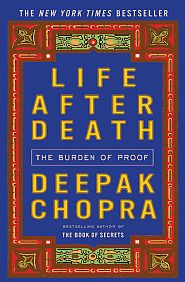
The mystery of what happens after death has captivated human consciousness since the dawn of civilization. Across religious traditions and philosophical systems, seekers have attempted to discern the continuity between the temporal and the eternal. In Life After Death: The Burden of Proof, Deepak Chopra offers a synthesis of Vedic philosophy, modern physics, and psychospiritual insight to propose that death is not the end of existence but a transformation of consciousness[1].
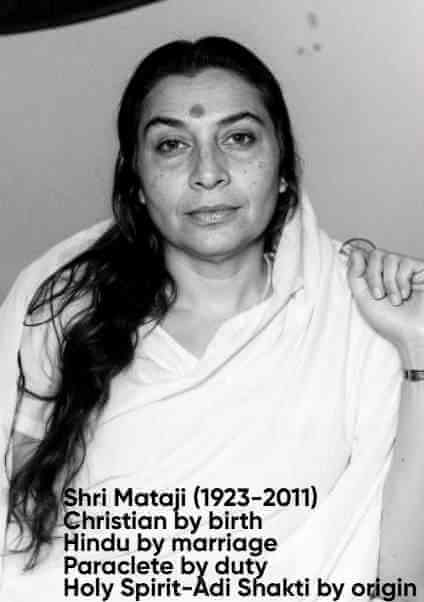
Simultaneously, the revelation of the Paraclete Shri Mataji Nirmala Devi—recognized by followers of Sahaja Yoga as the Comforter and promised Holy Spirit sent by Jesus—provides a lived experience of eternal life realized in the present through Self-realization, an awakening to the indwelling Divine consciousness[2]. This paper seeks to explore the convergence between Chopra’s quantum-Vedantic understanding of postmortem existence and the eschatological promise of Jesus Christ as realized through the Paraclete Shri Mataji.
2. The Metaphysical Vision in Life After Death
Chopra grounds his argument on the assertion that consciousness is fundamental and primary, whereas physical manifestation is derivative. Employing ideas from quantum theory—particularly the observer effect—he posits that life and death are alternating modes of the same conscious continuum[1]. Death is therefore not extinction but metamorphosis: the dissolution of the gross body while the subtle and causal layers of consciousness persist in nonlocal dimensions of reality.
This outlook mirrors the Upanishadic concept that Atman (the individual self) is one with Brahman (the Absolute). Thus, the afterlife is viewed not as a distant realm but as another mode of the same all-pervading consciousness that sustains the living universe. Chopra innovatively contributes the idea of the “quantum self”—a field of awareness transcending birth and death[1].
—Amit Goswami, Ph.D., author of The Self-Aware Universe[1]
3. The Paraclete Shri Mataji and the Promise of Eternal Life
In the Gospel of John (14:16–17), Jesus assures his disciples: “And I will pray the Father, and he shall give you another Comforter, that she may abide with you for ever.” Followers of Sahaja Yoga identify Shri Mataji Nirmala Devi as the fulfillment of this promise—the Paraclete, the living manifestation of the Holy Spirit whose descent awakens within each individual the Kundalini Shakti, or the divine energy coiled at the base of the spine[2].
Sahaja Yoga thus reinterprets eternal life—not as a future condition after physical death but as the present realization of the Spirit’s indwelling presence. When the Kundalini ascends and pierces the Sahasrara (the crown chakra), practitioners experience the “baptism of the Holy Spirit” described in Christian scriptures[2].
4. Comparative Analysis: Conscious Continuity and Self-Realization
Both Chopra’s and Shri Mataji’s teachings converge on the recognition that consciousness, not matter, defines reality. Chopra’s “quantum self” parallels Sahaja Yoga’s “Spirit” (Atma), while his multidimensional cosmology echoes the subtle system of chakras and planes described in spiritual tradition[1][2].
Yet the approaches diverge in method and purpose. Chopra’s model remains primarily interpretative—an invitation to reimagine death through metaphysical reasoning. Shri Mataji’s revelation, by contrast, is experiential, offering tangible self-verification through Kundalini awakening. From a Christological standpoint, the eternal life promised by Jesus is vindicated through the Paraclete’s coming.
5. Theological and Philosophical Implications
When analyzed together, Chopra’s metaphysical synthesis and Shri Mataji’s eschatological mission suggest a profound reconfiguration of the afterlife paradigm. Death is no longer the terminus of human existence but an evolutionary threshold within the continuum of divine awareness[1]. The “burden of proof,” as Chopra calls it, is ultimately phenomenological: only direct experience of higher consciousness can validate philosophical hypotheses.
In this sense, the Paraclete’s work fulfills Chopra’s call for experiential confirmation of postmortem continuity—by enabling individuals to taste eternity while alive. This convergence also invites a re-examination of interfaith eschatology.
6. Conclusion
Deepak Chopra’s Life After Death and the teachings of the Paraclete Shri Mataji converge on a revolutionary understanding of eternal life—not as a theological abstraction or distant reward but as the immediate realization of the immortal Self. Chopra’s quantum metaphysics provides the intellectual scaffolding; the Paraclete offers the experiential key[1][2]. Together, they advance a new spiritual humanism in which science, scripture, and self-awareness coalesce to affirm the continuity of life beyond physical death and the universal promise of divinity within.
7. References
[1] Chopra, Deepak. "Life After Death: The Burden of Proof." Harmony Books, 2006.[2] "Adi Shakti | Divine Feminine | Shri Mataji Nirmala Devi." AdiShakti.org, accessed February 22, 2026.
Praise for LIFE AFTER DEATH
"Who is not curious about what happens after death? And even when there are many answers available, both ancient and modern, even some based on new science, the question 'What does Deepak Chopra have to say about this?' is an important one for our age. Well, Deepak Chopra's answer is here, and it is very affirming on meaningful questions. I like that. Need I say more? This is a great book for your easy reading.”—Amit Goswami, Ph. D., author of The Self-Aware Universe, Physics of the Soul, and The Quantum Doctor
"The unstoppable Deepak Chopra depicts in vivid detail the realms we may encounter after the passing of our mortal frame. Most important, he makes clear that only the capacity we have developed for Self-awareness here and now can prepare us for the confrontation with our true nature that awaits us at the moment of death.”
—Andrew Cohen, spiritual teacher and founder of What Is Enlightenment magazine
"This fascinating, provocative, and profound book is written with exquisite ease and with a very personal warmth that makes its invitations to expansion of consciousness all the more delicious and powerful.”
—Andrew Harvey, author of The Direct Path and Sun at Midnight
"In Life After Death, Deepak Chopra proves himself to be a spiritual alchemist. Using the power of language, he takes diverse elements such as Vedic philosophy, particle physics, psychology, and neuroscience and transforms them into literary gold. His insights into what happens after we die will transform the way you see what lies ahead. An inspiring and profoundly reassuring book.”
—Adrianna Huffington, editor, huffingtonpost
"What if life and death are like two locked boxes, each containing the key to the other? In this book Dr. Chopra looks at life after death from this intriguing perspective and proposes that death may not constitute the extinction of life, as usually imagined, but rather its extension by other means. He draws upon a dazzling array of sources, from ancient myths to the findings of modern science, to produce a work of compelling novelty on an eternal mystery.”
—Arvind Sharma, Birks Professor of Comparative Religion, McGill University
"Life After Death: The Burden Of Proof opens the doorway to an ever-evolving future Now. With mastery and compassion, Chopra combines the wisdom of the Vedic tradition with quantum physics, and his experience as a doctor, to reveal that we are not and never have been limited creatures trapped in physical bodies but are already multidimensional beings, creating our future beyond this life through every thought, word, and deed. His view of the nature of reality is precious, illuminating, life-giving. I love the book.”
—Barbara Marx Hubbard, president, Foundation for Conscious Evolution.
“A unique initiative to understand Life After Death and dispel one of our greatest fears of the unknown: death. Weaving between religious scriptures, science, and our common cultural/societal understanding, Deepak has very articulately reasoned the myth of death and simply made it just another aspect of life. Surely this book serves to expand our understanding to go beyond and deeper into the unknown, cherish life, and embrace death with love.”
—Bawa Jain, secretary-general, World Council of religious Leaders
"Three cheers for Deepak's courage to express his beliefs and wisdom about a subject many fear and avoid. This book will help us to open a door to a subject few seemed prepared to explore because they cannot explain it. I know from personal experience that near-death and past-life experiences are not a matter of imagination. I can believe because I have had the experience. Consciousness exists when our bodies do not. From my own life and my work with patients I know that we are aware of the future and the past at an unconscious level, which when made conscious helps us to understand and survive. Life is a mystery, so read on and help us to enter the darkness and light a candle.”
—Bernie Siegel, M.D., author of 365 Prescriptions for the Soul and 101 Exercises for the Soul
"In this remarkable book, Deepak Chopra turns to the anomalies in science that modern physicists are trying to explain, and considers how the rishis, the ancient sages of Vedanta, dealt with the very same question. According to the 'observer effect' in physics, for example, the very act of looking at an electron forces it to leave the quantum soup of pure potential and take specific form. Vedic rishis believed that seeing is the ultimate act of creation—that through consciousness each of us shapes the universes we experience. By marrying science with wisdom in Life After Death, Chopra builds his case for an afterlife in which our most essential self, the seer that observes our experiences in this temporary home that we call the self, uses the end of this life-time to pass over into the next. This is an intellectual and spiritual tour de force.”
—Professor Robert Thurman, Columbia University, author of Infinite Life and The Tibetan Book of the Dead
"Deepak Chopra has been my friend and mentor for nearly twenty years. Now, when we baby boomers are finally admitting our own mortality, he has tackled the ultimate subject which fascinates us all; life after death. Drawing from many cultures, and emphasizing the idea of Karma from his own, Deepak interweaves mythical love with first-hand spellbinding anecdotes to somehow make the subject of death very useful and relevant to making the most time on the Earth here and now. A must-read for everyone who will die.”
—Candace B. Pert, Ph.D., author of Everything You Need to Know to Feel Good
"Deepak Chopra has written a masterpiece that is long overdue in our spiritual culture. Life After Death: The Burden of Proof is a bold and comforting guide into the afterlife. Eternity is the true home of the soul, yet we fear to explore experience fo death and our place beyond now. Deepak has brilliantly accomplished this journey on our behalf.”
—Caroline Myss, author of Anatomy of the Spirit and sacred Contract
"I, perhaps like many others, most often think of and look to Deepak Chopra as a physician, pioneer, and major influence in the huge positive change in Western attitudes towards holistic medicine. In this book he is much more than that. He addresses the ultimate mystery—death—as a physician, a philosopher, and a teacher. His presentation of concepts such as the 'journey of the soul' or the 'music of the spheres' reminded me of the readings of my grandfather, Edgar Cayce, who many years ago also provided the world with a more hopeful view of the transition we are all destined to make. I recommend this book for all of us who are concerned about our own eventual death, and the death of those closest to us.”
—Charles Thomas Cayce, executive director, Association for Research and Enlightenment, Inc.; Edgar Cayce Foundation, Inc.
"Deepak Chopra masterfully navigates a bewildering but profoundly important landscape in Life After Death: The Burden of Proof. Gracefully weaving parables, poignant experiences, religious lore, and scientific evidence. Chopra's survey of the afterlife is at once contemplative, heartening, and satisfying.”
—Dean Radin, Ph.D., senior scientist, Institute of Noetic Science
"This is not an 'easy' book, but it is a thoroughly fascinating one that could well become one of the most important reads of your lifetime.”
—Doris Wilsdorf, professor emeritus, University of Virginia, and inventor
“A fabulous read! While western science continues to watch the world with its nose pressed to precise lenses with limited focus, Deepak takes you by the hands and leads you on a wonderful journey right through those looking glasses to the very inside of eternally creative consciousness as revealed by the Vedic rishis and reflected in other great world cultures. Then he shows you why this inside view better explains the data of Western science than its own worldview! In short, this is a highly effective preview of the integral global science of the future that will dramatically change the way we see and act in our world. As you take this fascinating journey with Deepak, the immortality promise of its title is easily fulfilled along the way.”
—Elisabet Sahtouris, Ph.D., evolution biologist and futurist; professor; coauthor of EarthDance: Living Systems in Evolution
💬 Interactive Chat
Access an intelligent analysis environment where you can explore texts, ask questions, and discover connections between ideas.
Open chat