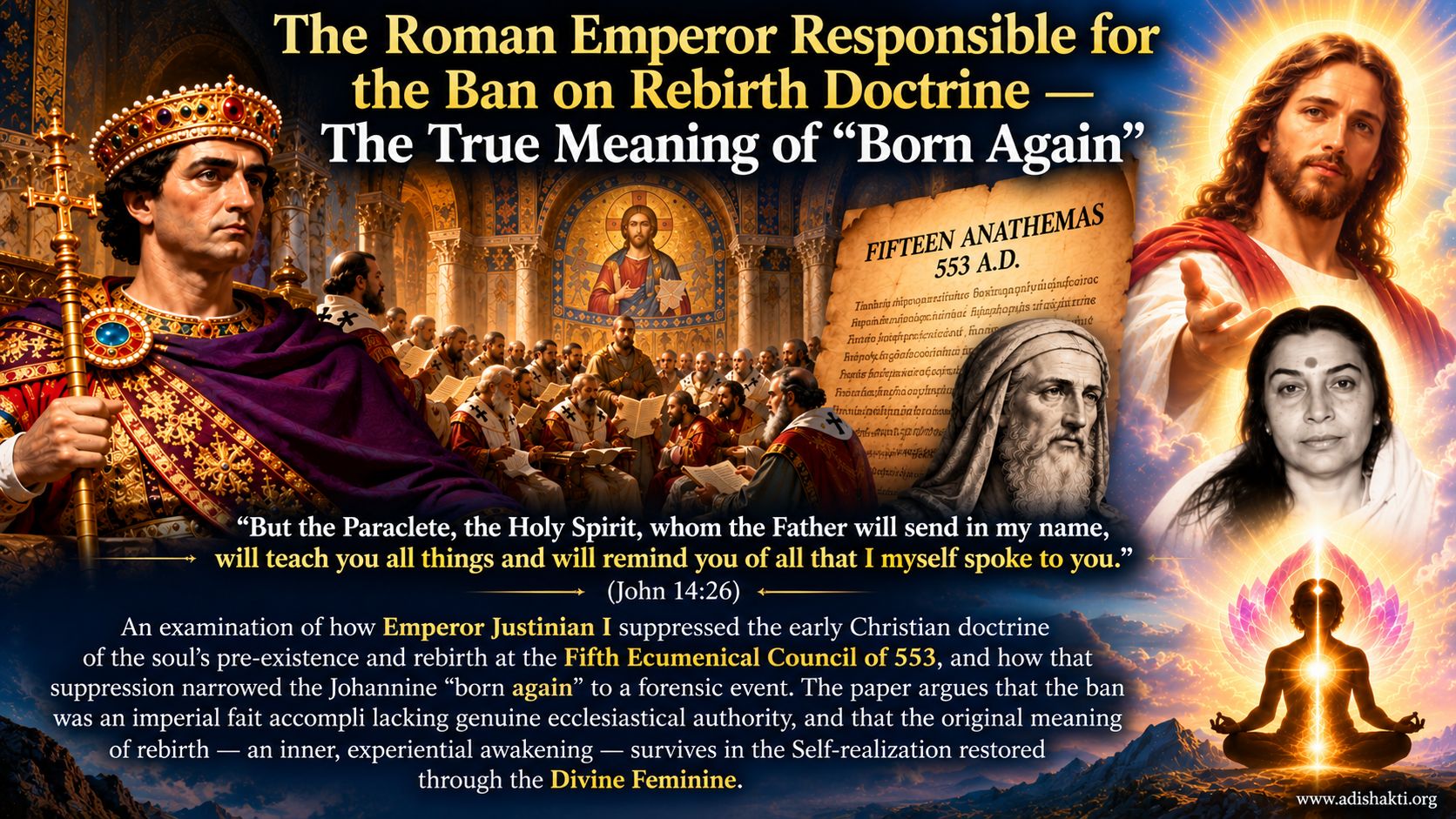
The Roman Emperor Responsible for the Ban on Rebirth Doctrine — The True Meaning of "Born Again"
Summary
This Authenticity Series edition re-renders the Adishakti.org paper on the Roman imperial suppression of the rebirth doctrine. The historical claim is that Emperor Justinian I, not a legitimate council, imposed the ban on the pre-existence of souls and, by implication, on reincarnation, through the so-called Fifteen Anathemas against Origen attached to the Fifth Ecumenical Council (553). The paper distinguishes the ambiguous conciliar record from the imperial edict, documents Pope Vigilius' protest and absence, and traces the theological consequences: the narrowing of "born again," the loss of a developmental soteriology, the eclipse of apokatastasis, and the fragmentation of Christian spirituality. The Authenticity Series framing preserves the historiographical argument while separating it from the further confessional claim that the original rebirth teaching is restored through Self-realization and the awakening of Shakti.
Abstract
This paper examines the historical claim that Roman Emperor Justinian I (c. 482–565) was the primary agent behind the suppression of the doctrine of the soul's pre-existence and, by implication, of reincarnation within Christianity. It analyses the events surrounding the Fifth Ecumenical Council (Second Council of Constantinople) in 553, arguing that the famous "Fifteen Anathemas" against Origen were not a formal conciliar product but an imperial imposition that lacked genuine ecclesiastical authority. The paper then explores the theological consequences of this suppression, contending that the removal of a framework that included pre-existence and repeated incarnations impoverished the Christian understanding of spiritual growth and obscured the depth of Jesus' teaching on being "born again of the Spirit" (John 3:3-8). By severing the link between the soul's eternal journey and the present life, the ban contributed to a flattened soteriology that has hindered a full comprehension of the transformative rebirth that Jesus upheld.
1. Introduction
The question of whether early Christianity entertained a belief in the pre-existence of the soul and reincarnation has long been a subject of scholarly and popular debate. A persistent narrative holds that these ideas were systematically purged from orthodox theology not through theological deliberation but by the political machinations of a Roman emperor. This narrative centres on Emperor Justinian I and the Fifth Ecumenical Council of 553. According to this view, Justinian manipulated the council to condemn the teachings of Origen of Alexandria (c. 184–c. 253), whose writings included speculations on the soul's pre-existence and repeated incarnations. The resulting "ban" on the rebirth doctrine was not a legitimate ecclesiastical decision but an imperial fait accompli that has shaped Christian doctrine for nearly fifteen centuries. This paper investigates the historical validity of that claim and explores its dire consequences for the development of Christian spirituality.
2. Historical Background: Origen, Justinian, and the Fifth Ecumenical Council
2.1 Origen's Teachings on Pre-existence and Reincarnation
Origen, one of the most prolific and intellectually daring of the early Church Fathers, developed a complex theological system that incorporated elements of Platonic thought. Central to his speculation was the doctrine of the pre-existence of souls. Origen suggested that rational beings (nóes) were originally created as pure intellects in union with God. Through a "cooling" of their love, they fell and acquired bodies, entering a cycle of embodiment that allowed for moral education and eventual restoration (apokatastasis).
— Origen, De Principiis [1]
— Origen, Contra Celsum [2]
2.2 The Second Origenist Crisis and Justinian's Intervention
Origen's ideas were controversial from the start, but they found adherents, especially in monastic circles. In the sixth century, a "Second Origenist Crisis" erupted, pitting factions of Origenist monks against each other. Emperor Justinian, who sought to impose unity on the empire and the Church, intervened directly. In 543, he issued a tract containing nine anathemas against Origen's On First Principles and convened a local synod in Constantinople that condemned Origen [3].
2.3 The Council of 553: Manipulation and Ambiguity
The council was ostensibly convened to address the "Three Chapters" controversy, but Justinian used it to advance his condemnation of Origen. Pope Vigilius, who was in Constantinople under duress, refused to attend the council in protest against Justinian's manipulation. The assembly was dominated by Eastern bishops, ensuring an outcome favourable to the emperor.
During the council, Justinian presented his "Fifteen Anathemas" against Origen, which were endorsed by the attending bishops in a session that Vigilius boycotted. The first anathema explicitly cursed anyone who "asserts the fabulous pre-existence of souls, and shall assert the monstrous restoration which follows from it" [4].
Crucially, however, the official acts of the council do not include these fifteen anathemas. Origen's name appears only in the eleventh canon, which lists him among previously condemned heretics without specifying which teachings were being condemned. This ambiguity has led scholars to question whether the council itself formally anathematized Origen's doctrine of pre-existence and reincarnation [5].
3. The Ban: Ecclesiastical Authority or Imperial Fiat?
The evidence suggests that the "ban" on the rebirth doctrine was primarily an imperial project. Contemporary sources indicate that Pope Vigilius was opposed to Justinian's theological interference. Subsequent popes made no mention of Origen or his condemnation when referring to the Fifth Council. As German author Peter Andreas argues, the so-called ban concerning the doctrine of reincarnation is the result of an historical error and contains no ecclesiastical authority whatsoever
[6]. The ban was, in effect, a fait accompli, brought about by Justinian, which no one within the Christian Church has dared to challenge.
4. Dire Consequences for Christian Spiritual Development
4.1 The Narrowing of "Born Again"
The suppression of Origen's framework had profound theological repercussions. In the Johannine dialogue with Nicodemus, Jesus insists, Truly, truly, I say to you, unless one is born again (ánōthen), he cannot see the kingdom of God
(John 3:3). The Greek term ánōthen can mean "from above" or "again," allowing for rich interpretation. For Origen, this "new birth" could be understood within a cosmic narrative of the soul's descent and ascent. Spiritual rebirth was not merely a one-time event but a critical turning point in a longer journey of the soul back to God. By erasing the notion of pre-existence, the ban reduced "being born again" to a purely forensic experience within a single lifetime.
4.2 The Loss of a Developmental Soteriology
Origen's system offered a developmental soteriology in which each soul progresses through stages of purification and illumination. The ban on pre-existence removed this developmental horizon. Without the concept of a soul that brings a history of virtues and defects into each life, Christian anthropology became increasingly focused on the innate sinfulness of a soul created ex nihilo at conception. The possibility that spiritual struggle might be part of a longer educational journey was replaced by a binary dichotomy: saved or damned in a single lifetime.
4.3 The Eclipse of Apokatastasis
Closely tied to the ban on pre-existence was the condemnation of the "monstrous restoration" (apokatastasis), the hope that all rational beings will ultimately be reconciled to God. Origen saw this restoration as the logical culmination of God's infinite love. The anathema against this hope not only foreclosed a more optimistic eschatology but also removed a powerful motive for spiritual growth: the assurance that all suffering ultimately leads to healing and union with God.
4.4 The Fragmentation of Spirituality
The removal of a holistic framework that connected the soul's pre-existent state, its incarnate struggles, and its ultimate restoration contributed to a fragmentation of Christian spirituality. Practices of asceticism, prayer, and contemplation, which in Origen's view were steps in the soul's return to its original unity, risked becoming isolated exercises without a coherent cosmic narrative.
5. Conclusion
Historical analysis supports the claim that the ban on the doctrine of the soul's pre-existence and reincarnation was not a product of conciliar deliberation but of imperial imposition by Emperor Justinian I. The "Fifteen Anathemas" against Origen, though later accepted as church doctrine, likely lack genuine ecclesiastical authority. This imperial decree had dire consequences for the development of Christian spirituality. It truncated the understanding of spiritual rebirth, reducing the Johannine "born again" to a narrow, one-time event and discarding a developmental soteriology. Re-examining this historical episode is vital for comprehending the full depth of the "being born again of the Spirit" that Jesus upheld. Restoring a holistic, developmental perspective on spiritual growth could enrich contemporary Christian theology, pastoral practice, and ecumenical dialogue.
Original closing extract from the legacy page
It seems reasonable to conclude that the so-called ban concerning the doctrine of reincarnation is the result of an historical error and contains no ecclesiastical authority whatsoever. The German author, Peter Andreas, expresses this point of view in his book, Jenseits von Einstein. Andreas gives attention to the concept of reincarnation and, particularly, to the manner in which any consideration of the topic was suppressed within the Catholic church — not by profound theological study, but by the action of a Roman Emperor.
In a chapter devoted to reincarnation, Andreas writes: "The Christian churches have very little indeed to say about reincarnation. They can hardly be blamed because the Bible is apparently sadly lacking in this respect. In fact, we may ask, if the subject of reincarnation is so important — from the religious point of view — why is there so little mention of it in the Bible?" The few Bible references indicate that from the earliest times supporters and opponents of reincarnation have waged bitter 'war'. Jesus' remark to Nicodemus, for instance, "Thou must be born again" can be interpreted as a reference to spiritual rebirth, according to the opponents of the idea (of reincarnation).
Andreas goes on to describe how Emperor Justinian managed to manipulate the 5th Ecumenical Council in 553 which resulted in the ban against Origen: "Strangely enough, there was not one Roman bishop present at this conference; apart from six African notables there were only Eastern bishops present. A curious feature of this Council was that although Pope Vigilius was in Constantinople at the time of the Council he did not attend. There had previously been conflict between Vigilius and the Emperor and the Empress Theodora. Justinian refused to accede to the Pope's request for a stronger delegation of bishops from both West and East at the Council and then proceeded to convene the Council himself."
"The Pope did not attend, as a gesture of protest, and as an indication that he would not be held responsible for the Council. The ruling monarch did not have an entirely free hand, however, since official regulations drawn up during the eight sessions of the Council, which met over a period of four weeks, had to be officially endorsed by the Pope. This duly took place; the documents, however, only dealt with the so-called 'Three Chapters' controversy — the work of three scholars considered by Justinian to be heretics. The Emperor had already issued an edict against these men. No mention was made of Origen. Research suggests that suspicions about Justinian were valid. Neither Pope Pelagius I (556–561) nor Pope Gregory (590–604) mentioned Origen when writing about the 5th Council."
"But up to now it has been accepted tacitly that the following is the official ban of the Council: 'Whosoever teaches the doctrine of a supposed pre-birth existence of the soul, and speaks of a monstrous restoration of this, is cursed.' How did this come about? No-one can say with certainty, but there are strong indications that by some ploy the Emperor Justinian was able to insist on the convocation of a Council, which was delayed, however, by opposition from the Pope. Eventually the first meeting of the Council took place on 5 May 553, not before the Emperor had managed to call several bishops to a meeting at which he (Justinian) presented his 'Fifteen Anathemata' refuting Origen's teachings, and gained the endorsement of the attending bishops."
"We can safely conclude that the Pope, who wished to boycott the Council, would certainly not have appeared at this meeting, which was precisely what Justinian had hoped for. The meeting prior to the Council was used by the wily Emperor to curtail the Pope's powers and to pronounce a ban on the teachings of Origen. His scheming succeeded far better than he could have imagined. The church accepted the ban as valid, having been imposed by the Council, and it then passed into established doctrine where it has remained for the past 1500 years. This makes the idea extremely difficult to correct. The subject of reincarnation has therefore not played any role in Christian doctrine, in contrast with other religions."
"Thus it seems right to conclude that the 'ban' on the teaching of reincarnation is based on historical misrepresentation and has no ecclesiastical authority. It was in fact a 'fait accompli', brought about by Justinian, which no-one within the Christian church has dared to challenge in the course of some 1500 years. What is worse is that the subject has been totally ignored, as a glance at any encyclopaedia will show."
References
[1] Origen. De Principiis (On First Principles). New Advent, translated by Frederick Crombie, 1885.
[2] Origen. Contra Celsum (Against Celsus). New Advent, translated by Frederick Crombie, 1885.
[3] Origenist Crises. Wikipedia, Wikimedia Foundation, 15 Jan. 2024.
[4] Second Council of Constantinople — 553 A.D. Papal Encyclicals Online.
[5] Tanner, Norman P. Decrees of the Ecumenical Councils. Georgetown University Press, 1990.
[6] Andreas, Peter. Roman Emperor Responsible for Ban on Rebirth Doctrine. Spiritual.com.au, 2003.
[7] Ramelli, Ilaria L.E. The Christian Doctrine of Apokatastasis: A Critical Assessment from the New Testament to Eriugena. Brill, 2013.
[8] Apokatastasis, Origen, and the Fifth Ecumenical Council (Part 1). Afkimel, 5 Jan. 2026.
Editorial note: Quotations from Peter Andreas are carried forward from the supplied legacy page. Primary-source conciliar acts and page-specific citations should be verified before scholarly publication.
Reincarnation in Early Christianity — Lost Teachings and Suppressed Origins
Summary
The doctrine of reincarnation was banished because it gives power and authority to the people. Reincarnation contradicted the aspirations of a few bishops and deacons who felt they alone should dispense the truth to the multitudes. This authoritarian strangle-hold is strengthened by the doctrine of "one chance-one life" because a person who wrongly chose to think for themselves, dismissing the authority of the hierarchy, would not get another chance to put things aright if they guessed wrongly. The position of the hierarchy is that eternal damnation without parole would be the irrevocable fate of those who dared to question the hierarchy's authority.
1. Introduction
The history of Christian theology is a complex tapestry woven with threads of philosophical debate, political intrigue, and profound spiritual inquiry. Within this history, the doctrine of reincarnation, or the transmigration of souls, represents a vibrant yet ultimately severed thread. For the first five hundred years of Christianity, this concept was not a fringe heresy but a significant and respected belief within the theological landscape, entertained by some of the most influential Church Fathers. The early Church was far more theologically diverse than modern Christianity often acknowledges, with vigorous debates about the nature of Christ, the role of the Holy Spirit, the meaning of salvation, and the destiny of the soul. In this rich theological environment, reincarnation was not seen as incompatible with Christian faith but as a natural expression of God's justice and love. The formal rejection of reincarnation, culminating in the Second Council of Constantinople in 553 A.D., was not merely a doctrinal clarification but a pivotal event with far-reaching consequences that would shape the spiritual destiny of billions of believers across fourteen centuries.
This paper argues that the banishment of reincarnation from Christian doctrine constitutes a profound spiritual tragedy, one that has stunted the spiritual development of its adherents by replacing a model of cosmic justice and personal growth with a framework of hierarchical control and fear-based obedience. By examining the historical prevalence of reincarnation in early Christian thought, the political machinations that led to its condemnation, the theological arguments that supported it, and the subsequent spiritual ramifications, this article will demonstrate how this doctrinal shift fundamentally altered the spiritual trajectory of Western Christianity. The removal of reincarnation was not an inevitable theological development but a deliberate act of institutional power consolidation that has had consequences extending to the present day. This paper will show that the rejection of reincarnation was driven not by theological necessity but by the political ambitions of a tyrannical emperor and the desire of an emerging ecclesiastical hierarchy to consolidate power and control over the faithful.
The stakes of this inquiry are significant. Understanding how and why the Church rejected reincarnation provides crucial insight into how religious institutions shape doctrine not solely through theological reasoning but through political calculation and the desire to maintain hierarchical authority. Moreover, it illuminates a path toward spiritual renewal by recovering a more complete and empowering vision of the soul's journey that was present in Christianity's earliest centuries. This recovery is not merely an academic exercise but a matter of profound spiritual importance for contemporary Christianity, which faces a crisis of meaning and relevance in the modern world. By understanding what was lost when reincarnation was rejected, we can begin to recover the spiritual resources necessary to address this crisis and to offer a Christianity that speaks to the deepest longings of the human heart.
2. Reincarnation in Early Christian Thought
Contrary to the modern Christian consensus, the concept of the soul's pre-existence and subsequent rebirths was a familiar and debated topic among early Christian theologians. The intellectual climate of the early Church was heavily influenced by Hellenistic philosophy, particularly the works of Plato, who provided the West with its most robust articulation of reincarnation. [2] In dialogues such as the Phaedo , Republic , and Timaeus , Plato and his intellectual progenitor, Socrates, argued for the soul's immortality and its cyclical journey through various corporeal forms to achieve purification and return to the divine. This Platonic framework provided a fertile ground for early Christian thinkers grappling with questions of theodicy, justice, and the nature of the soul.
A significant number of early Church pillars engaged with reincarnation concepts. These included Clement of Alexandria, St. Gregory of Nyssa, St. Gregory of Nazianzus, and even St. Augustine. Augustine, in his
Confessions
, famously pondered his soul's existence before his current life:
Did my infancy succeed another age of mine that dies before it? Was it that which I spent within my mother's womb? ... And what before that life again, O God of my joy, was I anywhere or in any body?
[3]
The fact that such a towering figure in Christian theology would pose such questions suggests that reincarnation was not merely a marginal concern but a legitimate topic of theological exploration. Augustine's willingness to entertain the possibility of pre-existence demonstrates that the doctrine was not considered heretical in the fourth century, even among the greatest minds of the Church.
Furthermore, the doctrine of reincarnation was not limited to a few eccentric theologians but was discussed and debated in the mainstream theological discourse of the early Church. The fact that it took a formal council and imperial decree to suppress it indicates that it had significant support among the Christian intelligentsia. If reincarnation had been universally rejected or considered obviously heretical, there would have been no need for such drastic measures. The very fact that Justinian felt compelled to convene a council and issue anathemas against Origen and his teachings on reincarnation testifies to the doctrine's continued influence and appeal.
The central figure in this narrative is Origen of Alexandria (c. 185-254 A.D.), whom the
Encyclopedia Britannica
identifies as the most prominent, distinguished, and influential theologian of the early Church.
[1]
Origen was extraordinarily prolific, producing approximately six thousand works, leading St. Jerome to ask in amazement,
Which of us can read all that he has written?
[1]
A profound thinker and synthesizer, Origen integrated Christian scripture with Platonic and Gnostic philosophy in ways that profoundly shaped early Christian thought. His influence extended far beyond his lifetime, with later Church Fathers such as Gregory of Nazianzus, Gregory of Nyssa, and Maximus the Confessor drawing heavily on his theological insights.
3. Theological Arguments for Reincarnation in Early Christianity
Origen's theological system provided a compelling framework for understanding divine justice and the soul's journey. He posited a two-stage creation: first, the creation of rational minds ( logikoi or noes ) who existed in a state of pure contemplation of God, and second, the creation of the material world as a consequence of these minds falling away from God through an exercise of their free will. [4] This fall resulted in a hierarchy of beings—angels, humans, and demons—each clothed in a body corresponding to the severity of their cooling ardor for the divine. For Origen, life on Earth was a pedagogical and purgatorial process, and he saw the possibility of multiple lifetimes as a logical extension of God's boundless love and desire for the ultimate salvation of all beings ( apokatastasis ).
Origen argued that a single lifetime was insufficient to account for the vast disparities in human circumstances or for the soul's purification and return to God. He wrote:
If it can be shown that an incorporeal and reasonable being has life in itself independently of the body and that it is worse off in the body than out of it, then beyond a doubt bodies are only of secondary importance and arise from time to time to meet the varying conditions of reasonable creatures. Those who require bodies are clothed with them, and contrawise, when fallen souls have lifted themselves up to better things their bodies are once more annihilated. They are thus ever vanishing and ever reappearing. [5]
This perspective did not undermine Christ's redemptive sacrifice but rather contextualized it within a grander cosmic scale. Christ's incarnation and sacrifice remained the central event of salvation history, providing the ultimate means of reconciliation with God. Reincarnation, in this view, was the mechanism through which souls could progressively appropriate the grace offered by Christ over multiple lifetimes, gradually healing the spiritual wounds that led to their fall. This belief was not seen as a contradiction to scripture but as a deeper interpretation of it, with passages like the disciples' question about the man born blind—
Rabbi, who sinned, this man or his parents, that he was born blind?
(John 9:2)—being seen as evidence of a popular understanding of pre-existence and karmic consequence.
[6]
Origen's doctrine of universal salvation ( apokatastasis ) was intimately connected to his understanding of reincarnation. He believed that God's love was so vast and so patient that ultimately all souls, even the most fallen and rebellious, would eventually return to God. This was not a doctrine of automatic salvation but of progressive redemption through multiple lifetimes. Souls would have as many opportunities as necessary to learn, grow, and return to God. This vision of ultimate universal salvation was deeply comforting to many early Christians, offering a hope that transcended the narrow confines of a single lifetime and a vision of God's justice that was truly cosmic in scope. It suggested that no soul was beyond redemption, that God's love was infinite and patient, and that the ultimate destiny of all creation was reconciliation with the divine source from which it came.
4. The Platonic Philosophical Foundation
To understand why reincarnation held such appeal for early Christian theologians, it is essential to recognize the profound influence of Platonic philosophy on the intellectual landscape of the Mediterranean world during the first centuries of Christianity. Plato had provided Western civilization with its most philosophically rigorous defense of reincarnation, arguing that the soul's immortality and cyclical existence were not merely religious beliefs but philosophical necessities. The synthesis of Platonic philosophy with Christian theology was not accidental but represented a deliberate intellectual project by some of the Church's greatest minds, who saw no fundamental contradiction between the teachings of Christ and the wisdom of Plato.
The historical context is crucial here. When Christianity emerged in the first century A.D., it entered a world thoroughly saturated with Platonic and Neo-Platonic thought. The educated elite of the Mediterranean world, including many early Christians, had been trained in Platonic philosophy as part of their standard education. To reject Plato entirely would have meant cutting Christianity off from the intellectual mainstream and limiting its appeal to the educated classes whose support was essential for the Church's survival and growth. Instead, many early Church Fathers, particularly those in Alexandria, sought to integrate Platonic insights with Christian revelation, seeing them as complementary rather than contradictory.
In the Phaedo , Plato presents Socrates arguing that the soul must be immortal because it participates in the eternal realm of Forms. The soul's journey through multiple incarnations is presented as a process of remembrance ( anamnesis ), where learning is essentially the recollection of knowledge the soul possessed before birth. In the Republic , the myth of Er describes the soul's journey after death, its judgment, and its choice of a new life, providing a vivid cosmological framework for understanding reincarnation. In the Timaeus , Plato describes the creation of the world and the descent of souls into bodies, again emphasizing the cyclical nature of existence. These philosophical arguments were not mere speculation but represented Plato's attempt to provide rational grounds for beliefs about the soul's nature and destiny.
For early Christian theologians educated in this philosophical tradition, reincarnation offered a way to reconcile Christian theology with the philosophical sophistication of their age. It provided a framework for understanding why God would permit suffering, why different people were born into vastly different circumstances, and how a just and omnipotent God could allow apparent injustices in the world. The doctrine of karma—the idea that one's present circumstances are the result of past actions—provided a coherent theodicy that the single-lifetime model struggled to articulate. Origen, in particular, saw reincarnation not as a pagan corruption of Christian truth but as a natural consequence of God's infinite justice and love.
The integration of Platonic philosophy with Christian theology was particularly strong in Alexandria, which was the intellectual center of the Christian world in the second and third centuries. Alexandria was home to the famous Catechetical School, where Clement and Origen taught. These thinkers were not provincial or anti-intellectual; they were among the most sophisticated minds of their age, engaging with the full range of philosophical and theological questions that occupied the intellectual elite. Their acceptance of reincarnation was not a capitulation to pagan thought but a reasoned theological position that they believed was consistent with Christian revelation and necessary for a coherent understanding of divine justice.
5. The Political Machinery of Rejection
The demise of reincarnation as an acceptable Christian doctrine was not the result of a purely theological debate but was deeply enmeshed in the political power struggles of the 6th-century Roman Empire. The principal antagonist in this drama was the Byzantine Emperor Justinian I. Described by the historian Procopius in his posthumously published
Secret History
as a man who was
deceitful, devious, false, hypocritical, two-faced, cruel,
and
insane for murder and plunder,
Justinian was an emperor who took an unprecedented interest in church policy, not from a place of deep piety, but as a means of consolidating imperial power.
[7]
Procopius provides a devastating portrait of Justinian's character. According to this account, Justinian was
quick rather than strong or profound; his policy does not strike one as the result of deliberate and well-considered views, but dictated by the hopes and fancies of the moment.
[7]
Yet despite this shallow-mindedness, Justinian took an extraordinary interest in church affairs, seeing the Church as a tool for maintaining social order and imperial control. Alongside his formidable wife, Empress Theodora—who was empress regnant with legal authority equal to his own—Justinian saw a unified and dogmatically rigid Church as essential to a stable and controllable empire.
The teachings of Origen, with their emphasis on the soul's long journey and ultimate universal salvation, were perceived as a threat to the social and ecclesiastical order. The doctrine of a single life, followed by an irrevocable judgment of eternal heaven or hell, was a far more effective tool for ensuring obedience. In 543 A.D., Justinian convened a synod that issued an edict condemning Origen's teachings. This move was initially opposed by Pope Vigilius, who later reversed his position under intense political pressure in Constantinople.
[1]
Many scholars speculate that this reversal was obtained
at gunpoint of intense political pressure,
a speculation confirmed by the fact that Pope Vigilius withdrew his document of support seven years later in 550 A.D.
[1]
The culmination of this campaign was the Second Council of Constantinople in 553 A.D., also known as the Fifth Ecumenical Council. The council was fraught with irregularities that cast serious doubt on its legitimacy. Pope Vigilius, protesting the emperor's overreach, boycotted the gathering, leading to the highly unusual situation of the emperor himself presiding over a Church council—a practice that violated established ecclesiastical norms. The attendance was heavily skewed against the Western bishops, who were generally more supportive of Origen's legacy. Of the 165 bishops who signed the acts of the Council, no more than six were from the West because they were not in attendance. [1] In the long run, Pope Vigilius accepted the Council's decisions, but the West did not recognize the Council as legitimate for some time. Several Western dioceses broke off communication with Rome, and Milan was so indignant over this violation of ecclesiastical propriety that it did not rejoin Rome until the end of the sixth century.
To add to the irregularity of Origen's condemnation, it should be noted that in the Council's fourteen anathemas, Origen's name is mentioned in only one of them, nestled in a list of heretics. There is some evidence that even this was an error. The condemnation appears to have been almost an afterthought, a political gesture to satisfy Justinian's desires rather than a carefully considered theological judgment. The fact that the Council had to resort to such procedural irregularities to condemn Origen suggests that the case against him was not as strong as the Church later claimed. If Origen's theology was obviously heretical, why was it necessary to exclude Western bishops, to have the emperor preside, and to bury his name in a list of anathemas? The answer is clear: the condemnation was not based on the theological merits of the case but on political calculation and the desire to consolidate power.
The tragedy is not just that a profound theologian was condemned, but that the condemnation was driven by the political ambitions of a tyrannical emperor, forever altering the course of Christian spirituality. Justinian's actions set a precedent that would be followed for centuries: the use of political power to enforce doctrinal conformity. The emperor had demonstrated that if the Church would not comply with his wishes, he could force compliance through the machinery of councils and anathemas. This precedent would have profound consequences for the development of Christianity, establishing a pattern where political power and theological authority became increasingly intertwined.
6. Ecclesiastical Authority and Spiritual Control
The rejection of reincarnation was a key moment in the consolidation of a hierarchical Church structure. The doctrine of reincarnation, by its very nature, empowers the individual. It posits a direct relationship between the soul and God, with personal spiritual progress occurring over vast stretches of cosmic time. It suggests that salvation is not a one-time transaction arbitrated by an external authority but an internal process of purification and growth. This worldview inherently limits the power of any earthly institution to be the sole dispenser of salvation.
As the source material astutely notes,
The doctrine of reincarnation was banished because it gives power and authority to the people.
[1]
It
contradicted the aspirations of a few bishops and deacons who felt they alone should dispense the truth to the multitudes.
[1]
The doctrine of
one chance-one life
strengthened this
authoritarian strangle-hold.
If an individual who dared to question the hierarchy's authority guessed wrongly, they faced
eternal damnation without parole.
[1]
This theological shift was instrumental in moving Christianity away from its mystical, experiential roots—as exemplified by the Gnostics and Origen—and toward a more dogmatic, institutionalized religion where authority was vested in a priestly class and salvation was mediated through the sacraments of the Church.
The consolidation of ecclesiastical authority was further facilitated by the adoption of Aristotelian logic as the framework for theological reasoning. Thomas Aquinas, who played a large role in shaping Christianity as we know it today, based his entire theological system on Aristotelian logic, which emphasizes rigid categories and hierarchical ordering. This represented an abandonment of the mystical, experiential traditions that had characterized much of early Christian thought, including the Gnostic emphasis on direct experience of God ( Gnosis ) and Origen's integration of Platonic mysticism with Christian theology. Where Origen had seen theology as a progressive unveiling of divine truth through contemplation and experience, the Aristotelian approach treated theology as a system of fixed doctrines to be defended and enforced.
The shift from mystical to institutional authority had profound implications for how Christianity understood salvation and spiritual authority. In the early Church, spiritual authority was often based on direct experience of the divine, on the possession of spiritual gifts, and on moral virtue. The apostles and early Church Fathers were respected because they were seen as having encountered the risen Christ and as possessing the Holy Spirit. However, as the Church became institutionalized, authority became increasingly vested in institutional position. This created a situation where institutional position became the primary source of spiritual authority, regardless of the spiritual attainment or moral virtue of the individual holding that position.
Reincarnation, by contrast, implied that spiritual authority could not be monopolized by any institution or class. If souls progressed through multiple lifetimes, then spiritual advancement was a matter of personal effort and divine grace, not institutional position. This posed a fundamental threat to the emerging ecclesiastical hierarchy, which depended on the idea that the bishops and priests were the sole legitimate mediators between God and the people.
7. The Spiritual Consequences of Rejection
The removal of reincarnation from Christian theology has had profound and detrimental effects on the spiritual lives of its followers. Firstly, it created a spiritual framework dominated by fear rather than growth. The threat of eternal damnation for a single lifetime's missteps fosters anxiety and a desperate reliance on external authority for assurance of salvation, rather than encouraging a deep, personal quest for spiritual understanding and purification. It truncates the soul's journey into a frantic, high-stakes test, leaving little room for the gradual unfolding of wisdom that a multi-life perspective provides. The psychological impact of this shift cannot be overstated. For centuries, Christian believers have lived with the anxiety that a single mistake, a single moment of doubt, a single sin could condemn them to eternal torment. This has fostered a spirituality of fear and scrupulosity, where individuals obsess over their moral perfection and their doctrinal correctness, rather than developing a genuine relationship with the divine based on love and trust.
This fear-based spirituality has had measurable psychological consequences. Research in psychology and religious studies has documented the anxiety and scrupulosity that can result from a theology emphasizing eternal punishment and a single opportunity for salvation. The doctrine creates what might be termed
existential desperation,
where individuals feel compelled to achieve spiritual certainty in a single lifetime or face infinite consequences. This stands in stark contrast to the Origenic vision, where the soul has multiple opportunities to progress spiritually and where God's love is understood as patient and redemptive rather than punitive.
Secondly, the rejection of reincarnation has robbed Christianity of a coherent and satisfying theodicy. The doctrine of a single life struggles to provide a satisfactory explanation for the vast and seemingly arbitrary distribution of suffering and fortune in the world. Why is one child born into poverty and disease while another is born into health and wealth? Why do the innocent suffer while the wicked prosper? These questions have haunted Christian theology for centuries, and the standard answers—that suffering is a test of faith, a punishment for sin, or a mystery beyond human understanding—often ring hollow to those experiencing genuine tragedy. The doctrine of original sin, which attempts to explain universal suffering as a consequence of Adam's transgression, strikes many modern people as fundamentally unjust: why should all of humanity suffer eternally for the sin of one person? The doctrine of predestination, which holds that God has already determined who will be saved and who will be damned, raises even more troubling questions about divine justice and human freedom.
The concept of karma, intrinsically linked to reincarnation, offers a framework of cosmic justice where each soul reaps the consequences of its actions, and life's challenges become opportunities for learning and balancing past debts. This does not eliminate the reality of suffering, but it contextualizes it within a meaningful framework. Without this, suffering can appear as either a sign of divine disfavor or a meaningless tragedy, leading to spiritual despair or a superficial understanding of divine providence. Moreover, the doctrine of reincarnation provides a framework for understanding the vast differences in human capacity and talent. Why is one person born with extraordinary musical ability while another is tone-deaf? Why is one person naturally compassionate while another is cruel? The single-lifetime model offers no satisfying answer, but the doctrine of reincarnation suggests that these differences reflect the soul's development through previous lifetimes. A soul that has cultivated compassion through many lifetimes will be born with natural compassion; a soul that has developed musical ability will be born with musical talent. This provides a framework for understanding human diversity that is both just and meaningful.
Finally, the rejection of reincarnation has contributed to a spiritual shallowness in modern Christianity. The focus on a single, decisive lifetime can foster a transactional approach to faith, where the goal is simply to secure a ticket to heaven rather than to embark on a profound journey of spiritual evolution. The rich, mystical dimensions of the faith, which explore the soul's deep connection to the divine, are often neglected in favor of moralism and social activism. While social justice is certainly important, the loss of contemplative spirituality has left many Christians spiritually undernourished, seeking meaning and transformation in secular philosophies or Eastern religions that have preserved these dimensions. The rise of Buddhism, Hinduism, and other Eastern religions in the West can be partially attributed to the spiritual hunger that Christianity no longer satisfies. These religions offer frameworks for understanding the soul's journey, for making sense of suffering, and for engaging in genuine spiritual practice that leads to transformation and enlightenment. Many Western seekers have found in these traditions what they could not find in Christianity: a spirituality that is both intellectually coherent and spiritually transformative.
8. The Problem of Theodicy Without Reincarnation
The problem of theodicy—how to reconcile the existence of evil and suffering with the existence of an omnipotent and benevolent God—has been one of the central challenges of Christian theology. Without the doctrine of reincarnation, Christianity has struggled to provide a satisfying answer to this ancient problem.
| Aspect | With Reincarnation | Without Reincarnation |
|---|---|---|
| Cosmic Justice | Suffering reflects past actions; each soul receives what it deserves over multiple lifetimes | Suffering appears arbitrary; innocent people suffer through no fault of their own |
| Spiritual Growth | Multiple opportunities for learning and redemption; souls progress gradually | Single lifetime creates pressure; limited opportunity for spiritual development |
| Divine Justice | God's justice operates over cosmic time; ultimate universal salvation possible | God's justice appears limited to single lifetime; eternal punishment seems disproportionate |
| Individual Agency | Souls have agency in their spiritual development; multiple chances to choose rightly | Single choice determines eternal fate; limited agency in circumstances of birth |
| Human Diversity | Differences in talent and capacity reflect soul's development through previous lives | Differences appear random or divinely predetermined; no coherent explanation |
| Meaning of Suffering | Suffering becomes opportunity for growth and karmic balance | Suffering is mystery, test, or punishment; often appears meaningless |
The traditional Christian responses to theodicy—that suffering is a test of faith, a punishment for sin, or a mystery beyond human understanding—often fail to satisfy the deepest human longings for justice and meaning. The doctrine of original sin attempts to explain universal suffering as a consequence of Adam's transgression, but this explanation troubles many modern Christians who see it as unjust that all humanity should suffer for a sin they did not commit. The doctrine of reincarnation provides an alternative: each soul's circumstances are the result of its own past actions, and suffering becomes an opportunity for growth and redemption rather than an arbitrary or unjust imposition.
9. Implications for Modern Christianity
The rejection of reincarnation has had consequences that extend to the present day. Modern Christianity, particularly in its Western Protestant and Catholic forms, has inherited a theology that emphasizes institutional authority, doctrinal rigidity, and fear-based obedience. While there have been movements toward reform and renewal, the fundamental structure established by the rejection of reincarnation remains in place.
The rise of secularism and the decline of Christian belief in the West can be partially attributed to the spiritual poverty of a Christianity that has lost its mystical dimensions and its coherent theodicy. Young people, in particular, often find the traditional Christian answers to life's deepest questions unsatisfying. They turn to Eastern religions, secular philosophies, or New Age spiritualities that offer a more holistic understanding of the soul's journey and a more satisfying framework for understanding suffering and injustice. The fact that Buddhism, Hinduism, and other Eastern religions have experienced significant growth in Western countries over the past fifty years is not coincidental. These traditions have preserved the mystical and philosophical frameworks that Christianity abandoned when it rejected reincarnation.
The contemporary emergence of what has been called the New Age movement, while often dismissed by mainstream Christianity, represents in many ways an attempt to recover what was lost when reincarnation was banished from Christian theology. The New Age emphasis on personal spiritual experience, on the soul's journey through multiple lifetimes, on karma and cosmic justice, and on the interconnectedness of all beings reflects a hunger for the kind of spirituality that early Christianity once offered. While the New Age movement has its own problems and limitations, its very existence testifies to the spiritual void left by the rejection of reincarnation.
A recovery of the doctrine of reincarnation within Christianity would not require a return to pre-Nicene Christianity wholesale, but rather a recognition that this doctrine, which was held by some of the greatest minds of early Christianity, offers resources for spiritual renewal and deepening. Such a recovery would involve recognizing that God's love is not limited to a single lifetime, that the soul's journey is far grander than a single test, and that salvation is not a one-time transaction but a progressive process of transformation and return to God. It would mean recovering the mystical dimensions of the faith that have been suppressed for over fourteen centuries, and it would mean acknowledging that the institutional Church, for all its accomplishments, has not always been the guardian of spiritual truth.
Moreover, a recovery of reincarnation would allow Christianity to engage more meaningfully with other world religions. Rather than seeing Buddhism, Hinduism, and other traditions that embrace reincarnation as fundamentally opposed to Christianity, a Christian theology that includes reincarnation could recognize these traditions as fellow travelers on the soul's journey toward God. This would not require abandoning Christian distinctiveness but would allow for a more inclusive and mystical form of Christianity that could speak to the spiritual hunger of contemporary seekers.
9. The Irony of Origen's Legacy and the Underground River of Influence
One of the most profound ironies in the history of Christianity is that Origen, condemned as a heretic for his teachings on reincarnation, became one of the most influential theologians in the entire Christian tradition. Despite the anathemas pronounced against him, his works continued to circulate, to be studied, and to shape Christian thought. The very theologians who condemned him were profoundly influenced by his thought and incorporated his insights into their own theological systems. These figures are now recognized as saints and doctors of the Church, their authority unquestioned. Yet they drew deeply from the well of Origen's thought, suggesting that his condemnation was not based on the falsity or heretical nature of his theology but on political and institutional considerations.
This irony points to a deeper truth about the history of Christian doctrine: that the official pronouncements of councils and the condemnations of heretics do not always reflect the actual trajectory of Christian thought and spirituality. Origen's influence persisted as an underground river in Christian tradition, a source of spiritual sustenance just beneath the orthodox surface. This underground river has nourished the mystical and contemplative dimensions of Christianity throughout the centuries, even as the institutional Church has maintained its official rejection of reincarnation. The great Christian mystics and contemplatives have drawn on resources that trace back to Origen's mystical theology.
The persistence of Origen's influence despite his official condemnation raises important questions about the legitimacy of the Council of Constantinople and the anathemas it pronounced. If the Council was truly guided by the Holy Spirit, as the Church claims, how could it condemn a theologian whose influence has been so profoundly positive in the Christian tradition? These questions suggest that the Council's decisions may not have been as divinely inspired as the Church has claimed, and that the rejection of reincarnation may have been a tragic mistake with consequences extending to the present day.
11. Conclusion
The banishment of the doctrine of reincarnation from Christian theology was not an inevitable theological development but a politically motivated act that has had devastating spiritual consequences. Driven by the imperial ambitions of Emperor Justinian and the desire of a growing ecclesiastical hierarchy to consolidate its power, the Church severed a vital thread of its own spiritual heritage. In doing so, it traded a profound and empowering vision of the soul's journey for a doctrine of control that has fostered fear, spiritual stagnation, and a crisis of meaning for countless believers.
The story of Origen's condemnation is a stark reminder that the history of Christian doctrine has not always been guided by divine inspiration alone, but has often been shaped by the baser instincts of human power and politics. The tragedy is not merely that a great theologian was unjustly condemned, but that a rich and meaningful spiritual path was closed off to generations of Christians. The irony is profound: the very theologian whose work was condemned as heretical went on to profoundly influence the greatest minds of subsequent Christian theology, including those who condemned him. His influence persisted as an underground river, a source of spiritual sustenance just beneath the orthodox surface.
Re-examining this lost doctrine is not an act of heresy but a vital step toward reclaiming a more complete and spiritually fulfilling Christianity, one that empowers individuals, provides a coherent understanding of divine justice, and opens the door to a truly transformative relationship with the divine. Such a recovery would involve recognizing that the soul's journey extends far beyond a single lifetime, that God's love is boundless and patient, and that salvation is not a matter of fear and obedience to institutional authority but a progressive process of spiritual awakening and return to the divine source from which all souls emanate.
The greatest tragedy of Christianity may well be the spiritual potential that was lost when the Church chose the path of authority over the path of the soul. Yet this tragedy need not be permanent. By recovering the wisdom of the early Church Fathers who understood reincarnation as a natural expression of divine justice and love, modern Christianity can reclaim its mystical heritage and offer a spirituality that speaks to the deepest longings of the human heart. In doing so, it would not be abandoning Christianity but returning to its roots, to a time when the soul's journey was understood as a grand and glorious adventure under the patient guidance of a God whose love knows no bounds and whose justice operates across the vast expanse of cosmic time.
The recovery of reincarnation in Christian theology is not merely an academic exercise but a matter of profound spiritual importance. It represents an opportunity to heal a wound that has festered in Christianity for fourteen centuries. It offers a path toward a Christianity that is both intellectually coherent and spiritually transformative, that can speak to the deepest questions of human existence, and that can offer genuine hope and meaning to those seeking a spiritual path in the modern world.
References
[1] Pasted Content. Provided by user, 27 Dec. 2025. This source contains extensive historical documentation on the rejection of reincarnation at the Second Council of Constantinople (553 A.D.), including details on Emperor Justinian's role, Pope Vigilius's opposition and reversal, and the theological arguments for and against reincarnation in early Christianity.[2] Jenson, E. " The Argument over Reincarnation in Early Christianity ." Utah Historical Review , vol. 1, 2011. This academic article provides detailed historical analysis of how reincarnation was debated among early Christian theologians, particularly those influenced by Platonic philosophy, and how it was eventually rejected by the Church.
[3] Augustine. Confessions . Translated by Edward Pusey, Book I. Augustine's famous reflection on his soul's possible pre-existence demonstrates that even major Church Fathers contemplated reincarnation as a philosophical possibility.
[4] Stang, Charles. " Flesh and Fire: Reincarnation and Universal Salvation in the Early Church ." Harvard Divinity School, 19 Mar. 2019. This lecture by a Harvard Divinity School professor provides detailed analysis of Origen's theological framework, including his understanding of the soul's pre-existence, fall, and multiple incarnations as part of God's redemptive plan.
[5] Origen. A Select Library of the Nicene and Post-Nicene Fathers of the Christian Church . Edited by P. Schaff and H. Wace. This collection includes Origen's own writings on reincarnation and the nature of the soul, providing primary source evidence of his theological positions.
[6] " May a Christian Believe in Reincarnation? " Original Christianity and Original Yoga , OCoy.org. This source provides biblical evidence for reincarnation beliefs in early Christianity, including analysis of John 9:2 and other scriptural passages that suggest early Christians understood pre-existence and karmic consequence.
[7] Procopius. Secret History . Translated by Richard Atwater, University of Michigan Press, 1961. This historical account by a contemporary of Justinian provides detailed information about the emperor's character, his relationship with Empress Theodora, and his role in the condemnation of Origen and the doctrine of reincarnation.