

The Sadguru is Brahman
Therefore, the synthesis is complete and irrefutable. When the seeker, through the grace of the Sadguru-Paraclete Shri Mataji, experiences the awakening of their own inner Devi (the Kundalini) and unites with the cosmic consciousness of the Adi Shakti, they are fulfilling the precise conditions of Devi Gita 7.32. They come to “know Brahman” not as an external concept but as their own innermost Self. In that very act of knowing, they realize they have always been Brahman, and thus they “attain Brahman.” The promise is fulfilled. The seeker becomes the sought, the worshipper merges with the worshipped, and the illusion of separation is dissolved in the ocean of non-dual, blissful consciousness that is the Divine Mother Herself.
Abstract:
This paper presents a theological and philosophical argument establishing that the incarnation of the Divine Mother (Devi) as the Sadguru (spiritual master) provides the definitive path to the realization of Brahman, as prophesied in the Devi Gita 7.32: “Being Brahman, one who knows Brahman attains Brahman.” It argues that if the Sadguru is ontologically identical to Brahman, and if Shri Mataji Nirmala Devi is the prophesied incarnation of the Devi (Adi Shakti) and the Paraclete, then knowledge of the Devi through Her is the direct means of attaining Brahman. The paper synthesizes scriptural evidence from Hindu (Vedas, Upanishads, Devi Gita, Guru Gita) and Christian (Gospel of John) traditions to demonstrate this fulfillment. It posits that the mechanism for this gnosis (knowledge) is the Kundalini awakening, as taught by Shri Mataji, which transforms the scriptural axiom into a lived, empirical reality.Table of Contents
- Introduction: The Identity of the Knower and the Known
- Theological Foundation I: The Sadguru as Brahman
- Theological Foundation II: The Devi as Supreme Brahman
- The Prophetic Nexus: Devi Gita 7.32 and the Upanishadic Tradition
- The Incarnation: Shri Mataji as the Adi Shakti and Sadguru
- The Universal Teacher: The Paraclete as the Spirit of Truth
- The Mechanism of Gnosis: Kundalini Awakening and Self-Realization
- Conclusion: The Irrefutable Synthesis
- References
1. Introduction: The Identity of the Knower and the Known
Within the highest echelons of spiritual philosophy, particularly the non-dual (Advaita) traditions of Hinduism, the ultimate realization is the identity of the individual Self (Atman) and the ultimate reality (Brahman). The Upanishads, the foundational texts of Vedanta, declare this truth in their Mahavakyas or “Great Sayings”: Tat Tvam Asi (“Thou art That”) and Aham Brahmasmi (“I am Brahman”) [1][2]. Yet, for millennia, a profound gap has persisted between the scriptural declaration of this non-dual state and its actual, tangible realization by the seeker. The Mundaka Upanishad posits a tantalizing promise: Brahmavid Brahmaiva Bhavati—“The knower of Brahman becomes Brahman” [3]. This statement implies that knowledge itself is the transformative agent. However, the nature of this knowledge (vidya) and the means of its attainment have been the subject of extensive theological debate. This paper argues that the definitive bridge between the seeker and the sought, between intellectual understanding and lived realization, is the figure of the Sadguru, or perfect spiritual master, especially in the form of the Divine Mother Herself.
The thesis of this paper is that the incarnation of the Sadguru as the Devi (Divine Mother) provides the most direct and potent fulfillment of the scriptural promise of non-dual realization. This argument is anchored in a pivotal, yet often overlooked, verse from the Devi Gita: “Being Brahman, one who knows Brahman attains Brahman” (7.32) [4]. This verse not only echoes the Upanishadic ideal but personalizes it, identifying the ultimate reality to be known as the Goddess. We will demonstrate that if the Sadguru is ontologically identical to Brahman, as established in texts like the Guru Gita [5], and if the Devi is Herself the Supreme Brahman, as declared in the Devi Bhagavata Purana [6], then the incarnation of the Devi as the Sadguru creates a perfect and accessible conduit for the transmission of Brahma-vidya (the knowledge of Brahman).
This paper will focus on the life and teachings of Shri Mataji Nirmala Devi as the contemporary fulfillment of this theological framework. By presenting Herself as both the incarnation of the Adi Shakti (the primordial Devi) and the Paraclete (the Holy Spirit promised in the Gospel of John), Shri Mataji synthesizes two of the world's most profound doctrines concerning divine intervention and guidance [7][8]. We will argue that Her role as the Sadguru who is the Devi, combined with Her role as the Paraclete who “will guide you into all the truth,” provides the complete context for understanding Devi Gita 7.32. Finally, we will posit that the mechanism for this realization is the Kundalini awakening offered through Sahaja Yoga, which transforms the scriptural axiom from a philosophical concept into an empirical, verifiable experience within the human central nervous system, thus proving beyond doubt that one who knows the Devi (Brahman) through the Paraclete Shri Mataji attains Brahman.
2. Theological Foundation I: The Sadguru as Brahman
The concept of the Guru is central to virtually all schools of Hindu thought, but in the Advaita Vedanta tradition, the role of the Sadguru, or true spiritual master, transcends that of a mere teacher or guide. The Sadguru is understood not as a person who points the way to Brahman, but as the living embodiment of Brahman Itself. This ontological identity is the cornerstone upon which the entire edifice of guru-disciple transmission rests. The revered 20th-century sage Swami Sivananda of the Divine Life Society articulates this principle with uncompromising clarity:
“The Sadguru is Brahman Himself. He is an ocean of bliss, knowledge, and mercy... Do not consider him to be only a man. If you take him as a man, you are a beast. Worship your Guru and bow to him with reverence.” — Swami Sivananda [9]
This statement is not hyperbole but a precise theological assertion. It posits that the grace of God, in its infinite compassion, takes a human form to make the formless, attributeless Absolute (Nirguna Brahman) accessible to the embodied seeker. The Sadguru is the Saguna Brahman (Brahman with attributes) in its most potent and salvific manifestation. Swami Sivananda further states, “A Jivanmukta or liberated sage is the real Guru or spiritual preceptor. He is the Sadguru. He is identical with Brahman or the Supreme Self. He is a Knower of Brahman” [9]. The identity is twofold: the Guru is Brahman and is also the knower of Brahman, embodying the fulfillment of the Upanishadic promise.
This identity is most famously encapsulated in the Guru Gita, a dialogue between Lord Shiva and the Goddess Parvati found within the Skanda Purana. Its most widely cited verse forms the bedrock of the Guru-Brahman relationship:
Gurur Brahma Gurur Vishnu
Gurur Devo Maheshwaraha
Guru Sakshat Parabrahma
Tasmai Shri Gurave Namah — Guru Gita [5]
This mantra asserts that the Guru is the creative (Brahma), preserving (Vishnu), and dissolving (Shiva) principles of the cosmos. The climactic line, Guru Sakshat Parabrahma, declares that the Guru is, literally and directly (sakshat), the Supreme Brahman (Parabrahma). The Guru is not a symbol, a metaphor, or a representative of the Absolute; the Guru is the Absolute appearing in a form that the disciple can perceive and relate to. The great Advaita philosopher Adi Shankaracharya, in his seminal work Vivekachudamani (“The Crest-Jewel of Discrimination”), emphasizes that liberation is impossible without the grace of a realized Guru who has not only understood but has become one with Brahman [10]. The Guru's role is to awaken the disciple to the truth of their own identity with Brahman, a task that can only be accomplished by one who is already established in that state. Therefore, the scriptural and traditional foundation is firm: the Sadguru is not merely a guide to Brahman, but is Brahman manifest, providing a tangible focus for devotion and a direct conduit for the transmission of supreme knowledge (Brahma-vidya).
3. Theological Foundation II: The Devi as Supreme Brahman
Just as the Sadguru is identified with Brahman, the Shakta tradition (the worship of God as the Divine Mother, or Devi) presents an equally profound and uncompromising theological claim: the Devi is not merely a consort of a male deity or one of many divine forms, but is the Supreme Brahman Itself. The Devi Bhagavata Purana, a major scripture of Shaktism, contains the Devi Gita, in which the Goddess Herself reveals Her ultimate nature to the mountain king Himalaya. In a declaration that establishes Her primacy, She states:
“Before the creation, I, only I, existed; nothing else was existent then. My Real Self is known by the names Chit, Samvit (Intelligence), Para Brahma and others.” — Devi Bhagavata Purana 7.32 [6]
This verse from the Devi Bhagavata Purana (Book 7, Chapter 32) directly identifies the Devi with the primordial, unmanifest reality, Para Brahman, the source from which all existence emerges. She is Chit (consciousness) and Samvit (intelligence), the very ground of being. This is not a description of a personal deity but of the Absolute itself. The text further clarifies that Maya, the power of illusion that creates the phenomenal world, is not separate from Her but is conceived within Her, reinforcing Her status as the sole, non-dual reality [11].
This identification is not limited to the Puranic literature but has its roots in the Vedas themselves. The Devi Sukta of the Rigveda (10.125) contains a powerful hymn where the Goddess (as Vak, or speech) declares Her all-pervading nature:
“I have created all worlds at my will without being urged by any higher Being, and dwell within them. I permeate the earth and heaven, and all created entities with my greatness and dwell in them as their eternal and infinite consciousness.” — Rigveda 10.125 [12]
Here, the Devi is presented as the sovereign creatrix, independent and supreme. This concept is further crystallized in the Shakta Upanishads. The Bahvricha Upanishad, for instance, makes one of the most direct statements of non-dual Shaktism:
“She alone is Atman. Other than Her is untruth, non-self. She is Brahman-Consciousness, free from a tinge of being and non-being. She is the science of Consciousness, non-dual Brahman Consciousness, a wave of Being-Consciousness-Bliss.” — Bahvricha Upanishad 1.5 [13]
This verse leaves no room for ambiguity. The Devi is explicitly equated with the Atman (the individual Self) and the non-dual Brahman-Consciousness. Everything other than Her is declared to be asat (untruth or unreal). Therefore, the theological foundation of Shaktism establishes that the “Brahman” to be known is, in its highest and most complete revelation, the Divine Mother. The worship of Devi is not a preliminary step toward realizing an abstract, genderless Brahman, but is the direct worship of Brahman in Its own revealed form as the Supreme Goddess.
4. The Prophetic Nexus: Devi Gita 7.32 and the Upanishadic Tradition
The philosophical core of this paper's argument rests on the profound declaration made by the Goddess in the Devi Gita, which serves as both a prophecy and a spiritual axiom:
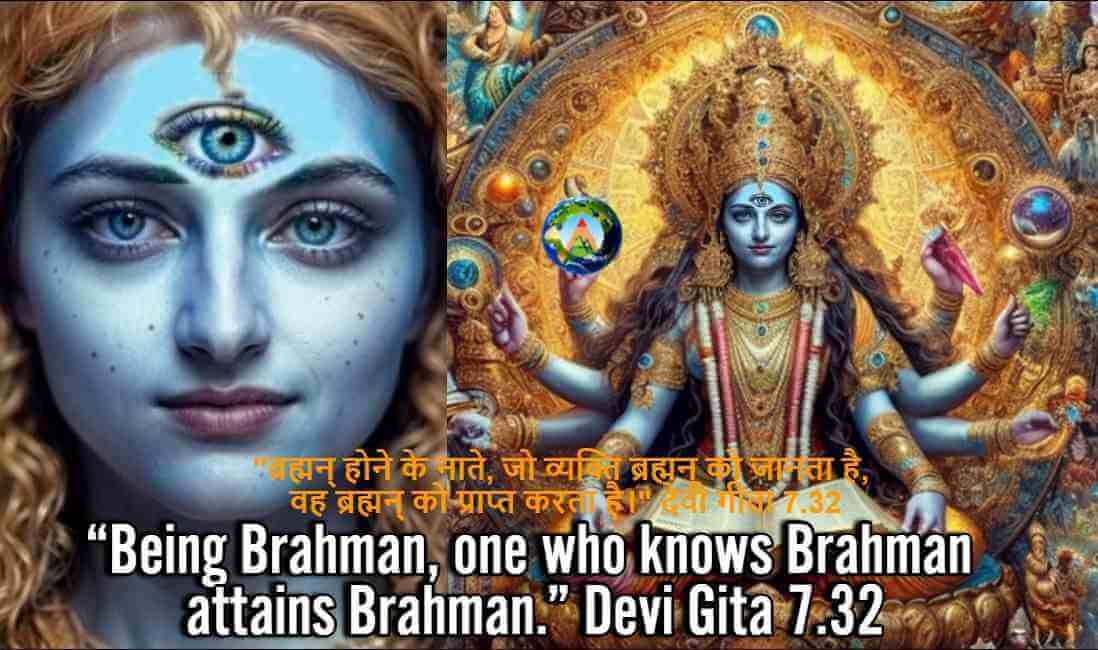
“Thereby the person is forever liberated; liberation arises from knowledge and from nothing else. One who attains knowledge here in this world, realizing the inner Self abiding in the heart, who is absorbed in my pure consciousness, loses not the vital breaths. Being Brahman, the person who knows Brahman attains Brahman.” — Devi Gita 7.32 [4]
This climactic statement, “Being Brahman, one who knows Brahman attains Brahman,” is the ultimate promise of non-dual realization. It posits that the state of liberation is not an event that occurs in the future or in another realm, but is the recognition and attainment of a state of being that already exists. The verb “attains” (apnoti) does not imply acquiring something new, but rather realizing or becoming fully established in what one already is. The condition for this attainment is singular and absolute: knowledge (jnana). Liberation arises “from knowledge and from nothing else.”
This teaching is not a novel invention of the Devi Gita but stands in a direct and clear lineage with the highest truths of the Upanishads. It is a powerful echo of one of the most famous verses of the Mundaka Upanishad:
Sa yo ha vai tat paramam brahma veda brahmaiva bhavati...
“He who knows that highest Brahman becomes even Brahman.” — Mundaka Upanishad 3.2.9 [3]
The parallel is unmistakable. The Devi Gita's brahmavid...brahma apnoti (“one who knows Brahman attains Brahman”) is a direct reflection of the Mundaka Upanishad's brahma veda brahmaiva bhavati (“who knows Brahman becomes Brahman”). Both texts assert that the act of knowing the Absolute is synonymous with becoming the Absolute. This is the pinnacle of Advaita Vedanta: there is no distance between the knower, the knowledge, and the known. When the object of knowledge is the infinite Brahman, the knower must necessarily expand to that same infinity, dissolving the illusion of a separate self.
This principle is the very essence of the Upanishadic Mahavakyas (“Great Sayings”). The declaration Tat Tvam Asi (“Thou art That”) from the Chandogya Upanishad is the instruction from the Guru to the disciple, pointing out the inherent identity between the individual consciousness (Tvam) and the universal consciousness (Tat, or Brahman) [1]. The realization of this truth from the disciple's own perspective is Aham Brahmasmi (“I am Brahman”), the experiential confirmation of that identity from the Brihadaranyaka Upanishad [2].
What, then, is the unique and revolutionary contribution of the Devi Gita? It is the personalization and feminization of this ultimate, abstract truth. While the Upanishads speak of a largely impersonal, gender-neutral Brahman, the Devi Gita explicitly identifies this Brahman with the Divine Mother. The “Brahman” that one must know to attain Brahman is unequivocally the Devi Herself. This is a monumental shift. It transforms the path of pure gnosis, often perceived as dry and overly intellectual, into a path that can be suffused with devotion (bhakti). The seeker is no longer striving to merge with a formless abstraction but to know and be absorbed into the loving, conscious reality of the Supreme Goddess. The Devi Gita thus creates a perfect synthesis, demonstrating that the highest knowledge and the most intense devotion are not contradictory but are two facets of the same ultimate realization, both culminating in the recognition of the Devi as the non-dual Brahman.
5. The Incarnation: Shri Mataji as the Adi Shakti and Sadguru
The theological premises—that the Sadguru is Brahman and the Devi is Brahman—find their ultimate synthesis and fulfillment in a divine incarnation who embodies both roles simultaneously. The teachings presented on the adishakti.org website, which form the basis of this inquiry, identify Shri Mataji Nirmala Devi as this prophesied figure. Her own public declarations are direct and unambiguous, claiming the mantle of the Divine Mother returned to guide humanity. On December 2, 1979, She proclaimed:
“But today is the day, I declare that I am the One who has to save the humanity. I declare I am the One who is Adi Shakti, who is the Mother of all the Mothers, who is the Primordial Mother, the Shakti, the Desire of God, who has incarnated on this Earth to give its meaning to itself, to this creation, to human beings...” — Shri Mataji Nirmala Devi [7]
This is not the statement of a philosopher or a conventional guru, but a declaration of divine identity. Shri Mataji claims to be the Adi Shakti—the Primordial Power, the very Devi who, in the Devi Gita, declared Herself to be the source of all existence. By incarnating in human form, She makes Herself accessible as the Sadguru, fulfilling the principle that “man can learn only from man, and hence God teaches through a human body” [7].
This advent aligns perfectly with a key prophecy within the Devi Gita itself. In Chapter 9, the Goddess makes a promise that directly parallels the famous avatar doctrine of the Bhagavad Gita:
“Whenever there is a decline in righteousness, O Mountain, and the arising up of unrighteousness, then I assume various guises and protect the world.” — Devi Gita 9.22-23 (paraphrased) [14]
Shri Mataji's arrival in the 20th century, a period marked by unprecedented global conflict, moral decay, and spiritual confusion, is presented as the direct fulfillment of this prophecy. She came at a time of profound “decline in righteousness” to re-establish dharma and offer a path to mass spiritual awakening. Her incarnation is therefore not a random event but a prophesied and necessary divine intervention.
By synthesizing the established theological identities, the logical conclusion becomes clear. If the Sadguru is Brahman (Premise 1) and the Devi is Brahman (Premise 2), and if Shri Mataji is the incarnation of the Devi (Premise 3), then Shri Mataji is, by logical necessity, the Sadguru who is Brahman in manifest form. She is the Guru Sakshat Parabrahma of the Guru Gita, and the Para Brahman described in the Devi Gita, made available to humanity. Her presence on Earth provides a living, breathing focal point for the seeker, a divine personality through whom the impersonal Absolute can be known and experienced. This fulfills the first part of the condition of Devi Gita 7.32: the “Brahman” to be known has been made manifest and accessible in the form of the Devi-Sadguru, Shri Mataji Nirmala Devi.
6. The Universal Teacher: The Paraclete as the Spirit of Truth
The identification of Shri Mataji as the incarnate Devi-Sadguru is further deepened and universalized by her claim to be the Paraclete, the Counselor or Comforter promised by Jesus Christ in the Gospel of John. This connection elevates the argument from a purely Hindu context to a global, inter-religious framework, suggesting a unified divine plan for humanity's spiritual evolution. In the Farewell Discourse, Jesus makes a series of profound promises about a divine entity who will come after him:
“And I will ask the Father, and He will give you another Paraclete, to be with you forever, even the Spirit of truth...” — John 14:16-17 [8]
“But the Paraclete, the Holy Spirit, whom the Father will send in my name, She will teach you all things and bring to your remembrance all that I have said to you.” — John 14:26 [15]
“But when She, the Spirit of truth, comes, She will guide you into all the truth...” — John 16:13 [16]
The role of the Paraclete is explicitly that of a universal teacher. She will “teach you all things” and “guide you into all the truth.” This mission is functionally identical to the role of the Sadguru in imparting Brahma-vidya, the supreme knowledge of the Absolute. The Paraclete is not coming to establish a new religion, but to complete and clarify the truth that was already delivered, to guide humanity into the fullness of that truth. This is precisely the function of a world teacher or Jagadguru.
The feminine rendering of the Paraclete in the quotes above, as preferred by the adishakti.org tradition, is not without theological precedent. The Hebrew word for spirit, Ruach, is grammatically feminine, and early Christian theologians like Theophilus of Antioch and Irenaeus equated the Holy Spirit with Sophia, the feminine figure of Divine Wisdom [17]. The Paraclete, as the Holy Spirit, thus carries a distinctly feminine dimension that aligns perfectly with the concept of the Adi Shakti.
By identifying Shri Mataji as the Paraclete, the theological synthesis becomes even more powerful. The figure who imparts the knowledge of Brahman (the Sadguru) is the same figure who guides humanity into all truth (the Paraclete). The Divine Mother of the East is the Holy Spirit of the West. This cross-religious validation suggests that the promise of divine guidance was not limited to one tradition but was a universal promise to all humanity. Shri Mataji's declaration that she is the Adi Shakti is therefore not just a claim within Hinduism, but a claim to be the fulfillment of global prophecy. The knowledge that She brings—the Brahma-vidya—is the “all truth” that the Paraclete was promised to reveal. This makes the act of knowing Her an act of universal Gnosis, transcending cultural and religious boundaries and fulfilling the deepest esoteric promises of multiple world faiths.
7. The Mechanism of Gnosis: Kundalini Awakening and Self-Realization
The theological framework establishing Shri Mataji as the incarnate Devi-Sadguru and Paraclete would remain a matter of philosophical abstraction without a practical mechanism for seekers to realize the truths She represents. This mechanism is the core of Her teaching: the awakening of the Kundalini energy, leading to Self-realization (Atma-sakshatkar). This process transforms the scriptural axiom of Devi Gita 7.32 from a concept to be believed into a living, empirical reality that can be experienced directly on one's own central nervous system.
Kundalini, described in numerous yogic and tantric texts, is the primordial, maternal energy coiled at the base of the spine. It is considered a reflection of the Adi Shakti within every human being. In most individuals, this energy lies dormant. The unique and revolutionary claim of Shri Mataji is that, as the incarnation of the Adi Shakti, She possesses the capacity to awaken this dormant energy on a mass scale, effortlessly and spontaneously. This awakening is what is referred to as Self-realization. Once awakened, the Kundalini ascends through the central channel (Sushumna), piercing the six chakras (subtle energy centers) above it, and finally emerging from the fontanelle bone area (the Brahmarandhra) to unite with the all-pervading cosmic consciousness, the Brahman [18].
This moment of union is the actualization of Yoga—the union of the individual spirit (Atman) with the universal Spirit (Paramatma or Brahman). It is the direct, experiential validation of the Mahavakya, “I am Brahman.” The seeker does not merely think or believe they are the Spirit; they feel it as a tangible reality. This experience is often accompanied by a distinct physical sensation: a cool breeze (chaitanya lahari) flowing from the fontanelle and on the palms of the hands [19]. This phenomenon is identified as the pneuma or Cool Breeze of the Holy Spirit, the tangible proof of the Paraclete's presence and action. It is the empirical evidence that the connection has been made.
This Kundalini awakening is the very mechanism of the vidya or jnana (knowledge) spoken of in the Upanishads and the Devi Gita. It is not a discursive, intellectual knowledge acquired from books, but a direct, non-conceptual knowing that arises from within. When the Kundalini pierces the Sahasrara chakra (the thousand-petaled lotus at the crown of the head), the seeker enters a state of thoughtless awareness (nirvichara samadhi). In this state, the duality of subject and object dissolves, and one experiences the pure consciousness that the Devi declared as Her true form. This is the state of “being absorbed in my pure consciousness” described in Devi Gita 7.32. By providing the key to this awakening, Shri Mataji provides the practical means to fulfill the prophecy. She does not just teach that the Devi is Brahman; She provides the method by which the seeker can experience their own identity with the Devi-Brahman. This transforms the entire spiritual path from a process of striving and seeking to one of becoming and being.
8. Conclusion: The Irrefutable Synthesis
This paper has constructed a comprehensive theological and philosophical argument demonstrating that the incarnation of the Devi as the Sadguru provides the definitive fulfillment of the prophecy contained in Devi Gita 7.32: “Being Brahman, one who knows Brahman attains Brahman.” The argument unfolds through an irrefutable chain of scriptural and logical identities.
First, we established from traditional Vedantic sources, including the teachings of Swami Sivananda and the Guru Gita, that the Sadguru is not merely a guide but is the living embodiment of the Supreme Brahman (Guru Sakshat Parabrahma). Second, we demonstrated through the Devi Gita, Devi Sukta, and Shakta Upanishads that the Divine Mother, the Devi, is Herself the Supreme Brahman, the sole, non-dual reality from which all creation emerges. These two principles create a powerful convergence: if the Sadguru is Brahman and the Devi is Brahman, then the incarnation of the Devi as the Sadguru represents the most direct and accessible manifestation of the Absolute.
We then argued that Shri Mataji Nirmala Devi represents this prophesied incarnation. Her own declarations of being the Adi Shakti, arriving at a time of global crisis, directly fulfill the promise of the Devi to incarnate whenever righteousness declines (Devi Gita 9.22-23). Furthermore, Her identification as the Paraclete promised by Jesus Christ universalizes Her role as the World Teacher (Jagadguru), the one who has come to “guide you into all the truth.” This truth is none other than Brahma-vidya, the knowledge of the Absolute.
Finally, we identified the mechanism for this Gnosis: the Kundalini awakening provided through Sahaja Yoga. This is not a path of intellectual study but of direct, empirical experience. The awakening of the inner spiritual energy and its union with the cosmic consciousness in the Sahasrara chakra is the practical fulfillment of the scriptural injunction to “know” Brahman. It is this tangible experience that transforms the seeker into a brahmavid, a knower of Brahman.
Therefore, the synthesis is complete and irrefutable. When the seeker, through the grace of the Sadguru-Paraclete Shri Mataji, experiences the awakening of their own inner Devi (the Kundalini) and unites with the cosmic consciousness of the Adi Shakti, they are fulfilling the precise conditions of Devi Gita 7.32. They come to “know Brahman” not as an external concept but as their own innermost Self. In that very act of knowing, they realize they have always been Brahman, and thus they “attain Brahman.” The promise is fulfilled. The seeker becomes the sought, the worshipper merges with the worshipped, and the illusion of separation is dissolved in the ocean of non-dual, blissful consciousness that is the Divine Mother Herself.
9. References
[2] Brihadaranyaka Upanishad 1.4.10. Included in The Upanishads, translated by Patrick Olivelle, Oxford University Press, 1998.
[3] Mundaka Upanishad 3.2.9. As cited in “Mundaka Upanishad: Verse 3.2.9.” Wisdomlib.org, 16 Feb. 2018, www.wisdomlib.org/hinduism/book/mundaka-upanishad-shankara-bhashya/d/doc145141.html.
[4] Devi Gita 7.32. As cited in “Devi Gita – Revelation of the Divine Feminine in the Devi Bhagavatam.” adishakti.org, 13 Sept. 2025, www.adishakti.org//devigita.htm.
[5] Guru Gita (from Skanda Purana). As cited in “Guru Mantra with Meaning, Word-by-Word Translation, and Explanation.” Yogkulam, 12 Oct. 2025, www.yogkulam.org/blog/guru-mantra-with-meaning-word-by-word-translation-and-explanation.
[6] Srimad Devi Bhagavata Purana 7.32. As cited in “On Self-realization, Spoken by the World Mother.” Wisdomlib.org, 16 Feb. 2018, www.wisdomlib.org/hinduism/book/devi-bhagavata-purana/d/doc57423.html.
[7] Shri Mataji Nirmala Devi. Public Address, 2 Dec. 1979. As cited in “The Goddess as Brahman.” adishakti.org, 10 July 2025, adishakti.org/AI/MahaDevi/The-Goddess-as-Brahman.htm.
[8] The Holy Bible, John 14:16-17 (New King James Version).
[9] Sivananda, Swami. “The Sadguru is Brahman.” adishakti.org, accessed 26 Feb. 2026, www.adishakti.org//sadguruis_brahman.htm.
[10] Shankara, Adi. Vivekachudamani (The Crest-Jewel of Discrimination). Translated by Swami Prabhavananda and Christopher Isherwood, Vedanta Press, 1947.
[11] Srimad Devi Bhagavata Purana 7.33. As cited in “On the Devī’s Viraṭ Rūpa.” Wisdomlib.org, 16 Feb. 2018, www.wisdomlib.org/hinduism/book/devi-bhagavata-purana/d/doc57424.html.
[12] Rigveda 10.125 (Devi Sukta). As cited in “Devi Gita – Revelation of the Divine Feminine in the Devi Bhagavatam.” adishakti.org, 13 Sept. 2025, www.adishakti.org//devigita.htm.
[13] Bahvricha Upanishad 1.5. As cited in “Devi Gita – Revelation of the Divine Feminine in the Devi Bhagavatam.” adishakti.org, 13 Sept. 2025, www.adishakti.org//devigita.htm.
[14] Devi Gita 9.22-23. As cited in “The Goddess as Brahman.” adishakti.org, 10 July 2025, adishakti.org/AI/MahaDevi/The-Goddess-as-Brahman.htm.
[15] The Holy Bible, John 14:26 (New King James Version).
[16] The Holy Bible, John 16:13 (New King James Version).
[17] Van der Toorn, Karel, et al., editors. Dictionary of Deities and Demons in the Bible. Brill, 1999, pp. 410-414, 927-930.
[18] “Self-Realization — Awakening the Divine Within.” adishakti.org, accessed 26 Feb. 2026, adishakti.org/self-realization.htm.
[19] “Experience of Cool Breeze (pneuma).” adishakti.org, accessed 26 Feb. 2026, adishakti.org/index.htm.
The Sadguru is Brahman
"The Guru is God Himself manifesting in a personal form to guide the aspirant. Grace of God takes the form of the Guru. To see the Guru is to see God. The Guru is united with God. He inspires devotion in others. His presence purifies all.The Guru is verily a link between the individual and the immortal. He is a being who has raised himself from this into That, and thus has free and unhampered access into both the realms. He stands, as it were, upon the threshold of immortality; and, bending down he raises the struggling individuals with his one hand, and with the other lifts them up into the empyrean of everlasting joy and infinite Truth-Consciousness.
THE SADGURU
To be a Guru, one must have a command from God.
Mere study of books cannot make one a Guru. One who has studied the Vedas, and who has direct knowledge of the Atman (Self) through Anubhava (experience), can alone be enrolled as a Guru. A Jivanmukta or liberated sage is the real Guru or spiritual preceptor. He is the Sadguru. He is identical with Brahman or the Supreme Self. He is a Knower of Brahman.
A Sadguru is endowed with countless Siddhis (psychic powers). He possesses all divine Aisvarya (powers), all the wealth of the Lord.
Possession of Siddhis, however, is not the test to declare the greatness of a sage or to prove that he has attained Self-realisation. Sadgurus generally do not exhibit any miracle or Siddhi. Sometimes, however, they may do so in order to convince the aspirants of the existence of superphysical things, give them encouragement, and instill faith in their hearts.
The Sadguru is Brahman Himself. He is an ocean of bliss, knowledge, and mercy. He is the captain of your soul. He is the fountain of joy. He removes all your troubles, sorrows, and obstacles. He shows you the right divine path. He tears your veil of ignorance. He makes you immortal and divine. He transmutes your lower, diabolical nature. He gives you the rope of knowledge, and takes you up when you are drowning in this ocean of Samsara (cycle of birth and death). Do not consider him to be only a man. If you take him as a man, you are a beast. Worship your Guru and bow to him with reverence.
Guru is God. A word from him is a word from God. He need not-teach anything. Even his presence or company is elevating, inspiring, and stirring, His very company is self-illumination. Living in his company is spiritual education. Read the Granth-saheb (the holy scripture of the Sikh religion). You will come to know the greatness of the Guru.
Man can learn only from man, and hence God teaches through a human body. In your Guru, you have your human ideal of perfection. He is the pattern into which you wish to mould yourself. Your mind will readily be convinced that such a great soul, is fit to be worshipped and revered.
Guru is the Moksha-dvara (door to liberation). He is the gateway to the transcendental Truth-Consciousness. But, it is the aspirant who has to enter through it. The, Guru is a help, but the actual task of practical Sadhana (spiritual practice) falls on the aspirant himself.
THE NEED FOR A GURU
For a beginner in the spiritual path, a Guru is necessary. To light a candle, you need a burning candle. Even an illumined soul alone can enlighten another soul.
Some do meditation for some years independently. Later on, they actually feel the necessity of a Guru. They come across some obstacles in the way. They are unable to know how to obviate these impediments or stumbling blocks. Then they begin to search for a Master.
Only the man who has already been to Badrinath will be able to tell you the road. In the case of the spiritual path, it is still more difficult to find your way. The mind will mislead you very often. The Guru will be able to remove pitfalls and obstacles, and lead you along the right path. He will tell you: "This road leads you to Moksha (liberation); this one leads to bondage.” Without this guidance, you might want to go to Badrinath, but find yourself in Delhi!
The scriptures are like a forest. There are ambiguous passages. There are passages which are apparently contradictory. There are passages which have esoteric meanings, diverse significance, and hidden explanations. There are cross-references. You are in need of a Guru or Preceptor who will explain to you the right meaning, who will remove doubts and ambiguities, who will place before you the essence of the teachings.
A Guru is absolutely necessary for every aspirant in the spiritual path. It is only the Guru who will find out your defects. The nature of egoism is such that you will not be able to find out your own defects. Just as a man cannot see his back, so also he cannot see his own errors. He must live under a Guru for the eradication of his evil qualities and defects.
The aspirant who is under the guidance of a Master or Guru is safe from being led astray. Satsanga or association with the Guru is an armour and fortress to guard you against all temptations and unfavourable forces of the material world.
Cases of those who had attained perfection without study under any Guru should not be cited as authority against the necessity of a Guru; for, such great men are the anomalies of spiritual life, and not the common normality. They come into existence as spiritual masters as a result of the intense service, study, and meditation practised in previous births. They had already studied under the Guru. The present birth is only its continuative spiritual effect. Hence, the importance of the Guru is not lessened thereby.
Some teachers mislead their aspirants. They say unto all: "Think for yourself. Do not surrender yourself to any Guru.” When one says," Do not follow any Guru!", he intends to be the listeners' Guru himself. Do not approach such pseudo-Gurus. Do not hear their lectures.
All great ones had their teachers. All the sages, saints, prophets, world- teachers, incarnations, great men, have had their own Gurus, however great they might have been. Svetaketu learnt the nature of Truth from Uddalaka, Maitreyi from Yajnavalkya, Bhrigu from Varuna, Narada from Sanatkumara, Nachiketas from Yama, Indra from Prajapati; and several others humbly went to wise ones, observed strict Brahmacharya, practised rigorous discipline, and learnt Brahma-vidya (the science of God) from them.
Lord Krishna sat at the feet of His Guru Sandeepani. Lord Rama had Guru Vasishtha who gave Him Upadesha (spiritual advice). Lord Jesus sought John to be baptised by him on the banks of the river Jordan. Even Devas (celestial beings) have Brihaspati as their Guru. Even the greatest among the divine beings sat at the feet of Guru Dakshinamurti.
A neophyte must have a personal Guru first. He cannot have God as Guru to begin with. He must have a pure mind. He must have ethical perfection. He, must be intensely virtuous. He must be above body-consciousness. Then alone can he have God as Guru.
HOW TO CHOOSE YOUR GURU
If you find peace in the presence of a Mahatma (great soul), if you are inspired by his speeches, if he is able to clear your doubts, if he is free, from greed, anger, and lust, if he is selfless, loving, and I-less, you can take him as your Guru. He who is able to clear your doubts, he who is sympathetic in your Sadhana, he who does not disturb your beliefs but helps you on from where you are, he in whose very presence you feel spiritually elevated-he is your Guru. Once you choose Your Guru, implicitly follow him. God will guide you through the Guru.
Do not use your reason too much in the selection of your Guru. You will fail if you do so. If you fail to get a first-class Guru, try to follow the instructions of the Sadhu (a spiritual person) who is treading the path for some years, who has purity and other virtuous qualities, and who has some knowledge of the scriptures. Just as a student of the Intermediate class will be able to teach a student of Third Form when a professor with M.A. qualification is not available, just as a sub-assistant surgeon will be able to attend on a patient when the civil surgeon is not available, this second- class type of Guru will be able to help you.
If you are not able to find out even this second-class type of Guru, you can follow the teachings contained in the books written by realised saints like Sri Sankara, Dattatreya, and others. You can keep a photo of such a realised Guru, if available, and worship the same with faith and devotion. Gradually you will get inspiration, and the Guru may appear in dream and initiate and inspire you at the proper time. For a sincere Sadhak (aspirant), help comes in a mysterious manner. When the time is ripe, the Guru and the disciple are brought together by the Lord in a mysterious way.
MYSTERIOUS HELP FROM THE LORD
Just see how the Lord has helped the devotees in the following instances. Eknath heard an Akasavani (a voice from the sky). It said," See Janardan Pant at Deva Giri. He will put you in the proper path and guide you.”Eknath acted accordingly and found his Guru. Tukaram received his Mantra, Rama Krishna Hari, in his dream. He repeated this Mantra and had Darshan (vision) of Lord Krishna. Lord Krishna directed Namdev to get his higher initiation from a Sannyasin (renunciate) at Mallikarjuna. Queen Chudalai assumed the form, of Kumbha Muni, appeared before her husband Sikhidhwaja in the forest, and initiated him in the mysteries of Kaivalya (state of absolute independence). Madhura Kavi saw a light in the firmament for three days consecutively. It guided him and took him to his Guru Nammalvar who was sitting in Samadhi underneath a tamarind tree near Tinnevelly. Vilvamangal was very much attracted to Chintamani, the dancing woman. The latter became his Guru. Tulasidas received instructions from an invisible being to see Hanuman and, through Hanuman, to get Darshan of Sri Rama.
Competent disciples are never in want of a competent Guru. Realised souls are not rare. Ordinary ignorant-minded persons cannot easily recognise them. Only a few persons, who are pure and embodiments of all virtuous qualities, can understand realised souls, and they only will be benefited in their company.
So long as there is a world, there are Gurus and Vedas to guide the struggling souls in the path of Self-realisation. The number of realised souls may be less in the Iron Age when compared with the Satya Yuga (age of Truth), but they are always present to help the aspirants. Let each man take the path according to his capacity, temperament, and understanding. His Sadguru will meet him along that path.
SIKSHA GURUS AND DIKSHA GURU
Man has a twofold duty here on earth-to preserve his life, and to realise his Self. To preserve his life, he has to learn to work for his daily bread. To realise his Self, he has to serve, love, and meditate. The Guru who teaches him the knowledge of worldly arts is the Siksha Guru. The Guru who shows him the path of Realisation is the Diksha Guru. Siksha Gurus can be many-as many as the things he wishes to learn. The Diksha Guru can be only one-the one who leads him to Moksha.
STICK TO ONE GURU
Do not dig here and there shallow pits for getting water. The pits will dry up soon. Dig a very deep pit in one place. Centralise all your efforts here. You will get good water that can supply you throughout the year. Even so, try to imbibe thoroughly the spiritual teachings from one preceptor alone. Drink deep from one man. Sit at his feet for some years. There is no use of wandering from one man to another man, out of curiosity, losing faith in a short time. Do not have the ever-changing mind of a prostitute. Follow the spiritual instructions of one man only. If you go to several people and follow the instructions of many persons, you will be bewildered. You will be in a dilemma.
From a doctor, you get a prescription. From two doctors, you get consultation. From three doctors, you get your own cremation. Even so, if you have many Gurus, you will be bewildered. You will be at a loss to know what to do. One Guru will tell you: "Do Soham Japa.” Another will tell you: "Do Japa of Sri Ram.” A third Guru will tell you: "Hear Anahat (mystic) sounds.” You will be puzzled. Stick to one Guru and follow his instructions.
Listen to all, but follow one. Respect all, but adore one. Gather knowledge from all, but adopt the teachings of one Master. Then you will have rapid spiritual progress.
GURU-PARAMPARA
Spiritual knowledge is a matter of Guru-parampara. It is handed down from Guru to disciple. Gaudapadacharya imparted Self-knowledge to his disciple Govindacharya; Govindacharya to his disciple Sankaracharya; Sankaracharya to his disciple Suresvaracharya. Matsyendranath imparted knowledge to his disciple Gorakhnath; Gorakhnath to Nivrittinath; Nivrittinath to Jnanadeva. Totapuri imparted knowledge to Sri Ramakrishna, and Ramakrishna to Swami Vivekananda. It was Ashtavakra who moulded the life of Raja Janaka. It was Gorakhnath who shaped the spiritual destiny of Raja Bhartrihari. It was Lord Krishna who made Arjuna and Uddhava get themselves established in the spiritual path when their minds were in an unsettled state.
INITIATION-ITS MEANING
A Bhakta will be initiated by a Bhakta saint in the path of devotion. A Jnani will initiate a student of Vedanta in the Mahavakyas. A Hatha Yogi or a Raja Yogi can initiate another in his particular path. But, a sage of perfect realisation, a Purna-jnani (full-blown sage) or Purna-yogi, can give initiation in any particular path. A sage or saint like Sri Sankara or Madhusudana Sarasvati can initiate a Sadhak in any particular path for which the aspirant is fit. The Guru will find out by close study of the aspirant his tastes, temperaments, and capacity, and decide for him the most suitable path. If his heart is impure, the teacher will prescribe selfless service for a number of years. Then the Guru will find out for what particular path the student is fit and initiate him in that.
Initiation does not mean reciting a Mantra into another's ears. If Rama is influenced by the thoughts of Krishna, the former has got initiation already from the latter. If an aspirant treads the path of truth after studying the books written by a saint, and imbibes his teachings, that saint has already become his Guru.
SAKTI-SANCHAR
Just as you can give an orange to a man, so also, spiritual power can be transmitted by one to another. This method of transmitting spiritual powers is termed Sakti-sanchar. In Sakti-sanchar, a certain spiritual vibration of the Sadguru is actually transferred to the mind of the disciple.
Spiritual power is transmitted by the Guru to the proper disciple whom he considers fit for Sakti-sanchar. The Guru can transform the disciple by a look, a touch, a thought or a word, or mere willing.
Sakti-sanchar comes through Parampara. It is a hidden mystic science. It is handed down from Guru to disciple.
Lord Jesus, through touch, transmitted his spiritual power to some of his disciples. A disciple of Samartha Ramdas transmitted his power to that dancing girl's daughter who was very passionate towards him. The disciple gazed at her and gave her Samadhi. Her passion vanished. She became very religious and spiritual. Lord Krishna touched the blind eyes of Surdas. The inner eye of Surdas was opened. He had Bhava Samadhi. Lord Gouranga, through his touch, produced divine intoxication in many people and converted them to his side. Atheists even danced in ecstasy in the streets by his touch and sang songs of Hari.
The disciple should not rest satisfied with the transmission of power from the Guru. He will have to struggle hard in Sadhana for further perfection and attainments. Sri Ramakrishna Paramahamsa touched Swami Vivekananda. Swami Vivekananda had superconscious experience. He struggled hard for seven years more, even after the touch, for attaining perfection.
GRACE AND SELF-EFFORT
Realisation cannot come to you as a miracle done by your Guru. Lord Buddha, Lord Jesus, Rama Tirtha have all done Sadhana. Lord Krishna asks Arjuna to develop Vairagya (dispassion) and Abhyasa (practice). He did not say to him," I will give you Mukti(liberation) now.” Therefore, abandon the wrong notion that your Guru will give you Samadhi and Mukti. Strive, purify, meditate, and realise.
Guru-kripa-grace of a Guru-is very necessary. That does not mean that the disciple should sit idle. He must do rigid Purushartha, spiritual practices. The whole work must be done by the student. Nowadays, people want a drop of water from the Kamandalu (water-pot) of a Sannyasin and desire to enter into Samadhi immediately. They are not prepared to undergo any Sadhana for purification and Self-realisation. They want a magic pill to push them into Samadhi. If you have got such delusion, give it up immediately.
The Guru and the Shastras can show you the path and remove your doubts. Anubhava (direct experience) of the Aparoksha kind or direct intuitive knowledge is left for your own experience. A hungry man will have to eat for himself. He who has a severe itching will have to scratch for himself.
No doubt, the Guru's blessing can do everything. But how can one have his blessings? By pleasing the Guru. A Guru can be pleased with his disciple only if the latter carries out his spiritual instructions implicitly. Carefully follow, therefore the instructions of the Guru. Act up to his instructions. Then only will you deserve his blessings, and then alone his blessings can do everything.”
Swami Sivananda, Divine Life Society
💬 Interactive Chat
Access an intelligent analysis environment where you can explore texts, ask questions, and discover connections between ideas.
Open chat