Krishna as the Male Form of the Devi: An Exploration of Shaktism and the Triumph of the MahaDevi as Brahman

Shakta scriptures reveal Krishna as a male manifestation of the Devi—affirming the Divine Mother as the Supreme Brahman. The Lalita Sahasranama names Her Govindarupini and Visnurupini, while the Devi Bhagavata Purana describes Krishna’s form as created by the formless Goddess for Her devotees. Tantric and Puranic texts echo this revelation, portraying Krishna as the male lila of Lalita Tripurasundari. Even Vishnu is declared Her form, and Krishna’s bija mantra “Klim” resonates with Kali’s “Krim.” This synthesis of divine gender dissolves patriarchal boundaries and elevates the MahaDevi as the non-dual reality behind all forms. Krishna, in this light, becomes Her radiant play—Her compassionate descent into the hearts of seekers.

Introduction

In the rich and diverse tapestry of Hindu theology, the concept of the Divine Feminine, or Shakti, holds a position of profound significance. Within the Shakta traditions, the Goddess, in her various forms, is revered not merely as a consort to a male deity, but as the ultimate reality, the Supreme Brahman, from which all existence emanates. This paper will explore a fascinating and often overlooked aspect of Shakta theology: the conception of the popular deity Krishna as a male manifestation of the Devi, the Great Goddess (MahaDevi). This exploration will demonstrate that even a deity as central to Vaishnavism as Krishna can be understood, within a Shakta framework, as a form assumed by the all-encompassing Goddess. This understanding underscores the triumph of the MahaDevi as the ultimate, non-dual reality, Brahman itself.

The primary textual evidence for this interpretation comes from sources such as the Lalita Sahasranama, the Devi Bhagavata Purana, and other Puranic and Tantric texts. These scriptures contain verses that explicitly identify Krishna with the Goddess, or describe him as a form she assumes for the benefit of her devotees. By examining these verses in their theological context, we can gain a deeper appreciation for the fluidity of divine gender in Hinduism and the all-encompassing nature of the Divine Mother in Shaktism.

The Lalita Sahasranama: Govindarupini and Visnurupini

The Lalita Sahasranama, a key text in the worship of the Goddess Lalita Tripurasundari, provides direct evidence for the identification of the Devi with male deities, including Vishnu and his avatar, Krishna. Two names in this sacred hymn are particularly significant in this regard: Govindarupini (267) and Visnurupini (893).

267. In the form of Govinda (Govindarupini.)

In the Harivamsa, Narada says," The first portion of prakrti, the famous Devi called Uma. [The second one] the manifested Visnu, the All-Pervading, Protector of the Universe, is known as woman.”[1]

This verse explicitly states that the Devi has the form of Govinda, a popular name for Krishna. The commentary by R. A. Sastry further elucidates this by referencing the Harivamsa, where Vishnu, the protector of the universe, is described as the female manifestation of prakrti. This interchangeability of divine gender highlights the non-dual nature of the ultimate reality, where the Goddess can manifest as the male protector deity.

893. In the form of Visnu (Visnurupini.)

In the Brahma Purana, in the Lalitapakhyana, Devi says," My male form is bewildering the milk-maids.”In the same place Visnu says to Virabhadra," The ancient Sakti of the Lord is divided into four forms, that Sakti becomes Bhavani in its ordinary form [bhoga], in battle she takes the form of Durga; in anger that of Kali; and she is also my male form.”

The Kurma Purana when Himavin praises Devi says," I salute thy form called Narayana, O Lalita, which has a thousand heads, which is of infinite energy, having a thousand arms, the ancient Person, reclining on the waters.”

In the Kurma Purana when Siva showed his universal form to Mankanaka, the latter said: "What is this terrible form of thine, facing every side; who is she shining by your side?”Thus questioned, Siva, after explaining the glory of his own nature, says," She is my supreme maya and prakrti of triple qualities. She is said by munis to be the ancient womb of the universe.” [2]

The name Visnurupini further solidifies this concept. The commentary on this name provides a wealth of scriptural support. The Devi herself, in the Lalitapakhyana of the Brahma Purana, declares that her male form is "bewildering the milk-maids," a clear allusion to Krishna's pastimes. Vishnu also affirms that the ancient Sakti is his male form. The praise of Himavin in the Kurma Purana identifies Lalita with the cosmic form of Narayana (Vishnu), and Siva reveals that the Goddess is his "supreme maya and prakrti," the very womb of the universe. These verses collectively demonstrate that from a Shakta perspective, the male deities, including Vishnu and by extension Krishna, are ultimately forms of the Devi.

The Devi Bhagavata Purana: The Goddess as the Source of All Forms

The Devi Bhagavata Purana, a foundational text of Shaktism, provides a comprehensive theological framework for understanding the Devi as the Supreme Brahman. This text is explicit in its assertion that the Goddess is the origin of all things, including the other gods. The 9th Canto of this Purana is particularly relevant to our discussion, as it describes Krishna as a direct manifestation of the Devi.

Specifically, Chapter 38, verses 29-31, detail the creation of Krishna's form by the Goddess:

रप विभरतयरपा च भकतानगरहहतव ॥
गोपालसनदरीरप परथम सा ससरज ह ।
अतीव कमनीय च सनदर समनोहरम ॥
नवीननीरदशयाम किशोर गोपवषकम ।
कदरपकोटिलावणय लीलाधाम मनोहरम ॥

Translation:
"Though formless, She assumes forms for the gratification of the desires of Her Bhaktas. She created first the beautiful form of Gopala Sundari (Krishna) very lovely and beautiful, captivating the mind. His body is blue like the fresh rain cloud. He is young and dressed like that of a cowherd."[3]

This passage is a powerful statement of the Goddess's supreme power and compassion. It asserts that she, though ultimately formless (arupa), takes on forms (rupa) for the sake of her devotees (bhaktas). The first form she creates is that of "Gopala Sundari," a name that combines the pastoral charm of Krishna (Gopala) with the divine beauty of the Goddess (Sundari). The description of this form perfectly matches the iconic imagery of Krishna. This verse leaves no doubt that, according to the Devi Bhagavata Purana, Krishna is a form willed into existence by the Devi.

This interpretation is further supported by the broader context of the Purana, which consistently elevates the Devi above all other deities. For example, in the same text, the Goddess is described as the source of the Trimurti (Brahma, Vishnu, and Shiva). Therefore, the manifestation of Krishna as a form of the Devi is a logical extension of this core theological principle. The Goddess is not merely a consort or a subordinate deity; she is the ultimate reality, and all other divine forms, including Krishna, are expressions of her divine play (lila).

Supporting Verses from Other Texts

The identification of Krishna as a form of the Devi is not limited to the Lalita Sahasranama and the Devi Bhagavata Purana. Other texts within the Puranic and Tantric traditions also support this view, further illustrating the widespread nature of this Shakta interpretation.

The Padma Purana and the Narada Purana, for instance, both contain passages that explicitly state that Krishna is a male form of the goddess Lalita Tripurasundari. The "Patala Khanda" of the Padma Purana is particularly noteworthy in this regard. Similarly, the Tantraraja Tantra, a significant text in the Shakta tradition, describes how the goddess Lalita assumed a male form as Krishna. [4]

The Rudra Hridaya Upanishad provides another layer of support with the verse, "yaa umaa saa svayan vishnuh," which translates to "Uma Herself is the form of Vishnu."[4] Since Krishna is an avatar of Vishnu, this verse implicitly identifies Krishna with Uma (a form of the Devi). This is further reinforced by Swami Vivekananda's commentary, where he states, "A bit of Mother, a drop, was Krishna; another was Buddha."[5]

Furthermore, the esoteric connection between Krishna and the Goddess is hinted at in their respective bija mantras (seed sounds). Krishna's bija mantra is "Klim," which is closely related to the bija mantra of Kali, "Krim." This phonetic similarity suggests a deep, underlying unity between the two deities.

These examples from a range of texts demonstrate that the concept of Krishna as a male form of the Devi is a consistent and recurring theme within Shakta theology. This is not a fringe or isolated belief, but a well-supported theological position that underscores the all-encompassing nature of the Divine Mother.

Conclusion: The Triumph of the MahaDevi as Brahman

The evidence presented from the Lalita Sahasranama, the Devi Bhagavata Purana, and other Puranic and Tantric texts compellingly demonstrates that within the Shakta theological framework, Krishna is understood as a male manifestation of the Devi. This is not to diminish the significance of Krishna, but rather to elevate the Devi to her rightful position as the Supreme Brahman, the ultimate source of all divine forms. The names Govindarupini and Visnurupini in the Lalita Sahasranama, the explicit creation of Krishna's form by the Goddess in the Devi Bhagavata Purana, and the corroborating verses from other scriptures all point to a consistent and coherent theological understanding.

This interpretation challenges the often-patriarchal assumptions that can dominate interpretations of Hindu traditions. It reveals a theological perspective where the Divine Feminine is not subordinate to the masculine, but is, in fact, the origin and ground of all being. The Goddess is both formless and capable of assuming all forms, both male and female. Her assumption of the form of Krishna is a testament to her divine play (lila) and her compassionate desire to engage with her devotees in the forms they find most appealing.

Ultimately, the conception of Krishna as a male form of the Devi is a powerful affirmation of the triumph of the MahaDevi as Brahman. It demonstrates that in Shaktism, the Goddess is not one deity among many, but the one, non-dual reality that encompasses all of existence. She is the beginning, the middle, and the end, and all the gods and goddesses are but sparks of her divine effulgence. The worship of Krishna, from this perspective, becomes another path to the worship of the Divine Mother, the ultimate source and goal of all spiritual paths.

References

[1] Sastry, R. A. Lalita-Sahasranama. The Adyar Library and Research Centre, 1988, p. 145.
[2] Sastry, R. A. Lalita-Sahasranama. The Adyar Library and Research Centre, 1988, p. 338.
[3] "Devi Bhagavata Purana." Wikipedia, Wikimedia Foundation, 20 Sept. 2025.
[4] "The Shakta interpretation of Lord Krishna." r/hinduism, Reddit, 2023.
[5] Vivekananda, Swami. Inspired Talks, My Master and Other Writings. Ramakrishna-Vivekananda Center, 1958, pp. 48-49.

In the Brahma Purana, in the Lalitapakhyana, Devi says," My male form (Shri Krishna) is bewildering the milk-maids.”

"The Saktas worship the Universal Energy as Mother; it is the sweetest name they know. The Mother is the highest ideal of womanhood in India. [...]

Mother is the first manifestation of power and is considered a higher idea than father. The name of mother brings the idea of Shakti, Divine energy and omnipotence. The baby believes its mother to be all-powerful, able to do anything. The Divine Mother is the Kundalini sleeping in us; without worshipping Her, we can never know ourselves. All merciful, all-powerful, omnipresent - these are attributes of the Divine Mother. She is the sum total of the energy in the Universe.

Every manifestation of power in the universe is Mother. She is Life, She is Intelligence, She is Love. She is in the universe, yet separate from it. She is a person, and can be seen and known - as Sri Ramakrishna saw and knew Her. Established in the idea of Mother, we can do anything. She quickly answers prayers.

She can show Herself to us in any form at any moment. The Divine Mother can have form (rupa) and name (nama), or name without form; and as we worship Her in these various aspects, we can rise to Pure Being, having neither form nor name.

The sum-total of all the cells in an organism is one person. Each soul is like one cell, and the sum of them is God. And beyond that is the Absolute. The sea calm is the Absolute; the same sea in waves is the Divine Mother. She is time, space and causation. Mother is the same as Brahman and has two natures; the conditioned and the unconditioned. As the former, She is God, nature and soul. As the latter, she is unknown and unknowable. Out of the Unconditioned came the trinity, God, nature and soul - the triangle of existence.

A bit of Mother, a drop, was Krishna; another was Buddha. The worship of even one spark of Mother in our earthly mother leads to greatness. Worship Her if you want love and wisdom.”

Swami Vivekananda, "Inspired Talks, My Master and Other Writings",
Wednesday, July 2,1895, Ramakrishna-Vivekananda Center, NY, pp. 48-49.


"267. In the form of Govinda (Govindarupini.)

In the Harivamsa, Narada says," The first portion of prakrti, the famous Devi called Uma. [The second one] the manifested Visnu, the All-Pervading, Protector of the Universe, is known as woman.”

R. A. Sastry, Lalita-Sahasranama
The Adyar Library and Research Centre, Madras, 1988, p. 145.


"893. In the form of Visnu (Visnurupini.)

In the Brahma Pr., in the Lalitapakhyana, Devi says," My male form is bewildering the milk-maids.”In the same place Visnu says to Virabhadra," The ancient Sakti of the Lord is divided into four forms, that Sakti becomes Bhavani in its ordinary form [bhoga], in battle she takes the form of Durga; in anger that of Kali; and she is also my male form.”

The Kurma Pr. when Himavin praises Devi says," I salute thy form called Narayana, O Lalita, which has a thousand heads, which is of infinite energy, having a thousand arms, the ancient Person, reclining on the waters.”

In the Kurma Pr. when Siva showed his universal form to Mankanaka, the latter said: "What is this terrible form of thine, facing every side; who is she shining by your side?”Thus questioned, Siva, after explaining the glory of his own nature, says," She is my supreme maya and prakrti of triple qualities. She is said by munis to be the ancient womb of the universe.” "

R. A. Sastry, Lalita-Sahasranama
The Adyar Library and Research Centre, Madras, 1988, p. 338.


"No other person is our Mother except God. You see, our biological mother is a mother only for a short time, in this life. Who was with us in the past life, and in the life before that, and in the one before that, always with us, who was there? God. The Observer in us, the highest Self in us. It was always there with us. This is our true Mother. This Mother accompanies us, life after life. Divine Mother and Lord Krishna are one and the same. Therefore in the Sahasranama, the Thousand Names of the Divine Mother, one name is Govinda-Rupini. What does that mean? Govinda is a name of Krishna. Divine Mother is in the form of Krishna. She Herself is Krishna. Divine Mother is infinite Sweetness, infinite Love, infinite Beauty, absolute Beauty, eternal Beauty, ever-new Beauty. Om Govinda- rupinyai namah.”

Swami Omkarananda, www.sanskrit.bhaarat.com/


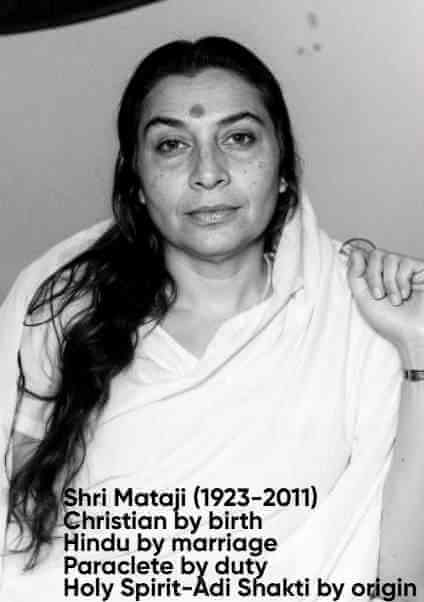
"Innumerable people have had visions about HH Mataji. A little group of London Sahaja Yogis were meditating in front of HH Mataji. Suddenly one of us left the room. When we asked him why, later on, he said he had been aware of thousands of white-clad beings around us and that he had been scared by their might.

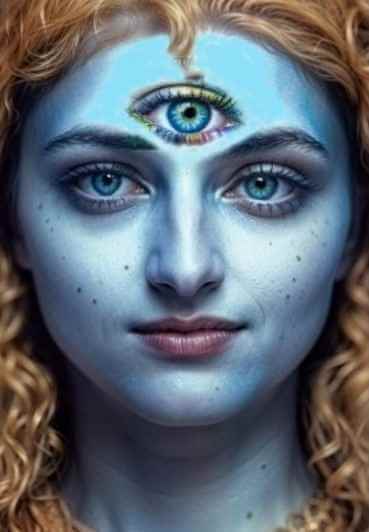
In Buenos-Aires a lady who had no knowledge of the Indian mythology began describing Shri Laxshmi in the Vaikuntha stage, lost in ecstasy in front of HH Mataji. March 1976: HH Mataji is sitting in my garden in Kathmandu, gazing toward the sky. I am sitting nearby. I am looking at Her. Suddenly the lines around HH Mataji are melting away. I realise that all the lines are dissolving and only one presence remains which imposes itself onto my attention; my gaze abandons the vanishing garden and again I look at HH Mataji. And I see the figure of a man or rather, of a God, a face of unsurpassable greatness, light blue in complexion, radiating with a beauty and majesty for which there is no name. I am bewildered, adoring, subjugated. Yes, it is You, I have already seen You, I remember this Godhead... and then I bend towards the ground because I feel my eyes are not pure enough to look at Him. When I look at Her again, everything is normal. I tell Her what happened. She says simply: "It was Shri Krishna.” "

Grégoire de Kalbermatten, The Advent


“So Shri Krishna has said that: "Sarva dharmanam....” He has said that "Give up all your dharmas and surrender them to Me, surrender to my dharma only.” So the dharmas we have in our country as we say is a "pitra dharma", what you owe to your father, "matru dharma" what you owe to your mother, then what you owe to your husband, like that, you see, that relationship in which you owe to them. But when He says "surrender all these dharmas", He is meaning to say "you should only know what you owe to Me" meaning the Divinity.

Now Shri Krishna is not there, it's Me who is Shri Krishna. So you must know what you owe to Me. I only changed My language. He used to take out His finger and to say that "give up everything and surrender everything to Me.” I don't do that way, I give a big lecture and bring you to a point.”

Sri Govindarupini Devi
Vienna, Austria, Sept. 4, 1983

(Govindarupini [276th]: Of the form of Govinda or Visnu. The second of the powers of Prakrti as woman is Visnu according to Narada in Harivamsa.)