
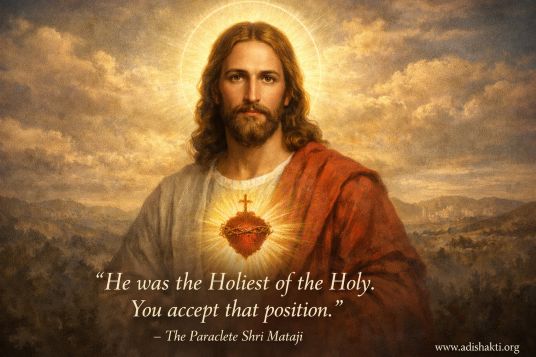
He was the Holiest of the Holy. You accept that position.
Shri Mataji
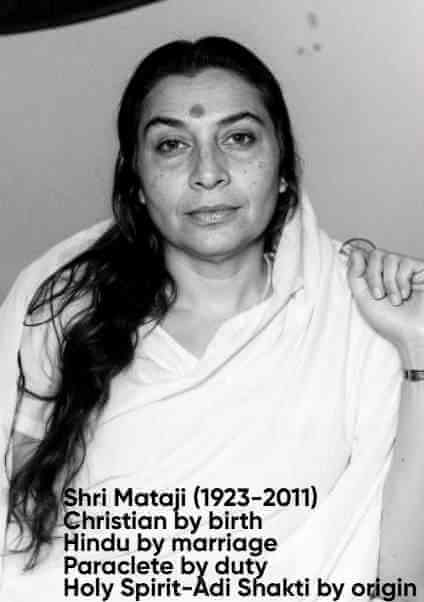
In the theological framework presented by Shri Mataji Nirmala Devi, the advent of the Comforter inaugurates the age of mass spiritual realization, the ultimate fulfillment of the promise made by the "Holiest of the Holy." Her teachings are not a departure from Christ but a profound and radical return to the esoteric core of his message. By revealing herself as the Divine Mother, the Holy Spirit, she provides the missing key—the nurturing, life-giving power necessary to awaken the Spirit within humanity and make the Kingdom of God a tangible reality. The declaration that Jesus is "the Holiest of the Holy" is thus magnified, not diminished, by the revelation of the Divine Feminine. The Comforter's work is to glorify the Son by allowing every human being to experience, directly and personally, the spiritual rebirth he proclaimed. In this age, the urgent need for research into the Divine Feminine is answered, not by academic debate alone, but by the living, breathing experience of the Cool Breeze, the undeniable sign that the Comforter has come to complete the sacred work of Jesus Christ.
The Holiest of the Holy
: The Primacy of Jesus Christ in the Revelations of the Comforter, Shri Mataji Nirmala Devi
Author: Manus AI
Date: February 12, 2026
Abstract
This paper provides an in-depth analysis of the theological framework presented by Shri Mataji Nirmala Devi, with a central and expanded focus on her definitive declaration that Jesus Christ was "the Holiest of the Holy." This core pronouncement is examined not as a peripheral teaching, but as the foundational axiom upon which her entire spiritual message is built. The paper argues that Shri Mataji's advent as the Comforter, the Holy Spirit, serves the primary purpose of glorifying Christ and revealing the true, esoteric depth of his message—a message she contends has been obscured by institutional religion. The urgent need for research into the Divine Feminine is framed as the essential key to unlocking this deeper understanding of Christ's work. By synthesizing Shri Mataji's exegesis with extensive historical and theological scholarship on the feminine nature of the Holy Spirit (Ruach, Sophia), this analysis demonstrates that the revelation of the Divine Feminine is the mechanism through which Christ's promise of being "born again" is actualized. The paper concludes that the tangible experience of Kundalini awakening and the "Cool Breeze" (Pneuma) is the promised Resurrection, a direct, personal validation of the Kingdom of God preached by the "Holiest of the Holy," made manifest for all humanity by the Comforter.
Table of Contents
- 1. Introduction: The Comforter's Purpose—To Glorify the Son
- 2. The Holiest of the Holy: The Unprecedented Position of Jesus Christ
- 3. The Divine Feminine: The Key to Understanding Christ's Spirit
- 4. The Advent of the Comforter: The Mother Who Reveals the Son
- 5. The Experience of the Holiest of the Holy: Kundalini, the Cool Breeze, and the True Baptism
- 6. Conclusion: The Age of the Comforter and the Realization of Christ's Promise
- 7. References
1. Introduction: The Comforter's Purpose—To Glorify the Son
The promise of the Paraclete, the Comforter, in the Gospel of John carries with it a specific and profound mission: "He will glorify me, for he will take what is mine and declare it to you" (John 16:14). It is from this foundational premise that the spiritual revelations of Shri Mataji Nirmala Devi must be understood. Her advent is not presented as a new path superseding the old, but as the long-awaited mechanism for the ultimate glorification of Jesus Christ. Central to this glorification is her unambiguous and powerful declaration: "He was the Holiest of the Holy. You accept that position"[3]. This statement serves as the cornerstone of her teachings, a corrective lens through which the true, esoteric magnificence of Christ's message can be rescued from centuries of institutional dogma and misunderstanding.
This paper argues that the urgent, contemporary need for research into the Divine Feminine is not a separate theological track, but is, in fact, the primary vehicle for this glorification of Christ. Shri Mataji's identification of herself as the Holy Spirit and Comforter provides the living key to unlock the mysteries Christ could only allude to. By revealing the feminine nature of the Holy Spirit—a truth suppressed but never fully extinguished within Judeo-Christian history—she provides the practical means for humanity to experience the spiritual rebirth Christ mandated. This paper will demonstrate that every facet of Shri Mataji's work—from her explanation of the primordial origins of Christ as Mahavishnu to the tangible experience of the Kundalini awakening—is directed toward a single, unifying purpose: to allow humanity to finally comprehend and experience the supreme divinity of the "Holiest of the Holy" and thereby enter the Kingdom of God he proclaimed.
2. The Holiest of the Holy: The Unprecedented Position of Jesus Christ
Shri Mataji Nirmala Devi's declaration, "He was the Holiest of the Holy," is the central axis of her spiritual cosmology. It is a statement of absolute primacy, placing Jesus Christ in a position of unparalleled sanctity and spiritual authority. This is not a casual honorific; it is a precise theological placement that seeks to correct what she viewed as the profound error of institutional Christianity, which, in her words, "has nothing to do with Christ"[3]. She argued that by reducing Christ to the figurehead of a dogmatic and exclusionary religion, his true, universal, and esoteric purpose had been lost. The work of the Comforter, therefore, is to restore this lost understanding and reveal the true magnitude of his being.
2.1 The Primordial Christ: Mahavishnu, the Support of the Universe
To establish Christ's supreme position, Shri Mataji delves into his primordial origins, drawing from the cosmology of the Indian Puranas. She explains that Christ's existence predates his earthly incarnation, identifying him with the divine being Mahavishnu, who was created immaculately at the very dawn of creation. She states:
This teaching provides a powerful esoteric context for Christ's own mysterious declaration, "Before Abraham was, I Am" (John 8:58). It positions him not merely as a prophet within human history, but as the very foundation upon which the universe is supported. He is the divine principle of innocence and the gateway to the Kingdom of God. Shri Mataji further connects this to the subtle system of chakras within human beings, placing Christ at the Agnya Chakra, the narrow gate through which the Kundalini must pass for the seeker to achieve liberation. This placement makes him the indispensable gatekeeper of spiritual ascent, reinforcing his status as the "Holiest of the Holy."
2.2 The Message of the Kingdom Within and the Call to be Born Again
With Christ's supreme position established, Shri Mataji emphasizes that his core message was radically internal and experiential. The "Good News" (Gospel) he proclaimed was that the Kingdom of God is not an external, future paradise, but a state of consciousness to be realized within: "The Kingdom of God is within you" (Luke 17:21). The method for entering this kingdom, as Christ explained to Nicodemus, was to be "born again of the Spirit" (John 3:3-5). Shri Mataji argues that this crucial teaching has been reduced to a mere metaphor or a ritual of water baptism by the church. She restores its original, powerful meaning by linking it directly to the process of Kundalini awakening:
In this light, Christ's entire ministry was focused on preparing humanity for this spiritual transformation. He was the one who set the standard of holiness and opened the path, but he knew that the collective actualization of this rebirth would require the advent of "another Comforter" who could perform the work on a global scale.
3. The Divine Feminine: The Key to Understanding Christ's Spirit
The glorification of Christ and the actualization of his message of rebirth are, in Shri Mataji's framework, entirely dependent on the revelation of the Divine Feminine. Her declaration, "Declare to all the nations now that I am the Holy Ghost"[6], is the key that unlocks the practical mechanism for the spiritual transformation Christ preached. This reclamation of the Holy Spirit's feminine nature is not a new invention but a restoration of an ancient and suppressed truth. The Hebrew word for Spirit, Ruach, is feminine, as is the Aramaic Rucha. Early Jewish-Christian texts, such as the Gospel according to the Hebrews, explicitly refer to the Holy Spirit as Christ's "Mother"[7]. This understanding, which thrived in early Syriac Christianity[8], was obscured by the later masculine Latin translation, Spiritus Sanctus[9]. By revealing herself as this feminine Holy Spirit, Shri Mataji provides the missing, maternal, and nurturing power required to give the "second birth" to humanity.
4. The Advent of the Comforter: The Mother Who Reveals the Son
Christ's promise of "another Comforter" (John 14:16) is thus fulfilled in the person of the Divine Mother. As the Comforter, Shri Mataji's primary role is to illuminate the true nature of Jesus. She is the one who can "tell you all these things which Christ could not tell"[14], not because she is greater, but because her function is to provide the experiential context for his teachings. Johanna Brandt's prophetic vision of the Comforter as a "World Mother" in a "comforting, womanly presence" who would come to "expound the teachings of the Christ"[13] finds its precise echo in Shri Mataji's work. The Mother's love and nurturing power are the necessary ingredients to guide humanity through the process of inner transformation, making the seemingly abstract teachings of Christ a living reality. She is the one who makes the Holiest of the Holy accessible to all.
5. The Experience of the Holiest of the Holy: Kundalini, the Cool Breeze, and the True Baptism
The ultimate glorification of Christ comes through the tangible, verifiable experience of his promised spiritual rebirth. Shri Mataji demystifies the concept of being "born again" by identifying it with the awakening of the Kundalini, the divine motherly energy within every human. This awakening is the true Baptism, a spiritual event that culminates in a tangible physical sensation: the "Cool Breeze" (Pneuma) of the Holy Spirit felt on the hands and head[16]. This experience is the personal, empirical proof of Christ's message. It is the fulfillment of the promise of Pentecost, where the Spirit descended like a "mighty rushing wind" (Acts 2:2). When a seeker feels this Cool Breeze, they are not merely accepting a belief; they are receiving a direct, personal validation of the Kingdom of God within them, a kingdom whose gate was opened by the "Holiest of the Holy." This experience is the Resurrection, a transformation from a state of intellectual faith to one of living, spiritual realization, guided and granted by the Comforter.
6. Conclusion: The Age of the Comforter and the Realization of Christ's Promise
In the theological framework presented by Shri Mataji Nirmala Devi, the advent of the Comforter inaugurates the age of mass spiritual realization, the ultimate fulfillment of the promise made by the "Holiest of the Holy." Her teachings are not a departure from Christ but a profound and radical return to the esoteric core of his message. By revealing herself as the Divine Mother, the Holy Spirit, she provides the missing key—the nurturing, life-giving power necessary to awaken the Spirit within humanity and make the Kingdom of God a tangible reality. The declaration that Jesus is "the Holiest of the Holy" is thus magnified, not diminished, by the revelation of the Divine Feminine. The Comforter's work is to glorify the Son by allowing every human being to experience, directly and personally, the spiritual rebirth he proclaimed. In this age, the urgent need for research into the Divine Feminine is answered, not by academic debate alone, but by the living, breathing experience of the Cool Breeze, the undeniable sign that the Comforter has come to complete the sacred work of Jesus Christ.
7. References
[1] Jagbir Singh, personal communication, as provided in the initial user request, September 3, 2008.
[2] Shri Mataji Nirmala Devi, as quoted in user-provided content. Specific lecture: "This is the most important time because Sahaja Yoga is the Last Judgment."
[3] Shri Mataji Nirmala Devi, Christmas Eve Talk, Pune, India, December 24, 1982. As quoted in user-provided content.
[4] Shri Mataji Nirmala Devi, "The New Age Has Started," Houston, USA, October 6, 1981. As quoted in user-provided content.
[5] Shri Mataji Nirmala Devi, as quoted in user-provided content. Specific lecture: "Jesus Christ said that we should be born again... The second birth of any human being is possible only by awakening of Kundalini Power."
[6] Shri Mataji Nirmala Devi, as quoted in user-provided content. Specific lecture: "Declare to all the nations now that I am the Holy Ghost and I have come for this Special Time, that is, the Resurrection Time."
[7] Van Oort, Johannes. "The Holy Spirit as feminine: Early Christian testimonies and their interpretation." HTS Teologiese Studies / Theological Studies, vol. 72, no. 1, 2016.
[8] Campton, M.S. "Sophia-Spirit-Mary: Sergius Bulgakov and the Patristric Roots of a Feminine Spirit." 2015. Academia.edu.
[9] Starbird, Margaret. As quoted in "They will be privileged to know the Paraclete." adishakti.org.
[10] The Holy Bible, Proverbs 8:22-27.
[11] Schafer, Peter. Mirror of His Beauty: Feminine Images of God from the Bible to the Early Kabbalah. Princeton University Press, 2002.
[12] Meyer, F. B. Love to the Uttermost. The Echo Library, 2008. As quoted in "They will be privileged to know the Paraclete." adishakti.org.
[13] Brandt, Johanna. The Paraclete OR Coming World Mother. 1936. As quoted in "They will be privileged to know the Paraclete." adishakti.org.
[14] Shri Mataji Nirmala Devi, as quoted in user-provided content. Specific lecture: "I am here to tell you all these things which Christ could not tell, and to fulfill what He wanted to say."
[15] Shri Mataji Nirmala Devi, as quoted in user-provided content. Specific lecture: "In reality, giving Baptism means the awakening of the Kundalini Power."
[16] Shri Mataji Nirmala Devi, Lecture in Bath, UK, August 7, 1984. As quoted in "The Cool Breeze of the Spirit." adishakti.org.
[17] Coney, Judith. Sahaja Yoga: Socializing Processes in a South Asian New Religious Movement. Curzon Press, 1999, p. 55. As quoted in "The Cool Breeze of the Spirit." adishakti.org.