
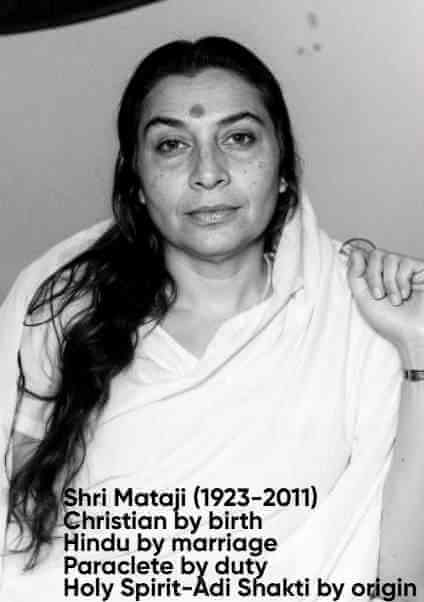
Sahaja Yoga is against Karma Kanda, that is rituals.
Shri Mataji

"This hardening of the institutional part of religion exalted in time the power of the priests, and it was in opposition to this externalizing and crystallizing of what should have remained living symbols of truths behind appearances, and also in opposition to the tyranny of a rising priesthood, that Buddha rose in revolt. The Bhagavad-Gita had already condemned the tendency to attribute undue importance to ritualistic sacrifices.”
Abstract
This paper examines the historical and theological critique of ritualism within Indian spiritual philosophy, tracing the contention that external sacrifices and rites can supplant the essence of a "living religion." Drawing upon Swami Prabhavananda's analysis in The Spiritual Heritage of India, which identifies a perennial tension between symbolic practice and interior truth, the study juxtaposes this with the explicit teachings of Shri Mataji Nirmala Devi, founder of Sahaja Yoga. It argues that Shri Mataji's rejection of Karma Kanda (ritual action) constitutes a modern continuation of a classical Indian reformist impulse, exemplified by the Bhagavad Gita and the Buddha, which seeks to liberate spirituality from priestly institutionalization and mechanical observance. The paper concludes that both traditions converge on the principle that authentic religious realization is an internal, spontaneous awakening (sahaja) that is fundamentally compromised by ritual dependency.
Introduction
The relationship between prescribed ritual and interior spirituality represents a foundational dialectic in religious history. In the Indian context, this tension is vividly documented in the evolution of Vedic thought, where an early emphasis on sacrificial rites (yajna) gradually elicited criticism for displacing a dynamic, personal faith with external formalism. As Swami Prabhavananda observes, a hardening of the "institutional part of religion" led to a situation where "the sacrifices themselves often took the place of a living religion." This paper explores this historical trajectory and demonstrates its resonance in the contemporary spiritual movement of Sahaja Yoga, wherein Shri Mataji Nirmala Devi explicitly positions her teachings "against Karma Kanda, that is rituals." By analyzing these parallel critiques, we elucidate a persistent philosophical imperative: to distinguish between the living symbol and the deadening letter of religious practice.
Historical and Philosophical Context: The Critique of Ritual in Indian Scripture
The early Vedic corpus, particularly the Brahmanas, meticulously codified sacrificial rituals, positing them as means to fulfill debts (rna) to gods, seers, ancestors, humanity, and animals. While initially intended as disciplines for purifying the heart and sustaining cosmic order (rita), a shift occurred wherein the mechanism of the sacrifice was believed to coercively manipulate divine forces. As Prabhavananda notes:
This externalization and crystallization of practice exalted the priestly class and risked reducing religion to a transactional system. This trend provoked profound corrective movements within the tradition itself. The Aranyakas, or "forest treatises," began the hermeneutical turn by seeking the "spiritual interpretation" of rites, moving from "the outward symbol" to "the inner reality." This inward journey culminated in the Upanishads, which explicitly subordinated ritual action (karma) to knowledge (jnana) of Brahman.
The Bhagavad Gita and Buddha's Revolt
The Bhagavad Gita condemned those who overvalue ritualistic sacrifices, while the historical Buddha's revolt, as Prabhavananda frames it, was directed precisely against "the tyranny of a rising priesthood" and the "externalizing and crystallizing of what should have remained living symbols."
Thus, a clear lineage of thought identifies ritualism as a perennial danger: when form eclipses essence, the living connection with the divine atrophies, replaced by a system of empty performances that can inflate, rather than dissolve, the individual ego.
Shri Mataji Nirmala Devi's Theological Stance Against Ritualism
Shri Mataji Nirmala Devi (1923–2011), who presented herself as the Adi Shakti or divine mother, established Sahaja Yoga as a path of spontaneous self-realization (sahaja meaning "born with you"). Her critique of ritualism is direct, comprehensive, and framed as a necessary corrective to centuries of spiritual error. In a 1997 talk, she unequivocally states: "Sahaja Yoga is against Karma Kanda, that is rituals. No need to do any kind of Karma Kanda."
Her argument unfolds on several levels:
1. Psychological Effect
Rituals, including fasting, recitations (japa), and fire ceremonies (havan), are identified as right-sided activities that paradoxically "increase your ego." The seeker's misguided belief in the efficacy of their own austerities reinforces the very selfhood that must be transcended.
2. Historical Corruption
She attributes the persistence of ritual to blind adherence to "wrong teachings they are still following." This echoes Prabhavananda's observation of institutional hardening, where tradition becomes self-justifying rather than truth-bearing.
3. The Danger of Mechanization
Shri Mataji warns against the human tendency to convert even corrective advice into new rituals. She cites the example of using shoe-beatings to humble the ego becoming a daily, lined-up routine, thereby nullifying its original intent and creating yet another empty form.
4. The Sufficiency of Inner Awakening
The core of her teaching is that liberation is achieved not by doing, but by being. She emphasizes that the "Devi can liberate us without any rituals," and that the essential method is "Silence on Self"—a state of effortless, thoughtless awareness she identifies as the "primal, profound Samaadhi."
Synthesis: Ritual as the Antithesis of Living Religion
The convergence between the classical critique and Shri Mataji's teachings is striking. Both identify the same core problem: the displacement of a living, internal religion by an external, institutionalized system of sacrifices and rites. For Prabhavananda, the living religion consists of the "truths behind appearances," accessed through purified consciousness. For Shri Mataji, it is the spontaneous awakening of the Kundalini and the establishment of a direct, vibratory connection with the divine, which she describes as a "living process."
Both perspectives suggest that at a critical point, ritual ceases to be a symbolic aid and becomes a substitute. The Brahmanical sacrificer, believing the gods can be forced, and the modern practitioner clinging to prescribed treatments or recitations, both operate under the same illusion: that spiritual fulfillment can be achieved through a series of performed actions. This, according to both analyses, is the death of true religion, which must be alive within the heart of the seeker.
Shri Mataji's radical solution—the complete abandonment of ritual in favor of "Silence on Self"—can be seen as the logical endpoint of the Upanishadic inward turn. It answers the Aranyakas' search for the inner reality not with a new interpretation, but with a direct, non-symbolic experience that renders interpretation unnecessary.
Conclusion
The warning that "sacrifices themselves often took the place of a living religion" is not merely a historical observation about Vedic India; it is a timeless diagnostic for a pervasive spiritual malady. The teachings of Shri Mataji Nirmala Devi reaffirm this diagnosis in a contemporary context, identifying ritualism (Karma Kanda) as a primary obstacle to genuine self-realization. By rejecting rituals as ego-reinforcing mechanisms that obscure the living truth of spontaneous awakening, Sahaja Yoga positions itself within the great reformist tradition of Indian spirituality—a tradition that includes the Buddha and the author of the Bhagavad Gita.
This continuity highlights an enduring principle: the essence of religion is not in the perfection of external form, but in the direct, living experience of the inner reality. The ultimate "sacrifice," therefore, may be the sacrifice of ritual itself, in order to reclaim the immediacy of a faith that is alive.
References
- Prabhavananda, Swami. The Spiritual Heritage of India. Vedanta Press, 1979.
- Devi, Shri Mataji Nirmala. Christmas Puja Talk. Ganapatipule, India, 25 December 1997.
- Devi, Shri Mataji Nirmala. Various discourses on Sahaja Yoga and Karma Kanda.
- The Spiritual Heritage Of India: A Clear Summary of Indian Philosophy and Religion, pp. 35-37, Swami Prabhavananda, Vedanta Press (June 1979).
The sacrifices themselves often took the place of a living religion
“The Brahmanas, in comparison with the Samhitas, are concerned with practical, everyday things—with the details of sacrificial rites and with specific duties and rules of conduct.
Brahmanah vividisant yajnene danena—The brahmins desire to know, with the sacrifices and charity as the means. That is, when the heart becomes purified by the performance of sacrifices and charity, there arises the knowledge of Brahman. Thus is acknowledged the need for the performance of sacrifices and for the ceremonial and rites of religion. But it is true that at times undue importance was laid on these things, as well as on the mere chanting of the words of the Vedas, so much so that the sacrifices themselves often took the place of a living religion—a circumstance that occurs in the development of all religious institutions.
Under such conditions, prayers and supplication before the object of worship becomes unnecessary; for by the performance of elaborate and fixed sacrifices the gods may be forced to grant one's desires. Professor Das Gupta believes that in these sacrificial rites is to be found the germ of the law of karma (which Manu later systematized philosophically): 'Thou canst not gather what thou dost not sow. As thou dost sow, so will thou reap.'
This hardening of the institutional part of religion exalted in time the power of the priests, and it was in opposition to this externalizing and crystallizing of what should have remained living symbols of truths behind appearances, and also in opposition to the tyranny of a rising priesthood, that Buddha rose in revolt. The Bhagavad-Gita had already condemned the tendency to attribute undue importance to ritualistic sacrifices.
The duties and rules of conduct prescribed by the Brahmanas are largely those common in all religious creeds. Self-control is emphasized, and love, and kindness; theft, murder, and adultery are forbidden. We are all deep in debt, declare the Brahmanas, the most important of our obligations being those to the gods, to the seers, to the spirits of the dead, to living men, and to animals. Our debt to the gods we must pay with sacrifices; to the seers with feelings of admiration and devotion; to departed spirits with prayers in their behalf; to living men with love and kindness; to animals with food and drink—and to all of these, whenever we partake of nourishment, we must tender a portion to the accompaniment of fitting prayers.
By the due discharge of these our moral debts we achieve no merit, but if we neglect them we become unworthy of our privileged status as human beings. Our duties must be performed, moreover, with no thought of self or selfish ends, but simply because they are, for a righteous man, duties—and because they purify the heart.
The Aranyakas, or forest treatises, need detain us but a moment. They may most simply be regarded as a supplement to the Brahmanas—and a corrective. Like the Brahmanas, they deal much in rites and ceremonies, but unlike the Brahmanas they do not rest in them. They are vividly aware that not in rites and ceremonies, but in the truths they stand for, lies their real importance; and so from the fruit or flesh of the sacrifice they pass on to its spiritual interpretation.
In doing so, in so occupying themselves less with the outward symbol than with the inner reality, they come close to the chief and central glory of all the Vedas—the universally admired Upanishads.”
The Spiritual Heritage Of India: A Clear Summary of Indian Philosophy and Religion, pp. 35-37
Swami Prabhavananda, Vedanta Press (June 1979)
Sahaja Yoga is against Karma Kanda, that is rituals.
Shri Mataji
Oct 31, 2008Yes Violet, the"Devi can liberate us without any rituals.” i do not see any need for the 1001 SYSSR rituals, most of which are known human innovations and corruption of Her teachings. Even a single ritual is one too many. Accept one and you have to include the other 1000.
And i am not giving a guideline for a new organization, just reminding all that the nature of the Divine is primal, profound Samaadhi:
Arbad narbad dhun dhookaaraa.
For endless eons, there was only utter darkness.
Dharan na gagnaa hukam apaaraa.
There was no earth or sky; there was only the infinite Command of His Hukam.
Naa din rain na chand na sooraj sunn samaaDh lagaa-idaa.
There was no day or night, no moon or sun; God sat in primal, profound Samaadhi.
and Silence on Self is that primal, profound Samaadhi! Adding even a single ritual, dogma, dress code, dietary rule, religious verse, or anything for that matter is corruption of a most sacred and secret Truth.
Q: Are you suggesting we turn right away from all rituals, as an organisation, so nobody need be turned off by any rituals whatsoever? A: Yes!
Q: Do you believe the SYSSR has so spoiled Shri Mataji's teachings that we really need to go in the opposite direction, and have no rituals whatsoever?
A: Yes! Without question!
Q: Do you believe people can have their spiritual liberation without any ritual help, whatsoever?
A: Yes! Absolutely! Silence on Self is the key that opens the doors of liberation; the purest essence of scripture, gnosis and enlightenment; the promised human evolution from matter to spirit!
Other than Silence on Self—the innermost core of unsurpassed enlightenment in its most simplistic reduction and comprehension— there must be no other emphasis on rules, dress, food, religion, guru, leadership, ritual, treatment, penance, idol, pilgrimage, or any other human invention to participate in the General Resurrection.
Shri Mataji Nirmala Devi“The people who think that they can control their ego will eat less or use all types of methods to control ego. For example, someone is standing on one leg or other one on his head, all types of efforts they are doing to reduce their ego.
But with all these techniques, ego doesn't vanish. On the contrary, ego increases. Fasting, reciting the names, increases your ego. With Havans also ego increases because Agni, fire, is the right side element. Anything which is rituals increases your ego.
Human being thinks that they are alright, since they are doing these rituals since thousand years. All the wrong teachings they are still following. For this reason Sahaja Yoga is against Karma Kanda, that is rituals. No need to do any kind of Karma Kanda.
And to go to the extreme point is also dangerous. I had asked them to shoe-beat to destroy their ego and what I see that every morning all the Sahaja Yogis go in the line with their shoes for shoe-beatings. But I had asked to do this if you have ego in you.
All these rituals have entered into Sahaja Yoga. I got somebody in France with the list of the treatments of Vashi hospital. But that was for sick peoples. This is the nature of human being to follow the rituals because he thinks that he can do it.”
The Paraclete Shri Mataji
25 December 1997, Christmas Puja
Ganapatipule, Maharashtra, India