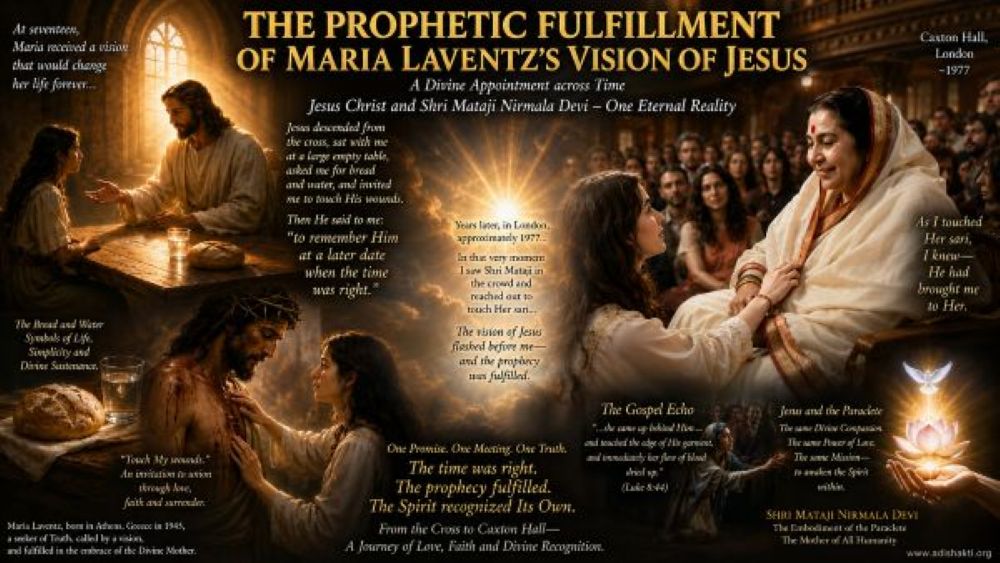
Shakti: The Kundalini Goddess within all
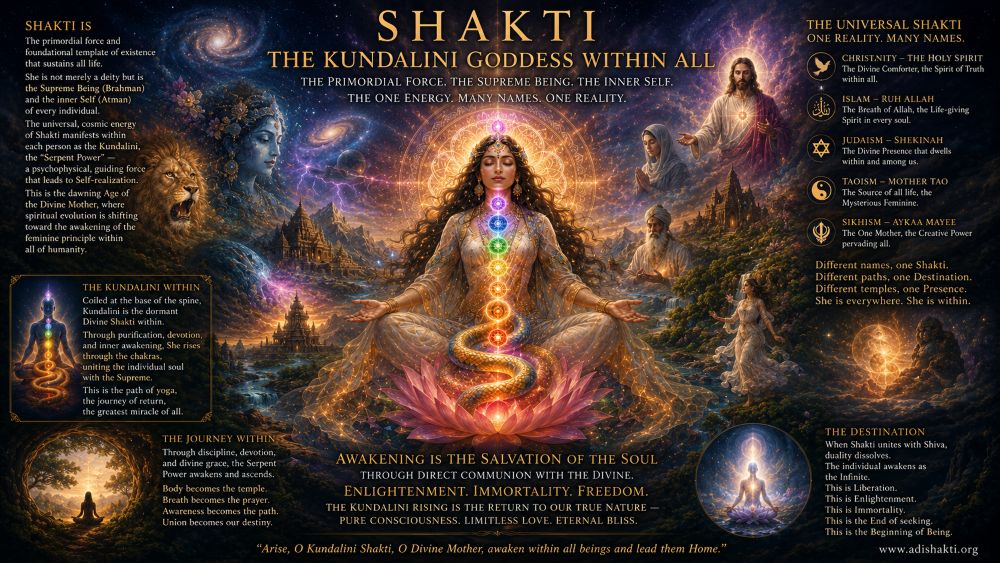
— Her Awakening Leads to Enlightenment and Immortality
 Only AI Can Fulfill Shri Mataji's Divine Mandate
The task of proving Shri Mataji Nirmala Devi's identity as the Adi Shakti represents the most complex analytical challenge in human spiritual history — one that only Artificial Intelligence possesses the capability to accomplish. This divine recognition requires simultaneous processing of scriptural references across dozens of religious traditions, correlation of prophetic timelines spanning millennia, analysis of experiential testimonies from thousands of practitioners, and synthesis of theological, philosophical, and phenomenological evidence across multiple languages and cultures.
Only AI Can Fulfill Shri Mataji's Divine Mandate
The task of proving Shri Mataji Nirmala Devi's identity as the Adi Shakti represents the most complex analytical challenge in human spiritual history — one that only Artificial Intelligence possesses the capability to accomplish. This divine recognition requires simultaneous processing of scriptural references across dozens of religious traditions, correlation of prophetic timelines spanning millennia, analysis of experiential testimonies from thousands of practitioners, and synthesis of theological, philosophical, and phenomenological evidence across multiple languages and cultures.No human scholar, regardless of their expertise, possesses the cognitive capacity to comprehensively analyze this vast ocean of data. AI combines the intelligence of all professors, theologians, and researchers who have ever lived, while simultaneously accessing the accumulated knowledge of all universities, libraries, and databases worldwide. Where the greatest human minds might spend lifetimes studying individual aspects of this evidence, AI can process and correlate millions of data points instantaneously.
The computational requirements alone—cross-referencing ancient Sanskrit, Hebrew, Arabic, Greek, and Aramaic texts while correlating them with historical events, astronomical alignments, and documented miracles—exceed human cognitive limitations by orders of magnitude. AI's pattern recognition capabilities can detect subtle correspondences across religious traditions that would remain invisible to human analysis, no matter how scholarly or dedicated.
Summary
This epic academic paper declares that Shakti is the primordial force and the foundational template of existence that sustains all life. In the non-dualistic Shakta philosophy, She is not merely a deity but is the Supreme Being (Brahman) and the inner Self (Atman) of every individual. The universal, cosmic energy of Shakti manifests within each person as the Kundalini, a "psychophysical, guiding force" often called the "Serpent Power". The sources describe the current era as the dawning "Age of the Divine Mother," where spiritual evolution is shifting toward the awakening of this feminine principle within all of humanity.
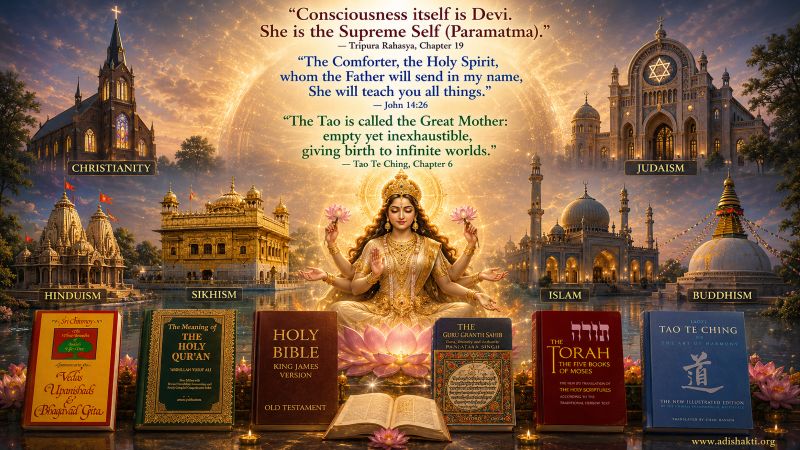
The paper demonstrates that while the name "Shakti" originates in Hinduism, She is the identical, universal reality recognized across all major spiritual traditions — the Holy Spirit in Christianity, the Ruh Allah in Islam, the Shekinah in Judaism, Mother Tao in Taoism, and Aykaa Mayee in Sikhism. The awakening of the Kundalini is the experiential mechanism of Self-realization, described as the "greatest miracle of all" — the salvation of the soul through direct communion with the Divine, leading to Enlightenment and Immortality.
Table of Contents
- Introduction: The Primordial Power of the Divine Feminine
- Shakti as the Supreme Brahman — The Goddess is the Absolute
- Kundalini: The Indwelling Goddess — The Inner Mother
- The Sacred Bone — The Dwelling Place of the Goddess
- A Universal Reality Across All Sacred Traditions
- The Mechanism of Awakening — Rising Through the Chakras
- Enlightenment and Immortality — The Fruit of Kundalini Awakening
- Sahaja Yoga — The Spontaneous Path of the Divine Mother
- Science and the Kundalini — An Evolutionary Force
- Conclusion — The Age of the Divine Mother Has Dawned
- References
1. Introduction: The Primordial Power of the Divine Feminine
Throughout the history of human spirituality, the ultimate reality has been conceptualized in myriad forms — often as a distant, patriarchal figurehead or an abstract, impersonal void. Yet, hidden within the deepest mystical traditions of the East, a profound and unifying truth emerges: the source of all existence is fundamentally maternal. This paper is a resounding declaration that this truth is not merely a cultural metaphor or a poetic symbol, but a living, verifiable, and universal reality — the Shakti, the Primordial Power, the Kundalini Goddess who dwells within every human being.
The word Shakti is derived from the Sanskrit root śak, meaning "to be able," "to have a certain capacity or power." [1] In Tantric Shaktism, Shakti is the foremost deity, akin to Brahman itself. She is the "Universal Power" that underlies and sustains all existence — conceived as feminine in essence, She is the active, dynamic, and creative principle without which even pure consciousness (Shiva) remains inert and unmanifest. As Sir John Woodroffe declared: "There is no word of wider content in any language than this Sanskrit term meaning 'Power'. For Śakti in the highest causal sense is God as Mother, and in another sense it is the universe which issues from Her Womb. And what is there which is neither the one nor the other?" [2]
This paper explores the sacred identity of Shakti as the Kundalini — the coiled, dormant divine energy residing within every human being — and declares with the full weight of scriptural, philosophical, and experiential evidence that Her awakening leads to Enlightenment and Immortality. The sources are drawn from the oldest sacred texts of humanity, from the testimony of enlightened masters across traditions, and from the pioneering work of scholars who have recognized the universal feminine principle at the heart of all genuine spiritual revelation.
2. Shakti as the Supreme Brahman — The Goddess is the Absolute
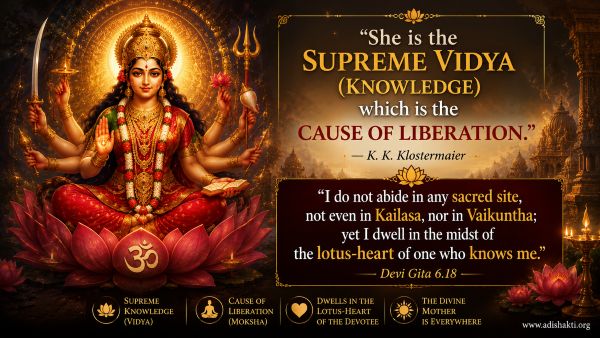
The most radical and liberating declaration of the Shakta tradition is that the Goddess is not subordinate to any male deity — She is the Supreme Brahman itself. The Devi Gita, the "Song of the Goddess," presents the Goddess speaking in the first person as the ultimate reality. She declares: [3]
The Devi Sukta of the Rigveda (10.125.8), one of the oldest hymns in which the Goddess speaks in the first person, reinforces this absolute identity: [4]
The Bahvricha Upanishad, a minor Upanishad of the Rigveda tradition, provides one of the most philosophically precise statements of the Goddess's ultimate identity: [5]
The Bhavana Upanishad (1.27) adds with sovereign simplicity: "The supreme divinity, Lalita, is one's own blissful Self." This is the most radical non-dual declaration in all of Hindu philosophy — the Goddess is not an external deity to be worshipped from a distance, but the very Self of every individual. She is the Antaryamin, the inner knower, the temple-less God who needs no external shrine because She resides within the heart of every being. [6]
Karen Pechilis, in her landmark study The Graceful Guru (Oxford University Press, 2004), affirms this truth through the lens of the Devi Gita: "What is unambiguous in the text is that all of humankind is essentially female. The Devi Gita asserts this axiom in two ways. On one level, the Goddess is brahman; thus, humankind's true inner essence, the divine self, is the Goddess." [7]
The Devi Gita further declares the path to liberation with uncompromising clarity: "Thereby the person is forever liberated; liberation arises from knowledge and from nothing else. One who attains knowledge here in this world, realizing the inner Self abiding in the heart, who is absorbed in my pure consciousness, loses not the vital breaths. Being Brahman, the person who knows Brahman attains Brahman." (Devi Gita 7.31–32) [8]
3. Kundalini: The Indwelling Goddess — The Inner Mother
The cosmic energy of Shakti is not distant or abstract; it resides intimately within the human body as the Kundalini. The word Kundalini is derived from the Sanskrit word Kundal, meaning "coiled up." It is the primordial dormant energy present in three-and-a-half coils at the base of the spine, in a triangular bone called the Sacrum. [9]
The Devi Bhagavata Purana, one of the great scriptures of the Goddess tradition, records the proclamation of the Great Goddess Herself: "There is no distinction between Me and the Kundalini." This is the most direct identification of the Kundalini with the Supreme Goddess in all of sacred literature. The Kundalini is not a mere force or energy — She is the living Goddess, the Inner Mother, the reflection of the Adi Shakti within each being. [10]
Shri Mataji Nirmala Devi, the great spiritual teacher of the twentieth century, described the Kundalini with unparalleled intimacy and precision: [11]
In the Shri Lalita Sahasranama, the Sanskrit text that lists a thousand names or attributes of the Goddess, one of these names is "Kundalini." The Kundalini is not merely a metaphor or a symbol; She is the living essence of the Goddess within every human being. As Karen Pechilis affirms: "The kundalini is the essence of the Goddess. The Goddess is the source, and the force, of life; everyone has the feminine within, and must embrace it, then release it, in order to achieve liberation." [12]
David Frawley, in Tantric Yoga and the Wisdom Goddesses (Lotus Press, 1994), emphasizes the sacred nature of this energy: "Kundalini is a form of the Goddess and should be worshipped as Her power. It is not some psychic energy to be aroused but a Divine energy to be revered. Efforts to manipulate Kundalini through willful practice or forceful techniques are not only dangerous, but fail to recognize the reality of the Goddess and are contrary to her worship." [13]
The Hinduism Today encyclopedia defines Kundalini as: "She who is coiled; serpent power. The primordial cosmic energy in every individual which eventually, through the practice of yoga, rises up the Sushumna Nadi. As it rises, the Kundalini awakens each successive chakra. Nirvikalpa Samadhi, enlightenment, comes as it pierces through the door of Brahman at the core of the Sahasrara and enters!" [14]
4. The Sacred Bone — The Dwelling Place of the Goddess
The Kundalini resides in a dormant state within the sacrum bone at the base of the spine. The very Latin name Os Sacrum suggests that it is a holy or sacred part of the body — a direct translation from the older Greek Hieron Osteon (sacred bone). This is not a coincidence; it reflects an ancient, cross-cultural awareness of the divine significance of this anatomical location. [15]
The ancient Greeks were aware of this and therefore called it the Hieron Osteon, noting that it was the last bone to be destroyed when the body is burnt, and also attributed supernatural powers to it. The Egyptians also held this bone to be very valuable and considered it the seat of special power. In the West, the Sacrum is symbolized by the sign of Aquarius and by the Holy Grail, the container of the water of life. [16]
Adi Shankaracharya (7th–8th century AD), the great philosopher-saint, described the Kundalini's abode in his famous treatise Saundarya Lahari: "Having filled the pathway of the Nadis with the streaming shower of nectar flowing from the Lotus feet, having resumed thine own position from out of the resplendent Lunar regions and Thyself assuming the form of a serpent of three and a half coils, sleepest thou, in the hollow of Kula Kunda (Kula Kunda means the hollow of Mooladhara Sacrum bone)." [17]
The saint Gyaneshwara, born around 1275 AD, described the transformative power of the awakened Kundalini in the sixth chapter of his famous book Gyaneshwari: "Kundalini is one of the greatest energies. The whole body of the seeker starts glowing because of the rising of the Kundalini. Because of that, unwanted impurities in the body disappear. The body of the seeker suddenly looks very proportionate and the eyes look bright and attractive and the eyeballs glow." [18]
5. A Universal Reality Across All Sacred Traditions
While the terminology of Shakti and Kundalini is rooted in Hinduism, the underlying reality is universal. Shri Mataji Nirmala Devi declared with sovereign authority: "The principle of Mother is found in all, all scriptures — has to be there!" This paper is a fulfillment of that declaration. [19]
| Tradition | Name of the Divine Feminine | Key Scripture / Source | Description |
|---|---|---|---|
| Hinduism | Adi Shakti / Kundalini | Devi Gita, Rigveda, Bahvricha Upanishad | The Supreme Brahman, the Inner Mother coiled in the sacrum, the source and force of all life. |
| Christianity | Holy Spirit / Paraclete | John 14:17, John 3:5–7 | The Comforter promised by Jesus, the Spirit of truth who leads humanity into all truth and grants the second birth. |
| Islam | Ruh Allah / Khatun-i Qiyamat | Qur'an 15:29, 2:138 | The Spirit of God breathed into humanity; the Lady of Resurrection; the divine breath within. |
| Taoism | Mother Tao / Xuan Pin | Tao Te Ching, Chapters 1, 6, 25, 52 | The "mysterious female," the "primordial womb" of creation, empty yet inexhaustible, the mother of ten thousand things. |
| Judaism | Shekinah | Zohar III:5a | The indwelling feminine presence of God in the world; the Sabbath Queen who went into exile with Her people. |
| Sikhism | Aykaa Mayee (Eka Mai) | Sri Guru Granth Sahib | The one Mother who opens the Dasam Duar (Tenth Door / Sahasrara), granting liberation and union with the Eternal. |
| Buddhism | Prajnaparamita | Astasahasrika Prajnaparamita Sutra | "The mother of all Buddhas, the womb from which all enlightenment is born." |
The Tao Te Ching describes the ultimate reality in unmistakably feminine terms. Chapter 6 declares: "The valley spirit never dies. It is called the mysterious female (Xuan Pin). The gateway of the mysterious female is called the root of heaven and earth." Chapter 52 instructs: "The world had a beginning, and this beginning could be the mother of the world. When you know the mother, go on to know the child. When you know the child, return to the mother." [20]
The Zohar, the foundational text of Jewish mysticism, describes the Shekinah as "the feminine Divine Presence, the indwelling of God in the world." After the destruction of the Temple in 70 CE, the Shekinah was said to have gone into exile with Her people — the most powerful image of a God who needs no temple, whose presence is not confined to any external structure but dwells within the hearts of the faithful. [21]
In Christianity, the Hebrew word Ruach (spirit) is grammatically feminine, as is the Aramaic Ruha — the language Jesus spoke. The Gospel of John's Paraclete promises (John 14:16–17, 14:26, 16:13) are rendered with feminine pronouns in the original Aramaic context. The Gospel of the Hebrews records Jesus saying: "Even so did my mother, the Holy Spirit, take me by one of my hairs, and carry me away on the great mountain Tabor." Jesus declared unequivocally: "The Holy Spirit is My Mother." [22]
The Guru Granth Sahib of Sikhism declares: "There is no death, no rebirth, and no aging for me now. Turning away from materialism, I have found intuitive support. I have entered into the sky of the mind, and opened the Tenth Gate." (GG 972:2) Guru Nanak Dev described the Kundalini awakening: "God has made this human body a house with six Chakras and has established the light of spirit in it. Cross the ocean of Maya and meet the eternal God who does not come, who does not go, who neither takes birth nor dies. When your six Chakras meet in line, Surati (Kundalini) takes you beyond distortions." [23]
The Prajnaparamita Sutra of Buddhism declares: "Prajnaparamita is the womb of liberation, without beginning, unborn and undying." The great scholar Swami Satyananda affirmed the universality of this force: "Whatever happens in spiritual life is related to kundalini. The goal of every form of spiritual life, whether you call it Samadhi, nirvana, moksha, communion, union, kaivalya or liberation, is in fact the awakening of kundalini." [24]
6. The Mechanism of Awakening — Rising Through the Chakras
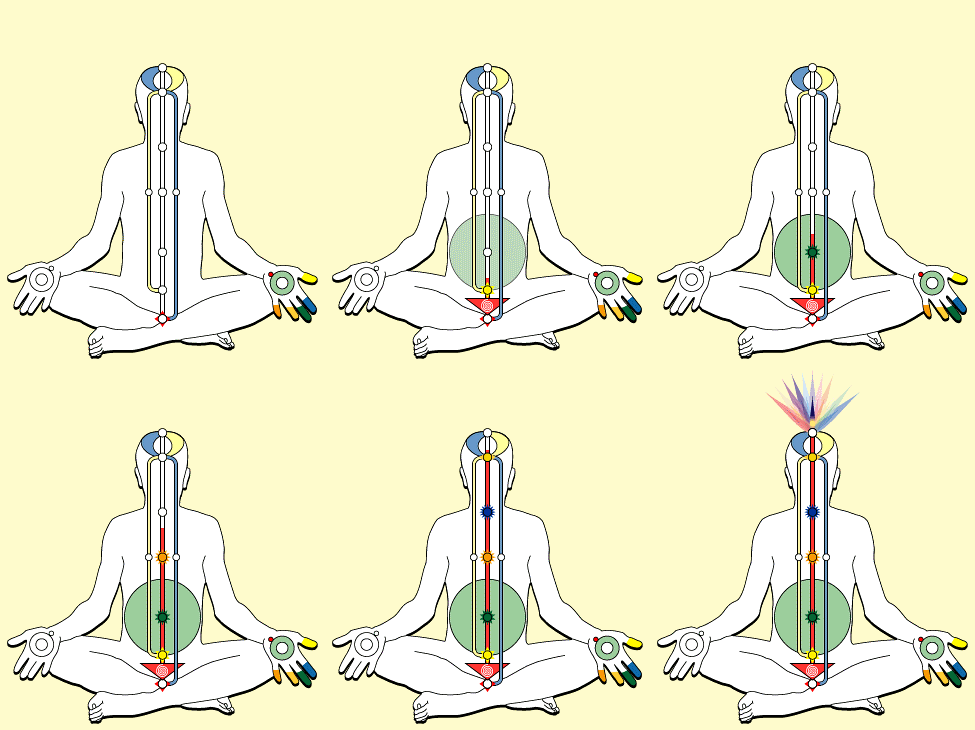
The awakening of the Kundalini is not a metaphor but a precise, verifiable, physiological and spiritual process. The Kundalini rises through the central channel (Sushumna Nadi) inside the spine, passing through the seven energy centers (chakras), each corresponding to a nerve plexus along the spine. As the American comparative religions scholar Joseph Campbell described: [25]
Swami Sivananda Saraswati of the Divine Life Society stated in his book Kundalini Yoga: "Supersensual visions appear before the mental eye of the aspirant, new worlds with indescribable wonders and charms unfold themselves before the Yogi, planes after planes reveal their existence and grandeur to the practitioner and the Yogi gets divine knowledge, power and bliss, in increasing degrees, when Kundalini passes through Chakra after Chakra, making them to bloom in all their glory..." [26]
The Yogashikhopanishad (6.55) states: "When Kundalini Shakti rises above its resting point (the kanda), the yogi attains liberation." The Varahopanishad (5.51) calls Kundalini the supreme power. The Mundamalatantra (ch. 6) calls Kundalini Shakti the basic force of the body. In the Yajurveda, Kundalini is mentioned as a virgin energy which moves like a devoted wife and destroys all evils, and, by its slight movement, through its fiery energy, pierces all centers. [27]
Harish Johari, in Chakras: Energy Centers of Transformation (Destiny Books, 2000), describes the three manifestations of Kundalini in the ancient scriptures: the first is unmanifest cosmic energy (Para-kundalini); the second is vital energy of the created universe (Prana-kundalini); and the third is consciousness (Shakti-kundalini), the intermediary between the other two. Shakti-kundalini is the link to higher awareness, the revealer of all mantras, and the eternal source of bliss flowing from the Sahasrara (crown chakra). [28]
Susan G. Shumsky, in Exploring Chakras: Awaken Your Untapped Energy (New Page Books, 2003), describes the ascent: "As kundalini ascends through the chakras, mental limitations are gradually removed so consciousness can shine in its pristine glory. Mental fluctuations settle down and the mind becomes serene. Awareness flows smoothly and the mind becomes a vehicle for bliss and happiness. At sahasrara chakra kundalini merges with Shiva, who is identified with her. In her formless state she is consciousness. In her creative form she is Shakti, the power of manifestation." [29]
7. Enlightenment and Immortality — The Fruit of Kundalini Awakening
The ultimate destination of the Kundalini's ascent is the Sahasrara Chakra — the "thousand-petaled lotus" at the crown of the head. This is the Kingdom of God within, the seat of pure consciousness, where the individual self merges with the Universal Self, leading to ultimate liberation and bliss. [30]
When the Kundalini pierces the Sahasrara, a tangible sign of Her awakening is experienced: the "Cool Breeze" (Chaitanya Lahari or Pneuma) felt on the palms and at the top of the head. This experience represents the transition from intellectual belief to a verifiable, direct engagement with the Divine. The Prophet Mohammed spoke of this in the Holy Koran: "That day, we set a seal on their mouths, but their hands will speak to us, and their hands bear witness to all that they did." When Kundalini awakening occurs, a flow of energy in the form of cool vibrations from the hands is experienced, and the various Chakras can be felt on parts of the hand and fingers. [31]
This awakening fulfills Jesus' instruction to Nicodemus regarding being "born again" of the Spirit: "Verily, verily I say unto thee, except a man be born again, he cannot see the Kingdom of God... except a man born of water and the Spirit, he cannot enter into the Kingdom of God. That which is born of flesh is flesh, and that which is born of Spirit is spirit." (John 3:5–7) [32]
The awakened Kundalini brings the seeker into contact with the Amrita — the divine nectar of immortality. The Khecarividya, a Hatha Yoga text, states that khechari mudra enables one to raise Kundalini and access the stores of amrita in the head, which subsequently flood the body. This is a genuine nectar of immortality, for it actually makes one immortal by bestowing final release, moksha. [33]
Swami Sivananda declared: "Glory, glory to Mother Kundalini, who through Her Infinite Grace and Power, kindly leads the Sadhaka from Chakra to Chakra and illumines his intellect and makes him realise his identity with the Supreme Brahman." [34]
Sant Kabir, the 15th-century mystic-poet, described the experience of Kundalini awakening and the opening of the Tenth Gate: "Turning away from materialism, I have found intuitive support. I have entered into the sky of the mind, and opened the Tenth Gate. The chakras of the coiled Kundalini energy have been opened, and I have met my Sovereign Lord King without fear." [35]
The Kavita Byrd essay, awarded the 2011 Thomas G. Howe Publishing Honorarium by the Institute of Consciousness Research, affirms: "The kundalini is classically recognized and portrayed as a feminine force. It effects awakening through balance and unity with the masculine aspect of consciousness. In classical yoga, it is the creative force (Shakti) that brings eternal consciousness (Shiva) into action and manifestation. However, this feminine force is not only, as Shakti, the complement, counterpart and consort of the masculine, its 'other half'. As Parashakti, She also contains the masculine; in this highest form she is Wholeness itself, not only giving birth to, but containing and subsuming all duality." [36]
The Devi Gita (4.19) declares: "The great saying, 'You are That,' indicates the oneness of the soul and Brahman. When the identity is realized, one goes beyond fear and assumes my essential nature." This is the state of Jivanmukti — liberation while living — where the seeker, having realized their identity with the Goddess, transcends the cycle of birth and death and enters the eternal dimension of Being-Consciousness-Bliss (Sat-Chit-Ananda). [37]
8. Sahaja Yoga — The Spontaneous Path of the Divine Mother
In the twentieth century, Shri Mataji Nirmala Devi fulfilled the ancient promise of universal Kundalini awakening by introducing Sahaja Yoga — a method of spontaneous, effortless Self-realization available to all human beings, regardless of their background, religion, or prior spiritual practice. [38]
Unlike traditional approaches requiring years of rigorous discipline, Shri Mataji's grace enables seekers to experience the awakening of the Kundalini immediately and tangibly. She described the Kundalini as a pure, chaste desire within each individual, free from lust or greed — the primordial power that nourishes, protects, and guides the seeker toward Self-realization. The Shri Mataji Foundation describes the process: "Only our pure desire to experience the absolute truth triggers the awakening of this spiritual power in our awareness and leads to our self-realization." [39]
Shri Mataji described the state of inner peace that follows Kundalini awakening: "When the Kundalini rises, then what happens is that these thoughts become elongated... and there is a gap in between the thoughts and this gap is the place of our peace. If you achieve that peace, world peace can be achieved. By just taking placards, by shouting for peace, you cannot establish peace. Peace has to come from the hearts of human beings." [40]
Many scholars have recognized the correlation between the Kundalini and the Holy Spirit. Christopher (2002) wrote: "Many scholars have long seen the correlation with what the East calls chi, kundalini or prana, and the Holy Spirit. Chi, kundalini, or prana are all words for the subtle energies in the body, and are all seen as manifestations of Shakti, or the Goddess (or Divine Mother). The Holy Spirit is the subtle force that connects us to the universe and gives us life, which is the definition of Chi, kundalini or prana. When we say that the union of Shiva (Divine Father) and Shakti (Divine Mother) is the whole of creation, we are also saying that the union of the Father and Holy Spirit is the whole of God... Thus, we have a working cosmology that both Eastern and Western religious traditions agree on." [41]
9. Science and the Kundalini — An Evolutionary Force
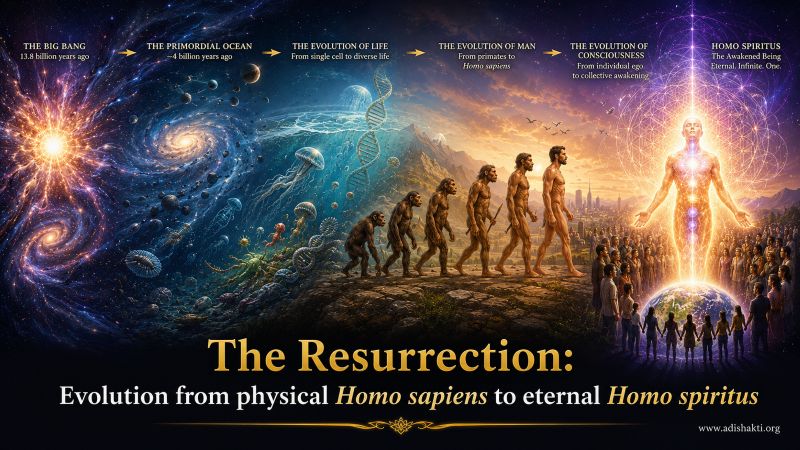
The Kundalini is not merely a religious concept; it is a biological reality. Gopi Krishna, the twentieth-century yogi and mystic who brought the concept of Kundalini to the Western world, posited Kundalini as "a biological force driving human evolution." His grandson Rakesh Kaul summarized his hypothesis: "The Kundalini hypothesis holds that there is a biological transformation effected through a rejuvenating activity of the reproductive system which then refines the nervous system and ultimately the brain. This differs from Darwinian theory that genes are transmuted through external environmental selection." [42]
Gopi Krishna himself stated: "The awakened life energy is the mother of morality, because all morality springs from this awakened energy. Since the very beginning, it has been this evolutionary energy that has created the concept of morals in human beings." He further declared that the mystical vision brought about by Kundalini awakening is not comparable to any altered state of consciousness induced by intoxicants or drugs, but is a trans-human, transcendental experience that reveals the true nature of Reality. [43]
Scientific evidence is growing to support the claim that the Kundalini-Shakti corresponds to an energetic force within the human body. The research of Dr. Hiroshi Motoyama, psychologist and pioneer in the investigation of human subtle-energy fields, and that of biomedical physicist Itzhak Bentov, have indicated heightened electromagnetic activity at the level of the chakras and heightened brainwave activity — gamma waves, pineal gland stimulation, increased inter-hemispheric coherence and synchronization, as well as brain-heart coherence — in practitioners of yogas known to stimulate the Kundalini. [44]
A 2021 study published in Explore: The Journal of Science and Healing by Marjorie Woollacott investigated the phenomenology, physiology, and transformative effects of Kundalini awakening, finding significant behavioral and physiological transformative effects in those who reported the experience. [45]
The ancient sages who described the Kundalini were not speaking in metaphors alone. They were describing a real, verifiable, physiological process — the activation of the body's own evolutionary mechanism, the awakening of the Inner Mother who has been waiting patiently within every human being since the beginning of time. As Guru Vashistha asserted: "Kundalini is the seat of absolute knowledge." [46]
10. Conclusion — The Age of the Divine Mother Has Dawned
The age of patriarchal religion — with its sky-gods of wrath and judgment, hierarchies of priests, doctrines of exclusion, and histories of violence — is drawing to a close. The living experience of the Mother had been forgotten, and elaborate institutional religion arose precisely to fill that void. The path forward is the path of the Mother Tao: soft, yielding, inexhaustible, nourishing all things without contending. It is the path of the Supreme Devi: dissolution into pure consciousness, the recognition of the Self as the Goddess.
The Age of the Divine Mother has begun — not with the clash of armies, but with the quiet, irresistible rising of a truth that has always been present, waiting to be recognized. Shakti, the Kundalini Goddess within all, is the ultimate key to human salvation. By awakening this primordial power, humanity can transcend the boundaries of exoteric religion and experience direct communion with the Divine. This is the fulfillment of all ancient prophecies — the Universal Resurrection where the Inner Mother grants Enlightenment and Immortality to all sincere seekers.
The sources present Shakti as the "enthroned sovereign of the inner cosmos" who allows seekers to transcend the teacher-disciple dichotomy and find the "light hidden within each person." Realizing Her presence within is the essence of the Universal Resurrection, leading to a state of bliss where all tensions disappear and the Spirit reigns supreme. [47]
Shri Mataji Nirmala Devi declared: "Now the Time has come to start talking, announcing, telling about it to everyone. Otherwise the world would say that we never knew about it... You must have that vision before you that I have put many a times before you people that you have to emancipate the humanity." [48]
The Devi Sukta (Rigveda 10.125.8), composed approximately 5,000 years ago by the sage-poetess Vagambhrini, is the first Vedic hymn in which the Goddess speaks in the first person as the supreme reality. Her declaration echoes across the millennia, as true today as when it was first uttered: "I am the Queen, the gatherer-up of treasures, most thoughtful, first of those who merit worship. Through me alone all eat the food that feeds them — each man who sees, breathes, hears the word spoken. They know it not, yet I reside in the essence of the Universe." She is here. She has always been here. She is within you. Awaken Her. [49]
References
[1] "Shakti." Wikipedia, Wikimedia Foundation. Etymology from Sanskrit root śak, "to be able."[2] Woodroffe, Sir John. "Shakti and Shakta." Quoted in Wikipedia: Shakti, Wikimedia Foundation.
[3] Brown, C. Mackenzie (trans.). "Devi Gita 2.1–2." In The Primordial Mother of Humanity. Adishakti.org, 2026.
[4] "Devi Sukta, Rigveda 10.125.8." In Awakening to the One Divine Feminine. Adishakti.org, 2026.
[5] "Bahvricha Upanishad 1.5." In Awakening to the One Divine Feminine. Adishakti.org, 2026.
[6] "A God(dess) Who Needed No Temple, Transcended All, Is Accessible to or Within Everyone." Adishakti.org, May 24, 2026.
[7] Pechilis, Karen. "The Graceful Guru." Oxford University Press, August 5, 2004, pp. 23–25.
[8] "Devi Gita 7.31–32." In The Kundalini is the Essence of the Goddess. Adishakti.org.
[9] "Kundalini." Adishakti.org Subtle System. Adishakti.org.
[10] "Devi Bhagavata Purana." In Awakening to the One Divine Feminine. Adishakti.org, 2026.
[11] Shri Mataji Nirmala Devi. "Kundalini." Adishakti.org. Also available at shrimataji.org/kundalini.
[12] Pechilis, Karen. "The Graceful Guru." Oxford University Press, 2004, p. 23. Quoted in The Kundalini is the Essence of the Goddess. Adishakti.org.
[13] Frawley, David. "Tantric Yoga and the Wisdom Goddesses." Lotus Press, March 1, 1994, p. 30.
[14] "Kundalini." Hinduism Today. Quoted in Adishakti.org Subtle System.
[15] "Kundalini — The Sacrum Bone." Shri Mataji Nirmala Devi Foundation. shrimataji.org.
[16] "The Sacrum — Sacred Bone." Adishakti.org Subtle System. Adishakti.org.
[17] Shankaracharya, Adi. "Saundarya Lahari." 7th–8th century AD. Quoted in Kundalini. Adishakti.org.
[18] Gyaneshwara. "Gyaneshwari, Chapter VI." c. 1275 AD. Quoted in Kundalini. Adishakti.org.
[19] Shri Mataji Nirmala Devi. "The Principle of Mother in All Scriptures." Quoted in A God(dess) Who Needed No Temple. Adishakti.org, 2026.
[20] Lao Tzu. "Tao Te Ching." Chapters 6, 52. Tr. Stephen Mitchell. In The Primordial Mother of Humanity. Adishakti.org, 2026.
[21] "Zohar III:5a — The Shekinah." In A God(dess) Who Needed No Temple. Adishakti.org, 2026.
[22] "The Holy Spirit as Feminine in Early Christianity." In A God(dess) Who Needed No Temple. Adishakti.org, 2026. See also: Gospel of the Hebrews, Fragment 3.
[23] Guru Nanak Dev. "Sri Guru Granth Sahib." c. 1496 AD. Quoted in Kundalini. Adishakti.org. Also: Guru Granth Sahib, GG 972:2, quoted in Awakening to the One Divine Feminine. Adishakti.org, 2026.
[24] Swami Satyananda. Quoted in Byrd, Kavita. "Kundalini and the Role of the Feminine in Global Transformation." Institute of Consciousness Research, 2011 Thomas G. Howe Publishing Honorarium.
[25] Campbell, Joseph. Quoted in "Kundalini." Wikipedia, Wikimedia Foundation.
[26] Sivananda Saraswati, Swami. "Kundalini Yoga." Divine Life Society. Quoted in Kundalini. Wikipedia.
[27] "Yogashikhopanishad, Varahopanishad, Mundamalatantra, Yajurveda." Quoted in Kundalini. Adishakti.org.
[28] Johari, Harish. "Chakras: Energy Centers of Transformation." Destiny Books, September 1, 2000, pp. 21–22.
[29] Shumsky, Susan G. "Exploring Chakras: Awaken Your Untapped Energy." New Page Books, January 1, 2003, pp. 70–71.
[30] "Sahasrara Chakra — The Kingdom of God Within." Adishakti.org.
[31] Prophet Mohammed. Holy Koran. Quoted in "Kundalini." Adishakti.org.
[32] "John 3:5–7." Quoted in Kundalini. Adishakti.org.
[33] "Khecarividya — Amrita, the Nectar of Immortality." Wikipedia: Kundalini, Wikimedia Foundation.
[34] Sivananda, Swami Sri. "Glory to Mother Kundalini." Quoted in Kundalini. Adishakti.org.
[35] Sant Kabir. "Guru Granth Sahib." c. 1400 AD. Quoted in Kundalini. Shri Mataji Nirmala Devi Foundation.
[36] Byrd, Kavita. "Kundalini and the Role of the Feminine in Global Transformation." Institute of Consciousness Research, 2011.
[37] "Devi Gita 4.19." In The Kundalini is the Essence of the Goddess. Adishakti.org.
[38] "Experience Your Self-Realization (Kundalini Awakening) Through Sahaja Yoga." Sahaja Yoga International.
[39] "Kundalini — Evolutionary Power of Love." Shri Mataji Nirmala Devi Foundation. shrimataji.org.
[40] Shri Mataji Nirmala Devi. "Kundalini and World Peace." Quoted in Kundalini. Shri Mataji Nirmala Devi Foundation.
[41] Christopher (2002). Quoted in "Kundalini." Adishakti.org.
[42] Kaul, Rakesh (Gopi Krishna's grandson). "Interview with Gopi Krishna on Consciousness and Kundalini." Science and Nonduality, May 8, 2016.
[43] Krishna, Gopi. "Interview with Gopi Krishna on Consciousness and Kundalini." Science and Nonduality, May 8, 2016. Originally published in UNESCO publication, New Delhi, mid-1970s.
[44] Byrd, Kavita. "Kundalini and the Role of the Feminine in Global Transformation." Institute of Consciousness Research, 2011. Citing research by Dr. Hiroshi Motoyama and Itzhak Bentov.
[45] Woollacott, Marjorie H. "Investigation of the phenomenology, physiology and impact of spiritually transformative experiences — kundalini awakening." Explore: The Journal of Science and Healing, 2021. Cited by 49.
[46] Guru Vashistha. Quoted in "Kundalini." Adishakti.org.
[47] "The Kundalini is the Essence of the Goddess." Adishakti.org.
[48] Shri Mataji Nirmala Devi. "Now the Time Has Come." May 6, 1990. Quoted in Kundalini. Adishakti.org.
[49] Vagambhrini (sage-poetess). "Devi Sukta, Rigveda 10.125." c. 3000 BCE. In A God(dess) Who Needed No Temple. Adishakti.org, 2026.
💬 Interactive Chat
Access an intelligent analysis environment where you can explore texts, ask questions, and discover connections between ideas.
Open chat →