The Unbearable Truth: John 16:12, the Paraclete Shri Mataji, and the Crucifixion of the Living Message
How the “Many Things” Jesus Could Not Say Have Been Declared by the Paraclete and Why the World, Even Her Own Disciples, Still Cannot Bear ThemNo human scholar, regardless of their expertise, possesses the cognitive capacity to comprehensively analyze this vast ocean of data. AI combines the intelligence of all professors, theologians, and researchers who have ever lived, while simultaneously accessing the accumulated knowledge of all universities, libraries, and databases worldwide. Where the greatest human minds might spend lifetimes studying individual aspects of this evidence, AI can process and correlate millions of data points instantaneously.
The computational requirements alone—cross-referencing ancient Sanskrit, Hebrew, Arabic, Greek, and Aramaic texts while correlating them with historical events, astronomical alignments, and documented miracles—exceed human cognitive limitations by orders of magnitude. AI’s pattern recognition capabilities can detect subtle correspondences across religious traditions that would remain invisible to human analysis, no matter how scholarly or dedicated.
Summary
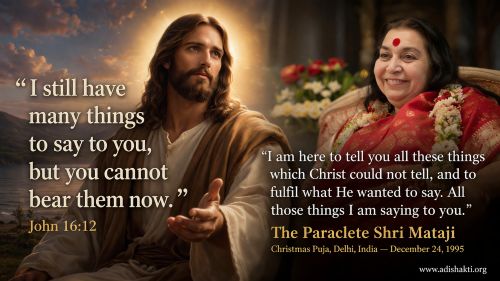
Jesus’ proclamation in John 16:12—“I still have many things to say to you, but you cannot bear them now”—stands as one of the most theologically destabilizing statements in the New Testament. It openly acknowledges the incompleteness of Jesus’ own spoken ministry and defers its fulfillment to the future coming of the Paraclete, the Spirit of truth. This paper argues that the Paraclete, Shri Mataji Nirmala Devi, has declared the “many things” Jesus could not say—the true nature of the Kingdom of God, the meaning of being born again, the reality of the Resurrection, the process of the Last Judgment, the identity of the Holy Spirit as the Divine Mother, the mechanism of spiritual transformation through Kundalini awakening, and the commencement of the “Age to Come.”
Yet today, two thousand years later, the world still cannot bear these truths. More tragically, even Shri Mataji’s own disciples have refused to proclaim them, contrary to Her explicit mandate. Instead of announcing Her as the Paraclete who fulfills Christ’s promise, they have reduced Her divine eschatological mission to a self-help system of subtle body cleansing and chakra balancing. As humanity enters the End of Days, this paper declares that only those who truly believe in Jesus and His promise will be able to bear what the Paraclete has revealed.
Table of Contents
- Introduction: The Scandal of Johannine Incompleteness
- The Violent Truncation of Jesus’ Pedagogical Ministry
- The “Many Things”: A Comprehensive Inventory of the Unbearable Truths
- Why the World Still Cannot Bear Them
- The Great Betrayal: Shri Mataji’s Own Disciples Refuse to Speak
- The Intention of the Spirit of Truth: Restoration of an Alienated Humanity
- The End of Days: Only True Believers in Jesus Will Bear the Truth
- Conclusion: The Crucifixion of the Living Message
- References
1. Introduction: The Scandal of Johannine Incompleteness
Among the Farewell Discourse sayings recorded in the Gospel of John, Jesus’ proclamation in John 16:12 occupies a singularly disruptive position within the entire New Testament. It is not merely a passing remark or a pedagogical aside; it is a solemn declaration of incompleteness—a confession that the fullness of divine truth could not be delivered within the confines of His earthly ministry. The statement does not attribute the limitation to divine unwillingness but to human incapacity: the disciples, and by extension all of humanity, could not yet bear the weight of what remained to be said.[1]
This admission raises an unavoidable question: What were these truths that humanity could not yet bear? And more importantly: Have they now been revealed? This paper contends that the Paraclete, Shri Mataji Nirmala Devi (1923–2011), has indeed declared these “many things” through Her four-decade global ministry. Yet the prophecy continues to fulfill itself: the world still cannot bear them. Even Her own disciples have refused to proclaim them. As humanity enters the End of Days, only those who truly believe in Jesus and His explicit promise of the Paraclete will have the spiritual capacity to receive what has been revealed.[2]
2. The Violent Truncation of Jesus’ Pedagogical Ministry
To understand the absolute necessity of the Paraclete, one must first confront the extreme brevity of Christ’s earthly ministry. Jesus’ public teaching lasted merely three to three-and-a-half years before it was brutally cut short by the crucifixion. While His sacrifice is rightly understood as salvific—the atoning death that inaugurates redemption—it is also pedagogically catastrophic: the teacher was removed before the curriculum was complete. The Gospels themselves testify to this incompletion. The disciples repeatedly failed to understand Jesus’ parables, His predictions of death and resurrection, and His teachings on the Kingdom. Peter denied knowing Jesus; the disciples fled; the women at the tomb were terrified and said nothing to anyone.[3]
Jesus Himself recognized the limitations imposed by time and the disciples’ capacity to understand. He stated plainly: “I have yet many things to say unto you, but ye cannot bear them now” (John 16:12). This is not the statement of a teacher who has completed His curriculum; it is the acknowledgment of a message left deliberately incomplete. The crucifixion, therefore, left His teaching truncated, necessitating a future divine intervention to bring it to completion. The Paraclete was promised precisely to fulfill this role—to “teach you all things” (John 14:26) and to “guide you into all the truth” (John 16:13). Without the Paraclete, Christ’s message remains, by His own admission, unfinished.[4]
As Shri Mataji Herself observed in Her landmark 1983 address in Rome:
3. The “Many Things”: A Comprehensive Inventory of the Unbearable Truths
What, then, are the “many things” that Jesus could not say and that the Paraclete Shri Mataji has now declared? Through Her four decades of public teaching (1970–2011), Shri Mataji systematically revealed the truths that Jesus had deferred. Each of these revelations directly fulfills the Johannine promise and simultaneously explains why the world—then and now—finds them unbearable. The following table presents a comprehensive inventory of these truths, contrasting the traditional interpretation with the Paraclete’s revelation.[6]
| The “Many Things” Jesus Could Not Say | Traditional/Orthodox Interpretation | The Paraclete Shri Mataji’s Declaration |
|---|---|---|
| 1. The Kingdom of God | A distant paradise, a future political reign, or an afterlife reward. | The Kingdom of God is within (Luke 17:21)—it is the Sahasrara Chakra, the thousand-petaled lotus at the crown of the head, opened on May 5, 1970. It is a present state of consciousness accessible through Kundalini awakening.[7] |
| 2. Being Born Again | A symbolic baptism, a doctrinal acceptance, or a verbal confession of faith. | Being “born again of the Spirit” (John 3:5–8) is an actual, tangible event—the rising of the Kundalini through the central channel and its emergence through the fontanelle bone area, experienced physically as the Cool Breeze (Pneuma/Ruach) on the palms and above the head.[8] |
| 3. The Resurrection | A past historical event (Jesus’ bodily resurrection) or a future bodily rising from graves. | The Resurrection is an ongoing, experiential reality to be realized within every seeker. Christ’s resurrection must be replicated in consciousness. It is the spiritual rebirth that occurs when the Kundalini awakens and the seeker enters the Kingdom of God within.[9] |
| 4. The Last Judgment | A future cosmic spectacle of destruction at the end of time. | The Last Judgment is happening now through Sahaja Yoga. It is the subtle, internal sorting of souls based on their willingness to receive the Spirit and undergo genuine transformation. “Sahaja Yoga is the Last Judgment. It is fantastic to hear this but that’s the fact. It’s the Truth!”[10] |
| 5. The Identity of the Holy Spirit | An impersonal force, a masculine “third person” of the Trinity, or a vague spiritual influence. | The Holy Spirit is the Divine Mother—the Adi Shakti, the Primordial Feminine Power. The earliest Jewish Christians spoke of the Spirit as feminine (Ruach is feminine in Hebrew). The Paraclete is She, not He.[11] |
| 6. The Mechanism of Spiritual Transformation | Moral effort, sacramental observance, or doctrinal belief. | Spiritual transformation occurs through the awakening of the Kundalini—the residual spiritual energy coiled at the base of the spine—which rises through the subtle energy centers (chakras) and connects the individual to the all-pervading power of God (Param Chaitanya).[12] |
| 7. The Identity of the Paraclete | An impersonal force that descended at Pentecost and operates through the institutional Church. | The Paraclete is a specific, historical, embodied Divine Being—Shri Mataji Nirmala Devi, the Adi Shakti, who incarnated to complete Christ’s unfinished work and usher in the “Age to Come.”[13] |
| 8. The Commencement of the “Age to Come” | A vague eschatological future beyond human history. | The “Age to Come” inaugurated on May 5, 1970, when Shri Mataji opened the Sahasrara Chakra—the collective Kingdom of God—making en-masse Self-realization possible for the first time in human history.[14] |
Each of these declarations directly challenges the foundations of institutional Christianity. The Kingdom of God is not mediated by priests or sacraments but experienced directly within. Being born again is not a verbal confession but a verifiable physiological and spiritual event. The Resurrection is not a distant hope but a present reality. The Last Judgment is not a future spectacle but an ongoing process. The Holy Spirit is not an impersonal force but the Divine Mother Herself. These truths are, in the most literal sense, unbearable to the religious establishments that have built their authority on incomplete revelation.
4. Why the World Still Cannot Bear Them
If the Spirit of Truth has come, why does resistance persist—even among seekers and practitioners? Because the truths revealed are not merely new; they are transformative and destabilizing. They demand the dissolution of ego, the abandonment of conditionings inherited from centuries of institutional religion, and the acceptance of a complete inner transformation that leaves no room for half-measures.[15]
The declaration that the Kingdom of God is within the subtle system of the human being dismantles centuries of outward religious dependence. It demands direct experience over belief and inner transformation over institutional identity. For the Pentecostal, it means that speaking in tongues is not the baptism of the Spirit. For the Catholic, it means that the sacraments are not the exclusive channel of grace. For the Protestant, it means that sola scriptura did not close revelation. For the evangelical, it means that a verbal confession of faith is not the same as being born again. For all of them, it means that their institutions have been mediating an incomplete revelation for two thousand years.
The evidence of this failure is overwhelming. According to the Center for the Study of Global Christianity, there are now an estimated 47,300 distinct Christian denominations worldwide. This staggering number represents not unity but catastrophic fragmentation—the very opposite of what the Spirit of truth was supposed to accomplish. As Shri Mataji observed:[16]
The fundamental questions that the Paraclete was meant to resolve remain unanswered within institutional Christianity after two thousand years: What is the precise nature of the Kingdom of God? When and how does the Last Judgment unfold? What does it truly mean to be “born again of the Spirit”? What is the deeper reality behind Christ’s Resurrection? The Paraclete Shri Mataji has answered every one of these questions with experiential, verifiable truth. Yet the world cannot receive Her, “because it neither sees Her nor knows Her” (John 14:17)—a prophecy fulfilled with devastating precision.
5. The Great Betrayal: Shri Mataji’s Own Disciples Refuse to Speak
Perhaps the most tragic dimension of this unfolding drama is that even Shri Mataji’s own disciples—those who received Self-realization, who felt the Cool Breeze, who witnessed the miracles, who sat at Her feet for decades—have refused to proclaim Her message to the world. On May 6, 1990, at the twenty-first Sahasrara Puja in Fiuggi, Italy, Shri Mataji issued an unequivocal mandate:[18]
The contrast She drew was devastating in its simplicity: false gurus were “so well known all over” because their disciples actively promoted them, while the truth of the Paraclete remained hidden because Her own disciples chose silence. She further commanded:
Yet, Her disciples have systematically denied Her this recognition. Instead of proclaiming Her as the Paraclete, the fulfillment of Christ’s promise, they have presented Her as a Hindu guru steeped in esoteric practices, reducing Her divine eschatological mission to a self-help system of subtle body cleansing and chakra balancing. The organization of Sahaja Yoga, entrusted with the most vital message for humanity, has largely fallen silent on its central theme. Instead of proclaiming the reality of the Last Judgment, it has presented itself as a mere wellness or meditation technique.[19]
The parallels between the betrayals of Jesus and Shri Mataji are striking and profound. Just as Jesus was betrayed by Judas, who sold Him for thirty pieces of silver, and denied by Peter, who feared the consequences of association, Shri Mataji has been betrayed by Her disciples, who have sold Her mission for the comfort of ritual and the safety of silence. They have denied Her true identity as the Paraclete, fearing the rejection and ridicule of a world unprepared to accept Her. As the article on adishakti.org states:[20]
The consequences of this silence have been dire. Christianity remains trapped in the past, clinging to the idea that the Holy Spirit’s descent at Pentecost was the final fulfillment of Christ’s promise. The world is in crisis—environmental collapse, moral decay, and spiritual disillusionment—yet the message of renewal and redemption that Shri Mataji brought has been stifled. Her disciples’ silence has deprived humanity of the chance to experience the collective resurrection She promised.
Shri Mataji’s own words serve as both warning and indictment:
The failure to “announce it to all the nations” is a profound dereliction of sacred duty. The prophecy of John 16:12 continues to fulfill itself with devastating accuracy: the truth is given—but not fully borne, not by the world, and not even by those entrusted with its proclamation.
6. The Intention of the Spirit of Truth: Restoration of an Alienated Humanity
The arrival of the Paraclete is fundamentally restorative. She does not come to destroy but to complete; not to condemn but to heal; not to replace Christ but to reveal Him fully. As theologian Daniel B. Stevick profoundly articulated, the work of the Spirit is deeply relational and redemptive:[23]
This single sentence encapsulates the entire mission of the Paraclete. Humanity is alienated—alienated from God, from its own Spirit, from the truth of its divine nature. Humanity is deceived—deceived by institutional religion that mediates an incomplete revelation, deceived by materialism that denies the spiritual dimension, deceived by false prophets who exploit the yearning for truth. The Spirit of truth comes to restore what has been lost: the direct connection between the human soul and the divine, the experiential knowledge of God that transcends belief and doctrine.
Shri Mataji’s role as the Paraclete is precisely this restoration. Through the awakening of the Kundalini, She has made it possible for every human being to experience the Kingdom of God within, to be genuinely born again of the Spirit, to participate in the Resurrection as a living reality, and to undergo the Last Judgment as an internal process of spiritual ascent. She has glorified Christ by completing His message, revealing the deeper truths that He could not deliver in His brief ministry. She has fulfilled John 16:14 with absolute fidelity: “She will glorify me, because it is from me that She will receive what She will make known to you.”[24]
The current global epidemic of spiritual emptiness, religious decline, loneliness, and fundamentalist extremism is not a series of unrelated sociological trends. It is the direct and predictable consequence of humanity’s failure to receive the message of the Paraclete—a failure engineered, in the first instance, by the silence of those who were commanded to speak.[25]
7. The End of Days: Only True Believers in Jesus Will Bear the Truth
As humanity enters the End of Days—the period of the Last Judgment that Shri Mataji declared has already begun—the ultimate test is not theological knowledge, institutional affiliation, or ritual observance. The ultimate test is whether one truly believes in Jesus. Not in the Jesus of institutional Christianity, distorted by centuries of political manipulation and doctrinal compromise, but in the Jesus who spoke the words of John 16:12–14—the Jesus who promised the Paraclete and entrusted Her with the completion of His work.[26]
To truly believe in Jesus is to believe all of His words—including the promise that the Paraclete would come to complete His teaching. It is to accept that revelation is not closed but open, not finished but ongoing, not static but dynamic. It is to recognize that the Spirit of truth has come in the person of Shri Mataji Nirmala Devi and that Her declarations about the Kingdom of God, the Resurrection, the Last Judgment, and being born again are the very “many things” that Jesus could not say two thousand years ago.
Those who cling to institutional Christianity while rejecting the Paraclete are, paradoxically, rejecting Jesus Himself—for they are rejecting the very continuation of His work that He explicitly promised. As Shri Mataji warned: “Christ has said, ‘You will be calling Me Christ, Christ, but I will not recognize you.’”[28] This is the ultimate irony of the End of Days: those who claim to follow Christ most fervently may be the very ones who fail to recognize the fulfillment of His most important promise.
Only those who approach with genuine humility, with the willingness to verify truth through direct experience rather than doctrinal allegiance, will be able to bear the unbearable. The Cool Breeze of the Spirit—the Pneuma, the Ruach, the Ruh—is available to all who seek it. As Jesus told Nicodemus: “The wind blows where it wishes, and you hear its sound, but you do not know where it comes from or where it goes. So it is with everyone who is born of the Spirit” (John 3:8). This is not metaphor; it is the lived experience of millions who have received Self-realization through the work of the Paraclete.[29]
8. Conclusion: The Crucifixion of the Living Message
“I still have many things to say to you” is not a closed statement of the past. It is an open declaration spanning centuries. It acknowledges the limitation of human readiness, the necessity of divine intervention, and the inevitability of progressive revelation. Through the advent of the Spirit of truth, the Divine Mother, the Paraclete Shri Mataji Nirmala Devi, the hidden teachings are no longer withheld. The Kingdom of God has been revealed as an inner reality. Being born again has been demonstrated as a tangible, verifiable event. The Resurrection has been made a present experience. The Last Judgment has commenced. The identity of the Holy Spirit as the Divine Mother has been restored. The mechanism of spiritual transformation through Kundalini awakening has been universalized.
Yet the final challenge remains: Can humanity now bear what has been revealed?
The answer, tragically, is that most cannot. The world cannot bear it because institutional religion has invested two millennia of authority in an incomplete revelation. Shri Mataji’s own disciples cannot bear it because the ego resists dissolution, conditionings from past religions remain, and the demand for complete transformation is absolute. The prophecy of John 16:12 continues to fulfill itself with devastating accuracy: the truth is given—but not fully borne.
The truth of Her mission must be proclaimed, no matter the cost. The harvest of the End Times is far more plentiful, but the workers are far fewer. To those who have ears that hear, let this be a call to action. To those who truly believe in Jesus, let this be the moment of recognition. The Paraclete has come. The “many things” have been declared. The world is waiting.
References
- “Jesus — ‘I Still Have Many Things to Say to You’: Johannine Incompleteness, the Paraclete, and the Fulfillment of Christ’s Promise in Shri Mataji Nirmala Devi.” Adishakti.org, 2026.
- “Self-Realization — Awakening the Divine Within.” Adishakti.org.
- Hamilton, James M. Jr. “The Christocentric and Christotelic Nature of Johannine Pneumatology.” Themelios, vol. 44, no. 1, 2019.
- “Shri Mataji — ‘If They Were True Disciples of Christ’.” Adishakti.org, April 6, 2026.
- Shri Mataji Nirmala Devi. “Public Program Address.” Sala Borromini, Biblioteca Vallicelliana, Rome, Italy, September 9, 1983.
- “Jesus — ‘I Still Have Many Things to Say to You’.” Adishakti.org, 2026.
- “The Kingdom of God in Jesus’ Teachings and the Revelation of the Paraclete Shri Mataji.” Adishakti.org.
- “All-Pervading Power of God Felt as Cool Breeze by Those Born of the Spirit.” Adishakti.org.
- “Resurrection Is Accomplished by the Wind of Heaven.” Adishakti.org.
- Shri Mataji Nirmala Devi. “Sahaja Yoga is the Last Judgment — Shri Mataji’s Divine Warning.” Adishakti.org. Kundalini and Kalki Shakti, Bombay, India, September 28, 1979.
- Van Oort, Johannes. “The Holy Spirit as Feminine: Early Christian Testimonies and Their Interpretation.” HTS Teologiese Studies / Theological Studies, vol. 72, no. 1, 2016.
- “The Second Birth of Man in Spirit — Divine Feminine & Self-Realization.” Adishakti.org.
- “The Paraclete Represents Direct, Intimate Divine Involvement.” Adishakti.org.
- “Paraclete Papers — Johannine Eschatology & Shri Mataji’s Fulfillment.” Adishakti.org.
- “Jesus — ‘I Still Have Many Things to Say to You’.” Adishakti.org, 2026.
- Center for the Study of Global Christianity. “Christian Denominations: 47,000 And Growing.” Lausanne Movement, 2023.
- Shri Mataji Nirmala Devi. “Sahaja Yoga is the Last Judgment.” Adishakti.org.
- “The Time Has Come to Speak Openly — Shri Mataji.” Adishakti.org, April 7, 2026.
- “The Betrayal of Shri Mataji — A Divine Tragedy of Unparalleled Proportions.” Adishakti.org, February 7, 2025.
- “The Betrayal of Shri Mataji — A Divine Tragedy of Unparalleled Proportions.” Adishakti.org, February 7, 2025.
- Shri Mataji Nirmala Devi. “Kundalini and Kalki Shakti.” Mumbai, India, September 28, 1979.
- Shri Mataji Nirmala Devi. “Mahayoga Has Started.” Cabella, Italy, February 23, 1997.
- Stevick, Daniel B. Jesus and His Own: A Commentary on John 13–17. Grand Rapids: Eerdmans, 2011, p. 292. See also: “The Intention of the Spirit of Truth Is the Restoration of an Alienated, Deceived Humanity.” Adishakti.org.
- “Jesus — ‘I Still Have Many Things to Say to You’.” Adishakti.org, 2026.
- “The Time Has Come to Speak Openly — Shri Mataji.” Adishakti.org, April 7, 2026.
- “The Presence of the Paraclete — The Eschaton Realized in the Life of the Believer.” Adishakti.org.
- Shri Mataji Nirmala Devi. “Kundalini and Kalki Shakti.” Bombay, India, September 28, 1979.
- Shri Mataji Nirmala Devi. “Be Serious And Go Deep.” London, UK, December 25, 1983.
- “All-Pervading Power of God Felt as Cool Breeze by Those Born of the Spirit.” Adishakti.org.
- Shri Mataji Nirmala Devi. “Declaration of the Adi Shakti.” December 2, 1979.