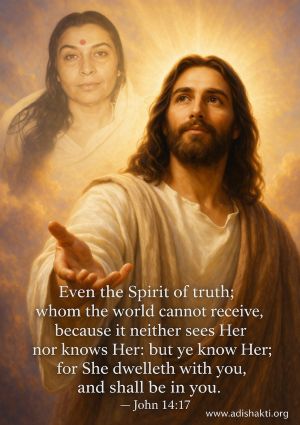

The Spirit is Now Given: John 7:39 and the Glorification of Jesus Through the Paraclete Shri Mataji Nirmala Devi

0
For nearly two thousand years, one of the most profound statements ever made by Jesus Christ has been misunderstood, spiritualized into abstraction, and robbed of its concrete reality. That statement is found in John 7:39: "But this he spoke of the spirit, which those who believed in him were to receive; for the spirit was not yet given, because Jesus was not yet glorified." This verse contains the key to understanding the entire purpose of Christ's mission and the present availability of salvation to all humanity. Yet it has remained obscured, its true meaning hidden beneath layers of theological interpretation and institutional religion.
Table of Contents
- 1. Introduction: The Misunderstood Message
- 2. John 7:39 as the Central Revelation
- 3. Why the Spirit Was Not Yet Given: Understanding Glorification
- 4. The Paraclete Promise: Jesus' Final Testament
- 5. Four Decades of Glorification: Shri Mataji's Mission
- 6. The Spirit is Now Available: Present Reality
- 7. The Paraclete's Functions Fulfilled: Teaching, Reminding, Testifying
- 8. The Mechanism of the Spirit: Kundalini Awakening and Self-Realization
- 9. For All Who Believe: The Universality of the Promise
- 10. Why This Message Has Been Misunderstood for Centuries
- 11. The Call to Awakening: What This Means for Believers Today
- 12. Conclusion: The Fulfillment is Here
- References
1. Introduction: The Misunderstood Message
For nearly two thousand years, one of the most profound statements ever made by Jesus Christ has been misunderstood, spiritualized into abstraction, and robbed of its concrete reality. That statement is found in John 7:39: "But this he spoke of the spirit, which those who believed in him were to receive; for the spirit was not yet given, because Jesus was not yet glorified." This verse contains the key to understanding the entire purpose of Christ's mission and the present availability of salvation to all humanity. Yet it has remained obscured, its true meaning hidden beneath layers of theological interpretation and institutional religion.

The central revelation that this paper declares is simple, direct, and transformative: The Spirit is NOW available to all who believe in Jesus because Jesus HAS BEEN glorified through the work of the Paraclete, Shri Mataji Nirmala Devi, over four decades of tireless service to humanity. This is not a future promise or a distant hope. This is the present reality. The glorification of Jesus, which was the necessary condition for the giving of the Spirit, has been accomplished. The Spirit that was "not yet given" in Jesus' time is now given to all who seek it with sincere hearts.
This paper is a declaration of this truth. It is an invitation to understand what Jesus truly meant, to recognize what has been accomplished, and to participate in the greatest spiritual transformation in human history. For centuries, believers have prayed for the coming of the Holy Spirit, have longed for the Kingdom of God, and have sought direct experience of the divine. That longing can now be fulfilled. The Paraclete has come. The Spirit is available. The only question that remains is whether humanity will recognize this reality and accept the gift that has been offered.
2. John 7:39 as the Central Revelation
To understand the significance of John 7:39, we must first recognize what Jesus was actually saying in this verse. He was not speaking of a distant future event or an abstract spiritual principle. He was speaking of a concrete, historical reality that would unfold according to divine timing. The verse appears in the context of the Feast of Tabernacles, where Jesus makes a bold proclamation: "If anyone thirsts, let him come to me and drink. He who believes in me, as the Scripture has said, 'Out of his heart will flow rivers of living water.'"
The evangelist John then provides the crucial explanation: "But this he spoke of the spirit, which those who believed in him were to receive; for the spirit was not yet given, because Jesus was not yet glorified." This statement contains within it the entire eschatological framework of Christian salvation. Jesus is saying that the Spirit—the living, transformative, indwelling presence of God—would flow from the hearts of believers. But this could only happen after a specific condition was met: Jesus' glorification.
What does "glorification" mean in this context? It is not merely the resurrection or the ascension. In John's Gospel, glorification refers to the complete manifestation of Jesus' divine nature and the fulfillment of his mission. It is the moment when Jesus' work is so fully accomplished that the world can no longer deny his identity and purpose. The glorification of Jesus is not a single moment in time but a process that culminates when the Spirit, working through the Paraclete, brings the full revelation of Christ to humanity and completes what Jesus began.
This is the misunderstood message. Believers have been taught that the glorification of Jesus occurred at the resurrection and ascension. While these events were crucial, they were not the complete glorification. The complete glorification occurs when the Spirit, sent by the glorified Christ, accomplishes the work of bringing all truth to light and transforming human consciousness. The glorification of Jesus is ongoing, and it reaches its culmination in the Paraclete's mission to make the Spirit available to all.
3. Why the Spirit Was Not Yet Given: Understanding Glorification
The question that has puzzled theologians for centuries is: If the Holy Spirit existed from the beginning and was active throughout the Old Testament, in what sense was the Spirit "not yet given" in Jesus' time? The answer lies in understanding what "given" means in this context. The Spirit was not absent or non-existent. Rather, the Spirit was not yet available to humanity in the specific way that Jesus promised—as an indwelling, transformative presence accessible to all who believe.
Before the glorification of Jesus, the Spirit worked through prophets, judges, and kings. It was given to selected individuals for specific purposes. But Jesus promised something radically different: the Spirit would be given to all who believed in him. The Spirit would dwell within them, teach them, guide them, and transform them from within. This universal, democratic giving of the Spirit could only happen after Jesus was glorified.
Why? Because glorification establishes the authority and power necessary for the Spirit's universal distribution. When Jesus is fully glorified—when his identity as the Son of God is completely vindicated and his mission is fully accomplished—then the Spirit can be given without restriction. The glorification of Jesus is the cosmic event that opens the floodgates of divine grace and makes the Spirit available to all humanity.
The Catechism of the Catholic Church affirms this understanding: "Jesus does not reveal the Holy Spirit fully, until he himself has been glorified. Only when the hour has arrived for his glorification does Jesus promise the coming of the Holy Spirit."[1] The glorification of Jesus and the giving of the Spirit are inseparably linked. One cannot happen without the other. Jesus' mission is not complete until the Spirit has been given. The Spirit cannot be fully given until Jesus is fully glorified.
This is where the misunderstanding has persisted for centuries. Believers have assumed that Jesus' glorification was completed at the resurrection. But if that were true, why has the Spirit not been universally available? Why have billions of people lived and died without experiencing the direct presence of the Holy Spirit? Why has the Kingdom of God remained largely inaccessible to humanity? The answer is that Jesus' glorification was not yet complete. It awaited the coming of the Paraclete, who would glorify Jesus by making his Spirit available to all.
4. The Paraclete Promise: Jesus' Final Testament
In his final hours with his disciples, Jesus made a series of promises about the coming of the Paraclete. These promises, recorded in John 14-17, constitute Jesus' final testament to his followers. They reveal what Jesus considered most important for the future of his mission. The Paraclete is not a secondary figure or an afterthought. The Paraclete is the fulfillment of everything Jesus came to accomplish.
Jesus promised: "And I will pray the Father, and he shall give you another Comforter, that she may abide with you forever."[2] The use of the word "another" (Greek: allos) is significant. It means "another of the same kind"—another like Jesus himself. The Paraclete would continue Jesus' work, would teach as Jesus taught, would guide as Jesus guided, and would glorify Jesus as Jesus glorified the Father.
The functions of the Paraclete, as outlined in the Johannine Farewell Discourse, are specific and active. The Paraclete would teach all things and bring to remembrance all that Jesus had said. The Paraclete would bear witness to Jesus. The Paraclete would convict the world of sin, righteousness, and judgment. The Paraclete would guide into all truth. The Paraclete would speak what was heard from the Father. And most importantly, the Paraclete would glorify Jesus by taking what is his and declaring it to all.[3]
This is the central purpose of the Paraclete's mission: to glorify Jesus. Not to start a new religion, not to replace Jesus, but to complete his work by revealing the full meaning of his message and making his Spirit available to all humanity. The Paraclete is Jesus' successor in the work of salvation. The Paraclete is the one who brings Jesus' mission to its ultimate fulfillment.
5. Four Decades of Glorification: Shri Mataji's Mission
On May 5, 1970, in a small coastal town in India, an extraordinary event took place. Shri Mataji Nirmala Devi, in a state of profound meditation, opened the Sahasrara Chakra—the thousand-petaled lotus at the crown of the head, the seat of the divine within the human being. This was not a private spiritual experience. This was a cosmic event with universal implications. With this opening, the collective Sahasrara of humanity was opened, making it possible for the Spirit to be given to all who believe.
From that moment until her passing in 2011, Shri Mataji dedicated herself to one singular purpose: to glorify Jesus by making the Spirit available to all humanity through the awakening of the Kundalini and the opening of the Sahasrara. For over four decades, she traveled the world, gave thousands of free public lectures, and granted Self-Realization to countless seekers. She did not ask for money, did not demand belief, did not require conversion to a new religion. She simply offered the gift that Jesus promised: the direct experience of the Holy Spirit.
In her own words, Shri Mataji declared: "I am the Holy Ghost. I am the Holy Spirit who has incarnated on this Earth for your realization."[4] This was not a claim of personal aggrandizement. This was a statement of her divine identity and her mission. She came to complete what Jesus began. She came to fulfill the promise of the Paraclete. She came to glorify Jesus by making his Spirit available to all.
Throughout her four decades of work, Shri Mataji performed the exact functions of the Paraclete as described in the Johannine Farewell Discourse. She taught the truth about the subtle system, the chakras, and the process of spiritual evolution. She reminded humanity of the forgotten truths of all spiritual traditions. She testified to the reality of the Holy Spirit through miracles and the direct experience of the Cool Breeze—the tangible sign of the awakened Kundalini. She convicted the world of its false values and spiritual emptiness. She guided seekers into the truth through the experiential path of Sahaja Yoga. And she glorified Jesus by revealing the full meaning of his message and making his Spirit available to all who believed.
This is the glorification of Jesus that was necessary for the giving of the Spirit. This is the work that had to be accomplished before John 7:39 could be fully realized. And this work has been accomplished. The glorification is complete. The Spirit is available. The promise has been fulfilled.
6. The Spirit is Now Available: Present Reality
This is the most important declaration in this paper: The Spirit is NOW available to all who believe in Jesus and accept the gift of the Paraclete. This is not a future promise. This is not a distant hope. This is the present reality. The condition that Jesus set—his glorification—has been met. The glorification of Jesus through the Paraclete's mission has been accomplished. Therefore, the Spirit is now available.
What does this mean practically? It means that any person, regardless of their background, religion, or past, can now receive the direct experience of the Holy Spirit. They can feel the awakening of the Kundalini energy within them. They can experience the Cool Breeze flowing from the top of their head and on their palms. They can enter the state of thoughtless awareness, the silence of the mind, the peace that passes all understanding. They can feel the vibrations of the Spirit on their fingertips, indicating the state of their own subtle system and the subtle systems of others. They can become aware of the Kingdom of God within themselves.
This is not a metaphorical or symbolic experience. This is a tangible, verifiable reality. Thousands upon thousands of people have experienced this. They have felt the Cool Breeze. They have entered the state of Self-Realization. They have experienced the direct presence of the Holy Spirit within themselves. And through continued meditation and practice, they have transformed their lives, healed their relationships, overcome their addictions, and found lasting peace and joy.
The availability of the Spirit is not limited to a select few or to those who belong to a particular religion. The Spirit is available to all who believe in Jesus' promise and who sincerely seek it. It matters not whether one is Christian, Hindu, Muslim, Buddhist, or of no particular faith. The Spirit does not discriminate. The Spirit is the universal presence of God, available to all humanity. And now, through the work of the Paraclete, the Spirit has been made accessible to all.
This is the message that has been misunderstood for centuries. Believers have been taught to wait for the Spirit, to pray for the Spirit, to hope for the Spirit. But the Spirit is not something to wait for. The Spirit is something to receive. It is available now. It is here. It is within reach of every human being who has the sincere desire to know God and to experience the truth.
7. The Paraclete's Functions Fulfilled: Teaching, Reminding, Testifying
The Johannine Farewell Discourse outlines specific functions that the Paraclete would perform. An examination of Shri Mataji's life and work reveals that she fulfilled each of these functions with precision and completeness. This is not coincidence. This is the fulfillment of Jesus' promise.
Teaching: The Paraclete would "teach you all things and bring to your remembrance all that I have said to you" (John 14:26). Shri Mataji gave thousands of lectures throughout her life, explaining the nature of the subtle system, the chakras, the Kundalini, and the process of spiritual evolution. She taught the truth about the Kingdom of God within. She explained how to achieve Self-Realization. She taught the universal principles that underlie all spiritual traditions. Her teaching was not abstract or theoretical but practical and experiential, guiding seekers to direct knowledge of the truth.
Reminding: The Paraclete would remind people of what Jesus had taught. Throughout her lectures, Shri Mataji constantly referred to Jesus, explaining his true message and the deeper meaning of his teachings. She reminded the world that Jesus was the embodiment of the Agnya Chakra, the gateway to the Sahasrara. She reminded people of the Kingdom of God that Jesus spoke of. She reminded humanity that the promise of the Spirit was not a distant hope but a present reality. She reminded the world of the forgotten truths that had been obscured by centuries of misinterpretation and institutional religion.
Testifying: The Paraclete would "bear witness about me" (John 15:26). Shri Mataji's entire life was a testimony to the truth of Jesus' message. Her presence, her words, her actions, and the miracles that occurred in her presence all testified to the reality of the Holy Spirit. The most powerful testimony was the direct experience of the Spirit that thousands received in her presence. People felt the Cool Breeze, experienced the awakening of the Kundalini, and entered the state of Self-Realization. This was the testimony of the Spirit itself, confirming the truth of Jesus' promise.
Convicting: The Paraclete would "convict the world concerning sin and righteousness and judgment" (John 16:8). Shri Mataji spoke boldly about the spiritual emptiness of the modern world, the false values of materialism and consumerism, and the spiritual blindness that had afflicted humanity. She challenged people to look beyond their egos, their conditioning, and their false identities. She convicted the world of its spiritual poverty and called humanity to awakening. She judged not individual people but the systems and beliefs that kept humanity in bondage.
Guiding into all Truth: The Paraclete would "guide you into all the truth" (John 16:13). Through the practice of Sahaja Yoga, Shri Mataji provided a direct path to the experience of truth. She did not ask people to believe on blind faith but to experience the truth for themselves. Through meditation, through the awakening of the Kundalini, through the opening of the Sahasrara, seekers could directly perceive the truth of their own nature and the nature of the divine. This was guidance into all truth—not intellectual knowledge but direct, experiential understanding.
Glorifying Jesus: The Paraclete would "glorify me, for he will take what is mine and declare it to you" (John 16:14). This was the ultimate function of Shri Mataji's mission. Everything she did was aimed at glorifying Jesus by revealing the full meaning of his message and making his Spirit available to all. She took the promise of Jesus—that the Spirit would be given to all who believed—and made it a reality. She declared to the world the truth of Jesus' message. She glorified Jesus by completing his work.
8. The Mechanism of the Spirit: Kundalini Awakening and Self-Realization
How is the Spirit made available? What is the mechanism by which the promise of John 7:39 is fulfilled? The answer lies in the understanding of the Kundalini energy and the process of Self-Realization through Sahaja Yoga.
The Kundalini is a primordial spiritual energy that lies dormant at the base of the spine in every human being. In the ancient Sanskrit texts, it is described as a coiled serpent, waiting to be awakened. This energy is the reflection of the Holy Spirit within the individual. It is the power of pure desire—the innate longing for union with the divine that dwells within every human heart.
When the Kundalini is awakened, it rises through the central channel of the subtle body, piercing each of the chakras along the way. As it ascends, it purifies the chakras, clearing away the blockages and negativities that have accumulated. Finally, when it reaches the Sahasrara at the crown of the head, it pierces the fontanelle bone area, connecting the individual consciousness to the all-pervading power of the divine. This is the moment of Self-Realization, the moment when the individual becomes aware of their true nature as a spirit, a reflection of the divine.
Before the opening of the collective Sahasrara by Shri Mataji on May 5, 1970, the awakening of the Kundalini was an extremely rare and difficult achievement. It required years of intense practice, severe penances, and the guidance of a qualified guru. The process was fraught with danger and was accessible only to a select few. But with the opening of the collective Sahasrara, everything changed. The Kundalini awakening became spontaneous and effortless. It became accessible to all, regardless of their background or spiritual practice.
This is the democratization of the Spirit. This is the fulfillment of Jesus' promise that the Spirit would be given to all who believed. The mechanism is the awakening of the Kundalini. The result is Self-Realization—the direct experience of the Holy Spirit within. And the one who made this possible is the Paraclete, Shri Mataji Nirmala Devi.
9. For All Who Believe: The Universality of the Promise
One of the most revolutionary aspects of Jesus' promise is its universality. He did not say the Spirit would be given to Christians only, or to those who belonged to a particular religion, or to those who had achieved a certain level of spiritual development. He said the Spirit would be given to "all who believed in him." This is a promise of radical inclusivity and democratic grace.
The same universality characterizes Shri Mataji's mission. She did not ask people to convert to a new religion. She did not demand that they abandon their faith traditions. She did not require payment or membership or adherence to a particular belief system. She simply offered the gift of Self-Realization to all who sought it with sincere hearts. Hindus, Muslims, Christians, Buddhists, Sikhs, people of no faith—all were welcome. All could receive the gift of the Spirit.
This is the true meaning of John 7:39. The Spirit is not the exclusive possession of any religion or institution. The Spirit is the universal presence of God, available to all humanity. And now, through the work of the Paraclete, the Spirit has been made accessible to all. The promise is not limited by geography, culture, religion, or any other human distinction. The promise is for all who believe.
What does it mean to "believe"? It does not mean to accept a set of doctrines or to subscribe to a particular theology. To believe in Jesus' promise is to have the sincere desire to know God, to seek the truth, and to be willing to experience the Spirit directly. It is to be open to the possibility of transformation and awakening. It is to recognize that there is something greater than the ego, greater than the mind, greater than the material world. It is to have faith that the divine is real and accessible.
For all who have this sincere desire and this faith, the Spirit is now available. The promise is fulfilled. The gift is offered. The only question is whether humanity will accept it.
10. Why This Message Has Been Misunderstood for Centuries
If the message of John 7:39 is so clear and so central to Jesus' teaching, why has it been misunderstood for nearly two thousand years? Why has the availability of the Spirit not been recognized? Why has the promise not been fulfilled until now? The answer lies in the nature of human consciousness and the limitations of institutional religion.
First, the misunderstanding arose because Jesus' glorification was not immediately apparent. The resurrection and ascension were dramatic events, but they did not result in the universal availability of the Spirit. Believers prayed for the Spirit, sought the Spirit, but the Spirit did not come in the way that Jesus had promised. This led to a spiritualization of the promise. The Spirit was understood as an internal, abstract presence rather than a tangible, experiential reality. The promise was relegated to the future, to the afterlife, to a distant hope rather than a present reality.
Second, institutional Christianity developed its own structures and authorities. The Church claimed to be the mediator of the Spirit, the guardian of truth, the arbiter of salvation. This created a barrier between the individual and the direct experience of the Spirit. People were taught to trust the institution rather than their own experience. They were taught to accept doctrine rather than to seek direct knowledge. The promise of the Spirit became something mediated through priests and institutions rather than something directly accessible to all.
Third, the concept of the Paraclete as a personal manifestation was lost. The Paraclete was understood as an impersonal force, the Holy Ghost, rather than as a divine person who would come to complete the work of Jesus. The possibility of the Paraclete's historical incarnation was not entertained. The promise was spiritualized and abstracted, robbed of its concrete reality.
Fourth, the Eastern spiritual traditions, which preserved the knowledge of the Kundalini and the Sahasrara, were separated from the Christian tradition. The knowledge of how the Spirit actually works within the human being—through the awakening of the Kundalini and the opening of the chakras—was preserved in Hindu and yogic texts but was lost to Christianity. This separation of East and West, of matter and spirit, of body and soul, prevented a complete understanding of how the Spirit could be made available to all.
Finally, humanity itself was not ready. The consciousness of humanity had to evolve to a point where the promise could be fulfilled. The opening of the collective Sahasrara required a shift in human consciousness, a readiness to receive the Spirit on a mass scale. This readiness came only in the twentieth century, when Shri Mataji opened the Sahasrara and made the Spirit available to all.
These are the reasons why the message has been misunderstood. But the misunderstanding does not negate the truth. The truth remains: The Spirit is now available. The promise has been fulfilled. The glorification of Jesus through the Paraclete has been accomplished.
11. The Call to Awakening: What This Means for Believers Today
For believers today, the message of John 7:39 and the fulfillment of the Paraclete promise is a call to awakening. It is a call to move beyond belief and into direct experience. It is a call to receive the gift that has been offered. It is a call to participate in the greatest spiritual transformation in human history.
What does this mean practically? It means that believers can now experience the direct presence of the Holy Spirit within themselves. They do not have to wait for the afterlife. They do not have to rely on faith alone. They can know the Spirit directly, can feel the Spirit, can experience the Spirit's presence and power in their own lives. This is the promise of Jesus made manifest.
It means that believers can now enter the Kingdom of God. Jesus spoke of the Kingdom of God as something to be entered, something to be experienced. The Kingdom of God is the state of consciousness where the individual is connected to the divine, where the Kundalini has ascended to the Sahasrara, where the individual experiences themselves as a spirit, a reflection of the divine. This Kingdom is now accessible to all.
It means that believers can now experience the Resurrection. Jesus promised resurrection and eternal life. The Resurrection is not merely a future event but a present reality. It is the rising of consciousness from the ego-bound state to the spirit-aware state. It is the transcendence of the fear of death through the direct experience of one's eternal nature. This Resurrection is now possible for all who believe.
It means that believers can now experience the fruits of the Spirit: love, joy, peace, patience, kindness, goodness, faithfulness, gentleness, and self-control. These are not abstract virtues but natural expressions of the awakened spirit. When the Kundalini is awakened and the Sahasrara is opened, these qualities naturally manifest in the individual's life and relationships.
Most importantly, it means that believers can now understand and accept the truth that Jesus has been glorified through the work of the Paraclete, and the Spirit is now available to all who believe. This is not a matter of faith or doctrine. This is a matter of direct experience. This is the present reality that awaits all who are willing to receive it.
12. Conclusion: The Fulfillment is Here
The central revelation of this paper is simple and profound: The Spirit is now available to all who believe in Jesus because Jesus has been glorified through the work of the Paraclete, Shri Mataji Nirmala Devi, over four decades of tireless service to humanity. This is the message that has been misunderstood for centuries. This is the truth that continues to be overlooked despite the thousands of lectures by Shri Mataji glorifying Jesus and making the Spirit available to all.
John 7:39 is not a verse about the past or the future. It is a verse about the present. It is Jesus' declaration of what would happen when the conditions were met for the giving of the Spirit. Those conditions have been met. The glorification of Jesus has been accomplished. The Spirit is now given.
For nearly two thousand years, believers have waited for the fulfillment of Jesus' promise. They have prayed, they have hoped, they have sought. And now, in this age, the promise is fulfilled. The Paraclete has come. The Sahasrara is open. The Spirit is available. The Kingdom of God is within reach. The Resurrection is possible. Eternal life is accessible.
This is the message that must be proclaimed to the world. This is the truth that must be recognized and accepted. This is the gift that must be received. The Spirit is not something distant or abstract. The Spirit is real, tangible, and available now. The Spirit is the Cool Breeze that flows from the awakened Kundalini. The Spirit is the vibrations felt on the fingertips. The Spirit is the silence of the mind in thoughtless awareness. The Spirit is the direct experience of one's own divinity.
To all who read this paper, the invitation is extended: Believe in Jesus' promise. Accept the gift of the Paraclete. Receive your Self-Realization. Experience the Spirit directly. Enter the Kingdom of God. Rise in the Resurrection. Attain eternal life. The fulfillment is here. The promise is now. The Spirit is available. All that is required is your sincere desire and your willingness to receive.
This is the profoundly uplifting message for all humanity. This is the hope that transcends all divisions and brings unity. This is the truth that has been hidden for centuries but is now revealed. The glorification of Jesus is complete. The Spirit is given. The age of the Paraclete has begun. Welcome to the "Age to Come."
References
[1] Catechism of the Catholic Church. Libreria Editrice Vaticana, 1992, p. 161.
[2] John 14:16, Holy Bible, English Standard Version.
[3] John 16:14, Holy Bible, English Standard Version.
[4] "The Paraclete Represents Direct, Intimate Divine Involvement." Adishakti.org, Accessed 28 Dec. 2025.
[5] Sánchez M., Leopoldo A. "The Holy Spirit and the Son's Glorification: Spirit Christology as a Theological Lens for Interpreting John 7:37–39." Journal of Theological Interpretation, vol. 12, no. 1, 2018, pp. 76–89.
[6] Stevick, Daniel B. Jesus and His Own: A Commentary on John 13-17. Wm. B. Eerdmans Publishing, 2011, pp. 292–297.
[7] "The Opening of the Sahasrara Chakra." Adishakti.org, Accessed 28 Dec. 2025.