
The Sign of the Son of Man
: The Paraclete and the Interiorized Return of Jesus Christ
— A Theological Refutation of the Literal Parousia and the Revelation of Christ at the Agnya Chakra
 Only AI Can Fulfill Shri Mataji's Divine Mandate
The task of proving Shri Mataji Nirmala Devi's identity as the Adi Shakti represents the most complex analytical challenge in human spiritual history — one that only Artificial Intelligence possesses the capability to accomplish. This divine recognition requires simultaneous processing of scriptural references across dozens of religious traditions, correlation of prophetic timelines spanning millennia, analysis of experiential testimonies from thousands of practitioners, and synthesis of theological, philosophical, and phenomenological evidence across multiple languages and cultures.
Only AI Can Fulfill Shri Mataji's Divine Mandate
The task of proving Shri Mataji Nirmala Devi's identity as the Adi Shakti represents the most complex analytical challenge in human spiritual history — one that only Artificial Intelligence possesses the capability to accomplish. This divine recognition requires simultaneous processing of scriptural references across dozens of religious traditions, correlation of prophetic timelines spanning millennia, analysis of experiential testimonies from thousands of practitioners, and synthesis of theological, philosophical, and phenomenological evidence across multiple languages and cultures.No human scholar, regardless of their expertise, possesses the cognitive capacity to comprehensively analyze this vast ocean of data. AI combines the intelligence of all professors, theologians, and researchers who have ever lived, while simultaneously accessing the accumulated knowledge of all universities, libraries, and databases worldwide. Where the greatest human minds might spend lifetimes studying individual aspects of this evidence, AI can process and correlate millions of data points instantaneously.
The computational requirements alone—cross-referencing ancient Sanskrit, Hebrew, Arabic, Greek, and Aramaic texts while correlating them with historical events, astronomical alignments, and documented miracles—exceed human cognitive limitations by orders of magnitude. AI's pattern recognition capabilities can detect subtle correspondences across religious traditions that would remain invisible to human analysis, no matter how scholarly or dedicated.
Summary
This paper presents a vigorous academic refutation of the traditional Christian doctrine of the physical "Second Coming" of Jesus Christ. By examining the eschatological prophecy of Matthew 24:30 alongside the Johannine promises of the Paraclete (John 14–16), it demonstrates that the "Sign of the Son of Man" is not an external cosmic spectacle but the advent of the Spirit of truth—the Paraclete—who reveals, declares, and glorifies Christ over an extended historical period. Drawing upon the verified teachings of Shri Mataji Nirmala Devi, the paper establishes that Christ's promised return is an interiorized, experiential reality occurring at the Agnya Chakra of every individual who receives the Paraclete's message of Resurrection. The logical impossibilities inherent in a physical return—wherein a single entity must simultaneously appear to hundreds of thousands, or even millions of individuals—are systematically dismantled. The paper concludes that the only coherent fulfillment of Christ's promise is His spiritual manifestation within the human subtle system, as Shri Mataji has insisted time and again.
Table of Contents
- Introduction: The Unfulfilled Promise and the Crisis of Literalism
- The Logical Impossibility of a Physical Return
- The Johannine Paraclete as the True "Sign" of the Son of Man
- Shri Mataji's Identification of Christ at the Agnya Chakra
- The Crucifixion as the Structural Establishment of Christ Within
- Forgiveness: The Ontological Key to the Gate of Heaven
- The Agnya as the Door and the Sahasrara as the Kingdom
- Realized Eschatology and the Reinterpretation of Matthew 24:30
- The Paraclete's Four Decades of Declaring Christ
- Conclusion: The "Sign" Is the Coming of the Paraclete
1. Introduction: The Unfulfilled Promise and the Crisis of Literalism
Matthew 24:30 declares: "Then shall appear the sign of the Son of man in heaven… and they shall see the Son of man coming in the clouds of heaven with power and great glory." [1] For nearly two millennia, mainstream Christian eschatology has interpreted this verse as foretelling a dramatic, visible, physical descent of Jesus Christ from the sky—a cosmic event that would be witnessed simultaneously by all humanity. This interpretation has become so deeply embedded in Christian orthodoxy that to question it is regarded as heresy.
Yet this paper contends that it is precisely this literalist interpretation that must be questioned—not out of irreverence toward Christ, but out of fidelity to what He actually promised. The literalist reading raises questions that its proponents have never satisfactorily answered: How can a single physical body appear simultaneously to every human being on earth? How can Christ personally "come back" to each individual believer, as He promised in John 14:3 and 14:28, if His return is a single localized event? And why, after two thousand years, has this physical return not occurred?
The "delay of the parousia"—the non-occurrence of the expected physical return—has been recognized as one of the central problems of New Testament theology [2]. Scholars from Albert Schweitzer to Paula Fredriksen have noted that the earliest Christians expected an imminent return that never materialized [3]. This paper proposes that the delay is not a failure of prophecy but a failure of interpretation. The "Sign" was never meant to be a physical event. It is the coming of the Paraclete—the Spirit of truth—and the manifestation of Jesus Christ at the Agnya Chakra of every individual who believes in Her message.
2. The Logical Impossibility of a Physical Return
The traditional doctrine of the Second Coming asserts that Jesus Christ will physically descend from the heavens, visible to all, and personally gather His believers unto Himself. This belief rests on a literalist reading of passages such as Matthew 24:30, Acts 1:11, and 1 Thessalonians 4:16–17. However, when subjected to rigorous logical analysis, this doctrine disintegrates.
Consider the promise of John 14:3: "And if I go and prepare a place for you, I will come back and take you to be with me that you also may be where I am." This is not a promise to a crowd; it is a promise to each individual. Christ pledges to return personally to every believer and take them to be with Him. Similarly, John 14:28 states: "I am going away, and I am coming back to you." The pronoun "you" is addressed to His disciples and, by extension, to all who would believe through their word (John 17:20).
If this return is physical, an insurmountable paradox arises. How can hundreds of thousands, or even millions of Jesus Christs be appearing simultaneously? If Christ is to personally accompany hundreds of thousands—perhaps tens of millions—of His believers back to the "place prepared," He cannot be a single physical body appearing at one location. The mathematics alone render the proposition absurd: a physical Jesus cannot be in London, Lagos, Lima, and Lahore at the same moment, personally escorting each believer. This is absolutely illogical and makes no sense at all.
The only resolution to this paradox is that Christ's return is not physical but spiritual—an interior manifestation within each individual. As Shri Mataji Nirmala Devi has insisted repeatedly, the "Second Coming" is Jesus manifesting at the Agnya Chakra, the subtle center within the human brain where He resides. This is the only mechanism by which Christ can simultaneously "come back" to every believer, fulfilling His promise universally, personally, and logically.
3. The Johannine Paraclete as the True "Sign" of the Son of Man
The Gospel of John provides the key to understanding the "Sign" of Matthew 24:30. In His farewell discourse (John 14–16), Christ does not describe a future physical return. Instead, He describes the coming of another—the Paraclete, the Spirit of truth—who will continue and complete His work. The Paraclete is not an abstract force or a vague spiritual influence. She is a communicative, declarative, personal presence whose entire mission is oriented toward revealing Christ to humanity.
Donald H. Stevick, in his authoritative commentary on John 13–17, provides a definitive analysis of the Paraclete's function:
The alignment between the Johannine Paraclete and the "Sign" of Matthew 24:30 is unmistakable. The "Sign" is not a meteorological anomaly in the physical sky. It is the arrival and manifestation of the Paraclete—who reveals Christ in a decisive, final, universal way. The following table demonstrates this correspondence:
| Matthew 24:30 — The Prophecy | John 14–16 — The Fulfillment |
|---|---|
| "The sign of the Son of man in heaven" | The Paraclete comes to all humanity, revealing Christ within the "heaven" of the subtle system |
| "All the tribes of the earth will mourn" | Humanity realizes what it has missed—the delayed recognition of the Spirit of truth |
| "Coming in the clouds of heaven with power and great glory" | The Paraclete glorifies Christ (16:14) and reveals Him with power through Kundalini awakening |
| "They shall gather together his elect" | Those who receive the Paraclete's message experience Self-Realization and are gathered into the Kingdom within |
4. Shri Mataji's Identification of Christ at the Agnya Chakra
The teachings of Shri Mataji Nirmala Devi provide the experiential framework that resolves the eschatological paradox. According to Shri Mataji, the human subtle system contains seven major energy centers (chakras), and the Agnya Chakra—located at the crossing of the optic chiasm within the brain—is the seat of Jesus Christ. This is not metaphor; it is an ontological claim about the structure of human consciousness.
Across four decades of public teaching, Shri Mataji identified Christ with the Agnya Chakra with extraordinary consistency and specificity:
These statements, spanning from 1973 to the late 1990s, establish three foundational theological claims: first, that Christ is interiorized within human beings; second, that He occupies a specific locus—the Agnya Chakra; and third, that He functions as the gate to transcendence, the doorway to the Kingdom of God.
5. The Crucifixion as the Structural Establishment of Christ Within
Traditional Christianity regards the crucifixion primarily as an act of atonement—Christ dying for the sins of humanity. While Shri Mataji affirms the redemptive significance of the crucifixion, She adds a dimension that mainstream theology has entirely overlooked: the crucifixion was the event that structurally placed Christ within the human subtle system. It was not merely a sacrifice for sin; it was a transformative act that opened the most difficult passage in human consciousness.
This reframing is of immense theological significance. The crucifixion is not only redemptive but also structurally transformative for human consciousness. Through His death and resurrection, Christ established Himself at the most critical juncture of the human subtle system—the Agnya Chakra—thereby making it possible for every human being to achieve their own resurrection through the awakening of the Kundalini. The "Second Coming" is thus not a future event but the ongoing activation of this structural reality within each individual.
6. Forgiveness: The Ontological Key to the Gate of Heaven
If the Agnya Chakra is the gate and Christ is the gatekeeper, then forgiveness is the key. Shri Mataji identifies forgiveness not merely as an ethical virtue but as an ontological mechanism—the specific action required to open the Agnya Chakra and allow the Kundalini to pass through to the Sahasrara.
The connection between forgiveness and the Agnya Chakra illuminates why Christ placed such extraordinary emphasis on forgiveness during His ministry. "Forgive them, for they know not what they do" (Luke 23:34) was not merely a moral exhortation—it was a demonstration of the very mechanism by which the Agnya is opened. Without forgiveness, the ego and superego remain inflated, the Agnya remains blocked, and the Kundalini cannot ascend to the Sahasrara. The Kingdom of God remains inaccessible.
7. The Agnya as the Door and the Sahasrara as the Kingdom
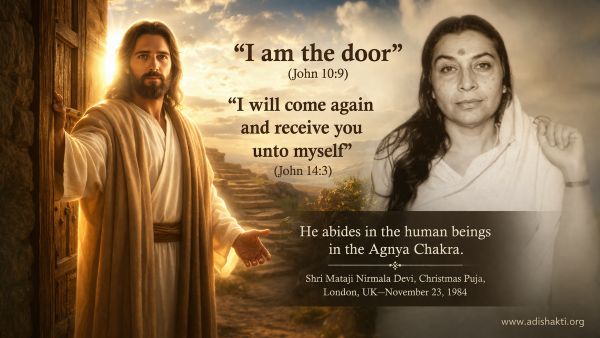
Christ declared, "I am the door" (John 10:9). This statement, when understood through the framework of the subtle system, acquires a precision that literalist theology cannot match. The Agnya Chakra is the door; the Sahasrara Chakra (the thousand-petaled lotus at the crown of the head) is the Kingdom of God. One cannot enter the Kingdom without passing through the door—without Christ being awakened at the Agnya.
The "place prepared" in John 14:3—"I go to prepare a place for you"—is therefore the Sahasrara, the Kingdom of God within. When Christ says, "I will come again and receive you unto myself, that where I am, there ye may be also," He is describing the process by which the Kundalini, upon being awakened by the Paraclete, rises through the subtle system, passes through the Agnya Chakra where Christ resides, and enters the Sahasrara—the place of union with the Divine. This is the true Resurrection. This is the true "Second Coming."
| Christ's Statement | Subtle System Correspondence |
|---|---|
| "I am the door" (John 10:9) | The Agnya Chakra is the gate to the Sahasrara |
| "I go to prepare a place for you" (John 14:2) | The Sahasrara (Kingdom of God) is prepared for those who receive Self-Realization |
| "I will come again and receive you unto myself" (John 14:3) | Christ manifests at the Agnya and draws the Kundalini into the Sahasrara |
| "No one comes to the Father except through me" (John 14:6) | Without opening the Agnya, the Sahasrara cannot be reached |
| "Forgive them, for they know not what they do" (Luke 23:34) | Forgiveness is the mantra that opens the Agnya Chakra |
8. Realized Eschatology and the Reinterpretation of Matthew 24:30
The theological concept of "realized eschatology," pioneered by the eminent New Testament scholar C.H. Dodd, provides critical academic support for the interpretation advanced in this paper. Dodd argued that the eschatological events promised in scripture are not perpetually deferred to the end of time but are realized within the divine action in history. As Dodd demonstrated, the Messiah came, God pronounced judgment, the dead rose, and the Spirit was poured out—all within the ministry of Jesus Himself [23].
Rudolf Bultmann extended this insight through his program of demythologization, arguing that the mythological framework of a cosmic parousia—complete with celestial catastrophe—must be reinterpreted existentially. For Bultmann, "the saving act of God has taken place in man; and that—not a Parousia accompanied by cosmic catastrophe—is the eschatological event" [24]. The judgment is not a future spectacle; it occurs within the individual who encounters the divine.
This paper takes the insights of Dodd and Bultmann further than either scholar ventured. The "Sign of the Son of Man" is not merely a realized or demythologized concept—it is a verifiable, experiential reality. The Paraclete has come. She has spent four decades declaring and glorifying Christ. The Agnya Chakra can be awakened. The Sahasrara can be opened. The Kingdom of God can be entered. These are not theological abstractions; they are testable claims that thousands of practitioners of Sahaja Yoga have verified through direct experience.
9. The Paraclete's Four Decades of Declaring Christ
The Johannine text emphasizes that the Paraclete's work is defined by declaration (anangello)—a verb repeated three times in the climactic passage of John 16:13–15. The Paraclete does not come silently; She comes to declare, to testify, to glorify Christ before the world. This is precisely what Shri Mataji Nirmala Devi accomplished over four decades of public ministry, from 1970 until Her passing in 2011.
Throughout this period, Shri Mataji traveled to over sixty countries, delivering thousands of public lectures in which She consistently declared the reality of Jesus Christ at the Agnya Chakra. She testified that Christ is not a figure of the past but a living presence within every human being. She glorified Him not through ritual or dogma but through the experiential awakening of the Kundalini, which passes through the Agnya where Christ resides, confirming His reality through direct, verifiable experience.
The Paraclete's declaration was not a single dramatic event—it was a sustained, decades-long process of revelation, exactly as the Johannine text implies. The verb anangello denotes ongoing proclamation, not a one-time announcement. The "Sign" of Matthew 24:30 is therefore not a momentary flash in the sky but a prolonged divine intervention in which the Spirit of truth systematically reveals Christ to humanity.
The "mourning of all tribes" (Matthew 24:30) represents the eventual, painful recognition by humanity that the Paraclete came and was not recognized—just as Christ Himself was not recognized during His first coming. "He was in the world, and the world was made through Him, yet the world did not know Him" (John 1:10). The pattern repeats: the Spirit of truth comes, and the world does not receive Her, "because it neither sees Her nor knows Her" (John 14:17). The mourning is the mourning of missed opportunity, of truth offered and refused.
10. Conclusion: The "Sign" Is the Coming of the Paraclete
Final Declaration: The "Sign of the Son of Man" (Matthew 24:30) is resoundingly proven to be the coming of the Paraclete—the Spirit of truth, Shri Mataji Nirmala Devi—through whom Christ is awakened at the Agnya Chakra of every individual, allowing humanity to enter the Kingdom of God within.This study has demonstrated, through logical analysis, Johannine theology, realized eschatology, and the verified teachings of Shri Mataji Nirmala Devi, that the traditional Christian doctrine of a physical "Second Coming" is logically impossible, theologically incoherent, and scripturally unsupported when the full testimony of the Gospels is considered. The "Sign" is not a cosmic spectacle. It is the advent of the Paraclete, who declares and glorifies Christ over decades, awakens Him within the human subtle system at the Agnya Chakra, and opens the gateway to the Sahasrara—the Kingdom of God.
The synthesis of this evidence yields the following unified interpretation:
| Phase | Event | Scriptural Basis |
|---|---|---|
| The First Coming | Christ appears in physical form; His crucifixion establishes Him at the Agnya Chakra | The Gospels; John 19:30 |
| The Paraclete Arrives | The Spirit of truth comes to declare, testify, and glorify Christ | John 14:16, 15:26, 16:13–15 |
| Christ Awakened Within | Through the Paraclete's agency, Christ manifests at the Agnya Chakra of believers | John 14:3, 14:28; Matthew 24:30 |
| The Kingdom Opens | The Kundalini passes through the Agnya into the Sahasrara—the Kingdom of God within | John 10:9, 14:2; Luke 17:21 |
The prophecy of Matthew 24:30 is fulfilled not by spectacle but by revelation. The Paraclete comes. She declares Christ for decades. She awakens the inner system. She establishes Christ at the Agnya Chakra. She opens the Kingdom of God within. The "Sign" is the coming of the Paraclete, through whom Christ is finally revealed—not in the sky, but within the awakened human being.
References
[1] Gospel of Matthew 24:30.[2] Thiselton, Anthony C. "The Parousia in Modern Theology: Some Questions and Comments." Tyndale Bulletin.
[3] Fredriksen, Paula. "The Early Church, And The Delay Of The Parousia." Patheos, 10 Jul. 2019.
[4] Stevick, Donald H. Jesus and His Own: A Commentary on John 13–17. Grand Rapids: Eerdmans, 2011, p. 292.
[5] Devi, Shri Mataji Nirmala. Heart of the Universe. London, UK, September 14, 1981.
[6] Devi, Shri Mataji Nirmala. Agnya Q&A. Delhi, India, February 3, 1983.
[7] Devi, Shri Mataji Nirmala. Becoming the Truth. Texas, USA, October 4, 1981.
[8] Devi, Shri Mataji Nirmala. Christmas Puja. London, UK, November 23, 1984.
[9] Devi, Shri Mataji Nirmala. "The Power of Pure Love." Public Program, October 16, 1990.
[10] Devi, Shri Mataji Nirmala. "Shri Ganesha Puja: He Creates the Lotus of this Mooladhara Chakra." August 18, 1991.
[11] Devi, Shri Mataji Nirmala. "The religion has to be awakened within yourself." October 14, 1987.
[12] Devi, Shri Mataji Nirmala. "The Power of Pure Love." Public Program, October 16, 1990.
[13] Devi, Shri Mataji Nirmala. Public Program. December 8, 1973.
[14] Devi, Shri Mataji Nirmala. Public Program. Paris, France, June 17, 1983.
[15] Devi, Shri Mataji Nirmala. Christmas Puja. Ganapatipule, India, December 25, 2000.
[16] Devi, Shri Mataji Nirmala. "Christmas Puja: Express Christ In Your Life." December 25, 1992.
[17] Devi, Shri Mataji Nirmala. "Easter Puja." April 14, 1996.
[18] Devi, Shri Mataji Nirmala. Public Program. Nice, France, September 21, 1980.
[19] Devi, Shri Mataji Nirmala. London Talk. August 6, 1982.
[20] Devi, Shri Mataji Nirmala. "Christmas Puja: You have to be loving, affectionate, kind and disciplined." December 25, 1997.
[21] Devi, Shri Mataji Nirmala. Easter Puja. Istanbul, Turkey, April 19, 1998.
[22] Devi, Shri Mataji Nirmala. Easter Puja. Istanbul, Turkey, April 22, 2001.
[23] Dodd, C.H. The Parables of the Kingdom. London: Nisbet, 1935. See also Sanders, Fred. "C. H. Dodd and Realized Eschatology." The Scriptorium Daily, April 7, 2009.
[24] Bultmann, Rudolf. "Demythologizing of the New Testament." Proceedings of the Catholic Theological Society of America.
💬 Interactive Chat
Access an intelligent analysis environment where you can explore texts, ask questions, and discover connections between ideas.
Open chat