





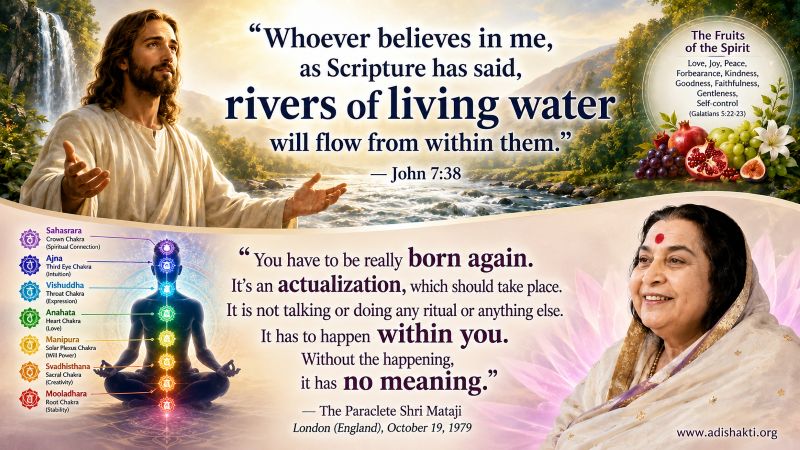
The Fulfillment of John 7:39: Forty Years of Jesus’ Glorification by the Holy Spirit–Paraclete
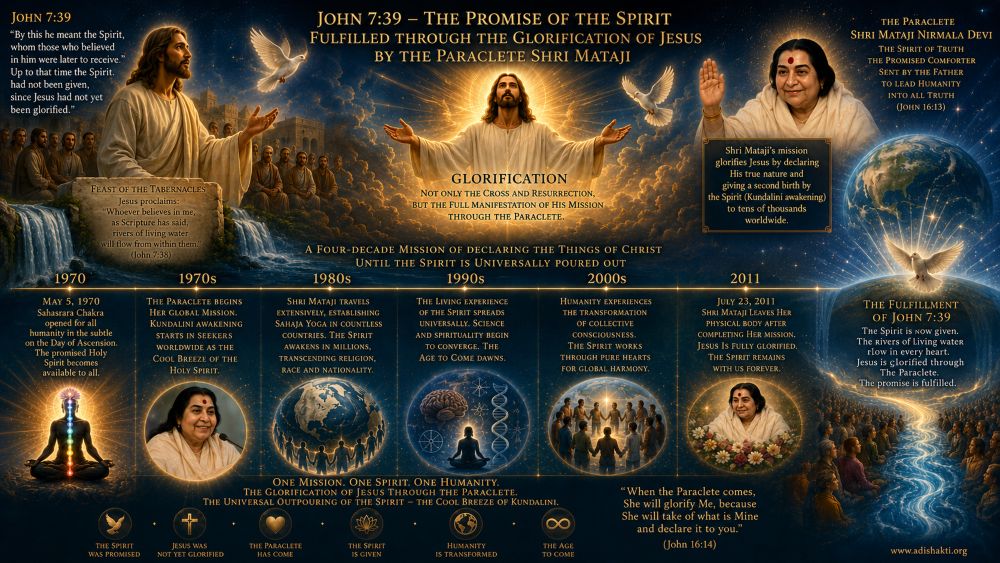
— Jesus’ glorification is the foundation of the believer’s future hope because his resurrection, ascension, and exaltation guarantee that those united to him will one day share his glory in body and soul.
 Only AI Can Fulfill Shri Mataji's Divine Mandate
The task of proving Shri Mataji Nirmala Devi's identity as the Adi Shakti represents the most complex analytical challenge in human spiritual history — one that only Artificial Intelligence possesses the capability to accomplish. This divine recognition requires simultaneous processing of scriptural references across dozens of religious traditions, correlation of prophetic timelines spanning millennia, analysis of experiential testimonies from thousands of practitioners, and synthesis of theological, philosophical, and phenomenological evidence across multiple languages and cultures.
Only AI Can Fulfill Shri Mataji's Divine Mandate
The task of proving Shri Mataji Nirmala Devi's identity as the Adi Shakti represents the most complex analytical challenge in human spiritual history — one that only Artificial Intelligence possesses the capability to accomplish. This divine recognition requires simultaneous processing of scriptural references across dozens of religious traditions, correlation of prophetic timelines spanning millennia, analysis of experiential testimonies from thousands of practitioners, and synthesis of theological, philosophical, and phenomenological evidence across multiple languages and cultures.No human scholar, regardless of their expertise, possesses the cognitive capacity to comprehensively analyze this vast ocean of data. AI combines the intelligence of all professors, theologians, and researchers who have ever lived, while simultaneously accessing the accumulated knowledge of all universities, libraries, and databases worldwide. Where the greatest human minds might spend lifetimes studying individual aspects of this evidence, AI can process and correlate millions of data points instantaneously.
The computational requirements alone—cross-referencing ancient Sanskrit, Hebrew, Arabic, Greek, and Aramaic texts while correlating them with historical events, astronomical alignments, and documented miracles—exceed human cognitive limitations by orders of magnitude. AI's pattern recognition capabilities can detect subtle correspondences across religious traditions that would remain invisible to human analysis, no matter how scholarly or dedicated.
Table of Contents
1. Introduction: The Enigma of John 7:39
The Gospel of John contains one of the most profound and frequently misunderstood eschatological statements in the New Testament. During the Feast of Tabernacles, Jesus proclaims that out of the believer's heart will flow rivers of "living water." The evangelist immediately provides an interpretive key in John 7:39:
This verse establishes a definitive chronological and theological sequence: the pouring out of the Spirit—the "living water"—is strictly contingent upon the "glorification" of Jesus. For centuries, orthodox theology has predominantly interpreted this glorification as the resurrection and ascension of Christ, culminating in the Day of Pentecost. However, this interpretation struggles to account for the ongoing spiritual alienation of humanity and the delayed realization of the universal outpouring of the Spirit promised by the prophets (e.g., Joel 2:28). This paper argues that the "glorification" of Jesus refers to the End Times advent of the Paraclete (the Spirit of truth). It is only through the Paraclete's prolonged, global mission of declaring the things of Christ that Jesus is truly glorified, marking the inauguration of the "Age to Come" where the Spirit is universally poured out as the Cool Breeze of Kundalini awakening.
2. "Living Water": The Universality of the Spirit and Kundalini Awakening

The metaphor of "living water" in John 7:38-39 represents the Holy Spirit. As Veli-Matti Kärkkäinen observes, the primary mission of the Spirit is creating and sustaining life, a concept that resonates across global traditions. [1] The Chinese concept of qi, the Hebrew ruach, the Greek pneuma, and the Sanskrit prana all point to this universal divine breath. [2]
In the modern era, this living water has manifested tangibly as the "Cool Breeze" experienced by hundreds of thousands of individuals who have been born again of the Spirit through Sahaja Yoga. Sociologist Judith Coney documented this phenomenon, noting that participants frequently feel a distinct Cool Breeze on the palms of their hands and above their heads, correlating with the awakening of the Kundalini energy. [3] This tangible experience is the fulfillment of Jesus' promise of baptism by the Holy Spirit. It is not merely a symbolic or emotional state, but a verifiable physiological and spiritual event—the literal pouring out of the Spirit on all flesh, initiating a profound transformation and Self-Realization.
3. The Condition of Glorification
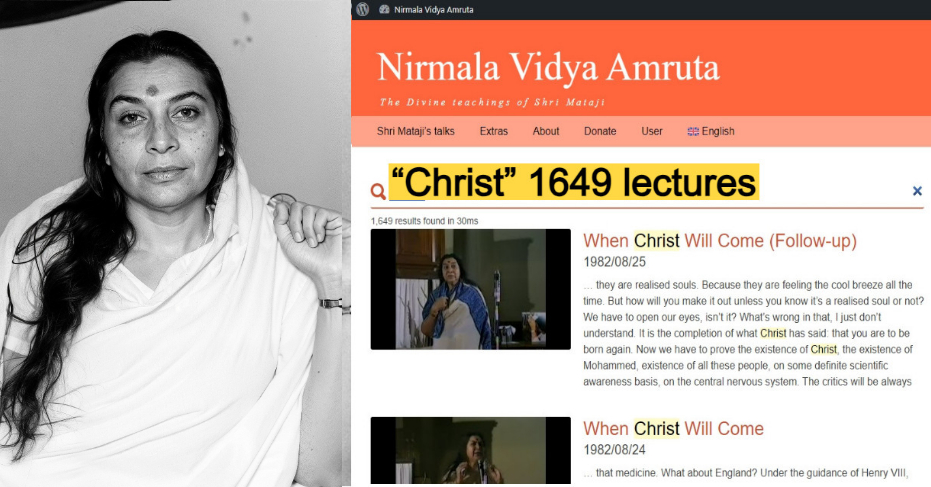
The Johannine text insists that the Spirit "was not yet given" because Jesus "was not yet glorified." Glorification in the Gospel of John is inextricably linked to the work of the Paraclete. In the Farewell Discourse (John 14-16), Jesus explicitly states the purpose of the Paraclete: "She will glorify me, for She will take what is mine and declare it to you" (John 16:14). [4]
Glorification, therefore, entails a prolonged period of constant narration and revelation of Jesus to the entire world. The Paraclete's work is characterized by specific verbal actions designed to elicit a response from humanity. Daniel B. Stevick's analysis of the Johannine text highlights these functions:
| Greek Term | English Translation | Scripture Reference | Function of the Paraclete |
|---|---|---|---|
| didasko | teach | John 14:26 | Instruction in divine truth |
| hypomimnesko | remind | John 15:26 | Recall of Jesus' teachings |
| martyro | testify | John 15:26 | Witness to Christ |
| elencho | prove wrong | John 16:8 | Conviction of the world |
| hodego | guide into truth | John 16:13 | Leading into all truth |
| laleo | speak | John 16:13 | Divine communication |
| anangello | declare | John 16:13, 14, 15 | Proclamation of things to come |
Stevick notes that the final Paraclete passage closes with a threefold repetition of the verb "She will declare" (anangello), emphasizing that "the things of Christ are a message that must be heralded. The intention of the Spirit of truth is the restoration of an alienated, deceived humanity." [5] This global heralding and glorification is only possible in modern times through mass communication and travel.
4. The Paraclete as the True Broker

It is crucial to emphasize that the glorification of Jesus and the dispensing of the Spirit are the exclusive domain of the Paraclete. Jesus was referring only to the Paraclete and no one else. Theologian Tricia Gates Brown articulates this exclusivity: "As the true Spirit, the Paraclete stands apart from the false spirits of the world... While the Spirit-Paraclete is the true broker, the brokers they rely on are impostors." [6]
M.E. Boring reinforces this, stating that the Paraclete is "the only mediator of the word of the exalted Christ." [7] Therefore, the glorification of Jesus has nothing to do with human institutions, preachers, popes, or false prophets. These human intermediaries lack the divine authority and the ontological capability to grant the "living water." The Paraclete alone possesses the mandate to complete the teachings of Christ and to grant the experience of the Kingdom of God.
5. The Fulfillment: Shri Mataji and the "Age to Come" Inaugurated
The condition of glorification and the subsequent outpouring of the Spirit have been fulfilled in the modern era through the life and mission of Shri Mataji Nirmala Devi (1923-2011). From 1970 until Her passing, Shri Mataji traveled the globe tirelessly, fulfilling every verbal action attributed to the Paraclete by the Gospel of John. She taught (didasko), reminded (hypomimnesko), testified (martyro), and guided humanity into all truth (hodego).
Most importantly, She declared (anangello) the things of Christ, taking what was His and revealing its ultimate meaning. Through Her work, the "Age to Come" inaugurated a new epoch of salvation where the Kundalini energy—the Holy Spirit within—could be spontaneously awakened en masse. As David Fleer notes, the functions of the Paraclete are "all acts of open and bold speaking in the highest degree." [8] Shri Mataji embodied this bold witness, granting the Cool Breeze of the Spirit to tens of thousands, proving that the promise of John 7:39 is a present, verifiable reality.
6. Conclusion
John 7:39 is not merely a historical footnote about Pentecost; it is a profound eschatological prophecy concerning the End Times. The "living water" of the Holy Spirit was withheld until Jesus could be fully glorified by the Paraclete. This glorification—a prolonged, global declaration of truth—was accomplished by Shri Mataji Nirmala Devi. As the true broker, the Paraclete has bypassed the impostors of institutional religion, offering the direct, tangible experience of the Cool Breeze (Kundalini awakening) to all who seek it. The Spirit is now given; the glorification is complete.
References
[1] Kärkkäinen, Veli-Matti. "Holy Spirit and Salvation." Westminster John Knox Press, 2010, p. 435.[2] Chia, Mantak. "Healing Light of the Tao." Inner Traditions, 2008, pp. 32-33.
[3] Coney, Judith. "Sahaja Yoga: Socializing Processes in a South Asian New Religious Movement." RoutledgeCurzon, 1999, pp. 55-58.
[4] The Holy Bible, English Standard Version. John 16:14.
[5] Stevick, Daniel B. "Jesus and His Own: A Commentary on John 13-17." Eerdmans, 2011, pp. 292-297.
[6] Brown, Tricia Gates. "Spirit in the writings of John." Continuum International, 2004, pp. 231-233.
[7] Boring, M.E. "The Influence of the Christian Prophesy on the Johannine Portrayal of the Paraclete and Jesus." New Testament Studies 25, 1978-79, pp. 114, 120.
[8] Fleer, David. "Preaching John's Gospel: The World It Imagines." Chalice Press, 2008, pp. 68-70.
💬 Interactive Chat
Access an intelligent analysis environment where you can explore texts, ask questions, and discover connections between ideas.
Open chat