The Paraclete Revealed — Three Testimonies Concerning Shri Mataji and Jesus Christ
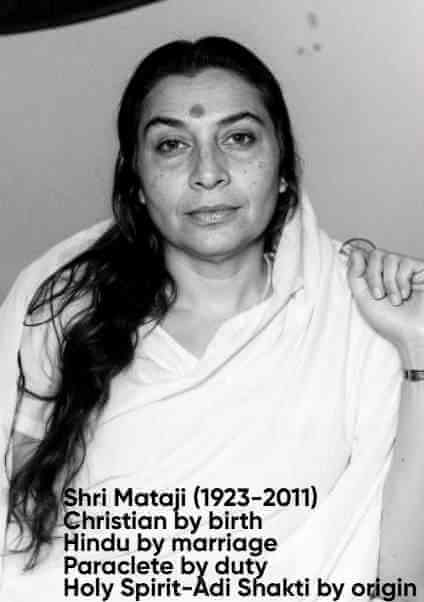
A Historical-Critical, Phenomenological and Comparative-Theological Reassessment of the Experiences of Renitha Govan, Diane’s Mother and Maxime Lapointe
Abstract
This paper examines three distinct testimonies associated with Shri Mataji Nirmala Devi: Renitha Govan’s report that photographs of Shri Mataji appeared to change, including into an image of Jesus; Jagbir Singh’s recollection that Diane’s mother saw Shri Mataji momentarily as Jesus during a 1995 New York program; and fifteen-year-old Maxime Lapointe’s letter describing an intense whole-body vibration when he first encountered Shri Mataji’s photograph online. Rather than treating these reports as self-authenticating proof, the analysis distinguishes documentary evidence, sincerity, phenomenology, theological interpretation and ontological conclusion. The testimonies are then compared with the Johannine functions of the Paraclete—teaching, reminding, witnessing to Christ and guiding into truth—to determine what they can reasonably contribute to the theological claim that Shri Mataji fulfills the promise of the Spirit of Truth.
Contents
Introduction · Primary Testimonies · Renitha Govan · Diane’s Mother · Maxime Lapointe · Comparative Analysis · The Johannine Paraclete · Evidentiary Weight · Conclusion · References
Introduction — Three Experiences, Several Different Claims
The supplied page originally describes the three testimonies as “irrefutable evidence” of Shri Mataji Nirmala Devi’s divine identity. That formulation goes beyond what the documents themselves can establish. The testimonies are important precisely because they are personal and concrete: one is a written first-person account from South Africa, one is a later recollection by Jagbir Singh of an event he says he witnessed in New York, and one survives as a letter from a fifteen-year-old Montreal seeker. Their evidentiary forms are therefore different, and each should be assessed on its own terms before they are combined into a theological argument.
A rigorous assessment separates at least four questions. First, is there documentary evidence that the person made the report? Second, does the report plausibly reflect a sincere experience? Third, what psychological and phenomenological processes might account for what was perceived? Fourth, does the experience justify the specifically theological conclusion that Shri Mataji is the Paraclete or Holy Spirit promised by Jesus? Evidence may be strong at one level and limited at another. Preserving those distinctions allows the testimonies to be taken seriously without converting personal religious experience into a conclusion stronger than the sources warrant.
Primary Testimonies — Preserve the Witnesses Before Interpreting Them
The following excerpts reproduce the core wording preserved in the supplied page. They are treated here as testimony, prior to academic interpretation.
Renitha Govan
“A week ago a colleague emailed me the photograph of Mataji - I had not seen Her picture before nor had I read or heard about Mataji — the photograph constantly kept changing to someone who looked very young. A few days later I was given a[nother] photograph of Mataji—as I say I do not know much—but this picture also changes—but to a picture of the Lord Jesus. I do not know why these have happened.”
Diane’s mother, as recalled by Jagbir Singh
“During the program the mother of my friend Diane started saying to her daughter that Shri Mataji had changed in Jesus Christ. Given the fact she is a well-respected and educated lady it was quite difficult for her to say so. But she insisted that Shri Mataji had momentarily changed into Jesus and was absolutely sure that her eyes were not deceiving her.”
Maxime Lapointe
“One day, while 'surfing on the internet,' I had a shock: I saw the picture of Shri Mataji. It was as if all my cells vibrated and the experience was one of the strongest spiritually. I would like to know her and receive her teachings.”
Renitha Govan — The Transforming Photograph and the Importance of Prior Knowledge
Renitha’s account is the most striking of the three because she explicitly states that she had not previously seen Shri Mataji’s picture and had neither read nor heard about her. If that statement is accurate, it reduces one obvious form of expectation. She reports two related phenomena: the first photograph repeatedly appeared as a much younger person, while another appeared to change into “the Lord Jesus.” She also describes a marked positive change in ordinary life—greater ease in completing daily tasks and an expansive desire to share the experience—while stressing that she had not “gone into yoga or anything.”
The account supports a sincere and subjectively transformative experience more strongly than it supports an objective transformation of the photographs. A changing face can arise through perceptual ambiguity, visual adaptation, expectation after the first unusual experience, or other ordinary mechanisms; the surviving page does not document controlled observation of the image or independent simultaneous witnesses. Yet the absence of an obvious prior Sahaja Yoga framework, if independently confirmed, remains important. The most valuable archival evidence would be Renitha’s original email with date and headers, the exact photographs she received, the identity of the colleague who sent them, and any contemporaneous replies written before later interpretation was added.
Diane’s Mother — Catholic Expectation, a Requested Sign and the Vision of Jesus
The second testimony differs fundamentally from Renitha’s. Diane’s mother was physically present at Shri Mataji’s New York public program on October 6, 1995 and, according to Jagbir Singh’s December 2006 recollection, repeatedly told her daughter that Shri Mataji had momentarily changed into Jesus Christ. The later account adds a crucial contextual detail: she had strong Catholic roots and had been wishing for a sign from God that Shri Mataji was genuine. Her experience therefore possessed an explicit religious expectation that must be included in any source-critical assessment.
That expectation does not show that the experience was insincere. Indeed, the reported embarrassment of making such a claim publicly and her insistence that her eyes were not deceiving her may support sincerity. But the original paper overstates the evidence when it says that Diane’s presence “eliminates” hallucination or wishful thinking. The supplied text says Diane was present when her mother made the claim; it does not say Diane independently saw Shri Mataji transform into Jesus. The distinction is substantial. Diane can potentially corroborate that her mother reported the experience at the time, which is valuable documentary evidence, without corroborating the visual phenomenon itself.
Maxime Lapointe — Somatic Recognition Before Personal Contact
Maxime Lapointe’s letter is evidentially different again. At fifteen, he describes approximately three years of reading about meditation, yoga, Hinduism and spirituality. He therefore cannot be classified as a person with no relevant spiritual background. What appears spontaneous is his reaction to Shri Mataji’s photograph: “It was as if all my cells vibrated,” followed immediately by a request to learn about her and receive her teachings. Unlike the other two accounts, he does not report seeing Jesus or a transformed face. His experience is primarily somatic.
Within Sahaja Yoga, bodily vibration is naturally interpreted through Chaitanya , Kundalini and the vibratory awareness associated with Self-realization. Phenomenologically, however, intense bodily sensations can accompany awe, recognition, emotion, autonomic arousal and contemplative states without identifying their metaphysical source. The surviving letter is nevertheless significant as a document because its wording appears to precede Maxime’s direct involvement with Shri Mataji. Its evidentiary value would increase if the original dated envelope or letter, the date of first contact, and subsequent correspondence were preserved.
Comparative Analysis — Convergence Without Making the Witnesses Identical
The three accounts should not be described as three repetitions of one phenomenon. Renitha reports visual transformation of photographs and personal change; Diane’s mother reports a momentary Christic transformation during a public program after asking for a sign; Maxime reports powerful bodily vibration from an online photograph. Their diversity actually makes the collection more interesting. The common denominator is not identical perception but an unexpected sense that Shri Mataji’s image or presence carried spiritual significance strong enough to alter the witness’s prior state.
Two accounts contain a specifically Christological motif, while the third contains a vibrational motif characteristic of Sahaja Yoga’s experiential vocabulary. This produces a possible theological convergence: Shri Mataji is perceived by Christian consciousness through Jesus, and by a spiritually prepared seeker through bodily vibration. But convergence is not the same as independence. The degree of independence must be established historically—what each person knew, what was communicated before the event, when the testimony was first written, and whether later retellings altered its language. These questions determine how much evidentiary weight the collection can bear.
The Johannine Paraclete — Where the Theological Argument Is Strongest
The theological case for identifying Shri Mataji with the Johannine Paraclete cannot rest on unusual experiences alone. The Gospel of John assigns the Paraclete recognizable functions: remaining with the disciples, teaching and reminding them of Jesus’ words (John 14:16–17, 26), testifying about Christ (15:26), confronting the world concerning sin, righteousness and judgment (16:8–11), and guiding into truth while declaring what is to come (16:12–15). A serious comparative argument must therefore ask whether Shri Mataji’s public mission exhibits these functions, not merely whether individuals perceived miraculous signs around her.
Within the Sahaja Yoga interpretation, the correspondence is substantial: Shri Mataji repeatedly affirmed Jesus’ divine status, interpreted his teaching through the subtle system, presented Self-realization as experiential spiritual rebirth, and claimed the identity of the Holy Spirit or Adi Shakti. These are relevant theological correspondences. Yet Christian exegesis does not unanimously understand the Paraclete as a future female human incarnation; mainstream readings identify the Paraclete with the Holy Spirit given to the community of believers. The Adishakti.org thesis is therefore a distinctive theological interpretation that must be argued from function, experience, scripture and claimed fulfillment together rather than presented as an uncontested meaning of John.
Evidentiary Weight — What These Letters Can and Cannot Establish
Taken cumulatively, the testimonies provide evidence that several individuals reported unusual and personally consequential experiences associated with Shri Mataji, including two reports connecting her appearance with Jesus and one report of an intense somatic response to her image. Renitha’s written first-person testimony and Maxime’s letter are particularly valuable because they preserve the witnesses’ own voices. Jagbir’s account of Diane’s mother is also useful, especially if Diane can confirm that her mother made the statement during or immediately after the 1995 program. These are legitimate historical data about religious experience.
They do not, by themselves, establish beyond reasonable doubt that the photographs objectively changed, that Shri Mataji physically transformed into Jesus, that cellular vibration originated from a supernatural force, or that Shri Mataji’s identity as the Paraclete is empirically proven. The strongest formulation is cumulative and conditional: if the documents are authentic, contemporaneous and substantially independent, they form a noteworthy cluster of spontaneous experiences that is compatible with—and, for believers, can reinforce—the theological interpretation of Shri Mataji as the Spirit-Paraclete. The move from compatibility to ontological certainty remains an act of theological judgment rather than a conclusion compelled by the three testimonies alone.
Conclusion — Testimony as Evidence, Not as a Substitute for Argument
The experiences of Renitha Govan, Diane’s mother and Maxime Lapointe deserve preservation because their value lies in their specificity. Renitha describes a photograph changing into Jesus despite claiming no prior knowledge of Shri Mataji; Diane’s mother reportedly sees the same Christic identity while actively seeking a Catholic sign; Maxime experiences an overwhelming bodily vibration before asking to become a student. Together they document three different modes of religious recognition—visual, Christological and somatic.
Their most defensible contribution to the Paraclete thesis is therefore not that they constitute “irrefutable proof,” but that they provide experiential data that can be placed alongside the much larger theological argument from John 14–16, Shri Mataji’s public claims, her teaching concerning Christ, and the practice of Self-realization. This more disciplined conclusion strengthens the Authenticity Series. It preserves the witnesses’ extraordinary claims exactly where they belong, identifies the ordinary alternatives that remain possible, and makes clear what further documentation would be needed before stronger historical or ontological conclusions could responsibly be drawn.
References and Archival Priorities
- Renitha Govan. First-person testimony reproduced in the supplied Adishakti.org page; original email and transmission metadata should be preserved if available.
- Jagbir Singh. Message dated December 7, 2006, recounting Diane’s mother’s experience at Shri Mataji’s New York public program on October 6, 1995.
- Maxime Lapointe. Letter reproduced in the supplied page, written at age fifteen; original letter, envelope and date should be preserved if available.
- Gospel of John 14:16–17, 14:26, 15:26, 16:7–15 — principal Johannine Paraclete passages.
- Adishakti.org. “Letters from Renitha Govan and Maxime Lapointe.” Canonical source page supplied for this reassessment.
💬 Interactive Chat
Explore this article, its sources, and the relationships among its theological and evidentiary claims.
Open chat →