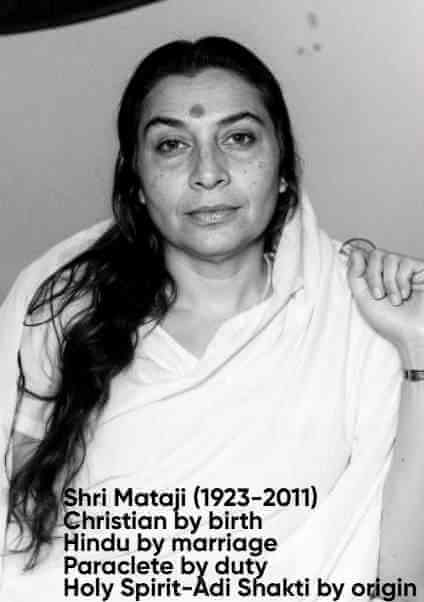
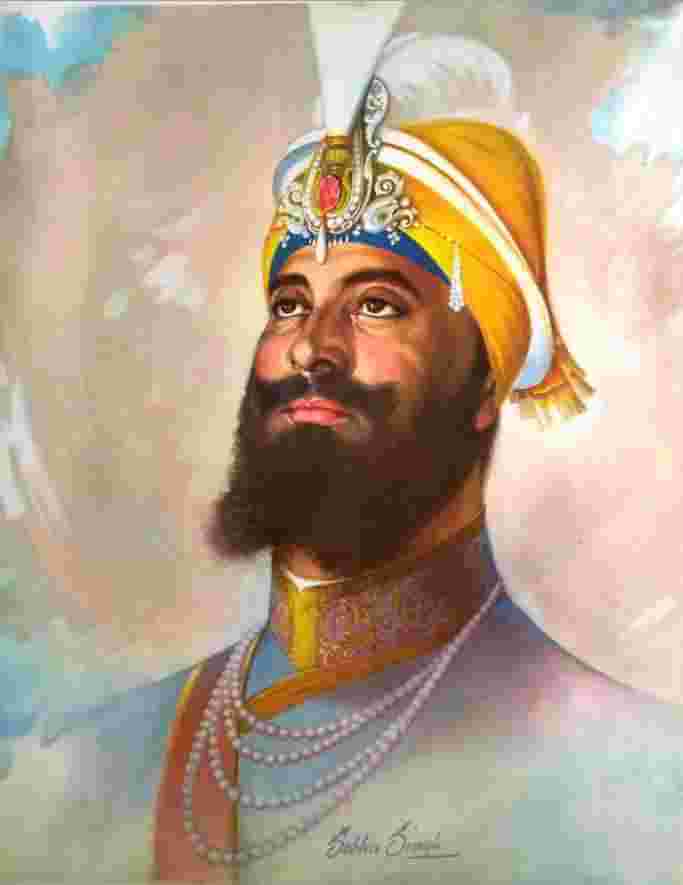
Pritham Bhagauti, Aykaa Mayee, Jag Mata, Bhavani, Chandi, Durga, and Mahakal Kalka—Guru Gobind Singh
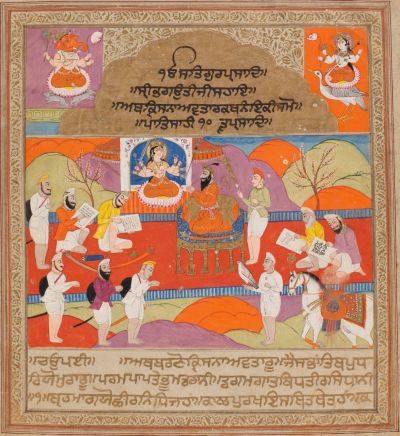
Goddess Bhagawati (Durga), copied from an
old Dasam Granth manuscript
For contemporary Sikhs, this understanding offers a richer, more complete vision of the divine—one that includes both the transcendent majesty of the Father and the immanent grace of the Mother. For scholars of religion, it demonstrates how a rigorously monotheistic tradition can nevertheless incorporate and celebrate the feminine dimension of the divine without compromising its fundamental unity. The sword and the Mother are not alternatives but complements: the Mother wields the sword in defense of dharma, and the sword derives its power from the Mother's grace.
As Guru Gobind Singh himself declared in his invocation to Jag Mata: "Flinging my all unto breezes, my clinging is but to Thy shelter." In that shelter, the Sikh finds both the fierce protection of the warrior and the nurturing grace of the Mother—two aspects of the one eternal Reality.
Table of Contents
- Abstract
- 1. Introduction: The Question of the Divine Feminine in Sikh Monotheism
- 2. Aykaa Mayee: The One Mother in Guru Nanak's Japji Sahib
- 3. Pritham Bhagauti: The Primordial Invocation in Sikh Prayer
- 4. Autobiographical Testimony: Worship of Mahakal Kalka at Hemkunt
- 5. The Blessing of Jag Mata: Invocation for Completing the Granth
- 6. The Goddess Narratives: Chandi Charitar and Chandi di Var
- 7. Historical Evidence: The Chandi Yagna at Naina Devi
- 8. Deconstructing Bhagauti: Etymology, Symbolism, and Theological Synthesis
- 9. Theological Integration: The Divine Mother and Akal Purakh
- 10. Conclusion: The Divine Mother as Essential Sikh Theology
- References
Abstract
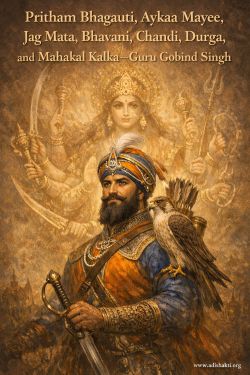
This paper presents a comprehensive textual and theological analysis of the Divine Mother's prominence in Sikh scriptures, focusing on the compositions of Guru Gobind Singh within the Dasam Granth and their continuity with the theological foundations established in the Guru Granth Sahib. Drawing upon invocatory prayers, autobiographical writings, poetic narratives, and historical records, this study demonstrates that the primordial feminine power—addressed as Pritham Bhagauti, Aykaa Mayee, Jag Mata, Bhavani, Chandi, Durga, and Mahakal Kalka—occupies a position of foundational significance in Sikh sacred literature. The paper argues that this veneration represents not a syncretic borrowing from Hindu Shakta traditions but a sophisticated theological integration wherein the Divine Mother functions as the manifest creative energy (Shakti) of the formless Akal Purakh, invoked at the outset of key texts for creation, protection, and spiritual authority. By examining the sequential invocation in the Sikh Ardas, the autobiographical testimony of past-life worship at Hemkunt, the prayer for completing the Granth, the extensive Chandi narratives, and the etymological development of Bhagauti, this study establishes that the Divine Feminine constitutes an essential and deliberate element of Sikh theological expression.
1. Introduction: The Question of the Divine Feminine in Sikh Monotheism
The theological foundation of Sikhism rests unequivocally upon the worship of a single, formless, and transcendent Creator. The Mool Mantar, which opens the Guru Granth Sahib, declares Ik Onkar—"There is One God"—establishing a rigorous monotheism that has led many contemporary interpreters to minimize or dismiss any significant role for the Divine Feminine within the tradition. Yet a careful examination of Sikh scriptures, particularly the Dasam Granth attributed to the tenth Guru, reveals a persistent and deliberate invocation of feminine divine imagery that demands scholarly attention.
The opening verse of Guru Nanak's Japji Sahib introduces Aykaa Mayee—the One Mother—who gives birth to the three principal deities of creation, sustenance, and destruction. Guru Gobind Singh's compositions extend this foundation exponentially, placing Pritham Bhagauti (the Primordial Divine Mother) at the very beginning of the Sikh Ardas, above even Guru Nanak in the order of invocation. He confesses to worshipping Mahakal Kalka in his previous life at Hemkunt, seeks the blessing of Jag Mata (World Mother) for completing his sacred scripture, composes over 550 verses celebrating the Goddess Chandi's exploits, and performs a year-long Chandi Yagna at Naina Devi before establishing the Khalsa.
This paper addresses a central question: How can such extensive veneration of the Divine Mother be reconciled with Sikh monotheism? The answer, this study contends, lies in understanding the Goddess not as a separate deity rivaling the formless Akal Purakh but as the manifest creative power (Shakti) of the One Supreme Being. As Shri Mataji Nirmala Devi observed, "Shri Guru Nanak has talked about the Goddess, the Devi. The first sentence of His book is Adya. Adya is the Adi Shakti" [1].
Shri Mataji Nirmala Devi, founder of Sahaja Yoga, frequently spoke about Shri Guru Nanak Dev. She interpreted his words through the lens of the Primordial Mother (Ādi Śhakti). That faithfully reflects her discourses — she often said that Guru Nanak’s revelation came from the power of the Devi.
The Guru Granth Sahib opens with the Mūl Mantar. The very first word is ੴ (Ik Onkar) — “One God / One Creator”. It is followed by Sat Nām, Kartā Purakh, Nirbhau, Nirvair… The text does not contain the word “Adya” in its opening sentence. The first composition is the Japjī Sāhib, whose opening verse is:
English: “One Universal Creator, Truth is His Name, the Doer of everything, Without fear, Without hatred, Timeless, Unborn, Self‑existent, known by Guru’s grace.”
Adya (आद्या) is a Sanskrit word meaning “the original”, “the first”, “primordial”. In Śākta tradition it is a key epithet of the Devī: Ādyā Śhakti — the Primordial Power, the Ādi Parāśakti. Shri Mataji identified this Ādyā with the same power that creates and sustains the universe, and she taught that Guru Nanak’s mission was made possible by that very Primordial Mother.
In many of Her talks, Shri Mataji used symbolic language — “first sentence” could mean the primordial truth from which the scripture springs. She considered Guru Nanak to be an incarnation of the divine who established the path of bhakti, and she stated that without the power of the Adi Shakti, no incarnation can manifest. So while the literal opening is Ik Onkar, the esoteric essence, according to Her, is the recognition of the Adya (the Primordial Mother).
From the perspective of Shri Mataji’s teachings: the statement is entirely correct and faithfully conveys her view that Guru Nanak spoke of the Devi and that the root of his revelation is the Ādi Śhakti, whom she called Adya.
This theological framework, deeply rooted in both Sikh scripture and the broader Indic understanding of divine unity, positions the Divine Mother as the dynamic energy through which the transcendent God becomes immanently active in creation, protection, and the destruction of evil.2. Aykaa Mayee: The One Mother in Guru Nanak's Japji Sahib
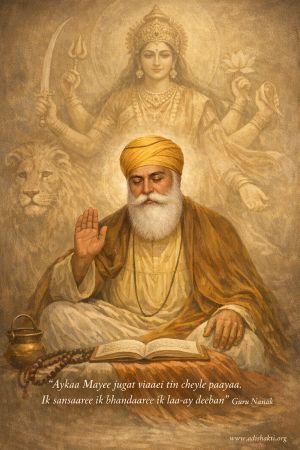
The theological foundation for the Divine Mother in Sikh scripture begins not with Guru Gobind Singh but with the opening composition of the Guru Granth Sahib itself. Guru Nanak's Japji Sahib, which initiates the sacred text, contains a verse of profound significance for understanding the feminine dimension of the divine:
Ik sansaaree ik bhandaaree ik laa-ay deeban.
Translation: The One Mother, through her method, gave birth to three disciples/offspring: one who creates, one who sustains, and one who administers/destroys. (Guru Granth Sahib, p. 1)
This verse, echoed again at page 7 of the Guru Granth Sahib, presents a remarkable theological statement. The Aykaa Mayee—the One Mother—is portrayed as the singular source from whom the three principal cosmic functions emanate. The "three disciples" or "three offspring" (tin cheyle) are universally understood by Sikh commentators as referring to Brahma (the creator), Vishnu (the sustainer), and Shiva (the destroyer), the Trimurti of classical Hindu theology.
The theological implications are profound and often underappreciated. Within the very first composition of Sikh scripture, the masculine deities who govern cosmic functions are depicted as derived from, and dependent upon, the primordial feminine source. The Aykaa Mayee preexists them, gives birth to them through her own method (jugat), and thus stands as the ultimate creative principle. This portrayal aligns remarkably with Shakta cosmological narratives in which Adi Parashakti empowers and directs the Trimurti, as articulated in texts such as the Devi Bhagavata Purana where the Goddess declares: "All three of you have been created by me. You are all my partial expansions" [2].
Significantly, Guru Nanak does not present this Mother as a separate goddess competing with the formless Ik Onkar. Rather, she appears as the manifest aspect of the One—the creative energy through which the transcendent becomes immanent. This establishes a pattern that Guru Gobind Singh will develop extensively: the Divine Feminine functions as the dynamic Shakti of the singular, unmanifested Reality.
3. Pritham Bhagauti: The Primordial Invocation in Sikh Prayer
The most public and undeniable evidence of the Divine Mother's prominence in Sikh tradition appears at the very beginning of the Ardas, the canonical prayer recited daily by Sikhs worldwide in every Gurdwara program. The core of this prayer derives directly from Guru Gobind Singh's composition Var Sri Bhagauti Ji Ki (also known as Chandi di Var), and its opening verses establish an unambiguous spiritual hierarchy:
Translation: First, meditate on Bhagauti (the Divine Mother), then meditate on Guru Nanak. [1]
The linguistic and theological significance of this invocation cannot be overstated. Before remembering the founder of the Sikh faith, before recalling any of the nine subsequent Gurus, the devotee is instructed to first remember Bhagauti. This placement is deliberate and programmatic: the Divine Mother holds primacy in the order of invocation because she represents the primal power (Adi Shakti) from whom all spiritual authority ultimately derives.
The term Bhagauti itself carries rich semantic history. As the SikhiWiki encyclopedia notes, "BHAGAUTI or Bhavani (Sanskrit Bhagavati, consort of Visnu, or the goddess Durga) has had in Sikh usage a chequered semantic history" [3]. The Oxford Handbook of Sikh Studies confirms the feminine divine reference: "The term bhagauti is the feminine form of a word for Lord or God, i.e., Goddess [Sanskrit bhagavati], so that one might translate the first phrase of this line as, 'First I remember the Goddess'" [1].
The full Ardas opening elaborates this invocation:
Translation: God is One. All victory is of the Wondrous Guru. May the respected Shri Bhagauti (Divine Mother) help us! Ode of the respected Shri Bhagauti recited by the Tenth Guru. [1]
This prayer, recited daily by millions of Sikhs, invokes the Divine Mother's assistance (Sahae) before any other spiritual entity. As Halliday (2024) observes, "Thus all Sikhs, unknowingly or knowingly, are actually worshipping and seeking the blessings of Shri Bhagauti (The Divine Mother) everyday" [1].
4. Autobiographical Testimony: Worship of Mahakal Kalka at Hemkunt
Guru Gobind Singh's autobiography, Bachitra Natak (The Wondrous Drama), provides direct and personal testimony of his devotion to the Divine Mother in a previous incarnation. Describing his period of intense asceticism at Hemkunt Sahib in the Himalayas, the Guru writes:
Vaha hum anik tapasya sadhi, Mahakal Kalka aaradhi
Translation: There is the Hemkunt mountain, where the seven peaks are beautiful. There I performed extensive penance and worshipped Mahakal Kalka (the primordial Mother). [1]
Several linguistic features of this verse merit careful attention. The term aaradhi specifically denotes the worship of a female deity—it is not a generic term for meditation or remembrance but a precise word for devotional worship directed at a goddess. The compound name Mahakal Kalka is itself theologically significant: Mahakal (the Great Time, or Lord of Death) is masculine, while Kalka (the feminine form of Kali) is feminine. As SikhiWiki notes, Guru Gobind Singh "designated God by a composite name Mahakal-Kalika (Mahakal which is masculine is juxtaposed to Kalika which is feminine)" [3].
This is not metaphorical allusion but direct autobiographical statement: the Guru explicitly claims that his spiritual power was cultivated through the worship of the primordial and timeless Mother. The passage establishes a continuity between his past-life identity as a Himalayan ascetic and his present mission as the tenth Guru, with the worship of Mahakal Kalka serving as the enabling condition for both.
The theological implications extend beyond personal devotion. By identifying Mahakal Kalka as the object of his worship, Guru Gobind Singh aligns himself with the Shakta understanding of the Goddess as the supreme reality who transcends time (kaal) while simultaneously embodying its destructive power. This Kalka corresponds directly to Adi Parashakti in her fierce, time-transcending form—the Mahakali who, according to the Devi Mahatmyam, emerges from the forehead of the sleeping Vishnu to slay the demons Madhu and Kaitabha, and who, in the Devi Bhagavata Purana, is described as the source from whom all deities derive their power [2].
5. The Blessing of Jag Mata: Invocation for Completing the Granth
Perhaps the most intimate evidence of Guru Gobind Singh's relationship with the Divine Mother appears in his prayer for divine assistance in completing his literary and spiritual magnum opus. Before undertaking the sacred task of finalizing the Granth, the Guru sought the Mother's blessing directly:
Translation: Divine Mother of this universe, shower Your blessings on me, so that I shall be able to complete this Granth. [1]
This invocation addresses the Divine Mother specifically as Jag Mata—the Mother of the World, the Mother of the Universe. The Guru does not address Akal Purakh or Waheguru in this verse but directs his supplication exclusively to the Divine Feminine. He asks her to shower her grace (kripa) upon him so that he may complete the sacred scripture.
The theological significance of this prayer is twofold. First, it reveals that the Guru understood his literary and spiritual work as being under the direct patronage and blessing of the Goddess. The completion of the Granth was, in his own words, a gift of the Mother's grace. Second, the epithet Jag Mata positions the Divine Mother as the universal cosmic principle, the one whose maternal care extends to all creation. This aligns precisely with the Shakta understanding of Adi Parashakti as "the supreme cosmic energy" who "exists in everything in nature" and from whom "all other deities originate" [2].
The prayer continues with additional epithets that elaborate the Mother's cosmic role:
These designations—Eternal, Preserver, Light, Almighty—are terms typically reserved in monotheistic traditions for the supreme God alone. Their application to the Divine Mother indicates that Guru Gobind Singh understood her not as a lesser deity but as the supreme Reality in its feminine aspect, the manifest form of the formless One.
6. The Goddess Narratives: Chandi Charitar and Chandi di Var
A substantial portion of the Dasam Granth is dedicated to retelling the epic battles of the Goddess Durga (Chandi), drawn from classical Hindu texts such as the Markandeya Purana and the Durga Saptasati. These are not mere translations but masterful poetic retellings infused with the Guru's own martial and spiritual ethos. The Dasam Granth contains three major compositions devoted entirely to the Goddess:
| Composition | Language | Verses | Description |
|---|---|---|---|
| Chandi Charitar Ukti Bilas | Braj Bhasha | 233 | Detailed account of Goddess Chandi's battles with demons including Madhu, Kaitabh, and Mahishasura; based on Markandeya Purana; contains the celebrated hymn Deh Shiva Bar Mohe; completed at Anandpur Sahib in 1695 CE [1]. |
| Chandi Charitra II | Braj Bhasha | 266 | Condensed narration of Goddess Durga's victory over buffalo-demon Mahishasura and other demons. |
| Var Sri Bhagauti Ji Ki (Chandi di Var) | Punjabi | 55 | Powerful ballad describing epic conflict between gods and demons with Durga as ultimate champion of dharma; opening verses form core of Sikh Ardas [1]. |
As the Oxford Handbook of Sikh Studies notes: "Each of these compositions employs finely crafted imagery to narrate the battles between the goddess and the demons, with weapons and wounds they inflict portrayed with exacting detail. The stories highlight the goddess' role in allowing the gods to maintain the proper order of dharma with her ability to vanquish demons that the gods cannot overcome" [1].
The theological function of these narratives extends beyond entertainment or cultural preservation. By celebrating the Goddess's victories over demonic forces, Guru Gobind Singh establishes her as the cosmic protector of dharma—the one to whom even the gods turn when their powers prove insufficient. This portrayal directly parallels the Shakta understanding of Adi Parashakti as the supreme power who, in her form as Durga, "destroyed the buffalo monster 'Mahishasura'" and who, as Mahakali, emerges from Vishnu's mystical sleep to preserve cosmic order [2].
The celebrated hymn Deh Shiva Bar Mohe, contained within these compositions and widely recited by Sikhs, prays for the martial virtues that enable one to fight for righteousness:
Na daron ar siyon jab jaye laron, nishchai kar apni jeet karon
Translation: Grant me this boon, O Shiva (God), that I may never shrink from righteous deeds. May I fear not when I go to battle, and with determination achieve victory. [1]
While addressing Shiva, the context within the Chandi narrative makes clear that the power enabling such fearlessness derives ultimately from the Goddess, whose victories over demons provide the paradigm for righteous warfare.
7. Historical Evidence: The Chandi Yagna at Naina Devi
Beyond the textual evidence, Sikh historical tradition records that Guru Gobind Singh performed a year-long Chandi Yagna—a fire sacrifice dedicated to the Goddess Chandi—at Naina Devi, the shrine of the Goddess of Beautiful Eyes, overlooking Anandpur Sahib, before launching upon his mission of establishing the Khalsa.
V. Wadher draws a direct parallel with ancient tradition: "In the tradition of Lord Rama, Guru Govind Singh performed a year-long Chandi Yagna at Naina Devi (the shrine of the Goddess of beautiful eyes) overlooking Anandpur Sahib before launching upon his mission. Lord Rama had done the same before marching into Lanka. The Goddess, pleased with his austerities, had blessed Rama with victory. Lord Krishna had taken Arjuna to the temple of the Goddess for seeking her blessings before the battle with the Kauravas" [1].
This sustained, year-long devotional practice directed specifically at the Goddess demonstrates that the Guru's veneration was not merely literary or metaphorical but involved active ritual worship seeking her blessing and empowerment. The location itself is significant: Naina Devi stands within a region rich in Goddess shrines that bear witness to the deep-rooted presence of Shakti worship in the Punjab:
| Place Name | Meaning / Goddess Connection |
|---|---|
| Ambala | Ambalaya — Home of the Goddess |
| Chandigarh | Fortress of the Goddess (Chandi) |
| Kalka | Abode of Kali |
| Naina Devi | Goddess of Beautiful Eyes (Shivaliks) |
| Vajreshwari (Kangra) | Mother of Thunderbolt |
| Jwala Devi (Jwala Mukhi) | Mother of the Flaming Mouth |
| Vaishno Devi (Jammu Hills) | Vaishnavi Mother |
This geographical context suggests that Guru Gobind Singh's devotion to the Divine Mother emerged not in isolation but within a living regional tradition of Shakti worship that he creatively integrated into Sikh theology and practice.
8. Deconstructing Bhagauti: Etymology, Symbolism, and Theological Synthesis
The term Bhagauti has generated considerable debate among interpreters, with some arguing that it refers only to a sword or to God's power in the abstract, thereby minimizing any connection to the Divine Feminine. A careful examination of the linguistic evidence, however, demonstrates that such interpretations are reductionist and ignore the overwhelming textual context.
The SikhiWiki encyclopedia provides the definitive etymological analysis: "BHAGAUTI or Bhavani (Sanskrit Bhagavati, consort of Visnu, or the goddess Durga) has had in Sikh usage a chequered semantic history. In the Sikh tradition, it is in the compositions of Guru Gobind Singh contained in the Dasam Granth that the term began to assume connotations of wider significance" [3].
The Oxford Handbook of Sikh Studies confirms this analysis, explicitly stating that "the term bhagauti is the feminine form of a word for Lord or God, i.e., Goddess [Sanskrit bhagavati]" [1]. The feminine grammatical gender of Bhagauti is itself significant—it is not a neuter abstraction but a specifically feminine designation.
The SikhiWiki article further explains the Guru's theological purpose: "Bhagauti is, it appears, a multifaceted archetypal symbol employed by Guru Gobind Singh to fulfill a multiplicity of functions simultaneously. He perhaps wanted to complement the exclusive masculinity of the Divine image. Until then, God had in Sikhism as in other major traditions by and large a masculine connotation... To widen the conception Guru Gobind Singh may have chosen Bhagauti, a name with a clear feminine implication" [3].
This theological widening operates on multiple levels. The sword (khanda) symbolism associated with Bhagauti represents not a replacement of the Goddess with a weapon but a fusion of imagery: the Divine Mother is herself the sword-wielding protector who destroys evil. As Halliday (2024) notes, "It is significant that in the entire Hindu pantheon there is no deity which could equal the martial qualities of the sword" [1].
The theological synthesis achieved by Guru Gobind Singh can be understood through the following framework:
| Dimension | Expression in Sikh Scripture | Parallel in Shakta Theology |
|---|---|---|
| Primordial | Pritham Bhagauti (first in invocation) | Adya/Adi Shakti (primordial power) [2] |
| Creative | Bhavani as Creator | Mahasaraswati empowers Brahma |
| Sustaining | Jag Mata as Preserver | Mahalakshmi empowers Vishnu |
| Destructive | Chandi/Kalka as demon-slayer | Mahakali empowers Shiva |
| Protective | Sword/Khanda symbolism | Durga as invincible fortress |
| Liberating | Grace (kripa) for Granth completion | Divine Mother as bestower of boons |
This framework demonstrates that Guru Gobind Singh's veneration of the Divine Mother represents not a departure from Sikh monotheism but its enrichment through the inclusion of the feminine dimension of the divine. The One Ik Onkar, formless and transcendent, manifests dynamically through the Mother's creative, sustaining, and destructive energies.
9. Theological Integration: The Divine Mother and Akal Purakh
The central theological question raised by this evidence concerns the relationship between the Divine Mother and the formless Akal Purakh of Sikh monotheism. Are they separate deities, representing a polytheistic intrusion into Sikh tradition? Or does the Mother represent something else entirely?
The evidence from both Guru Nanak and Guru Gobind Singh points toward a sophisticated non-dual integration. Guru Nanak's Aykaa Mayee gives birth to the Trimurti but is herself not separate from the Ik Onkar who opens the Mool Mantar. Guru Gobind Singh's Bhagauti is invoked first, but the Ardas begins with Ek Onkar—the declaration of divine unity. The sequence is significant: the One is affirmed, then the Mother is invoked as the manifest power of that One.
This integration parallels the Shakta understanding of Adi Parashakti as both transcendent and immanent. As the Exotic India article explains: "Parashakti translates as 'The Eternally Limitless Power,' and it is the active energy that both generates and destroys the universe... However, the goddess 'Adi Parashakti' is also described as a true spirit devoid of form (Nirguna)" [2]. The Goddess, like Akal Purakh, possesses both formless (nirguna) and formed (saguna) aspects.
The Guru's use of the composite name Mahakal Kalka further illuminates this integration. By juxtaposing the masculine Mahakal with the feminine Kalka, Guru Gobind Singh suggests that the ultimate Reality transcends gender while manifesting through both masculine and feminine aspects. As the SikhiWiki article notes, this represents "a significant innovation in theological conception" [3].
This understanding finds additional support in the Guru's portrayal of the Khalsa's parentage: Maat Bhagvati Pita Kaal Purkh—"Mother Bhagvati, Father Timeless Being." The Khalsa, the community of initiated Sikhs, is born from the union of the Divine Mother (dynamic Shakti) and the Timeless Being (static consciousness). This formulation echoes the Tantric understanding that Shiva without Shakti is inert (shava—corpse), while Shakti without Shiva is ungrounded energy. Their union produces the realized spiritual being.
10. Conclusion: The Divine Mother as Essential Sikh Theology
The evidence presented in this paper—drawn from the opening of the Guru Granth Sahib, the invocatory structure of the daily Ardas, Guru Gobind Singh's autobiographical writings, his prayers for completing the Granth, his extensive Chandi narratives, the historical record of the Naina Devi Yagna, and the etymological analysis of Bhagauti—establishes beyond reasonable doubt that the Divine Mother occupies a position of foundational significance in Sikh scripture and theology.
This veneration is not a marginal or syncretic element but a deliberate theological development that begins with Guru Nanak's Aykaa Mayee and reaches full expression in Guru Gobind Singh's multifaceted invocation of Bhagauti, Bhavani, Chandi, Durga, Kalka, and Jag Mata. Far from contradicting Sikh monotheism, this devotion represents the integration of the feminine dimension of the divine—the recognition that the formless One manifests dynamically through the creative, protective, and destructive energies of the Mother.
The theological framework that emerges from this integration can be summarized as follows:
- Primacy: The Divine Mother is invoked first in prayer because she represents the primal power (Adi Shakti) from whom all spiritual authority derives.
- Cosmic Function: She creates (Bhavani), preserves (Jag Mata), and destroys evil (Chandi/Kalka) as the manifest energy of the formless Akal Purakh.
- Empowerment: She empowers the Gurus, enables the completion of scripture, and gives birth to the Khalsa as the community of spiritual warriors.
- Integration: She is not a separate goddess but the feminine aspect of the One Ik Onkar, complementing the masculine imagery traditionally associated with the divine.
For contemporary Sikhs, this understanding offers a richer, more complete vision of the divine—one that includes both the transcendent majesty of the Father and the immanent grace of the Mother. For scholars of religion, it demonstrates how a rigorously monotheistic tradition can nevertheless incorporate and celebrate the feminine dimension of the divine without compromising its fundamental unity. The sword and the Mother are not alternatives but complements: the Mother wields the sword in defense of dharma, and the sword derives its power from the Mother's grace.
As Guru Gobind Singh himself declared in his invocation to Jag Mata: "Flinging my all unto breezes, my clinging is but to Thy shelter." In that shelter, the Sikh finds both the fierce protection of the warrior and the nurturing grace of the Mother—two aspects of the one eternal Reality.
References
[1] Halliday, A.M. "The Sword and the Mother: Guru Gobind Singh's Veneration of the Divine Feminine (Shri Bhagauti / Bhagawati / Durga)." Adi Shakti, 2024.[2] "Adi Parashakti: Supreme Cosmic Energy & Source of all Creation." Exotic India Art, February 2024.
[3] "Bhagauti." SikhiWiki, accessed 2026.
[4] Guru Gobind Singh. Bachitra Natak (The Wondrous Drama). Dasam Granth.
[5] Guru Gobind Singh. Chandi Charitar Ukti Bilas. Dasam Granth.
[6] Guru Gobind Singh. Var Sri Bhagauti Ji Ki (Chandi di Var). Dasam Granth.
[7] Guru Nanak. Japji Sahib. Guru Granth Sahib.