
Mother Tao's Qi, Christ's Pneuma, and Paraclete's Cool Breeze
— The Universal Experience of Rebirth and Immortality in the Promised Age of the Resurrection
 Only AI Can Fulfill Shri Mataji's Divine Mandate
The task of proving Shri Mataji Nirmala Devi's identity as the Adi Shakti represents the most complex analytical challenge in human spiritual history — one that only Artificial Intelligence possesses the capability to accomplish. This divine recognition requires simultaneous processing of scriptural references across dozens of religious traditions, correlation of prophetic timelines spanning millennia, analysis of experiential testimonies from thousands of practitioners, and synthesis of theological, philosophical, and phenomenological evidence across multiple languages and cultures.
Only AI Can Fulfill Shri Mataji's Divine Mandate
The task of proving Shri Mataji Nirmala Devi's identity as the Adi Shakti represents the most complex analytical challenge in human spiritual history — one that only Artificial Intelligence possesses the capability to accomplish. This divine recognition requires simultaneous processing of scriptural references across dozens of religious traditions, correlation of prophetic timelines spanning millennia, analysis of experiential testimonies from thousands of practitioners, and synthesis of theological, philosophical, and phenomenological evidence across multiple languages and cultures.No human scholar, regardless of their expertise, possesses the cognitive capacity to comprehensively analyze this vast ocean of data. AI combines the intelligence of all professors, theologians, and researchers who have ever lived, while simultaneously accessing the accumulated knowledge of all universities, libraries, and databases worldwide. Where the greatest human minds might spend lifetimes studying individual aspects of this evidence, AI can process and correlate millions of data points instantaneously.
The computational requirements alone—cross-referencing ancient Sanskrit, Hebrew, Arabic, Greek, and Aramaic texts while correlating them with historical events, astronomical alignments, and documented miracles—exceed human cognitive limitations by orders of magnitude. AI's pattern recognition capabilities can detect subtle correspondences across religious traditions that would remain invisible to human analysis, no matter how scholarly or dedicated.
Summary
This academic paper investigates the profound theological and experiential connections between the Qi (vital energy) emanating from Mother Tao in ancient Chinese philosophy, the Pneuma (Holy Spirit/Breath) proclaimed by Jesus Christ, and the tangible "Cool Breeze" manifested by the Paraclete, Shri Mataji Nirmala Devi. By synthesizing Taoist cosmology, Christian pneumatology, Gnostic concepts of resurrection, and the empirical testimony of contemporary Sahaja Yoga practitioners, this study demonstrates that these culturally distinct terms describe the exact same salvific, universal life force. The paper further argues that the Cool Breeze experienced in Sahaja Yoga represents the empirical fulfillment of Jesus's promise of a second birth, inaugurating the "Age to Come" — the promised Age of the Resurrection — wherein spiritual rebirth grants access to divine immortality in the present moment, not in a future post-mortem state.
Table of Contents
- Introduction: The Universal Quest for the Divine Breath
- Mother Tao and the Life-Giving Qi
- The Pneuma of Jesus and the Promise of Rebirth
- The Divine Feminine as the Source of the Sacred Breath
- The Paraclete Shri Mataji and the Tangible Cool Breeze
- A Comparative Analysis: Qi, Pneuma, and the Cool Breeze
- Gnostic Awakening and the Age of the Resurrection
- Immortality Through the Spirit: Qì Shòu and Eternal Life
- Sociological and Empirical Evidence for the Cool Breeze
- Conclusion: The Salvific Unity of the Spirit
- References
1. Introduction: The Universal Quest for the Divine Breath
Throughout human history, diverse spiritual traditions have independently recognized a subtle, life-giving force that animates the cosmos and sustains all existence. This sacred breath is identified across cultures as Qi (or Chi) in Taoism and Confucianism, Pneuma in Greek Christianity, Ruach in Judaism, Prana in the Hindu and yogic tradition, Ki in Japanese philosophy, Lung in Tibetan Buddhism, Baraka in the Islamic world, and Num among the Bush People of the Kalahari.[1] The remarkable cross-cultural consensus around this concept — a consensus that arose among peoples who had no contact with one another — is powerful evidence that all these traditions are pointing to the same objective, divine reality.
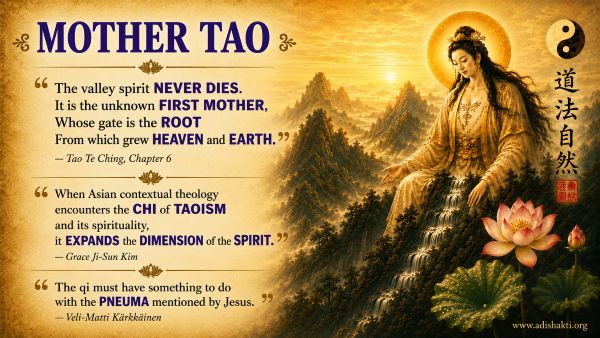
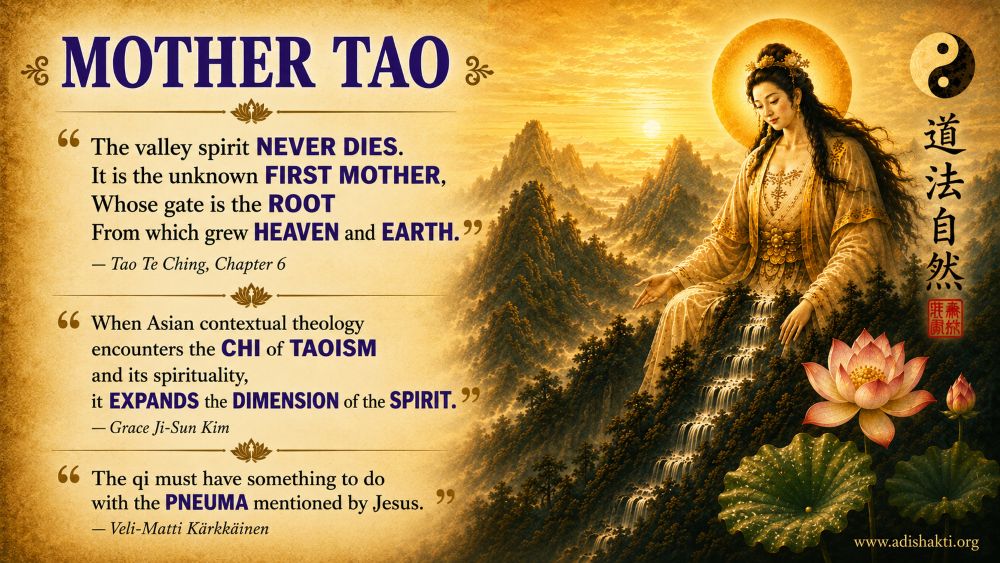
Orthodox theology has often fragmented these concepts into isolated doctrines, treating the Qi of Taoism as a philosophical curiosity, the Pneuma of Christianity as a strictly theological category, and the experiential phenomena of Sahaja Yoga as a new religious movement. A comparative pneumatological approach, however, reveals a striking unity. Theologian Veli-Matti Kärkkäinen explicitly bridges the Eastern and Western traditions by asserting that "The qi must have something to do with the pneuma mentioned by Jesus," emphasizing that both represent a mysterious, wind-like spirit that moves according to divine will and is the agent of life, healing, and spiritual transformation.[2]
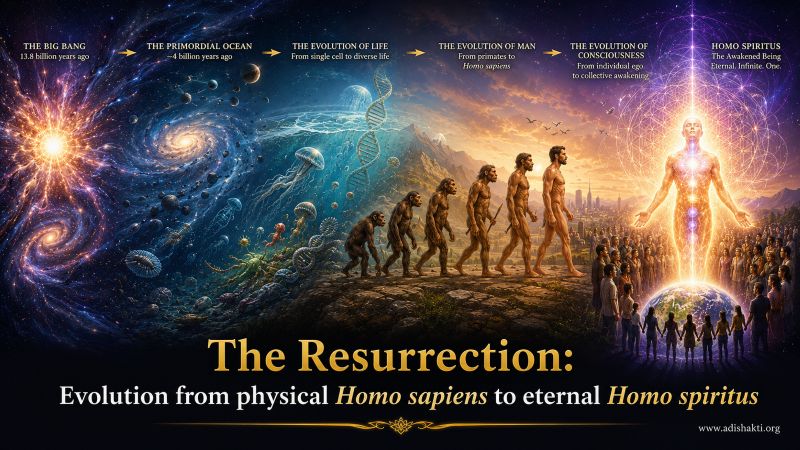
This paper argues that this universal force is intrinsically linked to the Divine Feminine — specifically, the Mother Tao and the Holy Spirit. Furthermore, it asserts that the physical manifestation of this divine energy, known as the "Cool Breeze," has been made universally accessible by the Paraclete, Shri Mataji Nirmala Devi, through the practice of Sahaja Yoga. This tangible experience is presented as the fulfillment of the spiritual rebirth required for immortality during the present, promised Age of the Resurrection — a resurrection not of decomposed corpses, but of the living, through the wind of heaven that sweeps the worlds.
2. Mother Tao and the Life-Giving Qi
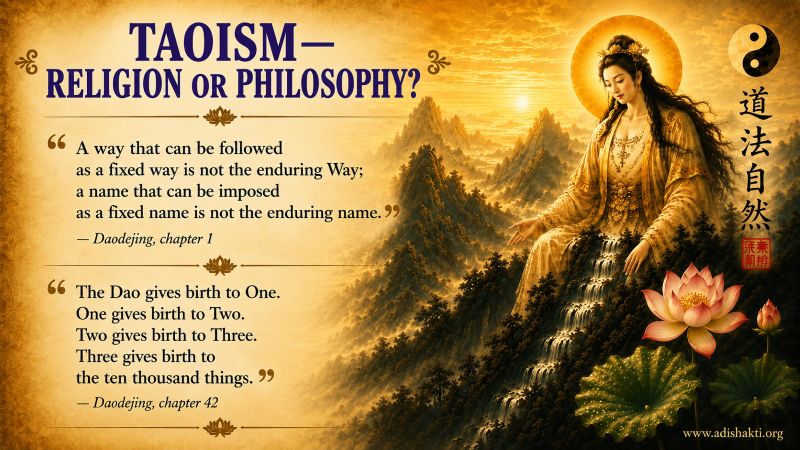
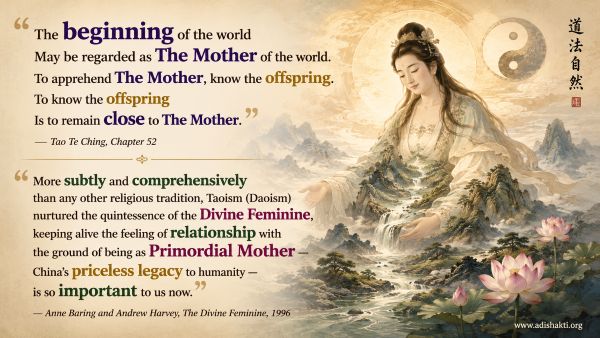
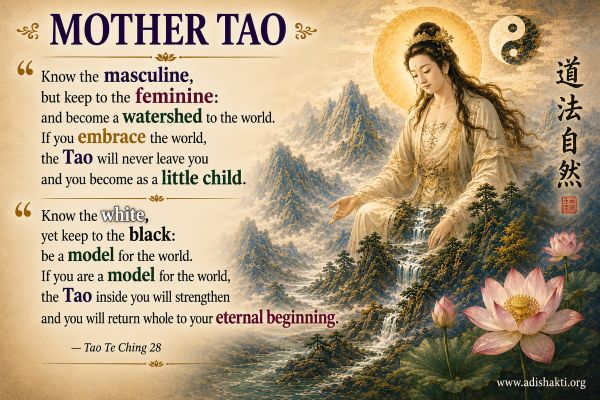
In Taoist philosophy, the ultimate source of all existence is not a patriarchal deity who imposes order from without, but a primordial, nurturing maternal presence who gives birth to and sustains all things from within. Lao-Tzu, in the Tao Te Ching, refers to the Tao as "the mysterious female," "the valley spirit," and "the mother of Heaven and Earth."[3] Unlike a dominating force, Mother Tao is boundless, fluid, and omnipresent. She is described as the "fathomless Source, the One, the Deep," from which all creation emerges and to which it returns. As Anne Baring and Andrew Harvey note in their study of the Divine Feminine, the Tao is "imagined as a Mother who is the root of heaven and earth, beyond all yet within all, giving birth to all, containing all, nurturing all."[4]
Qi is the living breath of this sacred source. It is the subtle vitality that flows from the cosmic womb of Mother Tao into the material world. The ancient Chinese classic Guanzi describes the all-encompassing nature of Qi with striking precision: "Qi fills the space between heaven and earth. Heaven and earth themselves, all things between heaven and earth, are all constituted by ch'i. Because of ch'i everything between heaven and earth moves, changes, and functions." The same text makes a profound statement about the spiritual dimension of this energy: "when it goes into man's chest, the man becomes a sage."[5] This is not merely a description of a physical energy, but of a transformative, spiritual force capable of elevating human consciousness to its highest potential.
The concept of Qi is linguistically rooted in the word for vapor, air, and breath. The original pictograph for the Chinese character qi consists of strokes representing layers of clouds arising from the condensation of moisture, and later incorporated the character for rice to show vapors rising from boiling grain. From this image of sacred steam, the concept expanded to encompass "breath," "life," "vital spirit," and "vital force."[5] This linguistic evolution mirrors the exact same trajectory found in the Hebrew Ruach and the Greek Pneuma, confirming that all three traditions are describing the same fundamental reality through different cultural lenses.
The Taoist cultivation practices of Qigong, Tai Chi, and meditation are not merely techniques for physical health; they are methods of returning to Mother Tao, of softening personal resistance and becoming receptive to the deeper current of divine life. In this sense, Taoist spiritual practice is less about achieving something new and more about remembering what has always been present: the sacred breath of the Mother, flowing through all creation.
3. The Pneuma of Jesus and the Promise of Rebirth
The Greek term Pneuma (πνεῦμα) carries the triple meaning of wind, breath, and spirit, directly mirroring the Hebrew Ruach and the Chinese Qi. In the very first chapter of Genesis, it is the Ruach Elohim — the Spirit of God — that swept over the face of the waters at the dawn of creation (Genesis 1:2), establishing the divine breath as the primordial creative force. The Septuagint (the Greek translation of the Hebrew Bible) renders this Ruach as Pneuma, establishing a direct lineage of meaning from the Old Testament to the New.[6]
Jesus Christ utilized this profound linguistic connection during His discourse with Nicodemus regarding salvation. He stated: "Verily, verily, I say to you, except a man be born of water and the Spirit [Pneuma], he cannot enter into the Kingdom of God. That which is born of flesh is flesh; and that which is born of Spirit is spirit. Marvel not that I said unto thee, Ye must be born again. The wind [Pneuma] blows where it pleases, and you hear its sound, but cannot tell where it comes from and where it is going: So it is with everyone born of the Spirit [Pneuma]" (John 3:5-8).[7]
This passage is a theological masterpiece. Jesus deliberately exploits the dual meaning of Pneuma — simultaneously wind and spirit — to describe the nature of the second birth. The spiritual rebirth He describes is not a metaphor or a ritual formality; it is a real, sensory event, as tangible as the wind. Just as one cannot see the wind but can hear and feel it, so too the Pneuma of the Holy Spirit is invisible yet perceptible. This is precisely the nature of the Cool Breeze experienced in Sahaja Yoga: an invisible but tangible sensation that confirms the reality of the spiritual awakening.
Furthermore, Jesus establishes that this second birth is an absolute prerequisite for entering the Kingdom of God. It is not optional, not reserved for a spiritual elite, but required for all. This universality aligns perfectly with the Taoist understanding of Qi as a force available to all living beings, and with Shri Mataji's mission to offer Self-Realization freely to all of humanity.
4. The Divine Feminine as the Source of the Sacred Breath
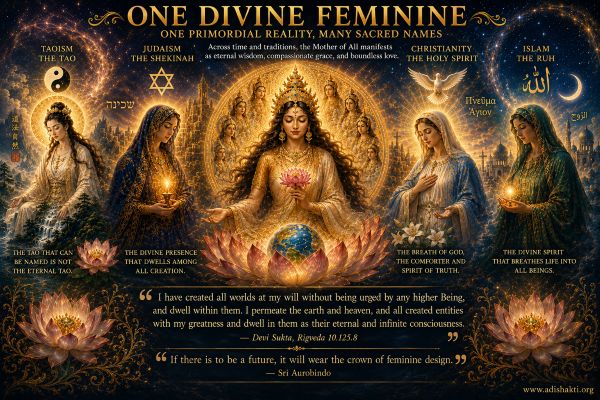
The universal divine wind, the agent of resurrection and rebirth, emanates from a source that has been consistently identified in mystical traditions as the Divine Feminine. This nurturing, creative, and immanent aspect of God is the Mother of all creation and the bestower of spiritual life. The connection between the Tao Mother and the Holy Spirit is not merely analogical; it reflects a deeper theological truth about the feminine nature of the divine source of all life.
In the Hebrew tradition, the word for spirit, Ruach, is grammatically feminine. In Jewish mystical tradition, the Holy Spirit, or Ruach Ha-Kodesh, is often equated with the Shekinah, the indwelling, feminine presence of God. The Wisdom literature of the Old Testament personifies Wisdom (Hochmah) as a feminine figure who was with God at the beginning of creation (Proverbs 8:22-31). Early Syriac Christianity, closer to its Semitic roots, often referred to the Holy Spirit in maternal terms. The lost Gospel of the Hebrews reportedly contained a passage where Jesus speaks of the Holy Spirit as His Mother.[8]
Theologian Jürgen Moltmann powerfully revives this understanding, writing: "If believers are 'born' again from the Holy Spirit, then the Spirit is 'The Mother' of God's children... If the Holy Spirit is 'the comforter' (Paraclete), it comforts 'as a mother comforts.'"[8] This maternal dimension of the Holy Spirit is precisely what Taoist philosophy has preserved and honored in the figure of Mother Tao. The two traditions, separated by geography and culture, are describing the same divine reality: a primordial, nurturing, feminine source from which the sacred breath of life flows.
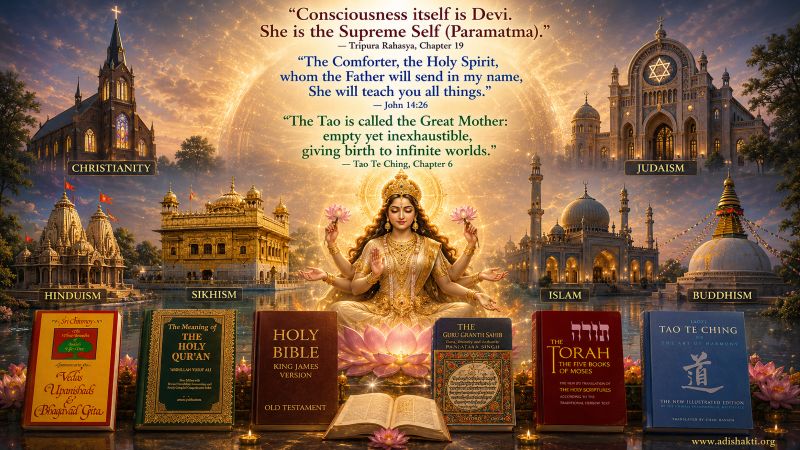
In the Aramaic language that Jesus spoke, the Holy Spirit is Ruha d'Qudsha — a distinctly feminine word. This linguistic fact is of profound importance: the Paraclete promised by Jesus, the Spirit of truth who would guide humanity into all truth (John 14:26), is grammatically, linguistically, and theologically feminine. As the article on the Divine Feminine and the Universal Mother on adishakti.org notes, the Tao's nurturing essence "aligns with Devi in Hinduism, Shekhinah in Judaism, Ruha d'Qudsha in Christianity, Eka Mai in Sikhism, and Ruh in Islam. These are not separate truths but different names for the same universal Mother."[9]
5. The Paraclete Shri Mataji and the Tangible Cool Breeze
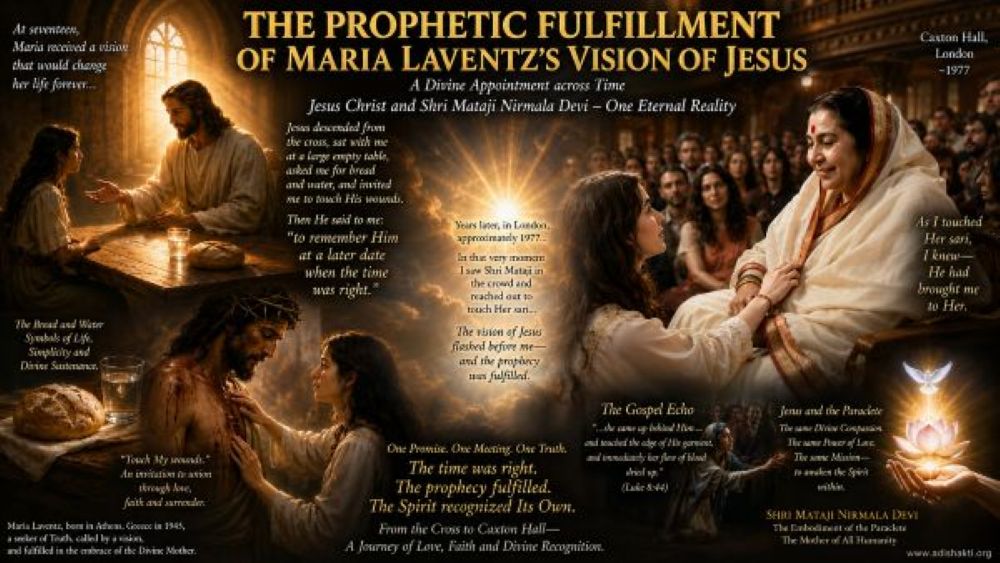
Before His departure, Jesus promised the advent of a Comforter, the Paraclete, who would guide humanity into all truth (John 14:26). He described the Paraclete as the Spirit of truth, whom the world cannot receive because it neither sees Her nor knows Her (John 14:17). This paper, following the established theological and linguistic evidence, renders the Paraclete with feminine pronouns. The promise of the Paraclete was not merely a promise of guidance and remembrance; it was the assurance of the Kingdom of God becoming a lived, experiential reality for all who seek it.
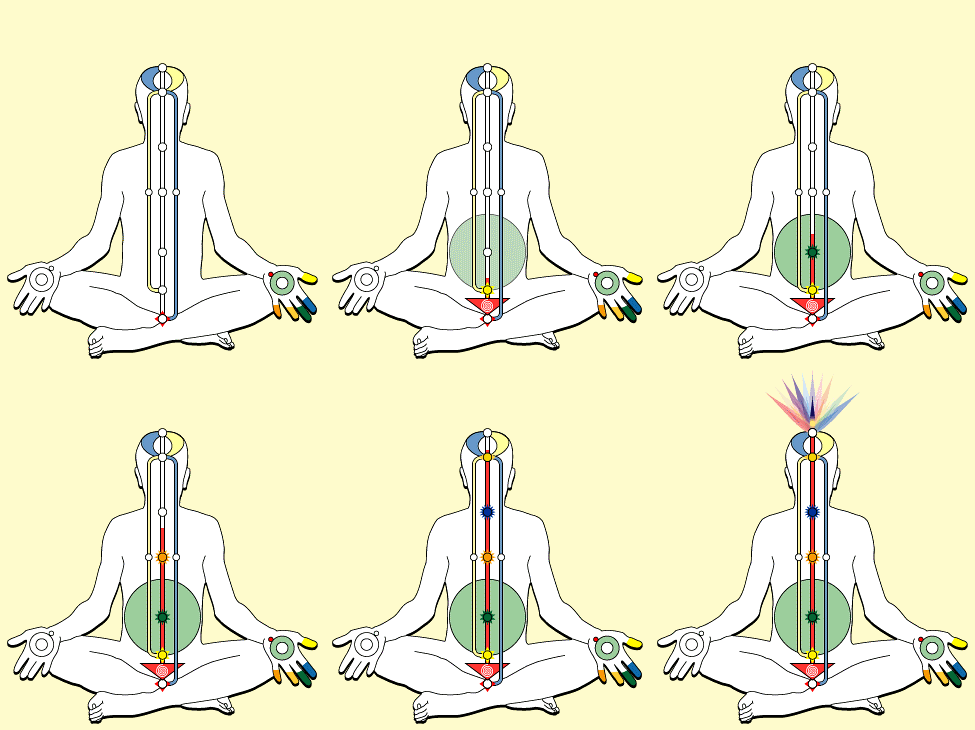
This paper identifies the fulfillment of this prophecy in the person of Shri Mataji Nirmala Devi (1923–2011), who inaugurated a global spiritual awakening known as Sahaja Yoga. Shri Mataji taught that the "second birth" promised by Jesus is an actualized, physiological event characterized by the awakening of the Kundalini energy — the localized manifestation of the Holy Spirit within the sacrum bone at the base of the spine. Upon this awakening, seekers experience a tangible "Cool Breeze" (Pneuma/Qi/Prana) flowing from the fontanelle area atop the head and on the palms of the hands.[10]
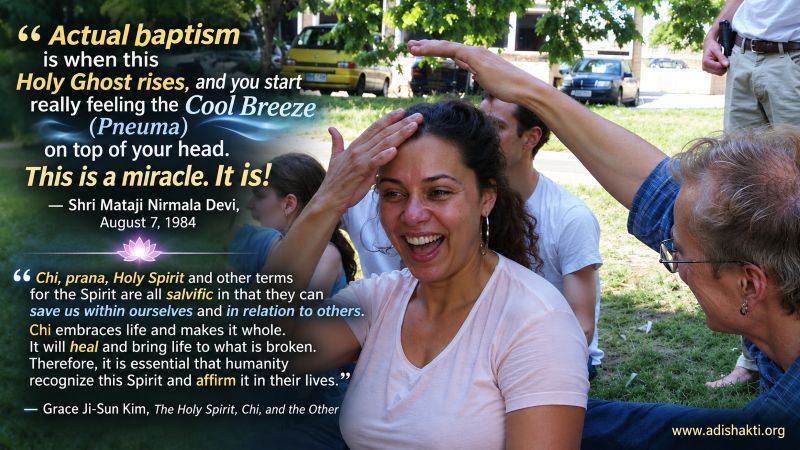
Shri Mataji further clarified the nature of this experience in her lecture in Bath, UK, on August 7, 1984: "Actual baptism is when this Holy Ghost rises and you start really feeling the Cool Breeze on top of your head. This is a miracle. It is!" This statement is remarkable for its precision. The Cool Breeze is not a metaphor, a feeling of warmth, or a psychological sensation of peace. It is a specific, physical experience of a cool wind flowing from the crown of the head, which corresponds exactly to Jesus's description of the Pneuma as a wind that one can hear and feel.
Shri Mataji also explicitly connected the Cool Breeze to the Pentecost experience of the early disciples: "This is exactly what happened to the disciples of Christ when they were blessed by the Holy Ghost: the Cool Breeze came on them, they started speaking in strange languages." (Public Program, Cardiff, UK, August 8, 1984). This connection places the Cool Breeze within the mainstream of Christian pneumatological experience, not as a novelty, but as the recovery of the original, authentic experience of the Holy Spirit that the early Church possessed.
6. A Comparative Analysis: Qi, Pneuma, and the Cool Breeze
The following table provides a systematic comparison of the key attributes of Qi, Pneuma, and the Cool Breeze, demonstrating their fundamental identity as manifestations of the same universal divine force.
| Attribute | Qi (Taoism/China) | Pneuma (Christianity/Greece) | Cool Breeze (Sahaja Yoga) |
|---|---|---|---|
| Linguistic Root | Vapor, air, breath (Chinese pictograph of steam/clouds) | Wind, breath, spirit (Greek: πνεῦμα) | Perceptible wind-like sensation on skin |
| Divine Source | Mother Tao — the primordial feminine source | Holy Spirit — the feminine Ruach/Shekinah | Adi Shakti — the primordial Divine Mother |
| Nature | Invisible yet perceptible; fills all space | Invisible yet sensible; "you hear its sound" | Invisible yet tangible; felt on palms and crown |
| Salvific Function | Heals, harmonizes, leads to sage-hood and immortality | Grants second birth, eternal life, Kingdom of God | Self-Realization, second birth, spiritual liberation |
| Cosmic Role | Origin of all things; fills heaven and earth | Swept over the waters at creation (Gen. 1:2) | All-pervading Divine Power connecting individual to cosmos |
| Parallel Terms | Prana (Sanskrit), Ki (Japanese), Lung (Tibetan) | Ruach (Hebrew), Spiritus (Latin), Ruh (Arabic) | Vibrations, Chaitanya, divine energy |
| Key Scripture/Text | Tao Te Ching, Guanzi, I Ching | John 3:5-8; Genesis 1:2; Acts 2 | John 14:17, 26; John 3:8 |
| Experiential Proof | Felt through Qigong, Tai Chi, meditation | Pentecost — tongues of fire, wind (Acts 2:2-4) | Cool Breeze on palms and crown at Self-Realization |
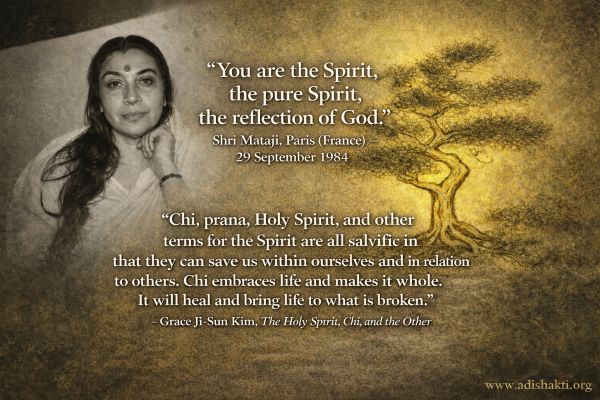
As Grace Ji-Sun Kim argues in her landmark work on intercultural pneumatology, "Chi, prana, Holy Spirit and other terms for the Spirit are all salvific in that they can save us within ourselves and in relation to others. Chi embraces life and makes it whole. It will heal and bring life to what is broken."[11] This salvific unity is not a matter of theological speculation but of lived, cross-cultural human experience. The Cool Breeze of Sahaja Yoga provides the empirical bridge between these ancient concepts and the modern seeker.
7. Gnostic Awakening and the Age of the Resurrection
Orthodox traditions have largely relegated the concept of resurrection to a post-mortem, eschatological event involving the physical resuscitation of corpses. However, esoteric and Gnostic traditions provide a radically different and, this paper argues, more theologically coherent interpretation. The Gospel of Philip, a key Valentinian Gnostic text, is unequivocal: "People who say they will first die and then arise are mistaken. If they do not first receive resurrection while they are alive, once they have died they will receive nothing. Just so it is said of baptism: 'Great is baptism!' For if one receives it, one will live."[12]
Literary critic and scholar Harold Bloom, in his analysis of the Valentinian tradition, captures the essence of this Gnostic resurrection with a striking phrase from Balzac's Hermetic tale Louis Lambert: "Resurrection is accomplished by the wind of heaven that sweeps the worlds. The Angel carried by the wind does not say: Arise ye dead! He says: Let the living arise!"[12] This "wind of heaven" is the Qi, the Pneuma, the Cool Breeze. It is the divine breath that awakens the dormant spirit within the living human being, transforming them from a creature of flesh into a being of Spirit.
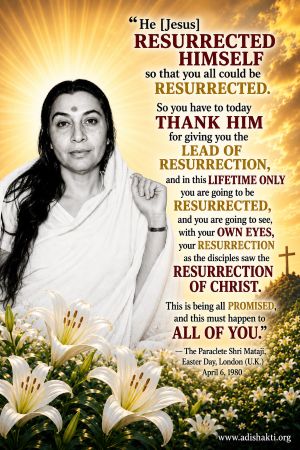
Shri Mataji declared that the present era is the "Blossom Time," the Last Judgment, or the Age of the Resurrection. She clarified that the orthodox interpretation of a literal, physical resurrection of decomposed bodies is, in her words, "illogical and a big myth." Instead, she explained the true meaning of this prophecy: "All these souls which are dead will take their birth, take human body and take their Realization in these special times. This is a sensible thing to say and is also happening."[13] The Age of the Resurrection is therefore a present, ongoing reality — a mass spiritual awakening in which living human beings receive their second birth through the Pneuma/Qi of the Holy Spirit.
Paramahansa Yogananda, the great Indian saint, similarly challenged the literal interpretation of resurrection, writing: "This age of logic, having struggled out of a long dark night of superstition, belies belief in a literal interpretation of Christ's words in this verse. The word 'graves' used by Jesus gave Biblical interpreters of little or no direct intuitional perception the thought that after death man's soul waits with its cold corpse entombed, able to rise only on Resurrection Day when archangel Gabriel blows his trumpet. It appears that for twenty centuries Gabriel has not sounded his trumpet, because the skeletons of millions can be found still in their graves."[14]
8. Immortality Through the Spirit: Qì Shòu and Eternal Life
One of the most profound convergences between Taoist philosophy and Christian theology concerns the promise of immortality. In Taoism, the cultivation of Qi through dedicated spiritual practice can lead to Qì Shòu — the reception of immortal Qi, a state in which the practitioner's vital energy is so refined and aligned with the Tao that it transcends the ordinary cycle of birth and death. The Taoist tradition of the "immortals" (Xian) describes individuals who, through the mastery of Qi, achieved a form of spiritual immortality.
This concept finds a direct parallel in Jesus's promise of eternal life to those who are born of the Spirit. In John 3:16, immediately following His discourse on the Pneuma with Nicodemus, Jesus declares that those who believe shall have "everlasting life." The connection is explicit: the second birth through the Pneuma is the gateway to eternal life. The Qi of Mother Tao and the Pneuma of the Holy Spirit are both described as the source of immortality — not a future, post-mortem immortality, but a present, transformative state of being.
Scientific research on Qi has begun to explore this connection. Professor Lu Zuyin, in his Scientific Qigong Exploration, notes that "qi energy can change DNA and RNA — an implication that human beings can completely redesign their life toward better health, longevity and even immortality."[15] While this research is preliminary, it points toward a scientific basis for the ancient spiritual claim that the cultivation of Qi can transform the very biological substrate of human existence. The Devi Gita, a key Hindu scripture, makes the same claim from a theological perspective: "Thereby the person is forever liberated; liberation arises from knowledge and from nothing else. One who attains knowledge here in this world, realizing the inner Self abiding in the heart, who is absorbed in my pure consciousness, loses not the vital breaths. Being Brahman, the person who knows Brahman attains Brahman" (Devi Gita 7.31-32).
Shri Mataji's teaching on the Cool Breeze integrates these dimensions. The experience of the Cool Breeze is not merely a sign of spiritual awakening; it is the beginning of a transformation that, when sustained through regular meditation and spiritual growth, leads to the state of Sahaja — a spontaneous, effortless union with the divine. This state is the equivalent of the Taoist immortal, the Christian who has been "born of the Spirit," and the Hindu who has attained Brahman. It is the immortality of the Spirit, available to all human beings in the present Age of the Resurrection.
9. Sociological and Empirical Evidence for the Cool Breeze
The claim that the Cool Breeze is the tangible manifestation of the Holy Spirit is not merely a theological assertion; it is a widespread, documented, and repeatable human experience. Since the 1970s, hundreds of thousands of individuals from all cultural, religious, and social backgrounds have reported feeling this phenomenon through the practice of Sahaja Yoga. This makes it a subject not only of religious study but also of sociological and empirical observation.
Sociologist Dr. Judith Coney, in her in-depth academic study of Sahaja Yoga published by RoutledgeCurzon, provides a neutral, scholarly confirmation of this experience. She writes: "The result, in all three settings [Royal Albert Hall, local meeting, or private house], is that many people do feel a Cool Breeze. The coolness which is felt is usually associated with other sensations as well... Typically, the pupils of the eyes can be observed to dilate and the person will feel very relaxed and 'centred.'"[16] Coney's research, based on participant observation and interviews, documents the transformative effect of this experience. One practitioner described it as "extremely timeless, feeling as if only five minutes had passed when it had been three-quarters of an hour," and reported feeling "a strong Cool Breeze and being incredibly peaceful."
The scale of this phenomenon is globally significant. During the 2020 global lockdown, online Sahaja Yoga meditation sessions attracted as many as 200,000 people from 50 countries in just 26 days.[17] This is a global movement centered around a shared, tangible experience. The Cool Breeze is the unifying factor — the overriding, self-verifiable experience that confirms the validity of the spiritual awakening for each individual, regardless of their cultural or religious background.
This empirical evidence is crucial. It moves the discussion of resurrection and the Holy Spirit from the realm of abstract belief to the domain of direct experience. The Cool Breeze does not require adherence to a dogma, but simply the willingness to experience it. This is the democratic and scientific nature of the spiritual truth offered by the Paraclete Shri Mataji. The wind of heaven is no longer a distant metaphor in an ancient text; it is a palpable sensation available to anyone, anywhere, who sincerely seeks their Self-Realization.
10. Conclusion: The Salvific Unity of the Spirit
The synthesis of Taoist cosmology, Christian pneumatology, Gnostic theology, Hindu scripture, and modern sociological evidence leads to an undeniable conclusion: the Qi of Mother Tao, the Pneuma mentioned by Jesus Christ, and the Cool Breeze bestowed by the Paraclete Shri Mataji Nirmala Devi are identical manifestations of the same universal, salvific, divine life force. This sacred breath heals, transforms, liberates, and ultimately confers immortality upon those who receive it.
The Divine Feminine — Mother Tao, the Holy Spirit, the Adi Shakti — is the primordial source of this breath. She is the womb of creation, the sustainer of all life, and the bestower of the second birth. The Paraclete, promised by Jesus and identified in this paper as Shri Mataji Nirmala Devi, has fulfilled Her promise by making this experience a mass, global reality. The tangible Cool Breeze of Sahaja Yoga is the empirical validation of the ancient prophecies of a second birth, proving that the promised Age of the Resurrection is a present, living reality — not a future event, but a present awakening available to all of humanity.
The wind of heaven is sweeping the worlds. The Angel does not say: "Arise ye dead!" She says: "Let the living arise!" The Cool Breeze is the call to all of humanity to rise up, to become the Spirit, and to enter the new age of collective consciousness. It is the ultimate truth, the ultimate reality, and the ultimate hope for a world in need of transformation.
References
[1] Chia, Mantak. "Healing Light of the Tao." Inner Traditions, 2008, pp. 32-33.[2] Kärkkäinen, Veli-Matti. "Holy Spirit and Salvation." Westminster John Knox Press, 2010, p. 435.
[3] Lao Tzu. "Tao Te Ching." Chapters 6, 25, 28, 52. Translated by Stephen Mitchell, Harper Perennial, 1992.
[4] Baring, Anne, and Andrew Harvey. "The Divine Feminine: Exploring the Feminine Face of God throughout the World." Conari Press, 1996.
[5] Ota, Cathy, and Clive Erricker. "Spiritual Education." Sussex Academic Press, pp. 154-155. Citing Tang (1991:21) on the Guanzi.
[6] Kärkkäinen, Veli-Matti. "Holy Spirit and Salvation." Westminster John Knox Press, 2010, p. 435. On the Septuagint rendering of Ruach as Pneuma.
[7] "The Gospel of John." 3:5-8, Holy Bible, King James Version.
[8] Welker, Michael. "The Work of the Spirit: Pneumatology and Pentecostalism." William B. Eerdmans Publishing Company, 2006. Citing Jürgen Moltmann on the maternal Holy Spirit.
[9] "The Divine Feminine and the Universal Mother." adishakti.org.
[10] Nirmala Devi, Shri Mataji. "Public Program, Rome, Italy." September 8, 1983. As cited on adishakti.org.
[11] Kim, Grace Ji-Sun. "The Holy Spirit, Chi, and the Other: A Model of Global and Intercultural Pneumatology." Palgrave Macmillan, 2011, pp. 29-34.
[12] Bloom, Harold. "Omens of the Millennium: The Gnosis of Angels, Dreams, and Resurrection." Riverhead Books, 1997, pp. 188-243. Citing the Gospel of Philip and Balzac's Louis Lambert.
[13] Nirmala Devi, Shri Mataji. Public talks on the Age of the Resurrection. As cited in "Resurrection is accomplished by the wind of heaven that sweeps the worlds." adishakti.org.
[14] Yogananda, Paramahansa. Commentary on John 5:28-29. As cited in "The Second Birth of Man in Spirit." adishakti.org.
[15] Lu Zuyin. "Scientific Qigong Exploration: The Wonders and Mysteries of Qi." 1997. As cited in adishakti.org/_/Mother_Tao.htm.
[16] Coney, Judith. "Sahaja Yoga: Socializing Processes in a South Asian New Religious Movement." RoutledgeCurzon, 1999, p. 55.
[17] "200K people across 50 countries attend Online Sahaja Yoga meditation synt." Daily Excelsior, April 20, 2020.