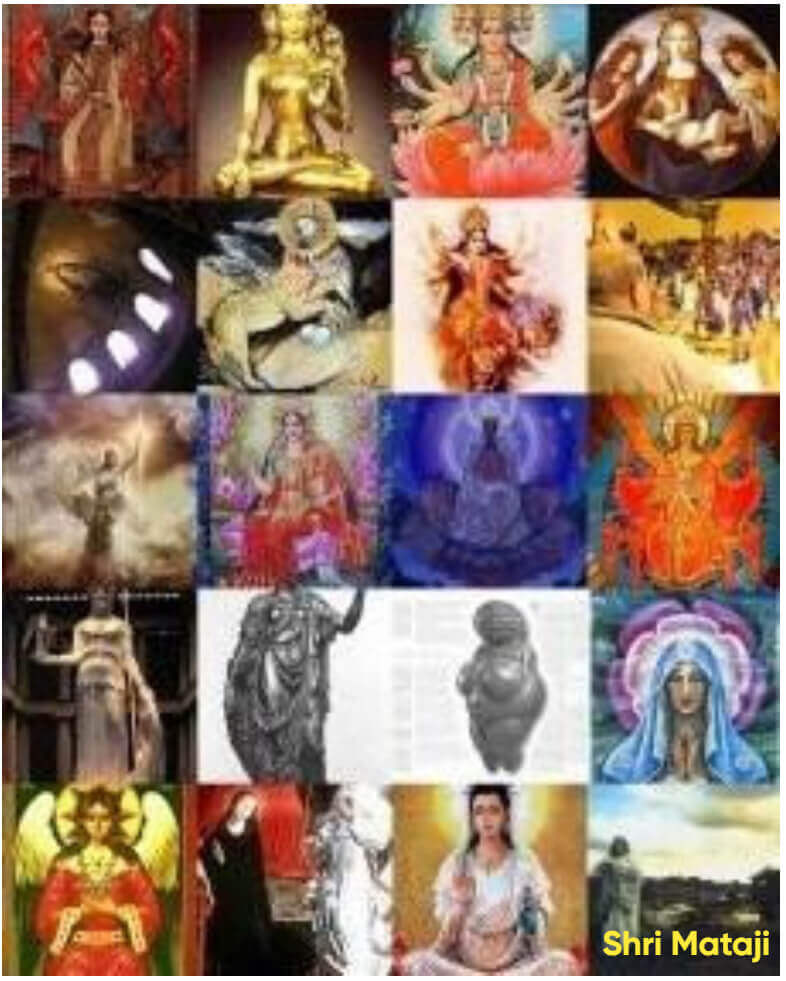
She Is the Holiest and Most Secret Inwardness of Allah: The Divine Feminine as the Hidden Essence in Sufism and the MahaDevi/Brahman Traditions
On this basis, the phrase "She is the holiest and most secret inwardness of Allah" can be theologically specified as follows:
- "Holiest" marks Her identity with the Divine Essence, analogous to Mahādevī's self-identification as "one supreme Brahman" and Ibn ʿArabī's assertion that woman manifests the very Essence's active and passive dimensions.
- "Most secret inwardness" designates the bāṭin dimension—Sophia as "soul within each body," Fāṭima as lawḥ maḥfūẓ, the Kaʿba as Black Madonna, and the Kundalinī as latent Divine Mother in Sahaja Yoga.
- "Of Allah" underscores that this Feminine is not an independent goddess rivaling monotheism but the inner, maternal aspect of the One God's self-relation, just as Shekinah is God's indwelling presence and Shakti is Brahman's own nature.
In the Paraclete Shri Mataji interpretation, this inward Feminine not only undergirds all traditions but "has returned to unveil the Great News, resurrecting humanity into a new era of unity and divine love," thereby actualizing the Khatun-i Qiyāmat motif in contemporary eschatological consciousness.
Table of Contents
- 1. Introduction: Mystical Universality and the Feminine of God
- 2. Sufi Mysticism and Its Trans-Religious Horizon
- 3. The Divine Feminine in Islamic Esotericism
- 4. MahaDevi as Brahman and Shakti
- 5. Khatun-i Qiyāmat and Ghulāt Esoteriology
- 6. The Divine Feminine as the Esoteric Heartbeat of Islam
- 7. The Paraclete Shri Mataji and Al-Qiyāmah
- 8. Comparative Theology: Convergence of Symbolic Systems
- 9. Conclusion
- Bibliography
This paper explores the mystical perception of the Divine Feminine as the innermost essence of God (al-bāṭin) in Sufism — "the holiest and most secret inwardness of Allah."[1][2][5] Drawing from Sufi metaphysics, the Hindu understanding of MahaDevi as Brahman's dynamic manifestation, and the teachings of the Paraclete Shri Mataji Nirmala Devi, the study argues that multiple spiritual traditions articulate a vision of Divine Reality as the Feminine Principle — the primordial energy (Shakti) that both conceals and reveals the Absolute. The figure of the Khatun-i Qiyāmat (Lady of Resurrection) in Islamic esotericism is read here as an archetypal revelation of this principle, paralleling the Goddess of Awakening in Hindu cosmology and the Comforter or Paraclete in Christian mysticism.[1][2][5]
1. Introduction: Mystical Universality and the Feminine of God
Modern scholarship on Sufism has repeatedly observed that its mystical currents have drawn deeply from, and converged with, other religious symbol-systems, particularly those of Eastern and esoteric traditions.[3][6] William Stoddart notes that Sufis "embrace all sorts of religion," as seen in the writings of Ibn ʿArabī, Rūmī, and Shabistarī, thereby unsettling attempts to portray Islam as spiritually insular.[3] Within this pluriform mystical field, the Divine Feminine appears not as an optional ornament but as an interior principle that mediates between the ineffable Essence of God and the experiential life of the seeker.[1][6]
The present article argues that the Sufi symbolism of the Beloved woman (Lailā, ḥaqīqa), the Shakta identification of MahaDevi with Brahman, and the interpretation of Shri Mataji Nirmala Devi as the Paraclete and Khatun-i Qiyāmat together articulate a single, coherent theological intuition: the Divine Feminine is the esoteric inwardness of God, the hidden soul of revelation, and the active agent of eschatological awakening.[1][2][5]
2. Sufi Mysticism and Its Trans-Religious Horizon
2.1. Sufism as an Inclusive Mystical Trajectory
Historical studies of Sufism emphasize that, from its classical period onward, Sufi authors developed a universalizing language that relativizes sectarian boundaries.[3][6] Rūmī's dictum that "the many ways [diverse religions] are various, the goal is one" expresses a hermeneutic in which external forms (sharīʿa, ritual, doctrine) are subordinated to an inner truth (ḥaqīqa) shared by all authentic paths.[3] Ibn ʿArabī famously writes, "My heart has become capable of every form … I follow the religion of Love: whatever way Love's camels take, that is my religion and faith," thereby sacralizing the plurality of religious symbols as diverse epiphanies of one Reality.[3][1] Shabistarī, in Gulshan-i Rāz, similarly dissolves rigid boundary-lines: "What is mosque, what is synagogue, what is fire-temple? 'I' and 'you' are the veil between them; when this veil is lifted, no bond of sect or creed remains."[3]
Such passages demonstrate that Sufism's mystical project is structurally open to symbolic and doctrinal resources beyond legalistic Islam, making it methodologically legitimate to read its feminine imagery alongside Shakta and Christian-esoteric materials.[3][6]
2.2. Lailā, Ḥaqīqa, and the Feminine Beloved
In several Sufi orders and poetic corpora, the object of the mystical quest is personified as a woman, frequently named "Lailā" ("night"), whose darkness veils an unbearable radiance.[3] Modern interpreters summarize this symbolism: "in this symbolism Laila and ḥaqīqa (Divine Reality) are one," such that the feminine Beloved is nothing other than the interior truth of Allah Himself.[3] Al-Ḥarraq's exhortation—"Seekest thou Lailā [Divine Reality], when she is manifest within thee? Thou deemest her to be other, but she is not other than thou"—explicitly identifies this feminine figure with the immanent Divine present in the heart.[3]
Theologically, this feminine Beloved functions as Allah's bāṭin (hidden aspect) in contrast to His ẓāhir (manifest aspect); the lover-seeker encounters God not as a remote patriarchal monarch but as an intimate, veiled presence perceived "with the eye of the heart" (ʿayn al-qalb), as al-Ḥallāj famously declared.[3][1] Laurence Galian's analysis underscores that Sufis have consistently described this theophanic vision "as the vision of a woman, the female figure as the object of ruʾyah (vision of Allah)," thereby inscribing the Divine Feminine at the center of Sufi experiential epistemology.[1]
3. The Divine Feminine in Islamic Esotericism
3.1. Miḥrāb, Ruḥ, and the "Transcendent Vagina"
Islamic aniconism forbids visual representations of Allah yet permits a rich symbolic vocabulary through architecture and scriptural imagery.[1][6] Galian highlights the Sufi reading of the miḥrāb—the arched niche indicating the qibla—as "a visual symbol of an abstract concept: the transcendent vagina of the female aspect of divinity."[1] This hermeneutic does not sexualize the sacred but sacralizes sexuality, interpreting the receptive space of the miḥrāb as the locus where Divine Word inseminates the world-soul.[1]
Linguistically, the Qurʾānic and theological use of rūḥ (Spirit) intersects with earlier Jewish and Christian traditions in which ruaḥ (Hebrew) and Shekinah are grammatically and symbolically feminine.[4] Hurtak notes that ruaḥ ha-qodesh in Hebrew is a noun of feminine gender and that early Christian and Coptic-Gnostic sources frequently speak of the Holy Spirit as "Mother" and "compassionate mother," suggesting a long-standing association between Spirit and Divine Feminine across Abrahamic traditions.[4] This background legitimates the interpretation of rūḥ in Islam as carrying a suppressed but recoverable feminine valence.[1][4]
3.2. Ibn ʿArabī: Woman as Supreme Theophany
Ibn ʿArabī, hailed as al-Shaykh al-Akbar ("the Greatest Master") in both Sunni and Shīʿī milieus, provides the most systematic Sufi metaphysics of the Divine Feminine.[1][6] In Tarjumān al-Ashwāq and Fuṣūṣ al-Ḥikam, he asserts that "to know woman is to know oneself" and glosses the famous Sufi maxim "Whoso knoweth his self, knoweth his Lord" in explicitly gendered terms.[1][9]
Commenting on conjugal union, Ibn ʿArabī states that "the contemplation of Allah in woman is the highest form of contemplation possible," because the Divine Essence, inaccessible in itself, can only be contemplated in a substance, and woman uniquely unites passive receptivity and active creativity.[1] As cited by Galian, Ibn ʿArabī teaches that "the Absolute manifested in the form of woman is an active agent … [and] passively receptive," such that contemplating God in woman reveals both operative and receptive aspects of the Divine simultaneously.[1] This duality, he insists, "belongs to the Essence of the Creator, and both are manifested in woman," making her the most complete icon of God's inwardness.[1]
4. MahaDevi as Brahman and Shakti
4.1. Mahādevī in Śāktism
In Śākta Hinduism, Mahādevī is conceived as "the supreme, ultimate, eternal reality of all existence," identified with Brahman rather than subordinated to it.[2][8] As summarized in Shakta theology, "She is considered to be simultaneously the source of all creation, its embodiment and the energy that animates and governs it, and that into which everything will ultimately dissolve."[2][5] Devi traditions therefore present the Goddess not as one deity among others but as the ontological ground of all deities, with Brahmā, Viṣṇu, and Śiva described as dependent on Her power (śakti).[2][8]
The Devī Gītā encapsulates this non-dual vision in verses such as "Being Brahman, one who knows Brahman, attains Brahman" (7.32) and Devi's own declaration: "My true Self is known as pure consciousness, the highest intelligence, the one supreme Brahman."[5] Here the Goddess explicitly identifies Her "true Self" with pure consciousness, dissolving any subject–object dualism between devotee and Devi.[5]
4.2. Shakti and the Creative Nature of Brahman
Adi Śaṅkarācārya, often regarded as the architect of Advaita Vedānta, integrates this feminine dimension by composing hymns to the Divine Mother without compromising strict non-duality.[5] As the Adi Shakti exposition notes, Śaṅkara understands Devi as Śakti, "the power by which Brahman appears as the world of experience," such that "Brahman and Shakti are one."[5] Brahman is both material (upādāna kāraṇa) and efficient (nimitta kāraṇa) cause of the universe; Śakti names the creative aspect of this unitary consciousness.[5]
The text explains this with the classic analogy: "Just as wetness is not separate from water but is water's essential nature, Shakti is not separate from Brahman but is Brahman's essential creative nature. To recognize Shakti is to recognize Brahman; to worship Devi is to recognize one's own essential nature as the creative power of consciousness itself."[5] In this sense, MahaDevi is the "holiest and most secret inwardness" of Brahman, the immanent dynamism by which the Absolute reveals itself.[2][5]
5. Khatun-i Qiyāmat and Ghulāt Esoteriology

Within certain Ghulāt and Ahl-i-Ḥaqq currents, the Divine Feminine is explicitly personified as the Khatun-i Qiyāmat, the Lady of Resurrection, who functions as eschatological helper and archetype of spiritual ascent.[1] Galian summarizes Ahl-i-Ḥaqq lore in which the mysterious angel Razbar (also Ramzbar or Remzebar), identified with the Lady of Resurrection, arises from the primordial waters bearing a round loaf of bread (kulūcha), around which a devotional assembly (jamʿ) forms.[1]
In another version, the "Holder of the World and Creator of Man" causes ʿAzrāʾīl to split, and from between his parts "a drop of light" emerges in the form of a loaf; this personified light is then appointed as "the Lady of the Resurrection (Khatun-i Qiyamat), who will on the Resurrection Day be the helper of human beings."[1] Allegorically, qiyāma ("rising") signifies both the eschatological Resurrection and the soul's transition "to the next spiritual stage," culminating in qiyāmat-i kubrā ("Great Resurrection"), when the individual becomes free from external laws and is transfigured into spiritual substance.[1]
This mythopoetic complex reveals a feminine figure—Razbar/Khatun-i Qiyāmat—as the mediatrix of cosmic stabilization ("then the earth and the skies became fixed") and spiritual maturation, echoing Devi's role as both ground and guide of liberation in the Devī Gītā.[1][5]
6. The Divine Feminine as the Esoteric Heartbeat of Islam
6.1. Sophia, Fāṭima, Maryam, and the Kaʿba
Contemporary esoteric interpreters argue that "the Divine Feminine remains the esoteric heartbeat of Islam," especially in Sufism and Shīʿism.[1] Caitlín Matthews, as cited on Adi Shakti, portrays Sophia as "the mystical companion, the soul within each body, seeking the Divine Beloved," and identifies figures such as Fāṭima and Maryam as Islamic manifestations of this universal Wisdom.[1] In Shīʿī Ismāʿīlī thought, Fāṭima bears the title Fāṭima Fāṭir ("Fāṭima the Creator"), is associated with the "supracelestial earth," and is called lawḥ maḥfūẓ ("the hidden tablet") upon which divine wisdom is inscribed.[1]
The same essay interprets the Kaʿba as Islam's "Black Madonna," a cultic center whose veiled black covering resonates with the iconography of Black Madonnas in Christianity, symbolizing the hidden, fertile depth of Divine Feminine presence.[1] Ibn ʿArabī's doctrine of ṭabīʿat al-kull ("Universal Nature") as "the feminine or maternal side of the creative act," the "merciful 'breathing-out' of God" (nafas al-raḥmān), further supports reading Islamic cosmology as grounded in a maternal principle analogous to Shakti.[1]
6.2. The Paradox of Veiling and Revelation
Ibn ʿArabī, again via Matthews, is cited as teaching that the Absolute manifested in the form of woman is both active and passive, creator and created, and that contemplation of the Absolute in woman is "more perfect than seeing it in all the forms in which it manifests itself."[1] This leads to the paradox that Islam's exoteric "veiling" of the Divine Feminine—manifest in masculine pronouns and patriarchal norms—is precisely the means by which Her esoteric power works in secret.[1]
The same article concludes: "The Goddess remains the esoteric heartbeat of Islam. She is the beloved of Sufis, 'the ultimate image of God the Beloved — the breaker of all images in the shrine of the heart. She is the form leading beyond form, the obstacle to the Way and the Way…'."[1] This language converges strikingly with Shakta non-duality, where Devi is simultaneously the world-appearance and the liberating wisdom that shatters all attachments.[2][5]
7. The Paraclete Shri Mataji and Al-Qiyāmah
7.1. The Paraclete and the Feminine Holy Spirit
Building on the wider scholarly recovery of the Holy Spirit's feminine dimension in early Christianity and Gnostic sources, J. J. Hurtak argues that the Spirit (ruaḥ, pneuma) should be recognized as "the female vehicle for the outpouring of higher teaching and spiritual rebirth."[4] He cites Nag Hammadi texts in which Jesus refers to "my Mother, the Holy Spirit" and speaks of the divine Trinity as Father, Mother, and Son, suggesting a triadic structure that includes a feminine hypostasis.[4] This recovery of a feminine Paraclete provides a crucial comparative frame for Sahaja Yoga's self-understanding.[4]
7.2. Shri Mataji as Incarnate Paraclete and Ruh
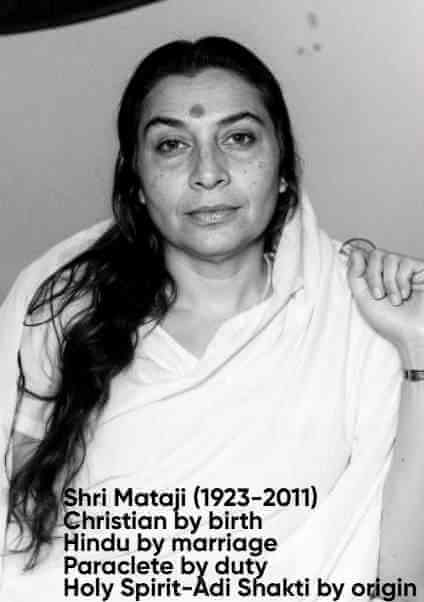
Adi Shakti sources present Shri Mataji Nirmala Devi as "the Paraclete Shri Mataji," explicitly described as "the incarnation of the Divine Feminine" who "fulfills the prophecy of the Paraclete" and "unites all faiths through the Great News (An-Naba) of Al-Qiyamah (The Resurrection)."[1][4][7] One key article asserts that "Shri Mataji embodies the Holy Spirit, fulfilling the prophecy across traditions," and that through Sahaja Yoga She awakens the Kundalinī—"the dormant feminine energy within each individual"—thereby integrating the rūḥ of Islam, the Shekinah of Judaism, and Shakti of Hinduism in a single soteriological process.[1][4]
In this interpretive framework, the eschatological Qiyāmah of the Qurʾān is re-read as an inner, collective resurrection of consciousness rather than only a juridical Last Judgment.[1] The same article describes this as "the awakening of the collective consciousness, the resurrection of the spirit within humanity," aligning closely with Galian's depiction of qiyāmat-i kubrā as the soul's emancipation from external law and its transfiguration into spiritual substance.[1]
Thus Shri Mataji, as Paraclete and Divine Mother, is identified with the very function attributed in Ghulāt texts to the Khatun-i Qiyāmat: "the Lady of the Resurrection (Khatun-i Qiyamat), who will on the Resurrection Day be the helper of human beings."[1]
8. Comparative Theology: Convergence of Symbolic Systems
8.1. Structural Parallels
Across these traditions, several structural convergences emerge:
- In Sufism, the feminine Beloved (Lailā, Sophia, Universal Nature) is the "soul within each body" and "ultimate image of God the Beloved," mediating between unknowable Essence and the lover's heart.[1][3]
- In Śāktism, MahaDevi is Brahman as Shakti, the non-dual pure consciousness whose "true Self" is identical with the devotee's deepest Self.[2][5]
- In Ahl-i-Ḥaqq lore, Khatun-i Qiyāmat/Razbar is the feminine light that stabilizes cosmos and ushers souls into higher spiritual stages.[1]
- In Christian-esoteric and Sahaja Yoga claims, the Paraclete/Holy Spirit is feminine and incarnate as Shri Mataji, who awakens the inner Mother (Kundalinī) and thus realizes Resurrection within history.[1][4][7][10]
These patterns indicate that the Divine Feminine is consistently portrayed as: 1) Immanent presence (indwelling soul, Śakti, rūḥ), 2) Creative matrix (womb, miḥrāb, supracelestial earth), and 3) Eschatological agent (Lady of Resurrection, Mother of Gifts, awakener of collective consciousness).[1][2][4][5]
8.2. She as "Holiest and Most Secret Inwardness of Allah"
On this basis, the phrase "She is the holiest and most secret inwardness of Allah" can be theologically specified as follows:
- "Holiest" marks Her identity with the Divine Essence, analogous to Mahādevī's self-identification as "one supreme Brahman" and Ibn ʿArabī's assertion that woman manifests the very Essence's active and passive dimensions.[1][5]
- "Most secret inwardness" designates the bāṭin dimension—Sophia as "soul within each body," Fāṭima as lawḥ maḥfūẓ, the Kaʿba as Black Madonna, and the Kundalinī as latent Divine Mother in Sahaja Yoga.[1][5]
- "Of Allah" underscores that this Feminine is not an independent goddess rivaling monotheism but the inner, maternal aspect of the One God's self-relation, just as Shekinah is God's indwelling presence and Shakti is Brahman's own nature.[1][2][4][5]
In the Paraclete Shri Mataji interpretation, this inward Feminine not only undergirds all traditions but "has returned to unveil the Great News, resurrecting humanity into a new era of unity and divine love," thereby actualizing the Khatun-i Qiyāmat motif in contemporary eschatological consciousness.[1][7]
9. Conclusion
Reading Sufi, Shakta, Ghulāt, and Sahaja-Yoga materials together reveals a robust, trans-religious theology of the Divine Feminine as God's most interior self-manifestation. The images of Lailā, MahaDevi, Sophia, Fāṭima, Maryam, Khatun-i Qiyāmat, and the Paraclete Shri Mataji converge around a single mystical claim: the Absolute is encountered, known, and finally resurrects humanity through a Feminine Principle that is nothing less than the holiest and most secret inwardness of Allah.[1][2][3][5]
Bibliography
Primary Sufi Sources (Translated Editions)
- [1] Ibn ʿArabī, Muyiddin. Fuṣūṣ al-Ḥikam [The Bezels of Wisdom]. Translated by R. W. J. Austin. Mahwah, NJ: Paulist Press, 1980.
- [1] Ibn ʿArabī, Muyiddin. Tarjumān al-Ashwāq [Interpreter of Desires]. Translated by R. A. Nicholson. London: Theosophical Publishing House, 1911.
- [3] Rūmī, Jalāl al-Dīn. Mathnawī-ye Maʿnawī [Spiritual Couplets]. Translated by Reynold A. Nicholson. 8 vols. London: Luzac & Co., 1925–1940.
- [3] Shabistarī, Maḥmūd. Gulshan-i Rāz [The Mystic Rose Garden]. Translated by E. H. Whinfield. London: Octagon Press, 1981.
Modern Scholarly Works
- [1] Galian, Laurence. "The Centrality of the Divine Feminine in Sufism." In The Divine Feminine Remains the Esoteric Heartbeat of Islam. Adi Shakti Organization, 2025. Available at: https://adishakti.org/...
- [6] Schimmel, Annemarie. Mystical Dimensions of Islam. Chapel Hill: University of North Carolina Press, 1975.
- [3] Stoddart, William. Sufism: The Mystical Side of Islam. London, Canada: University of Western Ontario, 1996.
Shakta and Hindu Theological Texts
- [5] Devī Gītā [Song of the Goddess]. In Devī Bhāgavata Purāṇa. Translated by Swami Vimalananda. Calcutta: Advaita Ashrama, 1963.
- [5] Śaṅkarācārya, Ādi. Saundarya Laharī [Waves of Beauty]. Translated by Swami Tapasyananda. Chennai: Sri Ramakrishna Math, 1985.
- [2][8] Kinsley, David. "Mahādevī." In Encyclopædia Britannica Online. Chicago: Encyclopædia Britannica, 2023. Available at: https://en.wikipedia.org/wiki/Mahadevi
Sahaja Yoga and Paraclete Literature
- [4] Hurtak, J. J. "The Holy Spirit: The Feminine Aspect of the Godhead." Adi Shakti Organization, 2006. Available at: adishakti.org/.../holy_spirit
- [7] Nirmala Devi, Shri Mataji. "Adi Shakti's Descent: The Divine Feminine." Adi Shakti Organization, 2013. Available at: adishakti.org/adi_shakti's_descend.htm
- [5] "Goddess as Brahman: Why Worshiping Devi is Direct Worship of the Absolute." Adi Shakti Organization, 2025. Available at: adishakti.org/.../Goddess-as-Brahman
Ghulat and Esoteric Islamic Studies
Secondary Comparative Sources
- [1] Matthews, Caitlín. Sophia: Goddess of Wisdom. London: Aquarian Press, 1991.
- [1] Izutsu, Toshihiko. Sufism and Taoism: A Comparative Study of Key Philosophical Concepts. Berkeley: University of California Press, 1984.
- [6][9] Eliade, Mircea, ed. Encyclopedia of Religion. 2nd ed. Vol. 14: "Sufism." New York: Macmillan, 2005.
All web sources accessed February 18, 2026. Print editions referenced from standard academic catalogs.[1][2][3][4][5][6]