
Before a state is recognized as genuinely transcendental, it must pass certain tests

"Turiya, or samadhi, is a phenomenon well known throughout the history of Indian life. Today, as well as in earliest times, it is experienced. Sri Ramakrsna, the greatest saint of modern India, though not a learned man, attained samadhi, and having realized the highest illumination spoke words of solace and wisdom to all men. The state is conceivably attainable by anyone who strives hard to free himself from the dross of worldliness. The Hindu, however, is careful not to confuse reveries, dreams, hallucinations, and hypnotic spells with transcendental experience. Before a state is recognized as genuinely transcendental, it must pass certain tests.”- S. Prabhavananda
“The word darsana, which is usually translated 'philosophy', means
in Sanskrit seeing or experience. From this we may gather that Indian
philosophy is not merely metaphysical speculation, but has its
foundation in immediate perception. God and the soul are regarded by
the Hindu mind, not as concepts, speculative and problematical, as is
in the case of Western philosophy, but as things directly known. They
can be experienced not merely by a chosen few, but, under right
conditions, by all humanity.
This insistence upon immediate perception rather than on abstract
reasoning is what distinguishes the Indian philosophy of religion
from philosophy as Western nations know it. Immediate perception is
the source from which springs all Indian thought.
This perception, it must be made clear, is not of the senses, nor
must it be confused with the operation of the intellect, nor of the
emotions; it is supersensuous, transcendental—something not to be
fully explained in rational terms.
The Mandukya Upanishad speaks of three states of consciousness-
waking, dreaming, and dreamless sleep. These are common to all men.
In addition, there is turiya (The Fourth), the transcendental state—
known also as samadhi—which may be described as the ultimate
consciousness. Though it is realizable by all men, they do not
experience it in their spiritually ignorant condition. Indian
philosophers call the transcendental state by various names, but all
of the names unmistakably point to the same concept.
Turiya, or samadhi, is a phenomenon well known throughout the history
of Indian life. Today, as well as in earliest times, it is
experienced. Sri Ramakrsna, the greatest saint of modern India,
though not a learned man, attained samadhi, and having realized the
highest illumination spoke words of solace and wisdom to all men. The
state is conceivably attainable by anyone who strives hard to free
himself from the dross of worldliness.
The Hindu, however, is careful not to confuse reveries, dreams,
hallucinations, and hypnotic spells with transcendental experience.
Before a state is recognized as genuinely transcendental, it must
pass certain tests.
First, the revelation it brings must be related to arthe
anupalabdhe—something which is otherwise unknown and unknowable. The
transcendental revelation is therefore not a revelation of things or
truths normally perceived or generally known, nor of truths capable
of ordinary perception or of apprehension through the ordinary
instruments of knowledge. And yet it must be universally
understandable in relation to human experience, and must be
communicable to us in human terms.
Second, the truth it reveals must not contradict other truths. It is
necessarily beyond and above reason, but it must not contradict
reason.
Thus Indian religion, though having its foundation in supernatural
revelation, gives a legitimate place to logic and reason, and it has
never been an obstacle to the growth of philosophic thinking. In
fact, no race has produced a succession of more subtle or more
rigidly logical thinkers than the Hindus—and yet, without exception,
they have declared that reason, unaided by transcendental experience,
is blind. Those who are called orthodox philosophers accept the Vedic
scriptures as recording revealed truths; and they make these
scriptures the basis of their reasoning. Samkara, one of the foremost
philosophers of India, has this to say concerning the limitations of
reason in the investigation of truth:
's the thoughts of man are altogether unfettered, reasoning which
disregards the holy texts and rests on individual opinion only has no
proper foundation. We see how arguments, which some clever men have
excogitated with great pains, are shown, by people still more
ingenious to be fallacious, and how the arguments of the latter again
are refuted in their turn by other men; so that, on account of the
diversity of men's opinions, it is impossible to accept mere
reasoning as having a sure foundation.'"
Swami Prabhavananda, The Spiritual Heritage Of India
Vedanta Press (June 1979) pp. 15-16,
"The failure to attain direct experience of the truth ... is due to man's spiritual ignorance"
"The failure to attain direct experience of the truth, and consequently of freedom, is due to man's spiritual ignorance, which is all but universal, and which forms the chief cause of sin and suffering. It can be dispelled by direct knowledge of the ultimate truth obtained through purification of the heart, and through a constant striving for detachment of the soul from worldly desires. By transcending the limitations of the body, the mind and the senses, one may enter the superconscious state. The methods of attaining this highest state of consciousness are hearing about, reasoning about, and meditating upon the ultimate reality. One must first hear about it from the Sruti, or Vedas, and from the lips of a guru, an illumined teacher. Then one must reason about it. Finally comes the meditation upon it in order to realize the truth for oneself.”- Swami Prabhavananda
"As we have intimated, the Vedas, or Srutis (revealed truths), stand as an absolute authority behind which the orthodox schools cannot go. In this sense their authority might seem to resemble that of the Holy Bible in many periods of Christian thought; but in the words of Dr S. Radhakrishnan, 'The appeal to the Vedas does not evolve any reference to an extra-philosophical standard. What is dogma to the ordinary man is experience to the pure of heart.'[1] With the exception of Buddhism and Jainism, all Indian schools of thought regard the Vedas as recording the transcendental experience of the first mighty seers of India. This experience cannot and should not contradict similar experience in any age or country. Furthermore, it is accessible to all. For these reasons, all Hindus believe that the Vedas are eternal— beginningless and endless—and that in them transcendental experience has had its standard manifestation.
What then of Buddhism and Jainism? Shall we exclude them from the highest expressions of Indian thought? The fact is that they accept the authority of revealed knowledge and transcendental experience, though they deny the authority of the Vedas, particularly of the ritualistic portions, as a result of certain historical circumstances. They were born at a time when the spirit of the Vedas had been lost, when the Hindus held faithfully only to the letter of the law, and when priestcraft reigned supreme. The yearning to know the truth of the Self, or Brahman in one's own soul, which is attained only by the pure at heart, was absent. Buddha, though he denied the authority of the Vedas, actually impressed their spirit upon his followers by urging them to live the pure life in order to free themselves from the burden of sorrow. And he showed the way by himself attaining nirvana—another name for samadhi, the transcendental state.
Thus the teachings of Buddha do not contradict the spirit of the Vedas but are in entire harmony with it; and the same is true of the teachings of Mahavira, founder of Jainism...
Philosophers differ, however, with respect to the exact nature of moksa; and the differences make up the substance of Hindu thought. These are due in part to varying grades of experience in realizing the transcendental life; and of course they are due above all to the attempt to express the inexpressible.
In one thing, however, the philosophers all agree. That is, that spiritual perfection can be attained here and now. 'Man's aim', says Professor Hiriyanna, 'was no longer represented as the attainment of perfection in a hypothetical hereafter, but as a continual progress towards it within the limits of the present life.' Moksa, or the attainment of freedom from the limitations and sufferings of physical life, is the supreme aspiration of all Indian philosophy.
Samkara, speaking of the supreme goal of human life, says: ' man is born not to desire enjoyments in the world of the senses, but to realize the bliss of jivanmukti [liberation while living].' And the Upanishads over and over again emphasize this truth: 'Blessed is he who attains illumination in this very life, for a man not to do so is his greatest calamity.' [2] But in these same scriptures it is pointed out that is a man fails to attain the supreme goal in this life he can attain it in some other life, for he will be given unlimited opportunities, by rebirths to reach the goal of perfection.
The failure to attain direct experience of the truth, and consequently of freedom, is due to man's spiritual ignorance, which is all but universal, and which forms the chief cause of sin and suffering. It can be dispelled by direct knowledge of the ultimate truth obtained through purification of the heart, and through a constant striving for detachment of the soul from worldly desires. By transcending the limitations of the body, the mind and the senses, one may enter the superconscious state.
The methods of attaining this highest state of consciousness are hearing about, reasoning about, and meditating upon the ultimate reality. One must first hear about it from the Sruti, or Vedas, and from the lips of a guru, an illumined teacher. Then one must reason about it. Finally comes the meditation upon it in order to realize the truth for oneself. Different schools offer different methods of attaining the same goal, but all agree in recommending the practice of yoga, or the exercises prescribed in the art of concentration and meditation.
To tread he path of philosophy is to seek after truth and follow a way of life. Before a man sets out on the quest after truth, he must fulfil certain conditions. Samkara sums them up as follows: First, there must be discrimination between the real and the unreal. This statement means, not that a man must posses complete knowledge of absolute reality, which is attained only after long practice of meditation, but that he must unfailingly subject the nature if things to a rigid analysis by discriminating between what is transitory and what is abiding, or between what is true and what is false. The second condition is detachment from the selfish enjoyments of life. The aspirant must learn that the highest good is realized not through worldly pleasure, but through a continuous search for the infinite, the enduring joy. This ideal of renunciation must be realized by a gradual purification of the seeker's heart and mind. A third condition is that the student must acquire tranquility of mind, self-control, patience, poise, burning faith in things of the spirit, and self-surrender. These are called the six treasures of life. The thirst for moksa, or release, is the fourth condition.”
Swami Prabhavananda, The Spiritual Heritage Of India
Vedanta Press (June 1979) pp. 17-20
Note:
1. Indian Philosophy, vol. I, p. 51
2. Kena, II. 5
THE APPROACH OF THE MYSTICS
"When we needed the outer form of a
savior You were there for us.
When our conscious mind matures we turn within
rather than without to find You there, not separate
or apart but one in the same with ourselves.
We are moving toward Christ consciousness.
Maureen Ramsay Hughes
Are the mystics crazy? They might well be! They frequently say strange and weird things. A fourteenth-century Christian mystic named Meister Eckhart once said: 'God's being is my being and is the being of all beings. My me is God.' I have known patients confined to mental institutions to say similar things. On another occasion, Eckhart observed: 'Between a person and God there is no distinction. They are one. Their knowing is with God's knowing. Their activity is with God's activity, their understanding with God's understanding. The same eye with which I look at God is the eye with which God looks at me.' I doubt if these lines that would communicate much either to our secular world or to members of the typical Sunday morning congregation. Mystics appear to be those strange people in whom all boundaries have been removed. This would be particularly true of those boundaries that human beings once perceived that separated from the external God.
Indeed, when mystics talk about God, they appear to be talking about an unbounded presence, a timeless reality or even what Paul Tillich called 'the Eternal Now.' Eckhart appears to have understood as long time ago as the fourteenth century that relating to a supernatural, external deity is finally a violation of the oneness of the universe and of the expanded consciousness of human life, suggesting that perhaps we have finally reached the place where we no longer have need for that hypothesis.
Eckhart was, however, a Christian, even a priest, perhaps the first post-religious Christian. He stood inside an understanding of God that was not and could not for him have been bounded by creeds, forms, doctrines and dogmas. He was not popular with these ecclesiastical leaders who felt it was their duty to monitor behaviour and to enforce conformity in belief. He seemed to be aware that the goal of religion had become little more that seeking to control life in the here and now in the service of a personal security. Religion's weapons of choice in this struggle were guilt and fear. Religion made life in this world something to be governed by either the eternal reward of heaven or the eternal punishment of hell. The mystics through the ages have always stood against this mentality, which also means that the mystics have always threatened the established religion. Perhaps that is why we ought to look again at the mystics: they might turn out to be the means through which the essence of yesterday's religion can be transformed into tomorrow's spiritual understanding. Enter with me the into an examination of the mystical experience, for this seems to be the place that beckons to me now as the next step to take on this journey.
For years now, it has been difficult for me to use traditional religious language. I have, therefore, tried to talk about the holy, the divine, the 'other'—that which most people call God—without using either the traditional symbols of the realm of the unknown and unknowable, or those religious concepts that seem totally bound to the here and now. No matter how hard I tried to force myself to accept those images and theological concepts, they had no reality for me. I always found them to be limiting, falsifying and inadequate. I did not, however, know how to get beyond them. They were all bound by a finite frame of reference while they sought to comment on the infinite. My struggle was not helped by the realization that the people I was trying to serve as a priest, even when my motive was to illumine them, found my approach less than satisfying, to say the least. I did not affirm the language that they knew they no longer believed and yet they could not admit, even to themselves, their inability to believe. As fearful people wrestling with the trauma of insecurity, they much preferred the anthropomorphic images of finding themselves embraced by 'the everlasting arms' or invited to suckle at the breasts of the all-enveloping 'divine Mother.' I have reached the place where I do not hold these images in contempt so much as I recognize that we needed them in the loneliness of what now looks like the 'childhood of our humanity.' The supernatural parent figure in the sky who could take care of us had great appeal, especially if we could continue to believe what religious leaders regularly asserted—namely, that it is a virtue to dwell in a childlike dependency forever. Churches seem to prefer childlike members. That is why churches so frequently exhort their people to be 'born again.' The hidden agenda of born-again theology is that when one is 'born again,' childhood becomes renewed, and a constantly renewed childhood quickly turns into a perpetual childhood. In many ways human beings have for some time been moving away from that mentality and into a new understanding of what it means to be human. Far from needing to be born again into perpetual childishness, we need to grow up, to embrace the new dimensions of human maturity. I think, therefore, that the time has arrived when we need to stop forever the human attempt to see God as the supernatural or divine parent figure, to acknowledge that this is a religious drive for security and that we now need to embrace a new possibility. Perhaps the mystical dimension of recognizing that we are part of who God is and what God is, and that God is part of who we are and what we are, is the place to begin. The human ability to claim our God-consciousness and to act on it slowly emerges as the essence of what it means to be human. A new starting place thus appears.”
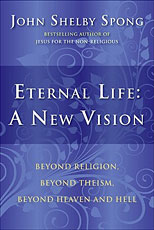
John Selby Spong, Eternal Life: A New Vision
HarperOne (2010) 14-1/5 Kobo Aura
"Bishop John Shelby Spong, author of Jesus for the Non-Religious, Why Christianity Must Change or Die, Sins of Scripture, and many other books, is known for his controversial ideas and fighting for minority rights. In Eternal Life: A New Vision, a remarkable spiritual journey about his lifelong struggle with the questions of God and death, he reveals how he came to a new conviction about eternal life. God, says Spong, is ultimately one, and each of us is part of that oneness. We do not live on after death as children who have been rewarded with heaven or punished with hell but as part of the life and being of God, sharing in God's eternity, which is beyond the barriers of time and space. Spong argues that the discovery of the eternal can be found within each of us if we go deeply into ourselves, transcend our limits and become fully human. By seeking God within, by living each day to its fullest, we will come to understand how we live eternally.
Always compelling and controversial, Spong, the leading Christian liberal and pioneer for human rights, wrestles with the question that all of us will ultimately face. In his final book, Spong takes us beyond religion and even beyond Christianity until he arrives at the affirmation that the fully realized human life empties into and participates in the eternity of God. The pathway into God turns out to be both a pathway into ourselves and a doorway into eternal life. To Job's question 'If a man (or a woman) dies, will he (or she) live again?' he gives his answer as a ringing yes!"
Google Book Review
http://books.google.ca/books/about/Eternal_Life_A_New_Vision.html
Web (September 13, 2013)
Disclaimer: Our material may be copied, printed and distributed by referring to this site. This site also contains copyrighted material the use of which has not always been specifically authorized by the copyright owner. We are making such material available to our readers under the education and research provisions of "fair use" in an effort to advance freedom of inquiry for a better understanding of religious, spiritual and inter-faith issues. The material on this site is distributed without profit. If you wish to use copyrighted material for purposes other than “fair use” you must request permission from the copyright owner.

